Surface Guided Radiotherapy for
Accuracy, Volume Reduction,
Real Time Tracking and Dose
Verification
Simon Powell MD PhD
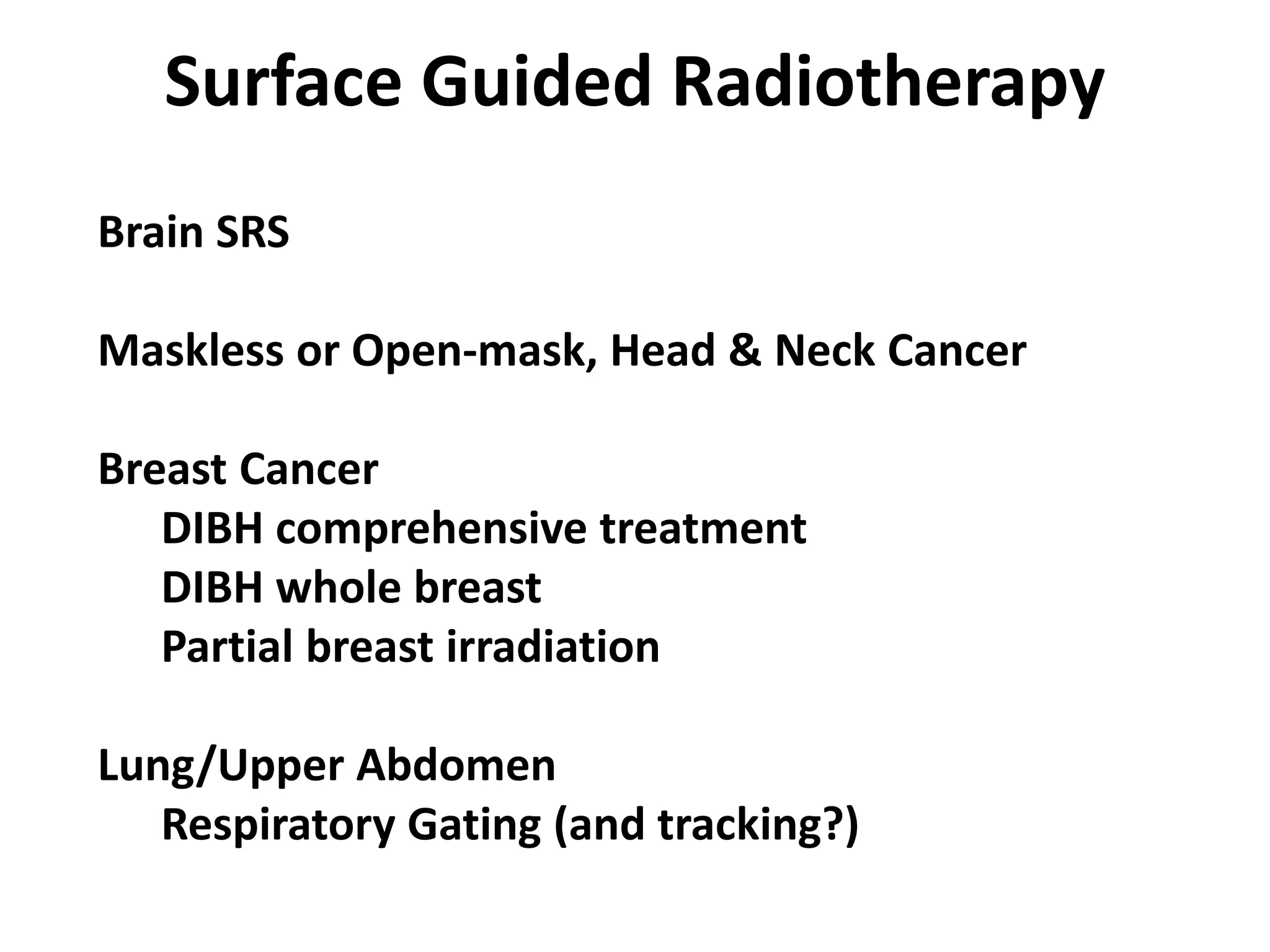
Surface Guided Radiotherapy
Monitor treatment position within RT delivery time
Competing technologies? MRI! 3D-Ultrasound?
Accuracy of surface topology to predict
internal tumor and organ position?
Set-up time and accuracy
Compared to kV imaging
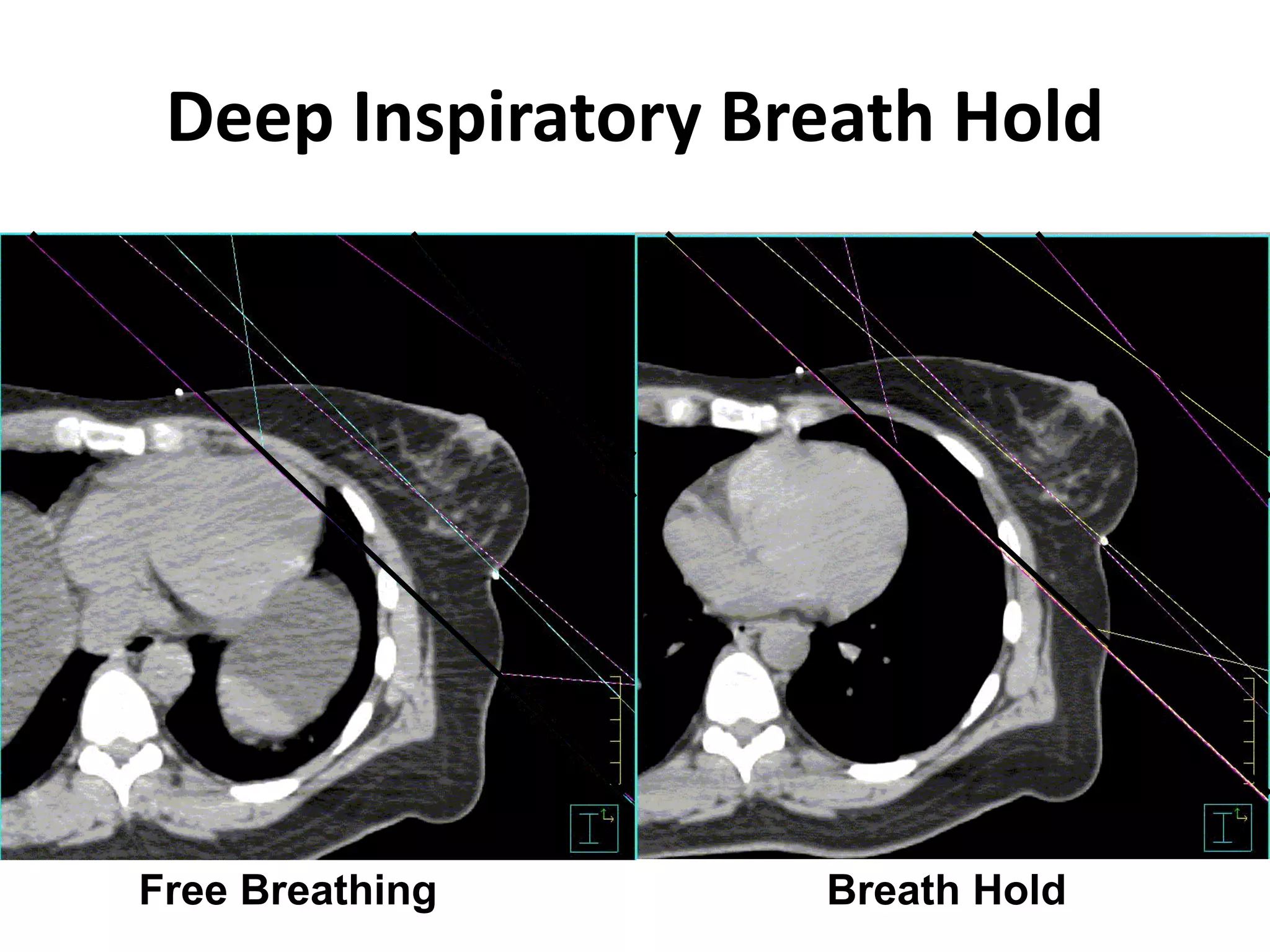
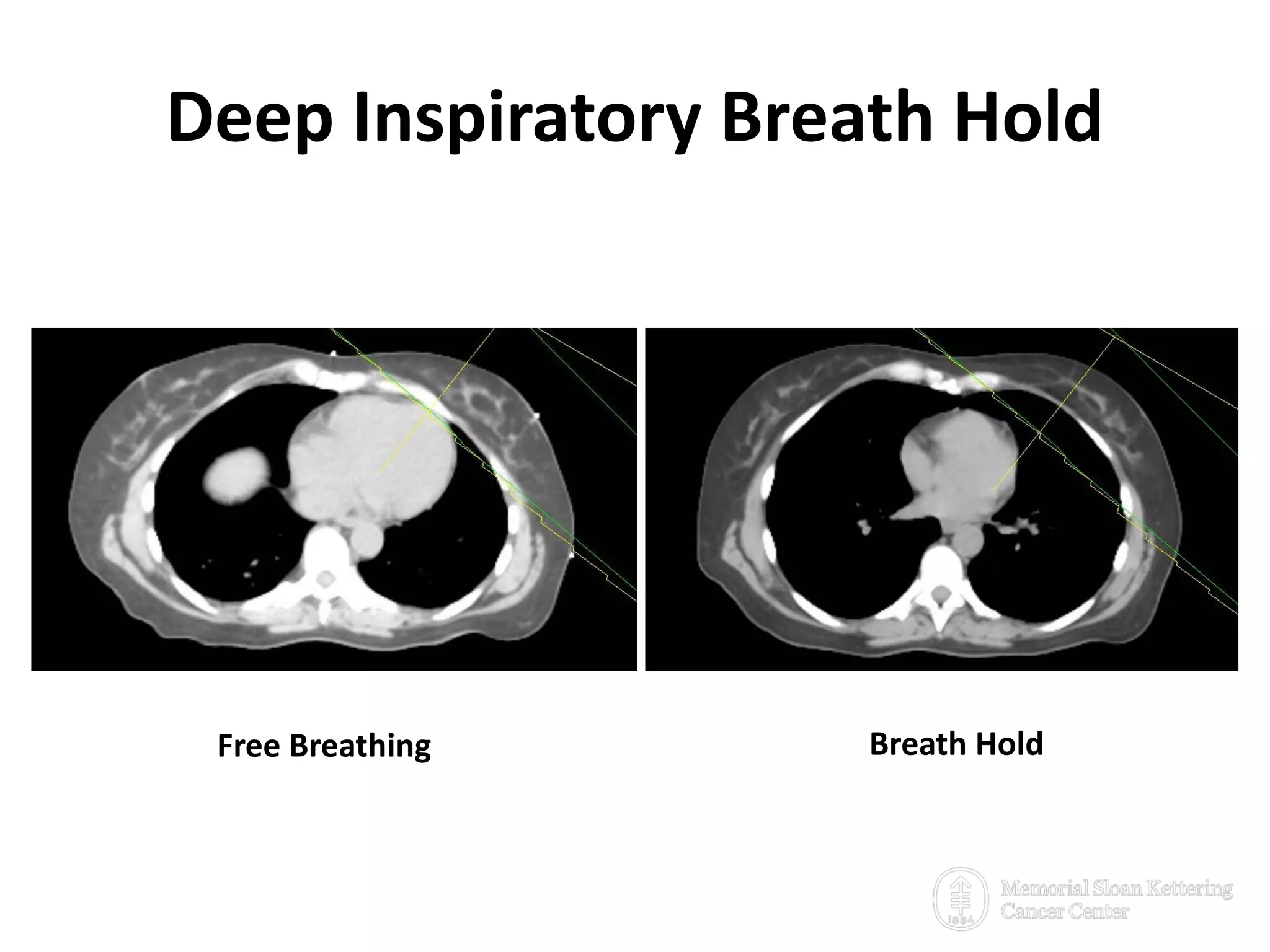
Deep inspiratory Breath Hold
Respiratory motion tracking and gating
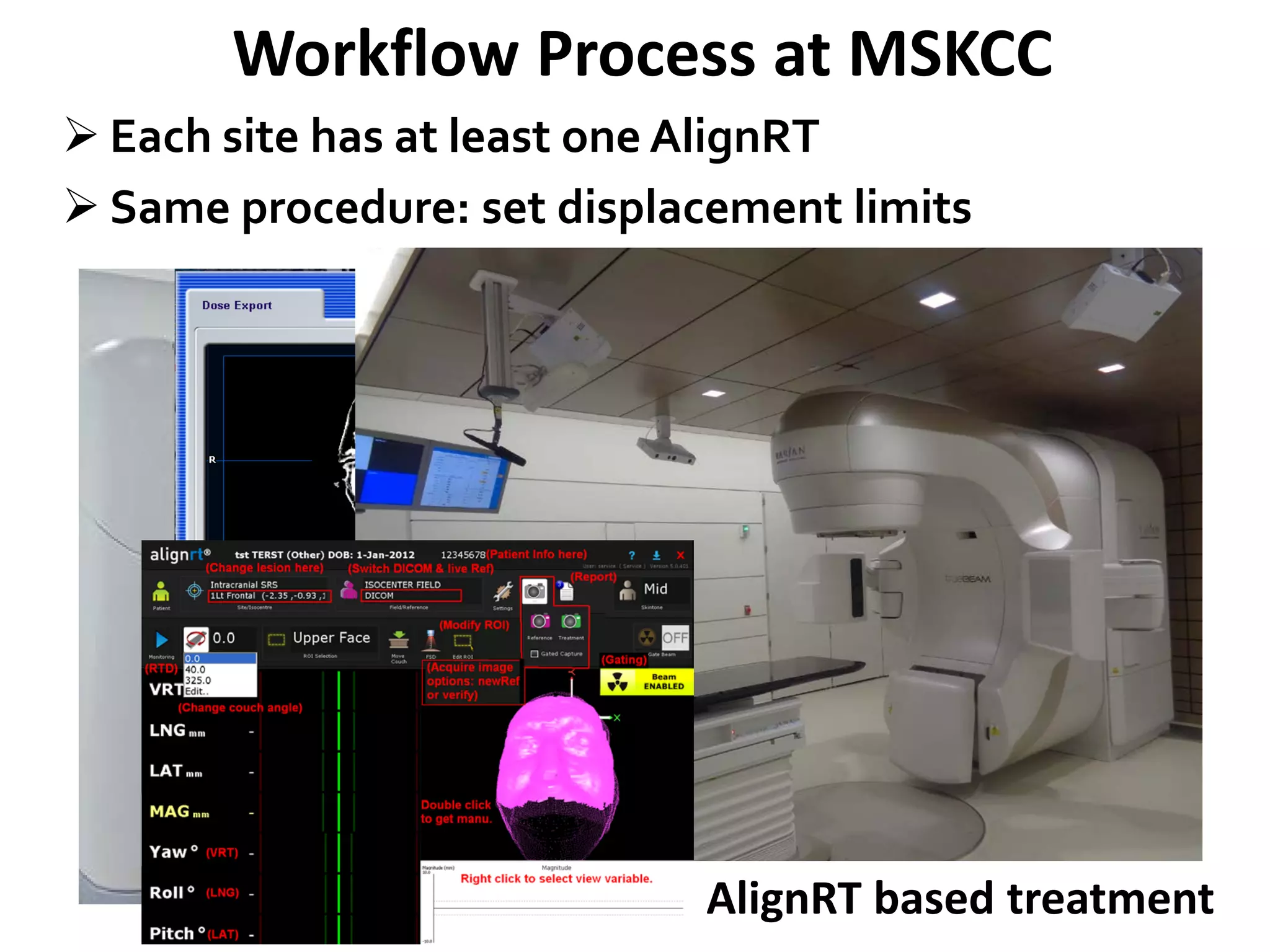
Workflow Process at MSKCC
3
 Each site has at least one AlignRT
 Same procedure: set displacement limits
CT SIM with immobilization
iPlan
AlignRT based treatment
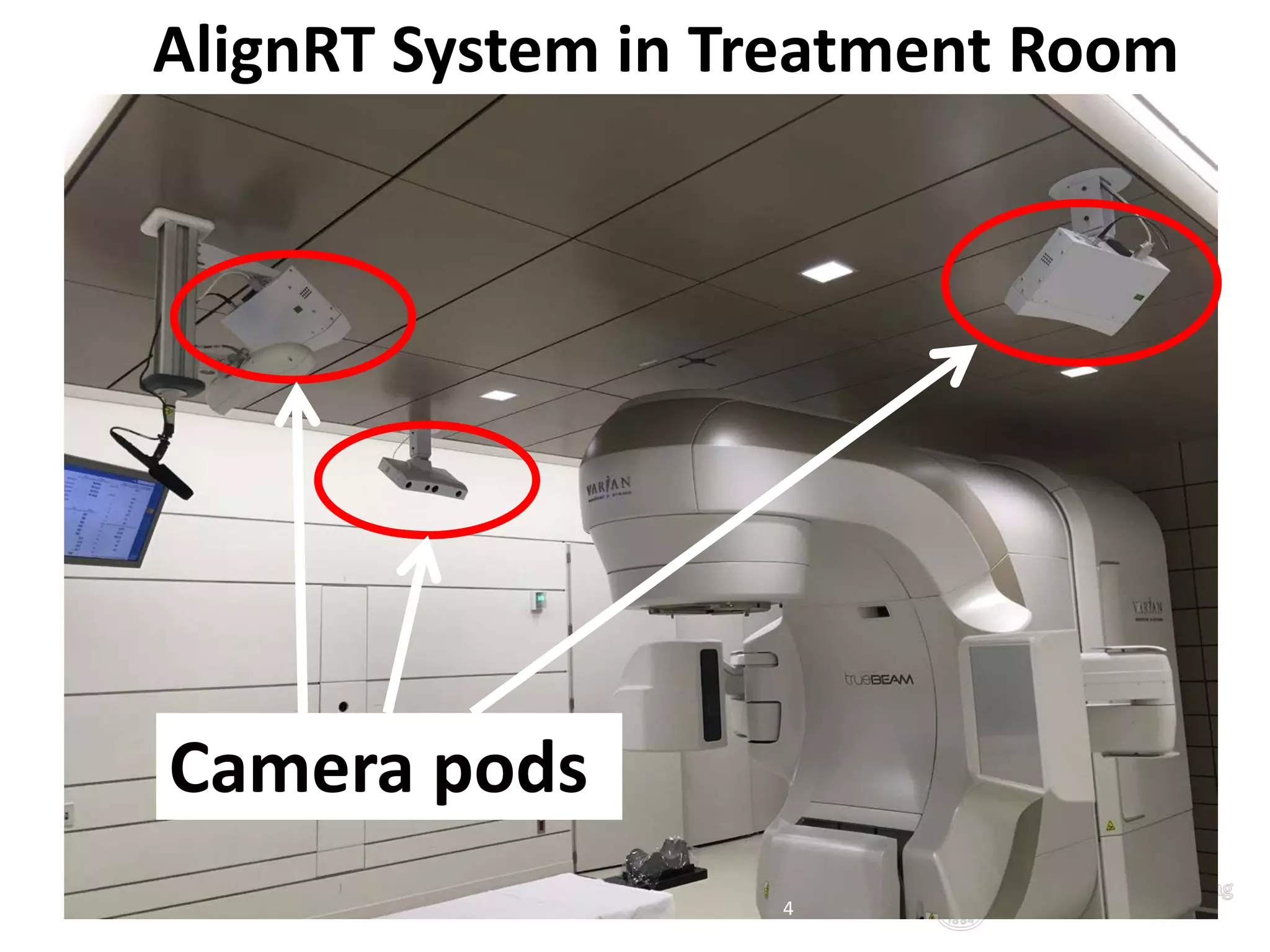
AlignRT System in Treatment Room
4
Camera pods
Real-Time Variance “Deltas” (RTD)
5
 Real time register Verification
surface to Reference surface to
calculate:
 All 3 translational displacements
and their MAG
 All 3 rotational displacements
 RTD < threshold  Beam ON
Surface Guided Radiotherapy
Brain SRS
Maskless or Open-mask, Head & Neck Cancer
Breast Cancer
DIBH comprehensive treatment
DIBH whole breast
Partial breast irradiation
Lung/Upper Abdomen
Respiratory Gating (and tracking?)
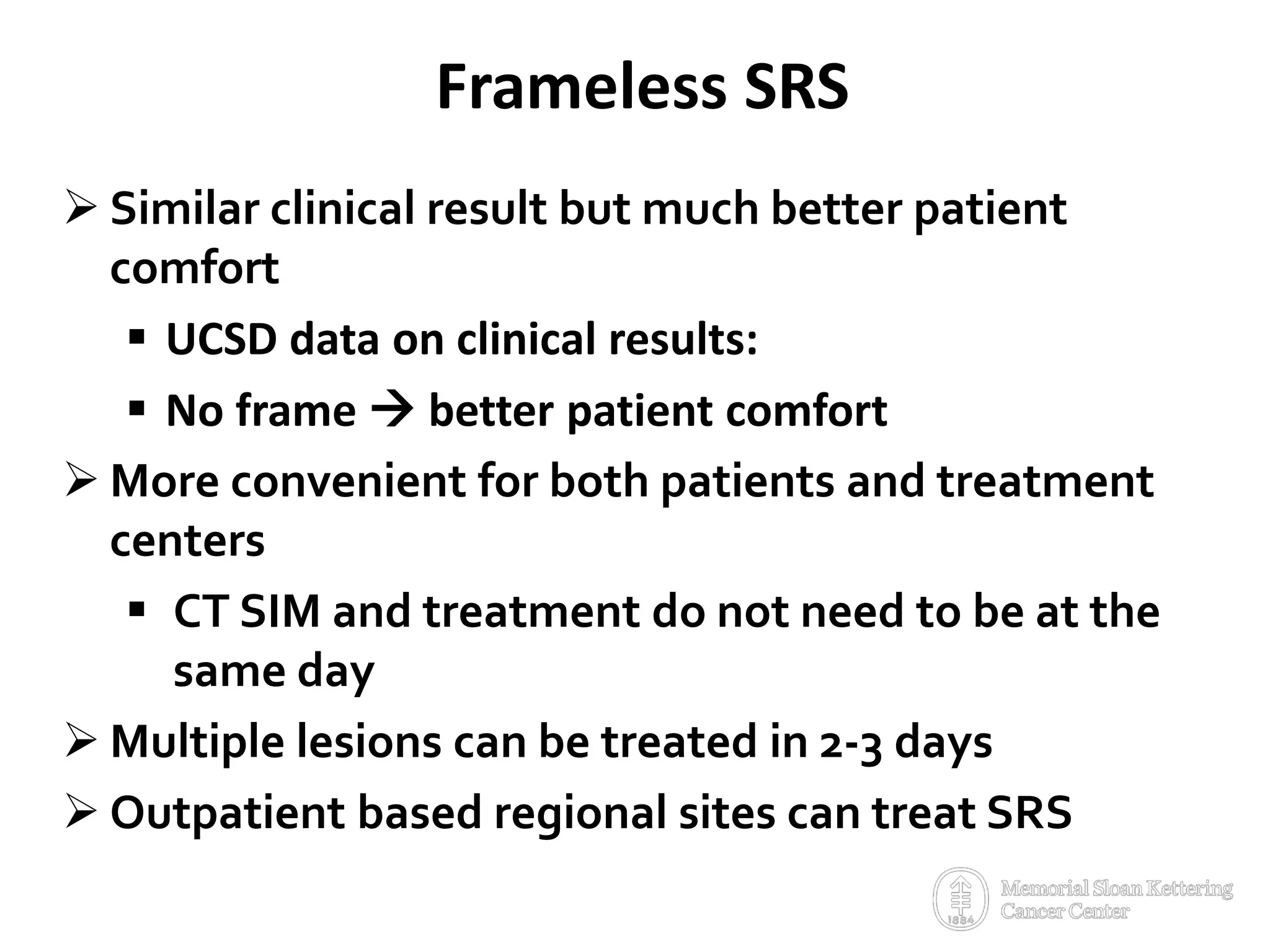
Frameless SRS
 Similar clinical result but much better patient
comfort
 UCSD data on clinical results:
 No frame  better patient comfort
 More convenient for both patients and treatment
centers
 CT SIM and treatment do not need to be at the
same day
 Multiple lesions can be treated in 2-3 days
 Outpatient based regional sites can treat SRS
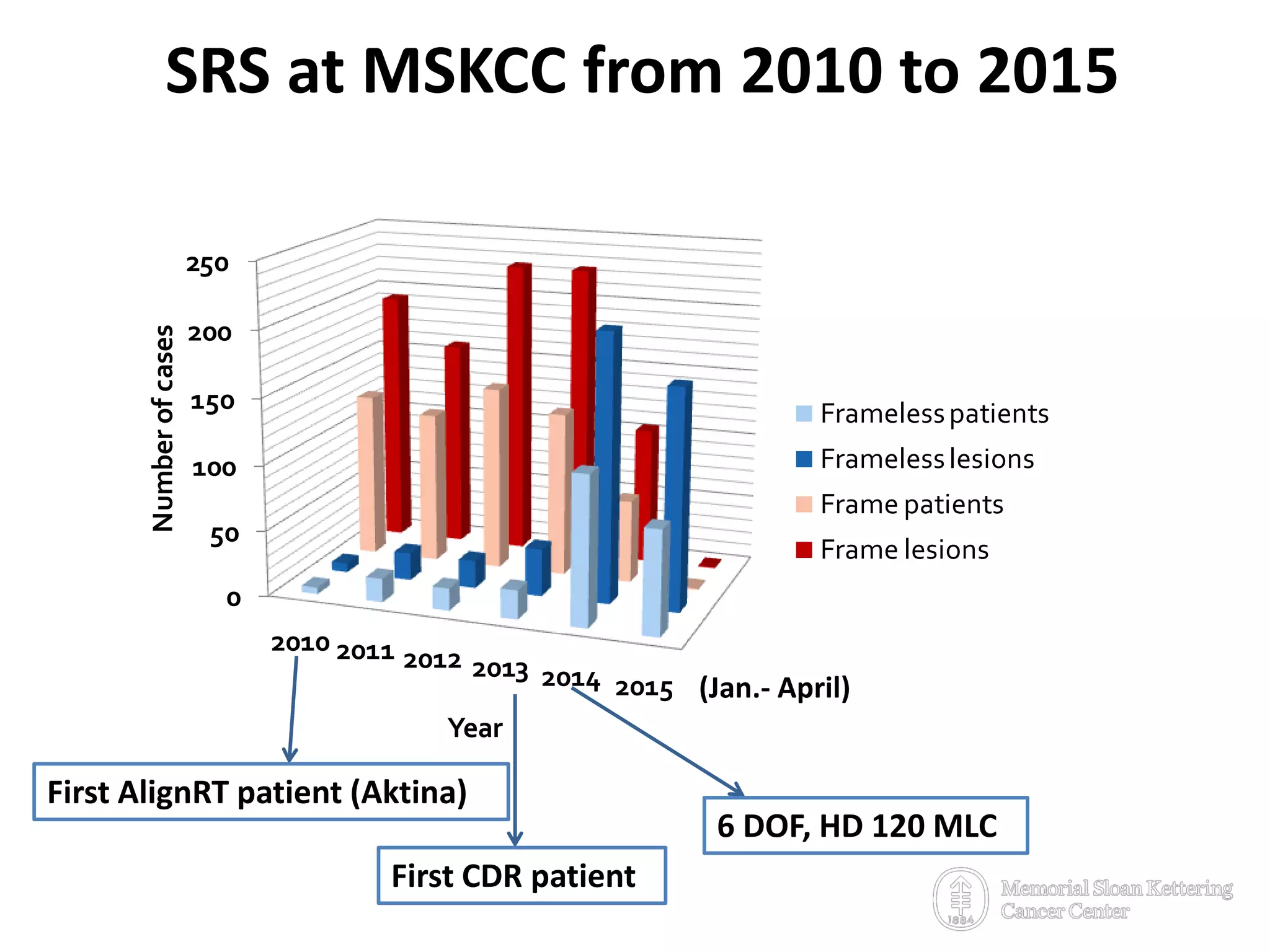
0
50
100
150
200
250
2010 2011 2012 2013 2014 2015
Numberofcases
Year
Framelesspatients
Framelesslesions
Frame patients
Frame lesions
SRS at MSKCC from 2010 to 2015
First AlignRT patient (Aktina)
First CDR patient
6 DOF, HD 120 MLC
85/15/2015
(Jan.- April)
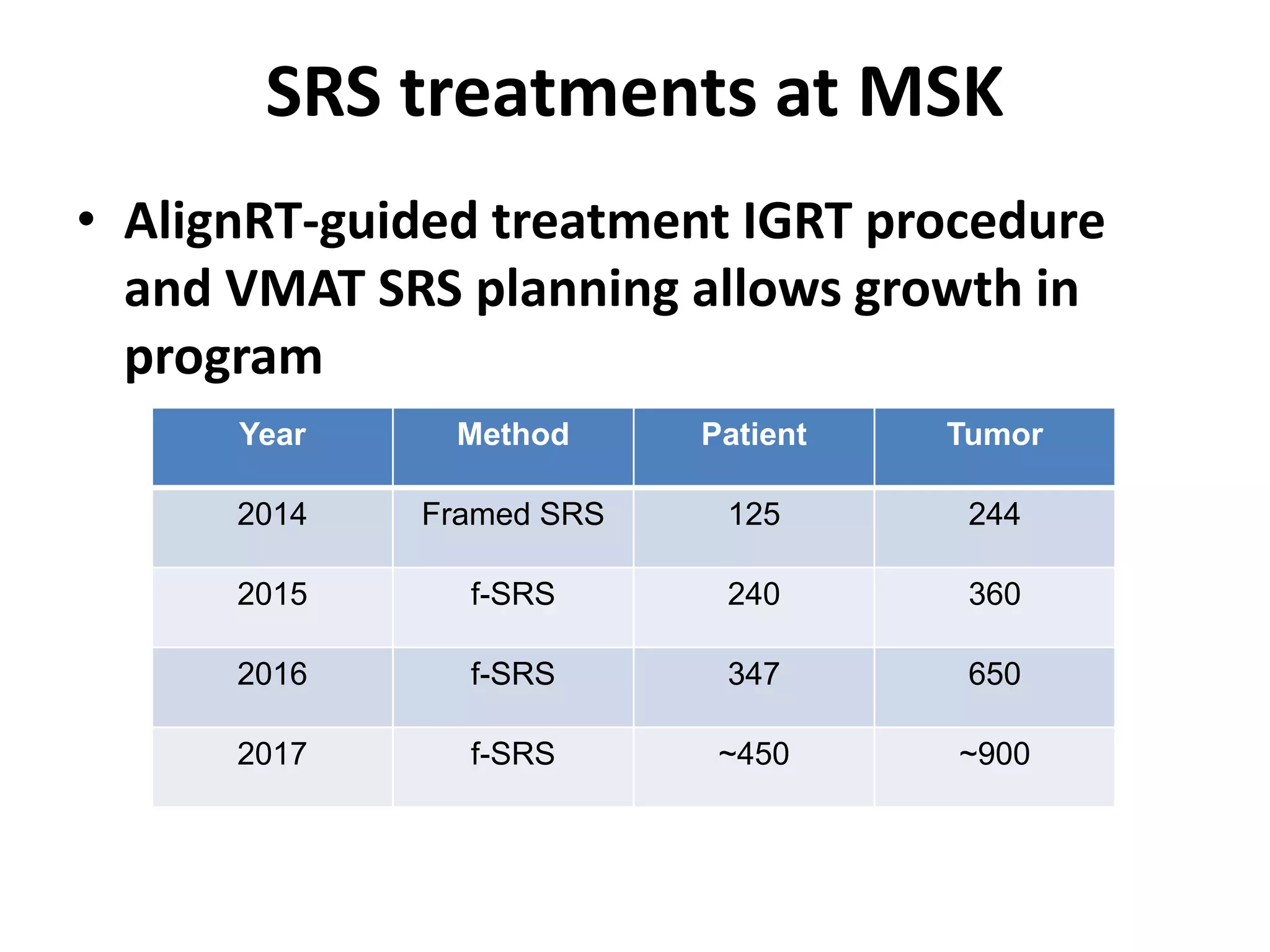
SRS treatments at MSK
• AlignRT-guided treatment IGRT procedure
and VMAT SRS planning allows growth in
program
Year Method Patient Tumor
2014 Framed SRS 125 244
2015 f-SRS 240 360
2016 f-SRS 347 650
2017 f-SRS ~450 ~900
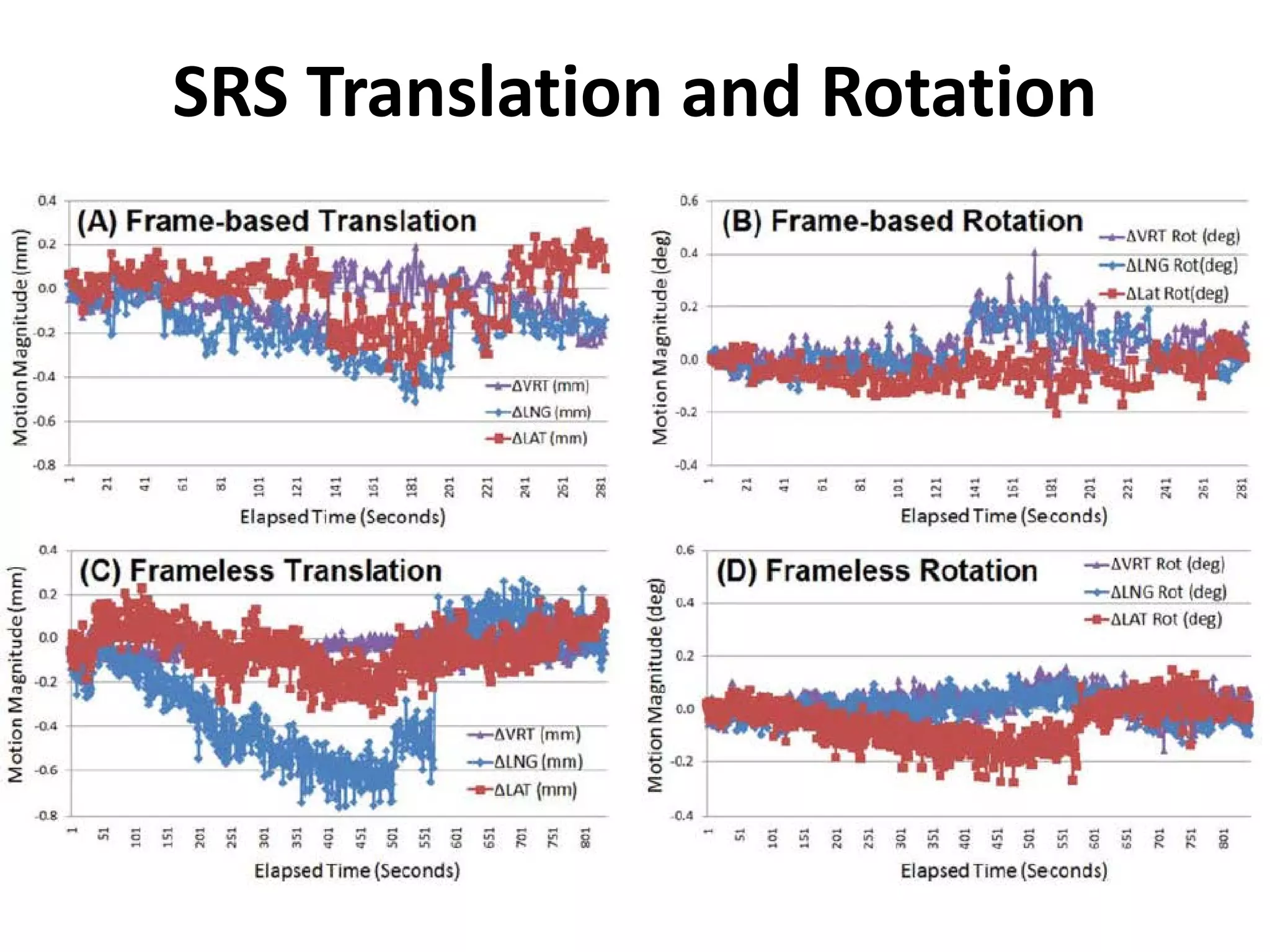
SRS Translation and Rotation
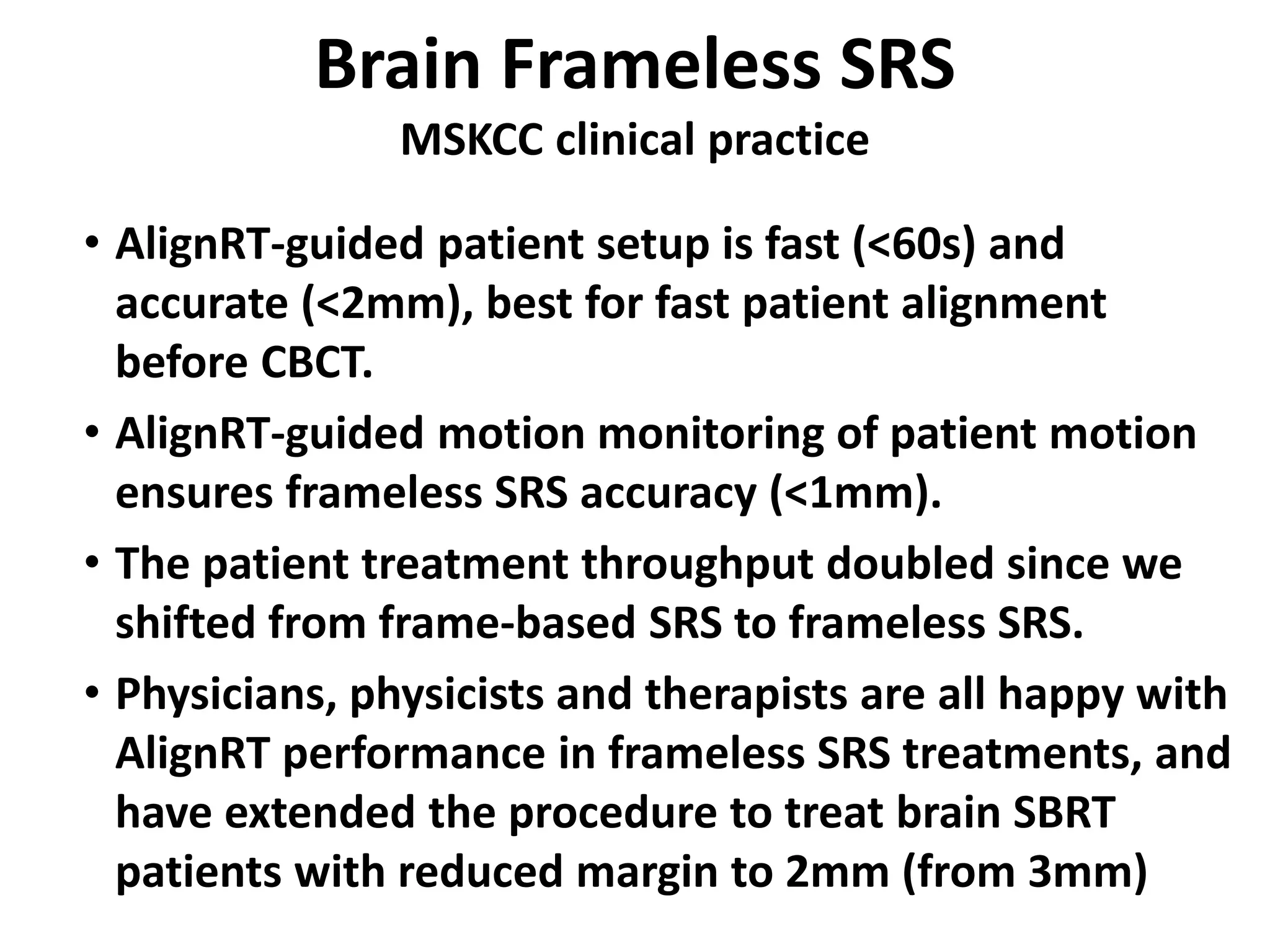
Brain Frameless SRS
MSKCC clinical practice
• AlignRT-guided patient setup is fast (<60s) and
accurate (<2mm), best for fast patient alignment
before CBCT.
• AlignRT-guided motion monitoring of patient motion
ensures frameless SRS accuracy (<1mm).
• The patient treatment throughput doubled since we
shifted from frame-based SRS to frameless SRS.
• Physicians, physicists and therapists are all happy with
AlignRT performance in frameless SRS treatments, and
have extended the procedure to treat brain SBRT
patients with reduced margin to 2mm (from 3mm)
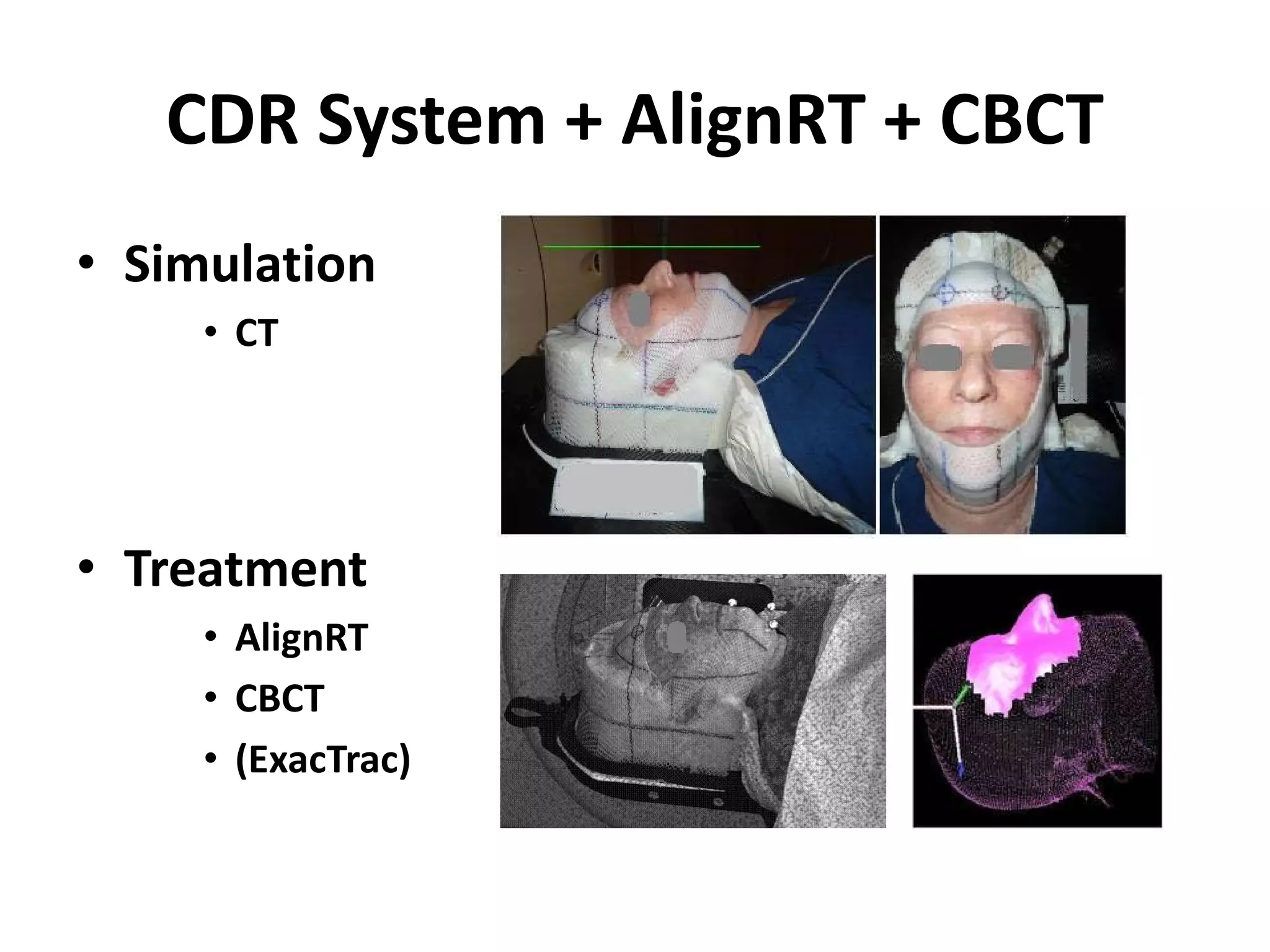
CDR System + AlignRT + CBCT
• Simulation
• CT
• Treatment
• AlignRT
• CBCT
• (ExacTrac)
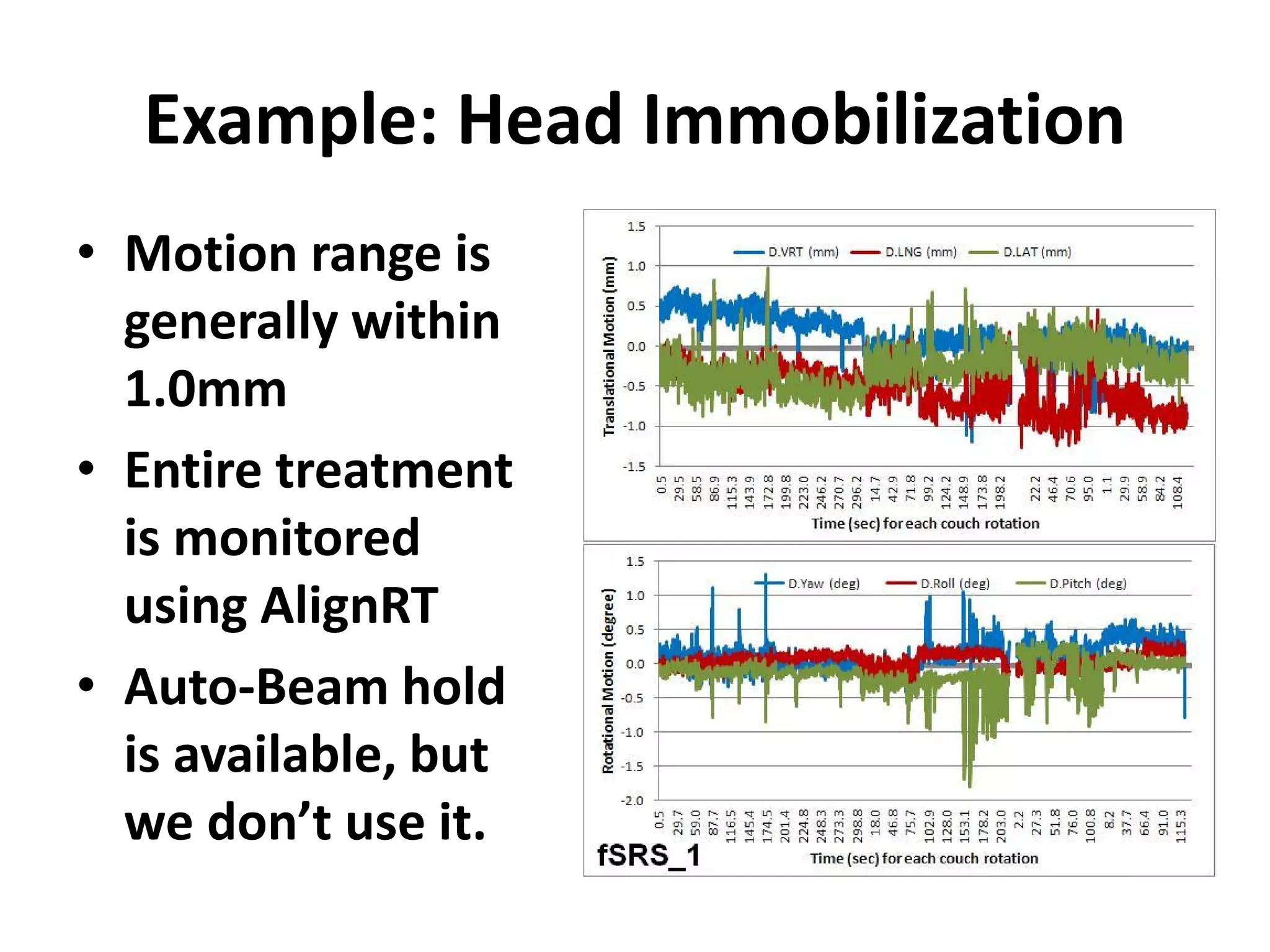
Example: Head Immobilization
• Motion range is
generally within
1.0mm
• Entire treatment
is monitored
using AlignRT
• Auto-Beam hold
is available, but
we don’t use it.
Head & Neck Cancer
Open mask or maskless H&N cancer treatments
rapid position verification
monitoring of movement during treatment
Level of precision is sub-mm
longitudinal axis has some drift seen, but also
sub-mm
Real-time verification is most useful in periods of
waiting for CBCT: reduce the need for re-imaging
AlignRT based DIBH
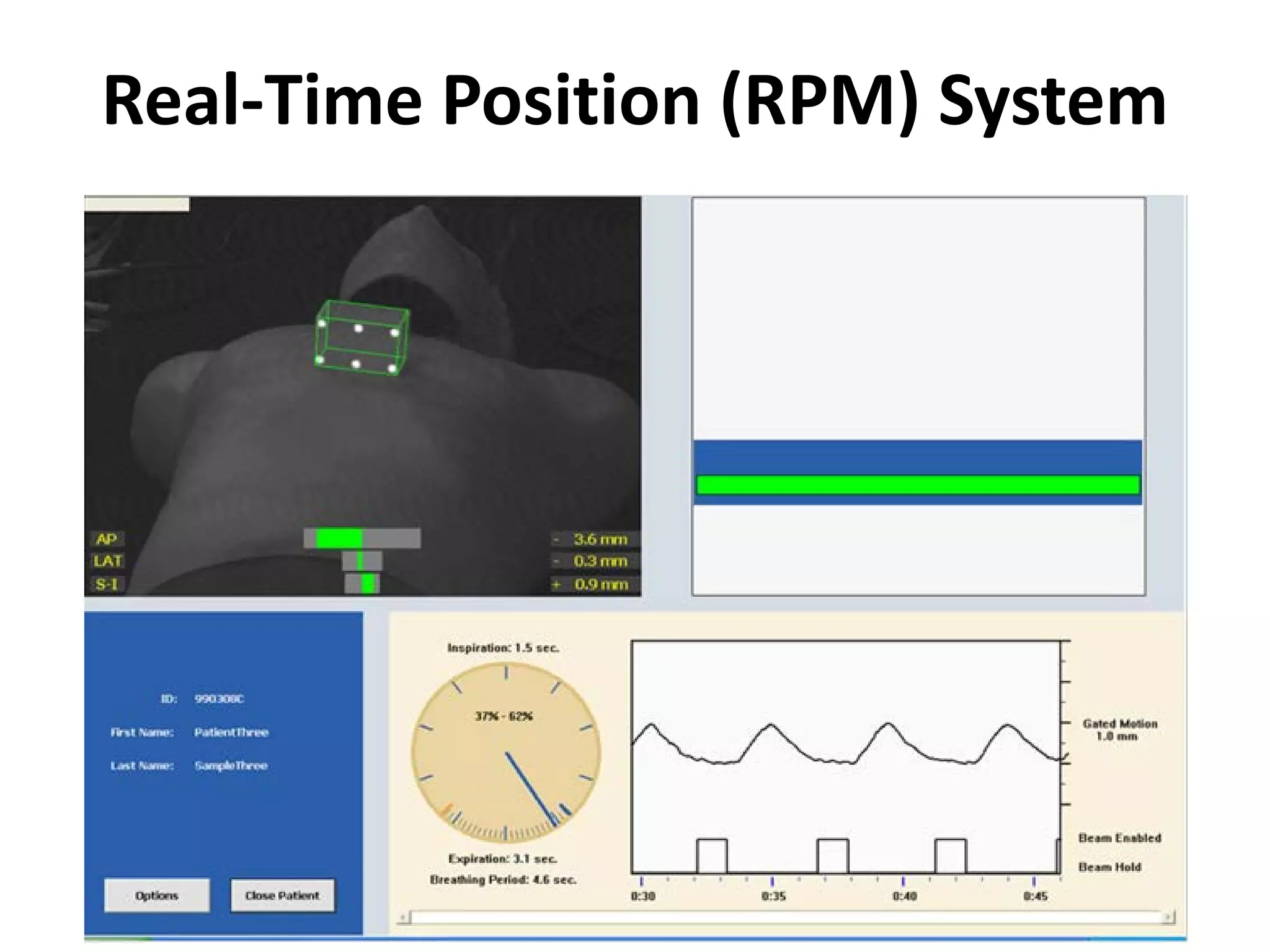
 Previously, we usedVarian RPM-based DIBH
 Started implementing AlignRT based DIBH in Jan
2015 (left-sided)
 Treated > 40 patients
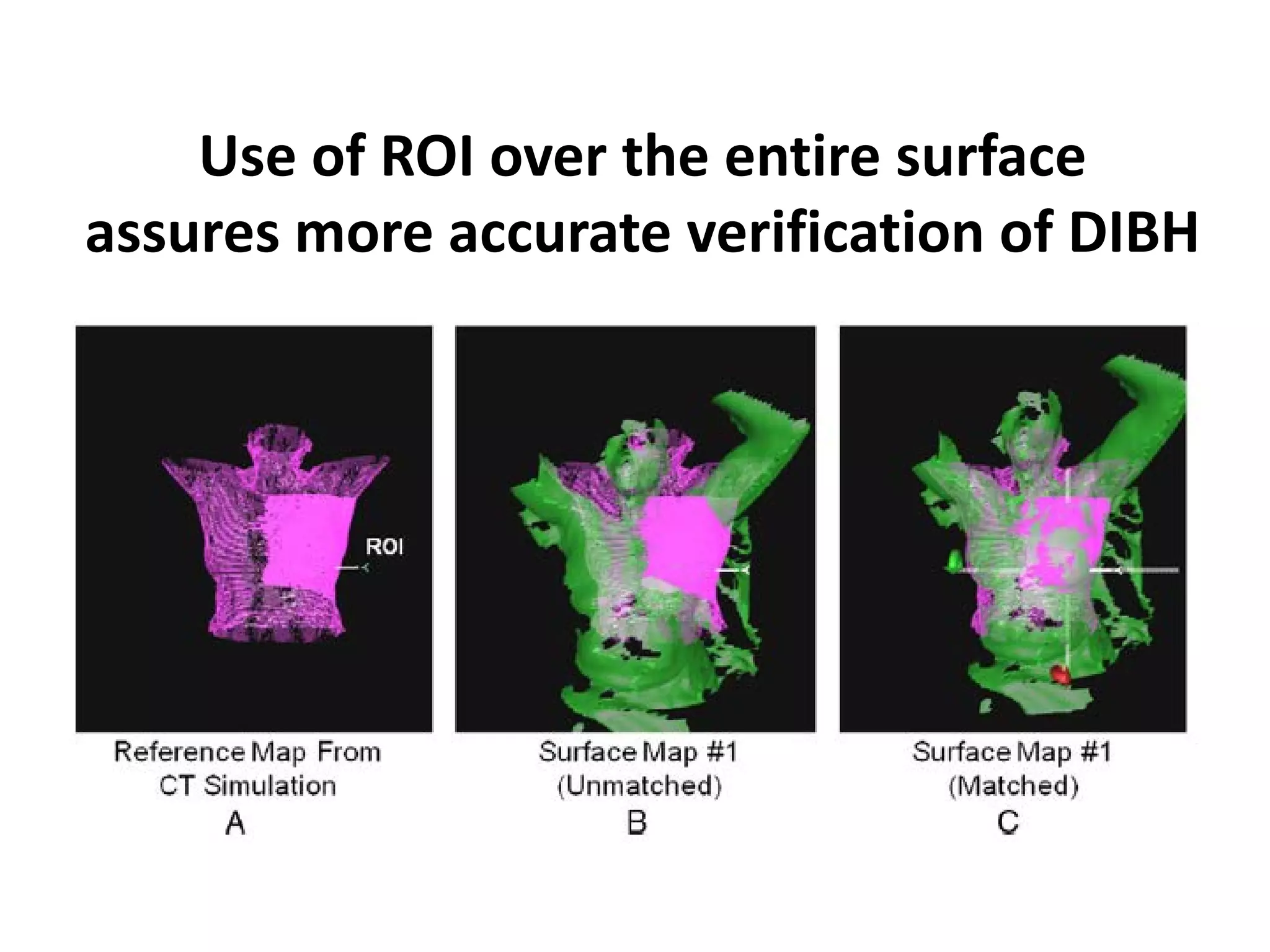
 Region of Interest is critical
 New applications:
 Right-sided breast DIBH
 Electron boost
Free Breathing Breath Hold
Deep Inspiratory Breath Hold
 Verify if patient breath hold is reproducible, and if
patient can hold breath for 20 seconds.
Whether DIBH is beneficial for this patient?
Free Breathing Breath Hold
Deep Inspiratory Breath Hold
Real-Time Position (RPM) System
Use of ROI over the entire surface
assures more accurate verification of DIBH
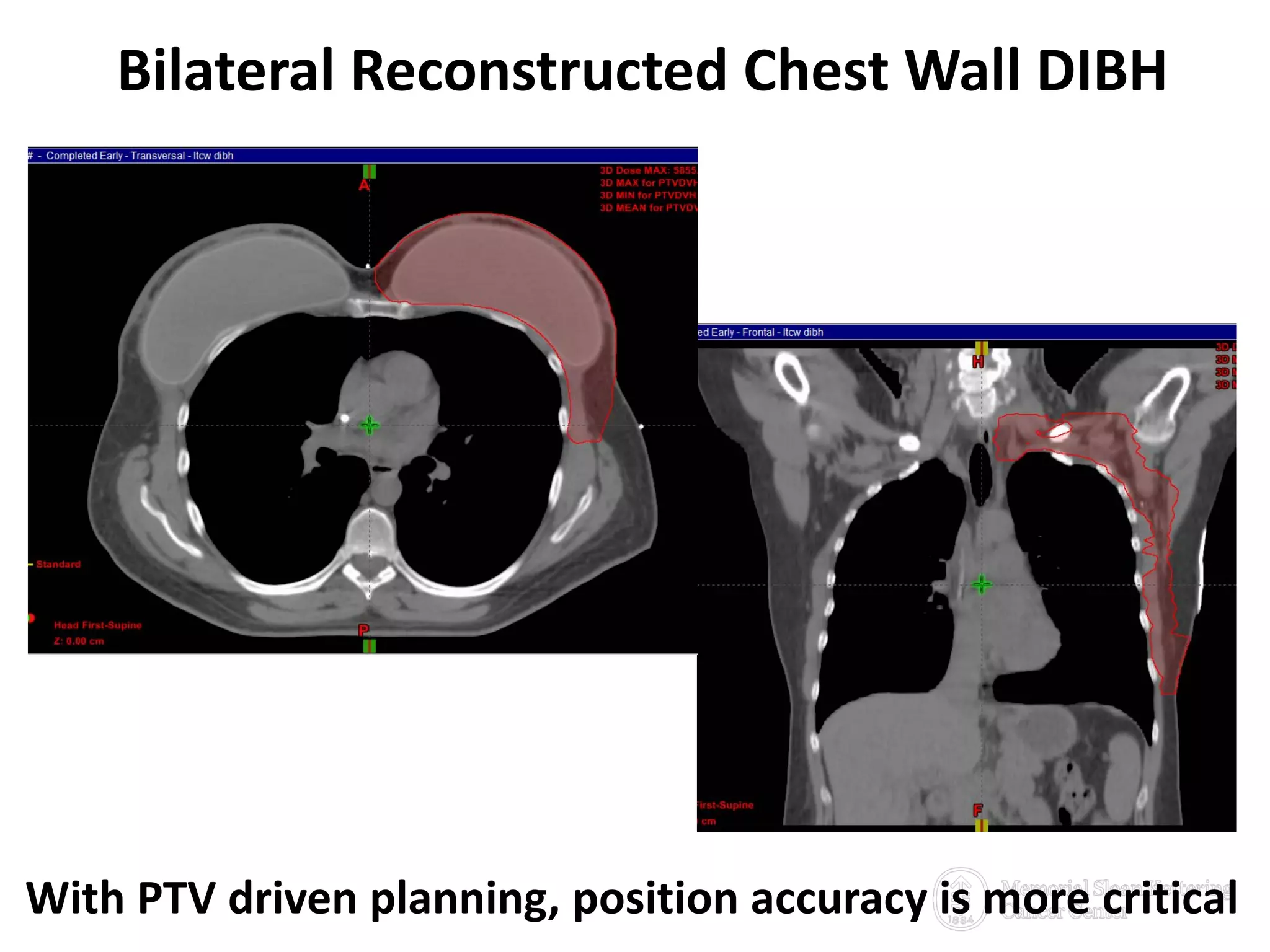
Bilateral Reconstructed Chest Wall DIBH
20With PTV driven planning, position accuracy is more critical
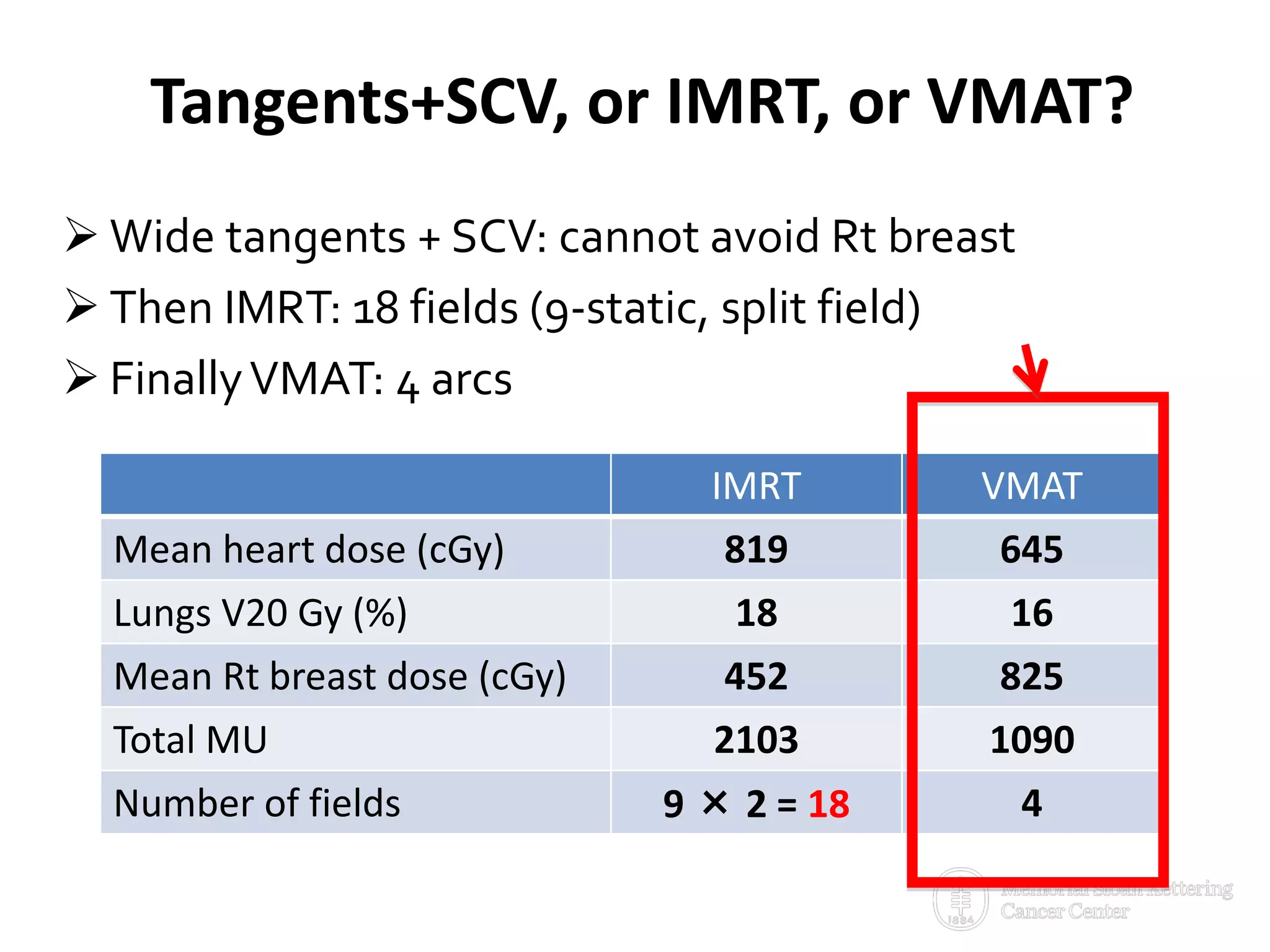
Tangents+SCV, or IMRT, or VMAT?
 Wide tangents + SCV: cannot avoid Rt breast
 Then IMRT: 18 fields (9-static, split field)
 FinallyVMAT: 4 arcs
IMRT VMAT
Mean heart dose (cGy) 819 645
Lungs V20 Gy (%) 18 16
Mean Rt breast dose (cGy) 452 825
Total MU 2103 1090
Number of fields 9 × 2 = 18 4
Breast, Chest Wall and Nodes
To minimize breast tissue deformation between
simulation and treatment
(A) Arm variation can occur (B) Arm Aligned patient setup
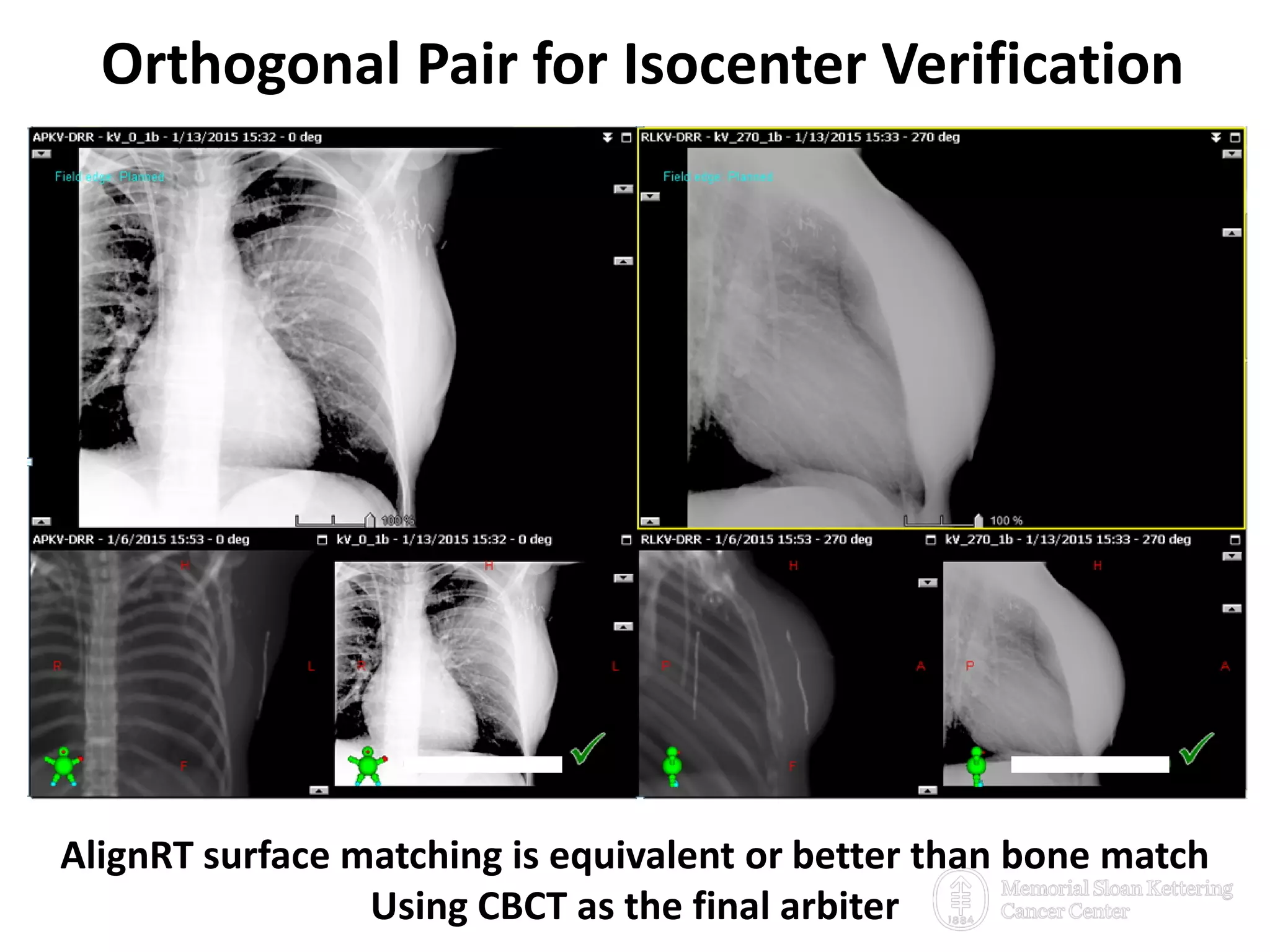
Orthogonal Pair for Isocenter Verification
23
AlignRT surface matching is equivalent or better than bone match
Using CBCT as the final arbiter
Region of Interest Reference Surface
24
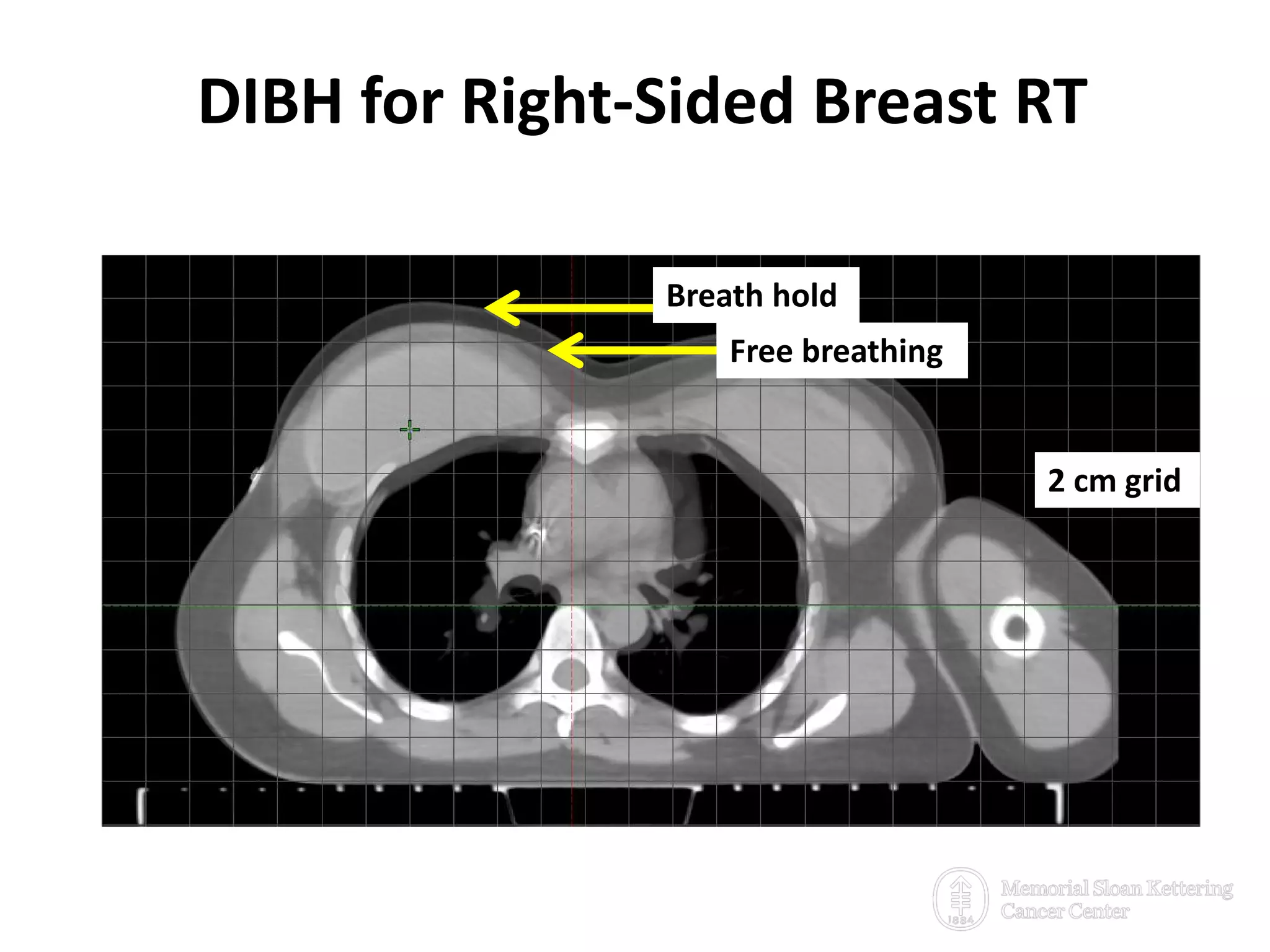
DIBH for Right-Sided Breast RT
25
 To spare contra-lateral breast
2 cm grid
Free breathing
Breath hold
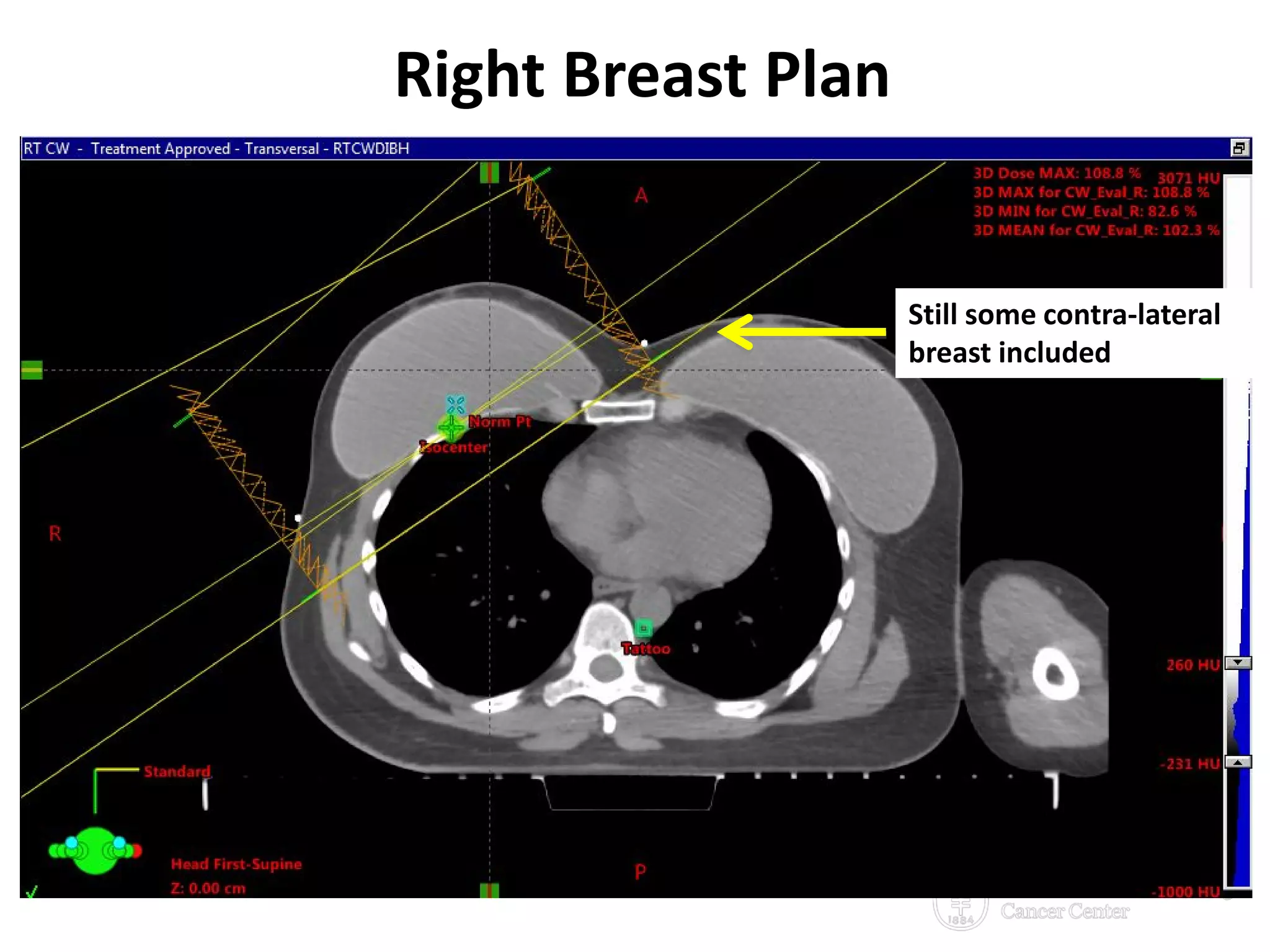
Right Breast Plan
6/29/2016 26
Still some contra-lateral
breast included
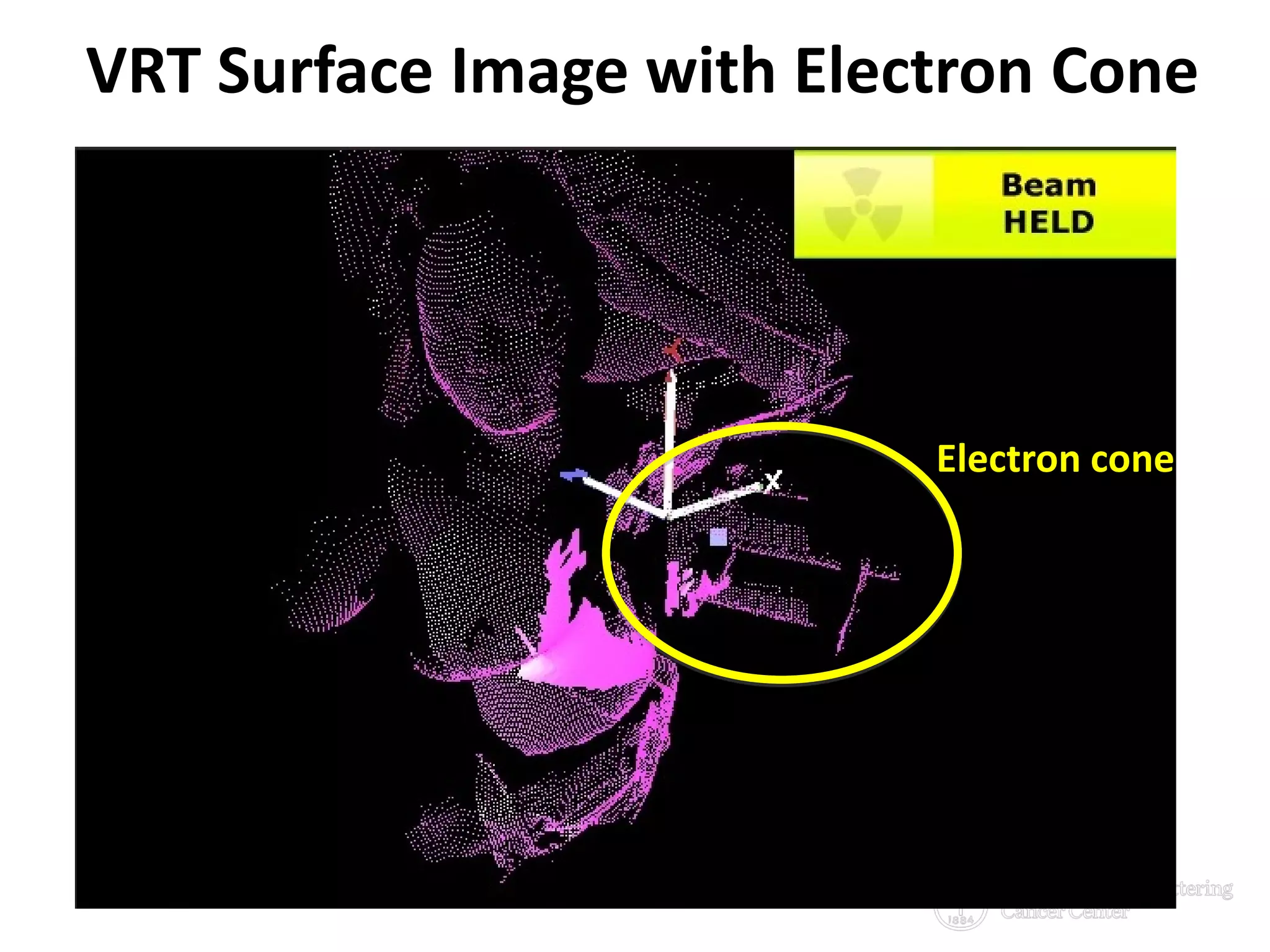
Electron Boost for DIBH RT
 Used to be treated in free breathing
 Electron cone in the way
 RPM cannot track either
 This is OK for most scenarios as electron is
superficial
 We have successfully implemented electron
workflow in the clinic
6/29/2016 28
VRT Surface Image with Electron Cone
Electron cone
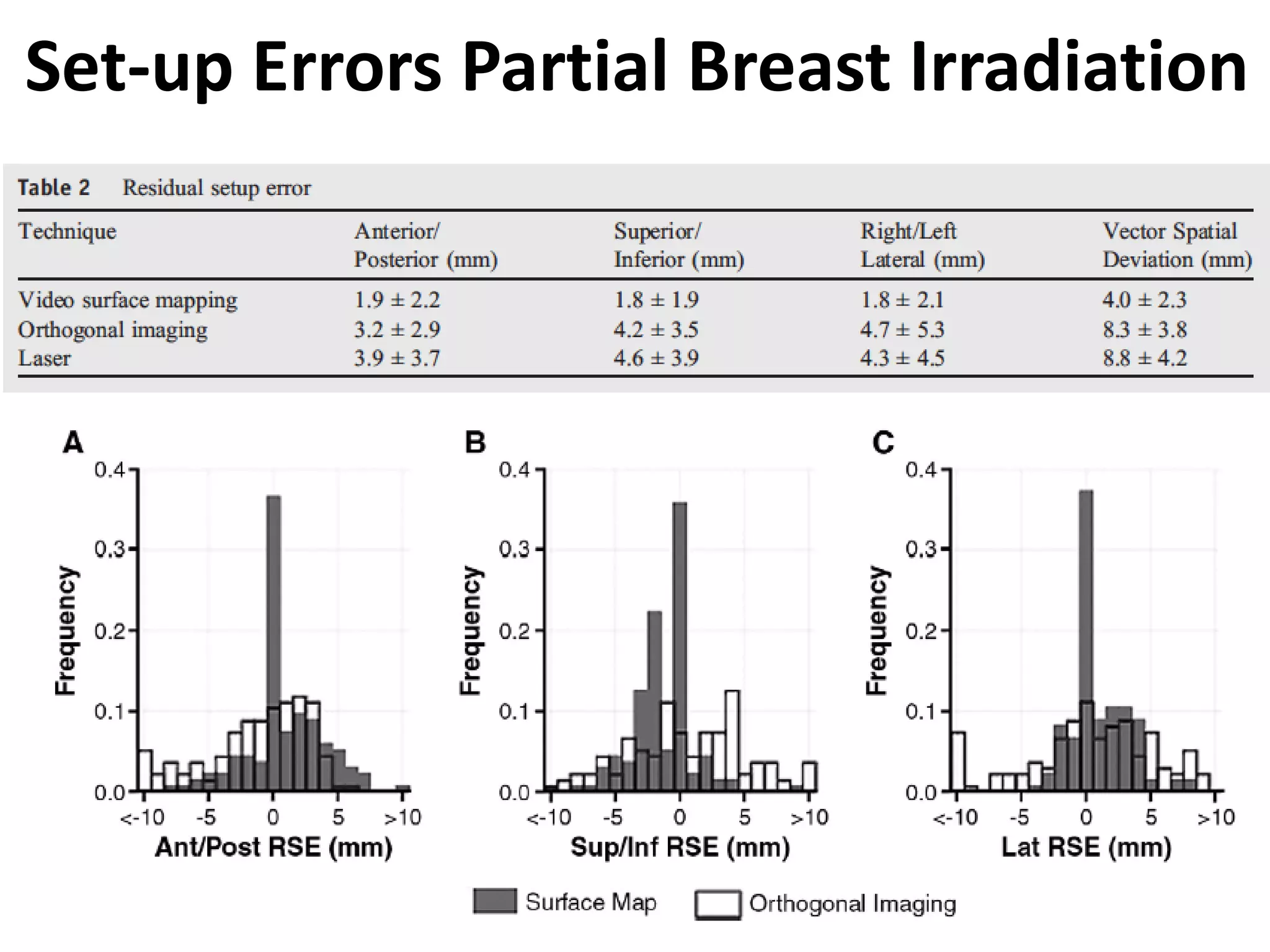
Set-up Errors Partial Breast Irradiation
Breast Cancer SGRT
• The arm and chin alignments are necessary to
minimize tissue deformation, prior to the breast
alignment.
• AlignRT patient setup procedure has ensured that we
treat patients the same way as planned
• No other technique offers such capacity to control and
minimize tissue deformation
• The AlignRT technique has been tested for treating PBI
patients.
• The AlignRT technique has been applied to treat DIBH
patients.
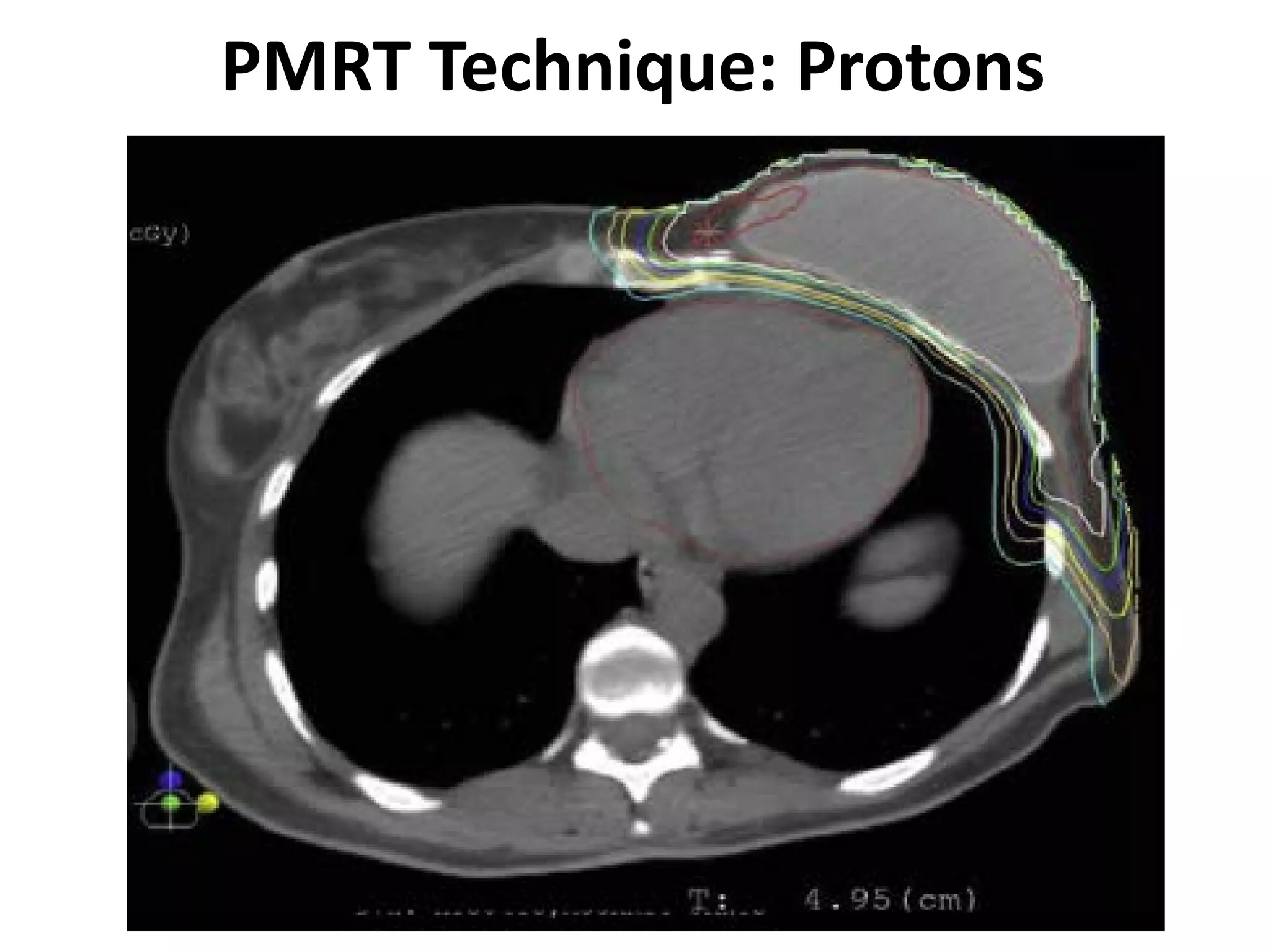
PMRT Technique: Protons
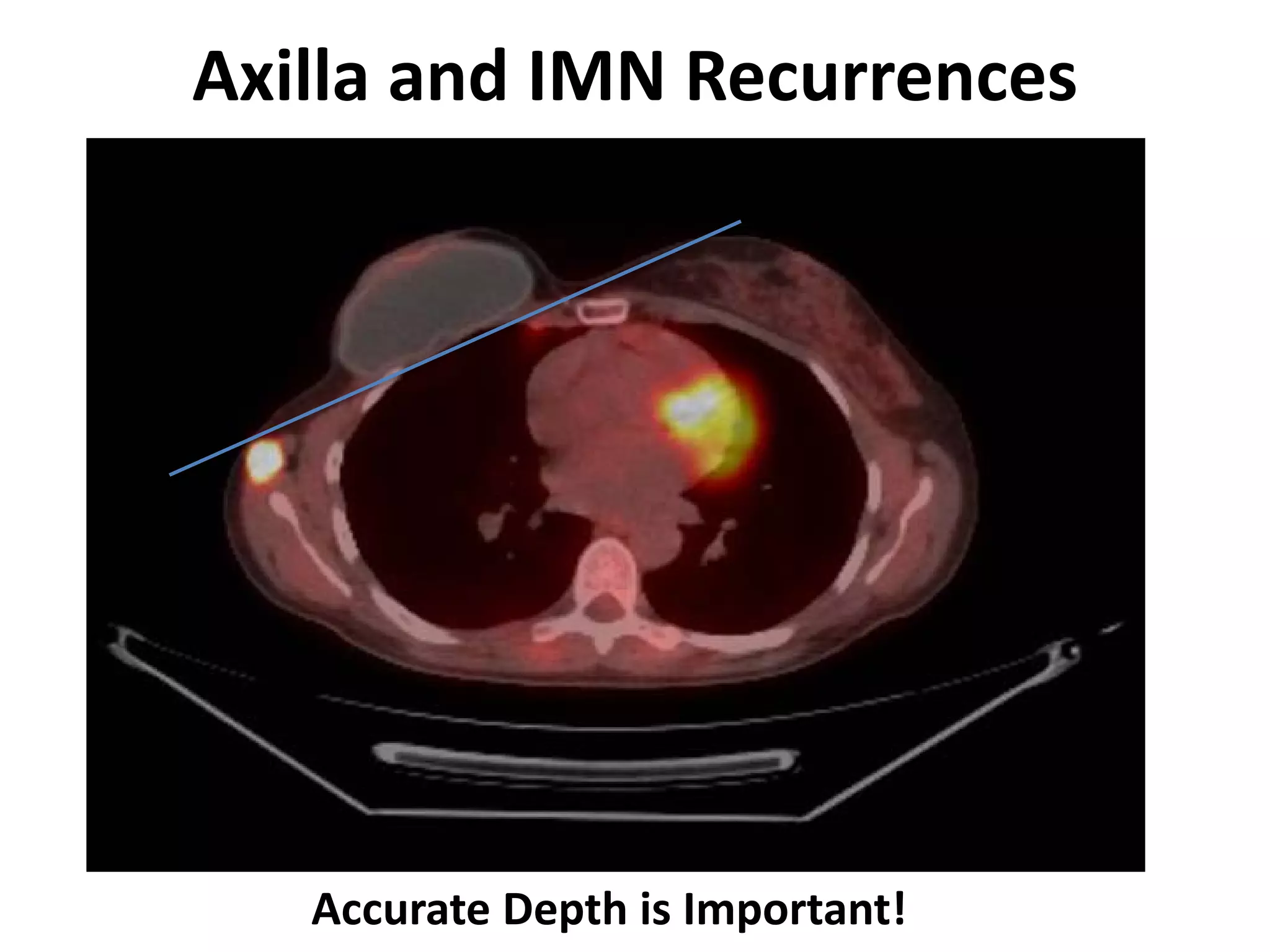
Axilla and IMN Recurrences
Accurate Depth is Important!
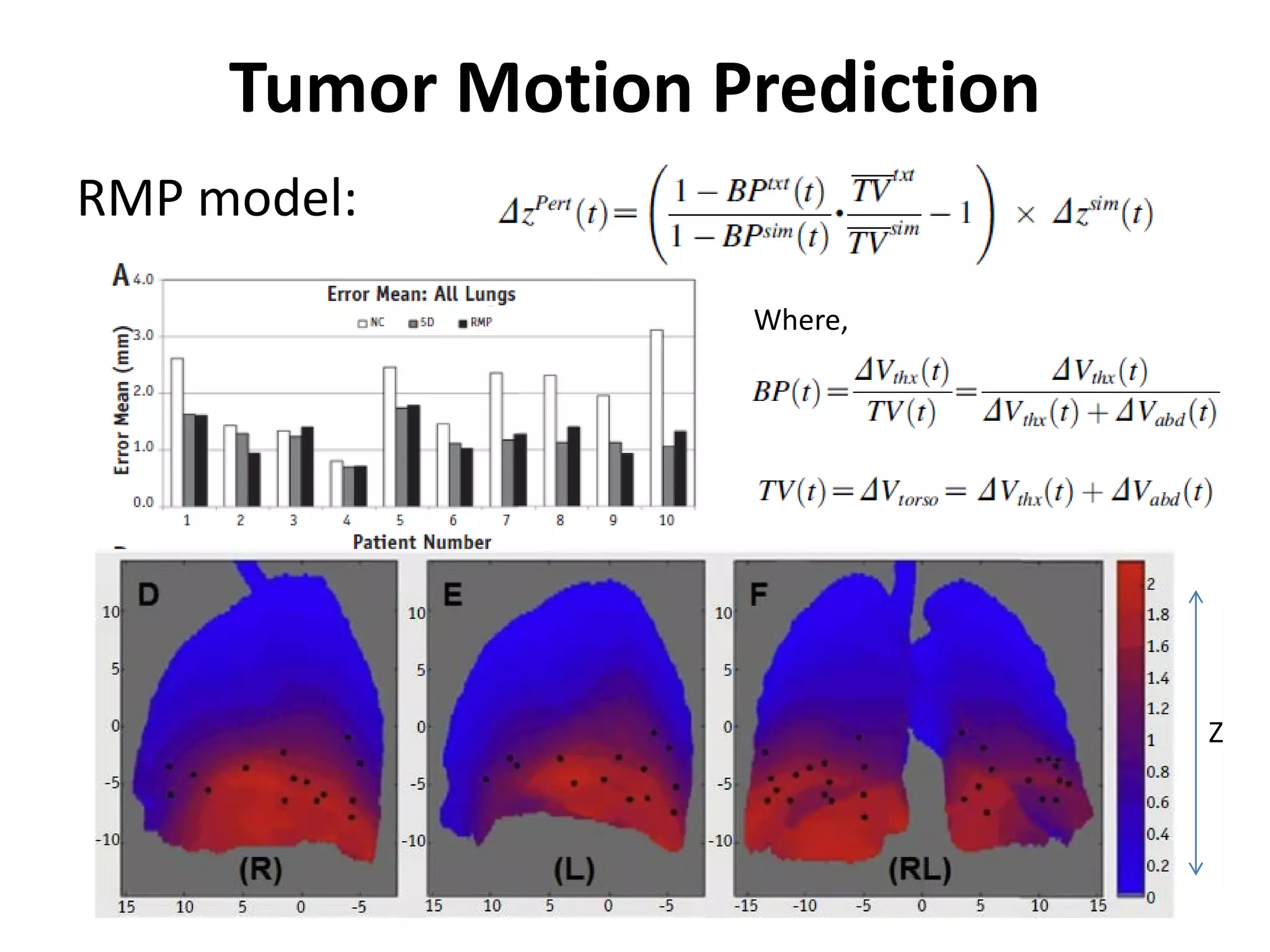
Lung Motion in IGRT
• Extension of AlignRT applications from rigid to
deformable/mobile anatomic sites
• Organ motion/deformation is a clinical challenge and
affects the treatment precision and outcome.
• Optical imaging of entire torso provides a physical
closed system
• The development of this technique is on hold, after the
proof-of-principle study.
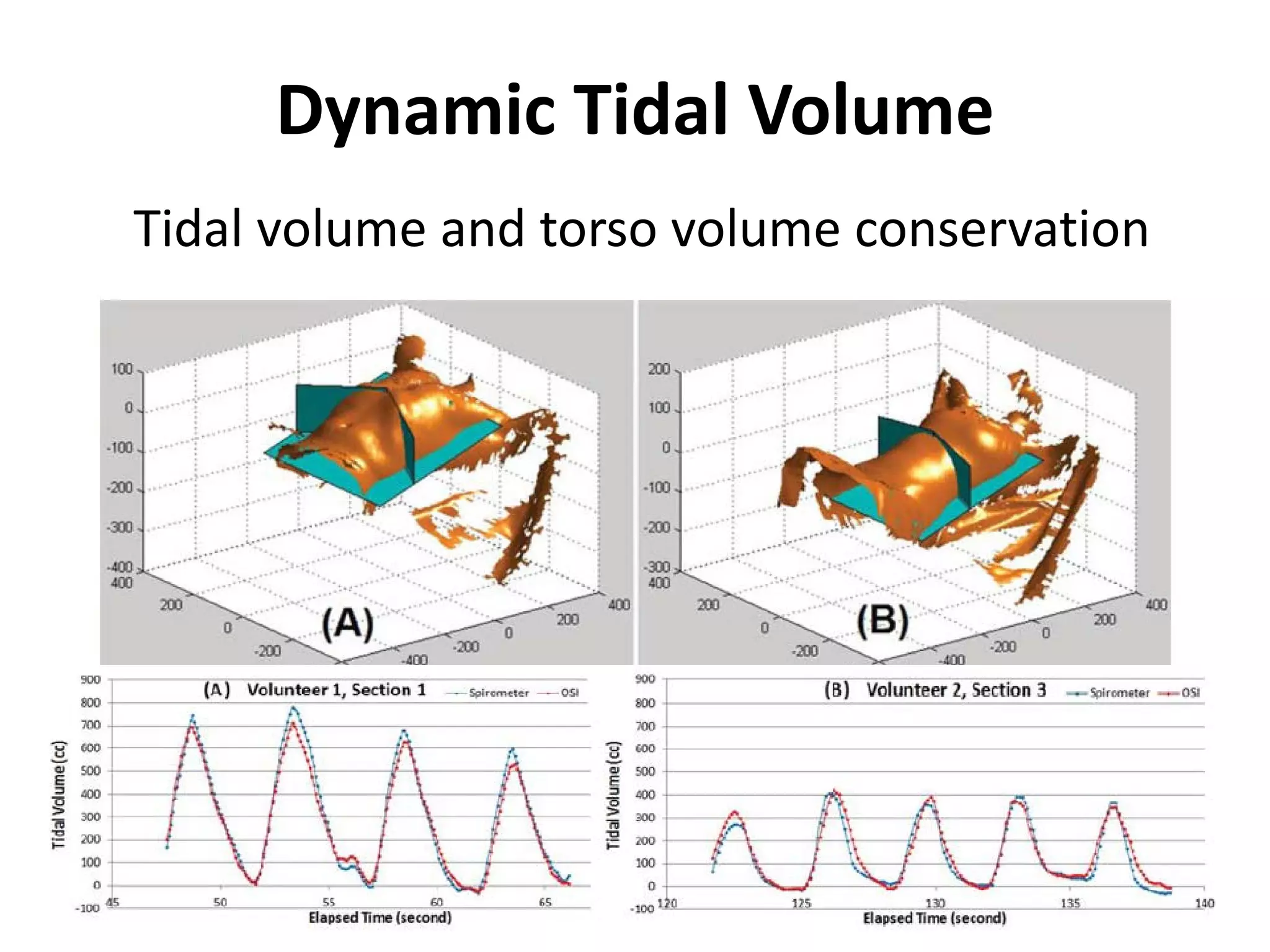
Dynamic Tidal Volume
Tidal volume and torso volume conservation
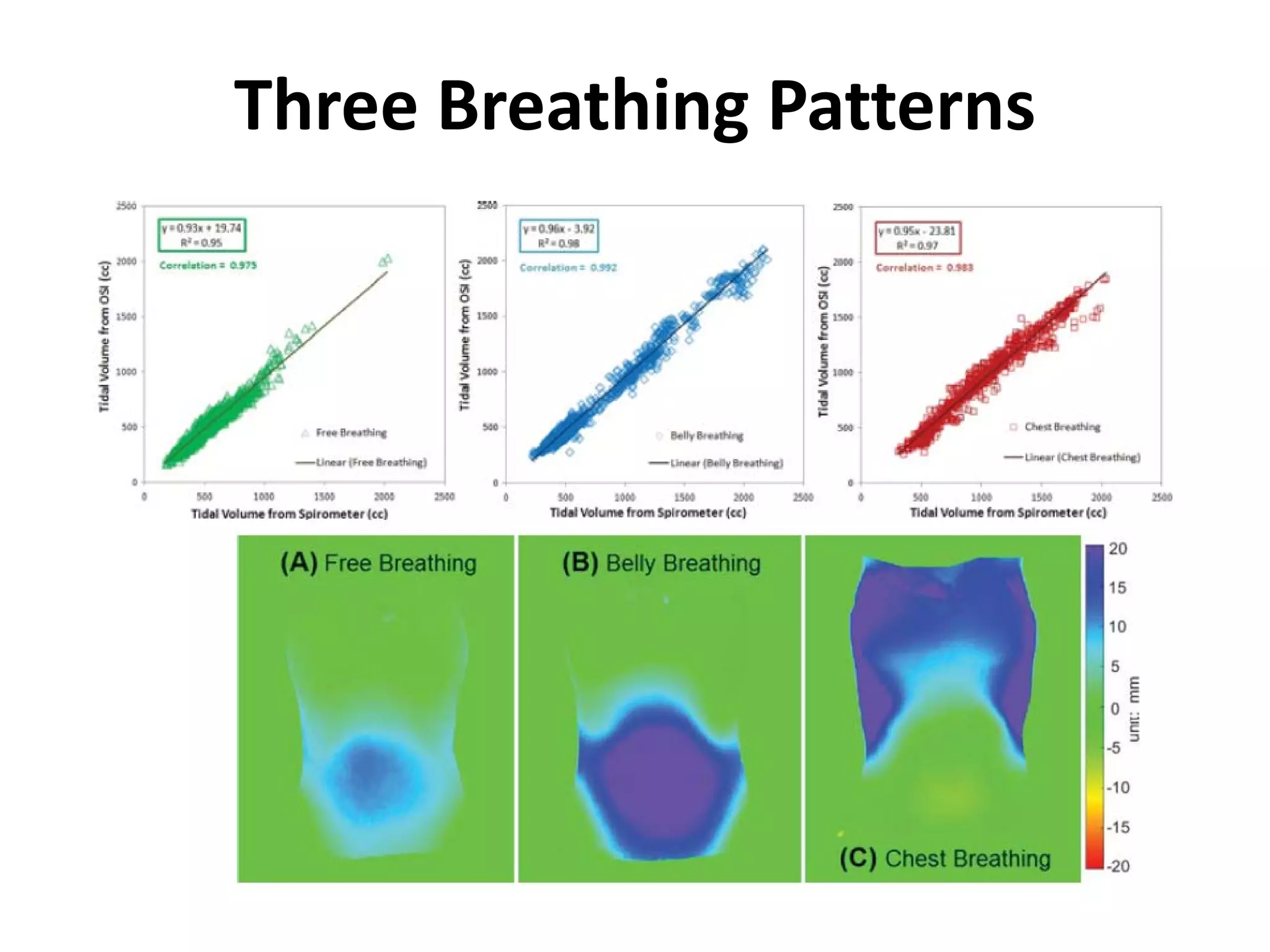
Three Breathing Patterns
Tumor Motion Prediction
RMP model:
Where,
Z
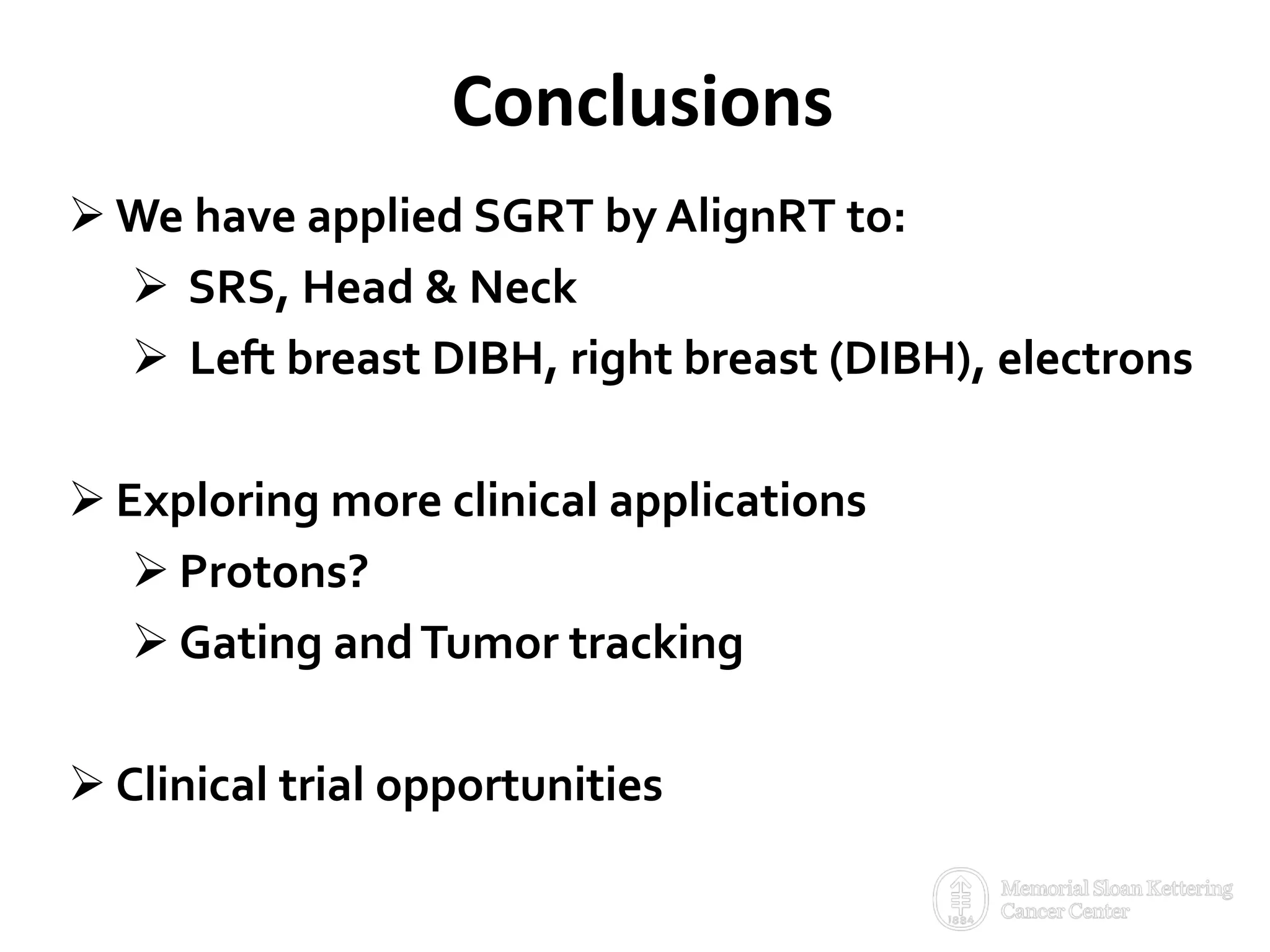
Conclusions
 We have applied SGRT by AlignRT to:
 SRS, Head & Neck
 Left breast DIBH, right breast (DIBH), electrons
 Exploring more clinical applications
 Protons?
 Gating andTumor tracking
 Clinical trial opportunities
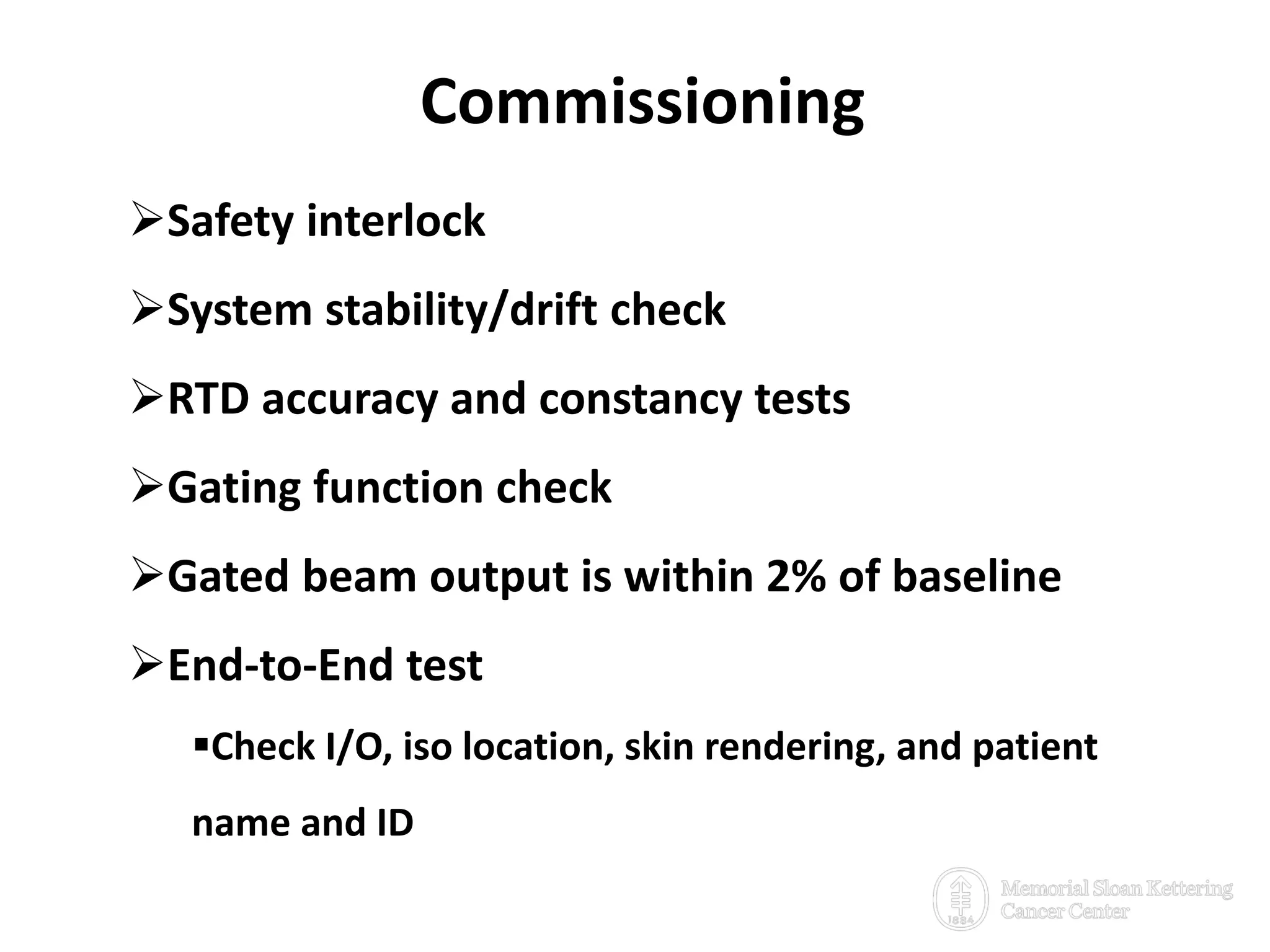
Commissioning
38
Safety interlock
System stability/drift check
RTD accuracy and constancy tests
Gating function check
Gated beam output is within 2% of baseline
End-to-End test
Check I/O, iso location, skin rendering, and patient
name and ID

Surface Guided Radiotherapy for Accuracy, Volume Reduction, Real time Tracking and Dose Verification

  • 1.
    Surface Guided Radiotherapyfor Accuracy, Volume Reduction, Real Time Tracking and Dose Verification Simon Powell MD PhD
  • 2.
    Surface Guided Radiotherapy Monitortreatment position within RT delivery time Competing technologies? MRI! 3D-Ultrasound? Accuracy of surface topology to predict internal tumor and organ position? Set-up time and accuracy Compared to kV imaging Deep inspiratory Breath Hold Respiratory motion tracking and gating
  • 3.
    Workflow Process atMSKCC 3  Each site has at least one AlignRT  Same procedure: set displacement limits CT SIM with immobilization iPlan AlignRT based treatment
  • 4.
    AlignRT System inTreatment Room 4 Camera pods
  • 5.
    Real-Time Variance “Deltas”(RTD) 5  Real time register Verification surface to Reference surface to calculate:  All 3 translational displacements and their MAG  All 3 rotational displacements  RTD < threshold  Beam ON
  • 6.
    Surface Guided Radiotherapy BrainSRS Maskless or Open-mask, Head & Neck Cancer Breast Cancer DIBH comprehensive treatment DIBH whole breast Partial breast irradiation Lung/Upper Abdomen Respiratory Gating (and tracking?)
  • 7.
    Frameless SRS  Similarclinical result but much better patient comfort  UCSD data on clinical results:  No frame  better patient comfort  More convenient for both patients and treatment centers  CT SIM and treatment do not need to be at the same day  Multiple lesions can be treated in 2-3 days  Outpatient based regional sites can treat SRS
  • 8.
    0 50 100 150 200 250 2010 2011 20122013 2014 2015 Numberofcases Year Framelesspatients Framelesslesions Frame patients Frame lesions SRS at MSKCC from 2010 to 2015 First AlignRT patient (Aktina) First CDR patient 6 DOF, HD 120 MLC 85/15/2015 (Jan.- April)
  • 9.
    SRS treatments atMSK • AlignRT-guided treatment IGRT procedure and VMAT SRS planning allows growth in program Year Method Patient Tumor 2014 Framed SRS 125 244 2015 f-SRS 240 360 2016 f-SRS 347 650 2017 f-SRS ~450 ~900
  • 10.
  • 11.
    Brain Frameless SRS MSKCCclinical practice • AlignRT-guided patient setup is fast (<60s) and accurate (<2mm), best for fast patient alignment before CBCT. • AlignRT-guided motion monitoring of patient motion ensures frameless SRS accuracy (<1mm). • The patient treatment throughput doubled since we shifted from frame-based SRS to frameless SRS. • Physicians, physicists and therapists are all happy with AlignRT performance in frameless SRS treatments, and have extended the procedure to treat brain SBRT patients with reduced margin to 2mm (from 3mm)
  • 12.
    CDR System +AlignRT + CBCT • Simulation • CT • Treatment • AlignRT • CBCT • (ExacTrac)
  • 13.
    Example: Head Immobilization •Motion range is generally within 1.0mm • Entire treatment is monitored using AlignRT • Auto-Beam hold is available, but we don’t use it.
  • 14.
    Head & NeckCancer Open mask or maskless H&N cancer treatments rapid position verification monitoring of movement during treatment Level of precision is sub-mm longitudinal axis has some drift seen, but also sub-mm Real-time verification is most useful in periods of waiting for CBCT: reduce the need for re-imaging
  • 15.
    AlignRT based DIBH Previously, we usedVarian RPM-based DIBH  Started implementing AlignRT based DIBH in Jan 2015 (left-sided)  Treated > 40 patients  Region of Interest is critical  New applications:  Right-sided breast DIBH  Electron boost
  • 16.
    Free Breathing BreathHold Deep Inspiratory Breath Hold
  • 17.
     Verify ifpatient breath hold is reproducible, and if patient can hold breath for 20 seconds. Whether DIBH is beneficial for this patient? Free Breathing Breath Hold Deep Inspiratory Breath Hold
  • 18.
  • 19.
    Use of ROIover the entire surface assures more accurate verification of DIBH
  • 20.
    Bilateral Reconstructed ChestWall DIBH 20With PTV driven planning, position accuracy is more critical
  • 21.
    Tangents+SCV, or IMRT,or VMAT?  Wide tangents + SCV: cannot avoid Rt breast  Then IMRT: 18 fields (9-static, split field)  FinallyVMAT: 4 arcs IMRT VMAT Mean heart dose (cGy) 819 645 Lungs V20 Gy (%) 18 16 Mean Rt breast dose (cGy) 452 825 Total MU 2103 1090 Number of fields 9 × 2 = 18 4
  • 22.
    Breast, Chest Walland Nodes To minimize breast tissue deformation between simulation and treatment (A) Arm variation can occur (B) Arm Aligned patient setup
  • 23.
    Orthogonal Pair forIsocenter Verification 23 AlignRT surface matching is equivalent or better than bone match Using CBCT as the final arbiter
  • 24.
    Region of InterestReference Surface 24
  • 25.
    DIBH for Right-SidedBreast RT 25  To spare contra-lateral breast 2 cm grid Free breathing Breath hold
  • 26.
    Right Breast Plan 6/29/201626 Still some contra-lateral breast included
  • 27.
    Electron Boost forDIBH RT  Used to be treated in free breathing  Electron cone in the way  RPM cannot track either  This is OK for most scenarios as electron is superficial  We have successfully implemented electron workflow in the clinic
  • 28.
    6/29/2016 28 VRT SurfaceImage with Electron Cone Electron cone
  • 29.
    Set-up Errors PartialBreast Irradiation
  • 30.
    Breast Cancer SGRT •The arm and chin alignments are necessary to minimize tissue deformation, prior to the breast alignment. • AlignRT patient setup procedure has ensured that we treat patients the same way as planned • No other technique offers such capacity to control and minimize tissue deformation • The AlignRT technique has been tested for treating PBI patients. • The AlignRT technique has been applied to treat DIBH patients.
  • 31.
  • 32.
    Axilla and IMNRecurrences Accurate Depth is Important!
  • 33.
    Lung Motion inIGRT • Extension of AlignRT applications from rigid to deformable/mobile anatomic sites • Organ motion/deformation is a clinical challenge and affects the treatment precision and outcome. • Optical imaging of entire torso provides a physical closed system • The development of this technique is on hold, after the proof-of-principle study.
  • 34.
    Dynamic Tidal Volume Tidalvolume and torso volume conservation
  • 35.
  • 36.
  • 37.
    Conclusions  We haveapplied SGRT by AlignRT to:  SRS, Head & Neck  Left breast DIBH, right breast (DIBH), electrons  Exploring more clinical applications  Protons?  Gating andTumor tracking  Clinical trial opportunities
  • 38.
    Commissioning 38 Safety interlock System stability/driftcheck RTD accuracy and constancy tests Gating function check Gated beam output is within 2% of baseline End-to-End test Check I/O, iso location, skin rendering, and patient name and ID