Does the tumour radiobiology
help in the move toward
hypofractionation?
Michael Joiner
Wayne State University
Radiation Oncology
Detroit, Michigan
joinerm@wayne.edu
Does the tumour radiobiology
hinder in the move toward
hypofractionation?
Michael Joiner
Wayne State University
Radiation Oncology
Detroit, Michigan
joinerm@wayne.edu
What radiobiology?
Historically…
•  Research has focused on doses per fraction
of 1–3 Gy: clinically relevant
•  Radiobiology is quite mature
•  Little incentive/funding for high-dose research

MCJ

Aug 12

3
Why reconsider high dose fractions?
•  Because we can: Physics
•  Patient convenience and demand
•  Lower cost of whole treatment
•  Evidence that it is very effective
•  Evidence of low !/" in some sites
The radiobiology has not yet caught up

MCJ

Aug 12

4
Why not LQ at high doses?
•  Reponse is really linear at higher doses?
•  Vascular damage?
•  Increased apotosis?
•  Immunological effects?
•  Mixed tumor cell populations with different
response characteristics?
Answers likely depend on tissue type
and tumor type / stage
MCJ

Aug 12

5
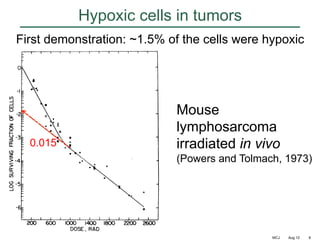
Hypoxic cells in tumors
First demonstration: ~1.5% of the cells were hypoxic

0.015

Mouse
lymphosarcoma
irradiated in vivo
(Powers and Tolmach, 1973)

MCJ

Aug 12

6
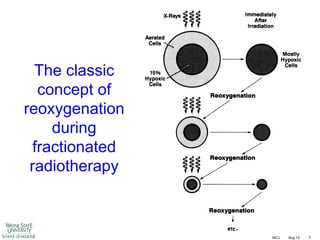
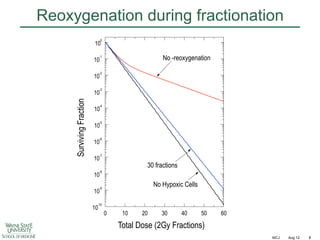
The classic
concept of
reoxygenation
during
fractionated
radiotherapy

MCJ

Aug 12

7
Reoxygenation during fractionation
0

10

No -reoxygenation

-1

10

-2

10

-3

Surviving Fraction

10

-4

10

-5

10

-6

10

-7

10

30 fractions

-8

10

No Hypoxic Cells

-9

10

-10

10

0

10

20

30

40

50

60

Total Dose (2Gy Fractions)
MCJ

Aug 12

8
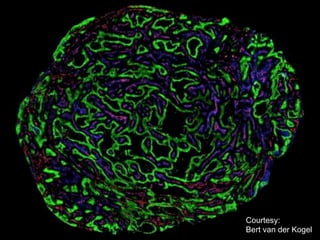
Courtesy:
Bert van der Kogel
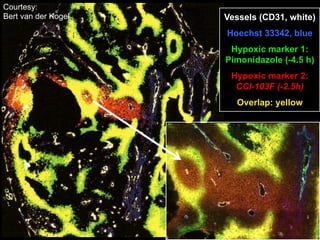
Courtesy:
Bert van der Kogel

Vessels (CD31, white)
Hoechst 33342, blue
Hypoxic marker 1:
Pimonidazole (-4.5 h)
Hypoxic marker 2:
CCI-103F (-2.5h)
Overlap: yellow
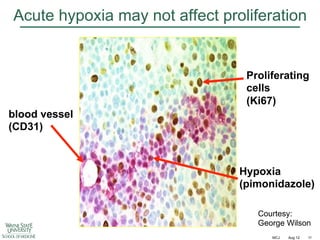
Acute hypoxia may not affect proliferation

Proliferating
cells
(Ki67)
blood vessel
(CD31)

Hypoxia
(pimonidazole)
Courtesy:
George Wilson
MCJ

Aug 12

11
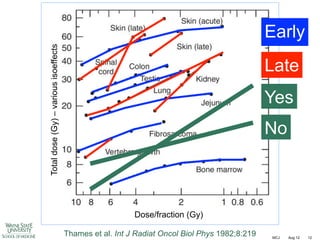
Total dose (Gy) – various isoeffects

Early
Late
Yes
No

Dose/fraction (Gy)
Thames et al. Int J Radiat Oncol Biol Phys 1982;8:219

MCJ

Aug 12

12
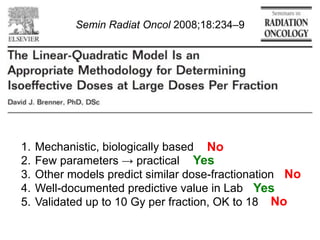
Semin Radiat Oncol 2008;18:234–9

1.  Mechanistic, biologically based No
2.  Few parameters ! practical Yes
3.  Other models predict similar dose-fractionation No
4.  Well-documented predictive value in Lab Yes
5.  Validated up to 10 Gy per fraction, OK to 18 No
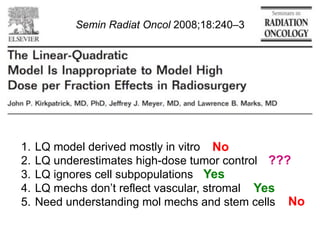
Semin Radiat Oncol 2008;18:240–3

1.  LQ model derived mostly in vitro No
2.  LQ underestimates high-dose tumor control ???
3.  LQ ignores cell subpopulations Yes
4.  LQ mechs don’t reflect vascular, stromal Yes
5.  Need understanding mol mechs and stem cells No
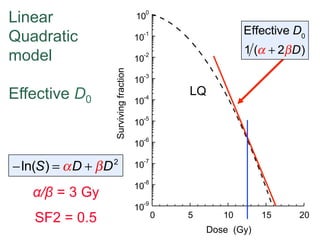
Linear
Quadratic
model

! ln(S) = " D + # D

!/" = 3 Gy

-1

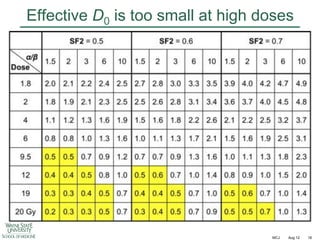
Effective D0

-2

1 (! + 2" D)

10
10

Surviving fraction

Effective D0

0

10

2

-3

10

LQ

-4

10

-5

10

-6

10

-7

10

-8

10

-9

SF2 = 0.5

10

0

5

10

Dose (Gy)

15

20
Effective D0 is too small at high doses

MCJ

Aug 12

16
-1

10

-2

10

Surviving fraction

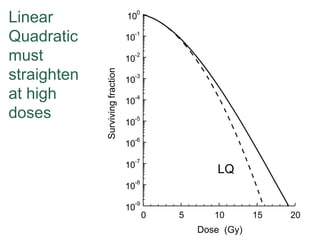
Linear
Quadratic
must
straighten
at high
doses

0

10

-3

10

-4

10

-5

10

-6

10

-7

10

LQ

-8

10

-9

10

0

5

10

Dose (Gy)

15

20
-1

10

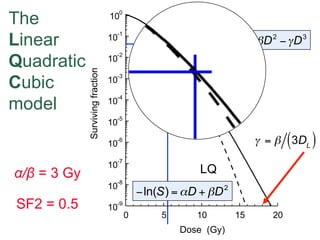
!ln(S) = "D + #D 2 ! $ D 3

-2

10

Surviving fraction

The
Linear
Quadratic
Cubic
model

0

10

LQC

-3

10

-4

10

-5

10

(

! = " 3DL

-6

10

-7

!/" = 3 Gy

10

LQ

-8

10

SF2 = 0.5

!ln(S) = "D + #D 2

-9

10

0

5

10

Dose (Gy)

15

20

)
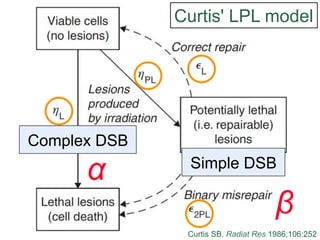
Curtis' LPL model

Complex DSB

!

Simple DSB

"
Curtis SB. Radiat Res 1986;106:252
Response heterogeneity
Alternative damage response pathways
and/or cell types which are dose dependent
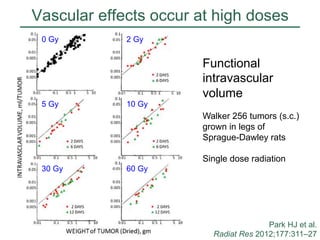
Vascular effects occur at high doses
0 Gy

5 Gy

2 Gy

10 Gy

Functional
intravascular
volume
Walker 256 tumors (s.c.)
grown in legs of
Sprague-Dawley rats
Single dose radiation

30 Gy

60 Gy

Park HJ et al.
Radiat Res 2012;177:311–27
MCJ
21
Aug 12
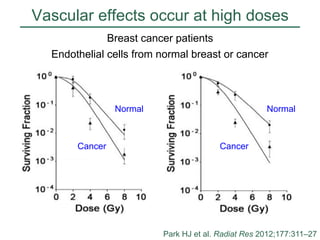
Vascular effects occur at high doses
Breast cancer patients
Endothelial cells from normal breast or cancer

Normal

Cancer

Normal

Cancer

Park HJ et al. Radiat Res 2012;177:311–27
MCJ
22
Aug 12
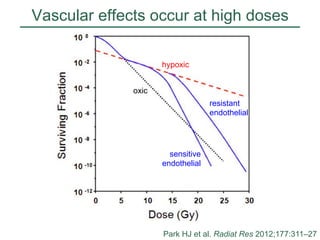
Vascular effects occur at high doses
hypoxic
oxic
resistant
endothelial

sensitive
endothelial

Park HJ et al. Radiat Res 2012;177:311–27
MCJ
23
Aug 12
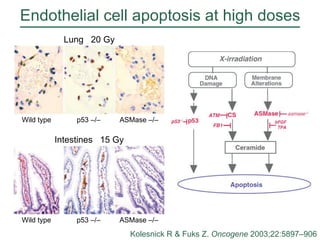
Endothelial cell apoptosis at high doses
Lung 20 Gy

Wild type

p53 –/–

ASMase –/–

Intestines 15 Gy

Wild type

p53 –/–

ASMase –/–

Kolesnick R & Fuks Z. Oncogene 2003;22:5897–906
MCJ
24
Aug 12
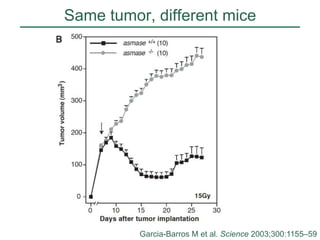
Same tumor, different mice

Garcia-Barros M et al. Science 2003;300:1155–59
MCJ
25
Aug 12
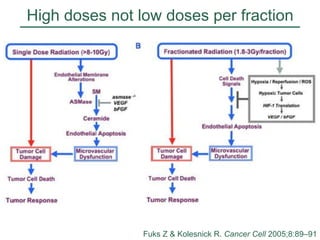
High doses not low doses per fraction

Fuks Z & Kolesnick R. Cancer Cell 2005;8:89–91
MCJ
26
Aug 12
Immunological effects at high doses
A549 Human NSCLC in lungs of nude mice
27 days after 12 Gy single dose
Hematoxylin-Eosin

Masson-Trichrome

IF

H

F
H
x20

Tumor

Small tumor nodules (arrows) with
degenerative changes in nuclei
and cytoplasm. Multiple large
vacuoles, hemorrhages [H] and
scattered inflammatory infiltrates

x40

Normal lung

Heavy infiltration of inflammatory
cells [IF] mostly lymphocytes and
neutrophils. Fibrous tissue [F] in
midst of inflammatory infiltrates

x40

C
Normal lung

Extensive fibrotic tissue [C] and
hemorrhages [H]

Hillman GG et al. Radiother Oncol 2011;101:329–36
MCJ

Aug 12

27
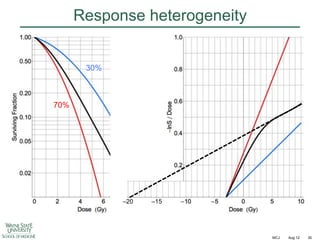
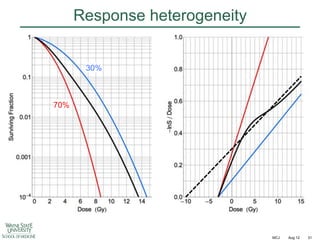
Response heterogeneity
Mixed target cell populations with different
sensitivites
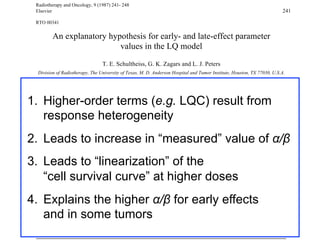
Radiotherapy and Oncology, 9 (1987) 241- 248
Elsevier

241

RTO 00341

An explanatory hypothesis for early- and late-effect parameter
values in the LQ model
T. E. Schultheiss, G. K. Zagars and L. J. Peters
Division of Radiotherapy, The University of Texas, M. D. Anderson Hospital and Tumor Institute, Houston, TX 77030, U.S.A.
(Received 3 November 1986, revision received 17 February 1987, accepted 17 February 1987)

1.  Higher-order terms (e.g. LQC) result from
response heterogeneity
Key words: Cell survival; lsoeffect: LQ model; Late effect

Summary
The isoeffect equation increase in “measured” value linear and
2.  Leads dose. derived from the linear-quadratic that higher-order cell survival containsof !/"
to Experimental studies have shown (LQ) model of terms may also be present. These
quadratic terms in
terms have been previously attributed to the fact that the LQ model may be the first two terms in a power
series approximation to a more complex model. This study shows that higher-order terms are introduced as
a result of heterogeneity in the response of the cell population being irradiated. This heterogeneity is modeled
by assuming that the parameters ! and " in the LQ model are distributed according to a bivariate normal
distribution. Using this distribution, the expected value of cell survival contains third- and fourth-order terms
in dose. These terms result in the previously observed downward curvature of Fe plots. Furthermore, these
higher-order terms introduce bias in the estimated values of ! and ", if only the linear and quadratic terms of
the LQ model are used, and higher-order terms are ignored. The bias is such that the estimated value of
! /" is substantially increased. Thus the higher values of ! /" observed for early effects as compared to late
effects may be due to greater heterogeneity of response in early-responding tissues than in later-responding
tissues. This differential effect is maintained even if the two cell populations have the same average values of
! and ".

3.  Leads to “linearization” of the
“cell survival curve” at higher doses

4.  Explains the higher !/" for early effects
and in some tumors
Response heterogeneity
30%

70%

–20

–15

MCJ

Aug 12

30
Response heterogeneity
30%

70%

MCJ

Aug 12

31
Put more of this heterogeneity modeling in?
A model is a lie
that helps you see the truth
- Howard Skipper

Thanks Patrick McDermott
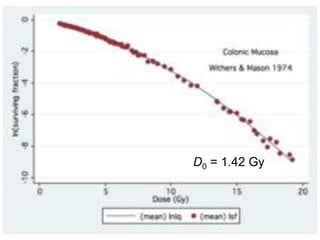
D0 = 1.42 Gy
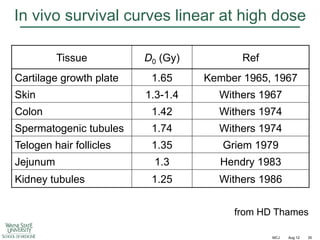
In vivo survival curves linear at high dose
Tissue

D0 (Gy)

Ref

1.65

Kember 1965, 1967

1.3-1.4

Withers 1967

Colon

1.42

Withers 1974

Spermatogenic tubules

1.74

Withers 1974

Telogen hair follicles

1.35

Griem 1979

Jejunum

1.3

Hendry 1983

Kidney tubules

1.25

Withers 1986

Cartilage growth plate
Skin

from HD Thames
MCJ

Aug 12

35
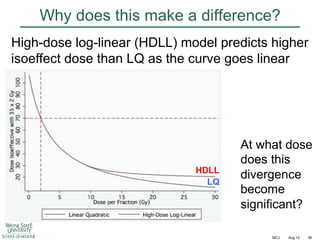
Why does this make a difference?
High-dose log-linear (HDLL) model predicts higher
isoeffect dose than LQ as the curve goes linear

HDLL
LQ

At what dose
does this
divergence
become
significant?
MCJ

Aug 12

36
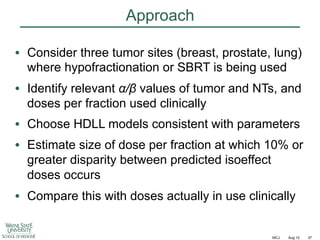
Approach
•  Consider three tumor sites (breast, prostate, lung)
where hypofractionation or SBRT is being used
•  Identify relevant !/" values of tumor and NTs, and
doses per fraction used clinically
•  Choose HDLL models consistent with parameters
•  Estimate size of dose per fraction at which 10% or
greater disparity between predicted isoeffect
doses occurs
•  Compare this with doses actually in use clinically

MCJ

Aug 12

37
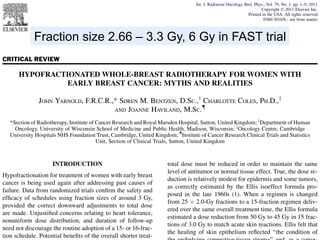
Fractionation in breast cancer

Mean = 4.0 [CL 1.0 – 7.8]
Int. J. Radiation Oncology Biol. Phys., Vol. 79, No. 1, pp. 1–9, 2011
Copyright Ó 2011 Elsevier Inc.
Printed in the USA. All rights reserved
0360-3016/$ - see front matter

doi:10.1016/j.ijrobp.2010.08.035

Fraction size 2.66 – 3.3 Gy, 6 Gy in FAST trial
CRITICAL REVIEW

HYPOFRACTIONATED WHOLE-BREAST RADIOTHERAPY FOR WOMEN WITH
EARLY BREAST CANCER: MYTHS AND REALITIES
JOHN YARNOLD, F.R.C.R.,* SØREN M. BENTZEN, D.SC.,y CHARLOTTE COLES, PH.D.,z
{
AND JOANNE HAVILAND, M.SC.
*Section of Radiotherapy, Institute of Cancer Research and Royal Marsden Hospital, Sutton, United Kingdom; yDepartment of Human
Oncology, University of Wisconsin School of Medicine and Public Health, Madison, Wisconsin; zOncology Centre, Cambridge
University Hospitals NHS Foundation Trust, Cambridge, United Kingdom; {Institute of Cancer Research Clinical Trials and Statistics
Unit, Section of Clinical Trials, Sutton, United Kingdom

INTRODUCTION
Hypofractionation for treatment of women with early breast
cancer is being used again after addressing past causes of
failure. Data from randomized trials confirm the safety and
efficacy of schedules using fraction sizes of around 3 Gy,
provided the correct downward adjustments to total dose
are made. Unjustified concerns relating to heart tolerance,
nonuniform dose distribution, and duration of follow-up
need not discourage the routine adoption of a 15- or 16-fraction schedule. Potential benefits of the overall shorter treat-

total dose must be reduced in order to maintain the same
level of antitumor or normal tissue effect. True, the dose reduction is relatively modest for epidermis and some tumors,
as correctly estimated by the Ellis isoeffect formula proposed in the late 1960s (1). When a regimen is changed
from 25 Â 2.0-Gy fractions to a 15-fraction regimen delivered over the same overall treatment time, the Ellis formula
estimated a dose reduction from 50 Gy to 45 Gy in 15 fractions of 3.0 Gy to match acute skin reactions. Ellis felt that
the healing of skin epithelium reflected ‘‘the condition of
Fractionation in prostate cancer
Int J Radiat Oncol Biol Phys
2011;79:195–201

Mean = 1.55 [CL 0.46 – 4.52]
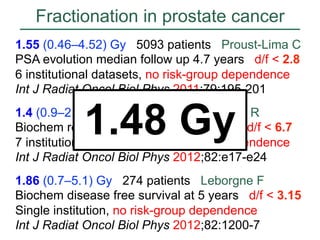
Fractionation in prostate cancer
1.55 (0.46–4.52) Gy 5093 patients Proust-Lima C
PSA evolution median follow up 4.7 years d/f < 2.8
6 institutional datasets, no risk-group dependence
Int J Radiat Oncol Biol Phys 2011;79:195-201

1.48 Gy

1.4 (0.9–2.2) Gy 5969 patients Miralbell R
Biochem relapse free survival at 5 years d/f < 6.7
7 institutional datasets, no risk-group dependence
Int J Radiat Oncol Biol Phys 2012;82:e17-e24
1.86 (0.7–5.1) Gy 274 patients Leborgne F
Biochem disease free survival at 5 years d/f < 3.15
Single institution, no risk-group dependence
Int J Radiat Oncol Biol Phys 2012;82:1200-7
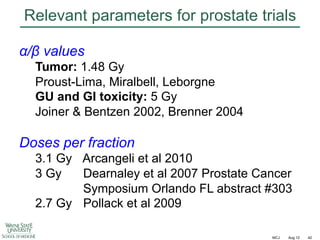
Relevant parameters for prostate trials
!/" values
Tumor: 1.48 Gy
Proust-Lima, Miralbell, Leborgne
GU and GI toxicity: 5 Gy
Joiner & Bentzen 2002, Brenner 2004

Doses per fraction
3.1 Gy Arcangeli et al 2010
3 Gy
Dearnaley et al 2007 Prostate Cancer
Symposium Orlando FL abstract #303
2.7 Gy Pollack et al 2009
MCJ

Aug 12

42
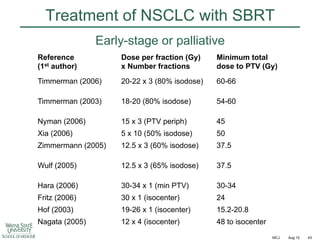
Treatment of NSCLC with SBRT
Early-stage or palliative
Reference
(1st author)

Dose per fraction (Gy)
x Number fractions

Minimum total
dose to PTV (Gy)

Timmerman (2006)

20-22 x 3 (80% isodose)

60-66

Timmerman (2003)

18-20 (80% isodose)

54-60

Nyman (2006)

15 x 3 (PTV periph)

45

Xia (2006)

5 x 10 (50% isodose)

50

Zimmermann (2005)

12.5 x 3 (60% isodose)

37.5

Wulf (2005)

12.5 x 3 (65% isodose)

37.5

Hara (2006)

30-34 x 1 (min PTV)

30-34

Fritz (2006)

30 x 1 (isocenter)

24

Hof (2003)

19-26 x 1 (isocenter)

15.2-20.8

Nagata (2005)

12 x 4 (isocenter)

48 to isocenter
MCJ

Aug 12

43
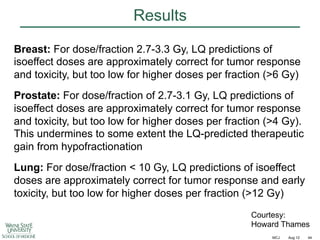
Results
Breast: For dose/fraction 2.7-3.3 Gy, LQ predictions of
isoeffect doses are approximately correct for tumor response
and toxicity, but too low for higher doses per fraction (>6 Gy)
Prostate: For dose/fraction of 2.7-3.1 Gy, LQ predictions of
isoeffect doses are approximately correct for tumor response
and toxicity, but too low for higher doses per fraction (>4 Gy).
This undermines to some extent the LQ-predicted therapeutic
gain from hypofractionation
Lung: For dose/fraction < 10 Gy, LQ predictions of isoeffect
doses are approximately correct for tumor response and early
toxicity, but too low for higher doses per fraction (>12 Gy)
Courtesy:
Howard Thames
MCJ

Aug 12

44
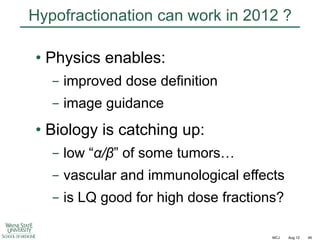
Hypofractionation can work in 2012 ?
•  Physics enables:
-  improved dose definition
-  image guidance

•  Biology is catching up:
-  low “!/"” of some tumors…
-  vascular and immunological effects
-  is LQ good for high dose fractions?
MCJ

Aug 12

45

2012-michael joiner-hypofractionation

  • 1.
    Does the tumourradiobiology help in the move toward hypofractionation? Michael Joiner Wayne State University Radiation Oncology Detroit, Michigan joinerm@wayne.edu
  • 2.
    Does the tumourradiobiology hinder in the move toward hypofractionation? Michael Joiner Wayne State University Radiation Oncology Detroit, Michigan joinerm@wayne.edu
  • 3.
    What radiobiology? Historically… •  Researchhas focused on doses per fraction of 1–3 Gy: clinically relevant •  Radiobiology is quite mature •  Little incentive/funding for high-dose research MCJ Aug 12 3
  • 4.
    Why reconsider highdose fractions? •  Because we can: Physics •  Patient convenience and demand •  Lower cost of whole treatment •  Evidence that it is very effective •  Evidence of low !/" in some sites The radiobiology has not yet caught up MCJ Aug 12 4
  • 5.
    Why not LQat high doses? •  Reponse is really linear at higher doses? •  Vascular damage? •  Increased apotosis? •  Immunological effects? •  Mixed tumor cell populations with different response characteristics? Answers likely depend on tissue type and tumor type / stage MCJ Aug 12 5
  • 6.
    Hypoxic cells intumors First demonstration: ~1.5% of the cells were hypoxic 0.015 Mouse lymphosarcoma irradiated in vivo (Powers and Tolmach, 1973) MCJ Aug 12 6
  • 7.
  • 8.
    Reoxygenation during fractionation 0 10 No-reoxygenation -1 10 -2 10 -3 Surviving Fraction 10 -4 10 -5 10 -6 10 -7 10 30 fractions -8 10 No Hypoxic Cells -9 10 -10 10 0 10 20 30 40 50 60 Total Dose (2Gy Fractions) MCJ Aug 12 8
  • 9.
  • 10.
    Courtesy: Bert van derKogel Vessels (CD31, white) Hoechst 33342, blue Hypoxic marker 1: Pimonidazole (-4.5 h) Hypoxic marker 2: CCI-103F (-2.5h) Overlap: yellow
  • 11.
    Acute hypoxia maynot affect proliferation Proliferating cells (Ki67) blood vessel (CD31) Hypoxia (pimonidazole) Courtesy: George Wilson MCJ Aug 12 11
  • 12.
    Total dose (Gy)– various isoeffects Early Late Yes No Dose/fraction (Gy) Thames et al. Int J Radiat Oncol Biol Phys 1982;8:219 MCJ Aug 12 12
  • 13.
    Semin Radiat Oncol2008;18:234–9 1.  Mechanistic, biologically based No 2.  Few parameters ! practical Yes 3.  Other models predict similar dose-fractionation No 4.  Well-documented predictive value in Lab Yes 5.  Validated up to 10 Gy per fraction, OK to 18 No
  • 14.
    Semin Radiat Oncol2008;18:240–3 1.  LQ model derived mostly in vitro No 2.  LQ underestimates high-dose tumor control ??? 3.  LQ ignores cell subpopulations Yes 4.  LQ mechs don’t reflect vascular, stromal Yes 5.  Need understanding mol mechs and stem cells No
  • 15.
    Linear Quadratic model ! ln(S) =" D + # D !/" = 3 Gy -1 Effective D0 -2 1 (! + 2" D) 10 10 Surviving fraction Effective D0 0 10 2 -3 10 LQ -4 10 -5 10 -6 10 -7 10 -8 10 -9 SF2 = 0.5 10 0 5 10 Dose (Gy) 15 20
  • 16.
    Effective D0 istoo small at high doses MCJ Aug 12 16
  • 17.
  • 18.
    -1 10 !ln(S) = "D+ #D 2 ! $ D 3 -2 10 Surviving fraction The Linear Quadratic Cubic model 0 10 LQC -3 10 -4 10 -5 10 ( ! = " 3DL -6 10 -7 !/" = 3 Gy 10 LQ -8 10 SF2 = 0.5 !ln(S) = "D + #D 2 -9 10 0 5 10 Dose (Gy) 15 20 )
  • 19.
    Curtis' LPL model ComplexDSB ! Simple DSB " Curtis SB. Radiat Res 1986;106:252
  • 20.
    Response heterogeneity Alternative damageresponse pathways and/or cell types which are dose dependent
  • 21.
    Vascular effects occurat high doses 0 Gy 5 Gy 2 Gy 10 Gy Functional intravascular volume Walker 256 tumors (s.c.) grown in legs of Sprague-Dawley rats Single dose radiation 30 Gy 60 Gy Park HJ et al. Radiat Res 2012;177:311–27 MCJ 21 Aug 12
  • 22.
    Vascular effects occurat high doses Breast cancer patients Endothelial cells from normal breast or cancer Normal Cancer Normal Cancer Park HJ et al. Radiat Res 2012;177:311–27 MCJ 22 Aug 12
  • 23.
    Vascular effects occurat high doses hypoxic oxic resistant endothelial sensitive endothelial Park HJ et al. Radiat Res 2012;177:311–27 MCJ 23 Aug 12
  • 24.
    Endothelial cell apoptosisat high doses Lung 20 Gy Wild type p53 –/– ASMase –/– Intestines 15 Gy Wild type p53 –/– ASMase –/– Kolesnick R & Fuks Z. Oncogene 2003;22:5897–906 MCJ 24 Aug 12
  • 25.
    Same tumor, differentmice Garcia-Barros M et al. Science 2003;300:1155–59 MCJ 25 Aug 12
  • 26.
    High doses notlow doses per fraction Fuks Z & Kolesnick R. Cancer Cell 2005;8:89–91 MCJ 26 Aug 12
  • 27.
    Immunological effects athigh doses A549 Human NSCLC in lungs of nude mice 27 days after 12 Gy single dose Hematoxylin-Eosin Masson-Trichrome IF H F H x20 Tumor Small tumor nodules (arrows) with degenerative changes in nuclei and cytoplasm. Multiple large vacuoles, hemorrhages [H] and scattered inflammatory infiltrates x40 Normal lung Heavy infiltration of inflammatory cells [IF] mostly lymphocytes and neutrophils. Fibrous tissue [F] in midst of inflammatory infiltrates x40 C Normal lung Extensive fibrotic tissue [C] and hemorrhages [H] Hillman GG et al. Radiother Oncol 2011;101:329–36 MCJ Aug 12 27
  • 28.
    Response heterogeneity Mixed targetcell populations with different sensitivites
  • 29.
    Radiotherapy and Oncology,9 (1987) 241- 248 Elsevier 241 RTO 00341 An explanatory hypothesis for early- and late-effect parameter values in the LQ model T. E. Schultheiss, G. K. Zagars and L. J. Peters Division of Radiotherapy, The University of Texas, M. D. Anderson Hospital and Tumor Institute, Houston, TX 77030, U.S.A. (Received 3 November 1986, revision received 17 February 1987, accepted 17 February 1987) 1.  Higher-order terms (e.g. LQC) result from response heterogeneity Key words: Cell survival; lsoeffect: LQ model; Late effect Summary The isoeffect equation increase in “measured” value linear and 2.  Leads dose. derived from the linear-quadratic that higher-order cell survival containsof !/" to Experimental studies have shown (LQ) model of terms may also be present. These quadratic terms in terms have been previously attributed to the fact that the LQ model may be the first two terms in a power series approximation to a more complex model. This study shows that higher-order terms are introduced as a result of heterogeneity in the response of the cell population being irradiated. This heterogeneity is modeled by assuming that the parameters ! and " in the LQ model are distributed according to a bivariate normal distribution. Using this distribution, the expected value of cell survival contains third- and fourth-order terms in dose. These terms result in the previously observed downward curvature of Fe plots. Furthermore, these higher-order terms introduce bias in the estimated values of ! and ", if only the linear and quadratic terms of the LQ model are used, and higher-order terms are ignored. The bias is such that the estimated value of ! /" is substantially increased. Thus the higher values of ! /" observed for early effects as compared to late effects may be due to greater heterogeneity of response in early-responding tissues than in later-responding tissues. This differential effect is maintained even if the two cell populations have the same average values of ! and ". 3.  Leads to “linearization” of the “cell survival curve” at higher doses 4.  Explains the higher !/" for early effects and in some tumors
  • 30.
  • 31.
  • 32.
    Put more ofthis heterogeneity modeling in?
  • 33.
    A model isa lie that helps you see the truth - Howard Skipper Thanks Patrick McDermott
  • 34.
  • 35.
    In vivo survivalcurves linear at high dose Tissue D0 (Gy) Ref 1.65 Kember 1965, 1967 1.3-1.4 Withers 1967 Colon 1.42 Withers 1974 Spermatogenic tubules 1.74 Withers 1974 Telogen hair follicles 1.35 Griem 1979 Jejunum 1.3 Hendry 1983 Kidney tubules 1.25 Withers 1986 Cartilage growth plate Skin from HD Thames MCJ Aug 12 35
  • 36.
    Why does thismake a difference? High-dose log-linear (HDLL) model predicts higher isoeffect dose than LQ as the curve goes linear HDLL LQ At what dose does this divergence become significant? MCJ Aug 12 36
  • 37.
    Approach •  Consider threetumor sites (breast, prostate, lung) where hypofractionation or SBRT is being used •  Identify relevant !/" values of tumor and NTs, and doses per fraction used clinically •  Choose HDLL models consistent with parameters •  Estimate size of dose per fraction at which 10% or greater disparity between predicted isoeffect doses occurs •  Compare this with doses actually in use clinically MCJ Aug 12 37
  • 38.
    Fractionation in breastcancer Mean = 4.0 [CL 1.0 – 7.8]
  • 39.
    Int. J. RadiationOncology Biol. Phys., Vol. 79, No. 1, pp. 1–9, 2011 Copyright Ó 2011 Elsevier Inc. Printed in the USA. All rights reserved 0360-3016/$ - see front matter doi:10.1016/j.ijrobp.2010.08.035 Fraction size 2.66 – 3.3 Gy, 6 Gy in FAST trial CRITICAL REVIEW HYPOFRACTIONATED WHOLE-BREAST RADIOTHERAPY FOR WOMEN WITH EARLY BREAST CANCER: MYTHS AND REALITIES JOHN YARNOLD, F.R.C.R.,* SØREN M. BENTZEN, D.SC.,y CHARLOTTE COLES, PH.D.,z { AND JOANNE HAVILAND, M.SC. *Section of Radiotherapy, Institute of Cancer Research and Royal Marsden Hospital, Sutton, United Kingdom; yDepartment of Human Oncology, University of Wisconsin School of Medicine and Public Health, Madison, Wisconsin; zOncology Centre, Cambridge University Hospitals NHS Foundation Trust, Cambridge, United Kingdom; {Institute of Cancer Research Clinical Trials and Statistics Unit, Section of Clinical Trials, Sutton, United Kingdom INTRODUCTION Hypofractionation for treatment of women with early breast cancer is being used again after addressing past causes of failure. Data from randomized trials confirm the safety and efficacy of schedules using fraction sizes of around 3 Gy, provided the correct downward adjustments to total dose are made. Unjustified concerns relating to heart tolerance, nonuniform dose distribution, and duration of follow-up need not discourage the routine adoption of a 15- or 16-fraction schedule. Potential benefits of the overall shorter treat- total dose must be reduced in order to maintain the same level of antitumor or normal tissue effect. True, the dose reduction is relatively modest for epidermis and some tumors, as correctly estimated by the Ellis isoeffect formula proposed in the late 1960s (1). When a regimen is changed from 25 Â 2.0-Gy fractions to a 15-fraction regimen delivered over the same overall treatment time, the Ellis formula estimated a dose reduction from 50 Gy to 45 Gy in 15 fractions of 3.0 Gy to match acute skin reactions. Ellis felt that the healing of skin epithelium reflected ‘‘the condition of
  • 40.
    Fractionation in prostatecancer Int J Radiat Oncol Biol Phys 2011;79:195–201 Mean = 1.55 [CL 0.46 – 4.52]
  • 41.
    Fractionation in prostatecancer 1.55 (0.46–4.52) Gy 5093 patients Proust-Lima C PSA evolution median follow up 4.7 years d/f < 2.8 6 institutional datasets, no risk-group dependence Int J Radiat Oncol Biol Phys 2011;79:195-201 1.48 Gy 1.4 (0.9–2.2) Gy 5969 patients Miralbell R Biochem relapse free survival at 5 years d/f < 6.7 7 institutional datasets, no risk-group dependence Int J Radiat Oncol Biol Phys 2012;82:e17-e24 1.86 (0.7–5.1) Gy 274 patients Leborgne F Biochem disease free survival at 5 years d/f < 3.15 Single institution, no risk-group dependence Int J Radiat Oncol Biol Phys 2012;82:1200-7
  • 42.
    Relevant parameters forprostate trials !/" values Tumor: 1.48 Gy Proust-Lima, Miralbell, Leborgne GU and GI toxicity: 5 Gy Joiner & Bentzen 2002, Brenner 2004 Doses per fraction 3.1 Gy Arcangeli et al 2010 3 Gy Dearnaley et al 2007 Prostate Cancer Symposium Orlando FL abstract #303 2.7 Gy Pollack et al 2009 MCJ Aug 12 42
  • 43.
    Treatment of NSCLCwith SBRT Early-stage or palliative Reference (1st author) Dose per fraction (Gy) x Number fractions Minimum total dose to PTV (Gy) Timmerman (2006) 20-22 x 3 (80% isodose) 60-66 Timmerman (2003) 18-20 (80% isodose) 54-60 Nyman (2006) 15 x 3 (PTV periph) 45 Xia (2006) 5 x 10 (50% isodose) 50 Zimmermann (2005) 12.5 x 3 (60% isodose) 37.5 Wulf (2005) 12.5 x 3 (65% isodose) 37.5 Hara (2006) 30-34 x 1 (min PTV) 30-34 Fritz (2006) 30 x 1 (isocenter) 24 Hof (2003) 19-26 x 1 (isocenter) 15.2-20.8 Nagata (2005) 12 x 4 (isocenter) 48 to isocenter MCJ Aug 12 43
  • 44.
    Results Breast: For dose/fraction2.7-3.3 Gy, LQ predictions of isoeffect doses are approximately correct for tumor response and toxicity, but too low for higher doses per fraction (>6 Gy) Prostate: For dose/fraction of 2.7-3.1 Gy, LQ predictions of isoeffect doses are approximately correct for tumor response and toxicity, but too low for higher doses per fraction (>4 Gy). This undermines to some extent the LQ-predicted therapeutic gain from hypofractionation Lung: For dose/fraction < 10 Gy, LQ predictions of isoeffect doses are approximately correct for tumor response and early toxicity, but too low for higher doses per fraction (>12 Gy) Courtesy: Howard Thames MCJ Aug 12 44
  • 45.
    Hypofractionation can workin 2012 ? •  Physics enables: -  improved dose definition -  image guidance •  Biology is catching up: -  low “!/"” of some tumors… -  vascular and immunological effects -  is LQ good for high dose fractions? MCJ Aug 12 45