Motion Management in Lung
Cancer Radiotherapy
Dr Jyotirup Goswami
Consultant Radiation Oncologist
Westbank Cancer Centre
Westbank Health & Wellness Institute
Why?
• Enables more accurate and less toxic
treatment
• Relevant for both early stage (stereotactic
body radiotherapy) and locally advanced
unresectable lung cancers
PROBLEMS WITH STANDARD
APPROACHES
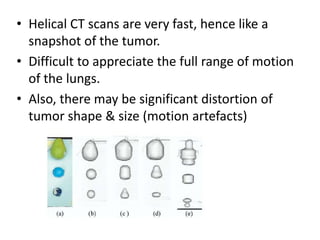
• Helical CT scans are very fast, hence like a
snapshot of the tumor.
• Difficult to appreciate the full range of motion
of the lungs.
• Also, there may be significant distortion of
tumor shape & size (motion artefacts)
TECHNIQUES OF MOTION
MANAGEMENT IN LUNG CANCER
METHODS OF ASSESSING LUNG TUMOR MOTION
DURING RESPIRATION
• Four dimensional computerised tomography
(4DCT) / respiratory gated CT scans
• Slow CT scans
METHODS TO CONTROL / COMPENSATE FOR
LUNG MOTION DURING RESPIRATION
Free breathing methods:
• Internal Target Volume
(ITV)-based treatment
• Gating
• Tracking
Breath-hold methods:
• Active Breathing
Coordinator (ABC)
ITV-based treatment
Generates a composite target volume for lung
tumors, taking into account the different
shape, size and position of the tumor in each
phase of respiration
Can be done on any LA with MLCs or on
Tomotherapy , where there is no specialised
motion management technology available for
treatment delivery.
Gating
Treatment delivery is done in the phase of
respiration where the tumor motion &
resulting treatment volume is minimum, by
coupling the beam delivery with the phase of
respiration
Usually requires an internal fiducial,
implanted within the tumor.
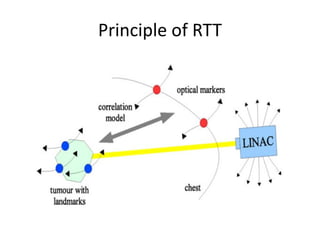
Tumor Tracking
Imaging is used to track the actual tumor motion
during treatment delivery and to move the
treatment beam accordingly based on the
varying position of the tumor.
Usually requires an internal fiducial, implanted
within the tumor.
Can also be done non-invasively in some cases.
Active Breathing Coordinator
The patient is coached to breath-hold in
inspiration, to eliminate lung motion &
treatment is delivered only in this state.
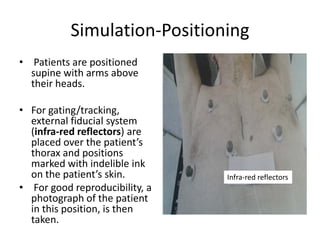
Simulation-Positioning
• Patients are positioned
supine with arms above
their heads.
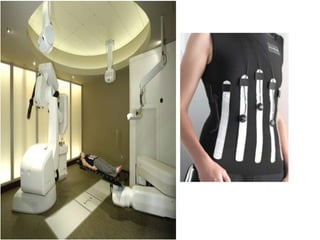
• For gating/tracking,
external fiducial system
(infra-red reflectors) are
placed over the patient’s
thorax and positions
marked with indelible ink
on the patient’s skin.
• For good reproducibility, a
photograph of the patient
in this position, is then
taken.
Infra-red reflectors
Simulation -Positioning
.
• For patients due for ITV-based treatment or
ABC, conventional CT simulation is done using
3 LASER markers, with radio-opaque fiducials
placed on the patient’s skin
Simulation-Imaging
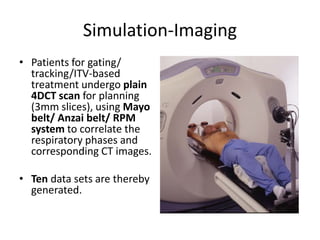
• Patients for gating/
tracking/ITV-based
treatment undergo plain
4DCT scan for planning
(3mm slices), using Mayo
belt/ Anzai belt/ RPM
system to correlate the
respiratory phases and
corresponding CT images.
• Ten data sets are thereby
generated.
• Patients for ABC need not undergo 4DCT scan.
• They can undergo an inhale breath-hold spiral
CT scan with/ without contrast.
Delineation: GTV & ITV
• GTV is contoured using lung windows. Mediastinal windows may be
suitable for defining tumours proximal to the chest wall.
• Where available, information from PET/CT should be incorporated into
delineating the GTV.
• For gating/tracking, tumor delineation is done on the end-expiratory data
set. This is because, in this phase, lung motion is minimum.
• For ITV-based treatment, tumor delineation is done on the end-
expiratory data set and extrapolated across the other data sets, to
generate the ITV.
Delineation: CTV & PTV
• No CTV margin is given for stereotactic body
radiotherapy for early inoperable lung cancers.
• For locally advanced disease, CTV margins
between 0.6-0.8 cm are usually applied.
• Setup margins of 0.5 cm are normally applied (to
the GTV/ CTV/ITV, as appropriate) to arrive at the
PTV
Treatment setup
• The patients are positioned accurately by
matching LASER fiducials OR Infra-red
markers, as for initial simulation.
• Where available, pre-treatment Cone
Beam/Fan Beam CT scans are taken &
matched with the planning CT scan, for
accurate patient positioning.
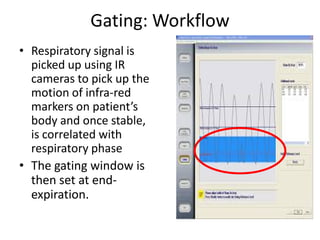
Gating: Workflow
• Respiratory signal is
picked up using IR
cameras to pick up the
motion of infra-red
markers on patient’s
body and once stable,
is correlated with
respiratory phase
• The gating window is
then set at end-
expiration.
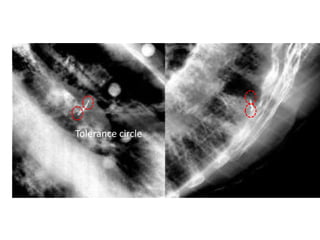
• Oblique image pairs are taken by ExacTrac
system’s stereoscopic X ray imagers.
• Internal fiducial ends are identified to the system
• The system builds a correlation model between
the end-positions and the respiratory phase
(accuracy of correlation 3mm).
• The treatment beam is then turned on and is
configured to treat ONLY in the gating window.
Tolerance circle
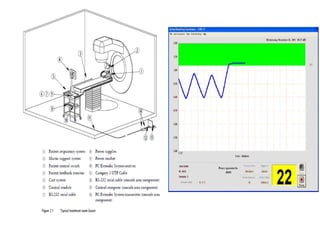
ABC: Principle
• The patient is able to produce an accurate breath-hold to a known
volume by observing their own respiratory information on a patient
display monitor from the imaging or treatment table.
• Patient coaching prior to imaging or therapy instructs the patient
on how to hold their breath at a predefined volume (threshold
volume) which is clearly shown on the patient display monitor.
• Accurate and reproducible timing of the breath-hold period is aided
by a patient controlled balloon valve that is directly connected to
the flow meter device.
• Image acquisition and beam delivery are only performed while the
patient is holding their breath to an identical lung volume.
Pros & Cons
• The amount of air that
remains in the lungs
immediately following a
normal unforced
exhalation (functional
residual capacity) is
very stable.
• Proper use of the
system requires that the
patient is undergoing
normal breathing
Real Time Tumor Tracking
• ExacTrac system (VERO)
• Cyberknife
Principle of RTT
Requisites of Correlation Model
• Accuracy
• Speed
• Imaging dose required should be minimum
Cyberknife: RTT Modes
Non-invasive:
Xsight lung
• Possible if:
• Tumour >1.5 cm,
surrounded by air
• Tumour visible by imaging
system
Invasive (with implanted
fiducial):
Synchrony
• 3-5 fiducial markers need
to be inserted in close
proximity to the lesion.
• They have to be well-
separated (>2cm) and
non overlapping on
projections from the in
room x-ray images
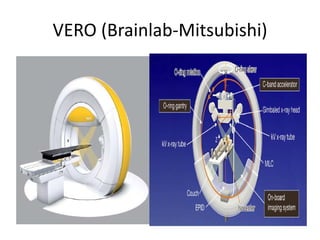
VERO (Brainlab-Mitsubishi)
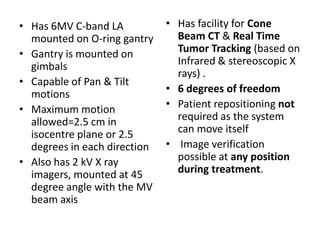
• Has 6MV C-band LA
mounted on O-ring gantry
• Gantry is mounted on
gimbals
• Capable of Pan & Tilt
motions
• Maximum motion
allowed=2.5 cm in
isocentre plane or 2.5
degrees in each direction
• Also has 2 kV X ray
imagers, mounted at 45
degree angle with the MV
beam axis
• Has facility for Cone
Beam CT & Real Time
Tumor Tracking (based on
Infrared & stereoscopic X
rays) .
• 6 degrees of freedom
• Patient repositioning not
required as the system
can move itself
• Image verification
possible at any position
during treatment.

Motion Management in Lung Cancer Radiotherapy

  • 1.
    Motion Management inLung Cancer Radiotherapy Dr Jyotirup Goswami Consultant Radiation Oncologist Westbank Cancer Centre Westbank Health & Wellness Institute
  • 2.
    Why? • Enables moreaccurate and less toxic treatment • Relevant for both early stage (stereotactic body radiotherapy) and locally advanced unresectable lung cancers
  • 3.
  • 4.
    • Helical CTscans are very fast, hence like a snapshot of the tumor. • Difficult to appreciate the full range of motion of the lungs. • Also, there may be significant distortion of tumor shape & size (motion artefacts)
  • 5.
  • 6.
    METHODS OF ASSESSINGLUNG TUMOR MOTION DURING RESPIRATION • Four dimensional computerised tomography (4DCT) / respiratory gated CT scans • Slow CT scans
  • 7.
    METHODS TO CONTROL/ COMPENSATE FOR LUNG MOTION DURING RESPIRATION Free breathing methods: • Internal Target Volume (ITV)-based treatment • Gating • Tracking Breath-hold methods: • Active Breathing Coordinator (ABC)
  • 8.
    ITV-based treatment Generates acomposite target volume for lung tumors, taking into account the different shape, size and position of the tumor in each phase of respiration Can be done on any LA with MLCs or on Tomotherapy , where there is no specialised motion management technology available for treatment delivery.
  • 9.
    Gating Treatment delivery isdone in the phase of respiration where the tumor motion & resulting treatment volume is minimum, by coupling the beam delivery with the phase of respiration Usually requires an internal fiducial, implanted within the tumor.
  • 10.
    Tumor Tracking Imaging isused to track the actual tumor motion during treatment delivery and to move the treatment beam accordingly based on the varying position of the tumor. Usually requires an internal fiducial, implanted within the tumor. Can also be done non-invasively in some cases.
  • 11.
    Active Breathing Coordinator Thepatient is coached to breath-hold in inspiration, to eliminate lung motion & treatment is delivered only in this state.
  • 12.
    Simulation-Positioning • Patients arepositioned supine with arms above their heads. • For gating/tracking, external fiducial system (infra-red reflectors) are placed over the patient’s thorax and positions marked with indelible ink on the patient’s skin. • For good reproducibility, a photograph of the patient in this position, is then taken. Infra-red reflectors
  • 13.
    Simulation -Positioning . • Forpatients due for ITV-based treatment or ABC, conventional CT simulation is done using 3 LASER markers, with radio-opaque fiducials placed on the patient’s skin
  • 14.
    Simulation-Imaging • Patients forgating/ tracking/ITV-based treatment undergo plain 4DCT scan for planning (3mm slices), using Mayo belt/ Anzai belt/ RPM system to correlate the respiratory phases and corresponding CT images. • Ten data sets are thereby generated.
  • 15.
    • Patients forABC need not undergo 4DCT scan. • They can undergo an inhale breath-hold spiral CT scan with/ without contrast.
  • 16.
    Delineation: GTV &ITV • GTV is contoured using lung windows. Mediastinal windows may be suitable for defining tumours proximal to the chest wall. • Where available, information from PET/CT should be incorporated into delineating the GTV. • For gating/tracking, tumor delineation is done on the end-expiratory data set. This is because, in this phase, lung motion is minimum. • For ITV-based treatment, tumor delineation is done on the end- expiratory data set and extrapolated across the other data sets, to generate the ITV.
  • 17.
    Delineation: CTV &PTV • No CTV margin is given for stereotactic body radiotherapy for early inoperable lung cancers. • For locally advanced disease, CTV margins between 0.6-0.8 cm are usually applied. • Setup margins of 0.5 cm are normally applied (to the GTV/ CTV/ITV, as appropriate) to arrive at the PTV
  • 18.
    Treatment setup • Thepatients are positioned accurately by matching LASER fiducials OR Infra-red markers, as for initial simulation. • Where available, pre-treatment Cone Beam/Fan Beam CT scans are taken & matched with the planning CT scan, for accurate patient positioning.
  • 19.
    Gating: Workflow • Respiratorysignal is picked up using IR cameras to pick up the motion of infra-red markers on patient’s body and once stable, is correlated with respiratory phase • The gating window is then set at end- expiration.
  • 20.
    • Oblique imagepairs are taken by ExacTrac system’s stereoscopic X ray imagers. • Internal fiducial ends are identified to the system • The system builds a correlation model between the end-positions and the respiratory phase (accuracy of correlation 3mm). • The treatment beam is then turned on and is configured to treat ONLY in the gating window.
  • 21.
  • 22.
    ABC: Principle • Thepatient is able to produce an accurate breath-hold to a known volume by observing their own respiratory information on a patient display monitor from the imaging or treatment table. • Patient coaching prior to imaging or therapy instructs the patient on how to hold their breath at a predefined volume (threshold volume) which is clearly shown on the patient display monitor. • Accurate and reproducible timing of the breath-hold period is aided by a patient controlled balloon valve that is directly connected to the flow meter device. • Image acquisition and beam delivery are only performed while the patient is holding their breath to an identical lung volume.
  • 24.
    Pros & Cons •The amount of air that remains in the lungs immediately following a normal unforced exhalation (functional residual capacity) is very stable. • Proper use of the system requires that the patient is undergoing normal breathing
  • 25.
    Real Time TumorTracking • ExacTrac system (VERO) • Cyberknife
  • 26.
  • 27.
    Requisites of CorrelationModel • Accuracy • Speed • Imaging dose required should be minimum
  • 28.
    Cyberknife: RTT Modes Non-invasive: Xsightlung • Possible if: • Tumour >1.5 cm, surrounded by air • Tumour visible by imaging system Invasive (with implanted fiducial): Synchrony • 3-5 fiducial markers need to be inserted in close proximity to the lesion. • They have to be well- separated (>2cm) and non overlapping on projections from the in room x-ray images
  • 30.
  • 31.
    • Has 6MVC-band LA mounted on O-ring gantry • Gantry is mounted on gimbals • Capable of Pan & Tilt motions • Maximum motion allowed=2.5 cm in isocentre plane or 2.5 degrees in each direction • Also has 2 kV X ray imagers, mounted at 45 degree angle with the MV beam axis • Has facility for Cone Beam CT & Real Time Tumor Tracking (based on Infrared & stereoscopic X rays) . • 6 degrees of freedom • Patient repositioning not required as the system can move itself • Image verification possible at any position during treatment.