Image Guided Radiation Therapy (IGRT)
Teekendra Singh Faujdar
Sr. Radiation Therapist
Medanta The Medicity, Gurgaon
Introduction
• Radiotherapy has always required inputs from imaging for treatment
planning as well as execution, when the treatment target is not
located on the surface and inspection and visual confirmation are not
feasible.
• Traditional radiotherapy practices incorporate use of anatomic
surface landmarks as well as radiologic correlation with two-
dimensional imaging in the form of port films or fluoroscopic imaging.
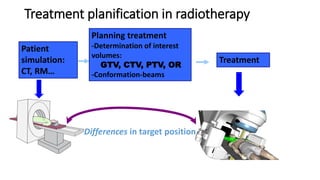
Treatment planification in radiotherapy
Patient
simulation:
CT, RM…
Treatment
Differences in target position
Planning treatment
-Determination of interest
volumes:
GTV, CTV, PTV, OR
-Conformation-beams
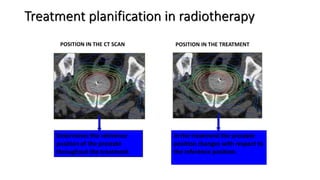
Treatment planification in radiotherapy
POSITION IN THE CT SCAN POSITION IN THE TREATMENT
In the treatment the prostate
position changes with respect to
the reference position.
Determines the reference
position of the prostate
throughout the treatment.
Why may the target be elsewhere?
• Mispositioning (interfraction)
• Organ motion (intrafraction)
• Shape change (interfraction)
May result in absorbed dose in the volumes
of interest and organs at risk that do not
correspond to the theoretical dose planned.
Sources of
uncertainties
Image Guided Radiotherapy
• How can we know the position of the target?
• What is IGRT
• Image-based RT (use of imaging to define the target and normal tissues for
treatment planning) - such as contrast enhanced computed tomography (CECT) scans, magnetic
resonance imaging (MRI), positron emission tomography (PET) scans, and angiography obtain three-
dimensional (3D) structural and biologic information
• Image-guided RT (use of imaging to monitor and modify treatment) -such as
planar, volumetric, video, or ultrasound-based imaging methods, in which obtaining periodic information
on target position and movement (within the same session or between consecutive sessions) by
comparing it with reference imaging, and give feedback to correct the patient setup and optimize target
localization.
IGRT
BroadDefinition– 6D’sofIGRT
• Detection anddiagnosis
• Determining biologicalattributes
• Delineation of target and organs atrisk
• Dose distributiondesign
• Dose deliveryassurance
• Deciphering treatment responsethrough imaging
Errors and Margins in Radiotherapy:
• An error in radiotherapy delivery is defined as any deviation from intended or
planned treatment.
 Mechanical Uncertainties - related to treatment unit parameters such as couch and gantry motion
 Geometrical Uncertainties - related to position and motion of target
 Dosimatric Uncertainties – related to Quality Assurance
• IGRT deals with the geometric uncertainties, which may be either intrafractional
or interfractional.
• M. van Herk, “Errors andmargins in radiotherapy,” Seminars in Radiation Oncology, vol. 14, no. 1, pp. 52–64, 2004.
• C. Rasch, R. Steenbakkers, andM. vanHerk, “Target definition in prostate, head, and neck,” Seminars in Radiation Oncology, vol. 15, no. 3, pp. 136–145, 2005.
Errors and Margins in Radiotherapy:
• Both inter- and intra-fractional uncertainties may be a result of a combination of systematic
and random errors.
A systematic error, is essentially a treatment preparation error and is introduced into the chain during the process
of positioning, simulation, or target delineation. This error, if uncorrected, would affect all treatment fractions
uniformly.
A random error, is a treatment execution error, is unpredictable, and varies with each fraction.
Systematic errors shift the entire dose distribution away from the CTV, while random errors blur this distribution
around the CTV.
Margins are added to the CTV to take these errors into account.
• These margins are geometric expansions around the CTV and may be non-uniform in all dimensions depending on
the expected errors. These margins ensure that dosimetric planning goals are met despite the variations during
and between fractions.
• ICRU 62 defines the expansion of PTV around the CTV as a composite of two factors—internal target motion
(internal margin) and setup variations (setup margin). Depending on observed systematic and random errors in a
given setup for a particular treatment site, a variety of recipes for calculating PTV margins exist in literature.
• J. C. Stroom and B. J. M. Heijmen, “Geometrical uncertainties, radiotherapy planning margins, and the ICRU-62 report,” Radiotherapy and Oncology, vol. 64, no. 1, pp. 75–83, 2002.
• M. van Herk, P. Remeijer, C. Rasch, and J. V. Lebesque, “The probability of correct target dosage: dose-population histograms for deriving treatment margins in radiotherapy,” International
Journal of Radiation Oncology, Biology, Physics, vol. 47, no. 4, pp. 1121–1135, 2000.
• J. C. Stroom, H. C. J. de Boer, H. Huizenga, and A. G. Visser, “Inclusion of geometrical uncertainties in radiotherapy treatment planning by means of coverage probability,” International Journal
of Radiation Oncology Biology Physics, vol. 43, no. 4, pp. 905–919, 1999.
IGRT Technology Solutions
• Depending on the imaging methods used, the IGRT systems may broadly be divided into two groups:
• J. M. Balter and Y. Cao, “Advanced technologies in image guided radiation therapy,” Seminars in Radiation Oncology, vol. 17, no. 4, pp. 293–297, 2007
• J. de los Santos, R. Popple, N. Agazaryan et al., “Image guided radiation therapy (IGRT) technologies for radiation therapy localization and delivery,”
IJROBP, vol. 87, no. 1, pp. 33–45, 2013.
Non-Radiation Based Systems Radiation Based Systems
• Ultrasound based systems
• Camera-based systems
• Electromagnetic tracking,
• MRI based systems
• Electronic Portal Imaging Devices (EPID)
• Cone Beam CT (CBCT) – KV or MV
• Fan Beam KV CT (CT-on-Rails)
• Fan Beam MV CT (TomoTherapy)
• Exac-Trac X-Ray 6-D Stereotactic IGRT System
• Hybrid Systems for Real Time 4D Tracking
 2D KV Stereoscopic Imaging (Cyber-Knife)
 Real Time Tumor-Tracking (RTRT) System.
 VERO system
Non-Radiation Based IGRT Systems
Ultrasound Based Systems:
• Vendors:
•BAT
•SonArray
•Crarity
•I-Beam
• These systems acquire 3D images that help align
targets to correct for inter-fractional errors.
• Geometric accuracy is 3–5mm and the greatest
advantage is lack of any ionizing radiation.
• Sites of common application include prostate,
lung, and breast radiotherapy.
• M. Fuss, B. J. Salter, S. X. Cavanaugh et al., “Daily ultrasound-based image-guided targeting for radiotherapy of upper abdominal malignancies,”
International Journal of Radiation Oncology Biology Physics vol. 59, no. 4, pp. 1245–1256, 2004.
Camera-Based (Infrared) or Optical Tracking Systems
• Vendor - VisionRT (AlignRT)
• These systems identify the patient reference setup point
positions in comparison to their location in the planning
CT coordinate system, which aids in computing the
treatment couch translation to align the treatment
isocenter with plan isocenter.
• Optical tracking may also be used for intra-fraction
position monitoring for either gating (treatment delivery
only at a certain position of target) or repositioning for
correction.
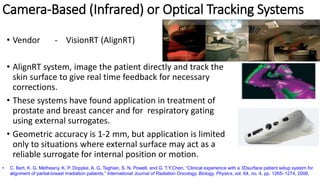
Camera-Based (Infrared) or Optical Tracking Systems
• Vendor - VisionRT (AlignRT)
• AlignRT system, image the patient directly and track the
skin surface to give real time feedback for necessary
corrections.
• These systems have found application in treatment of
prostate and breast cancer and for respiratory gating
using external surrogates.
• Geometric accuracy is 1-2 mm, but application is limited
only to situations where external surface may act as a
reliable surrogate for internal position or motion.
• C. Bert, K. G. Metheany, K. P. Doppke, A. G. Taghian, S. N. Powell, and G. T.Y.Chen, “Clinical experience with a 3Dsurface patient setup system for
alignment of partial-breast irradiation patients,” International Journal of Radiation Oncology, Biology, Physics, vol. 64, no. 4, pp. 1265–1274, 2006.
Electromagnetic Tracking Systems
• Vendor - CALYPSO
Five elements of the calypso system:
• Beacon Electromagnetic transponder
• 4D Console
• 4D Electromagnetic Array
• 4D Tracking Station
• Optical System
Electromagnetic Tracking Systems
• Vendor - CALYPSO
• This system make use of electromagnetic
transponders (beacons) embedded within the
tumor, and motion of these beacons may be
tracked in real time using a detector array
system.
• Beacons need to be placed through a minimally
invasive procedure, their presence may introduce
artifacts in MR images, and there are limitations
to the patient size.
• Calypso has a geometric accuracy of <2 mm.
• D.W.Litzenberg, T. R.Willoughby, J.M. Balter et al., “Positional stability of electromagnetic transponders used for prostate localization and continuous, real-time tracking,”
International Journal of Radiation Oncology Biology Physics, vol. 68, no. 4, pp. 1199–1206, 2007.
• T. R.Willoughby, P. A. Kupelian, J. Pouliot et al., “Target localization and real-time tracking using theCalypso 4D localization system in patients with localized prostate
cancer,” International Journal of Radiation Oncology Biology Physics, vol. 65, no. 2, pp. 528–534, 2006.
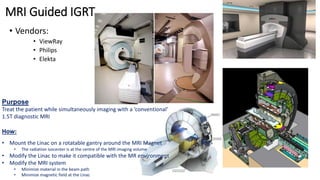
MRI Guided IGRT
• Vendors:
• ViewRay
• Philips
• Elekta
Purpose
Treat the patient while simultaneously imaging with a ‘conventional’
1.5T diagnostic MRI
How:
• Mount the Linac on a rotatable gantry around the MRI Magnet
• The radiation isocenter is at the centre of the MRI imaging volume
• Modify the Linac to make it compatible with the MR environment
• Modify the MRI system
• Minimize material in the beam path
• Minimize magnetic field at the Linac
• These systems help real time assessment of internal
soft tissue anatomy and motion using continual soft
tissue imaging and allow for intrafractional corrections.
• Geometric accuracy of the system is 1-2 mm. However,
MRI has certain drawbacks such as motion artifacts,
distortion with non-uniform magnetic fields, and
cannot be performed for patients with pacemakers or
metallic implants.
• All these limitations of diagnostic MRI apply to this IGRT
system as well. A wide application potential exists in
treatment of prostate, liver, and brain, as well as for
brachytherapy.
MRI Guided IGRT
• J. Dempsey, B. Dionne, J. Fitzsimmons, A. Haghigat, and J. Li, “A real-time MRI guided external beam
radiotherapy delivery system,” Medical Physics, vol. 33, article 2254, 2006.
• B. G. Fallone, B. Murray, S. Rathee et al., “First MR images obtained during megavoltage photon irradiation
from a prototype integrated linac-MR system,” Medical Physics, vol. 36, no. 6, pp. 2084–2088, 2009.
• These include static as well as real time tracking, using either kilovoltage (KV),
megavoltage (MV), or hybrid methods.
Radiation Based IGRT Systems
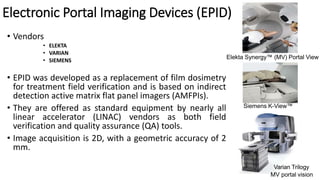
Electronic Portal Imaging Devices (EPID)
• Vendors
• ELEKTA
• VARIAN
• SIEMENS
• EPID was developed as a replacement of film dosimetry
for treatment field verification and is based on indirect
detection active matrix flat panel imagers (AMFPIs).
• They are offered as standard equipment by nearly all
linear accelerator (LINAC) vendors as both field
verification and quality assurance (QA) tools.
• Image acquisition is 2D, with a geometric accuracy of 2
mm.
Varian Trilogy
MV portal vision
Elekta Synergy™ (MV) Portal View
Siemens K-View™
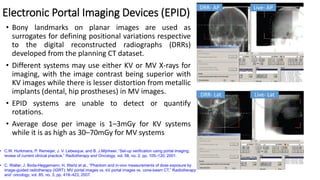
Electronic Portal Imaging Devices (EPID)
• Bony landmarks on planar images are used as
surrogates for defining positional variations respective
to the digital reconstructed radiographs (DRRs)
developed from the planning CT dataset.
• Different systems may use either KV or MV X-rays for
imaging, with the image contrast being superior with
KV images while there is lesser distortion from metallic
implants (dental, hip prostheses) in MV images.
• EPID systems are unable to detect or quantify
rotations.
• Average dose per image is 1–3mGy for KV systems
while it is as high as 30–70mGy for MV systems
DRR- AP Live- AP
DRR- Lat Live- Lat
• C.W. Hurkmans, P. Remeijer, J. V. Lebesque, and B. J.Mijnheer, “Set-up verification using portal imaging;
review of current clinical practice,” Radiotherapy and Oncology, vol. 58, no. 2, pp. 105–120, 2001.
• C. Walter, J. Boda-Heggemann, H. Wertz et al., “Phantom and in-vivo measurements of dose exposure by
image-guided radiotherapy (IGRT): MV portal images vs. kV portal images vs. cone-beam CT,” Radiotherapy
and oncology, vol. 85, no. 3, pp. 418–423, 2007.
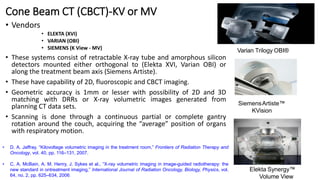
Cone Beam CT (CBCT)-KV or MV
• Vendors
• ELEKTA (XVI)
• VARIAN (OBI)
• SIEMENS (K View - MV)
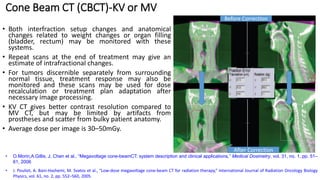
• These systems consist of retractable X-ray tube and amorphous silicon
detectors mounted either orthogonal to (Elekta XVI, Varian OBI) or
along the treatment beam axis (Siemens Artiste).
• These have capability of 2D, fluoroscopic and CBCT imaging.
• Geometric accuracy is 1mm or lesser with possibility of 2D and 3D
matching with DRRs or X-ray volumetric images generated from
planning CT data sets.
• Scanning is done through a continuous partial or complete gantry
rotation around the couch, acquiring the “average” position of organs
with respiratory motion.
Varian Trilogy OBI®
Elekta Synergy™
Volume View
SiemensArtiste™
KVision
• D. A. Jaffray, “Kilovoltage volumetric imaging in the treatment room,” Frontiers of Radiation Therapy and
Oncology, vol. 40, pp. 116–131, 2007.
• C. A. McBain, A. M. Henry, J. Sykes et al., “X-ray volumetric imaging in image-guided radiotherapy: the
new standard in ontreatment imaging,” International Journal of Radiation Oncology, Biology, Physics, vol.
64, no. 2, pp. 625–634, 2006.
Cone Beam CT (CBCT)-KV or MV
• Both interfraction setup changes and anatomical
changes related to weight changes or organ filling
(bladder, rectum) may be monitored with these
systems.
• Repeat scans at the end of treatment may give an
estimate of intrafractional changes.
• For tumors discernible separately from surrounding
normal tissue, treatment response may also be
monitored and these scans may be used for dose
recalculation or treatment plan adaptation after
necessary image processing.
• KV CT gives better contrast resolution compared to
MV CT, but may be limited by artifacts from
prostheses and scatter from bulky patient anatomy.
• Average dose per image is 30–50mGy.
Before Correction
After Correction
• O.Morin,A.Gillis, J. Chen et al., “Megavoltage cone-beamCT: system description and clinical applications,” Medical Dosimetry, vol. 31, no. 1, pp. 51–
61, 2006
• J. Pouliot, A. Bani-Hashemi, M. Svatos et al., “Low-dose megavoltage cone-beam CT for radiation therapy,” International Journal of Radiation Oncology Biology
Physics, vol. 61, no. 2, pp. 552–560, 2005.
Fan Beam KVCT (CT on Rail)
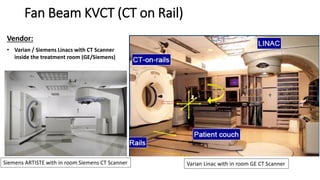
Vendor:
• Varian / Siemens Linacs with CT Scanner
inside the treatment room (GE/Siemens)
Varian Linac with in room GE CT ScannerSiemens ARTISTE with in room Siemens CT Scanner
Fan Beam KVCT (CT on Rail)
• This system has an in-room CT scanner and gantry that moves across the
treatment couch/patient, which can be rotated towards either the scanner or
the gantry for imaging and treatment, respectively.
• 3D images are taken with the patient immobilized on the couch, the difference
from a diagnostic CT being a larger bore size (>80 cm diameter) to
accommodate bulky immobilization devices, and a multi-slice detector.
• Accuracy and applications are similar to CBCT with average dose of 10–50mGy
per image
• R. de Crevoisier, D. Kuban, and D. Lefkopoulos, “Image-guided radiotherapy by in-room CT-linear accelerator
combination,” Cancer/Radiotherapie, vol. 10, no. 5, pp. 245–251, 2006.
Fan Beam MV CT
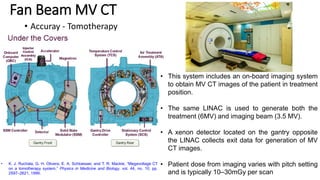
• Accuray - Tomotherapy
• This system includes an on-board imaging system
to obtain MV CT images of the patient in treatment
position.
• The same LINAC is used to generate both the
treatment (6MV) and imaging beam (3.5 MV).
• A xenon detector located on the gantry opposite
the LINAC collects exit data for generation of MV
CT images.
• Patient dose from imaging varies with pitch setting
and is typically 10–30mGy per scan
• K. J. Ruchala, G. H. Olivera, E. A. Schloesser, and T. R. Mackie, “Megavoltage CT
on a tomotherapy system,” Physics in Medicine and Biology, vol. 44, no. 10, pp.
2597–2621, 1999.
Hybrid Systems for Real Time 4D Tracking
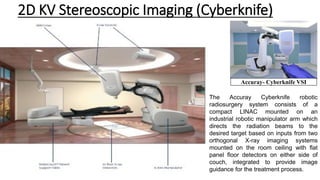
2D KV Stereoscopic Imaging (Cyberknife)
Accuray- Cyberknife VSI
The Accuray Cyberknife robotic
radiosurgery system consists of a
compact LINAC mounted on an
industrial robotic manipulator arm which
directs the radiation beams to the
desired target based on inputs from two
orthogonal X-ray imaging systems
mounted on the room ceiling with flat
panel floor detectors on either side of
couch, integrated to provide image
guidance for the treatment process.
• Images are acquired throughout the treatment duration at periodic intervals ranging
from 5 to 90 seconds, and the couch and robotic head movements are guided through
an automatic process.
• Several tracking methods may be used depending upon the treatment site:
• 6D Skull
• X-Sight Spine
• X-Sight Lung
• Fiducial Synchrony Tracking
• In-Tempo Tracking
• The system also has a couch that has 6 degrees of freedom to correct for positional
variations.
• Treatment may be limited by patient position and size, and posterior treatment beams
cannot be used.
• A semi-invasive procedure may be required if Fiducial markers are needed for tracking.
• This system can be employed for both cranial (frameless) and extra-cranial radiosurgery
or SRT.
2D KV Stereoscopic Imaging (Cyberknife)
• J. R. Adler Jr., S. D. Chang, M. J. Murphy, J. Doty, P. Geis, and S. L.Hancock, “The Cyberknife: a frameless robotic system for radiosurgery,” Stereotactic
and Functional Neurosurgery, vol. 69, no. 1–4, pp. 124–128, 1997.
• C. Antypas and E. Pantelis, “Performance evaluation of a CyberKnife G4 image-guided robotic stereotactic radiosurgery system,” Physics in Medicine and
Biology, vol. 53, no. 17, pp. 4697–4718, 2008.
Real Time Tumor-Tracking (RTRT) System
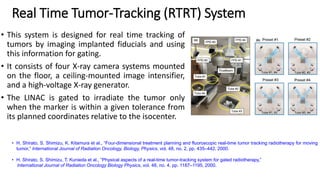
• This system is designed for real time tracking of
tumors by imaging implanted fiducials and using
this information for gating.
• It consists of four X-ray camera systems mounted
on the floor, a ceiling-mounted image intensifier,
and a high-voltage X-ray generator.
• The LINAC is gated to irradiate the tumor only
when the marker is within a given tolerance from
its planned coordinates relative to the isocenter.
• H. Shirato, S. Shimizu, K. Kitamura et al., “Four-dimensional treatment planning and fluoroscopic real-time tumor tracking radiotherapy for moving
tumor,” International Journal of Radiation Oncology, Biology, Physics, vol. 48, no. 2, pp. 435–442, 2000.
• H. Shirato, S. Shimizu, T. Kunieda et al., “Physical aspects of a real-time tumor-tracking system for gated radiotherapy,”
International Journal of Radiation Oncology Biology Physics, vol. 48, no. 4, pp. 1187–1195, 2000.
VERO System
• This system has two X-ray tubes and corresponding
flat panel detectors and uses a combination of initial
couch motion and a pair of radiographs for patient
alignment.
• The couch is capable of 3D alignment for initial
coarse setup and then the on-board imaging
subsystem helps fine-tuning.
• A pair of radiographs is acquired and registered with
prior DRRs using bony landmarks to evaluate the
translational and rotational shifts.
• The system can also compensate for organ motion Vero 4DRT System
• Y. Kamino, K. Takayama, M. Kokubo et al., “Development of a four-dimensional image-guided radiotherapy system with a gimbaled X-ray head,”
International Journal of Radiation Oncology, Biology, Physics, vol. 66, no. 1, pp. 271–278, 2006.
ExacTrac X-Ray 6-D Stereotactic IGRT System
• It uses a combination of optical positioning and KV radiographic imaging
for online positioning corrections.
• There are two main subsystems: an infrared-based system for initial
patient setup and precise control of couch movement using a robotic
couch and a radiographic KV X-ray imaging system for position
verification and readjustment based on internal anatomy or implanted
markers.
• Infrared system may also be used for respiratory monitoring and
signaling to LINAC for beam tracking and gating.
• Novalis Tx combines this system with an additional on-board imaging
system (MV, KV Xrays, and KVCBCT) on a multi-photon/electron beam
LINAC.
• Z. Chang, Z. Wang, Q. J. Wu et al., “Dosimetric characteristics of Novalis Tx
system with high definition multileaf collimator,” Medical Physics, vol. 35, no.
10, pp. 4460–4463, 2008.
• [38] J.-Y. Jin, F.-F. Yin, S. E. Tenn, P. M. Medin, and T. D. Solberg, “Use of the
BrainLAB ExacTrac X-Ray 6D System in Image- Guided Radiotherapy,”
Medical Dosimetry, vol. 33, no. 2, pp. 124–134, 2008.
As well as the imaging dose to the patient
Imaging Protocol on the basis of Treatment Technique:
• Daily XVI: For SBRT (Stereo tactic Body Radiation Therapy), VMAT (Volumetric
Modulated Arc Therapy) and IGRT (Image Guided Radiation Therapy) cases.
• Pre, Mid and Post XVI: For SRS/SRT (Stereo tactic Radiation Therapy) and SBRT cases.
• For SBRT (>8 Gy/#): Pre and post treatment XVI on day 1 and then daily XVI.
• Weekly XVI: For 3DCRT & IMRT cases (First 3 days daily then weekly XVI).
• Random XVI: Any time in cases of doubt in patient setup or in case of missing
reference marks.
• Note: On the basis of clinical requirements or site of the patient, Daily XVI or
Alternative day XVI can be acquired with the prior approval from duty consultant.
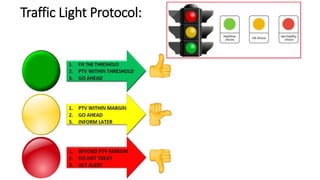
Traffic Light Protocol:
Summary:
• IGRT seeks to address geometric uncertainties in dose placement for target
and normal tissues.
• Use of the IGRT process has improved our awareness and understanding of
daily inter- and intra-fractional setup variations and motion.
• It has become a routine part of current RT practice worldwide.
• Safe application of IGRT technology requires additional training and careful
integration into the clinical process.
• IGRT reveals changes in anatomy during RT that challenge conventional
practices
• The experience and appropriate trainings of the team is likely more
important than the actual device/treatment technique used.
Thank You..!!
No matter how good is the beam, if the target is not where we thought”.

Image Guided Radiation Therapy (IGRT)

  • 1.
    Image Guided RadiationTherapy (IGRT) Teekendra Singh Faujdar Sr. Radiation Therapist Medanta The Medicity, Gurgaon
  • 2.
    Introduction • Radiotherapy hasalways required inputs from imaging for treatment planning as well as execution, when the treatment target is not located on the surface and inspection and visual confirmation are not feasible. • Traditional radiotherapy practices incorporate use of anatomic surface landmarks as well as radiologic correlation with two- dimensional imaging in the form of port films or fluoroscopic imaging.
  • 3.
    Treatment planification inradiotherapy Patient simulation: CT, RM… Treatment Differences in target position Planning treatment -Determination of interest volumes: GTV, CTV, PTV, OR -Conformation-beams
  • 4.
    Treatment planification inradiotherapy POSITION IN THE CT SCAN POSITION IN THE TREATMENT In the treatment the prostate position changes with respect to the reference position. Determines the reference position of the prostate throughout the treatment.
  • 5.
    Why may thetarget be elsewhere? • Mispositioning (interfraction) • Organ motion (intrafraction) • Shape change (interfraction) May result in absorbed dose in the volumes of interest and organs at risk that do not correspond to the theoretical dose planned. Sources of uncertainties
  • 6.
    Image Guided Radiotherapy •How can we know the position of the target? • What is IGRT • Image-based RT (use of imaging to define the target and normal tissues for treatment planning) - such as contrast enhanced computed tomography (CECT) scans, magnetic resonance imaging (MRI), positron emission tomography (PET) scans, and angiography obtain three- dimensional (3D) structural and biologic information • Image-guided RT (use of imaging to monitor and modify treatment) -such as planar, volumetric, video, or ultrasound-based imaging methods, in which obtaining periodic information on target position and movement (within the same session or between consecutive sessions) by comparing it with reference imaging, and give feedback to correct the patient setup and optimize target localization. IGRT
  • 7.
    BroadDefinition– 6D’sofIGRT • Detectionanddiagnosis • Determining biologicalattributes • Delineation of target and organs atrisk • Dose distributiondesign • Dose deliveryassurance • Deciphering treatment responsethrough imaging
  • 8.
    Errors and Marginsin Radiotherapy: • An error in radiotherapy delivery is defined as any deviation from intended or planned treatment.  Mechanical Uncertainties - related to treatment unit parameters such as couch and gantry motion  Geometrical Uncertainties - related to position and motion of target  Dosimatric Uncertainties – related to Quality Assurance • IGRT deals with the geometric uncertainties, which may be either intrafractional or interfractional. • M. van Herk, “Errors andmargins in radiotherapy,” Seminars in Radiation Oncology, vol. 14, no. 1, pp. 52–64, 2004. • C. Rasch, R. Steenbakkers, andM. vanHerk, “Target definition in prostate, head, and neck,” Seminars in Radiation Oncology, vol. 15, no. 3, pp. 136–145, 2005.
  • 9.
    Errors and Marginsin Radiotherapy: • Both inter- and intra-fractional uncertainties may be a result of a combination of systematic and random errors. A systematic error, is essentially a treatment preparation error and is introduced into the chain during the process of positioning, simulation, or target delineation. This error, if uncorrected, would affect all treatment fractions uniformly. A random error, is a treatment execution error, is unpredictable, and varies with each fraction. Systematic errors shift the entire dose distribution away from the CTV, while random errors blur this distribution around the CTV. Margins are added to the CTV to take these errors into account. • These margins are geometric expansions around the CTV and may be non-uniform in all dimensions depending on the expected errors. These margins ensure that dosimetric planning goals are met despite the variations during and between fractions. • ICRU 62 defines the expansion of PTV around the CTV as a composite of two factors—internal target motion (internal margin) and setup variations (setup margin). Depending on observed systematic and random errors in a given setup for a particular treatment site, a variety of recipes for calculating PTV margins exist in literature. • J. C. Stroom and B. J. M. Heijmen, “Geometrical uncertainties, radiotherapy planning margins, and the ICRU-62 report,” Radiotherapy and Oncology, vol. 64, no. 1, pp. 75–83, 2002. • M. van Herk, P. Remeijer, C. Rasch, and J. V. Lebesque, “The probability of correct target dosage: dose-population histograms for deriving treatment margins in radiotherapy,” International Journal of Radiation Oncology, Biology, Physics, vol. 47, no. 4, pp. 1121–1135, 2000. • J. C. Stroom, H. C. J. de Boer, H. Huizenga, and A. G. Visser, “Inclusion of geometrical uncertainties in radiotherapy treatment planning by means of coverage probability,” International Journal of Radiation Oncology Biology Physics, vol. 43, no. 4, pp. 905–919, 1999.
  • 10.
    IGRT Technology Solutions •Depending on the imaging methods used, the IGRT systems may broadly be divided into two groups: • J. M. Balter and Y. Cao, “Advanced technologies in image guided radiation therapy,” Seminars in Radiation Oncology, vol. 17, no. 4, pp. 293–297, 2007 • J. de los Santos, R. Popple, N. Agazaryan et al., “Image guided radiation therapy (IGRT) technologies for radiation therapy localization and delivery,” IJROBP, vol. 87, no. 1, pp. 33–45, 2013. Non-Radiation Based Systems Radiation Based Systems • Ultrasound based systems • Camera-based systems • Electromagnetic tracking, • MRI based systems • Electronic Portal Imaging Devices (EPID) • Cone Beam CT (CBCT) – KV or MV • Fan Beam KV CT (CT-on-Rails) • Fan Beam MV CT (TomoTherapy) • Exac-Trac X-Ray 6-D Stereotactic IGRT System • Hybrid Systems for Real Time 4D Tracking  2D KV Stereoscopic Imaging (Cyber-Knife)  Real Time Tumor-Tracking (RTRT) System.  VERO system
  • 11.
  • 12.
    Ultrasound Based Systems: •Vendors: •BAT •SonArray •Crarity •I-Beam • These systems acquire 3D images that help align targets to correct for inter-fractional errors. • Geometric accuracy is 3–5mm and the greatest advantage is lack of any ionizing radiation. • Sites of common application include prostate, lung, and breast radiotherapy. • M. Fuss, B. J. Salter, S. X. Cavanaugh et al., “Daily ultrasound-based image-guided targeting for radiotherapy of upper abdominal malignancies,” International Journal of Radiation Oncology Biology Physics vol. 59, no. 4, pp. 1245–1256, 2004.
  • 13.
    Camera-Based (Infrared) orOptical Tracking Systems • Vendor - VisionRT (AlignRT) • These systems identify the patient reference setup point positions in comparison to their location in the planning CT coordinate system, which aids in computing the treatment couch translation to align the treatment isocenter with plan isocenter. • Optical tracking may also be used for intra-fraction position monitoring for either gating (treatment delivery only at a certain position of target) or repositioning for correction.
  • 14.
    Camera-Based (Infrared) orOptical Tracking Systems • Vendor - VisionRT (AlignRT) • AlignRT system, image the patient directly and track the skin surface to give real time feedback for necessary corrections. • These systems have found application in treatment of prostate and breast cancer and for respiratory gating using external surrogates. • Geometric accuracy is 1-2 mm, but application is limited only to situations where external surface may act as a reliable surrogate for internal position or motion. • C. Bert, K. G. Metheany, K. P. Doppke, A. G. Taghian, S. N. Powell, and G. T.Y.Chen, “Clinical experience with a 3Dsurface patient setup system for alignment of partial-breast irradiation patients,” International Journal of Radiation Oncology, Biology, Physics, vol. 64, no. 4, pp. 1265–1274, 2006.
  • 15.
    Electromagnetic Tracking Systems •Vendor - CALYPSO Five elements of the calypso system: • Beacon Electromagnetic transponder • 4D Console • 4D Electromagnetic Array • 4D Tracking Station • Optical System
  • 16.
    Electromagnetic Tracking Systems •Vendor - CALYPSO • This system make use of electromagnetic transponders (beacons) embedded within the tumor, and motion of these beacons may be tracked in real time using a detector array system. • Beacons need to be placed through a minimally invasive procedure, their presence may introduce artifacts in MR images, and there are limitations to the patient size. • Calypso has a geometric accuracy of <2 mm. • D.W.Litzenberg, T. R.Willoughby, J.M. Balter et al., “Positional stability of electromagnetic transponders used for prostate localization and continuous, real-time tracking,” International Journal of Radiation Oncology Biology Physics, vol. 68, no. 4, pp. 1199–1206, 2007. • T. R.Willoughby, P. A. Kupelian, J. Pouliot et al., “Target localization and real-time tracking using theCalypso 4D localization system in patients with localized prostate cancer,” International Journal of Radiation Oncology Biology Physics, vol. 65, no. 2, pp. 528–534, 2006.
  • 17.
    MRI Guided IGRT •Vendors: • ViewRay • Philips • Elekta Purpose Treat the patient while simultaneously imaging with a ‘conventional’ 1.5T diagnostic MRI How: • Mount the Linac on a rotatable gantry around the MRI Magnet • The radiation isocenter is at the centre of the MRI imaging volume • Modify the Linac to make it compatible with the MR environment • Modify the MRI system • Minimize material in the beam path • Minimize magnetic field at the Linac
  • 18.
    • These systemshelp real time assessment of internal soft tissue anatomy and motion using continual soft tissue imaging and allow for intrafractional corrections. • Geometric accuracy of the system is 1-2 mm. However, MRI has certain drawbacks such as motion artifacts, distortion with non-uniform magnetic fields, and cannot be performed for patients with pacemakers or metallic implants. • All these limitations of diagnostic MRI apply to this IGRT system as well. A wide application potential exists in treatment of prostate, liver, and brain, as well as for brachytherapy. MRI Guided IGRT • J. Dempsey, B. Dionne, J. Fitzsimmons, A. Haghigat, and J. Li, “A real-time MRI guided external beam radiotherapy delivery system,” Medical Physics, vol. 33, article 2254, 2006. • B. G. Fallone, B. Murray, S. Rathee et al., “First MR images obtained during megavoltage photon irradiation from a prototype integrated linac-MR system,” Medical Physics, vol. 36, no. 6, pp. 2084–2088, 2009.
  • 19.
    • These includestatic as well as real time tracking, using either kilovoltage (KV), megavoltage (MV), or hybrid methods. Radiation Based IGRT Systems
  • 20.
    Electronic Portal ImagingDevices (EPID) • Vendors • ELEKTA • VARIAN • SIEMENS • EPID was developed as a replacement of film dosimetry for treatment field verification and is based on indirect detection active matrix flat panel imagers (AMFPIs). • They are offered as standard equipment by nearly all linear accelerator (LINAC) vendors as both field verification and quality assurance (QA) tools. • Image acquisition is 2D, with a geometric accuracy of 2 mm. Varian Trilogy MV portal vision Elekta Synergy™ (MV) Portal View Siemens K-View™
  • 21.
    Electronic Portal ImagingDevices (EPID) • Bony landmarks on planar images are used as surrogates for defining positional variations respective to the digital reconstructed radiographs (DRRs) developed from the planning CT dataset. • Different systems may use either KV or MV X-rays for imaging, with the image contrast being superior with KV images while there is lesser distortion from metallic implants (dental, hip prostheses) in MV images. • EPID systems are unable to detect or quantify rotations. • Average dose per image is 1–3mGy for KV systems while it is as high as 30–70mGy for MV systems DRR- AP Live- AP DRR- Lat Live- Lat • C.W. Hurkmans, P. Remeijer, J. V. Lebesque, and B. J.Mijnheer, “Set-up verification using portal imaging; review of current clinical practice,” Radiotherapy and Oncology, vol. 58, no. 2, pp. 105–120, 2001. • C. Walter, J. Boda-Heggemann, H. Wertz et al., “Phantom and in-vivo measurements of dose exposure by image-guided radiotherapy (IGRT): MV portal images vs. kV portal images vs. cone-beam CT,” Radiotherapy and oncology, vol. 85, no. 3, pp. 418–423, 2007.
  • 22.
    Cone Beam CT(CBCT)-KV or MV • Vendors • ELEKTA (XVI) • VARIAN (OBI) • SIEMENS (K View - MV) • These systems consist of retractable X-ray tube and amorphous silicon detectors mounted either orthogonal to (Elekta XVI, Varian OBI) or along the treatment beam axis (Siemens Artiste). • These have capability of 2D, fluoroscopic and CBCT imaging. • Geometric accuracy is 1mm or lesser with possibility of 2D and 3D matching with DRRs or X-ray volumetric images generated from planning CT data sets. • Scanning is done through a continuous partial or complete gantry rotation around the couch, acquiring the “average” position of organs with respiratory motion. Varian Trilogy OBI® Elekta Synergy™ Volume View SiemensArtiste™ KVision • D. A. Jaffray, “Kilovoltage volumetric imaging in the treatment room,” Frontiers of Radiation Therapy and Oncology, vol. 40, pp. 116–131, 2007. • C. A. McBain, A. M. Henry, J. Sykes et al., “X-ray volumetric imaging in image-guided radiotherapy: the new standard in ontreatment imaging,” International Journal of Radiation Oncology, Biology, Physics, vol. 64, no. 2, pp. 625–634, 2006.
  • 23.
    Cone Beam CT(CBCT)-KV or MV • Both interfraction setup changes and anatomical changes related to weight changes or organ filling (bladder, rectum) may be monitored with these systems. • Repeat scans at the end of treatment may give an estimate of intrafractional changes. • For tumors discernible separately from surrounding normal tissue, treatment response may also be monitored and these scans may be used for dose recalculation or treatment plan adaptation after necessary image processing. • KV CT gives better contrast resolution compared to MV CT, but may be limited by artifacts from prostheses and scatter from bulky patient anatomy. • Average dose per image is 30–50mGy. Before Correction After Correction • O.Morin,A.Gillis, J. Chen et al., “Megavoltage cone-beamCT: system description and clinical applications,” Medical Dosimetry, vol. 31, no. 1, pp. 51– 61, 2006 • J. Pouliot, A. Bani-Hashemi, M. Svatos et al., “Low-dose megavoltage cone-beam CT for radiation therapy,” International Journal of Radiation Oncology Biology Physics, vol. 61, no. 2, pp. 552–560, 2005.
  • 24.
    Fan Beam KVCT(CT on Rail) Vendor: • Varian / Siemens Linacs with CT Scanner inside the treatment room (GE/Siemens) Varian Linac with in room GE CT ScannerSiemens ARTISTE with in room Siemens CT Scanner
  • 25.
    Fan Beam KVCT(CT on Rail) • This system has an in-room CT scanner and gantry that moves across the treatment couch/patient, which can be rotated towards either the scanner or the gantry for imaging and treatment, respectively. • 3D images are taken with the patient immobilized on the couch, the difference from a diagnostic CT being a larger bore size (>80 cm diameter) to accommodate bulky immobilization devices, and a multi-slice detector. • Accuracy and applications are similar to CBCT with average dose of 10–50mGy per image • R. de Crevoisier, D. Kuban, and D. Lefkopoulos, “Image-guided radiotherapy by in-room CT-linear accelerator combination,” Cancer/Radiotherapie, vol. 10, no. 5, pp. 245–251, 2006.
  • 26.
    Fan Beam MVCT • Accuray - Tomotherapy • This system includes an on-board imaging system to obtain MV CT images of the patient in treatment position. • The same LINAC is used to generate both the treatment (6MV) and imaging beam (3.5 MV). • A xenon detector located on the gantry opposite the LINAC collects exit data for generation of MV CT images. • Patient dose from imaging varies with pitch setting and is typically 10–30mGy per scan • K. J. Ruchala, G. H. Olivera, E. A. Schloesser, and T. R. Mackie, “Megavoltage CT on a tomotherapy system,” Physics in Medicine and Biology, vol. 44, no. 10, pp. 2597–2621, 1999.
  • 27.
    Hybrid Systems forReal Time 4D Tracking
  • 28.
    2D KV StereoscopicImaging (Cyberknife) Accuray- Cyberknife VSI The Accuray Cyberknife robotic radiosurgery system consists of a compact LINAC mounted on an industrial robotic manipulator arm which directs the radiation beams to the desired target based on inputs from two orthogonal X-ray imaging systems mounted on the room ceiling with flat panel floor detectors on either side of couch, integrated to provide image guidance for the treatment process.
  • 29.
    • Images areacquired throughout the treatment duration at periodic intervals ranging from 5 to 90 seconds, and the couch and robotic head movements are guided through an automatic process. • Several tracking methods may be used depending upon the treatment site: • 6D Skull • X-Sight Spine • X-Sight Lung • Fiducial Synchrony Tracking • In-Tempo Tracking • The system also has a couch that has 6 degrees of freedom to correct for positional variations. • Treatment may be limited by patient position and size, and posterior treatment beams cannot be used. • A semi-invasive procedure may be required if Fiducial markers are needed for tracking. • This system can be employed for both cranial (frameless) and extra-cranial radiosurgery or SRT. 2D KV Stereoscopic Imaging (Cyberknife) • J. R. Adler Jr., S. D. Chang, M. J. Murphy, J. Doty, P. Geis, and S. L.Hancock, “The Cyberknife: a frameless robotic system for radiosurgery,” Stereotactic and Functional Neurosurgery, vol. 69, no. 1–4, pp. 124–128, 1997. • C. Antypas and E. Pantelis, “Performance evaluation of a CyberKnife G4 image-guided robotic stereotactic radiosurgery system,” Physics in Medicine and Biology, vol. 53, no. 17, pp. 4697–4718, 2008.
  • 30.
    Real Time Tumor-Tracking(RTRT) System • This system is designed for real time tracking of tumors by imaging implanted fiducials and using this information for gating. • It consists of four X-ray camera systems mounted on the floor, a ceiling-mounted image intensifier, and a high-voltage X-ray generator. • The LINAC is gated to irradiate the tumor only when the marker is within a given tolerance from its planned coordinates relative to the isocenter. • H. Shirato, S. Shimizu, K. Kitamura et al., “Four-dimensional treatment planning and fluoroscopic real-time tumor tracking radiotherapy for moving tumor,” International Journal of Radiation Oncology, Biology, Physics, vol. 48, no. 2, pp. 435–442, 2000. • H. Shirato, S. Shimizu, T. Kunieda et al., “Physical aspects of a real-time tumor-tracking system for gated radiotherapy,” International Journal of Radiation Oncology Biology Physics, vol. 48, no. 4, pp. 1187–1195, 2000.
  • 31.
    VERO System • Thissystem has two X-ray tubes and corresponding flat panel detectors and uses a combination of initial couch motion and a pair of radiographs for patient alignment. • The couch is capable of 3D alignment for initial coarse setup and then the on-board imaging subsystem helps fine-tuning. • A pair of radiographs is acquired and registered with prior DRRs using bony landmarks to evaluate the translational and rotational shifts. • The system can also compensate for organ motion Vero 4DRT System • Y. Kamino, K. Takayama, M. Kokubo et al., “Development of a four-dimensional image-guided radiotherapy system with a gimbaled X-ray head,” International Journal of Radiation Oncology, Biology, Physics, vol. 66, no. 1, pp. 271–278, 2006.
  • 32.
    ExacTrac X-Ray 6-DStereotactic IGRT System • It uses a combination of optical positioning and KV radiographic imaging for online positioning corrections. • There are two main subsystems: an infrared-based system for initial patient setup and precise control of couch movement using a robotic couch and a radiographic KV X-ray imaging system for position verification and readjustment based on internal anatomy or implanted markers. • Infrared system may also be used for respiratory monitoring and signaling to LINAC for beam tracking and gating. • Novalis Tx combines this system with an additional on-board imaging system (MV, KV Xrays, and KVCBCT) on a multi-photon/electron beam LINAC. • Z. Chang, Z. Wang, Q. J. Wu et al., “Dosimetric characteristics of Novalis Tx system with high definition multileaf collimator,” Medical Physics, vol. 35, no. 10, pp. 4460–4463, 2008. • [38] J.-Y. Jin, F.-F. Yin, S. E. Tenn, P. M. Medin, and T. D. Solberg, “Use of the BrainLAB ExacTrac X-Ray 6D System in Image- Guided Radiotherapy,” Medical Dosimetry, vol. 33, no. 2, pp. 124–134, 2008.
  • 33.
    As well asthe imaging dose to the patient
  • 34.
    Imaging Protocol onthe basis of Treatment Technique: • Daily XVI: For SBRT (Stereo tactic Body Radiation Therapy), VMAT (Volumetric Modulated Arc Therapy) and IGRT (Image Guided Radiation Therapy) cases. • Pre, Mid and Post XVI: For SRS/SRT (Stereo tactic Radiation Therapy) and SBRT cases. • For SBRT (>8 Gy/#): Pre and post treatment XVI on day 1 and then daily XVI. • Weekly XVI: For 3DCRT & IMRT cases (First 3 days daily then weekly XVI). • Random XVI: Any time in cases of doubt in patient setup or in case of missing reference marks. • Note: On the basis of clinical requirements or site of the patient, Daily XVI or Alternative day XVI can be acquired with the prior approval from duty consultant.
  • 35.
  • 36.
    Summary: • IGRT seeksto address geometric uncertainties in dose placement for target and normal tissues. • Use of the IGRT process has improved our awareness and understanding of daily inter- and intra-fractional setup variations and motion. • It has become a routine part of current RT practice worldwide. • Safe application of IGRT technology requires additional training and careful integration into the clinical process. • IGRT reveals changes in anatomy during RT that challenge conventional practices • The experience and appropriate trainings of the team is likely more important than the actual device/treatment technique used.
  • 37.
    Thank You..!! No matterhow good is the beam, if the target is not where we thought”.