3. VENTILATORY
SETTING
June 1, 2016 1
June 1, 2016 2
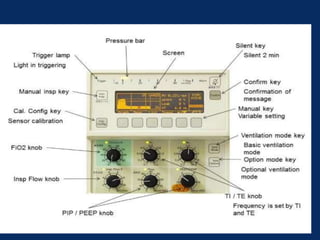
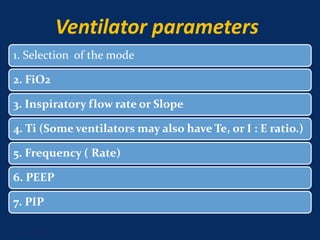
Ventilator parameters
1. Selection of the mode
2. FiO2
3. Inspiratory flow rate or Slope
4. Ti (Some ventilators may also have Te, or I : E ratio.)
5. Frequency ( Rate)
6. PEEP
7. PIP
June 1, 2016 3
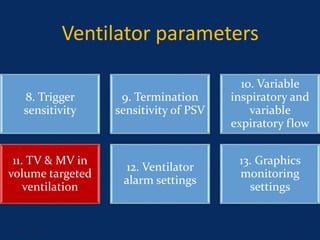
Ventilator parameters
8. Trigger
sensitivity
9. Termination
sensitivity of PSV
10. Variable
inspiratory and
variable
expiratory flow
11. TV & MV in
volume targeted
ventilation
12. Ventilator
alarm settings
13. Graphics
monitoring
settings
June 1, 2016 4
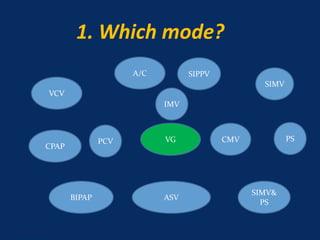
1. Which mode?
June 1, 2016 5
IMV
A/C SIPPV
SIMV
CPAP
PS
SIMV&
PS
CMVVG
BIPAP ASV
PCV
VCV
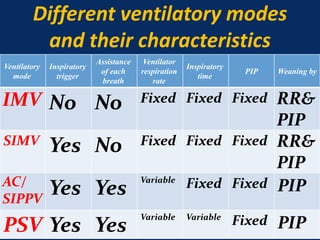
Different ventilatory modes
and their characteristics
Weaning byPIP
Inspiratory
time
Ventilator
respiration
rate
Assistance
of each
breath
Inspiratory
trigger
Ventilatory
mode
RR&
PIP
FixedFixedFixedNoNoIMV
RR&
PIP
FixedFixedFixedNoYesSIMV
PIPFixedFixedVariable
YesYesAC/
SIPPV
PIPFixedVariableVariable
YesYesPSV
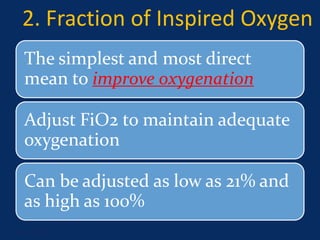
2. Fraction of Inspired Oxygen
The simplest and most direct
mean to improve oxygenation
Adjust FiO2 to maintain adequate
oxygenation
Can be adjusted as low as 21% and
as high as 100%
June 1, 2016 7
FIO2
 Oxygen is a drug used to:
Relieving hypoxemia
pulmonary vasodilator in cases of PPHTN
 Inadequate O2 administration will resultant to:
Hypoxemia and hypoxia
May result in severe neurologic injury
June 1, 2016 8
FIO2
 Excessive O2 administration has been
implicated as:
ROP
BPD
 Try to maintain:
PaO2 (60-80 mmHg)
Saturation (PT 90-95% & FT >
95%)
June 1, 2016 9
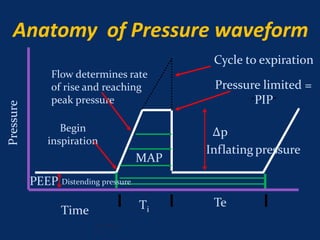
Anatomy of Pressure waveform
Hera NICU
2016
Ti
Te
Pressure
Begin
inspiration
Cycle to expiration
Time
Flow determines rate
of rise and reaching
peak pressure
Pressure limited =
“PIP”
PEEP
∆p
MAP
Inflating pressure
Distending pressure
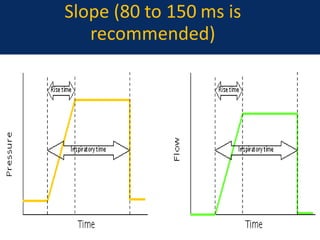
3. Flow Rate
Volume of gas passed / time unit (liter/minute)
Minimum flow of at least 3 times the baby’s minute
ventilation is usually required but in practice the operating
range can be much higher
Flow rate of 6-10 liter/minute are usually sufficient
Flow rate is an important determinant of the ability of the
ventilator to deliver desired levels of PIP, waveform, I : E
ratios, and in some cases, respiratory rate.
June 1, 2016 11
June 1, 2016 Hera NICU 12
Slope (80 to 150 ms is
recommended)
June 1, 2016 13
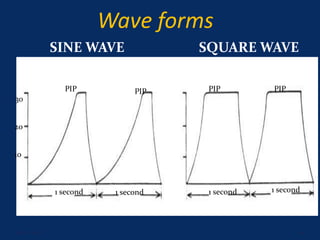
Wave forms
SINE WAVE SQUARE WAVE
June 1, 2016 14
PIPPIPPIP PIP
20
30
10
1 second 1 second 1 second 1 second
June 1, 2016 15
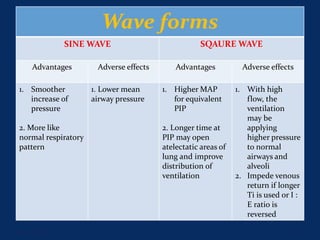
Wave forms
SQAURE WAVESINE WAVE
Adverse effectsAdvantagesAdverse effectsAdvantages
1. With high
flow, the
ventilation
may be
applying
higher pressure
to normal
airways and
alveoli
2. Impede venous
return if longer
Ti is used or I :
E ratio is
reversed
1. Higher MAP
for equivalent
PIP
2. Longer time at
PIP may open
atelectatic areas of
lung and improve
distribution of
ventilation
1. Lower mean
airway pressure
1. Smoother
increase of
pressure
2. More like
normal respiratory
pattern
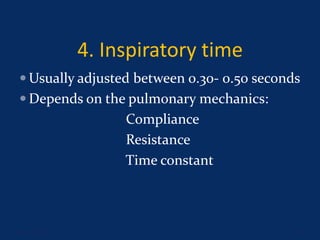
4. Inspiratory time
 Usually adjusted between 0.30- 0.50 seconds
 Depends on the pulmonary mechanics:
Compliance
Resistance
Time constant
June 1, 2016 16
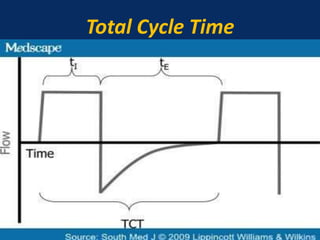
Total Cycle Time
June 1, 2016 17
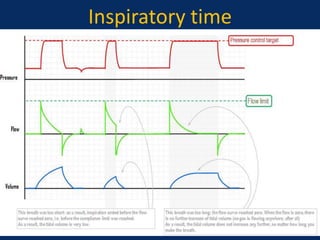
Inspiratory time
June 1, 2016 18
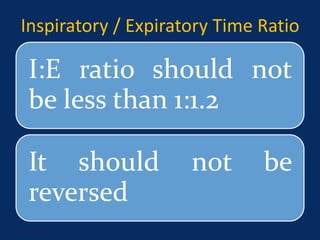
Inspiratory / Expiratory Time Ratio
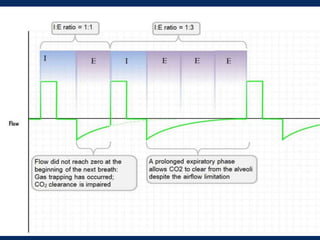
I:E ratio should not
be less than 1:1.2
It should not be
reversed
June 1, 2016 19
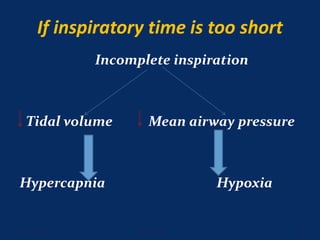
If inspiratory time is too short
Incomplete inspiration
Tidal volume Mean airway pressure
Hypercapnia Hypoxia
June 1, 2016 Hera NICU 20
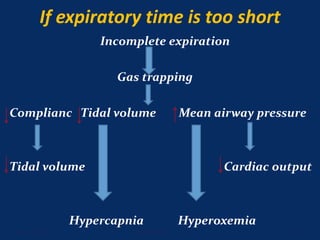
If expiratory time is too short
Incomplete expiration
Gas trapping
Complianc Tidal volume Mean airway pressure
Tidal volume Cardiac output
Hypercapnia Hyperoxemia
June 1, 2016 Hera NICU 21
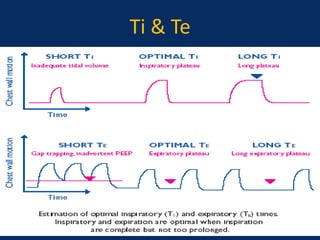
Ti & Te
June 1, 2016 22
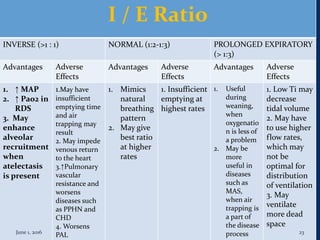
I / E Ratio
PROLONGED EXPIRATORY
(> 1:3)
NORMAL (1:2-1:3)INVERSE (>1 : 1)
Adverse
Effects
AdvantagesAdverse
Effects
AdvantagesAdverse
Effects
Advantages
1. Low Ti may
decrease
tidal volume
2. May have
to use higher
flow rates,
which may
not be
optimal for
distribution
of ventilation
3. May
ventilate
more dead
space
1. Useful
during
weaning,
when
oxygenatio
n is less of
a problem
2. May be
more
useful in
diseases
such as
MAS,
when air
trapping is
a part of
the disease
process
1. Insufficient
emptying at
highest rates
1. Mimics
natural
breathing
pattern
2. May give
best ratio
at higher
rates
1.May have
insufficient
emptying time
and air
trapping may
result
2. May impede
venous return
to the heart
3.↑Pulmonary
vascular
resistance and
worsens
diseases such
as PPHN and
CHD
4. Worsens
PAL
1. ↑ MAP
2. ↑ Pao2 in
RDS
3. May
enhance
alveolar
recruitment
when
atelectasis
is present
June 1, 2016 23
June 1, 2016 24
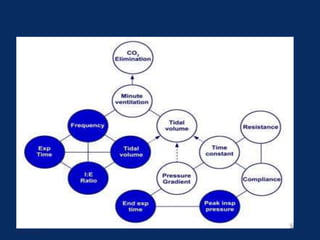
 Determine minute ventilation ( RR x VT),
thus CO2 elimination
 Depend on:
The infant gestational age
The underling disease and resulting
pulmonary mechanics
June 1, 2016 25
5. Respiratory Rate
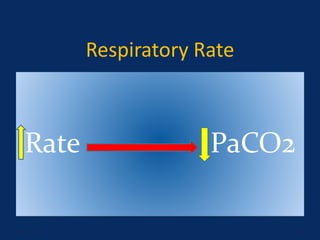
Respiratory Rate
Rate PaCO2
June 1, 2016 26
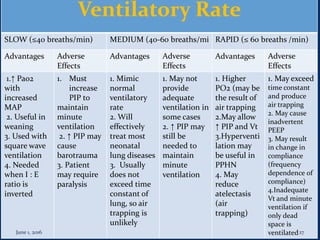
Ventilatory Rate
RAPID (≤ 60 breaths /min)MEDIUM (40-60 breaths/miSLOW (≤40 breaths/min)
Adverse
Effects
AdvantagesAdverse
Effects
AdvantagesAdverse
Effects
Advantages
1. May exceed
time constant
and produce
air trapping
2. May cause
inadvertent
PEEP
3. May result
in change in
compliance
(frequency
dependence of
compliance)
4.Inadequate
Vt and minute
ventilation if
only dead
space is
ventilated
1. Higher
PO2 (may be
the result of
air trapping
2.May allow
↑ PIP and Vt
3.Hyperventi
lation may
be useful in
PPHN
4. May
reduce
atelectasis
(air
trapping)
1. May not
provide
adequate
ventilation in
some cases
2. ↑ PIP may
still be
needed to
maintain
minute
ventilation
1. Mimic
normal
ventilatory
rate
2. Will
effectively
treat most
neonatal
lung diseases
3. Usually
does not
exceed time
constant of
lung, so air
trapping is
unlikely
1. Must
increase
PIP to
maintain
minute
ventilation
2. ↑ PIP may
cause
barotrauma
3. Patient
may require
paralysis
1.↑ Pao2
with
increased
MAP
2. Useful in
weaning
3. Used with
square wave
ventilation
4. Needed
when I : E
ratio is
inverted
June 1, 2016 27
6. Positive End Expiratory Pressure
The positive pressure applied at the end of
expiration to prevent lung collapse and maintain
stability of the alveoli (FRC)
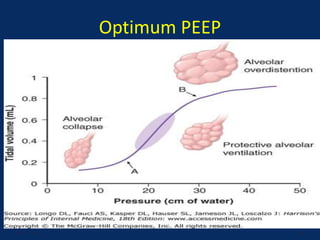
Optimum PEEP is the level below which the lung
volume is not maintained and above which the
lung volume become over-distended
Can be as low as low as 4 cm H2o& as high as 8
cm H2o, PEEP less than 5 cm in diseased lung is
exception.
June 1, 2016 28
Optimum PEEP
June 1, 2016 29
PEEP
 The benefits of PEEP are:
a. Stabilization and recruitment of lung
volume.
b. Improvement in lung compliance.
c. Improvement in ventilation-perfusion
matching in the lungs.

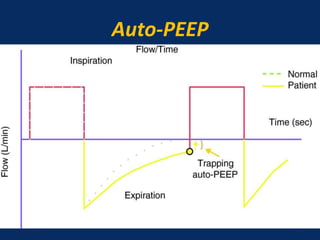
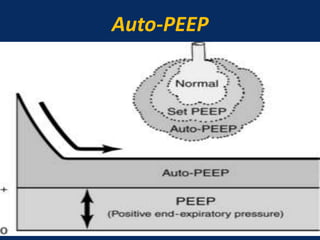
 Inadvertent PEEP: increase chosen PEEP if
expiration time is too short or airway resistance
is increased
June 1, 2016 30
Auto-PEEP
June 1, 2016 31
Auto-PEEP
June 1, 2016 32
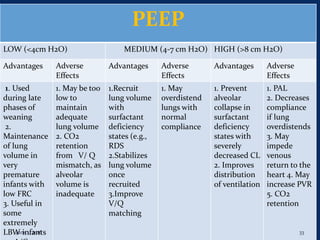
PEEP
HIGH (>8 cm H2O)MEDIUM (4-7 cm H2O)LOW (<4cm H2O)
Adverse
Effects
AdvantagesAdverse
Effects
AdvantagesAdverse
Effects
Advantages
1. PAL
2. Decreases
compliance
if lung
overdistends
3. May
impede
venous
return to the
heart 4. May
increase PVR
5. CO2
retention
1. Prevent
alveolar
collapse in
surfactant
deficiency
states with
severely
decreased CL
2. Improves
distribution
of ventilation
1. May
overdistend
lungs with
normal
compliance
1.Recruit
lung volume
with
surfactant
deficiency
states (e.g.,
RDS
2.Stabilizes
lung volume
once
recruited
3.Improve
V/Q
matching
1. May be too
low to
maintain
adequate
lung volume
2. CO2
retention
from V/ Q
mismatch, as
alveolar
volume is
inadequate
1. Used
during late
phases of
weaning
2.
Maintenance
of lung
volume in
very
premature
infants with
low FRC
3. Useful in
some
extremely
LBW infantsJune 1, 2016 33
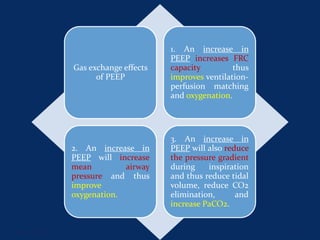
Gas exchange effects
of PEEP
1. An increase in
PEEP increases FRC
capacity thus
improves ventilation-
perfusion matching
and oxygenation.
2. An increase in
PEEP will increase
mean airway
pressure and thus
improve
oxygenation.
3. An increase in
PEEP will also reduce
the pressure gradient
during inspiration
and thus reduce tidal
volume, reduce CO2
elimination, and
increase PaCO2.
June 1, 2016 34
PEEP affect PaO2 & PaCO2
in the same direction.
June 1, 2016 35
7. Peak Inspiratory Pressure
The maximum pressure reached during
inspiration
Primary factor to deliver VT in pressure
ventilators
Adjust PIP to achieve adequate VT as
reflected by chest expansion and adequate
breath sounds
June 1, 2016 36
PIP
Gas
exchange
effects of
PIP
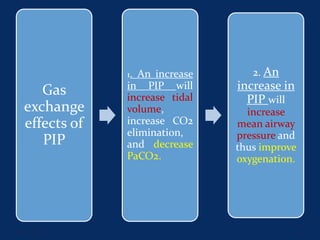
1. An increase
in PIP will
increase tidal
volume,
increase CO2
elimination,
and decrease
PaCO2.
2. An
increase in
PIP will
increase
mean airway
pressure and
thus improve
oxygenation.
June 1, 2016 37
PIP
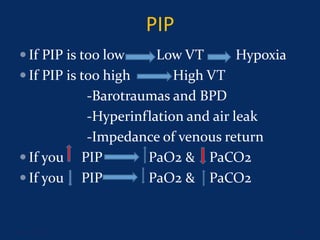
 If PIP is too low Low VT Hypoxia
 If PIP is too high High VT
-Barotraumas and BPD
-Hyperinflation and air leak
-Impedance of venous return
 If you PIP PaO2 & PaCO2
June 1, 2016 38
PIP affects PaCO2
&PaO2 in different
directions.
June 1, 2016 39
June 1, 2016 40
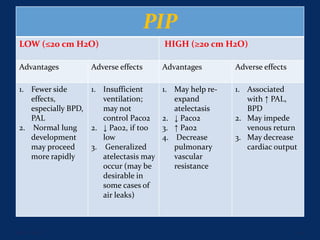
PIP
HIGH (≥20 cm H2O)LOW (≤20 cm H2O)
Adverse effectsAdvantagesAdverse effectsAdvantages
1. Associated
with ↑ PAL,
BPD
2. May impede
venous return
3. May decrease
cardiac output
1. May help re-
expand
atelectasis
2. ↓ Paco2
3. ↑ Pao2
4. Decrease
pulmonary
vascular
resistance
1. Insufficient
ventilation;
may not
control Paco2
2. ↓ Pao2, if too
low
3. Generalized
atelectasis may
occur (may be
desirable in
some cases of
air leaks)
1. Fewer side
effects,
especially BPD,
PAL
2. Normal lung
development
may proceed
more rapidly
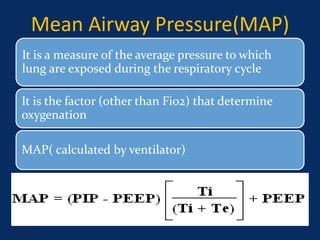
Mean Airway Pressure(MAP)
It is a measure of the average pressure to which
lung are exposed during the respiratory cycle
It is the factor (other than Fio2) that determine
oxygenation
MAP( calculated by ventilator)
June 1, 2016 41
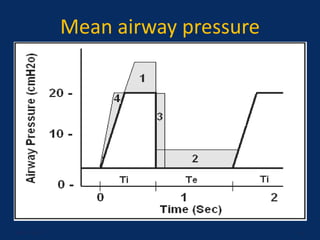
Mean airway pressure
June 1, 2016 42
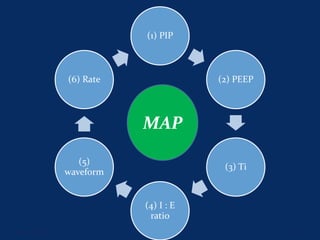
(1) PIP
(2) PEEP
(3) Ti
(4) I : E
ratio
(5)
waveform
(6) Rate
June 1, 2016 43
MAP
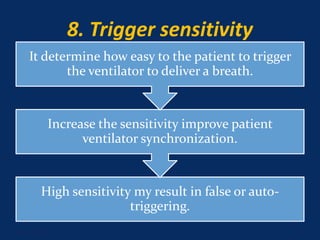
8. Trigger sensitivity
June 1, 2016 44
High sensitivity my result in false or auto-
triggering.
Increase the sensitivity improve patient
ventilator synchronization.
It determine how easy to the patient to trigger
the ventilator to deliver a breath.
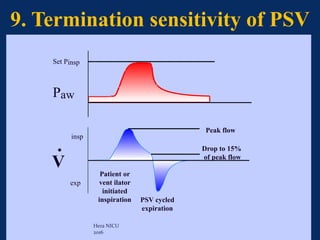
Paw
V
•
insp
exp
Patient or
vent ilator
initiated
inspiration PSV cycled
expiration
Peak flow
Drop to 15%
of peak flow
9. Termination sensitivity of PSV
Set Pinsp
Hera NICU
2016
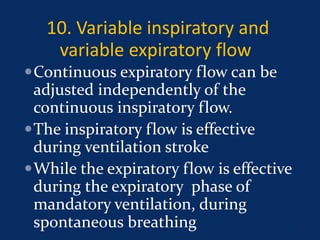
10. Variable inspiratory and
variable expiratory flow
Continuous expiratory flow can be
adjusted independently of the
continuous inspiratory flow.
The inspiratory flow is effective
during ventilation stroke
While the expiratory flow is effective
during the expiratory phase of
mandatory ventilation, during
spontaneous breathing 46
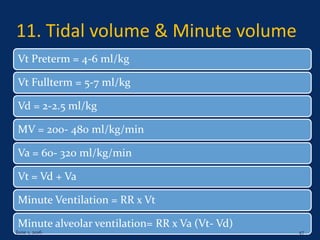
11. Tidal volume & Minute volume
Vt Preterm = 4-6 ml/kg
Vt Fullterm = 5-7 ml/kg
Vd = 2-2.5 ml/kg
MV = 200- 480 ml/kg/min
Va = 60- 320 ml/kg/min
Vt = Vd + Va
Minute Ventilation = RR x Vt
Minute alveolar ventilation= RR x Va (Vt- Vd)
June 1, 2016 47
12. Ventilator alarm settings
Some alarm limits are set
automatically e.g. airway pressure,
oxygen concentration
Some alarm limits are set
manually e.g. minute
ventilation, apnea time,
frequency
June 1, 2016 48
13. Graphics monitoring settings
Displaying the mode
Displaying curves : pressure , flow and
volume against time.
Displaying measured pressure values:
peak, mean and PEEP
Displaying lung values: R, C and TC
Displaying measured volume values: VT,
MV, leak and spont.
Displaying trends
June 1, 2016 49
Goals of mechanical ventilation
 Maintain acceptable gas exchange with a
minimum of:
Lung injury
Hemodynamic impairment
Other adverse events (neurologic
injury)
 Minimize work of breathing.
June 1, 2016 50
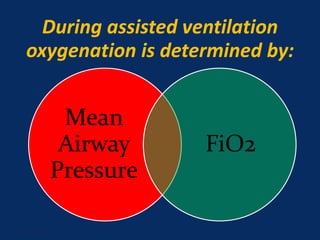
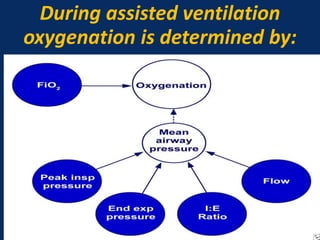
During assisted ventilation
oxygenation is determined by:
Mean
Airway
Pressure
FiO2
June 1, 2016 51
During assisted ventilation
oxygenation is determined by:
June 1, 2016 52
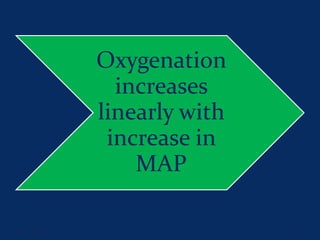
Oxygenation
increases
linearly with
increase in
MAP
June 1, 2016 53
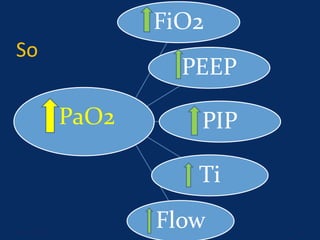
So
June 1, 2016 54
FiO2
PEEP
PIP
Ti
Flow
PaO2
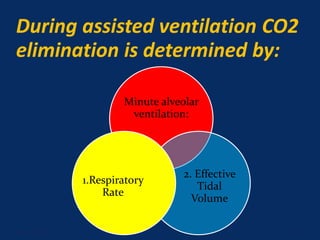
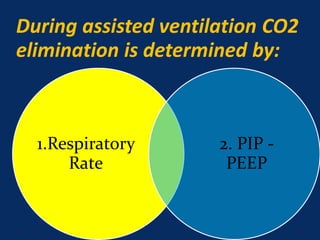
During assisted ventilation CO2
elimination is determined by:
Minute alveolar
ventilation:
2. Effective
Tidal
Volume
1.Respiratory
Rate
June 1, 2016 55
During assisted ventilation CO2
elimination is determined by:
1.Respiratory
Rate
2. PIP -
PEEP
June 1, 2016 56
June 1, 2016 57
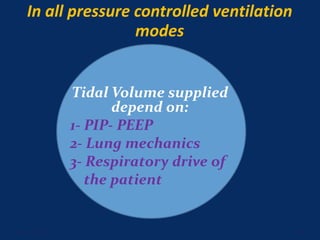
In all pressure controlled ventilation
modes
June 1, 2016 58
Tidal Volume supplied
depend on:
1- PIP- PEEP
2- Lung mechanics
3- Respiratory drive of
the patient
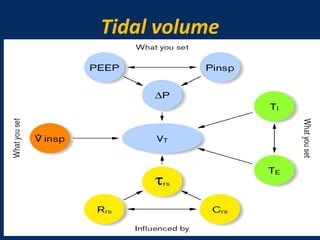
Tidal volume
June 1, 2016 59
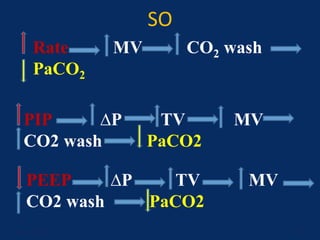
SO
June 1, 2016 60
Rate MV CO2 wash
PaCO2
PIP ∆P TV MV
CO2 wash PaCO2
PEEP ∆P TV MV
CO2 wash PaCO2
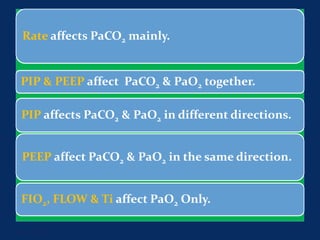
Rate affects PaCO2 mainly.
PIP & PEEP affect PaCO2 & PaO2 together.
PIP affects PaCO2 & PaO2 in different directions.
PEEP affect PaCO2 & PaO2 in the same direction.
FIO2, FLOW & Ti affect PaO2 Only.
June 1, 2016 61
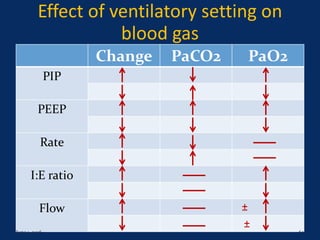
Effect of ventilatory setting on
blood gas
PaO2PaCO2Change
PIP
PEEP
Rate
I:E ratio
±Flow
±
June 1, 2016 62
June 1, 2016 63

3. ventilatory setting

  • 1.
  • 2.
  • 3.
    Ventilator parameters 1. Selectionof the mode 2. FiO2 3. Inspiratory flow rate or Slope 4. Ti (Some ventilators may also have Te, or I : E ratio.) 5. Frequency ( Rate) 6. PEEP 7. PIP June 1, 2016 3
  • 4.
    Ventilator parameters 8. Trigger sensitivity 9.Termination sensitivity of PSV 10. Variable inspiratory and variable expiratory flow 11. TV & MV in volume targeted ventilation 12. Ventilator alarm settings 13. Graphics monitoring settings June 1, 2016 4
  • 5.
    1. Which mode? June1, 2016 5 IMV A/C SIPPV SIMV CPAP PS SIMV& PS CMVVG BIPAP ASV PCV VCV
  • 6.
    Different ventilatory modes andtheir characteristics Weaning byPIP Inspiratory time Ventilator respiration rate Assistance of each breath Inspiratory trigger Ventilatory mode RR& PIP FixedFixedFixedNoNoIMV RR& PIP FixedFixedFixedNoYesSIMV PIPFixedFixedVariable YesYesAC/ SIPPV PIPFixedVariableVariable YesYesPSV
  • 7.
    2. Fraction ofInspired Oxygen The simplest and most direct mean to improve oxygenation Adjust FiO2 to maintain adequate oxygenation Can be adjusted as low as 21% and as high as 100% June 1, 2016 7
  • 8.
    FIO2  Oxygen isa drug used to: Relieving hypoxemia pulmonary vasodilator in cases of PPHTN  Inadequate O2 administration will resultant to: Hypoxemia and hypoxia May result in severe neurologic injury June 1, 2016 8
  • 9.
    FIO2  Excessive O2administration has been implicated as: ROP BPD  Try to maintain: PaO2 (60-80 mmHg) Saturation (PT 90-95% & FT > 95%) June 1, 2016 9
  • 10.
    Anatomy of Pressurewaveform Hera NICU 2016 Ti Te Pressure Begin inspiration Cycle to expiration Time Flow determines rate of rise and reaching peak pressure Pressure limited = “PIP” PEEP ∆p MAP Inflating pressure Distending pressure
  • 11.
    3. Flow Rate Volumeof gas passed / time unit (liter/minute) Minimum flow of at least 3 times the baby’s minute ventilation is usually required but in practice the operating range can be much higher Flow rate of 6-10 liter/minute are usually sufficient Flow rate is an important determinant of the ability of the ventilator to deliver desired levels of PIP, waveform, I : E ratios, and in some cases, respiratory rate. June 1, 2016 11
  • 12.
    June 1, 2016Hera NICU 12
  • 13.
    Slope (80 to150 ms is recommended) June 1, 2016 13
  • 14.
    Wave forms SINE WAVESQUARE WAVE June 1, 2016 14 PIPPIPPIP PIP 20 30 10 1 second 1 second 1 second 1 second
  • 15.
    June 1, 201615 Wave forms SQAURE WAVESINE WAVE Adverse effectsAdvantagesAdverse effectsAdvantages 1. With high flow, the ventilation may be applying higher pressure to normal airways and alveoli 2. Impede venous return if longer Ti is used or I : E ratio is reversed 1. Higher MAP for equivalent PIP 2. Longer time at PIP may open atelectatic areas of lung and improve distribution of ventilation 1. Lower mean airway pressure 1. Smoother increase of pressure 2. More like normal respiratory pattern
  • 16.
    4. Inspiratory time Usually adjusted between 0.30- 0.50 seconds  Depends on the pulmonary mechanics: Compliance Resistance Time constant June 1, 2016 16
  • 17.
  • 18.
  • 19.
    Inspiratory / ExpiratoryTime Ratio I:E ratio should not be less than 1:1.2 It should not be reversed June 1, 2016 19
  • 20.
    If inspiratory timeis too short Incomplete inspiration Tidal volume Mean airway pressure Hypercapnia Hypoxia June 1, 2016 Hera NICU 20
  • 21.
    If expiratory timeis too short Incomplete expiration Gas trapping Complianc Tidal volume Mean airway pressure Tidal volume Cardiac output Hypercapnia Hyperoxemia June 1, 2016 Hera NICU 21
  • 22.
    Ti & Te June1, 2016 22
  • 23.
    I / ERatio PROLONGED EXPIRATORY (> 1:3) NORMAL (1:2-1:3)INVERSE (>1 : 1) Adverse Effects AdvantagesAdverse Effects AdvantagesAdverse Effects Advantages 1. Low Ti may decrease tidal volume 2. May have to use higher flow rates, which may not be optimal for distribution of ventilation 3. May ventilate more dead space 1. Useful during weaning, when oxygenatio n is less of a problem 2. May be more useful in diseases such as MAS, when air trapping is a part of the disease process 1. Insufficient emptying at highest rates 1. Mimics natural breathing pattern 2. May give best ratio at higher rates 1.May have insufficient emptying time and air trapping may result 2. May impede venous return to the heart 3.↑Pulmonary vascular resistance and worsens diseases such as PPHN and CHD 4. Worsens PAL 1. ↑ MAP 2. ↑ Pao2 in RDS 3. May enhance alveolar recruitment when atelectasis is present June 1, 2016 23
  • 24.
  • 25.
     Determine minuteventilation ( RR x VT), thus CO2 elimination  Depend on: The infant gestational age The underling disease and resulting pulmonary mechanics June 1, 2016 25 5. Respiratory Rate
  • 26.
  • 27.
    Ventilatory Rate RAPID (≤60 breaths /min)MEDIUM (40-60 breaths/miSLOW (≤40 breaths/min) Adverse Effects AdvantagesAdverse Effects AdvantagesAdverse Effects Advantages 1. May exceed time constant and produce air trapping 2. May cause inadvertent PEEP 3. May result in change in compliance (frequency dependence of compliance) 4.Inadequate Vt and minute ventilation if only dead space is ventilated 1. Higher PO2 (may be the result of air trapping 2.May allow ↑ PIP and Vt 3.Hyperventi lation may be useful in PPHN 4. May reduce atelectasis (air trapping) 1. May not provide adequate ventilation in some cases 2. ↑ PIP may still be needed to maintain minute ventilation 1. Mimic normal ventilatory rate 2. Will effectively treat most neonatal lung diseases 3. Usually does not exceed time constant of lung, so air trapping is unlikely 1. Must increase PIP to maintain minute ventilation 2. ↑ PIP may cause barotrauma 3. Patient may require paralysis 1.↑ Pao2 with increased MAP 2. Useful in weaning 3. Used with square wave ventilation 4. Needed when I : E ratio is inverted June 1, 2016 27
  • 28.
    6. Positive EndExpiratory Pressure The positive pressure applied at the end of expiration to prevent lung collapse and maintain stability of the alveoli (FRC) Optimum PEEP is the level below which the lung volume is not maintained and above which the lung volume become over-distended Can be as low as low as 4 cm H2o& as high as 8 cm H2o, PEEP less than 5 cm in diseased lung is exception. June 1, 2016 28
  • 29.
  • 30.
    PEEP  The benefitsof PEEP are: a. Stabilization and recruitment of lung volume. b. Improvement in lung compliance. c. Improvement in ventilation-perfusion matching in the lungs.  Inadvertent PEEP: increase chosen PEEP if expiration time is too short or airway resistance is increased June 1, 2016 30
  • 31.
  • 32.
  • 33.
    PEEP HIGH (>8 cmH2O)MEDIUM (4-7 cm H2O)LOW (<4cm H2O) Adverse Effects AdvantagesAdverse Effects AdvantagesAdverse Effects Advantages 1. PAL 2. Decreases compliance if lung overdistends 3. May impede venous return to the heart 4. May increase PVR 5. CO2 retention 1. Prevent alveolar collapse in surfactant deficiency states with severely decreased CL 2. Improves distribution of ventilation 1. May overdistend lungs with normal compliance 1.Recruit lung volume with surfactant deficiency states (e.g., RDS 2.Stabilizes lung volume once recruited 3.Improve V/Q matching 1. May be too low to maintain adequate lung volume 2. CO2 retention from V/ Q mismatch, as alveolar volume is inadequate 1. Used during late phases of weaning 2. Maintenance of lung volume in very premature infants with low FRC 3. Useful in some extremely LBW infantsJune 1, 2016 33
  • 34.
    Gas exchange effects ofPEEP 1. An increase in PEEP increases FRC capacity thus improves ventilation- perfusion matching and oxygenation. 2. An increase in PEEP will increase mean airway pressure and thus improve oxygenation. 3. An increase in PEEP will also reduce the pressure gradient during inspiration and thus reduce tidal volume, reduce CO2 elimination, and increase PaCO2. June 1, 2016 34
  • 35.
    PEEP affect PaO2& PaCO2 in the same direction. June 1, 2016 35
  • 36.
    7. Peak InspiratoryPressure The maximum pressure reached during inspiration Primary factor to deliver VT in pressure ventilators Adjust PIP to achieve adequate VT as reflected by chest expansion and adequate breath sounds June 1, 2016 36
  • 37.
    PIP Gas exchange effects of PIP 1. Anincrease in PIP will increase tidal volume, increase CO2 elimination, and decrease PaCO2. 2. An increase in PIP will increase mean airway pressure and thus improve oxygenation. June 1, 2016 37
  • 38.
    PIP  If PIPis too low Low VT Hypoxia  If PIP is too high High VT -Barotraumas and BPD -Hyperinflation and air leak -Impedance of venous return  If you PIP PaO2 & PaCO2  If you PIP PaO2 & PaCO2 June 1, 2016 38
  • 39.
    PIP affects PaCO2 &PaO2in different directions. June 1, 2016 39
  • 40.
    June 1, 201640 PIP HIGH (≥20 cm H2O)LOW (≤20 cm H2O) Adverse effectsAdvantagesAdverse effectsAdvantages 1. Associated with ↑ PAL, BPD 2. May impede venous return 3. May decrease cardiac output 1. May help re- expand atelectasis 2. ↓ Paco2 3. ↑ Pao2 4. Decrease pulmonary vascular resistance 1. Insufficient ventilation; may not control Paco2 2. ↓ Pao2, if too low 3. Generalized atelectasis may occur (may be desirable in some cases of air leaks) 1. Fewer side effects, especially BPD, PAL 2. Normal lung development may proceed more rapidly
  • 41.
    Mean Airway Pressure(MAP) Itis a measure of the average pressure to which lung are exposed during the respiratory cycle It is the factor (other than Fio2) that determine oxygenation MAP( calculated by ventilator) June 1, 2016 41
  • 42.
  • 43.
    (1) PIP (2) PEEP (3)Ti (4) I : E ratio (5) waveform (6) Rate June 1, 2016 43 MAP
  • 44.
    8. Trigger sensitivity June1, 2016 44 High sensitivity my result in false or auto- triggering. Increase the sensitivity improve patient ventilator synchronization. It determine how easy to the patient to trigger the ventilator to deliver a breath.
  • 45.
    Paw V • insp exp Patient or vent ilator initiated inspirationPSV cycled expiration Peak flow Drop to 15% of peak flow 9. Termination sensitivity of PSV Set Pinsp Hera NICU 2016
  • 46.
    10. Variable inspiratoryand variable expiratory flow Continuous expiratory flow can be adjusted independently of the continuous inspiratory flow. The inspiratory flow is effective during ventilation stroke While the expiratory flow is effective during the expiratory phase of mandatory ventilation, during spontaneous breathing 46
  • 47.
    11. Tidal volume& Minute volume Vt Preterm = 4-6 ml/kg Vt Fullterm = 5-7 ml/kg Vd = 2-2.5 ml/kg MV = 200- 480 ml/kg/min Va = 60- 320 ml/kg/min Vt = Vd + Va Minute Ventilation = RR x Vt Minute alveolar ventilation= RR x Va (Vt- Vd) June 1, 2016 47
  • 48.
    12. Ventilator alarmsettings Some alarm limits are set automatically e.g. airway pressure, oxygen concentration Some alarm limits are set manually e.g. minute ventilation, apnea time, frequency June 1, 2016 48
  • 49.
    13. Graphics monitoringsettings Displaying the mode Displaying curves : pressure , flow and volume against time. Displaying measured pressure values: peak, mean and PEEP Displaying lung values: R, C and TC Displaying measured volume values: VT, MV, leak and spont. Displaying trends June 1, 2016 49
  • 50.
    Goals of mechanicalventilation  Maintain acceptable gas exchange with a minimum of: Lung injury Hemodynamic impairment Other adverse events (neurologic injury)  Minimize work of breathing. June 1, 2016 50
  • 51.
    During assisted ventilation oxygenationis determined by: Mean Airway Pressure FiO2 June 1, 2016 51
  • 52.
    During assisted ventilation oxygenationis determined by: June 1, 2016 52
  • 53.
  • 54.
    So June 1, 201654 FiO2 PEEP PIP Ti Flow PaO2
  • 55.
    During assisted ventilationCO2 elimination is determined by: Minute alveolar ventilation: 2. Effective Tidal Volume 1.Respiratory Rate June 1, 2016 55
  • 56.
    During assisted ventilationCO2 elimination is determined by: 1.Respiratory Rate 2. PIP - PEEP June 1, 2016 56
  • 57.
  • 58.
    In all pressurecontrolled ventilation modes June 1, 2016 58 Tidal Volume supplied depend on: 1- PIP- PEEP 2- Lung mechanics 3- Respiratory drive of the patient
  • 59.
  • 60.
    SO June 1, 201660 Rate MV CO2 wash PaCO2 PIP ∆P TV MV CO2 wash PaCO2 PEEP ∆P TV MV CO2 wash PaCO2
  • 61.
    Rate affects PaCO2mainly. PIP & PEEP affect PaCO2 & PaO2 together. PIP affects PaCO2 & PaO2 in different directions. PEEP affect PaCO2 & PaO2 in the same direction. FIO2, FLOW & Ti affect PaO2 Only. June 1, 2016 61
  • 62.
    Effect of ventilatorysetting on blood gas PaO2PaCO2Change PIP PEEP Rate I:E ratio ±Flow ± June 1, 2016 62
  • 63.