NIPPV

BY Dr Irappa Madabhavi
NON INVASIVE VENTILATION

    DR IRAPPA MADABHAVI
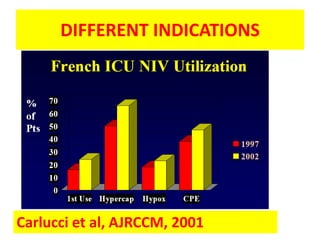
DIFFERENT INDICATIONS


Carlucci et al, AJRCCM, 2001
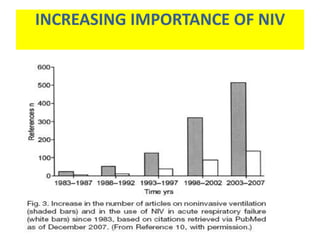
INCREASING IMPORTANCE OF NIV
WHY THE INTEREST IN NIV?
• It avoids the need for endotracheal
  intubation/sedation/NMB
• It reduces the occurrence of complications such
  as Nosocomial infection and tracheal stenosis
• It decreases intensive care unit (ICU) stay and
  overall cost of hospitalization in selected patients
• Achieves alveolar ventilation and gas exchange
  parameters similar to IMV
• Permits removal of secretions, eating and speech
   Brochard L, Mancebo J, Elliott MW.
   Noninvasive ventilation for acute respiratory
   failure. Eur Respir J 2002;19(4):712-721.
DEFINITION OF NIV
• Noninvasive ventilation is the delivery of
  ventilatory support without the need for an
  invasive artificial airway (an endotracheal or
  tracheostomy tube)

• NPPV typically is administered through a nasal or an
  oral mask
     ARFC Consensus Conference: non-invasive positive pressure
     ventilation: consensus statement, Respir Care 42:362, 1997
Types of Noninvasive Ventilation (NIV)

• Negative Pressure Ventilation (NPV)

• Noninvasive Positive Pressure Ventilation
  (NPPV)
Negative Pressure Ventilation (NPV)


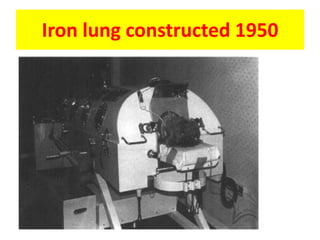
• Iron lung/tank ventilator
• Cuirass
• Pneumojacket /pneumosuit
Iron lung constructed 1950
Continuous Positive Airway Pressure
              (CPAP)
• Provides a constant pressure, but no ventilatory support.
  So CPAP is not considered as a form of ventilation
• More effective in hypoxemic than in hypercapnic states.
• It requires a spontaneously breathing patient and is
  unable to support in the case of apnea.
• Improves alveolar edema and increases functional
  residual capacity
• Main uses are:
                     OSA pt
                     Congestive heart failure

      Am J Respir Crit Care Med 2001;163: 283–291
Noninvasive Positive Pressure
           Ventilation
• Both pressure-cycled and volume-cycled
  modes are available.

• Pressure-cycled ventilation is the preferred
  mode. In this mode, a preset pressure is
  applied with inspiration and expiration known
  as IPAP and EPAP
IPAP –       Inspiratory positive airway
                   pressure
• Reduces the work of breathing
   – Alleviates respiratory distress
   – Unloads respiratory muscles
   – Improves respiratory muscle function
 Augments alveolar ventilation
      Reduces dead space ventilation
      Reduces rate related auto PEEP dynamic
  hyperinflation
• Improves gas exchange: hypoxemia and
  hypercapnia
            Antonelli M et al, Crit Care 2000
EPAP – Expiratory positive airway
                pressure
• Improves gas exchange: by alveolar recruitment and
  corrects hypoxemia
• Increases FRC by preventing end exp collapse
• Improves respiratory muscle fn : reduces dynamic
  hyperinflation advantage to the diaphragm and
  intercostals
• Auto PEEP (Inspiratory threshold load) : Offsets
  intrinsic PEEP, aids triggering
• Reduces re-breathing
• Enhances the delivery of bronchodilators to distal
  bronchial tree
DIFFERENT MODES
• Continuous positive airway pressure
• Pressure support ventilation( IPAP alone)
• Bilevel positive airway pressure: BiPAP (IPAP+
  EPAP)
• Proportional assist ventilation(PAV)
• Assist-controlled ventilation (mask IPPV)

           Craig TH, Emerg Med 2002
           Mehta Set al, AJRCCM 2001
CHOICE OF INTERFACES
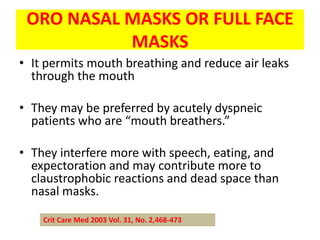
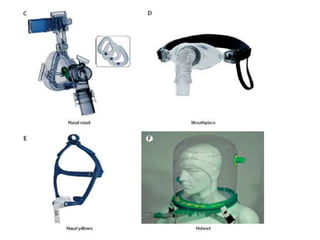
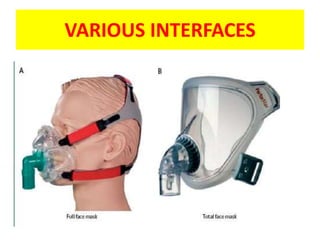
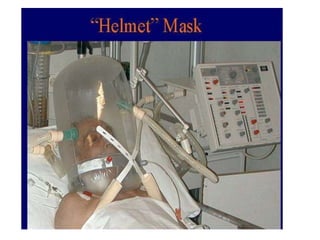
• Currently available interfaces include nasal,
  oronasal and facial masks, mouthpieces and
  helmets.

• For treatment of acute respiratory failure,
  facial masks are most commonly used (70% of
  cases), followed by nasal masks (25%) and
  nasal pillows (5%)
NASAL MASKS
• More air leakage through the mouth so fail to
  deliver air pressures to the lungs reliably
• Better tolerance, less claustrophobia
• Small dead space (104 ml vs. 250 ml facial mask)
• Better ability to vocalize, expectorate, eat and
  drink
• Resistance of the nasal passages. Limited
  effectiveness when the nasal resistance exceeds 5
  cm H2O/L per second
ORO NASAL MASKS OR FULL FACE
           MASKS
• It permits mouth breathing and reduce air leaks
  through the mouth

• They may be preferred by acutely dyspneic
  patients who are “mouth breathers.”

• They interfere more with speech, eating, and
  expectoration and may contribute more to
  claustrophobic reactions and dead space than
  nasal masks.

    Crit Care Med 2003 Vol. 31, No. 2,468-473
VARIOUS INTERFACES
Crit Care Med 2009; 37:124 –131
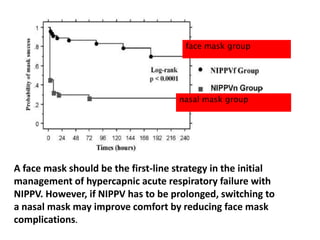
face mask group


                                      nasal mask group


A face mask should be the first-line strategy in the initial
management of hypercapnic acute respiratory failure with
NIPPV. However, if NIPPV has to be prolonged, switching to
a nasal mask may improve comfort by reducing face mask
complications.
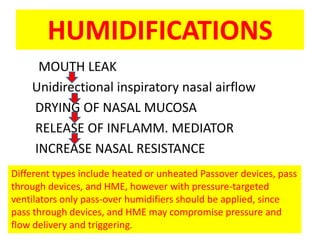
HUMIDIFICATIONS
     MOUTH LEAK
    Unidirectional inspiratory nasal airflow
    DRYING OF NASAL MUCOSA
    RELEASE OF INFLAMM. MEDIATOR
    INCREASE NASAL RESISTANCE
Different types include heated or unheated Passover devices, pass
through devices, and HME, however with pressure-targeted
ventilators only pass-over humidifiers should be applied, since
pass through devices, and HME may compromise pressure and
flow delivery and triggering.
EVIDENCE BASED
   GUIDELINES:
INDICATION OF NIV
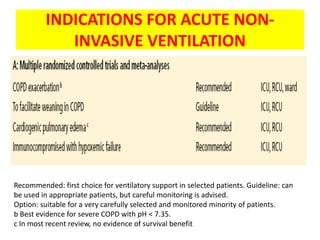
INDICATIONS FOR ACUTE NON-
            INVASIVE VENTILATION


Recommended: first choice for ventilatory support in selected patients. Guideline: can
be used in appropriate patients, but careful monitoring is advised.
Option: suitable for a very carefully selected and monitored minority of patients.
b Best evidence for severe COPD with pH < 7.35.
c In most recent review, no evidence of survival benefit
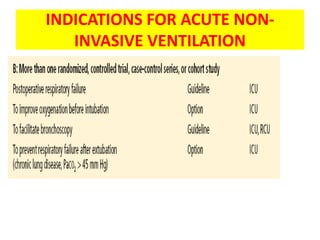
INDICATIONS FOR ACUTE NON-
   INVASIVE VENTILATION
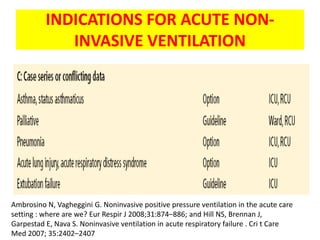
INDICATIONS FOR ACUTE NON-
             INVASIVE VENTILATION


Ambrosino N, Vagheggini G. Noninvasive positive pressure ventilation in the acute care
setting : where are we? Eur Respir J 2008;31:874–886; and Hill NS, Brennan J,
Garpestad E, Nava S. Noninvasive ventilation in acute respiratory failure . Cri t Care
Med 2007; 35:2402–2407
NIPPV AND AE-COPD
• NPPV has been proposed as the first-line
  ventilatory strategy for treatment of acute-
  on-chronic respiratory failure due to AECOPD.
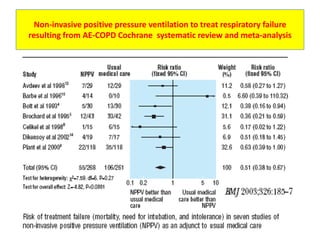
Non-invasive positive pressure ventilation to treat respiratory failure
resulting from AE-COPD Cochrane systematic review and meta-analysis
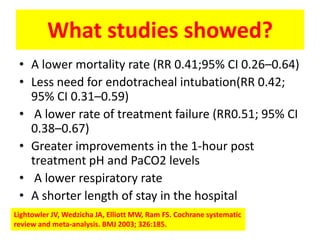
What studies showed?
 • A lower mortality rate (RR 0.41;95% CI 0.26–0.64)
 • Less need for endotracheal intubation(RR 0.42;
   95% CI 0.31–0.59)
 • A lower rate of treatment failure (RR0.51; 95% CI
   0.38–0.67)
 • Greater improvements in the 1-hour post
   treatment pH and PaCO2 levels
 • A lower respiratory rate
 • A shorter length of stay in the hospital
Lightowler JV, Wedzicha JA, Elliott MW, Ram FS. Cochrane systematic
review and meta-analysis. BMJ 2003; 326:185.
USE OF NIPPV AND DIFFERENT
         SEVERITY OF ARF


Eur Respir J 2008; 31: 874–886
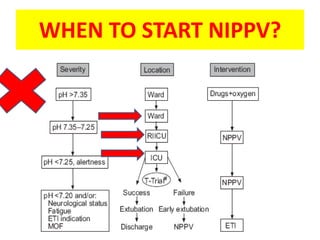
WHEN TO START NIPPV?
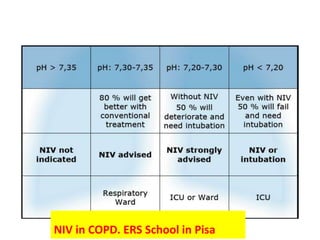
NIV in COPD. ERS School in Pisa
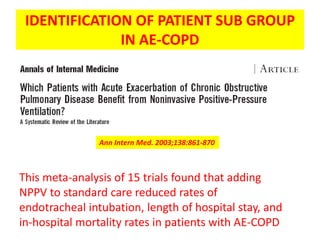
IDENTIFICATION OF PATIENT SUB GROUP
              IN AE-COPD


                Ann Intern Med. 2003;138:861-870


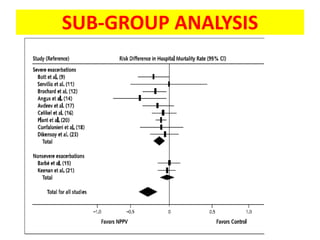
This meta-analysis of 15 trials found that adding
NPPV to standard care reduced rates of
endotracheal intubation, length of hospital stay, and
in-hospital mortality rates in patients with AE-COPD
SUB-GROUP ANALYSIS
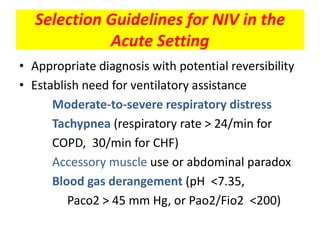
Selection Guidelines for NIV in the
            Acute Setting
• Appropriate diagnosis with potential reversibility
• Establish need for ventilatory assistance
      Moderate-to-severe respiratory distress
      Tachypnea (respiratory rate > 24/min for
      COPD, 30/min for CHF)
      Accessory muscle use or abdominal paradox
      Blood gas derangement (pH <7.35,
         Paco2 > 45 mm Hg, or Pao2/Fio2 <200)
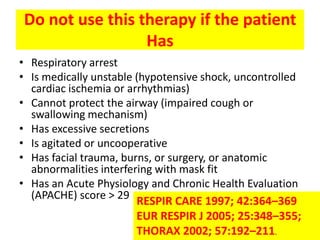
Do not use this therapy if the patient
                 Has
• Respiratory arrest
• Is medically unstable (hypotensive shock, uncontrolled
  cardiac ischemia or arrhythmias)
• Cannot protect the airway (impaired cough or
  swallowing mechanism)
• Has excessive secretions
• Is agitated or uncooperative
• Has facial trauma, burns, or surgery, or anatomic
  abnormalities interfering with mask fit
• Has an Acute Physiology and Chronic Health Evaluation
  (APACHE) score > 29
                        RESPIR CARE 1997; 42:364–369
                        EUR RESPIR J 2005; 25:348–355;
                        THORAX 2002; 57:192–211.
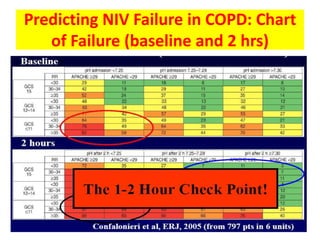
Predicting NIV Failure in COPD: Chart
   of Failure (baseline and 2 hrs)
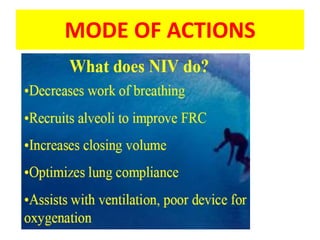
MODE OF ACTIONS
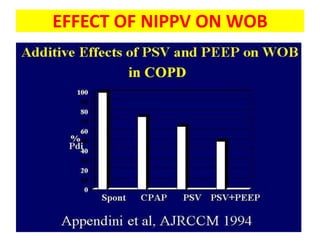
EFFECT OF NIPPV ON WOB
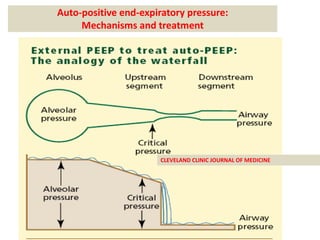
CONSEQUENCES OF AUTO-PEEP
• Increases the work of breathing
• Worsens gas exchange
• Can cause hemodynamic compromise .
  Reduces the preload of the right and left ventricles, decreases LV
   compliance and can increase RV after load by increasing PVR.

Can lead to inappropriate treatment
  Misinterpretation of CVP AND PCWP measurements
  Erroneous calculations of static respiratory compliance:
   The true value of static compliance will be
    underestimated
  Inappropriate fluid administration or unnecessary
   vasopressor therapy
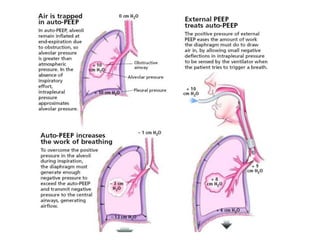
Auto-positive end-expiratory pressure:
     Mechanisms and treatment


                      CLEVELAND CLINIC JOURNAL OF MEDICINE
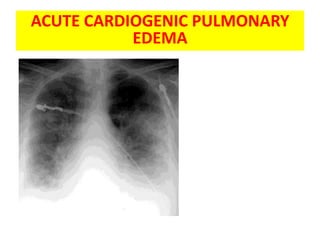
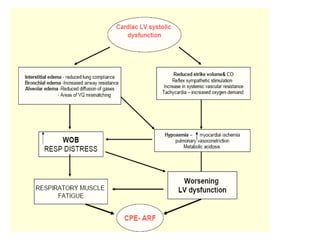
ACUTE CARDIOGENIC PULMONARY
            ACPE
           EDEMA
CARDIOGENIC PULMONARY EDEMA


           The 3CPO Trial
      N Engl J Med 2008;359:142-51.
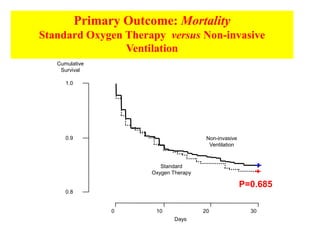
Primary Outcome: Mortality
Standard Oxygen Therapy versus Non-invasive
                Ventilation
   Cumulative
    Survival

      1.0


      0.9                                 Non-invasive
                                           Ventilation


                           Standard
                        Oxygen Therapy

                                                         P=0.685
      0.8


                  0      10              20                30
                                Days
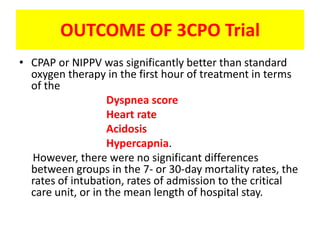
OUTCOME OF 3CPO Trial
• CPAP or NIPPV was significantly better than standard
  oxygen therapy in the first hour of treatment in terms
  of the
                   Dyspnea score
                   Heart rate
                   Acidosis
                   Hypercapnia.
  However, there were no significant differences
  between groups in the 7- or 30-day mortality rates, the
  rates of intubation, rates of admission to the critical
  care unit, or in the mean length of hospital stay.
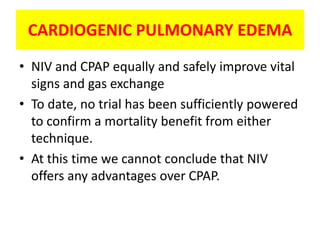
CARDIOGENIC PULMONARY EDEMA
• NIV and CPAP equally and safely improve vital
  signs and gas exchange
• To date, no trial has been sufficiently powered
  to confirm a mortality benefit from either
  technique.
• At this time we cannot conclude that NIV
  offers any advantages over CPAP.
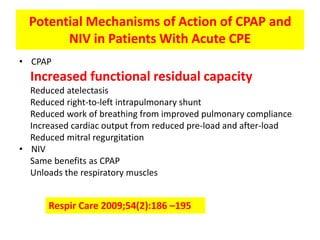
Potential Mechanisms of Action of CPAP and
        NIV in Patients With Acute CPE
• CPAP
  Increased functional residual capacity
  Reduced atelectasis
  Reduced right-to-left intrapulmonary shunt
  Reduced work of breathing from improved pulmonary compliance
  Increased cardiac output from reduced pre-load and after-load
  Reduced mitral regurgitation
• NIV
  Same benefits as CPAP
  Unloads the respiratory muscles


      Respir Care 2009;54(2):186 –195
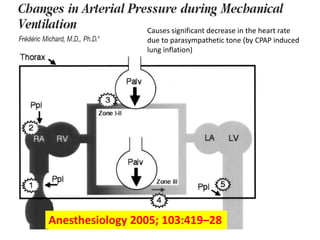
Causes significant decrease in the heart rate
                 due to parasympathetic tone (by CPAP induced
                 lung inflation)


Anesthesiology 2005; 103:419–28
DIASTOLIC HEART FAILURE
• CPAP improves oxygenation and ventilatory
  parameters in all kinds of CPE.
• In patients with preserved LV contractility, the
  hemodynamic benefit of CPAP results from a
  decrease in LV end-diastolic volume (preload)
• CPAP, by decreasing respiratory work in patients
  with cardiopulmonary edema, unloads the heart
  from the large amount of cardiac output that
  supplies the respiratory muscles and improves
  oxygen delivery for other tissues.
  Chest 2005; 127:1053–1058
WHEN TO USE NIV IN ACPE?
• GRAY ET AL noninvasive ventilation (CPAP or
  NIPPV) be considered as “adjunctive
  therapy” in patients with acute cardiogenic
  pulmonary edema who have severe
  respiratory distress or whose condition does
  not improve with pharmacologic therapy

   Start with CPAP•If persisting dyspnea or
   hypercapnia with CPAP alone, add pressure
   support
Respiratory Failure in Immunocompromised
Patients

 RCTs have found
 decreased intubation
 shorter ICU lengths of stay and
 Decreased ICU mortality rates

 The reduced mortality is likely related to reduced
 infectious complications associated with NIV use
 VAP, other nosocomial infections, and septic shock


                               Antonelli et al JAMA 2000; 283:235
                         Hilbert G, et al: N Engl J Med 2001; 344: 481
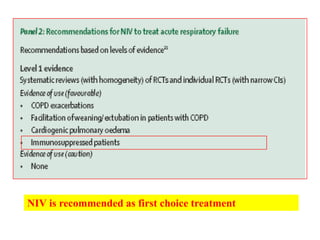
NIV is recommended as first choice treatment
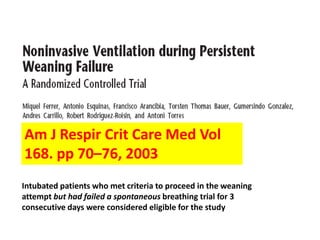
Am J Respir Crit Care Med Vol
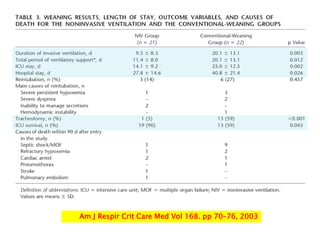
168. pp 70–76, 2003
Intubated patients who met criteria to proceed in the weaning
attempt but had failed a spontaneous breathing trial for 3
consecutive days were considered eligible for the study
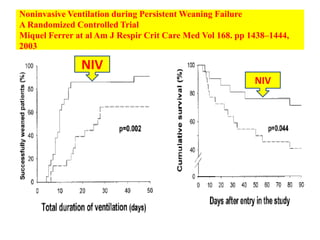
Noninvasive Ventilation during Persistent Weaning Failure
A Randomized Controlled Trial
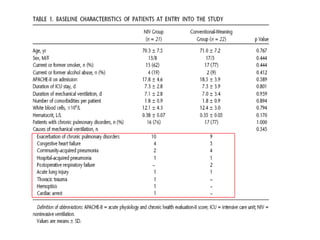
Miquel Ferrer at al Am J Respir Crit Care Med Vol 168. pp 1438–1444,
2003

               NIV
                                                           NIV
Am J Respir Crit Care Med Vol 168. pp 70–76, 2003
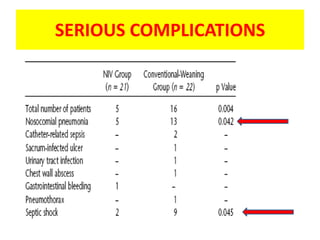
SERIOUS COMPLICATIONS
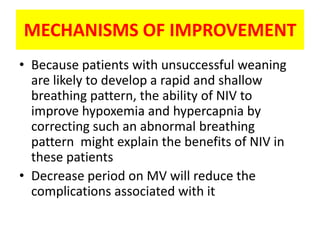
MECHANISMS OF IMPROVEMENT
• Because patients with unsuccessful weaning
  are likely to develop a rapid and shallow
  breathing pattern, the ability of NIV to
  improve hypoxemia and hypercapnia by
  correcting such an abnormal breathing
  pattern might explain the benefits of NIV in
  these patients
• Decrease period on MV will reduce the
  complications associated with it
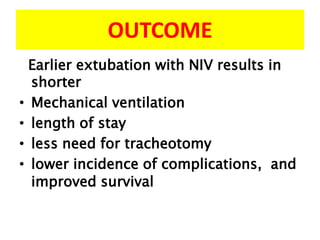
OUTCOME
  Earlier extubation with NIV results in
  shorter
• Mechanical ventilation
• length of stay
• less need for tracheotomy
• lower incidence of complications, and
  improved survival
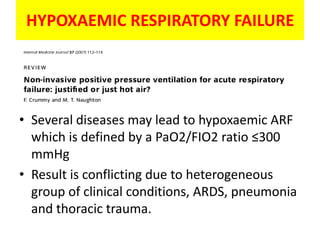
HYPOXAEMIC RESPIRATORY FAILURE


• Several diseases may lead to hypoxaemic ARF
  which is defined by a PaO2/FIO2 ratio ≤300
  mmHg
• Result is conflicting due to heterogeneous
  group of clinical conditions, ARDS, pneumonia
  and thoracic trauma.
NIV in Acute Hypoxemic Respiratory
              Failure


    Respir Care 2009;54(12):1679 –1687
RECOMMENDATIONS IN DIFFERENT
       SUBGROUPS


Crit Care Med 2007;
35:2402–2407
RECOMMENDATIONS IN DIFFERENT
        SUBGROUPS
• NIV cannot be recommended as routine
  therapy for ALI/ARDS
• A cautious trial in highly selected patients with
  a Simplified Acute Physiology Score II ≤34 and
  readiness to promptly intubate if oxygenation
  fails to improve sufficiently within the first
  hour.
• Trial should always be done in ICU
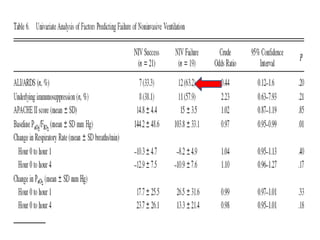
Predictors for failure in hypoxaemic
          respiratory failure
• No or minimum rise in the ratio of PaO2/FIO2
  after 1–2 h
• Patients older than 40 years (one study)
• Simplified acute physiology score >34 at
  admission
• Presence of ARDS
• CAP with or without sepsis, and multiorgan
  system failure
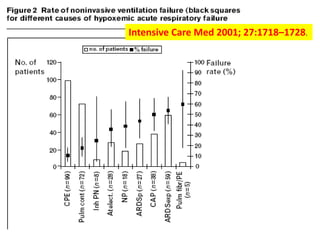
Intensive Care Med 2001; 27:1718–1728.
NIV IN ASTHMA
• According to the British Thoracic Society
  Standards of Care Committee Statements:
• ‘‘NPPV should not be used routinely in acute
  asthma, but a trial might be considered in
  patients not promptly responding to standard
  treatments’
POST OPERATIVE RESPIRATORY
              FAILURE
• Respiratory insufficiency in patients undergoing
  major surgery, especially of the chest or upper
  abdomen, is relatively common.
• After abdominal surgery, respiratory
  complications occur in approximately 10% of
  patients, and reintubation represents 30% of
  those complications.
• Pain, splinting, and respiratory muscle
  dysfunction, atelectasis are likely contributors to
  hypoxemia and respiratory insufficiency.
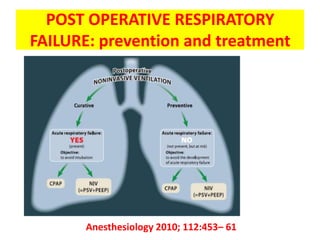
POST OPERATIVE RESPIRATORY
FAILURE: prevention and treatment


       Anesthesiology 2010; 112:453– 61
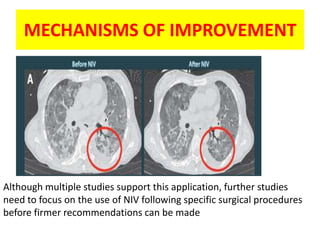
MECHANISMS OF IMPROVEMENT


Although multiple studies support this application, further studies
need to focus on the use of NIV following specific surgical procedures
before firmer recommendations can be made
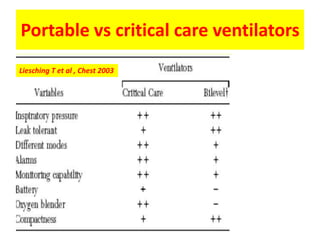
Portable vs critical care ventilators
Liesching T et al , Chest 2003
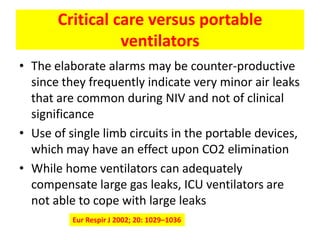
Critical care versus portable
                 ventilators
• The elaborate alarms may be counter-productive
  since they frequently indicate very minor air leaks
  that are common during NIV and not of clinical
  significance
• Use of single limb circuits in the portable devices,
  which may have an effect upon CO2 elimination
• While home ventilators can adequately
  compensate large gas leaks, ICU ventilators are
  not able to cope with large leaks
          Eur Respir J 2002; 20: 1029–1036
COMPLICATIONS
• Masks- pressure ulceration on the bridge of
  the nose or above the ears (due to mask
  straps/headgear).
• Conjunctival irritation may be associated with
  air leak around the mask.
• Nasal congestion, oral or nasal dryness and
  insufflation of air into the stomach.
• Claustrophobia
COMPLICATIONS
• More serious complications include aspiration
  pneumonia, haemodynamic compromise
  associated with increased intrathoracic
  pressures and pneumothorax.
• The occurrence of each of these more serious
  complications, however, has been identified as
  less than 5% (Hill 2006).
COMPLICATIONS
• Significant air leak for most bi level devices is
  0.4L/sec above intentional leak
• Decreased effectiveness of ventilation (NIPSV)
– Inability to maintain optimal pressures (CPAP)
– Sleep fragmentation
– Inability to trigger ventilator
– Prolonged inspiratory time
– Greater oxygen requirement
Leak Monitoring in Noninvasive Ventilation
 Arch Bronconeumol 2004;40(11):508-17
EXTUBATION FAILURE
• USE OF NIV routinely after extubation for
  reducing extubation failure not recommended
• Can be recommended in high risk patients
  after extubation
             Age>65
             APACHEII>12 at the time of ext.
             Cardiac failure at the time of intub.
KHILNANI ET AL, IJCCM,2006
GUIDELINES FOR NIV IN ARF
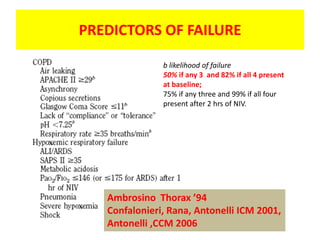
PREDICTORS OF FAILURE

               b likelihood of failure
               50% if any 3 and 82% if all 4 present
               at baseline;
               75% if any three and 99% if all four
               present after 2 hrs of NIV.


   Ambrosino Thorax ’94
   Confalonieri, Rana, Antonelli ICM 2001,
   Antonelli ,CCM 2006
WEANING METHODS
• SBT after 48hrs stabilization on MV
• FAIL SBT>STABILIZE WITH FULL MV SUPPORT
  FOR 1 HR> EXTUBATE AND PUT ON NIV


GUIDELINES FOR NIV IN ARF
IJCCM,2006

Nippv ,,,,,,,,,by dr irappa madabhavi

  • 1.
  • 2.
    NON INVASIVE VENTILATION DR IRAPPA MADABHAVI
  • 3.
  • 4.
  • 5.
    WHY THE INTERESTIN NIV? • It avoids the need for endotracheal intubation/sedation/NMB • It reduces the occurrence of complications such as Nosocomial infection and tracheal stenosis • It decreases intensive care unit (ICU) stay and overall cost of hospitalization in selected patients • Achieves alveolar ventilation and gas exchange parameters similar to IMV • Permits removal of secretions, eating and speech Brochard L, Mancebo J, Elliott MW. Noninvasive ventilation for acute respiratory failure. Eur Respir J 2002;19(4):712-721.
  • 6.
    DEFINITION OF NIV •Noninvasive ventilation is the delivery of ventilatory support without the need for an invasive artificial airway (an endotracheal or tracheostomy tube) • NPPV typically is administered through a nasal or an oral mask ARFC Consensus Conference: non-invasive positive pressure ventilation: consensus statement, Respir Care 42:362, 1997
  • 7.
    Types of NoninvasiveVentilation (NIV) • Negative Pressure Ventilation (NPV) • Noninvasive Positive Pressure Ventilation (NPPV)
  • 8.
    Negative Pressure Ventilation(NPV) • Iron lung/tank ventilator • Cuirass • Pneumojacket /pneumosuit
  • 9.
  • 10.
    Continuous Positive AirwayPressure (CPAP) • Provides a constant pressure, but no ventilatory support. So CPAP is not considered as a form of ventilation • More effective in hypoxemic than in hypercapnic states. • It requires a spontaneously breathing patient and is unable to support in the case of apnea. • Improves alveolar edema and increases functional residual capacity • Main uses are: OSA pt Congestive heart failure Am J Respir Crit Care Med 2001;163: 283–291
  • 11.
    Noninvasive Positive Pressure Ventilation • Both pressure-cycled and volume-cycled modes are available. • Pressure-cycled ventilation is the preferred mode. In this mode, a preset pressure is applied with inspiration and expiration known as IPAP and EPAP
  • 12.
    IPAP – Inspiratory positive airway pressure • Reduces the work of breathing – Alleviates respiratory distress – Unloads respiratory muscles – Improves respiratory muscle function Augments alveolar ventilation Reduces dead space ventilation Reduces rate related auto PEEP dynamic hyperinflation • Improves gas exchange: hypoxemia and hypercapnia Antonelli M et al, Crit Care 2000
  • 13.
    EPAP – Expiratorypositive airway pressure • Improves gas exchange: by alveolar recruitment and corrects hypoxemia • Increases FRC by preventing end exp collapse • Improves respiratory muscle fn : reduces dynamic hyperinflation advantage to the diaphragm and intercostals • Auto PEEP (Inspiratory threshold load) : Offsets intrinsic PEEP, aids triggering • Reduces re-breathing • Enhances the delivery of bronchodilators to distal bronchial tree
  • 14.
    DIFFERENT MODES • Continuouspositive airway pressure • Pressure support ventilation( IPAP alone) • Bilevel positive airway pressure: BiPAP (IPAP+ EPAP) • Proportional assist ventilation(PAV) • Assist-controlled ventilation (mask IPPV) Craig TH, Emerg Med 2002 Mehta Set al, AJRCCM 2001
  • 15.
    CHOICE OF INTERFACES •Currently available interfaces include nasal, oronasal and facial masks, mouthpieces and helmets. • For treatment of acute respiratory failure, facial masks are most commonly used (70% of cases), followed by nasal masks (25%) and nasal pillows (5%)
  • 16.
    NASAL MASKS • Moreair leakage through the mouth so fail to deliver air pressures to the lungs reliably • Better tolerance, less claustrophobia • Small dead space (104 ml vs. 250 ml facial mask) • Better ability to vocalize, expectorate, eat and drink • Resistance of the nasal passages. Limited effectiveness when the nasal resistance exceeds 5 cm H2O/L per second
  • 17.
    ORO NASAL MASKSOR FULL FACE MASKS • It permits mouth breathing and reduce air leaks through the mouth • They may be preferred by acutely dyspneic patients who are “mouth breathers.” • They interfere more with speech, eating, and expectoration and may contribute more to claustrophobic reactions and dead space than nasal masks. Crit Care Med 2003 Vol. 31, No. 2,468-473
  • 19.
  • 21.
    Crit Care Med2009; 37:124 –131
  • 22.
    face mask group nasal mask group A face mask should be the first-line strategy in the initial management of hypercapnic acute respiratory failure with NIPPV. However, if NIPPV has to be prolonged, switching to a nasal mask may improve comfort by reducing face mask complications.
  • 23.
    HUMIDIFICATIONS MOUTH LEAK Unidirectional inspiratory nasal airflow DRYING OF NASAL MUCOSA RELEASE OF INFLAMM. MEDIATOR INCREASE NASAL RESISTANCE Different types include heated or unheated Passover devices, pass through devices, and HME, however with pressure-targeted ventilators only pass-over humidifiers should be applied, since pass through devices, and HME may compromise pressure and flow delivery and triggering.
  • 24.
    EVIDENCE BASED GUIDELINES: INDICATION OF NIV
  • 25.
    INDICATIONS FOR ACUTENON- INVASIVE VENTILATION Recommended: first choice for ventilatory support in selected patients. Guideline: can be used in appropriate patients, but careful monitoring is advised. Option: suitable for a very carefully selected and monitored minority of patients. b Best evidence for severe COPD with pH < 7.35. c In most recent review, no evidence of survival benefit
  • 26.
    INDICATIONS FOR ACUTENON- INVASIVE VENTILATION
  • 27.
    INDICATIONS FOR ACUTENON- INVASIVE VENTILATION Ambrosino N, Vagheggini G. Noninvasive positive pressure ventilation in the acute care setting : where are we? Eur Respir J 2008;31:874–886; and Hill NS, Brennan J, Garpestad E, Nava S. Noninvasive ventilation in acute respiratory failure . Cri t Care Med 2007; 35:2402–2407
  • 28.
    NIPPV AND AE-COPD •NPPV has been proposed as the first-line ventilatory strategy for treatment of acute- on-chronic respiratory failure due to AECOPD.
  • 29.
    Non-invasive positive pressureventilation to treat respiratory failure resulting from AE-COPD Cochrane systematic review and meta-analysis
  • 30.
    What studies showed? • A lower mortality rate (RR 0.41;95% CI 0.26–0.64) • Less need for endotracheal intubation(RR 0.42; 95% CI 0.31–0.59) • A lower rate of treatment failure (RR0.51; 95% CI 0.38–0.67) • Greater improvements in the 1-hour post treatment pH and PaCO2 levels • A lower respiratory rate • A shorter length of stay in the hospital Lightowler JV, Wedzicha JA, Elliott MW, Ram FS. Cochrane systematic review and meta-analysis. BMJ 2003; 326:185.
  • 31.
    USE OF NIPPVAND DIFFERENT SEVERITY OF ARF Eur Respir J 2008; 31: 874–886
  • 32.
  • 33.
    NIV in COPD.ERS School in Pisa
  • 34.
    IDENTIFICATION OF PATIENTSUB GROUP IN AE-COPD Ann Intern Med. 2003;138:861-870 This meta-analysis of 15 trials found that adding NPPV to standard care reduced rates of endotracheal intubation, length of hospital stay, and in-hospital mortality rates in patients with AE-COPD
  • 35.
  • 36.
    Selection Guidelines forNIV in the Acute Setting • Appropriate diagnosis with potential reversibility • Establish need for ventilatory assistance Moderate-to-severe respiratory distress Tachypnea (respiratory rate > 24/min for COPD, 30/min for CHF) Accessory muscle use or abdominal paradox Blood gas derangement (pH <7.35, Paco2 > 45 mm Hg, or Pao2/Fio2 <200)
  • 37.
    Do not usethis therapy if the patient Has • Respiratory arrest • Is medically unstable (hypotensive shock, uncontrolled cardiac ischemia or arrhythmias) • Cannot protect the airway (impaired cough or swallowing mechanism) • Has excessive secretions • Is agitated or uncooperative • Has facial trauma, burns, or surgery, or anatomic abnormalities interfering with mask fit • Has an Acute Physiology and Chronic Health Evaluation (APACHE) score > 29 RESPIR CARE 1997; 42:364–369 EUR RESPIR J 2005; 25:348–355; THORAX 2002; 57:192–211.
  • 38.
    Predicting NIV Failurein COPD: Chart of Failure (baseline and 2 hrs)
  • 39.
  • 40.
  • 42.
    CONSEQUENCES OF AUTO-PEEP •Increases the work of breathing • Worsens gas exchange • Can cause hemodynamic compromise . Reduces the preload of the right and left ventricles, decreases LV compliance and can increase RV after load by increasing PVR. Can lead to inappropriate treatment Misinterpretation of CVP AND PCWP measurements Erroneous calculations of static respiratory compliance: The true value of static compliance will be underestimated Inappropriate fluid administration or unnecessary vasopressor therapy
  • 43.
    Auto-positive end-expiratory pressure: Mechanisms and treatment CLEVELAND CLINIC JOURNAL OF MEDICINE
  • 44.
  • 46.
    CARDIOGENIC PULMONARY EDEMA The 3CPO Trial N Engl J Med 2008;359:142-51.
  • 47.
    Primary Outcome: Mortality StandardOxygen Therapy versus Non-invasive Ventilation Cumulative Survival 1.0 0.9 Non-invasive Ventilation Standard Oxygen Therapy P=0.685 0.8 0 10 20 30 Days
  • 48.
    OUTCOME OF 3CPOTrial • CPAP or NIPPV was significantly better than standard oxygen therapy in the first hour of treatment in terms of the Dyspnea score Heart rate Acidosis Hypercapnia. However, there were no significant differences between groups in the 7- or 30-day mortality rates, the rates of intubation, rates of admission to the critical care unit, or in the mean length of hospital stay.
  • 49.
    CARDIOGENIC PULMONARY EDEMA •NIV and CPAP equally and safely improve vital signs and gas exchange • To date, no trial has been sufficiently powered to confirm a mortality benefit from either technique. • At this time we cannot conclude that NIV offers any advantages over CPAP.
  • 50.
    Potential Mechanisms ofAction of CPAP and NIV in Patients With Acute CPE • CPAP Increased functional residual capacity Reduced atelectasis Reduced right-to-left intrapulmonary shunt Reduced work of breathing from improved pulmonary compliance Increased cardiac output from reduced pre-load and after-load Reduced mitral regurgitation • NIV Same benefits as CPAP Unloads the respiratory muscles Respir Care 2009;54(2):186 –195
  • 51.
    Causes significant decreasein the heart rate due to parasympathetic tone (by CPAP induced lung inflation) Anesthesiology 2005; 103:419–28
  • 52.
    DIASTOLIC HEART FAILURE •CPAP improves oxygenation and ventilatory parameters in all kinds of CPE. • In patients with preserved LV contractility, the hemodynamic benefit of CPAP results from a decrease in LV end-diastolic volume (preload) • CPAP, by decreasing respiratory work in patients with cardiopulmonary edema, unloads the heart from the large amount of cardiac output that supplies the respiratory muscles and improves oxygen delivery for other tissues. Chest 2005; 127:1053–1058
  • 53.
    WHEN TO USENIV IN ACPE? • GRAY ET AL noninvasive ventilation (CPAP or NIPPV) be considered as “adjunctive therapy” in patients with acute cardiogenic pulmonary edema who have severe respiratory distress or whose condition does not improve with pharmacologic therapy Start with CPAP•If persisting dyspnea or hypercapnia with CPAP alone, add pressure support
  • 54.
    Respiratory Failure inImmunocompromised Patients RCTs have found decreased intubation shorter ICU lengths of stay and Decreased ICU mortality rates The reduced mortality is likely related to reduced infectious complications associated with NIV use VAP, other nosocomial infections, and septic shock Antonelli et al JAMA 2000; 283:235 Hilbert G, et al: N Engl J Med 2001; 344: 481
  • 55.
    NIV is recommendedas first choice treatment
  • 56.
    Am J RespirCrit Care Med Vol 168. pp 70–76, 2003 Intubated patients who met criteria to proceed in the weaning attempt but had failed a spontaneous breathing trial for 3 consecutive days were considered eligible for the study
  • 58.
    Noninvasive Ventilation duringPersistent Weaning Failure A Randomized Controlled Trial Miquel Ferrer at al Am J Respir Crit Care Med Vol 168. pp 1438–1444, 2003 NIV NIV
  • 59.
    Am J RespirCrit Care Med Vol 168. pp 70–76, 2003
  • 60.
  • 61.
    MECHANISMS OF IMPROVEMENT •Because patients with unsuccessful weaning are likely to develop a rapid and shallow breathing pattern, the ability of NIV to improve hypoxemia and hypercapnia by correcting such an abnormal breathing pattern might explain the benefits of NIV in these patients • Decrease period on MV will reduce the complications associated with it
  • 62.
    OUTCOME Earlierextubation with NIV results in shorter • Mechanical ventilation • length of stay • less need for tracheotomy • lower incidence of complications, and improved survival
  • 63.
    HYPOXAEMIC RESPIRATORY FAILURE •Several diseases may lead to hypoxaemic ARF which is defined by a PaO2/FIO2 ratio ≤300 mmHg • Result is conflicting due to heterogeneous group of clinical conditions, ARDS, pneumonia and thoracic trauma.
  • 64.
    NIV in AcuteHypoxemic Respiratory Failure Respir Care 2009;54(12):1679 –1687
  • 66.
    RECOMMENDATIONS IN DIFFERENT SUBGROUPS Crit Care Med 2007; 35:2402–2407
  • 67.
    RECOMMENDATIONS IN DIFFERENT SUBGROUPS • NIV cannot be recommended as routine therapy for ALI/ARDS • A cautious trial in highly selected patients with a Simplified Acute Physiology Score II ≤34 and readiness to promptly intubate if oxygenation fails to improve sufficiently within the first hour. • Trial should always be done in ICU
  • 68.
    Predictors for failurein hypoxaemic respiratory failure • No or minimum rise in the ratio of PaO2/FIO2 after 1–2 h • Patients older than 40 years (one study) • Simplified acute physiology score >34 at admission • Presence of ARDS • CAP with or without sepsis, and multiorgan system failure
  • 69.
    Intensive Care Med2001; 27:1718–1728.
  • 70.
    NIV IN ASTHMA •According to the British Thoracic Society Standards of Care Committee Statements: • ‘‘NPPV should not be used routinely in acute asthma, but a trial might be considered in patients not promptly responding to standard treatments’
  • 71.
    POST OPERATIVE RESPIRATORY FAILURE • Respiratory insufficiency in patients undergoing major surgery, especially of the chest or upper abdomen, is relatively common. • After abdominal surgery, respiratory complications occur in approximately 10% of patients, and reintubation represents 30% of those complications. • Pain, splinting, and respiratory muscle dysfunction, atelectasis are likely contributors to hypoxemia and respiratory insufficiency.
  • 72.
    POST OPERATIVE RESPIRATORY FAILURE:prevention and treatment Anesthesiology 2010; 112:453– 61
  • 73.
    MECHANISMS OF IMPROVEMENT Althoughmultiple studies support this application, further studies need to focus on the use of NIV following specific surgical procedures before firmer recommendations can be made
  • 75.
    Portable vs criticalcare ventilators Liesching T et al , Chest 2003
  • 76.
    Critical care versusportable ventilators • The elaborate alarms may be counter-productive since they frequently indicate very minor air leaks that are common during NIV and not of clinical significance • Use of single limb circuits in the portable devices, which may have an effect upon CO2 elimination • While home ventilators can adequately compensate large gas leaks, ICU ventilators are not able to cope with large leaks Eur Respir J 2002; 20: 1029–1036
  • 77.
    COMPLICATIONS • Masks- pressureulceration on the bridge of the nose or above the ears (due to mask straps/headgear). • Conjunctival irritation may be associated with air leak around the mask. • Nasal congestion, oral or nasal dryness and insufflation of air into the stomach. • Claustrophobia
  • 78.
    COMPLICATIONS • More seriouscomplications include aspiration pneumonia, haemodynamic compromise associated with increased intrathoracic pressures and pneumothorax. • The occurrence of each of these more serious complications, however, has been identified as less than 5% (Hill 2006).
  • 79.
    COMPLICATIONS • Significant airleak for most bi level devices is 0.4L/sec above intentional leak • Decreased effectiveness of ventilation (NIPSV) – Inability to maintain optimal pressures (CPAP) – Sleep fragmentation – Inability to trigger ventilator – Prolonged inspiratory time – Greater oxygen requirement Leak Monitoring in Noninvasive Ventilation Arch Bronconeumol 2004;40(11):508-17
  • 80.
    EXTUBATION FAILURE • USEOF NIV routinely after extubation for reducing extubation failure not recommended • Can be recommended in high risk patients after extubation Age>65 APACHEII>12 at the time of ext. Cardiac failure at the time of intub. KHILNANI ET AL, IJCCM,2006 GUIDELINES FOR NIV IN ARF
  • 81.
    PREDICTORS OF FAILURE b likelihood of failure 50% if any 3 and 82% if all 4 present at baseline; 75% if any three and 99% if all four present after 2 hrs of NIV. Ambrosino Thorax ’94 Confalonieri, Rana, Antonelli ICM 2001, Antonelli ,CCM 2006
  • 82.
    WEANING METHODS • SBTafter 48hrs stabilization on MV • FAIL SBT>STABILIZE WITH FULL MV SUPPORT FOR 1 HR> EXTUBATE AND PUT ON NIV GUIDELINES FOR NIV IN ARF IJCCM,2006