DR/ MAHMOUD EL
NAGGAR
Egyptian Board of NeonatologyJune 1, 2016
1
2. VENTILATORY MODES
Definition of Mechanical
Ventilation
June 1, 2016
2
Mechanical ventilation is the
movement of gas in and out of
the lung by an external source
(an automatic mechanical device)
connected directly to the patient.
Purpose of MV
June 1, 2016
3
 Facilitate alveolar ventilation and carbon dioxide
removal.
 Provide adequate tissue oxygenation
 Reduce the work of breathing
 Relieve respiratory distress and Reverse respiratory
muscle fatigue
 Permit lung healing
 Avoid complications
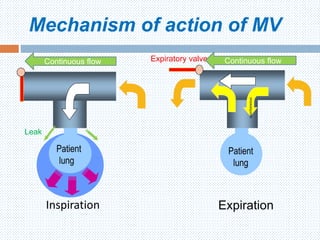
Mechanism of action of MV
Patient
lung
Expiration
Patient
lung
Inspiration
Expiratory valve
Leak
Continuous flowContinuous flow
spontaneous
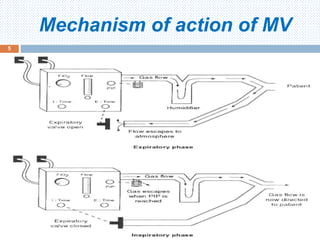
Mechanism of action of MV
5
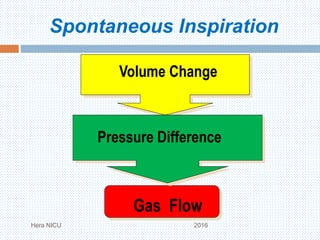
Spontaneous Inspiration
Hera NICU 2016
Volume Change
Gas Flow
Pressure Difference
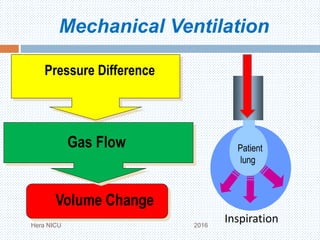
Mechanical Ventilation
Hera NICU 2016
Pressure Difference
Volume Change
Gas Flow Patient
lung
Inspiration
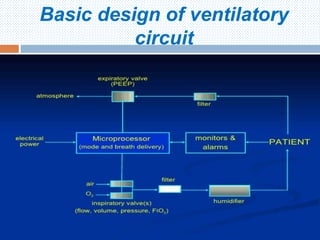
Basic design of ventilatory
circuit
Hera NICU 2016
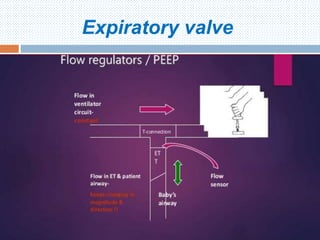
Expiratory valve
Hera NICU 2016
Unique challenges during
neonatal ventilation
Children ≠ Small adult
Neonate ≠ Small child
10
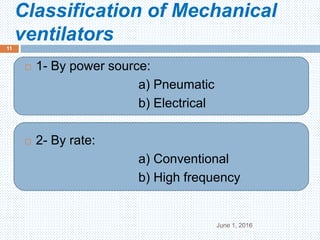
Classification of Mechanical
ventilators
June 1, 2016
11
 1- By power source:
a) Pneumatic
b) Electrical
 2- By rate:
a) Conventional
b) High frequency
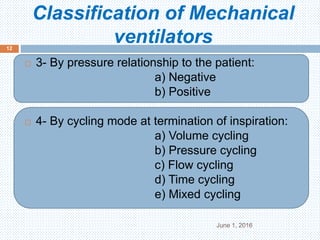
Classification of Mechanical
ventilators
June 1, 2016
12
 3- By pressure relationship to the patient:
a) Negative
b) Positive
 4- By cycling mode at termination of inspiration:
a) Volume cycling
b) Pressure cycling
c) Flow cycling
d) Time cycling
e) Mixed cycling
Classification of Mechanical
ventilators
June 1, 2016
13
 5- Loop control of ventilator output:
a) Opened loop
b) Closed loop
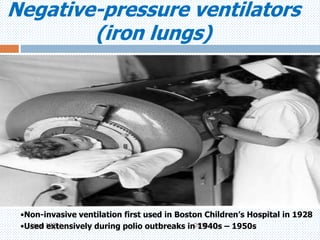
Negative-pressure ventilators
(iron lungs)
Hera NICU 2016
•Non-invasive ventilation first used in Boston Children’s Hospital in 1928
•Used extensively during polio outbreaks in 1940s – 1950s
Polio outbreaks
June 1, 2016
15
Iron lung polio ward at Rancho Los Amigos Hospital in 1953
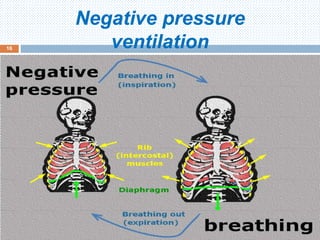
Negative pressure
ventilation16
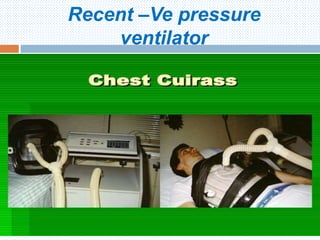
Recent –Ve pressure
ventilator
Hera NICU 2016
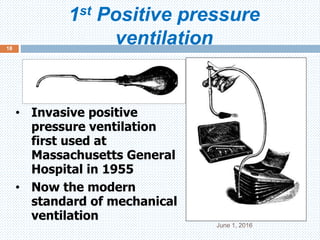
1st Positive pressure
ventilation
June 1, 2016
18
• Invasive positive
pressure ventilation
first used at
Massachusetts General
Hospital in 1955
• Now the modern
standard of mechanical
ventilation
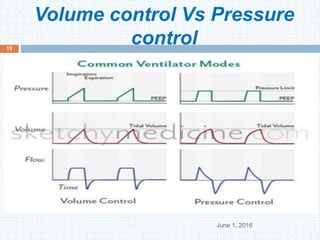
Volume control Vs Pressure
control
June 1, 2016
19
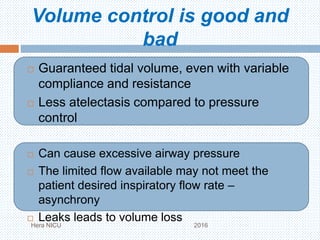
Volume control is good and
bad
 Guaranteed tidal volume, even with variable
compliance and resistance
 Less atelectasis compared to pressure
control
 Can cause excessive airway pressure
 The limited flow available may not meet the
patient desired inspiratory flow rate –
asynchrony
 Leaks leads to volume loss
Hera NICU 2016
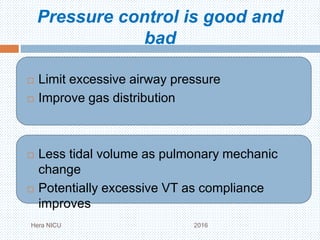
Pressure control is good and
bad
 Limit excessive airway pressure
 Improve gas distribution
 Less tidal volume as pulmonary mechanic
change
 Potentially excessive VT as compliance
improves
Hera NICU 2016
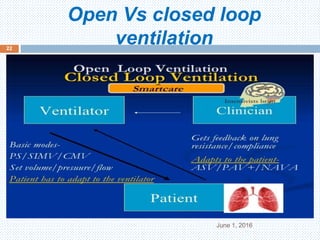
Open Vs closed loop
ventilation
June 1, 2016
22
June 1, 2016
23
1- Set tidal volume
With
2- Safer pressure limit
Target of
neonatal
ventilation
Conventional Neonatal
Ventilators
June 1, 2016
24
Pressure limited
Time cycled
Continuous flow
ventilators
In all pressure controlled
ventilation modes
June 1, 2016
25
Tidal Volume supplied
depend on:
1- PIP- PEEP
2- Lung mechanics
3- Respiratory drive
of the patient
Why volume control not
suitable of newborn?
June 1, 2016
26
 Use of small number of tidal volumes
 Leak around un-cuffed ET
 True tidal volume is influenced by ventilator
circuit compliance
 Comprisable volume of the circuit including the
humidifier, can affect the tidal volume
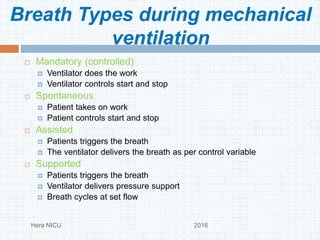
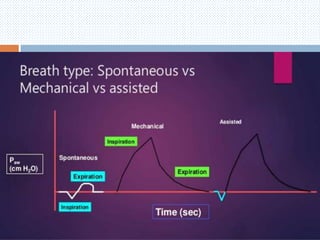
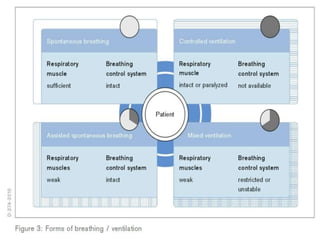
Breath Types during mechanical
ventilation
 Mandatory (controlled)
 Ventilator does the work
 Ventilator controls start and stop
 Spontaneous
 Patient takes on work
 Patient controls start and stop
 Assisted
 Patients triggers the breath
 The ventilator delivers the breath as per control variable
 Supported
 Patients triggers the breath
 Ventilator delivers pressure support
 Breath cycles at set flow
Hera NICU 2016
Hera NICU 2016
June 1, 2016
29
Ideal ventilator design
June 1, 2016
30
 Achieve all the important goals of mechanical
ventilator
 Provide a variety of modes that can ventilate
even the most challenging lung diseases.
 Has monitoring capabilities to adequately
assess the ventilator and patient performance.
 Has safety features and alarms that over lung
protective strategies.
 Neonatal ventilator.
Ideal ventilator mode
June 1, 2016
31
The mode which deliver a breath that:
 Synchronized with the patient spontaneous
breathing
 Maintain adequate and consistent tidal volume and
minute ventilation at low airway pressure.
 Response to rapid change of lung mechanic or
patient demands.
 Provide the lowest possible work of breathing.
A mode of ventilation is only as good as the
operator who applies it.
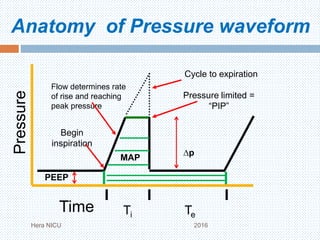
Anatomy of Pressure waveform
Hera NICU 2016
Ti Te
Pressure
Begin
inspiration
Cycle to expiration
Time
Flow determines rate
of rise and reaching
peak pressure
Pressure limited =
“PIP”
PEEP
∆p
MAP
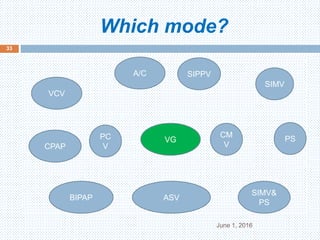
Which mode?
June 1, 2016
33
IMV
A/C SIPPV
SIMV
CPAP
PS
SIMV&
PS
CM
V
VG
BIPAP ASV
PC
V
VCV
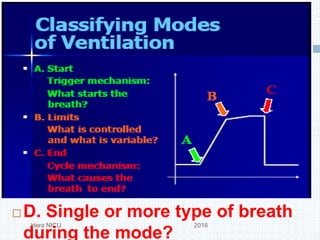
 D. Single or more type of breath
during the mode?
Hera NICU 2016
Classification of ventilatory
modes
June 1, 2016
35
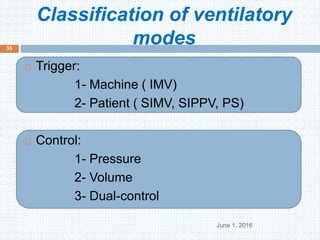
 Trigger:
1- Machine ( IMV)
2- Patient ( SIMV, SIPPV, PS)
 Control:
1- Pressure
2- Volume
3- Dual-control
Classification of ventilatory
modes
June 1, 2016
36
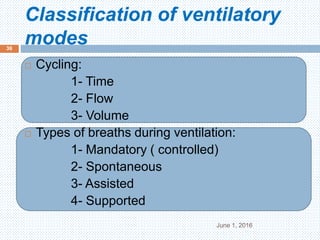
 Cycling:
1- Time
2- Flow
3- Volume
 Types of breaths during ventilation:
1- Mandatory ( controlled)
2- Spontaneous
3- Assisted
4- Supported
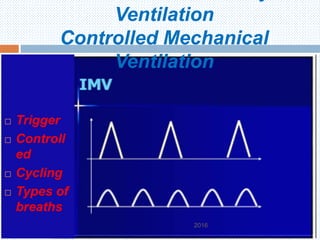
Ventilation
Controlled Mechanical
Ventilation
Hera NICU 2016
 Trigger
 Controll
ed
 Cycling
 Types of
breaths
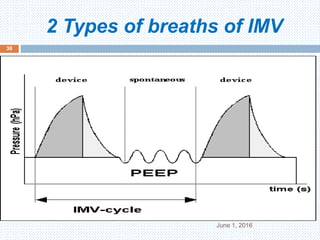
2 Types of breaths of IMV
June 1, 2016
38
Hazards of desynchronization
June 1, 2016
39
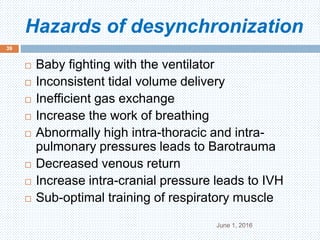
 Baby fighting with the ventilator
 Inconsistent tidal volume delivery
 Inefficient gas exchange
 Increase the work of breathing
 Abnormally high intra-thoracic and intra-
pulmonary pressures leads to Barotrauma
 Decreased venous return
 Increase intra-cranial pressure leads to IVH
 Sub-optimal training of respiratory muscle
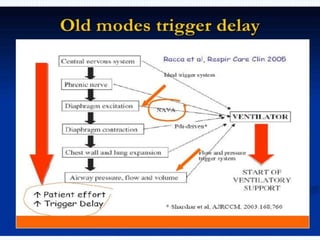
So, synchrony is extremely important
and can be achieved by detecting infant’s
inspiratory effort and using it to trigger
positive pressure inflation (triggered-
ventilation).
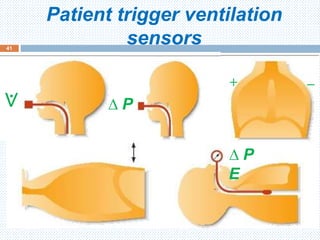
Patient trigger ventilation
sensors
June 1, 2016
41
+ −
∆ P⟇
∆ P
E
June 1, 2016
42
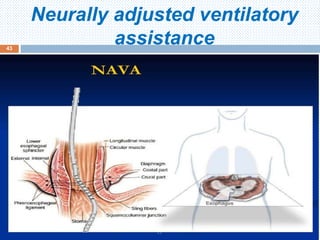
Neurally adjusted ventilatory
assistance
June 1, 2016
43
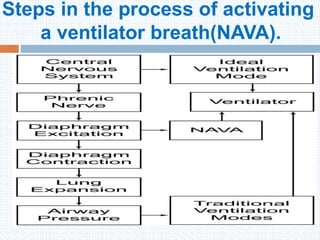
Steps in the process of activating
a ventilator breath(NAVA).
Trigger sensitivity
June 1, 2016
45
 It determine how easy to the patient to trigger
the ventilator to deliver a breath.
 Increase the sensitivity improve patient
ventilator synchronization.
 High sensitivity my result in false or auto-
triggering.
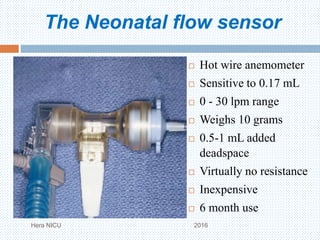
The Neonatal flow sensor
Hera NICU 2016
 Hot wire anemometer
 Sensitive to 0.17 mL
 0 - 30 lpm range
 Weighs 10 grams
 0.5-1 mL added
deadspace
 Virtually no resistance
 Inexpensive
 6 month use
Flow Sensor Measurement
Principle
Hera NICU 2016
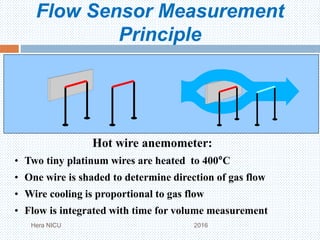
Hot wire anemometer:
• Two tiny platinum wires are heated to 400°C
• One wire is shaded to determine direction of gas flow
• Wire cooling is proportional to gas flow
• Flow is integrated with time for volume measurement
Limitations of the flow sensor
June 1, 2016
48
 If ET leak, expiratory tidal volume may be
underestimated.
 Imposing 1 ml of a dead space , which may
increase the WOB in very tiny preterm.
 If less than the expected expiratory tidal
volume due to ET leak is registered as a
negative flow and trigger a ventilator breath,
auto-triggering.
Limitations of the flow sensor
June 1, 2016
49
 Humidity; water will create significant
fluctuations of accuracy.
 Secretions- surfactant; reading above or below
baseline in the presence of zero flow
 Very delicate-breaks easily, wears-out due to
processing and age
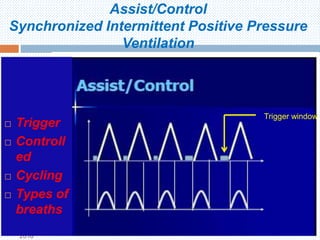
Assist/Control
Synchronized Intermittent Positive Pressure
Ventilation
Hera NICU
2016
 Trigger
 Controll
ed
 Cycling
 Types of
breaths
Trigger window
June 1, 2016
51
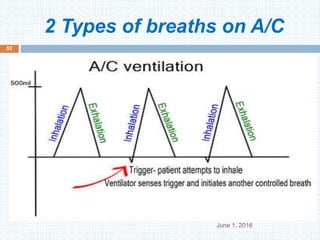
2 Types of breaths on A/C
June 1, 2016
52
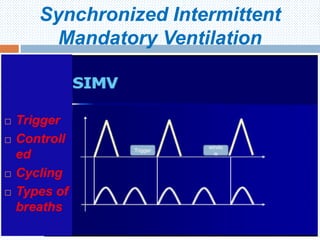
Synchronized Intermittent
Mandatory Ventilation
Hera NICU 2016
 Trigger
 Controll
ed
 Cycling
 Types of
breaths
Trigger
windo
w
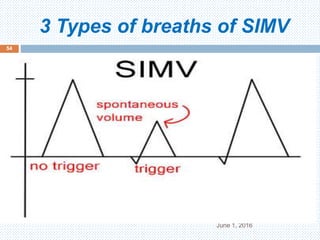
3 Types of breaths of SIMV
June 1, 2016
54
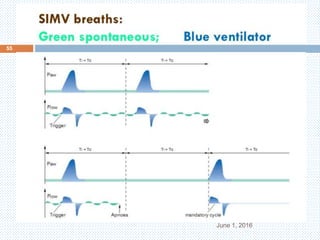
June 1, 2016
55
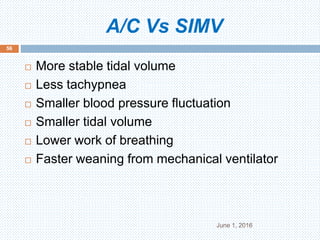
A/C Vs SIMV
June 1, 2016
56
 More stable tidal volume
 Less tachypnea
 Smaller blood pressure fluctuation
 Smaller tidal volume
 Lower work of breathing
 Faster weaning from mechanical ventilator
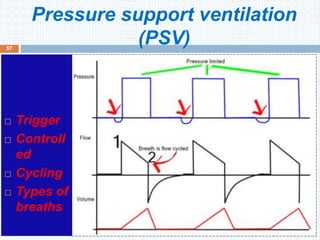
Pressure support ventilation
(PSV)
June 1, 2016
57
 Trigger
 Controll
ed
 Cycling
 Types of
breaths
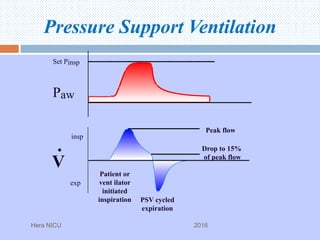
Paw
V
•
insp
exp
Patient or
vent ilator
initiated
inspiration PSV cycled
expiration
Peak flow
Drop to 15%
of peak flow
Pressure Support Ventilation
Set Pinsp
Hera NICU 2016
PSV Vs A/C
June 1, 2016
59
 PSV, Allow the newborn more control over the
respiratory pattern, with synchronization at the
end of inspiration not only the beginning.
 PSV, Decreasing asynchrony by minimize the
chance of active expiration against high
positive pressure.
 PSV, Automatically adjust Ti according to
change in patient time constant breath by
breath.
 PSV, Allow the infant to sigh as needed to
prevent atelectasis.
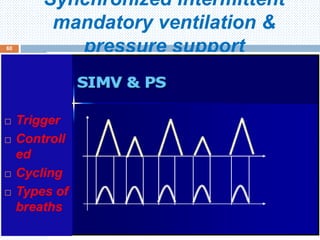
Synchronized intermittent
mandatory ventilation &
pressure support
June 1, 2016
60
 Trigger
 Controll
ed
 Cycling
 Types of
breaths
Proportional Assist Ventilation (PAV)&
Neurally adjusted ventilatory
assistance(NAVA)
June 1, 2016
61
 New ventilatory modes designed to assist
spontaneous ventilation
 The breath delivered is similar to PS but the
pressure support level is variable and is
proportional to patient spontaneous effort
a) The harder the patient work = the more
support by ventilator
b) The less the patient work = the less
support is provided
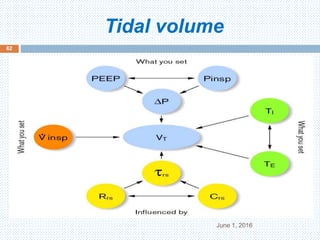
Tidal volume
June 1, 2016
62
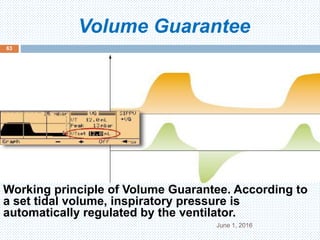
Volume Guarantee
June 1, 2016
63
Working principle of Volume Guarantee. According to
a set tidal volume, inspiratory pressure is
automatically regulated by the ventilator.
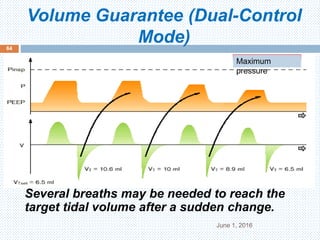
Volume Guarantee (Dual-Control
Mode)
June 1, 2016
64
Several breaths may be needed to reach the
target tidal volume after a sudden change.
Maximum
pressure
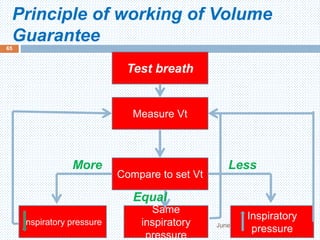
Principle of working of Volume
Guarantee
June 1, 2016
65
Test breath
Measure Vt
Inspiratory
pressure
Same
inspiratory
pressure
Inspiratory pressure
Compare to set Vt
More
Equal
Less
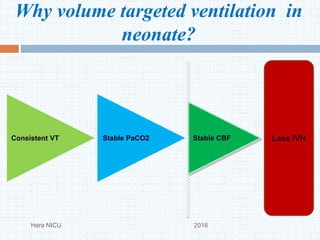
Why volume targeted ventilation in
neonate?
Consistent VT Stable PaCO2 Stable CBF Less IVH
Hera NICU 2016
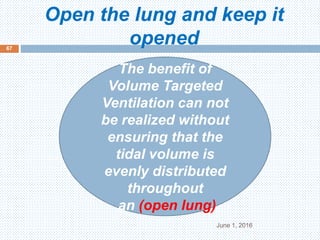
Open the lung and keep it
opened
June 1, 2016
67
The benefit of
Volume Targeted
Ventilation can not
be realized without
ensuring that the
tidal volume is
evenly distributed
throughout
an (open lung)
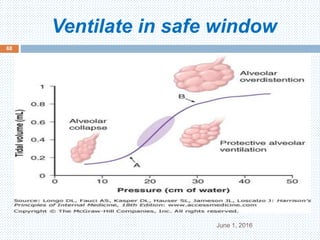
Ventilate in safe window
June 1, 2016
68
Volume guarantee why?
June 1, 2016
69
 It is volu-trauma than baro-trauma
 More stable tidal volume
 Wean PIP if lung mechanics improved
 Less hypo-capnea
 Work better with A/C than SIMV
 Bio-trauma decreased with TV 5ml/kg
 Faster weaning from mechanical ventilator
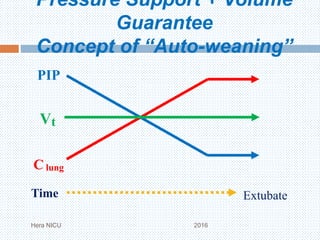
Pressure Support + Volume
Guarantee
Concept of “Auto-weaning”
Hera NICU 2016
PIP
C lung
Vt
ExtubateTime
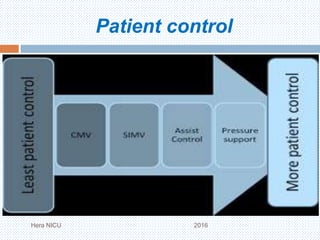
Patient control
Hera NICU 2016
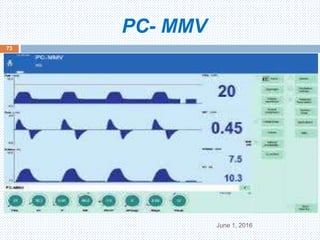
Mandatory Minute Ventilation
MMV
June 1, 2016
72
 Guarantee a minimum minute ventilation ( RR x
TV)
 If the patient maintain a MV above the set MV this
mode will function like PS mode
 If the patient MV falls below the set MV the mode
will deliver mandatory breaths ( SIMV or IMV +
VG), only the numbers of breaths that required to
return patient MV to the set MV
Depends on the patient ventilatory drive
When the spontaneous breathing increased,
fewer mandatory breaths will be provided
PC- MMV
June 1, 2016
73
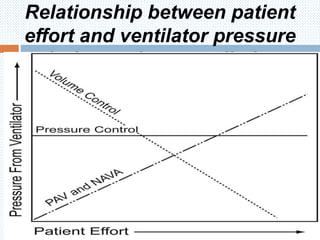
Relationship between patient
effort and ventilator pressure
during various ventilation
modes.
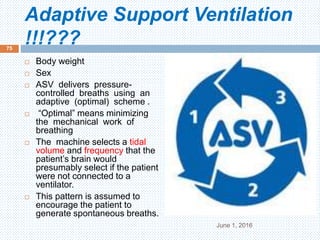
Adaptive Support Ventilation
!!!???
June 1, 2016
75
 Body weight
 Sex
 ASV delivers pressure-
controlled breaths using an
adaptive (optimal) scheme .
 “Optimal” means minimizing
the mechanical work of
breathing
 The machine selects a tidal
volume and frequency that the
patient’s brain would
presumably select if the patient
were not connected to a
ventilator.
 This pattern is assumed to
encourage the patient to
generate spontaneous breaths.
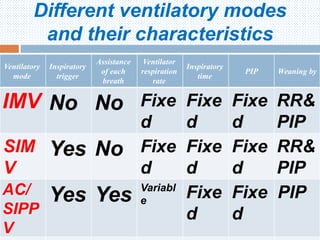
Different ventilatory modes
and their characteristics
Weaning byPIP
Inspiratory
time
Ventilator
respiration
rate
Assistance
of each
breath
Inspiratory
trigger
Ventilatory
mode
RR&
PIP
Fixe
d
Fixe
d
Fixe
d
NoNoIMV
RR&
PIP
Fixe
d
Fixe
d
Fixe
d
NoYesSIM
V
PIPFixe
d
Fixe
d
Variabl
eYesYesAC/
SIPP
V
Thanks

2. ventilatory modes

  • 1.
    DR/ MAHMOUD EL NAGGAR EgyptianBoard of NeonatologyJune 1, 2016 1 2. VENTILATORY MODES
  • 2.
    Definition of Mechanical Ventilation June1, 2016 2 Mechanical ventilation is the movement of gas in and out of the lung by an external source (an automatic mechanical device) connected directly to the patient.
  • 3.
    Purpose of MV June1, 2016 3  Facilitate alveolar ventilation and carbon dioxide removal.  Provide adequate tissue oxygenation  Reduce the work of breathing  Relieve respiratory distress and Reverse respiratory muscle fatigue  Permit lung healing  Avoid complications
  • 4.
    Mechanism of actionof MV Patient lung Expiration Patient lung Inspiration Expiratory valve Leak Continuous flowContinuous flow spontaneous
  • 5.
  • 6.
    Spontaneous Inspiration Hera NICU2016 Volume Change Gas Flow Pressure Difference
  • 7.
    Mechanical Ventilation Hera NICU2016 Pressure Difference Volume Change Gas Flow Patient lung Inspiration
  • 8.
    Basic design ofventilatory circuit Hera NICU 2016
  • 9.
  • 10.
    Unique challenges during neonatalventilation Children ≠ Small adult Neonate ≠ Small child 10
  • 11.
    Classification of Mechanical ventilators June1, 2016 11  1- By power source: a) Pneumatic b) Electrical  2- By rate: a) Conventional b) High frequency
  • 12.
    Classification of Mechanical ventilators June1, 2016 12  3- By pressure relationship to the patient: a) Negative b) Positive  4- By cycling mode at termination of inspiration: a) Volume cycling b) Pressure cycling c) Flow cycling d) Time cycling e) Mixed cycling
  • 13.
    Classification of Mechanical ventilators June1, 2016 13  5- Loop control of ventilator output: a) Opened loop b) Closed loop
  • 14.
    Negative-pressure ventilators (iron lungs) HeraNICU 2016 •Non-invasive ventilation first used in Boston Children’s Hospital in 1928 •Used extensively during polio outbreaks in 1940s – 1950s
  • 15.
    Polio outbreaks June 1,2016 15 Iron lung polio ward at Rancho Los Amigos Hospital in 1953
  • 16.
  • 17.
  • 18.
    1st Positive pressure ventilation June1, 2016 18 • Invasive positive pressure ventilation first used at Massachusetts General Hospital in 1955 • Now the modern standard of mechanical ventilation
  • 19.
    Volume control VsPressure control June 1, 2016 19
  • 20.
    Volume control isgood and bad  Guaranteed tidal volume, even with variable compliance and resistance  Less atelectasis compared to pressure control  Can cause excessive airway pressure  The limited flow available may not meet the patient desired inspiratory flow rate – asynchrony  Leaks leads to volume loss Hera NICU 2016
  • 21.
    Pressure control isgood and bad  Limit excessive airway pressure  Improve gas distribution  Less tidal volume as pulmonary mechanic change  Potentially excessive VT as compliance improves Hera NICU 2016
  • 22.
    Open Vs closedloop ventilation June 1, 2016 22
  • 23.
    June 1, 2016 23 1-Set tidal volume With 2- Safer pressure limit Target of neonatal ventilation
  • 24.
    Conventional Neonatal Ventilators June 1,2016 24 Pressure limited Time cycled Continuous flow ventilators
  • 25.
    In all pressurecontrolled ventilation modes June 1, 2016 25 Tidal Volume supplied depend on: 1- PIP- PEEP 2- Lung mechanics 3- Respiratory drive of the patient
  • 26.
    Why volume controlnot suitable of newborn? June 1, 2016 26  Use of small number of tidal volumes  Leak around un-cuffed ET  True tidal volume is influenced by ventilator circuit compliance  Comprisable volume of the circuit including the humidifier, can affect the tidal volume
  • 27.
    Breath Types duringmechanical ventilation  Mandatory (controlled)  Ventilator does the work  Ventilator controls start and stop  Spontaneous  Patient takes on work  Patient controls start and stop  Assisted  Patients triggers the breath  The ventilator delivers the breath as per control variable  Supported  Patients triggers the breath  Ventilator delivers pressure support  Breath cycles at set flow Hera NICU 2016
  • 28.
  • 29.
  • 30.
    Ideal ventilator design June1, 2016 30  Achieve all the important goals of mechanical ventilator  Provide a variety of modes that can ventilate even the most challenging lung diseases.  Has monitoring capabilities to adequately assess the ventilator and patient performance.  Has safety features and alarms that over lung protective strategies.  Neonatal ventilator.
  • 31.
    Ideal ventilator mode June1, 2016 31 The mode which deliver a breath that:  Synchronized with the patient spontaneous breathing  Maintain adequate and consistent tidal volume and minute ventilation at low airway pressure.  Response to rapid change of lung mechanic or patient demands.  Provide the lowest possible work of breathing. A mode of ventilation is only as good as the operator who applies it.
  • 32.
    Anatomy of Pressurewaveform Hera NICU 2016 Ti Te Pressure Begin inspiration Cycle to expiration Time Flow determines rate of rise and reaching peak pressure Pressure limited = “PIP” PEEP ∆p MAP
  • 33.
    Which mode? June 1,2016 33 IMV A/C SIPPV SIMV CPAP PS SIMV& PS CM V VG BIPAP ASV PC V VCV
  • 34.
     D. Singleor more type of breath during the mode? Hera NICU 2016
  • 35.
    Classification of ventilatory modes June1, 2016 35  Trigger: 1- Machine ( IMV) 2- Patient ( SIMV, SIPPV, PS)  Control: 1- Pressure 2- Volume 3- Dual-control
  • 36.
    Classification of ventilatory modes June1, 2016 36  Cycling: 1- Time 2- Flow 3- Volume  Types of breaths during ventilation: 1- Mandatory ( controlled) 2- Spontaneous 3- Assisted 4- Supported
  • 37.
    Ventilation Controlled Mechanical Ventilation Hera NICU2016  Trigger  Controll ed  Cycling  Types of breaths
  • 38.
    2 Types ofbreaths of IMV June 1, 2016 38
  • 39.
    Hazards of desynchronization June1, 2016 39  Baby fighting with the ventilator  Inconsistent tidal volume delivery  Inefficient gas exchange  Increase the work of breathing  Abnormally high intra-thoracic and intra- pulmonary pressures leads to Barotrauma  Decreased venous return  Increase intra-cranial pressure leads to IVH  Sub-optimal training of respiratory muscle
  • 40.
    So, synchrony isextremely important and can be achieved by detecting infant’s inspiratory effort and using it to trigger positive pressure inflation (triggered- ventilation).
  • 41.
    Patient trigger ventilation sensors June1, 2016 41 + − ∆ P⟇ ∆ P E
  • 42.
  • 43.
  • 44.
    Steps in theprocess of activating a ventilator breath(NAVA).
  • 45.
    Trigger sensitivity June 1,2016 45  It determine how easy to the patient to trigger the ventilator to deliver a breath.  Increase the sensitivity improve patient ventilator synchronization.  High sensitivity my result in false or auto- triggering.
  • 46.
    The Neonatal flowsensor Hera NICU 2016  Hot wire anemometer  Sensitive to 0.17 mL  0 - 30 lpm range  Weighs 10 grams  0.5-1 mL added deadspace  Virtually no resistance  Inexpensive  6 month use
  • 47.
    Flow Sensor Measurement Principle HeraNICU 2016 Hot wire anemometer: • Two tiny platinum wires are heated to 400°C • One wire is shaded to determine direction of gas flow • Wire cooling is proportional to gas flow • Flow is integrated with time for volume measurement
  • 48.
    Limitations of theflow sensor June 1, 2016 48  If ET leak, expiratory tidal volume may be underestimated.  Imposing 1 ml of a dead space , which may increase the WOB in very tiny preterm.  If less than the expected expiratory tidal volume due to ET leak is registered as a negative flow and trigger a ventilator breath, auto-triggering.
  • 49.
    Limitations of theflow sensor June 1, 2016 49  Humidity; water will create significant fluctuations of accuracy.  Secretions- surfactant; reading above or below baseline in the presence of zero flow  Very delicate-breaks easily, wears-out due to processing and age
  • 50.
    Assist/Control Synchronized Intermittent PositivePressure Ventilation Hera NICU 2016  Trigger  Controll ed  Cycling  Types of breaths Trigger window
  • 51.
  • 52.
    2 Types ofbreaths on A/C June 1, 2016 52
  • 53.
    Synchronized Intermittent Mandatory Ventilation HeraNICU 2016  Trigger  Controll ed  Cycling  Types of breaths Trigger windo w
  • 54.
    3 Types ofbreaths of SIMV June 1, 2016 54
  • 55.
  • 56.
    A/C Vs SIMV June1, 2016 56  More stable tidal volume  Less tachypnea  Smaller blood pressure fluctuation  Smaller tidal volume  Lower work of breathing  Faster weaning from mechanical ventilator
  • 57.
    Pressure support ventilation (PSV) June1, 2016 57  Trigger  Controll ed  Cycling  Types of breaths
  • 58.
    Paw V • insp exp Patient or vent ilator initiated inspirationPSV cycled expiration Peak flow Drop to 15% of peak flow Pressure Support Ventilation Set Pinsp Hera NICU 2016
  • 59.
    PSV Vs A/C June1, 2016 59  PSV, Allow the newborn more control over the respiratory pattern, with synchronization at the end of inspiration not only the beginning.  PSV, Decreasing asynchrony by minimize the chance of active expiration against high positive pressure.  PSV, Automatically adjust Ti according to change in patient time constant breath by breath.  PSV, Allow the infant to sigh as needed to prevent atelectasis.
  • 60.
    Synchronized intermittent mandatory ventilation& pressure support June 1, 2016 60  Trigger  Controll ed  Cycling  Types of breaths
  • 61.
    Proportional Assist Ventilation(PAV)& Neurally adjusted ventilatory assistance(NAVA) June 1, 2016 61  New ventilatory modes designed to assist spontaneous ventilation  The breath delivered is similar to PS but the pressure support level is variable and is proportional to patient spontaneous effort a) The harder the patient work = the more support by ventilator b) The less the patient work = the less support is provided
  • 62.
  • 63.
    Volume Guarantee June 1,2016 63 Working principle of Volume Guarantee. According to a set tidal volume, inspiratory pressure is automatically regulated by the ventilator.
  • 64.
    Volume Guarantee (Dual-Control Mode) June1, 2016 64 Several breaths may be needed to reach the target tidal volume after a sudden change. Maximum pressure
  • 65.
    Principle of workingof Volume Guarantee June 1, 2016 65 Test breath Measure Vt Inspiratory pressure Same inspiratory pressure Inspiratory pressure Compare to set Vt More Equal Less
  • 66.
    Why volume targetedventilation in neonate? Consistent VT Stable PaCO2 Stable CBF Less IVH Hera NICU 2016
  • 67.
    Open the lungand keep it opened June 1, 2016 67 The benefit of Volume Targeted Ventilation can not be realized without ensuring that the tidal volume is evenly distributed throughout an (open lung)
  • 68.
    Ventilate in safewindow June 1, 2016 68
  • 69.
    Volume guarantee why? June1, 2016 69  It is volu-trauma than baro-trauma  More stable tidal volume  Wean PIP if lung mechanics improved  Less hypo-capnea  Work better with A/C than SIMV  Bio-trauma decreased with TV 5ml/kg  Faster weaning from mechanical ventilator
  • 70.
    Pressure Support +Volume Guarantee Concept of “Auto-weaning” Hera NICU 2016 PIP C lung Vt ExtubateTime
  • 71.
  • 72.
    Mandatory Minute Ventilation MMV June1, 2016 72  Guarantee a minimum minute ventilation ( RR x TV)  If the patient maintain a MV above the set MV this mode will function like PS mode  If the patient MV falls below the set MV the mode will deliver mandatory breaths ( SIMV or IMV + VG), only the numbers of breaths that required to return patient MV to the set MV Depends on the patient ventilatory drive When the spontaneous breathing increased, fewer mandatory breaths will be provided
  • 73.
  • 74.
    Relationship between patient effortand ventilator pressure during various ventilation modes.
  • 75.
    Adaptive Support Ventilation !!!??? June1, 2016 75  Body weight  Sex  ASV delivers pressure- controlled breaths using an adaptive (optimal) scheme .  “Optimal” means minimizing the mechanical work of breathing  The machine selects a tidal volume and frequency that the patient’s brain would presumably select if the patient were not connected to a ventilator.  This pattern is assumed to encourage the patient to generate spontaneous breaths.
  • 76.
    Different ventilatory modes andtheir characteristics Weaning byPIP Inspiratory time Ventilator respiration rate Assistance of each breath Inspiratory trigger Ventilatory mode RR& PIP Fixe d Fixe d Fixe d NoNoIMV RR& PIP Fixe d Fixe d Fixe d NoYesSIM V PIPFixe d Fixe d Variabl eYesYesAC/ SIPP V
  • 77.