ELIGABILITY FOR THERAPEUTIC HYPOTHERMIA
Birth: Date ---------------------------------------- Time: ---------------------------------------------Beforedelivery
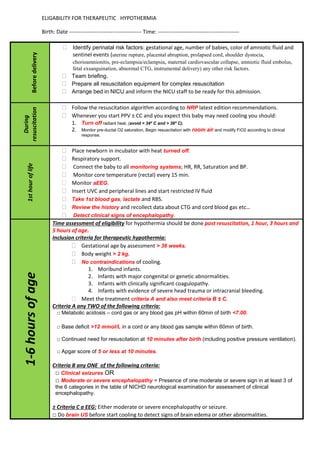
 Identify perinatal risk factors: gestational age, number of babies, color of amniotic fluid and
sentinel events (uterine rupture, placental abruption, prolapsed cord, shoulder dystocia,
chorioamnionitis, pre-eclampsia/eclampsia, maternal cardiovascular collapse, amniotic fluid embolus,
fetal exsanguination, abnormal CTG, instrumental delivery) any other risk factors.
 Team briefing.
 Prepare all resuscitation equipment for complex resuscitation
 Arrange bed in NICU and inform the NICU staff to be ready for this admission.
During
resuscitation
 Follow the resuscitation algorithm according to NRP latest edition recommendations.
 Whenever you start PPV ± CC and you expect this baby may need cooling you should:
1. Turn off radiant heat, (avoid < 34º C and > 36º C).
2. Monitor pre-ductal O2 saturation, Begin resuscitation with room air and modify FiO2 according to clinical
response.
1sthouroflife
 Place newborn in incubator with heat turned off.
 Respiratory support.
 Connect the baby to all monitoring systems; HR, RR, Saturation and BP.
 Monitor core temperature (rectal) every 15 min.
 Monitor aEEG.
 Insert UVC and peripheral lines and start restricted IV fluid
 Take 1st blood gas, lactate and RBS.
 Review the history and recollect data about CTG and cord blood gas etc…
 Detect clinical signs of encephalopathy.
1-6hoursofage
Time assessment of eligibility for hypothermia should be done post resuscitation, 1 hour, 3 hours and
5 hours of age.
Inclusion criteria for therapeutic hypothermia:
 Gestational age by assessment > 36 weeks.
 Body weight > 2 kg.
 No contraindications of cooling.
1. Moribund infants.
2. Infants with major congenital or genetic abnormalities.
3. Infants with clinically significant coagulopathy.
4. Infants with evidence of severe head trauma or intracranial bleeding.
 Meet the treatment criteria A and also meet criteria B ± C.
Criteria A any TWO of the following criteria:
□ Metabolic acidosis – cord gas or any blood gas pH within 60min of birth <7.00.
□ Base deficit >12 mmol/L in a cord or any blood gas sample within 60min of birth.
□ Continued need for resuscitation at 10 minutes after birth (including positive pressure ventilation).
□ Apgar score of 5 or less at 10 minutes.
Criteria B any ONE of the following criteria:
□ Clinical seizures OR
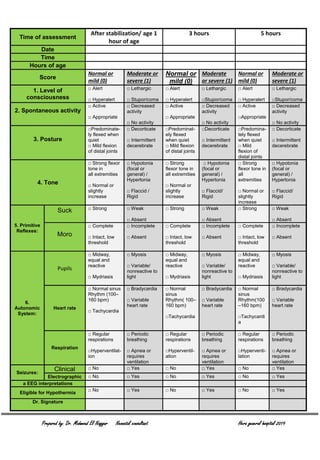
□ Moderate or severe encephalopathy = Presence of one moderate or severe sign in at least 3 of
the 6 categories in the table of NICHD neurological examination for assessment of clinical
encephalopathy.
± Criteria C a EEG: Either moderate or severe encephalopathy or seizure.
□ Do brain US before start cooling to detect signs of brain edema or other abnormalities.
Time of assessment
After stabilization/ age 1
hour of age
3 hours 5 hours
Date
Time
Hours of age
Score
Normal or
mild (0)
Moderate or
severe (1)
Normal or
mild (0)
Moderate
or severe (1)
Normal or
mild (0)
Moderate or
severe (1)
1. Level of
consciousness
□ Alert
□ Hyperalert
□ Lethargic
□ Stupor/coma
□ Alert
□ Hyperalert
□ Lethargic
□Stupor/coma
□ Alert
□ Hyperalert
□ Lethargic
□Stupor/coma
2. Spontaneous activity
□ Active
□ Appropriate
□ Decreased
activity
□ No activity
□ Active
□ Appropriate
□ Decreased
activity
□ No activity
□ Active
□Appropriate
□ Decreased
activity
□ No activity
3. Posture
□Predominate-
ly flexed when
quiet
□ Mild flexion
of distal joints
□ Decorticate
□ Intermittent
decerebrate
□Predominat-
ely flexed
when quiet
□ Mild flexion
of distal joints
□Decorticate
□ Intermittent
decerebrate
□Predomina-
tely flexed
when quiet
□ Mild
flexion of
distal joints
□ Decorticate
□ Intermittent
decerebrate
4. Tone
□ Strong flexor
tone in
all extremities
□ Normal or
slightly
increase
□ Hypotonia
(focal or
general) /
Hypertonia
□ Flaccid /
Rigid
□ Strong
flexor tone in
all extremities
□ Normal or
slightly
increase
□ Hypotonia
(focal or
general) /
Hypertonia
□ Flaccid/
Rigid
□ Strong
flexor tone in
all
extremities
□ Normal or
slightly
increase
□ Hypotonia
(focal or
general) /
Hypertonia
□ Flaccid/
Rigid
5. Primitive
Reflexes:
Suck □ Strong □ Weak
□ Absent
□ Strong □ Weak
□ Absent
□ Strong □ Weak
□ Absent
Moro
□ Complete
□ Intact, low
threshold
□ Incomplete
□ Absent
□ Complete
□ Intact, low
threshold
□ Incomplete
□ Absent
□ Complete
□ Intact, low
threshold
□ Incomplete
□ Absent
6.
Autonomic
System:
Pupils
□ Midway,
equal and
reactive
□ Mydriasis
□ Myosis
□ Variable/
nonreactive to
light
□ Midway,
equal and
reactive
□ Mydriasis
□ Myosis
□ Variable/
nonreactive to
light
□ Midway,
equal and
reactive
□ Mydriasis
□ Myosis
□ Variable/
nonreactive to
light
Heart rate
□ Normal sinus
Rhythm (100–
160 bpm)
□ Tachycardia
□ Bradycardia
□ Variable
heart rate
□ Normal
sinus
Rhythm( 100–
160 bpm)
□Tachycardia
□ Bradycardia
□ Variable
heart rate
□ Normal
sinus
Rhythm(100
–160 bpm)
□Tachycardi
a
□ Bradycardia
□ Variable
heart rate
Respiration
□ Regular
respirations
□Hyperventilat-
ion
□ Periodic
breathing
□ Apnea or
requires
ventilation
□ Regular
respirations
□Hyperventil-
ation
□ Periodic
breathing
□ Apnea or
requires
ventilation
□ Regular
respirations
□Hyperventi-
lation
□ Periodic
breathing
□ Apnea or
requires
ventilation
Seizures:
Clinical □ No □ Yes □ No □ Yes □ No □ Yes
Electrographic □ No □ Yes □ No □ Yes □ No □ Yes
a EEG interpretations
Eligible for Hypothermia
□ No □ Yes □ No □ Yes □ No □ Yes
Dr. Signature
Prepared by: Dr. Mahmoud El Naggar Neonatal consultant Hera general hospital 2019

Eligability for therapeutic hypothermia protocol

  • 1.
    ELIGABILITY FOR THERAPEUTICHYPOTHERMIA Birth: Date ---------------------------------------- Time: ---------------------------------------------Beforedelivery  Identify perinatal risk factors: gestational age, number of babies, color of amniotic fluid and sentinel events (uterine rupture, placental abruption, prolapsed cord, shoulder dystocia, chorioamnionitis, pre-eclampsia/eclampsia, maternal cardiovascular collapse, amniotic fluid embolus, fetal exsanguination, abnormal CTG, instrumental delivery) any other risk factors.  Team briefing.  Prepare all resuscitation equipment for complex resuscitation  Arrange bed in NICU and inform the NICU staff to be ready for this admission. During resuscitation  Follow the resuscitation algorithm according to NRP latest edition recommendations.  Whenever you start PPV ± CC and you expect this baby may need cooling you should: 1. Turn off radiant heat, (avoid < 34º C and > 36º C). 2. Monitor pre-ductal O2 saturation, Begin resuscitation with room air and modify FiO2 according to clinical response. 1sthouroflife  Place newborn in incubator with heat turned off.  Respiratory support.  Connect the baby to all monitoring systems; HR, RR, Saturation and BP.  Monitor core temperature (rectal) every 15 min.  Monitor aEEG.  Insert UVC and peripheral lines and start restricted IV fluid  Take 1st blood gas, lactate and RBS.  Review the history and recollect data about CTG and cord blood gas etc…  Detect clinical signs of encephalopathy. 1-6hoursofage Time assessment of eligibility for hypothermia should be done post resuscitation, 1 hour, 3 hours and 5 hours of age. Inclusion criteria for therapeutic hypothermia:  Gestational age by assessment > 36 weeks.  Body weight > 2 kg.  No contraindications of cooling. 1. Moribund infants. 2. Infants with major congenital or genetic abnormalities. 3. Infants with clinically significant coagulopathy. 4. Infants with evidence of severe head trauma or intracranial bleeding.  Meet the treatment criteria A and also meet criteria B ± C. Criteria A any TWO of the following criteria: □ Metabolic acidosis – cord gas or any blood gas pH within 60min of birth <7.00. □ Base deficit >12 mmol/L in a cord or any blood gas sample within 60min of birth. □ Continued need for resuscitation at 10 minutes after birth (including positive pressure ventilation). □ Apgar score of 5 or less at 10 minutes. Criteria B any ONE of the following criteria: □ Clinical seizures OR □ Moderate or severe encephalopathy = Presence of one moderate or severe sign in at least 3 of the 6 categories in the table of NICHD neurological examination for assessment of clinical encephalopathy. ± Criteria C a EEG: Either moderate or severe encephalopathy or seizure. □ Do brain US before start cooling to detect signs of brain edema or other abnormalities.
  • 2.
    Time of assessment Afterstabilization/ age 1 hour of age 3 hours 5 hours Date Time Hours of age Score Normal or mild (0) Moderate or severe (1) Normal or mild (0) Moderate or severe (1) Normal or mild (0) Moderate or severe (1) 1. Level of consciousness □ Alert □ Hyperalert □ Lethargic □ Stupor/coma □ Alert □ Hyperalert □ Lethargic □Stupor/coma □ Alert □ Hyperalert □ Lethargic □Stupor/coma 2. Spontaneous activity □ Active □ Appropriate □ Decreased activity □ No activity □ Active □ Appropriate □ Decreased activity □ No activity □ Active □Appropriate □ Decreased activity □ No activity 3. Posture □Predominate- ly flexed when quiet □ Mild flexion of distal joints □ Decorticate □ Intermittent decerebrate □Predominat- ely flexed when quiet □ Mild flexion of distal joints □Decorticate □ Intermittent decerebrate □Predomina- tely flexed when quiet □ Mild flexion of distal joints □ Decorticate □ Intermittent decerebrate 4. Tone □ Strong flexor tone in all extremities □ Normal or slightly increase □ Hypotonia (focal or general) / Hypertonia □ Flaccid / Rigid □ Strong flexor tone in all extremities □ Normal or slightly increase □ Hypotonia (focal or general) / Hypertonia □ Flaccid/ Rigid □ Strong flexor tone in all extremities □ Normal or slightly increase □ Hypotonia (focal or general) / Hypertonia □ Flaccid/ Rigid 5. Primitive Reflexes: Suck □ Strong □ Weak □ Absent □ Strong □ Weak □ Absent □ Strong □ Weak □ Absent Moro □ Complete □ Intact, low threshold □ Incomplete □ Absent □ Complete □ Intact, low threshold □ Incomplete □ Absent □ Complete □ Intact, low threshold □ Incomplete □ Absent 6. Autonomic System: Pupils □ Midway, equal and reactive □ Mydriasis □ Myosis □ Variable/ nonreactive to light □ Midway, equal and reactive □ Mydriasis □ Myosis □ Variable/ nonreactive to light □ Midway, equal and reactive □ Mydriasis □ Myosis □ Variable/ nonreactive to light Heart rate □ Normal sinus Rhythm (100– 160 bpm) □ Tachycardia □ Bradycardia □ Variable heart rate □ Normal sinus Rhythm( 100– 160 bpm) □Tachycardia □ Bradycardia □ Variable heart rate □ Normal sinus Rhythm(100 –160 bpm) □Tachycardi a □ Bradycardia □ Variable heart rate Respiration □ Regular respirations □Hyperventilat- ion □ Periodic breathing □ Apnea or requires ventilation □ Regular respirations □Hyperventil- ation □ Periodic breathing □ Apnea or requires ventilation □ Regular respirations □Hyperventi- lation □ Periodic breathing □ Apnea or requires ventilation Seizures: Clinical □ No □ Yes □ No □ Yes □ No □ Yes Electrographic □ No □ Yes □ No □ Yes □ No □ Yes a EEG interpretations Eligible for Hypothermia □ No □ Yes □ No □ Yes □ No □ Yes Dr. Signature Prepared by: Dr. Mahmoud El Naggar Neonatal consultant Hera general hospital 2019