
NIV: indications, settings, and that
pesky order form
Ryan Cheng
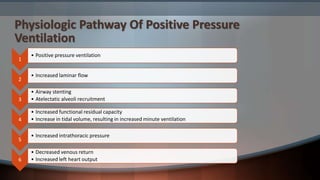
Physiologic Pathway Of Positive Pressure
Ventilation
1
• Positive pressure ventilation
2
• Increased laminar flow
3
• Airway stenting
• Atelectatic alveoli recruitment
4
• Increased functional residual capacity
• Increase in tidal volume, resulting in increased minute ventilation
5
• Increased intrathoracic pressure
6
• Decreased venous return
• Increased left heart output
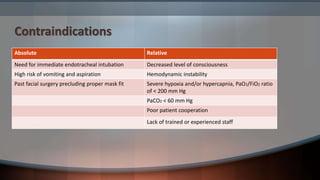
Contraindications
Absolute Relative
Need for immediate endotracheal intubation Decreased level of consciousness
High risk of vomiting and aspiration Hemodynamic instability
Past facial surgery precluding proper mask fit Severe hypoxia and/or hypercapnia, PaO2/FiO2 ratio
of < 200 mm Hg
PaCO2 < 60 mm Hg
Poor patient cooperation
Lack of trained or experienced staff
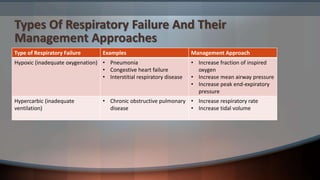
Types Of Respiratory Failure And Their
Management Approaches
Type of Respiratory Failure Examples Management Approach
Hypoxic (inadequate oxygenation) • Pneumonia
• Congestive heart failure
• Interstitial respiratory disease
• Increase fraction of inspired
oxygen
• Increase mean airway pressure
• Increase peak end-expiratory
pressure
Hypercarbic (inadequate
ventilation)
• Chronic obstructive pulmonary
disease
• Increase respiratory rate
• Increase tidal volume
BiPAP vs CPAP
• CPAP: inspiratory = expiratory pressure (constant)
• Acute hypoxia
• BiPAP: inspiratory > expiratory pressure
• Hypercapnic respiratory failure with acidosis
Pressure Settings
• CPAP: start at 10cm H2O
• BiPAP: IPAP of 10cm H2O and EPAP of 5cm H2O
• IPAP > 20cm H2O poorly tolerated and can cause gastric insufflation
• Pressures should never exceed 25cm
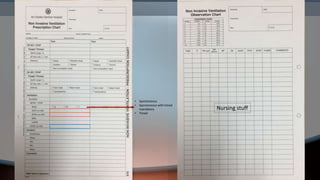
• Spontaneous
• Spontaneous with timed
mandatory
• Timed
Nursing stuff
Troubleshooting
• Persistent ↑CO2
• ↑ IPAP: obesity, poor compliance
• Increase by 2cm increments
• Keep EPAP unchanged while increasing IPAP to increase tidal volume
• Persistent ↓O2 despite ↓CO2
• ↑FiO2
• ↑EPAP
• Increase by 1cm increments
• IPAP must be increased simultaneously to maintain tidal volume
• Sudden deterioration
• Consider alternatives: pneumo, PE, arrhythmias…
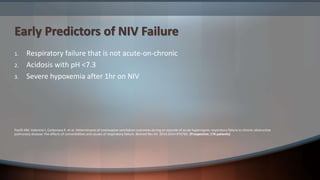
Early Predictors of NIV Failure
1. Respiratory failure that is not acute-on-chronic
2. Acidosis with pH <7.3
3. Severe hypoxemia after 1hr on NIV
Pacilli AM, Valentini I, Carbonara P, et al. Determinants of noninvasive ventilation outcomes during an episode of acute hypercapnic respiratory failure in chronic obstructive
pulmonary disease: the effects of comorbidities and causes of respiratory failure. Biomed Res Int. 2014;2014:976783. (Prospective; 176 patients)
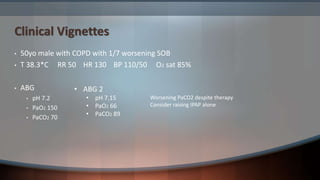
Clinical Vignettes
• 50yo male with COPD with 1/7 worsening SOB
• T 38.3*C RR 50 HR 130 BP 110/50 O2 sat 85%
• ABG
• pH 7.2
• PaO2 150
• PaCO2 70
• ABG 2
• pH 7.15
• PaO2 66
• PaCO2 89
Worsening PaCO2 despite therapy
Consider raising IPAP alone
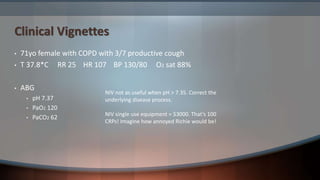
Clinical Vignettes
• 71yo female with COPD with 3/7 productive cough
• T 37.8*C RR 25 HR 107 BP 130/80 O2 sat 88%
• ABG
• pH 7.37
• PaO2 120
• PaCO2 62
NIV not as useful when pH > 7.35. Correct the
underlying disease process.
NIV single use equipment = $3000. That’s 100
CRPs! Imagine how annoyed Richie would be!
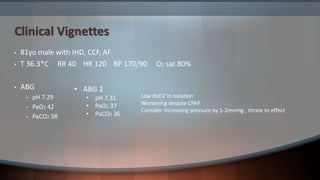
Clinical Vignettes
• 81yo male with IHD, CCF, AF
• T 36.3*C RR 40 HR 120 BP 170/90 O2 sat 80%
• ABG
• pH 7.29
• PaO2 42
• PaCO2 38
• ABG 2
• pH 7.31
• PaO2 37
• PaCO2 36
Low PaO2 in isolation
Worsening despite CPAP
Consider increasing pressure by 1-2mmHg , titrate to effect

Non-Invasive Ventilation

  • 1.
    NIV: indications, settings,and that pesky order form Ryan Cheng
  • 2.
    Physiologic Pathway OfPositive Pressure Ventilation 1 • Positive pressure ventilation 2 • Increased laminar flow 3 • Airway stenting • Atelectatic alveoli recruitment 4 • Increased functional residual capacity • Increase in tidal volume, resulting in increased minute ventilation 5 • Increased intrathoracic pressure 6 • Decreased venous return • Increased left heart output
  • 4.
    Contraindications Absolute Relative Need forimmediate endotracheal intubation Decreased level of consciousness High risk of vomiting and aspiration Hemodynamic instability Past facial surgery precluding proper mask fit Severe hypoxia and/or hypercapnia, PaO2/FiO2 ratio of < 200 mm Hg PaCO2 < 60 mm Hg Poor patient cooperation Lack of trained or experienced staff
  • 5.
    Types Of RespiratoryFailure And Their Management Approaches Type of Respiratory Failure Examples Management Approach Hypoxic (inadequate oxygenation) • Pneumonia • Congestive heart failure • Interstitial respiratory disease • Increase fraction of inspired oxygen • Increase mean airway pressure • Increase peak end-expiratory pressure Hypercarbic (inadequate ventilation) • Chronic obstructive pulmonary disease • Increase respiratory rate • Increase tidal volume
  • 6.
    BiPAP vs CPAP •CPAP: inspiratory = expiratory pressure (constant) • Acute hypoxia • BiPAP: inspiratory > expiratory pressure • Hypercapnic respiratory failure with acidosis
  • 7.
    Pressure Settings • CPAP:start at 10cm H2O • BiPAP: IPAP of 10cm H2O and EPAP of 5cm H2O • IPAP > 20cm H2O poorly tolerated and can cause gastric insufflation • Pressures should never exceed 25cm
  • 8.
    • Spontaneous • Spontaneouswith timed mandatory • Timed Nursing stuff
  • 9.
    Troubleshooting • Persistent ↑CO2 •↑ IPAP: obesity, poor compliance • Increase by 2cm increments • Keep EPAP unchanged while increasing IPAP to increase tidal volume • Persistent ↓O2 despite ↓CO2 • ↑FiO2 • ↑EPAP • Increase by 1cm increments • IPAP must be increased simultaneously to maintain tidal volume • Sudden deterioration • Consider alternatives: pneumo, PE, arrhythmias…
  • 10.
    Early Predictors ofNIV Failure 1. Respiratory failure that is not acute-on-chronic 2. Acidosis with pH <7.3 3. Severe hypoxemia after 1hr on NIV Pacilli AM, Valentini I, Carbonara P, et al. Determinants of noninvasive ventilation outcomes during an episode of acute hypercapnic respiratory failure in chronic obstructive pulmonary disease: the effects of comorbidities and causes of respiratory failure. Biomed Res Int. 2014;2014:976783. (Prospective; 176 patients)
  • 11.
    Clinical Vignettes • 50yomale with COPD with 1/7 worsening SOB • T 38.3*C RR 50 HR 130 BP 110/50 O2 sat 85% • ABG • pH 7.2 • PaO2 150 • PaCO2 70 • ABG 2 • pH 7.15 • PaO2 66 • PaCO2 89 Worsening PaCO2 despite therapy Consider raising IPAP alone
  • 12.
    Clinical Vignettes • 71yofemale with COPD with 3/7 productive cough • T 37.8*C RR 25 HR 107 BP 130/80 O2 sat 88% • ABG • pH 7.37 • PaO2 120 • PaCO2 62 NIV not as useful when pH > 7.35. Correct the underlying disease process. NIV single use equipment = $3000. That’s 100 CRPs! Imagine how annoyed Richie would be!
  • 13.
    Clinical Vignettes • 81yomale with IHD, CCF, AF • T 36.3*C RR 40 HR 120 BP 170/90 O2 sat 80% • ABG • pH 7.29 • PaO2 42 • PaCO2 38 • ABG 2 • pH 7.31 • PaO2 37 • PaCO2 36 Low PaO2 in isolation Worsening despite CPAP Consider increasing pressure by 1-2mmHg , titrate to effect