Ventilation Strategies in ARDS  MICU-ER Joint Conference Dr. Rachmale, Dr. Prasankumar 12/3/08
Initial ICU Management EGDT implemented, CVP- Subclavian line placed, Initial CVP= 8 , Lactic Acid- 5.5  CVP aim > 12, Map > 65   IV fluids 3L, Urine output >0.5ml/kg/hr Antibiotics- zosyn/ ciprofloxacin within one hour Initial ABG: pH: 7.19 Po2: 60  Pco2: 48, sat 84%  At this time Ventilator setting: AC/TV-400/RR-28/FiO2 100%/PAP-36/PLP-30/ peep- 7 Pao2/Fi02:60
ARDS- Definition 1. PaO2/FiO2 ≤ 200  2. Bilateral (patchy, diffuse, or homogeneous) infiltrates consistent with pulmonary edema 3. No clinical evidence of left atrial hypertension ( PCWP<18)
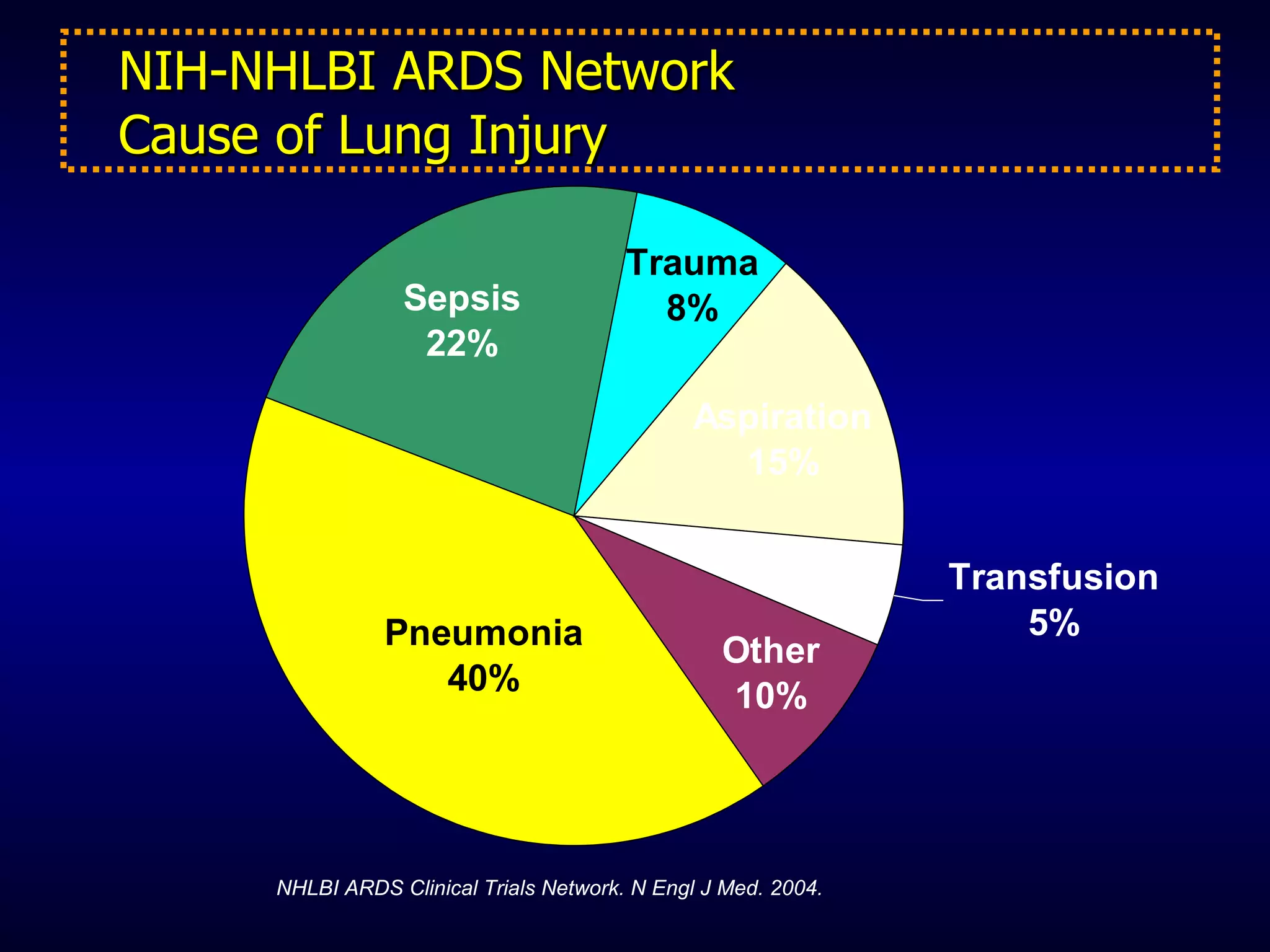
NIH-NHLBI ARDS Network  Cause of Lung Injury NHLBI ARDS Clinical Trials Network. N Engl J Med. 2004.
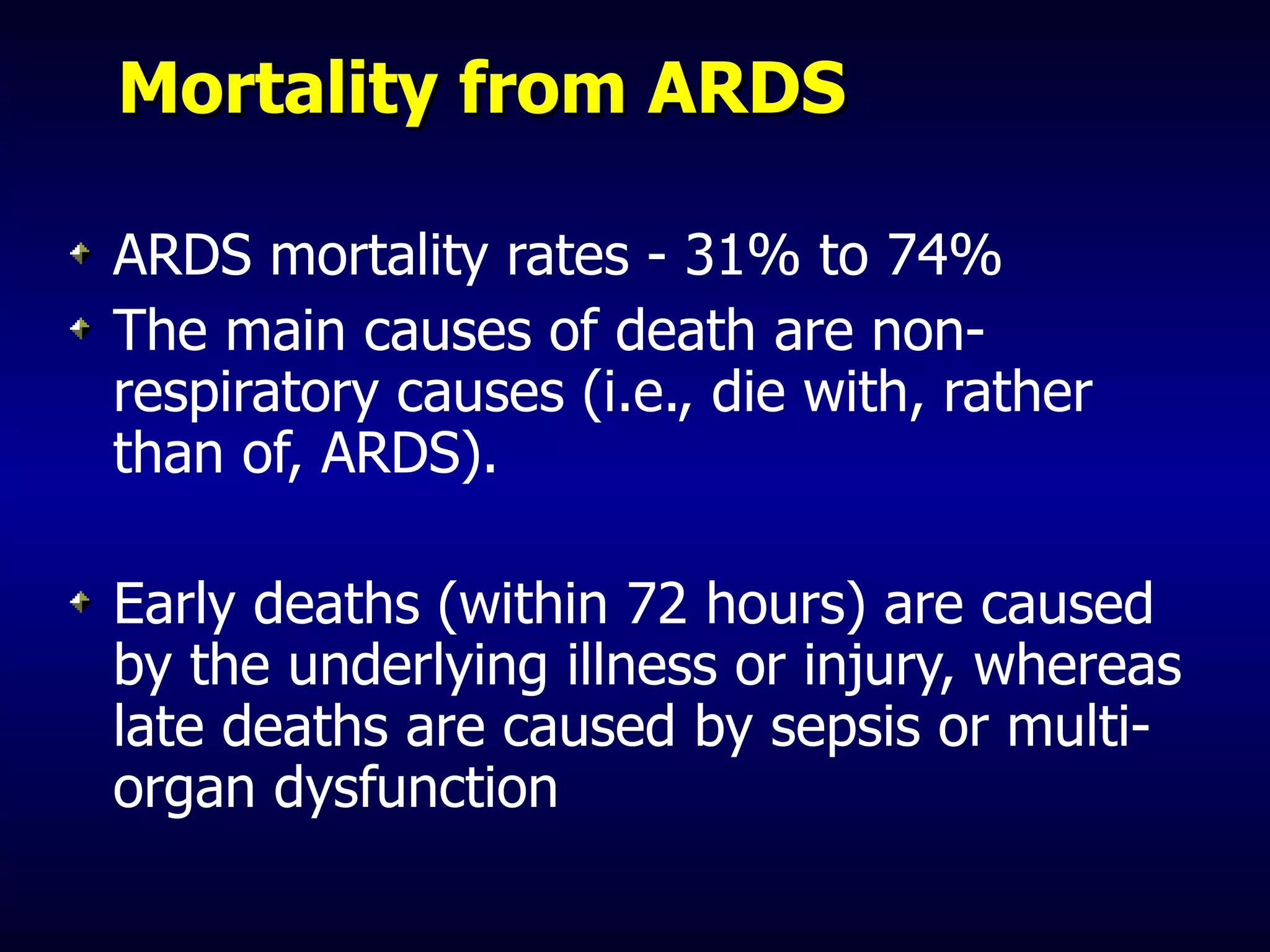
Mortality from ARDS ARDS mortality rates - 31% to 74% The main causes of death are non-respiratory causes (i.e., die with, rather than of, ARDS). Early deaths (within 72 hours) are caused by the underlying illness or injury, whereas late deaths are caused by sepsis or multi-organ dysfunction
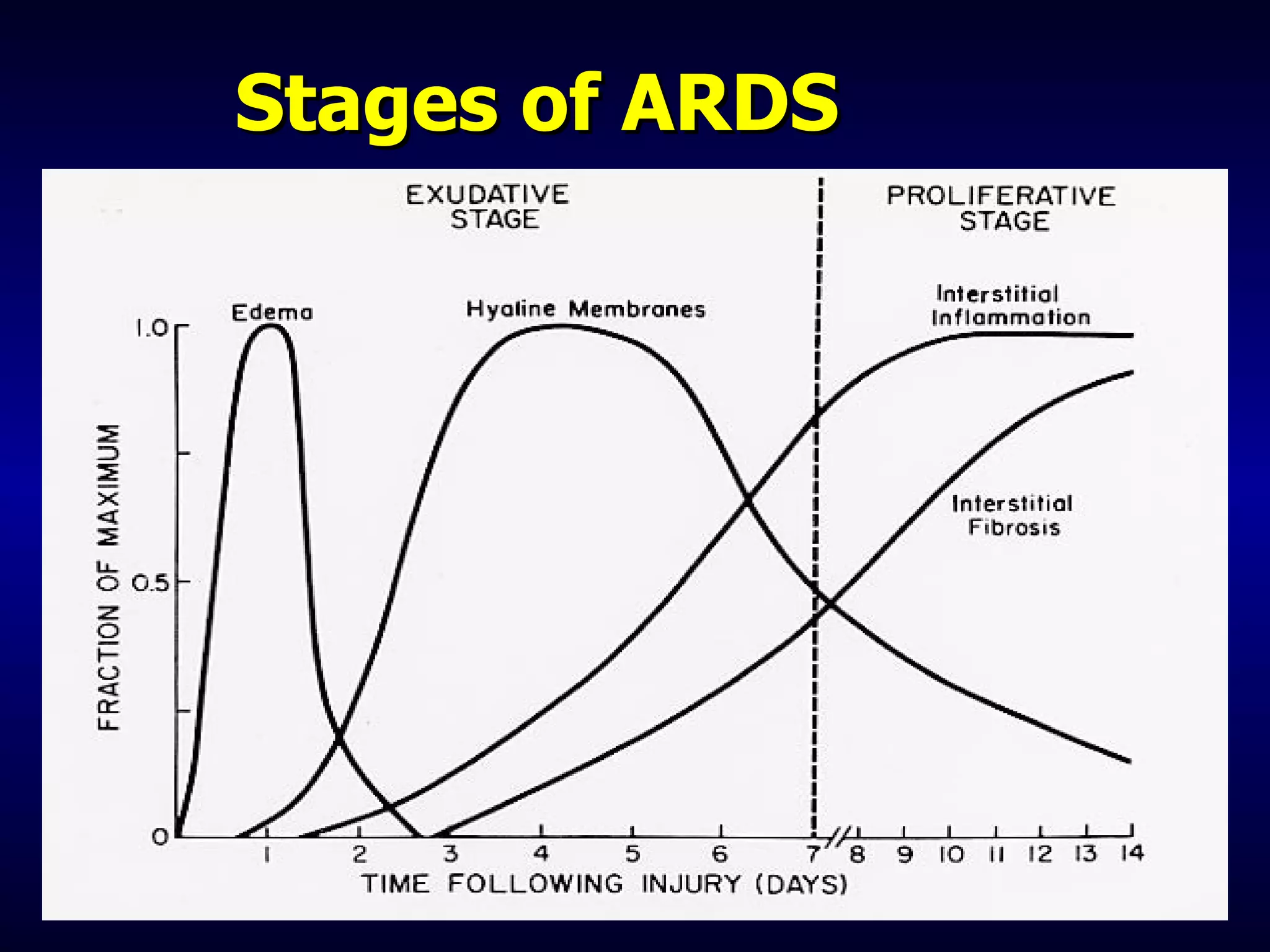
Stages of ARDS
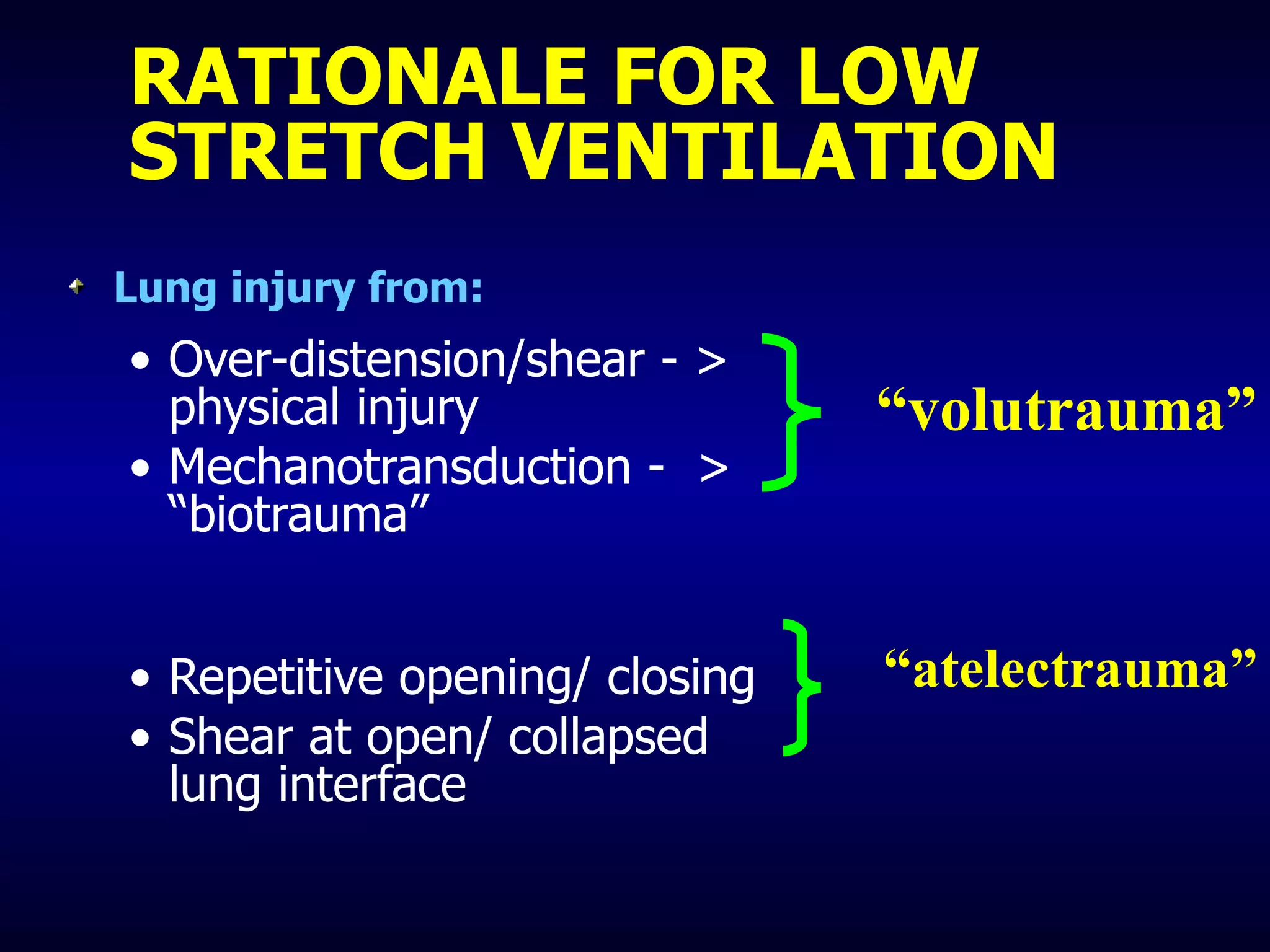
RATIONALE FOR LOW STRETCH VENTILATION Lung injury from: Over-distension/shear - > physical injury Mechanotransduction -  > “biotrauma” Repetitive opening/ closing  Shear at open/ collapsed lung interface “ atelectrauma” “ volutrauma”
ARDSNET- Initial Ventilator Strategies Low Tidal Volume (6ml/kg) Calculate predicted body weight (PBW)  Males  = 50 + 2.3 [height (inches) –  Females  = 45.5 + 2.3 [height (inches) -60 ] Plateau Pressure < 30 cms
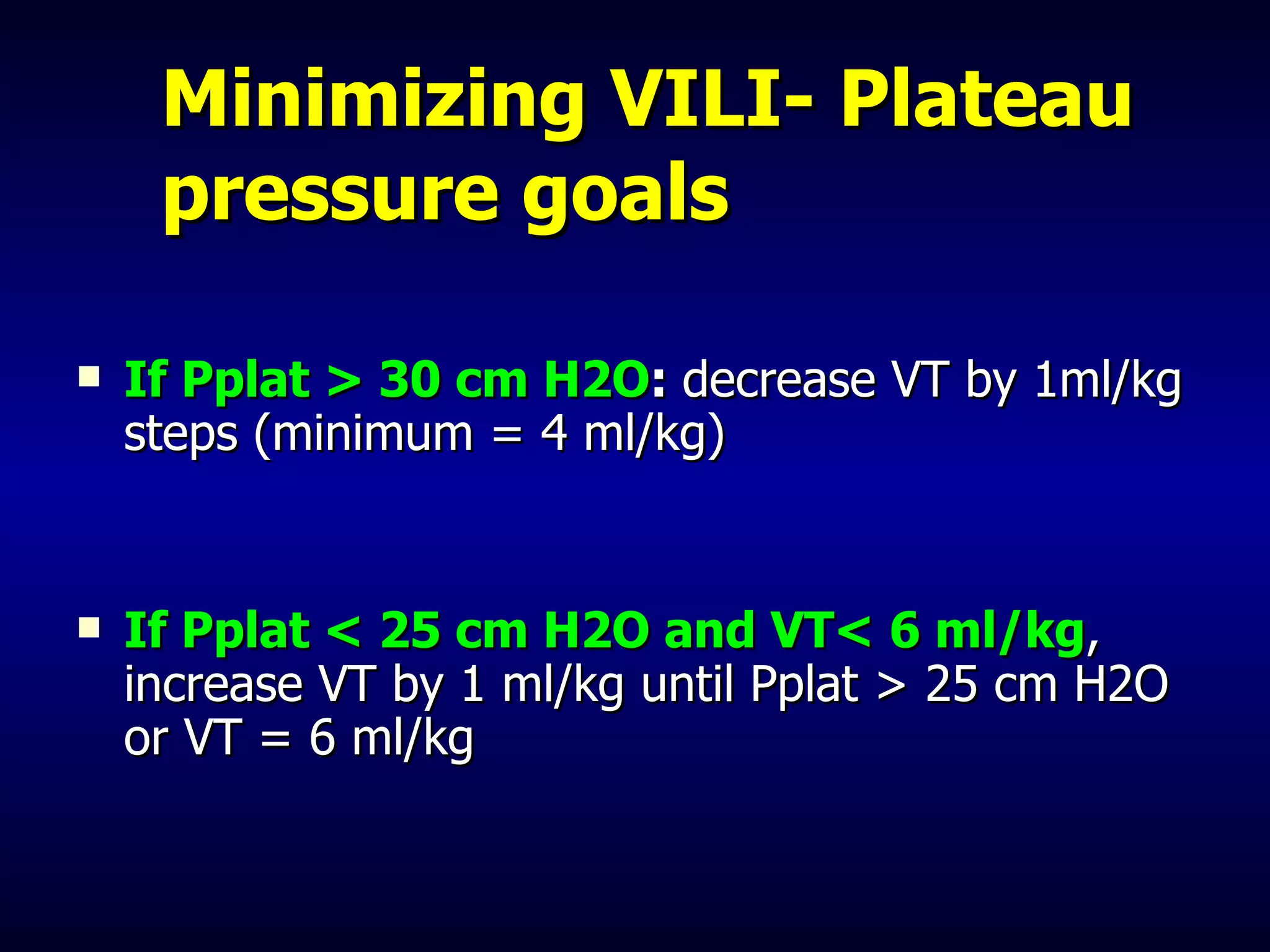
Minimizing VILI- Plateau pressure goals If Pplat > 30 cm H2O :  decrease VT by 1ml/kg steps (minimum = 4 ml/kg) If Pplat < 25 cm H2O and VT< 6 ml/kg , increase VT by 1 ml/kg until Pplat > 25 cm H2O or VT = 6 ml/kg
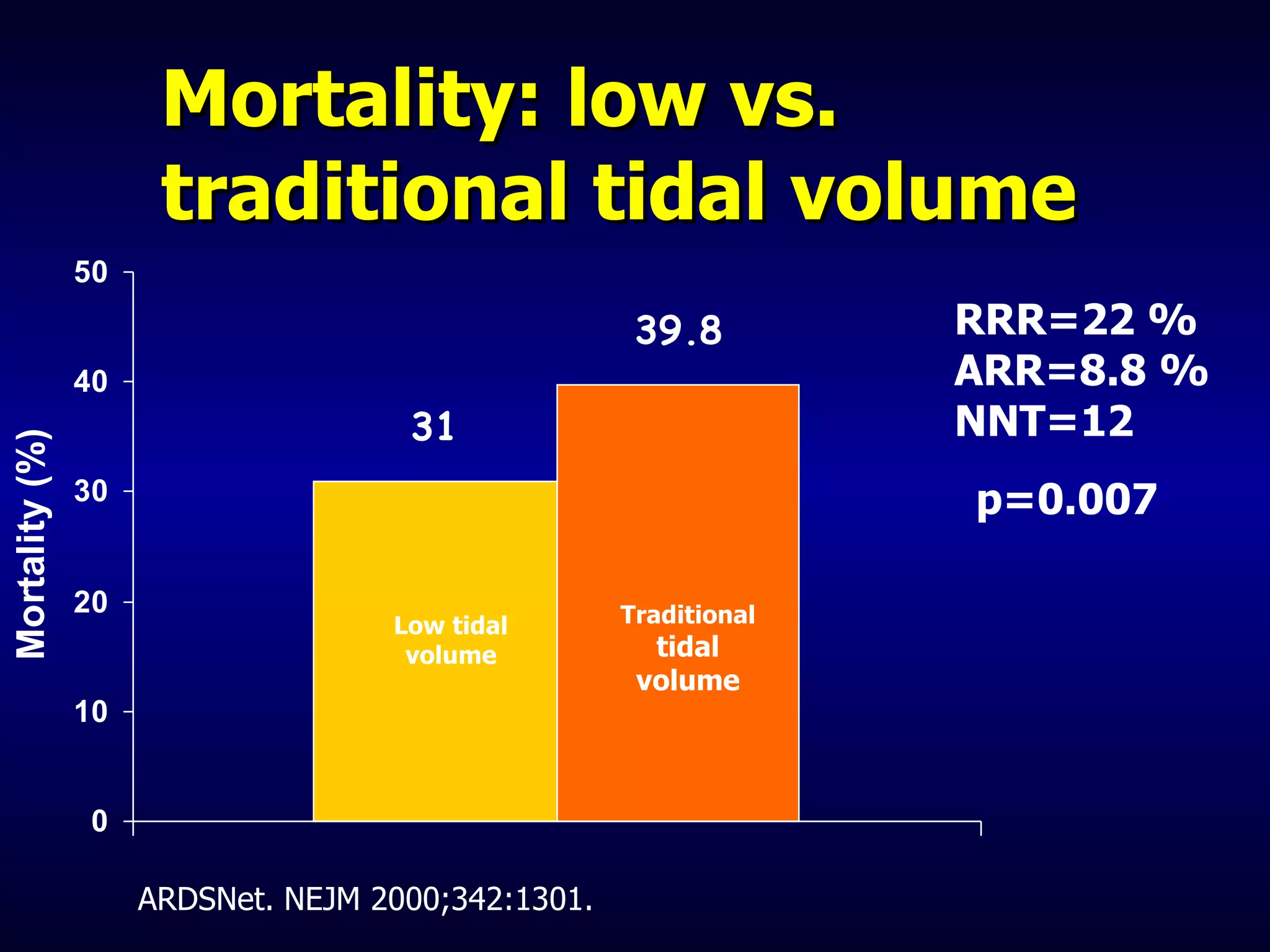
Mortality: low vs. traditional tidal volume Low tidal volume Traditional tidal volume RRR=22 % ARR=8.8 % NNT=12 p=0.007 ARDSNet. NEJM 2000;342:1301.
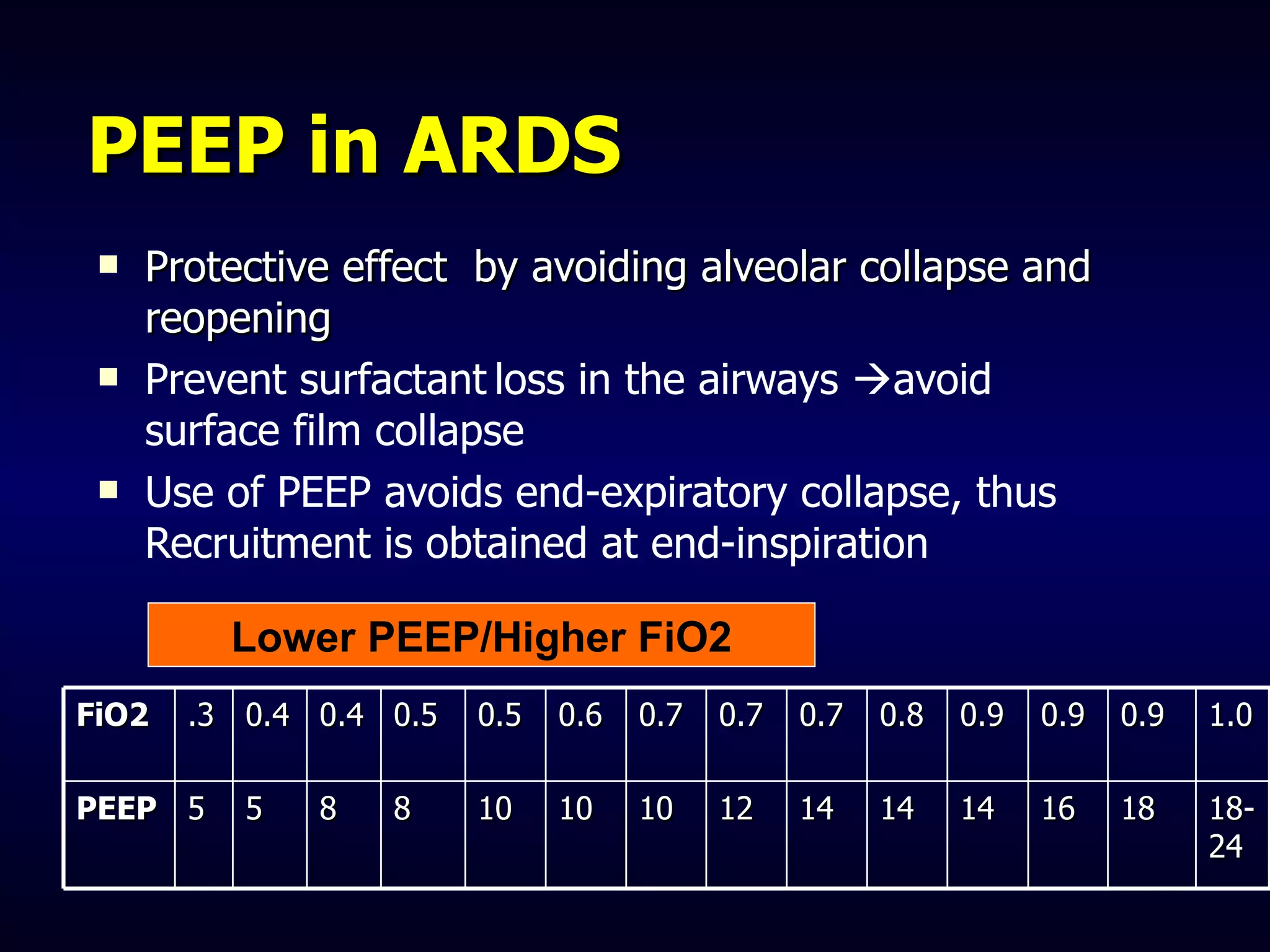
PEEP in ARDS Protective effect  by avoiding alveolar collapse and reopening Prevent surfactant   loss in the airways   avoid surface film collapse Use of PEEP avoids end-expiratory collapse, thus Recruitment is obtained at end-inspiration Lower PEEP/Higher FiO2 FiO2 .3  0.4  0.4  0.5  0.5  0.6  0.7  0.7  0.7 0.8 0.9 0.9 0.9 1.0 PEEP  5  5  8  8  10  10  10  12  14 14 14 16 18 18-24
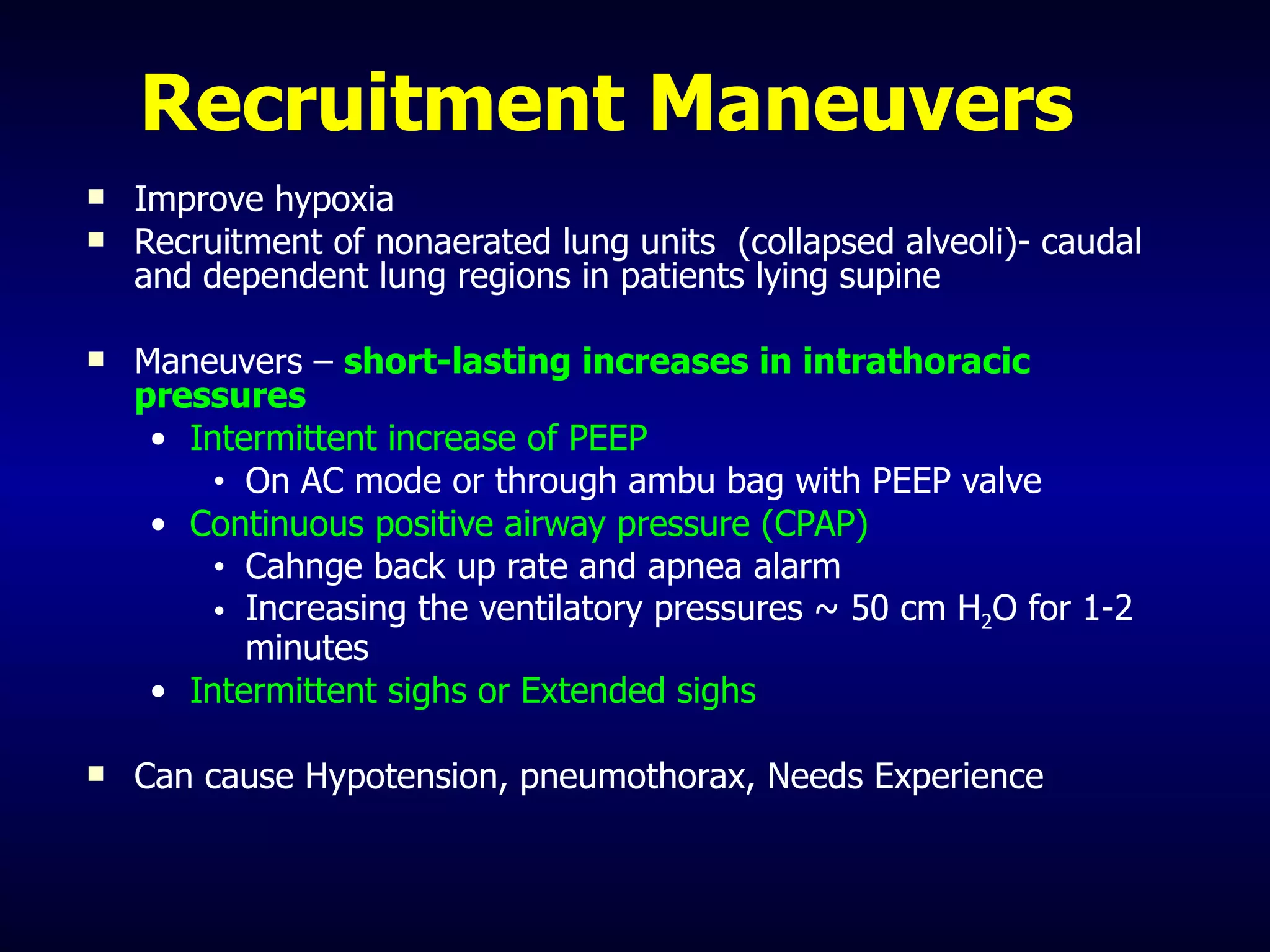
Recruitment Maneuvers Improve hypoxia Recruitment of nonaerated lung units  (collapsed alveoli)- caudal and dependent lung regions in patients lying supine Maneuvers –  short-lasting increases in intrathoracic pressures Intermittent increase of PEEP On AC mode or through ambu bag with PEEP valve Continuous positive airway pressure (CPAP) Cahnge back up rate and apnea alarm Increasing the ventilatory pressures ~ 50 cm H 2 O for 1-2 minutes  Intermittent sighs or Extended sighs Can cause Hypotension, pneumothorax, Needs Experience
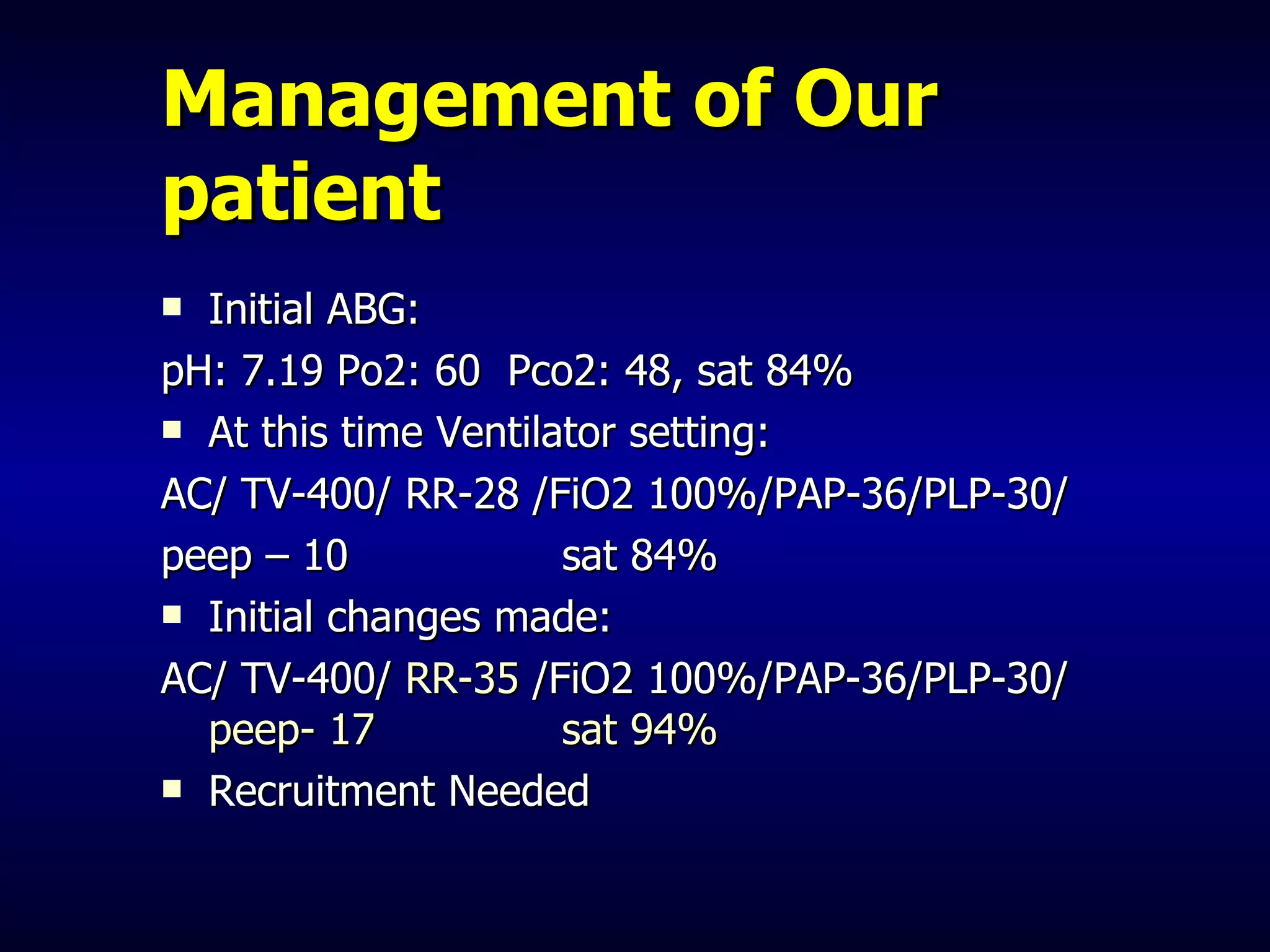
Management of Our patient Initial ABG: pH: 7.19 Po2: 60  Pco2: 48, sat 84%  At this time Ventilator setting: AC/ TV-400/ RR-28 /FiO2 100%/PAP-36/PLP-30/  peep – 10  sat 84% Initial changes made: AC/ TV-400/  RR-35  /FiO2 100%/PAP-36/PLP-30/  peep- 17  sat 94% Recruitment Needed
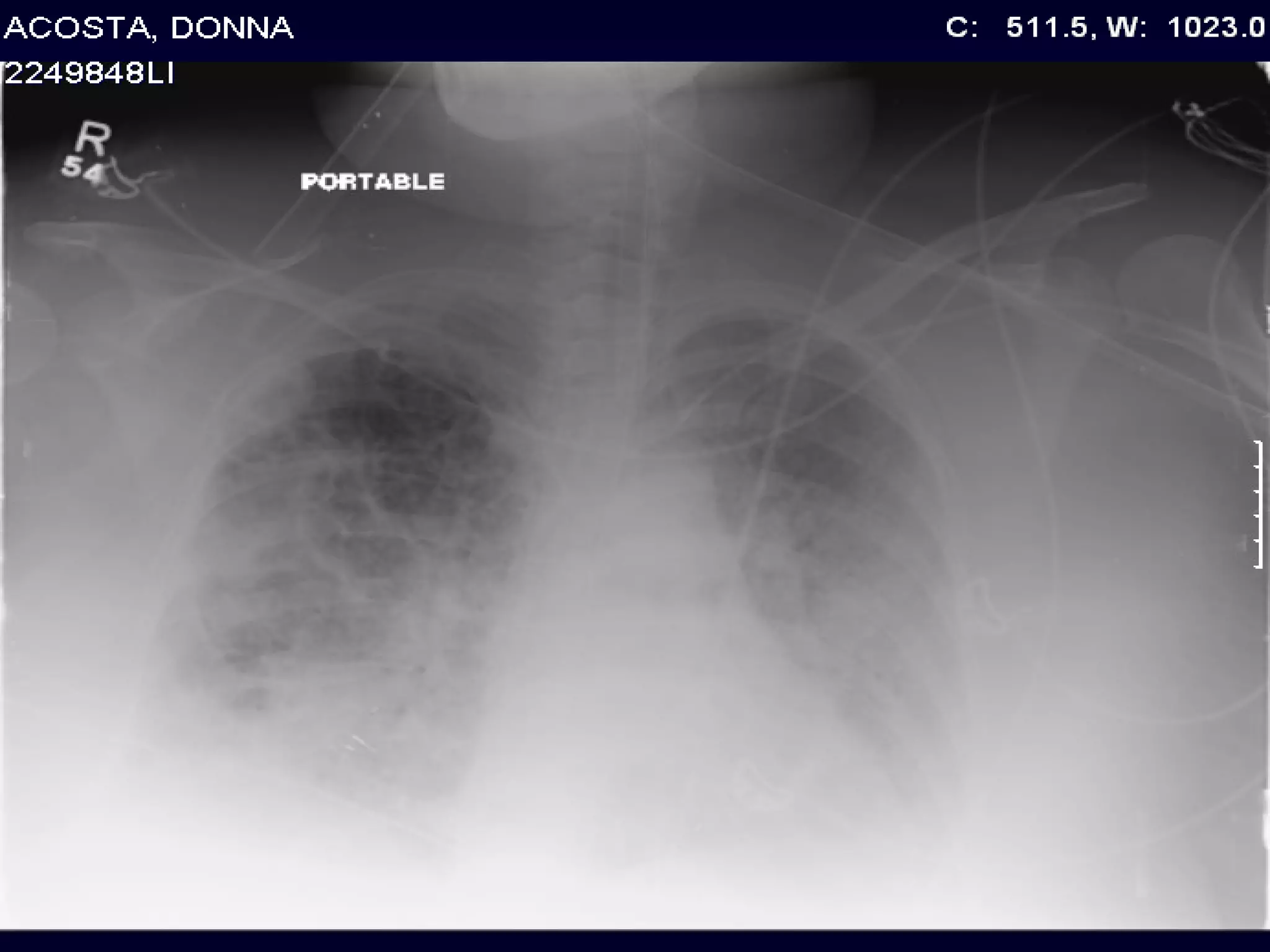
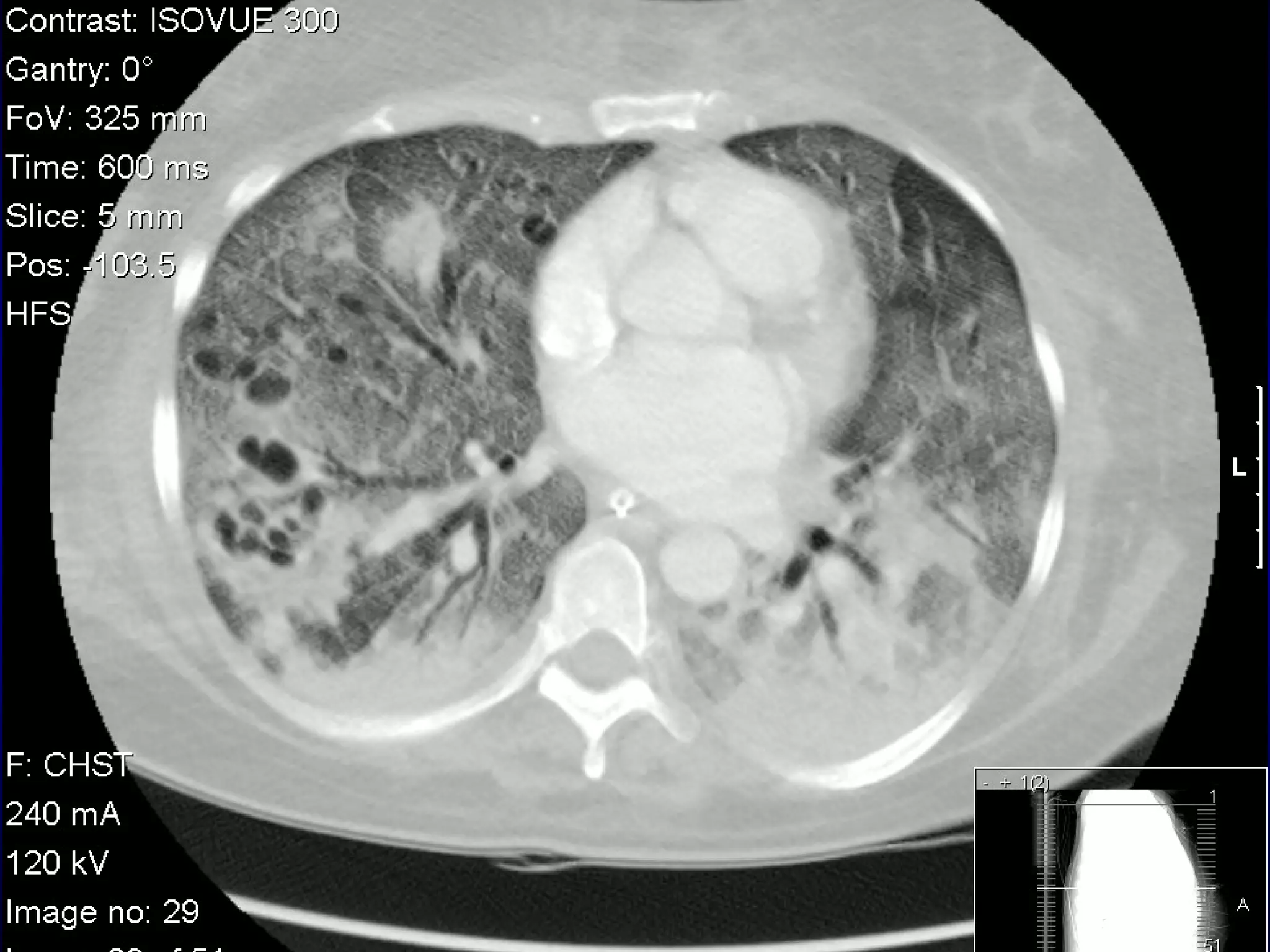
Management continued After transfer to MICU, episodes of hypoxia despite maximal mechanical ventilation Improved with recruitment maneuvers Next 48 hours : Vt decreased to  370  then 320, PEEP increased to  20  then  22 , plateau pressures  34-37  on 100% FiO2 Even such Low Vt, unable to maintain plateau pressures below 30  Permissive Hypercapnia
 
 
Management continued   Severe sepsis   septic shock, apache 38 Aggressive hydration, Vasopressor (Levophed) to maintain MAP>65, fixed dose vasopressin, hydrocortisone and xigris ( Activated Protein C) given Lactate remained high, SvO2: 70-77%  BC – Strep pneumonia-
Hospital Course During entire 25 day course Fio2 requirements could not be lowered to less than 80%, the least PEEP was 14 Peak and plateau pressure remained high Septic shock   MSOF   death
Alternative  strategies Prone Positioning-  recruitment of posterior lung fields High frequency oscillatory ventilation (HFOV)-  low tial volumes at high frequences Nitric oxide-  selective vasodilator of vessels that perfuse well ventilated lung zones Extracorporeal membrane oxygenation (ECMO )-Veno-arterial bypass which supports gas exchange and oxygenation
Limited VT 6 mL/kg  PBW to avoid alveolar distension End-inspiratory  plateau pressure < 30  cm  H 2 O Adequate end expiratory lung volumes utilizing  PEEP  and higher mean airway pressures to minimize atelectrauma and improve oxygenation Consider recruitment maneuvers Summary of Recommendations

Ventilation strategies in ards rachmale

  • 1.
    Ventilation Strategies inARDS MICU-ER Joint Conference Dr. Rachmale, Dr. Prasankumar 12/3/08
  • 2.
    Initial ICU ManagementEGDT implemented, CVP- Subclavian line placed, Initial CVP= 8 , Lactic Acid- 5.5 CVP aim > 12, Map > 65  IV fluids 3L, Urine output >0.5ml/kg/hr Antibiotics- zosyn/ ciprofloxacin within one hour Initial ABG: pH: 7.19 Po2: 60 Pco2: 48, sat 84% At this time Ventilator setting: AC/TV-400/RR-28/FiO2 100%/PAP-36/PLP-30/ peep- 7 Pao2/Fi02:60
  • 3.
    ARDS- Definition 1.PaO2/FiO2 ≤ 200 2. Bilateral (patchy, diffuse, or homogeneous) infiltrates consistent with pulmonary edema 3. No clinical evidence of left atrial hypertension ( PCWP<18)
  • 4.
    NIH-NHLBI ARDS Network Cause of Lung Injury NHLBI ARDS Clinical Trials Network. N Engl J Med. 2004.
  • 5.
    Mortality from ARDSARDS mortality rates - 31% to 74% The main causes of death are non-respiratory causes (i.e., die with, rather than of, ARDS). Early deaths (within 72 hours) are caused by the underlying illness or injury, whereas late deaths are caused by sepsis or multi-organ dysfunction
  • 6.
  • 7.
    RATIONALE FOR LOWSTRETCH VENTILATION Lung injury from: Over-distension/shear - > physical injury Mechanotransduction - > “biotrauma” Repetitive opening/ closing Shear at open/ collapsed lung interface “ atelectrauma” “ volutrauma”
  • 8.
    ARDSNET- Initial VentilatorStrategies Low Tidal Volume (6ml/kg) Calculate predicted body weight (PBW) Males = 50 + 2.3 [height (inches) – Females = 45.5 + 2.3 [height (inches) -60 ] Plateau Pressure < 30 cms
  • 9.
    Minimizing VILI- Plateaupressure goals If Pplat > 30 cm H2O : decrease VT by 1ml/kg steps (minimum = 4 ml/kg) If Pplat < 25 cm H2O and VT< 6 ml/kg , increase VT by 1 ml/kg until Pplat > 25 cm H2O or VT = 6 ml/kg
  • 10.
    Mortality: low vs.traditional tidal volume Low tidal volume Traditional tidal volume RRR=22 % ARR=8.8 % NNT=12 p=0.007 ARDSNet. NEJM 2000;342:1301.
  • 11.
    PEEP in ARDSProtective effect by avoiding alveolar collapse and reopening Prevent surfactant loss in the airways  avoid surface film collapse Use of PEEP avoids end-expiratory collapse, thus Recruitment is obtained at end-inspiration Lower PEEP/Higher FiO2 FiO2 .3 0.4 0.4 0.5 0.5 0.6 0.7 0.7 0.7 0.8 0.9 0.9 0.9 1.0 PEEP 5 5 8 8 10 10 10 12 14 14 14 16 18 18-24
  • 12.
    Recruitment Maneuvers Improvehypoxia Recruitment of nonaerated lung units (collapsed alveoli)- caudal and dependent lung regions in patients lying supine Maneuvers – short-lasting increases in intrathoracic pressures Intermittent increase of PEEP On AC mode or through ambu bag with PEEP valve Continuous positive airway pressure (CPAP) Cahnge back up rate and apnea alarm Increasing the ventilatory pressures ~ 50 cm H 2 O for 1-2 minutes Intermittent sighs or Extended sighs Can cause Hypotension, pneumothorax, Needs Experience
  • 13.
    Management of Ourpatient Initial ABG: pH: 7.19 Po2: 60 Pco2: 48, sat 84% At this time Ventilator setting: AC/ TV-400/ RR-28 /FiO2 100%/PAP-36/PLP-30/ peep – 10 sat 84% Initial changes made: AC/ TV-400/ RR-35 /FiO2 100%/PAP-36/PLP-30/ peep- 17 sat 94% Recruitment Needed
  • 14.
    Management continued Aftertransfer to MICU, episodes of hypoxia despite maximal mechanical ventilation Improved with recruitment maneuvers Next 48 hours : Vt decreased to 370 then 320, PEEP increased to 20 then 22 , plateau pressures 34-37 on 100% FiO2 Even such Low Vt, unable to maintain plateau pressures below 30 Permissive Hypercapnia
  • 15.
  • 16.
  • 17.
    Management continued Severe sepsis  septic shock, apache 38 Aggressive hydration, Vasopressor (Levophed) to maintain MAP>65, fixed dose vasopressin, hydrocortisone and xigris ( Activated Protein C) given Lactate remained high, SvO2: 70-77% BC – Strep pneumonia-
  • 18.
    Hospital Course Duringentire 25 day course Fio2 requirements could not be lowered to less than 80%, the least PEEP was 14 Peak and plateau pressure remained high Septic shock  MSOF  death
  • 19.
    Alternative strategiesProne Positioning- recruitment of posterior lung fields High frequency oscillatory ventilation (HFOV)- low tial volumes at high frequences Nitric oxide- selective vasodilator of vessels that perfuse well ventilated lung zones Extracorporeal membrane oxygenation (ECMO )-Veno-arterial bypass which supports gas exchange and oxygenation
  • 20.
    Limited VT 6mL/kg PBW to avoid alveolar distension End-inspiratory plateau pressure < 30 cm H 2 O Adequate end expiratory lung volumes utilizing PEEP and higher mean airway pressures to minimize atelectrauma and improve oxygenation Consider recruitment maneuvers Summary of Recommendations

Editor's Notes

  • #10 PLATEAU PRESSURE GOAL: ≤ 30 cm H2O Check Pplat (0.5 second inspiratory pause), at least q 4h and after each change in PEEP or VT. If Pplat &gt; 30 cm H2O: decrease VT by 1ml/kg steps (minimum = 4 ml/kg). If Pplat &lt; 25 cm H2O and VT&lt; 6 ml/kg , increase VT by 1 ml/kg until Pplat &gt; 25 cm H2O or VT = 6 ml/kg. If Pplat &lt; 30 and breath stacking or dys-synchrony occurs: may increase VT in 1ml/kg increments to 7 or 8 ml/kg if Pplat remains &lt; 30 cm H2O.
  • #11 Mortality=death before discharge home and was breathing without assistance
  • #14 PT ideal body weight approx: 52.3- 6 ml/kg: 294, 8 ml/kg: 456
  • #15 Ac/Vt 370/35/ 36/30/peep 20/ AC/ Vt 370/33/Pif 50/PAP40/PlP:37PEEP: 22 VC+/320/35/I time 1.00/ 40/36/22 A long TI, a high TI/TTOT, and a low mean inspiratory flow all promote ventilation with an inverse I:E ratio. Long pause times favor the recruitment of previously collapsed or flooded alveoli and offer a means of shortening expiration independent of rate and mean inspiratory flow