

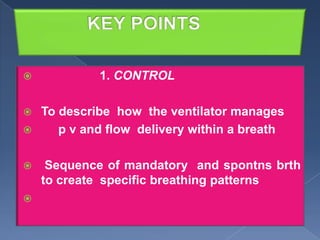
1. CONTROL

To describe how the ventilator manages

p v and flow delivery within a breath





Sequence of mandatory and spontns brth
to create specific breathing patterns
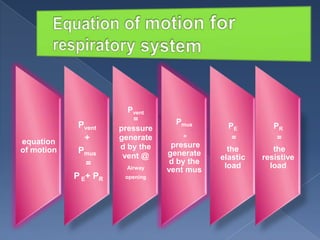
equation
of motion

Pvent
+
Pmus
=
P E+ PR

Pvent
=
pressure
generate
d by the
vent @
Airway
opening

Pmus
=

presure
generate
d by the
vent mus

PE
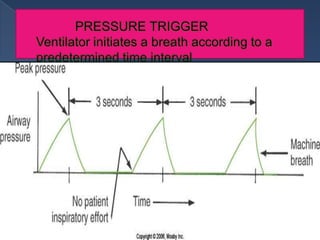
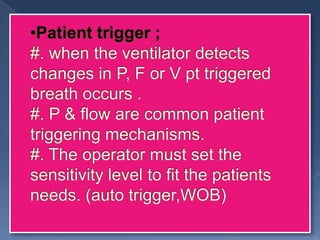
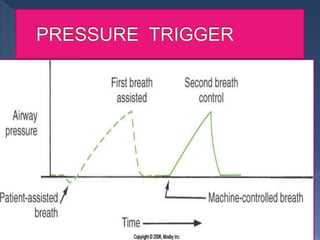
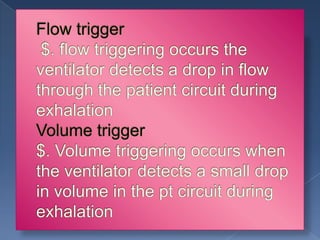
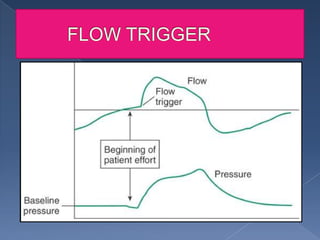
=
the
elastic
load

PR
=
the
resistive
load
To calculate the lung mechanic parameters of
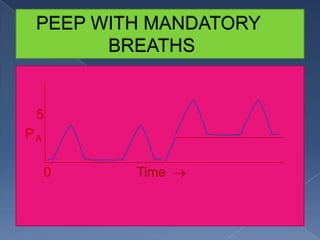
R, C given information about p, v and flow.
2. To predict p, v, flow given values for R & C
1.

“For any mode only one variable can be
controlled at a time” ( p v &flow)
Flow is the derivative of volume as a function of
tme, and volume is the integral of flow
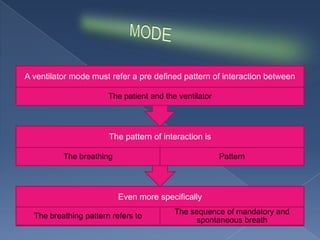
A ventilator mode must refer a pre defined pattern of interaction between
The patient and the ventilator

The pattern of interaction is
The breathing

Pattern

Even more specifically
The breathing pattern refers to

The sequence of mandatory and
spontaneous breath
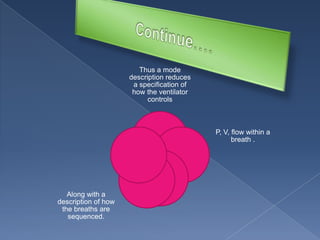
Thus a mode
description reduces
a specification of
how the ventilator
controls

P, V, flow within a
breath .

Along with a
description of how
the breaths are
sequenced.









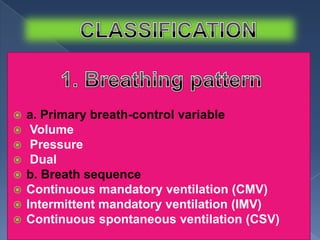
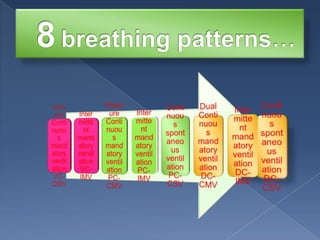
a. Primary breath-control variable
Volume
Pressure
Dual
b. Breath sequence
Continuous mandatory ventilation (CMV)
Intermittent mandatory ventilation (IMV)
Continuous spontaneous ventilation (CSV)











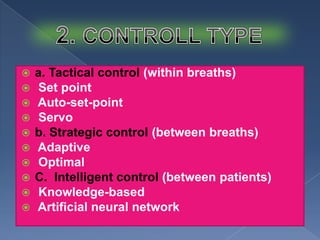
a. Tactical control (within breaths)
Set point
Auto-set-point
Servo
b. Strategic control (between breaths)
Adaptive
Optimal
C. Intelligent control (between patients)
Knowledge-based
Artificial neural network
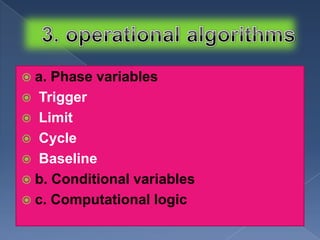
 a.

Phase variables
 Trigger
 Limit
 Cycle
 Baseline
 b. Conditional variables
 c. Computational logic
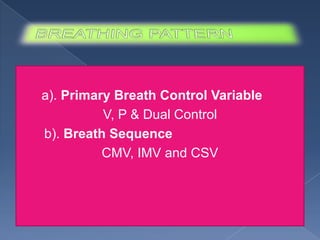
a). Primary Breath Control Variable
V, P & Dual Control
b). Breath Sequence
CMV, IMV and CSV
1a. Control variable.
The control variable is the variable that the
ventilator uses as a feedback signal to
control inspiration
(ie, pressure, volume, or flow).
The control variable can be identified as follows:
 If the peak inspiratory pressure remains
constant as
 the load experienced by the ventilator changes,
then the control variable is pressure.
If the peak pressure changes as the load
changes but VT remains constant, then the
control variable is volume.
 Volume control implies flow control and vice
versa,

„‟ Inspiration starts out as VCV and then
switches to PCV before the end of breath
or vice versa ”
CMV

IMV
CSV
Volume control implies that the ventilator
determines the
 tidal volume [VT], whereas in a spontaneous
breath the
 patient determines the VT.

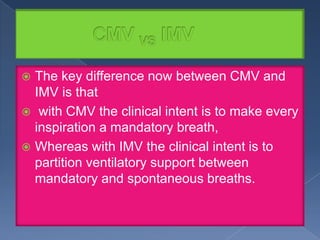
The key difference now between CMV and
IMV is that
 with CMV the clinical intent is to make every
inspiration a mandatory breath,
 Whereas with IMV the clinical intent is to
partition ventilatory support between
mandatory and spontaneous breaths.

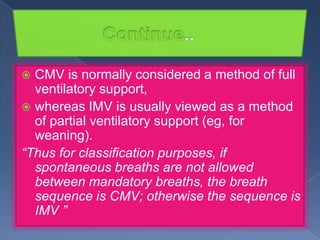
CMV is normally considered a method of full
ventilatory support,
 whereas IMV is usually viewed as a method
of partial ventilatory support (eg, for
weaning).
“Thus for classification purposes, if
spontaneous breaths are not allowed
between mandatory breaths, the breath
sequence is CMV; otherwise the sequence is
IMV ”



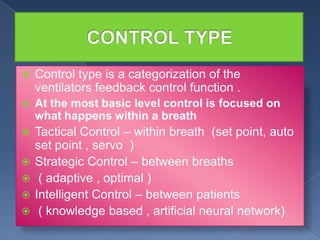
Control type is a categorization of the
ventilators feedback control function .



At the most basic level control is focused on
what happens within a breath



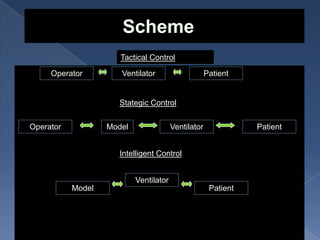
Tactical Control – within breath (set point, auto
set point , servo )
Strategic Control – between breaths
( adaptive , optimal )
Intelligent Control – between patients
( knowledge based , artificial neural network)





Set point
 The output of the ventilator matches a
constant operator preset input value .
 Mandatory breaths are pressure limited and
time cycled, according to the operator set
values for peak inspiratory pressure and
frequency

Eg : PC-IMV

The ventilator Selects which operator
adjusted set points are enforced at the
moment
 Inspiration starts in PCV and switches to
VCV
 Eg ; volume assured pressure support

The ventilator output automatically follows a
varying input
 The instantaneous value of pressure is
proportional to the instantaneous volume or
flow generated by the patient .




Eg; PAV & ATC
One ventilator set point is automatically
adjusted to achieve another set point as the
patient condition changes .
 Mandatory breaths are pressure limited , and
the pressure limit is automatically adjusted
between breaths to achieve the preset tidal
volume

Eg ; PRVC

One ventilator set point is automatically
adjusted to optimize another set point according
to some model of system behavior, whose
output can be maximized or minimized
dynamically.
 Each breath is pressure limited , and the
pressure limit is automatically adjusted between
breaths ( using ventilator mechanics
measurements ) to minimize WOB
 Eg ; adaptive support ventilation

 Set

points are automatically adjusted
according to a rule based expert system.
 pressure support level for spontaneous
breath is automatically adjusted to
maintain appropriate breathing frequency,
TV, ETCO2, depending on the type of
patient .

Eg : smart care








Auto adjusted set points by artificial neural
network.
The relation b/w inputs & outputs determined by
weighting factors at neural nodes that change
with learning.
The network inputs are the current ventilator
settings and partial pressure of ABG and PH
Network outputs are the most appropriate
ventilator settings projected to maintain blood
gases within an acceptable range
Eg ; experimental
Tactical Control
Operator

Ventilator

Patient

Stategic Control
Operator

Model

Ventilator

Patient

Intelligent Control
Ventilator

Model

Patient


PHASE VARIABLES

a. Phase variables
Trigger
Limit
Cycle
Baseline
b. Conditional variables
c. Computational logic
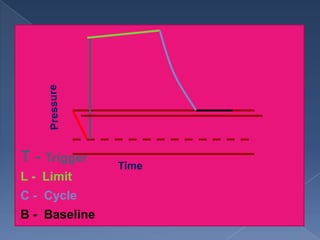
T - Trigger
L - Limit
C - Cycle

B - Baseline

Time
The phase variable begins, sustains, and ends
each of the four phases of a breath .
The four phases are ;
1. Change from exhalation to inhalation
2. inspiration
3. Change from inspiration to expiration
4. Exhalation
The mechanism the ventilator uses to end
exhalation and begin inspiration is the
triggering mechanism .
 Time trigger ; the ventilator can trigger itself,
 the rate of breathing is controlled by the
ventilator .
 So this mode sometimes is called controlled
ventilation
A limit variable is the maximum value a variable
( p, v, v; t) can attain .
1. Pressure limiting; allows pressure to rise to a
certain value but not exceed it .
To prevent excessive pressure from entering
the patients lungs , the operator set a control
sometimes labeled a high pressure limit.
when the vent reaches the high p limit excess
pressure will vented through a spring loaded
pressure release or valve.

A volume limited breath is controlled by an
electronically operated valve that measures
the flow passing through during a specific
interval .
 The volume may be set by the operator, or
the ventilator may have a bag, or piston
cylinder that contains a fixed volume .

Baseline variable is the parameter that
generally controlled during exhalation .
 Although either V or flow could serve as a
baseline variable , P is the most practical
choice and is used by all modern ventilators.
 The pressure level from which a ventilator
breath begins is called the baseline pressure
 It can be zero , which is also called (ZEEP)
or (PEEP).

5

PA
0

Time
Any unique combination of breathing
pattern, control type, and operational
algorithms is technically a mode.
It can be described in terms of “if then”
statements
 Eg ; if spontaneous minute ventilation falls
below a preset threshold , then deliver
enough mandatory breaths to raise MV
above the threshold .
Description of the relationship between the inputs,
feedback signals, and outputs, adding detail about
how the mode operates that does not given in the
other components of mode specification.
Eg ; ASV mode of Hamilton Galileo uses WOB as the
performance function , and it is related to lung
mechanics, alveolar ventilation , dead space volume
And breathing frequency. As lung mechanics change,
the ventilator finds the optimum frequency ( to
minimize wob) and then sets the VT to meet the MV
requirement .(Smartcare

mode on dragger)
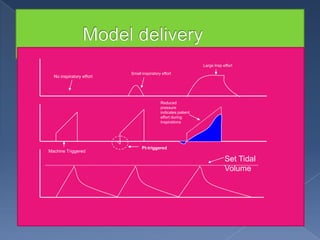
Large Insp effort

No inspiratory effort

Small inspiratory effort

Reduced
pressure
indicates patient
effort during
inspirations

Machine Triggered

Pt-triggered

Set Tidal
Volume
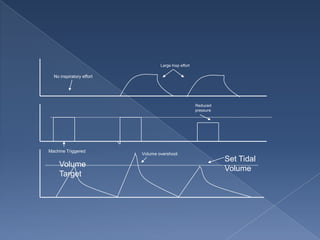
Large Insp effort

No inspiratory effort

Reduced
pressure

Machine Triggered

Volume
Target

Volume overshoot

Set Tidal
Volume


A machine that produces breathing patterns
that mimic the humans normally breathe at
rates and tidal volumes our bodies produces
during the normal activities.
Ventilator mode classification

Ventilator mode classification

  • 2.
     1. CONTROL To describehow the ventilator manages  p v and flow delivery within a breath    Sequence of mandatory and spontns brth to create specific breathing patterns
  • 3.
    equation of motion Pvent + Pmus = P E+PR Pvent = pressure generate d by the vent @ Airway opening Pmus = presure generate d by the vent mus PE = the elastic load PR = the resistive load
  • 4.
    To calculate thelung mechanic parameters of R, C given information about p, v and flow. 2. To predict p, v, flow given values for R & C 1. “For any mode only one variable can be controlled at a time” ( p v &flow) Flow is the derivative of volume as a function of tme, and volume is the integral of flow
  • 5.
    A ventilator modemust refer a pre defined pattern of interaction between The patient and the ventilator The pattern of interaction is The breathing Pattern Even more specifically The breathing pattern refers to The sequence of mandatory and spontaneous breath
  • 6.
    Thus a mode descriptionreduces a specification of how the ventilator controls P, V, flow within a breath . Along with a description of how the breaths are sequenced.
  • 8.
            a. Primary breath-controlvariable Volume Pressure Dual b. Breath sequence Continuous mandatory ventilation (CMV) Intermittent mandatory ventilation (IMV) Continuous spontaneous ventilation (CSV)
  • 9.
              a. Tactical control(within breaths) Set point Auto-set-point Servo b. Strategic control (between breaths) Adaptive Optimal C. Intelligent control (between patients) Knowledge-based Artificial neural network
  • 10.
     a. Phase variables Trigger  Limit  Cycle  Baseline  b. Conditional variables  c. Computational logic
  • 11.
    a). Primary BreathControl Variable V, P & Dual Control b). Breath Sequence CMV, IMV and CSV
  • 12.
    1a. Control variable. Thecontrol variable is the variable that the ventilator uses as a feedback signal to control inspiration (ie, pressure, volume, or flow).
  • 13.
    The control variablecan be identified as follows:  If the peak inspiratory pressure remains constant as  the load experienced by the ventilator changes, then the control variable is pressure. If the peak pressure changes as the load changes but VT remains constant, then the control variable is volume.  Volume control implies flow control and vice versa, 
  • 14.
    „‟ Inspiration startsout as VCV and then switches to PCV before the end of breath or vice versa ”
  • 15.
  • 17.
    Volume control impliesthat the ventilator determines the  tidal volume [VT], whereas in a spontaneous breath the  patient determines the VT. 
  • 18.
    The key differencenow between CMV and IMV is that  with CMV the clinical intent is to make every inspiration a mandatory breath,  Whereas with IMV the clinical intent is to partition ventilatory support between mandatory and spontaneous breaths. 
  • 19.
    CMV is normallyconsidered a method of full ventilatory support,  whereas IMV is usually viewed as a method of partial ventilatory support (eg, for weaning). “Thus for classification purposes, if spontaneous breaths are not allowed between mandatory breaths, the breath sequence is CMV; otherwise the sequence is IMV ” 
  • 20.
     Control type isa categorization of the ventilators feedback control function .  At the most basic level control is focused on what happens within a breath  Tactical Control – within breath (set point, auto set point , servo ) Strategic Control – between breaths ( adaptive , optimal ) Intelligent Control – between patients ( knowledge based , artificial neural network)    
  • 21.
    Set point  Theoutput of the ventilator matches a constant operator preset input value .  Mandatory breaths are pressure limited and time cycled, according to the operator set values for peak inspiratory pressure and frequency  Eg : PC-IMV 
  • 22.
    The ventilator Selectswhich operator adjusted set points are enforced at the moment  Inspiration starts in PCV and switches to VCV  Eg ; volume assured pressure support 
  • 23.
    The ventilator outputautomatically follows a varying input  The instantaneous value of pressure is proportional to the instantaneous volume or flow generated by the patient .   Eg; PAV & ATC
  • 24.
    One ventilator setpoint is automatically adjusted to achieve another set point as the patient condition changes .  Mandatory breaths are pressure limited , and the pressure limit is automatically adjusted between breaths to achieve the preset tidal volume  Eg ; PRVC 
  • 25.
    One ventilator setpoint is automatically adjusted to optimize another set point according to some model of system behavior, whose output can be maximized or minimized dynamically.  Each breath is pressure limited , and the pressure limit is automatically adjusted between breaths ( using ventilator mechanics measurements ) to minimize WOB  Eg ; adaptive support ventilation 
  • 26.
     Set points areautomatically adjusted according to a rule based expert system.  pressure support level for spontaneous breath is automatically adjusted to maintain appropriate breathing frequency, TV, ETCO2, depending on the type of patient .  Eg : smart care
  • 27.
         Auto adjusted setpoints by artificial neural network. The relation b/w inputs & outputs determined by weighting factors at neural nodes that change with learning. The network inputs are the current ventilator settings and partial pressure of ABG and PH Network outputs are the most appropriate ventilator settings projected to maintain blood gases within an acceptable range Eg ; experimental
  • 28.
  • 29.
     PHASE VARIABLES a. Phasevariables Trigger Limit Cycle Baseline b. Conditional variables c. Computational logic
  • 30.
    T - Trigger L- Limit C - Cycle B - Baseline Time
  • 31.
    The phase variablebegins, sustains, and ends each of the four phases of a breath . The four phases are ; 1. Change from exhalation to inhalation 2. inspiration 3. Change from inspiration to expiration 4. Exhalation
  • 32.
    The mechanism theventilator uses to end exhalation and begin inspiration is the triggering mechanism .  Time trigger ; the ventilator can trigger itself,  the rate of breathing is controlled by the ventilator .  So this mode sometimes is called controlled ventilation
  • 38.
    A limit variableis the maximum value a variable ( p, v, v; t) can attain . 1. Pressure limiting; allows pressure to rise to a certain value but not exceed it . To prevent excessive pressure from entering the patients lungs , the operator set a control sometimes labeled a high pressure limit. when the vent reaches the high p limit excess pressure will vented through a spring loaded pressure release or valve. 
  • 39.
    A volume limitedbreath is controlled by an electronically operated valve that measures the flow passing through during a specific interval .  The volume may be set by the operator, or the ventilator may have a bag, or piston cylinder that contains a fixed volume . 
  • 42.
    Baseline variable isthe parameter that generally controlled during exhalation .  Although either V or flow could serve as a baseline variable , P is the most practical choice and is used by all modern ventilators.  The pressure level from which a ventilator breath begins is called the baseline pressure  It can be zero , which is also called (ZEEP) or (PEEP). 
  • 43.
  • 44.
    Any unique combinationof breathing pattern, control type, and operational algorithms is technically a mode. It can be described in terms of “if then” statements  Eg ; if spontaneous minute ventilation falls below a preset threshold , then deliver enough mandatory breaths to raise MV above the threshold .
  • 45.
    Description of therelationship between the inputs, feedback signals, and outputs, adding detail about how the mode operates that does not given in the other components of mode specification. Eg ; ASV mode of Hamilton Galileo uses WOB as the performance function , and it is related to lung mechanics, alveolar ventilation , dead space volume And breathing frequency. As lung mechanics change, the ventilator finds the optimum frequency ( to minimize wob) and then sets the VT to meet the MV requirement .(Smartcare mode on dragger)
  • 46.
    Large Insp effort Noinspiratory effort Small inspiratory effort Reduced pressure indicates patient effort during inspirations Machine Triggered Pt-triggered Set Tidal Volume
  • 47.
    Large Insp effort Noinspiratory effort Reduced pressure Machine Triggered Volume Target Volume overshoot Set Tidal Volume
  • 48.
     A machine thatproduces breathing patterns that mimic the humans normally breathe at rates and tidal volumes our bodies produces during the normal activities.