CODE
DIVISION
MULTIPLE
ACCESS
Lecture Videos are available for this slides
at
www.youtube.com/gurukula
Support by Subscribing to my
Channel
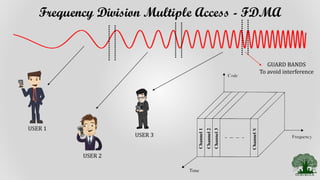
Frequency Division Multiple Access - FDMA
USER 1
USER 3
USER 2
GUARD BANDS
To avoid interference
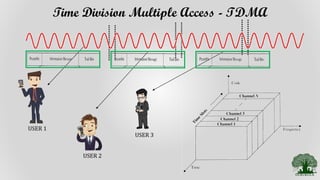
Time Division Multiple Access - TDMA
USER 1
USER 3
USER 2
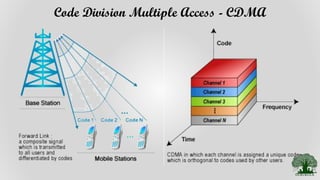
Code Division Multiple Access - CDMA
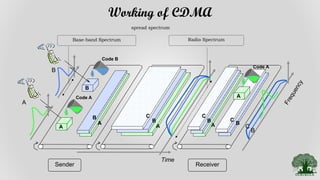
Working of CDMA
A
Sender Receiver
Code A
A
Code B
B
A
B
A
B
C
B
C
A
Code A
A
B
C
Time
B
C
B
Base-band Spectrum Radio Spectrum
spread spectrum
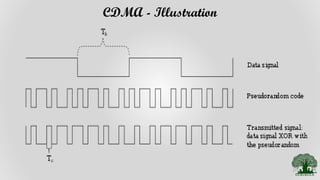
CDMA - Illustration
Code Division Multiple Access - CDMA
• In CDMA systems, the narrow band message signal is multiplied with large
bandwidth signal called the “ Spreading Signal”.
• These spreading signals are nothing but the PN Sequences whose chip rate is larger
than the data rate of the message.
• CDMA uses same carrier frequency to modulate all the users and also it allows all the
users to transmit simultaneously.
• Each user has his own pseudorandom code word which is approximately orthogonal
to all other code words,
• To ensure multiple users on a CDMA system cause minimal mutual interference the
spreading codes must be orthogonal
• The receiver performs the time correlation function so that all other signals appears
uncorrelated, However the receiver should know the code word to decrypt the
message signals.
• In CDMA systems the power of the user determines the noise floor of the entire
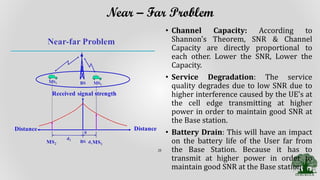
system. Failing to incorporate the proper power control leads to Near Far Problem.
• i.e. users with low power will not get a chance to connect to the base station thereby
left unserved.
CDMA – Pros and Cons
• Unlike TDMA and FDMA, CDMA has a soft limit on the capacity of number of
users. Increasing the number of users in the system will lead to increased
power.
• There is no absolute limit on the number users to be added but rather, the
system performance gets degrades for all users.
• Multipath fading is considerably reduces as the signal spreads over a large
bandwidth.
• Channel data rates are very high in CDMA systems.
• Symbol period is very less than the channel delay spread hence any delayed
signal for the duration more than one chip is considered as noise.
• RAKE Receivers are used to improve the reception by collecting time delayed
versions of the required signal.
• Self jamming is problem in CDMA which arises when the PN sequence are not
orthogonal. (causes interference between the users)
• Near Far problem arises when the power levels of undesired user are higher
than the power levels of desired user.
Near – Far Problem
• Channel Capacity: According to
Shannon's Theorem, SNR & Channel
Capacity are directly proportional to
each other. Lower the SNR, Lower the
Capacity.
• Service Degradation: The service
quality degrades due to low SNR due to
higher interference caused by the UE's at
the cell edge transmitting at higher
power in order to maintain good SNR at
the Base station.
• Battery Drain: This will have an impact
on the battery life of the User far from
the Base Station. Because it has to
transmit at higher power in order to
maintain good SNR at the Base station
Capacity of CDMA systems
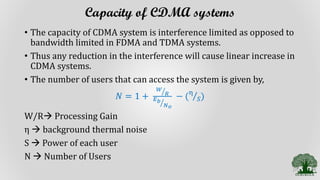
• The capacity of CDMA system is interference limited as opposed to
bandwidth limited in FDMA and TDMA systems.
• Thus any reduction in the interference will cause linear increase in
CDMA systems.
• The number of users that can access the system is given by,
𝑁 = 1 +
𝑊
𝑅
𝐸 𝑏
𝑁 𝑜
− (η
𝑆)
W/R Processing Gain
η  background thermal noise
S  Power of each user
N  Number of Users
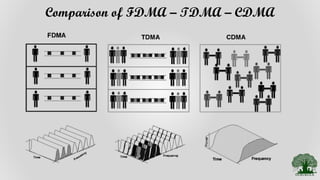
Comparison of FDMA – TDMA – CDMA
Summary
• Recap of FDMA, TDMA
• Working of CDMA systems
• Pros and Cons of CDMA systems
• Capacity of CDMA systems
• Comparison of FDMA – TDMA – CDMA systems
***---***

2.4 code division multiple access

  • 1.
  • 2.
    Lecture Videos areavailable for this slides at www.youtube.com/gurukula Support by Subscribing to my Channel
  • 3.
    Frequency Division MultipleAccess - FDMA USER 1 USER 3 USER 2 GUARD BANDS To avoid interference
  • 4.
    Time Division MultipleAccess - TDMA USER 1 USER 3 USER 2
  • 5.
  • 6.
    Working of CDMA A SenderReceiver Code A A Code B B A B A B C B C A Code A A B C Time B C B Base-band Spectrum Radio Spectrum spread spectrum
  • 7.
  • 8.
    Code Division MultipleAccess - CDMA • In CDMA systems, the narrow band message signal is multiplied with large bandwidth signal called the “ Spreading Signal”. • These spreading signals are nothing but the PN Sequences whose chip rate is larger than the data rate of the message. • CDMA uses same carrier frequency to modulate all the users and also it allows all the users to transmit simultaneously. • Each user has his own pseudorandom code word which is approximately orthogonal to all other code words, • To ensure multiple users on a CDMA system cause minimal mutual interference the spreading codes must be orthogonal • The receiver performs the time correlation function so that all other signals appears uncorrelated, However the receiver should know the code word to decrypt the message signals. • In CDMA systems the power of the user determines the noise floor of the entire system. Failing to incorporate the proper power control leads to Near Far Problem. • i.e. users with low power will not get a chance to connect to the base station thereby left unserved.
  • 9.
    CDMA – Prosand Cons • Unlike TDMA and FDMA, CDMA has a soft limit on the capacity of number of users. Increasing the number of users in the system will lead to increased power. • There is no absolute limit on the number users to be added but rather, the system performance gets degrades for all users. • Multipath fading is considerably reduces as the signal spreads over a large bandwidth. • Channel data rates are very high in CDMA systems. • Symbol period is very less than the channel delay spread hence any delayed signal for the duration more than one chip is considered as noise. • RAKE Receivers are used to improve the reception by collecting time delayed versions of the required signal. • Self jamming is problem in CDMA which arises when the PN sequence are not orthogonal. (causes interference between the users) • Near Far problem arises when the power levels of undesired user are higher than the power levels of desired user.
  • 10.
    Near – FarProblem • Channel Capacity: According to Shannon's Theorem, SNR & Channel Capacity are directly proportional to each other. Lower the SNR, Lower the Capacity. • Service Degradation: The service quality degrades due to low SNR due to higher interference caused by the UE's at the cell edge transmitting at higher power in order to maintain good SNR at the Base station. • Battery Drain: This will have an impact on the battery life of the User far from the Base Station. Because it has to transmit at higher power in order to maintain good SNR at the Base station
  • 11.
    Capacity of CDMAsystems • The capacity of CDMA system is interference limited as opposed to bandwidth limited in FDMA and TDMA systems. • Thus any reduction in the interference will cause linear increase in CDMA systems. • The number of users that can access the system is given by, 𝑁 = 1 + 𝑊 𝑅 𝐸 𝑏 𝑁 𝑜 − (η 𝑆) W/R Processing Gain η  background thermal noise S  Power of each user N  Number of Users
  • 12.
    Comparison of FDMA– TDMA – CDMA
  • 13.
    Summary • Recap ofFDMA, TDMA • Working of CDMA systems • Pros and Cons of CDMA systems • Capacity of CDMA systems • Comparison of FDMA – TDMA – CDMA systems ***---***