Code Division Multiple Access
D.Gopinath AP/ECE
Ramco Institute of technology
Academic year (2017-18 Even)
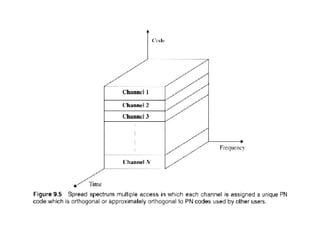
Spread Spectrum Multiple Access
(SSMA)
 Transmission bandwidth is several orders of magnitude greater
than the minimum required RF bandwidth.
Pseudo-noise (PN) sequence converts a narrowband signal to a
wideband noise-like signal.
 Provides immunity to multipath interference and robust
multiple access capability.
 Bandwidth efficient in a multi user environment.
Two main types SSMA:
Frequency hopped multiple access (FH)
Direct sequence multiple access (DS)
Direct sequence multiple access is also called code division
multiple access (CDMA).
Frequency Hopped Multiple Access
(FHMA)
• The carrier frequencies of the individual users
are varied in a pseudorandom fashion within a
wideband channel.
• The pseudorandom change of the carrier
frequencies of the user randomizes the
occupancy of a specific channel at any given
time, multiple access allowed.
• At any given point in time, a frequency hopped
signal only occupies a single, relatively narrow
channel.
Frequency Hopped Multiple Access
(FHMA)
Difference between FHMA and FDMA:
• In FHMA, The frequency hopped signal changes
channels at rapid intervals.
Fast hopping and slow hopping:
• fast frequency hopping ---- the rate of change of
the carrier frequency is greater than the symbol
rate
• slow frequency hopping ---- the channel changes
at a rate less than or equal to the symbol rate
Code Division Multiple Access
(CDMA)
• In CDMA, the narrowband message signal is
multiplied by a very large bandwidth signal called the
spreading signal.
• The spreading signal is a pseudo-noise code sequence
that has a chip rate which is orders of magnitudes
greater than the data rate of the message.
• All users use the same carrier frequency and may
transmit simultaneously.
• Each user has its own pseudorandom code word
which is approximately orthogonal to all other code
words.
Code Division Multiple Access
(CDMA)
• The receiver performs a time correlation
operation to detect only the specific desired
codeword.
All other codewords appear as noise due to
decorrelation.
• The receiver needs to know the codeword
used by the transmitter.
• Each user operates independently with no
knowledge of the other users.
Near-far problem in CDMA
• The near-far problem occurs when many mobile
users share the same channel.
• In general, the strongest received mobile signal
will capture the
• demodulator at a base station.
• In CDMA, stronger received signal levels raise
the noise floor at the base station demodulators
for the weaker signals, thereby decreasing the
probability that weaker signals will be received.
• the power of multiple users at a receiver
determines the noise floor after decorrelation.
Power control
• Provided by each base station in a cellular system and
assures that each mobile within the base station
coverage area provides the same signal level to the
base station receiver.
• This solves the problem of a nearby subscriber
overpowering the base station receiver and drowning
out the signals of far away subscribers.
• Power control is implemented at the base station by
rapidly sampling the radio signal strength indicator
(RSSI) levels of each mobile and then sending a power
change command over the forward radio link.
Features of CDMA:
• Many users of a CDMA system share the same
frequency. Either TDD or FDD may be used.
• Unlike TDMA or FDMA, CDMA has a soft
capacity limit. Increasing the number of users in
a CDMA system raises the noise floor in a linear
manner.
• Multipath fading may be substantially reduced
because the signal is spread over a large
spectrum.
• Channel data rates are very high in CDMA
systems.
Features of CDMA (continued):
• Soft handoff is performed by the MSC, which
can simultaneously monitor a particular user
from two or more base stations. The MSC
may chose the best version of the signal at
any time without switching frequencies.
• The near-far problem occurs at a CDMA
receiver if an undesired user has a high
detected power as compared to the desired
user.
Space Division Multiple Access
(SDMA)
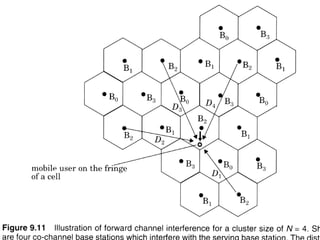
• SDMA serves different users by using spot beam
antennas to control the radiated energy for each user
in space.
• These different areas covered by the antenna beam
may be served by the same frequency (in a TDMA or
CDMA systern) or different frequencies (in an FDMA
system).
• Sectorized antennas ----
primitive application of SDMA.
• Adaptive antennas ----
simultaneously steer energy in the direction of many
users at once.
Channel Capacity
TEXTBOOKS:
• 1. Rappaport,T.S., “Wireless communications”, Second Edition,
Pearson Education, 2010.
• 2. Andreas.F. Molisch, “Wireless Communications”, John Wiley –
India, 2006.
REFERENCES:
• 1. David Tse and Pramod Viswanath, “Fundamentals of Wireless
Communication”, Cambridge University Press, 2005.
• 2. Upena Dalal, “ Wireless Communication”, Oxford University
Press, 2009.
• 3. Van Nee, R. and Ramji Prasad, “OFDM for wireless multimedia
communications”, Artech House, 2000.
Thank You

Code Division Multiple Access

  • 1.
    Code Division MultipleAccess D.Gopinath AP/ECE Ramco Institute of technology Academic year (2017-18 Even)
  • 2.
    Spread Spectrum MultipleAccess (SSMA)  Transmission bandwidth is several orders of magnitude greater than the minimum required RF bandwidth. Pseudo-noise (PN) sequence converts a narrowband signal to a wideband noise-like signal.  Provides immunity to multipath interference and robust multiple access capability.  Bandwidth efficient in a multi user environment. Two main types SSMA: Frequency hopped multiple access (FH) Direct sequence multiple access (DS) Direct sequence multiple access is also called code division multiple access (CDMA).
  • 3.
    Frequency Hopped MultipleAccess (FHMA) • The carrier frequencies of the individual users are varied in a pseudorandom fashion within a wideband channel. • The pseudorandom change of the carrier frequencies of the user randomizes the occupancy of a specific channel at any given time, multiple access allowed. • At any given point in time, a frequency hopped signal only occupies a single, relatively narrow channel.
  • 4.
    Frequency Hopped MultipleAccess (FHMA) Difference between FHMA and FDMA: • In FHMA, The frequency hopped signal changes channels at rapid intervals. Fast hopping and slow hopping: • fast frequency hopping ---- the rate of change of the carrier frequency is greater than the symbol rate • slow frequency hopping ---- the channel changes at a rate less than or equal to the symbol rate
  • 5.
    Code Division MultipleAccess (CDMA) • In CDMA, the narrowband message signal is multiplied by a very large bandwidth signal called the spreading signal. • The spreading signal is a pseudo-noise code sequence that has a chip rate which is orders of magnitudes greater than the data rate of the message. • All users use the same carrier frequency and may transmit simultaneously. • Each user has its own pseudorandom code word which is approximately orthogonal to all other code words.
  • 7.
    Code Division MultipleAccess (CDMA) • The receiver performs a time correlation operation to detect only the specific desired codeword. All other codewords appear as noise due to decorrelation. • The receiver needs to know the codeword used by the transmitter. • Each user operates independently with no knowledge of the other users.
  • 8.
    Near-far problem inCDMA • The near-far problem occurs when many mobile users share the same channel. • In general, the strongest received mobile signal will capture the • demodulator at a base station. • In CDMA, stronger received signal levels raise the noise floor at the base station demodulators for the weaker signals, thereby decreasing the probability that weaker signals will be received. • the power of multiple users at a receiver determines the noise floor after decorrelation.
  • 9.
    Power control • Providedby each base station in a cellular system and assures that each mobile within the base station coverage area provides the same signal level to the base station receiver. • This solves the problem of a nearby subscriber overpowering the base station receiver and drowning out the signals of far away subscribers. • Power control is implemented at the base station by rapidly sampling the radio signal strength indicator (RSSI) levels of each mobile and then sending a power change command over the forward radio link.
  • 10.
    Features of CDMA: •Many users of a CDMA system share the same frequency. Either TDD or FDD may be used. • Unlike TDMA or FDMA, CDMA has a soft capacity limit. Increasing the number of users in a CDMA system raises the noise floor in a linear manner. • Multipath fading may be substantially reduced because the signal is spread over a large spectrum. • Channel data rates are very high in CDMA systems.
  • 11.
    Features of CDMA(continued): • Soft handoff is performed by the MSC, which can simultaneously monitor a particular user from two or more base stations. The MSC may chose the best version of the signal at any time without switching frequencies. • The near-far problem occurs at a CDMA receiver if an undesired user has a high detected power as compared to the desired user.
  • 12.
    Space Division MultipleAccess (SDMA) • SDMA serves different users by using spot beam antennas to control the radiated energy for each user in space. • These different areas covered by the antenna beam may be served by the same frequency (in a TDMA or CDMA systern) or different frequencies (in an FDMA system). • Sectorized antennas ---- primitive application of SDMA. • Adaptive antennas ---- simultaneously steer energy in the direction of many users at once.
  • 13.
  • 15.
    TEXTBOOKS: • 1. Rappaport,T.S.,“Wireless communications”, Second Edition, Pearson Education, 2010. • 2. Andreas.F. Molisch, “Wireless Communications”, John Wiley – India, 2006. REFERENCES: • 1. David Tse and Pramod Viswanath, “Fundamentals of Wireless Communication”, Cambridge University Press, 2005. • 2. Upena Dalal, “ Wireless Communication”, Oxford University Press, 2009. • 3. Van Nee, R. and Ramji Prasad, “OFDM for wireless multimedia communications”, Artech House, 2000.
  • 16.