Telecom Tutorials
Monday, June 03, 2013www.tempustelcosys.com
Frequency Reuse
Monday, June 03, 2013www.tempustelcosys.com
GSM900
Upward 890 915 MHz
Downward 935 960 MHz
Tx-Rx difference is 45MHz,carrier space is 200KHz。
GSM1800
Upward 1710 1785 MHz
Downward 1805 1880 MHz
Tx-Rx difference is 95MHz,carrier space is 200KHz。
Monday, June 03, 2013www.tempustelcosys.com
GSM900
GSM900: FU(n) = 890 + 0.2 n MHz
FD(n) = Fu(n) + 45 MHz,1 n 124
E-GSM900:FU(n) = 890 + 0.2 (n-1024),974 n 1023
FD(n) = Fu(n) + 45 MHz
n is called Absolutely Radio Frequency Channel Number.
GSM1800
Fu(n) = 1710.2 + 0.2 (n-512) MHz
FD(n) = Fl(n) + 95 MHz, 512 n 885
374 channels
Monday, June 03, 2013www.tempustelcosys.com
Frequency reuse is referred to as the same frequency is reused after
a certain distance in cellular wireless system. Generally, a limited
frequency band is divided into many groups, each containing a few
carriers, which are in turn assigned to adjacent cells
Usually, frequency reuse patterns include:
Ordinary frequency reuse: “4 3”, “3 3” and more close “2 3”
and “1 3”.
Dual frequency reuse: BCCH and TCH adopt different frequency
reuse patterns respectively.
Concentric: the Underlay and Overlay adopt different frequency
reuse patterns respectively.
MRP: different layers adopt different reuse patterns.
Monday, June 03, 2013www.tempustelcosys.com
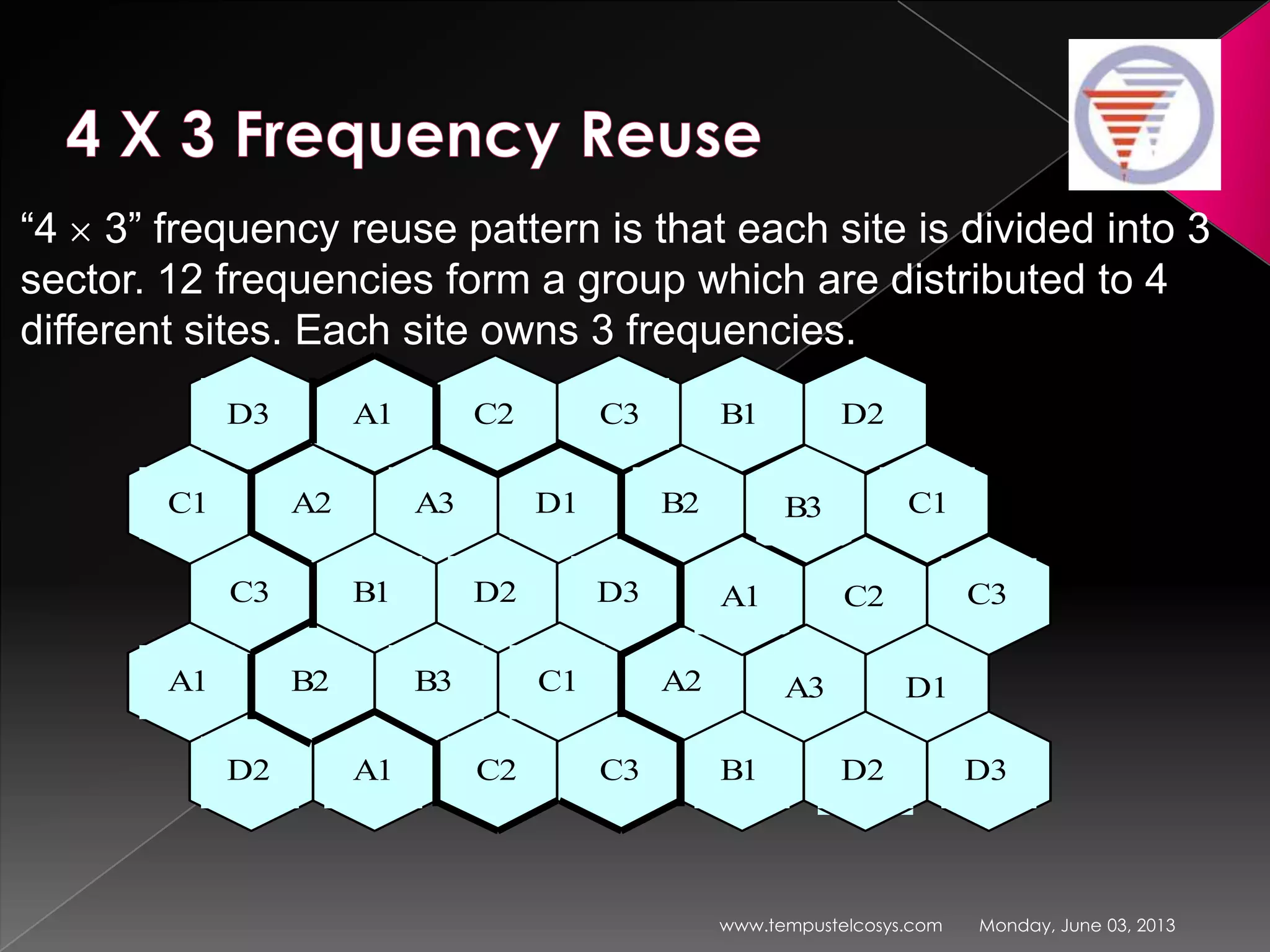
“4 3” frequency reuse pattern is that each site is divided into 3
sector. 12 frequencies form a group which are distributed to 4
different sites. Each site owns 3 frequencies.
Monday, June 03, 2013www.tempustelcosys.com
A3
D2B1
C3
B2D1
D3
A2C1
B3
C2A1
B3
C2A1
A3
A1B1
D1
D3D2
C3
B2A1
C3D2
C3
C1
D2B1C2A1
A2C1
D3
Monday, June 03, 2013www.tempustelcosys.com
A3
C2B1
B3
A2C1
C3
B2A1
A3
C2B1
B3
A2C1
B3
A1C1
A1
A3A2
C3
B2A1
A3A3
C3
C1
B2A1B2A1
A2C1
B3
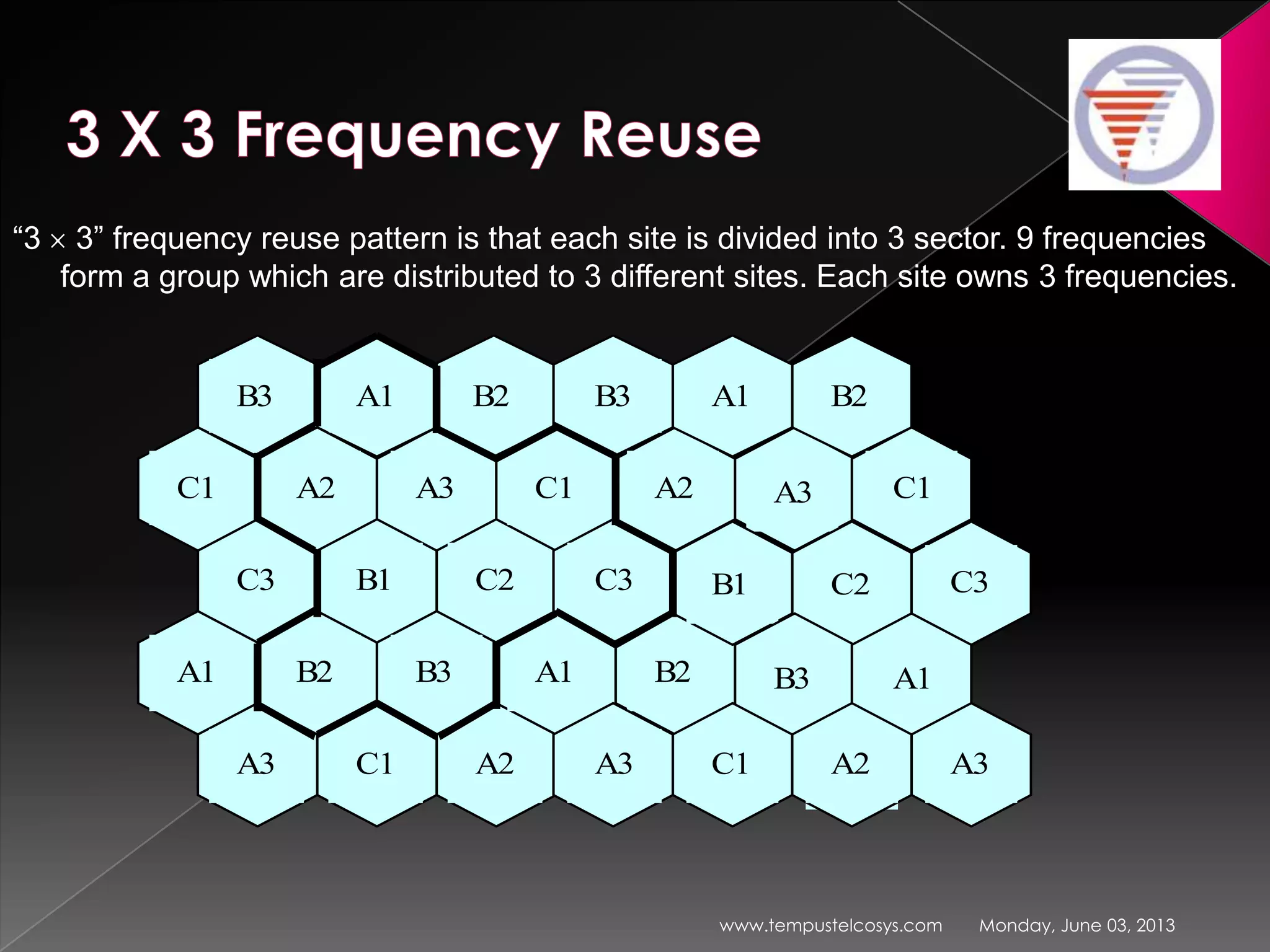
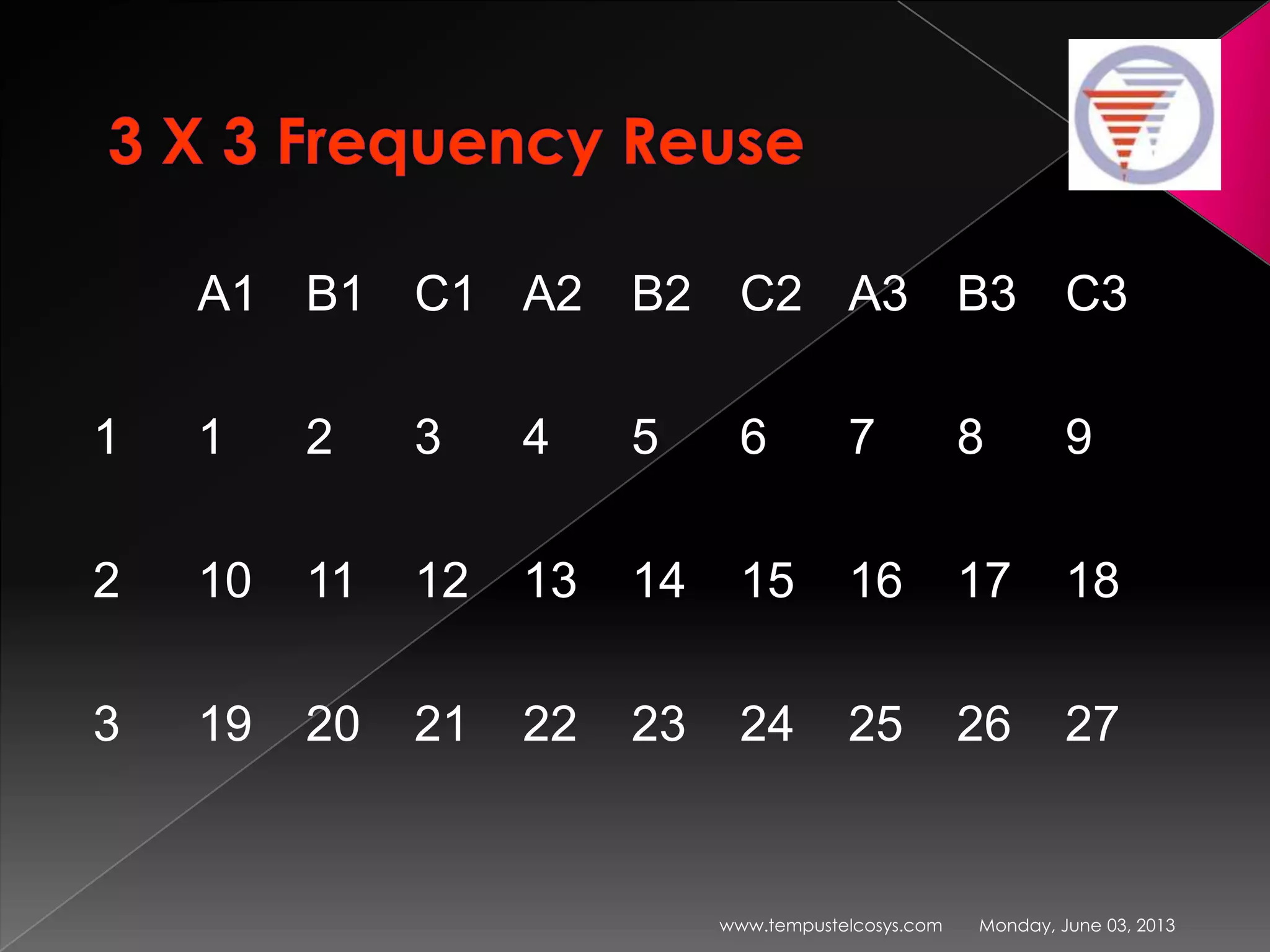
“3 3” frequency reuse pattern is that each site is divided into 3 sector. 9 frequencies
form a group which are distributed to 3 different sites. Each site owns 3 frequencies.
Monday, June 03, 2013www.tempustelcosys.com
A1 B1 C1 A2 B2 C2 A3 B3 C3
1 1 2 3 4 5 6 7 8 9
2 10 11 12 13 14 15 16 17 18
3 19 20 21 22 23 24 25 26 27
 The following equation is used to estimate frequency reuse
distance:
D —— frequency reuse distance
R —— cell radius
N —— frequency reuse factor.
N=9 for “3 3”; N=12 for “4 3”
 For “3/9” frequency reuse, D=5.2R
 For “4/12” frequency reuse, D=6R
Monday, June 03, 2013www.tempustelcosys.com
• Co-channel Interference C/I:
 C/I refers to the interference of another cell
using the same frequency to the current cell. The
ratio of carrier to interference is called C/I.
 GSM specification regulates that C/I >9dB. In
implementing, it requires C/I>12dB.
• Adjacent channel interference C/A
 C/A refers to interference of adjacent cell to
the current cell. The ratio is called C/A. The GSM
specification regulates that C/A>-9dB.
Monday, June 03, 2013www.tempustelcosys.com
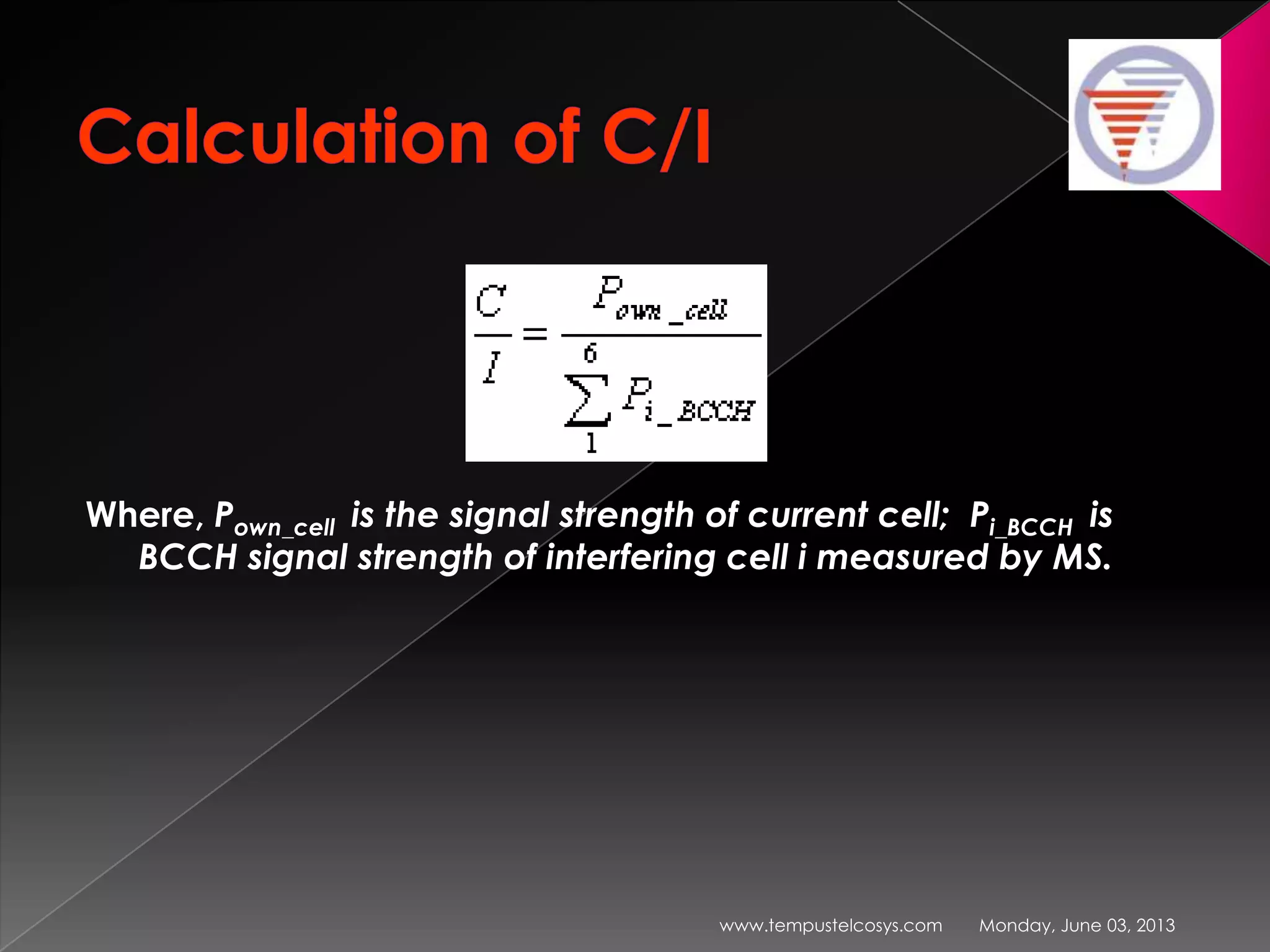
Where, Pown_cell is the signal strength of current cell; Pi_BCCH is
BCCH signal strength of interfering cell i measured by MS.
Monday, June 03, 2013www.tempustelcosys.com
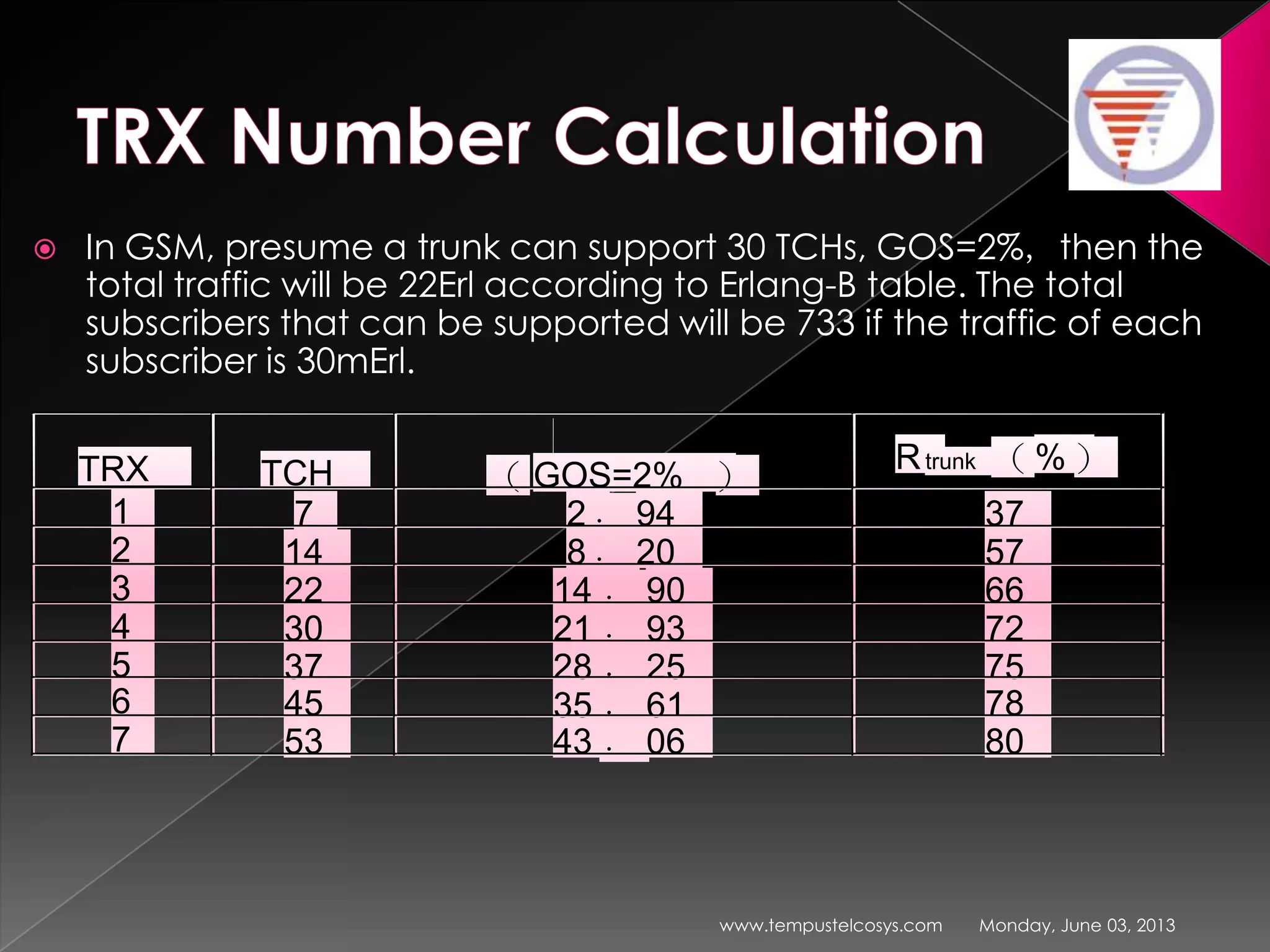
 In GSM, presume a trunk can support 30 TCHs, GOS=2%,then the
total traffic will be 22Erl according to Erlang-B table. The total
subscribers that can be supported will be 733 if the traffic of each
subscriber is 30mErl.
Monday, June 03, 2013www.tempustelcosys.com
TRX TCH ( GOS=2% )
Rtrunk ( % )
1 7 2. 94 37
2 14 8. 20 57
3 22 14 . 90 66
4 30 21 . 93 72
5 37 28 . 25 75
6 45 35 . 61 78
7 53 43 . 06 80
 Analyze total traffic and traffic distribution feature
within the service area
 Calculate system capacity, the traffic that each cell can
provide and subscriber numbers
 Calculate the total numbers of TRX s required
 Determine the total numbers of cells required
 Determine the TRX configuration mode of each cell.
 Adjust the configuration (optimization) in combination
with
cell planning and frequency planning
Monday, June 03, 2013www.tempustelcosys.com
• Analogy of telephone set
 Prediction mode: Y5 = r X5
 where, Y5:predicted subscriber number on 5th year
 X5:total numbers of telephone set on 5th year
 r :percentage of mobile phone to telephone set
• Social survey and city analogy
 Based on social survey, compare with the cities where mobile
network has been established and where the city scale, economy
and customer requirement are similar. Refer to that cities’ subscribers
to predict the potential numbers of mobile subscribers of the city.
Monday, June 03, 2013www.tempustelcosys.com

Frequency Reuse

  • 1.
    Telecom Tutorials Monday, June03, 2013www.tempustelcosys.com Frequency Reuse
  • 2.
    Monday, June 03,2013www.tempustelcosys.com GSM900 Upward 890 915 MHz Downward 935 960 MHz Tx-Rx difference is 45MHz,carrier space is 200KHz。 GSM1800 Upward 1710 1785 MHz Downward 1805 1880 MHz Tx-Rx difference is 95MHz,carrier space is 200KHz。
  • 3.
    Monday, June 03,2013www.tempustelcosys.com GSM900 GSM900: FU(n) = 890 + 0.2 n MHz FD(n) = Fu(n) + 45 MHz,1 n 124 E-GSM900:FU(n) = 890 + 0.2 (n-1024),974 n 1023 FD(n) = Fu(n) + 45 MHz n is called Absolutely Radio Frequency Channel Number. GSM1800 Fu(n) = 1710.2 + 0.2 (n-512) MHz FD(n) = Fl(n) + 95 MHz, 512 n 885 374 channels
  • 4.
    Monday, June 03,2013www.tempustelcosys.com Frequency reuse is referred to as the same frequency is reused after a certain distance in cellular wireless system. Generally, a limited frequency band is divided into many groups, each containing a few carriers, which are in turn assigned to adjacent cells
  • 5.
    Usually, frequency reusepatterns include: Ordinary frequency reuse: “4 3”, “3 3” and more close “2 3” and “1 3”. Dual frequency reuse: BCCH and TCH adopt different frequency reuse patterns respectively. Concentric: the Underlay and Overlay adopt different frequency reuse patterns respectively. MRP: different layers adopt different reuse patterns. Monday, June 03, 2013www.tempustelcosys.com
  • 6.
    “4 3” frequencyreuse pattern is that each site is divided into 3 sector. 12 frequencies form a group which are distributed to 4 different sites. Each site owns 3 frequencies. Monday, June 03, 2013www.tempustelcosys.com A3 D2B1 C3 B2D1 D3 A2C1 B3 C2A1 B3 C2A1 A3 A1B1 D1 D3D2 C3 B2A1 C3D2 C3 C1 D2B1C2A1 A2C1 D3
  • 7.
    Monday, June 03,2013www.tempustelcosys.com A3 C2B1 B3 A2C1 C3 B2A1 A3 C2B1 B3 A2C1 B3 A1C1 A1 A3A2 C3 B2A1 A3A3 C3 C1 B2A1B2A1 A2C1 B3 “3 3” frequency reuse pattern is that each site is divided into 3 sector. 9 frequencies form a group which are distributed to 3 different sites. Each site owns 3 frequencies.
  • 8.
    Monday, June 03,2013www.tempustelcosys.com A1 B1 C1 A2 B2 C2 A3 B3 C3 1 1 2 3 4 5 6 7 8 9 2 10 11 12 13 14 15 16 17 18 3 19 20 21 22 23 24 25 26 27
  • 9.
     The followingequation is used to estimate frequency reuse distance: D —— frequency reuse distance R —— cell radius N —— frequency reuse factor. N=9 for “3 3”; N=12 for “4 3”  For “3/9” frequency reuse, D=5.2R  For “4/12” frequency reuse, D=6R Monday, June 03, 2013www.tempustelcosys.com
  • 10.
    • Co-channel InterferenceC/I:  C/I refers to the interference of another cell using the same frequency to the current cell. The ratio of carrier to interference is called C/I.  GSM specification regulates that C/I >9dB. In implementing, it requires C/I>12dB. • Adjacent channel interference C/A  C/A refers to interference of adjacent cell to the current cell. The ratio is called C/A. The GSM specification regulates that C/A>-9dB. Monday, June 03, 2013www.tempustelcosys.com
  • 11.
    Where, Pown_cell isthe signal strength of current cell; Pi_BCCH is BCCH signal strength of interfering cell i measured by MS. Monday, June 03, 2013www.tempustelcosys.com
  • 12.
     In GSM,presume a trunk can support 30 TCHs, GOS=2%,then the total traffic will be 22Erl according to Erlang-B table. The total subscribers that can be supported will be 733 if the traffic of each subscriber is 30mErl. Monday, June 03, 2013www.tempustelcosys.com TRX TCH ( GOS=2% ) Rtrunk ( % ) 1 7 2. 94 37 2 14 8. 20 57 3 22 14 . 90 66 4 30 21 . 93 72 5 37 28 . 25 75 6 45 35 . 61 78 7 53 43 . 06 80
  • 13.
     Analyze totaltraffic and traffic distribution feature within the service area  Calculate system capacity, the traffic that each cell can provide and subscriber numbers  Calculate the total numbers of TRX s required  Determine the total numbers of cells required  Determine the TRX configuration mode of each cell.  Adjust the configuration (optimization) in combination with cell planning and frequency planning Monday, June 03, 2013www.tempustelcosys.com
  • 14.
    • Analogy oftelephone set  Prediction mode: Y5 = r X5  where, Y5:predicted subscriber number on 5th year  X5:total numbers of telephone set on 5th year  r :percentage of mobile phone to telephone set • Social survey and city analogy  Based on social survey, compare with the cities where mobile network has been established and where the city scale, economy and customer requirement are similar. Refer to that cities’ subscribers to predict the potential numbers of mobile subscribers of the city. Monday, June 03, 2013www.tempustelcosys.com