TIME
DIVISION
MULTIPLE
ACCESS
Lecture Videos are available for this slides
at
www.youtube.com/gurukula
Support by Subscribing to my
Channel
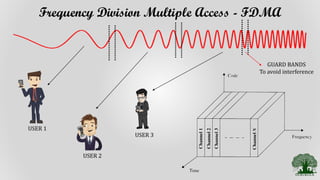
Frequency Division Multiple Access - FDMA
USER 1
USER 3
USER 2
GUARD BANDS
To avoid interference
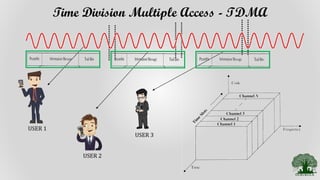
Time Division Multiple Access - TDMA
USER 1
USER 3
USER 2
Time Division Multiple Access - TDMA
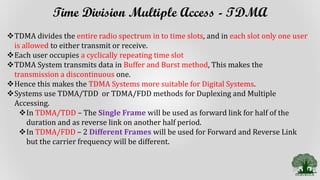
TDMA divides the entire radio spectrum in to time slots, and in each slot only one user
is allowed to either transmit or receive.
Each user occupies a cyclically repeating time slot
TDMA System transmits data in Buffer and Burst method, This makes the
transmission a discontinuous one.
Hence this makes the TDMA Systems more suitable for Digital Systems.
Systems use TDMA/TDD or TDMA/FDD methods for Duplexing and Multiple
Accessing.
In TDMA/TDD – The Single Frame will be used as forward link for half of the
duration and as reverse link on another half period.
In TDMA/FDD – 2 Different Frames will be used for Forward and Reverse Link
but the carrier frequency will be different.
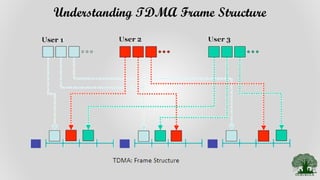
Understanding TDMA Frame Structure
Time Division Multiple Access - TDMA
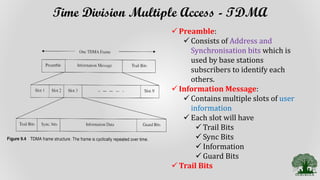
 Preamble:
 Consists of Address and
Synchronisation bits which is
used by base stations
subscribers to identify each
others.
 Information Message:
 Contains multiple slots of user
information
 Each slot will have
 Trail Bits
 Sync Bits
 Information
 Guard Bits
 Trail Bits
Features of TDMA
1.In case of TDMA a single carrier frequency is shared among several users. The time
slots used by the users depends on several factors such as modulation techniques and
the available bandwidth.
2.The Handoff process is much simpler in the case of TDMA because of its discontinuity
and it is able to listen to the other base stations during its idle slot time.
3.The Transmission rates are very high in the case of TDMA as compared to the FDMA
because of the Adaptive Equalization which is necessary in the case of TDMA.
4.The guard time present in the case of TDMA should be minimum.
5.The main advantage of TDMA is that it is very cost-effective.
6.TDMA technology is used to separate users in time and ensure that there will not be
any interference which is presented from any other simultaneous transmissions.
Efficiency in TDMA
• Calculation of Efficiency becomes trivial as TDMA uses high Overhead than
compared to FDMA.
• The efficiency of TDMA System is a measure of the percentage of transmitted
data that contains information as opposed to providing overhead for the scheme.
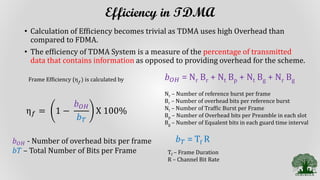
Frame Efficiency (η 𝑓
) is calculated by
η 𝑓 = 1 −
𝑏 𝑂𝐻
𝑏 𝑇
X 100%
𝑏 𝑂𝐻 = Nr Br + Nt Bp + Nt Bg + Nr Bg
Nr – Number of reference burst per frame
Br – Number of overhead bits per reference burst
Nt – Number of Traffic Burst per Frame
Bp – Number of Overhead bits per Preamble in each slot
Bg – Number of Equalent bits in each guard time interval
𝑏 𝑇 = Tf R
Tf – Frame Duration
R – Channel Bit Rate
𝑏 𝑂𝐻 - Number of overhead bits per frame
𝑏𝑇 – Total Number of Bits per Frame
Number of Channels in TDMA Systems
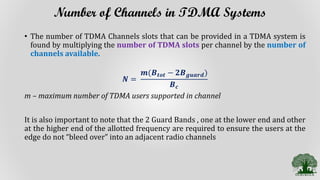
• The number of TDMA Channels slots that can be provided in a TDMA system is
found by multiplying the number of TDMA slots per channel by the number of
channels available.
𝑵 =
𝒎(𝑩 𝒕𝒐𝒕 − 𝟐𝑩 𝒈𝒖𝒂𝒓𝒅)
𝑩 𝒄
m – maximum number of TDMA users supported in channel
It is also important to note that the 2 Guard Bands , one at the lower end and other
at the higher end of the allotted frequency are required to ensure the users at the
edge do not “bleed over” into an adjacent radio channels
Summary
• Recap of FDMA
• Concepts and Working of TDMA
• Frame Structure of TDMA
• Features of TDMA
• Efficiency of TDMA Systems
• Capacity of TDMA Systems
***---***

2.3 time division multiple access

  • 1.
  • 2.
    Lecture Videos areavailable for this slides at www.youtube.com/gurukula Support by Subscribing to my Channel
  • 3.
    Frequency Division MultipleAccess - FDMA USER 1 USER 3 USER 2 GUARD BANDS To avoid interference
  • 4.
    Time Division MultipleAccess - TDMA USER 1 USER 3 USER 2
  • 5.
    Time Division MultipleAccess - TDMA TDMA divides the entire radio spectrum in to time slots, and in each slot only one user is allowed to either transmit or receive. Each user occupies a cyclically repeating time slot TDMA System transmits data in Buffer and Burst method, This makes the transmission a discontinuous one. Hence this makes the TDMA Systems more suitable for Digital Systems. Systems use TDMA/TDD or TDMA/FDD methods for Duplexing and Multiple Accessing. In TDMA/TDD – The Single Frame will be used as forward link for half of the duration and as reverse link on another half period. In TDMA/FDD – 2 Different Frames will be used for Forward and Reverse Link but the carrier frequency will be different.
  • 6.
  • 7.
    Time Division MultipleAccess - TDMA  Preamble:  Consists of Address and Synchronisation bits which is used by base stations subscribers to identify each others.  Information Message:  Contains multiple slots of user information  Each slot will have  Trail Bits  Sync Bits  Information  Guard Bits  Trail Bits
  • 8.
    Features of TDMA 1.Incase of TDMA a single carrier frequency is shared among several users. The time slots used by the users depends on several factors such as modulation techniques and the available bandwidth. 2.The Handoff process is much simpler in the case of TDMA because of its discontinuity and it is able to listen to the other base stations during its idle slot time. 3.The Transmission rates are very high in the case of TDMA as compared to the FDMA because of the Adaptive Equalization which is necessary in the case of TDMA. 4.The guard time present in the case of TDMA should be minimum. 5.The main advantage of TDMA is that it is very cost-effective. 6.TDMA technology is used to separate users in time and ensure that there will not be any interference which is presented from any other simultaneous transmissions.
  • 9.
    Efficiency in TDMA •Calculation of Efficiency becomes trivial as TDMA uses high Overhead than compared to FDMA. • The efficiency of TDMA System is a measure of the percentage of transmitted data that contains information as opposed to providing overhead for the scheme. Frame Efficiency (η 𝑓 ) is calculated by η 𝑓 = 1 − 𝑏 𝑂𝐻 𝑏 𝑇 X 100% 𝑏 𝑂𝐻 = Nr Br + Nt Bp + Nt Bg + Nr Bg Nr – Number of reference burst per frame Br – Number of overhead bits per reference burst Nt – Number of Traffic Burst per Frame Bp – Number of Overhead bits per Preamble in each slot Bg – Number of Equalent bits in each guard time interval 𝑏 𝑇 = Tf R Tf – Frame Duration R – Channel Bit Rate 𝑏 𝑂𝐻 - Number of overhead bits per frame 𝑏𝑇 – Total Number of Bits per Frame
  • 10.
    Number of Channelsin TDMA Systems • The number of TDMA Channels slots that can be provided in a TDMA system is found by multiplying the number of TDMA slots per channel by the number of channels available. 𝑵 = 𝒎(𝑩 𝒕𝒐𝒕 − 𝟐𝑩 𝒈𝒖𝒂𝒓𝒅) 𝑩 𝒄 m – maximum number of TDMA users supported in channel It is also important to note that the 2 Guard Bands , one at the lower end and other at the higher end of the allotted frequency are required to ensure the users at the edge do not “bleed over” into an adjacent radio channels
  • 11.
    Summary • Recap ofFDMA • Concepts and Working of TDMA • Frame Structure of TDMA • Features of TDMA • Efficiency of TDMA Systems • Capacity of TDMA Systems ***---***