
FREQUENCY
DIVISION
MULTIPLE
ACCESS
Lecture Videos are available for this slides
at
www.youtube.com/gurukula
Support by Subscribing to my
Channel
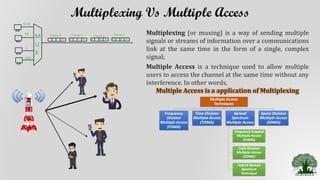
Multiplexing Vs Multiple Access
Multiplexing (or muxing) is a way of sending multiple
signals or streams of information over a communications
link at the same time in the form of a single, complex
signal;
Multiple Access is a technique used to allow multiple
users to access the channel at the same time without any
interference. In other words,
Multiple Access is a application of Multiplexing
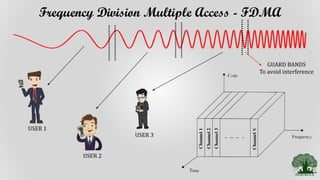
Frequency Division Multiple Access - FDMA
USER 1
USER 3
USER 2
GUARD BANDS
To avoid interference
FDMA
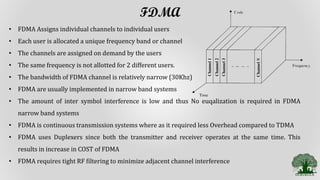
• FDMA Assigns individual channels to individual users
• Each user is allocated a unique frequency band or channel
• The channels are assigned on demand by the users
• The same frequency is not allotted for 2 different users.
• The bandwidth of FDMA channel is relatively narrow (30Khz)
• FDMA are usually implemented in narrow band systems
• The amount of inter symbol interference is low and thus No euqalization is required in FDMA
narrow band systems
• FDMA is continuous transmission systems where as it required less Overhead compared to TDMA
• FDMA uses Duplexers since both the transmitter and receiver operates at the same time. This
results in increase in COST of FDMA
• FDMA requires tight RF filtering to minimize adjacent channel interference
Non Linear Effects in FDMA
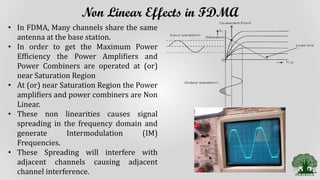
• In FDMA, Many channels share the same
antenna at the base station.
• In order to get the Maximum Power
Efficiency the Power Amplifiers and
Power Combiners are operated at (or)
near Saturation Region
• At (or) near Saturation Region the Power
amplifiers and power combiners are Non
Linear.
• These non linearities causes signal
spreading in the frequency domain and
generate Intermodulation (IM)
Frequencies.
• These Spreading will interfere with
adjacent channels causing adjacent
channel interference.
Capacity of FDMA
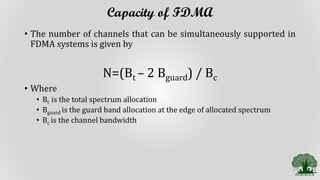
• The number of channels that can be simultaneously supported in
FDMA systems is given by
N=(Bt – 2 Bguard) / Bc
• Where
• Bt is the total spectrum allocation
• Bguard is the guard band allocation at the edge of allocated spectrum
• Bc is the channel bandwidth
Summary
• Multiplexing Vs Multiple Access
• Multiple Access is an application of Multiplexing
• Type of Multiple access Techniques
• Frequency Division Multiple Access Technique
• Principle of Operation
• Pros and Cons
• Non Linear Effects of FDMA
• Channel Capacity of FDMA systems

2.2 frequency division multiple access

  • 1.
  • 2.
    Lecture Videos areavailable for this slides at www.youtube.com/gurukula Support by Subscribing to my Channel
  • 3.
    Multiplexing Vs MultipleAccess Multiplexing (or muxing) is a way of sending multiple signals or streams of information over a communications link at the same time in the form of a single, complex signal; Multiple Access is a technique used to allow multiple users to access the channel at the same time without any interference. In other words, Multiple Access is a application of Multiplexing
  • 4.
    Frequency Division MultipleAccess - FDMA USER 1 USER 3 USER 2 GUARD BANDS To avoid interference
  • 5.
    FDMA • FDMA Assignsindividual channels to individual users • Each user is allocated a unique frequency band or channel • The channels are assigned on demand by the users • The same frequency is not allotted for 2 different users. • The bandwidth of FDMA channel is relatively narrow (30Khz) • FDMA are usually implemented in narrow band systems • The amount of inter symbol interference is low and thus No euqalization is required in FDMA narrow band systems • FDMA is continuous transmission systems where as it required less Overhead compared to TDMA • FDMA uses Duplexers since both the transmitter and receiver operates at the same time. This results in increase in COST of FDMA • FDMA requires tight RF filtering to minimize adjacent channel interference
  • 6.
    Non Linear Effectsin FDMA • In FDMA, Many channels share the same antenna at the base station. • In order to get the Maximum Power Efficiency the Power Amplifiers and Power Combiners are operated at (or) near Saturation Region • At (or) near Saturation Region the Power amplifiers and power combiners are Non Linear. • These non linearities causes signal spreading in the frequency domain and generate Intermodulation (IM) Frequencies. • These Spreading will interfere with adjacent channels causing adjacent channel interference.
  • 7.
    Capacity of FDMA •The number of channels that can be simultaneously supported in FDMA systems is given by N=(Bt – 2 Bguard) / Bc • Where • Bt is the total spectrum allocation • Bguard is the guard band allocation at the edge of allocated spectrum • Bc is the channel bandwidth
  • 8.
    Summary • Multiplexing VsMultiple Access • Multiple Access is an application of Multiplexing • Type of Multiple access Techniques • Frequency Division Multiple Access Technique • Principle of Operation • Pros and Cons • Non Linear Effects of FDMA • Channel Capacity of FDMA systems