26/11/20071
CDMA: An Introduction
Βαγγέλης Δούρος
EY0619
douros06@aueb.gr
2
Motivation
Why do we need CDMA?
Which are its basic principles?
What do we earn by using it?
3
Outline
Introduction
CDMA Basics
CDMA Deeper
CDMA Problems
CDMA Benefits
Conclusions
4
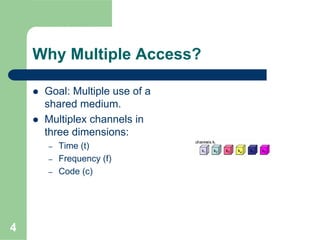
Why Multiple Access?
Goal: Multiple use of a
shared medium.
Multiplex channels in
three dimensions:
– Time (t)
– Frequency (f)
– Code (c)
5
Frequency Division Multiple Access
(FDMA)
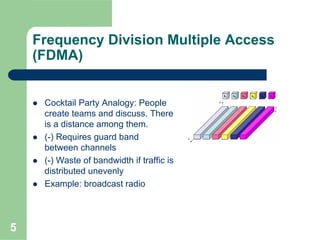
Cocktail Party Analogy: People
create teams and discuss. There
is a distance among them.
(-) Requires guard band
between channels
(-) Waste of bandwidth if traffic is
distributed unevenly
Example: broadcast radio
6
Time Division Multiple Access (TDMA)
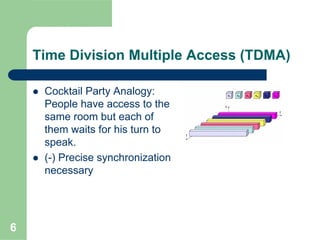
Cocktail Party Analogy:
People have access to the
same room but each of
them waits for his turn to
speak.
(-) Precise synchronization
necessary
7
Time and Frequency Division Multiple
Access
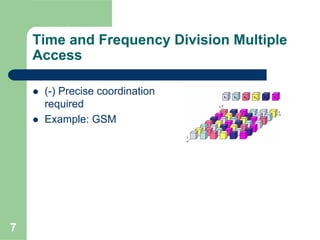
(-) Precise coordination
required
Example: GSM
8
Code Division Multiple Access (CDMA)
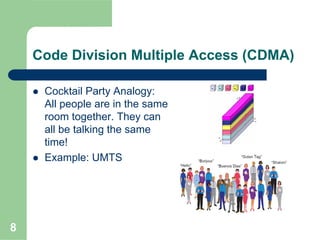
Cocktail Party Analogy:
All people are in the same
room together. They can
all be talking the same
time!
Example: UMTS
9
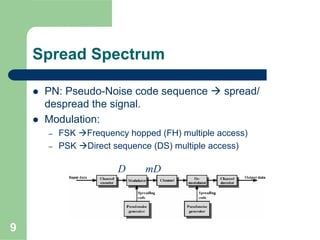
Spread Spectrum
PN: Pseudo-Noise code sequence spread/
despread the signal.
Modulation:
– FSK Frequency hopped (FH) multiple access)
– PSK Direct sequence (DS) multiple access)
D mD
10
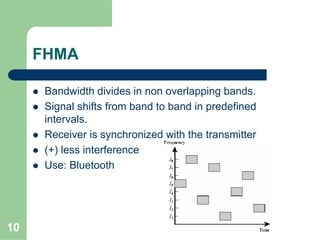
FHMA
Bandwidth divides in non overlapping bands.
Signal shifts from band to band in predefined
intervals.
Receiver is synchronized with the transmitter
(+) less interference
Use: Bluetooth
11
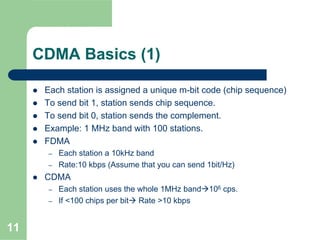
CDMA Basics (1)
Each station is assigned a unique m-bit code (chip sequence)
To send bit 1, station sends chip sequence.
To send bit 0, station sends the complement.
Example: 1 MHz band with 100 stations.
FDMA
– Each station a 10kHz band
– Rate:10 kbps (Assume that you can send 1bit/Hz)
CDMA
– Each station uses the whole 1MHz band 106 cps.
– If <100 chips per bit Rate >10 kbps
12
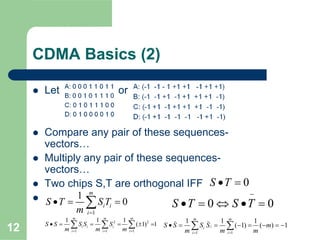
CDMA Basics (2)
Let or
Compare any pair of these sequences-
vectors…
Multiply any pair of these sequences-
vectors…
Two chips S,T are orthogonal IFF
0 0S T S T
−
• = ⇔ • =
0S T• =
1
1
0
m
i i
i
S T S T
m =
• = =∑
2 2
1 1 1
1 1 1
( 1) 1
m m m
i i i
i i i
S S S S S
m m m= = =
• = = = ± =∑ ∑ ∑
_ _
1 1
1 1 1
( 1) ( ) 1
m m
ii
i i
S S S S m
m m m= =
• = = − = − = −∑ ∑
13
CDMA Basics (3)
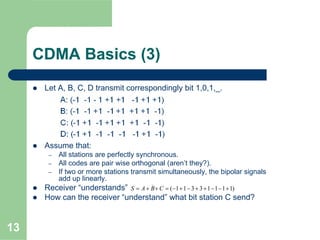
Let A, B, C, D transmit correspondingly bit 1,0,1,_.
Assume that:
– All stations are perfectly synchronous.
– All codes are pair wise orthogonal (aren’t they?).
– If two or more stations transmit simultaneously, the bipolar signals
add up linearly.
Receiver “understands”
How can the receiver “understand” what bit station C send?
_
( 1 1 3 3 1 1 1 1)S A B C= + + = − + − + + − − +
14
CDMA Basics (4)
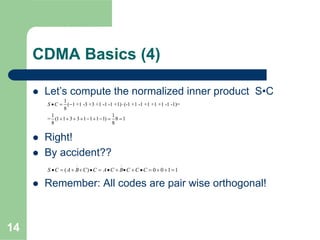
Let’s compute the normalized inner product S•C
Right!
By accident??
Remember: All codes are pair wise orthogonal!
1
( 1 +1 -3 +3 +1 -1 -1 +1) (-1 +1 -1 +1 +1 +1 -1 -1)=
8
1 1
= (1 1 3 3 1 1 1 1) 8 1
8 8
S C• = − ⋅
+ + + + − + − = =
( ) 0 0 1 1S C A B C C A C B C C C
− −
• = + + • = • + • + • = + + =
15
CDMA Basics (5)
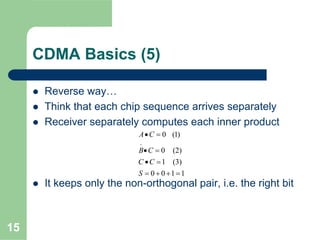
Reverse way…
Think that each chip sequence arrives separately
Receiver separately computes each inner product
It keeps only the non-orthogonal pair, i.e. the right bit
0 (1)
0 (2)
1 (3)
0 0 1 1
A C
B C
C C
S
−
• =
• =
• =
= + + =
16
CDMA Deeper (1)
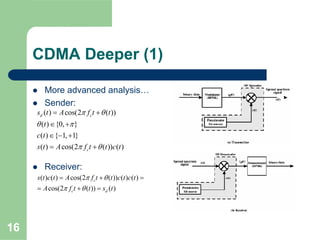
More advanced analysis…
Sender:
Receiver:
( ) cos(2 ( ))
( ) {0, }
( ) { 1, 1}
( ) cos(2 ( )) ( )
d c
c
s t A f t t
t
c t
s t A f t t c t
π θ
θ π
π θ
= +
∈ +
∈ − +
= +
( ) ( ) cos(2 ( )) ( ) ( )
cos(2 ( )) ( )
c
c d
s t c t A f t t c t c t
A f t t s t
π θ
π θ
= + =
= + =
17
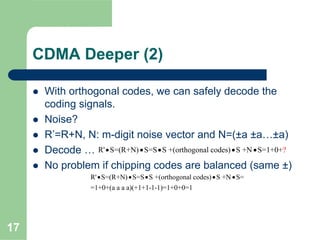
CDMA Deeper (2)
With orthogonal codes, we can safely decode the
coding signals.
Noise?
R’=R+N, N: m-digit noise vector and N=(±a ±a…±a)
Decode …
No problem if chipping codes are balanced (same ±)
R' S=(R+N) S=S S +(orthogonal codes) S +N S= 0 ?1+ +• • • • •
R' S=(R+N) S=S S +(orthogonal codes) S +N S=
=1+0+(a a a a)(+1+1-1-1)=1+0+0=1
• • • • •
18
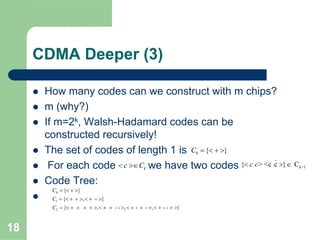
CDMA Deeper (3)
How many codes can we construct with m chips?
m (why?)
If m=2k, Walsh-Hadamard codes can be
constructed recursively!
The set of codes of length 1 is
For each code we have two codes
Code Tree:
0 { }C = < + >
kc C< >∈
_
k+1{ > <c c } Cc c< > ∈
0
1
2
{ }
{ , }
{ , - - , - - , - - }
C
C
C
= < + >
= < + + > < + − >
= < + + + + > < + + > < + + > < + + >
19
CDMA Deeper (4)
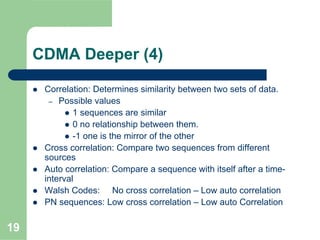
Correlation: Determines similarity between two sets of data.
– Possible values
1 sequences are similar
0 no relationship between them.
-1 one is the mirror of the other
Cross correlation: Compare two sequences from different
sources
Auto correlation: Compare a sequence with itself after a time-
interval
Walsh Codes: No cross correlation – Low auto correlation
PN sequences: Low cross correlation – Low auto Correlation
20
CDMA Deeper (5)
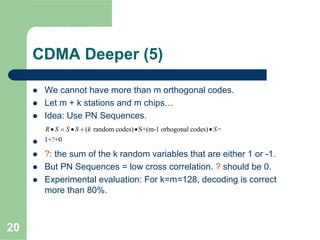
We cannot have more than m orthogonal codes.
Let m + k stations and m chips…
Idea: Use PN Sequences.
?: the sum of the k random variables that are either 1 or -1.
But PN Sequences = low cross correlation. ? should be 0.
Experimental evaluation: For k=m=128, decoding is correct
more than 80%.
( random codes) S+(m-1 orhogonal codes
?
) =
1+ +0
R S S S k S• = • + • •
21
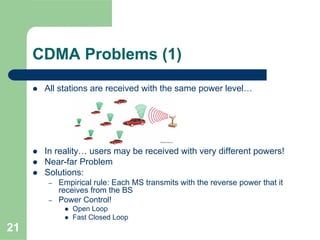
CDMA Problems (1)
All stations are received with the same power level…
In reality… users may be received with very different powers!
Near-far Problem
Solutions:
– Empirical rule: Each MS transmits with the reverse power that it
receives from the BS
– Power Control!
Open Loop
Fast Closed Loop
22
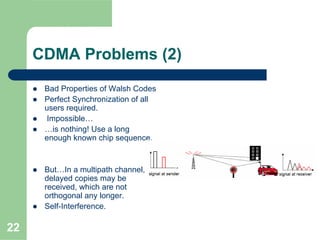
CDMA Problems (2)
Bad Properties of Walsh Codes
Perfect Synchronization of all
users required.
Impossible…
…is nothing! Use a long
enough known chip sequence.
But…In a multipath channel,
delayed copies may be
received, which are not
orthogonal any longer.
Self-Interference.
23
CDMA Problems (3)
So far…
(-)tight synchronization
(-)self-interference
(-)Near-far problem
(-)Higher complexity of sender/ receiver
…
How did Qualcomm convince people to use
this stuff??
24
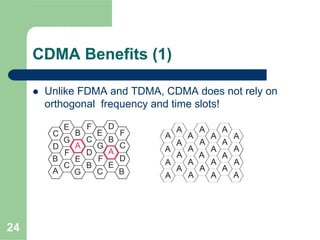
CDMA Benefits (1)
Unlike FDMA and TDMA, CDMA does not rely on
orthogonal frequency and time slots!
25
CDMA Benefits (2)
In TDMA and FDMA systems
– Nothing to send time/frequency slot is wasted
– Dynamic allocation is very difficult
In CDMA systems
– Nothing to send less interference
– Transmit ~half times doubles the capacity
26
CDMA Benefits (3)
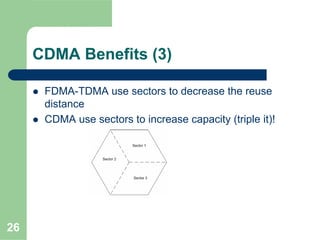
FDMA-TDMA use sectors to decrease the reuse
distance
CDMA use sectors to increase capacity (triple it)!
27
CDMA Benefits (4)
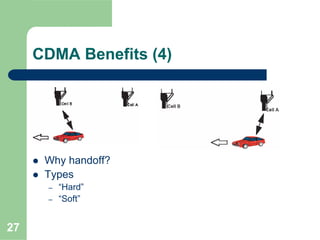
Why handoff?
Types
– “Hard”
– “Soft”
28
CDMA Benefits (5)
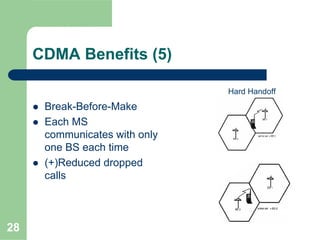
Break-Before-Make
Each MS
communicates with only
one BS each time
(+)Reduced dropped
calls
Hard Handoff
29
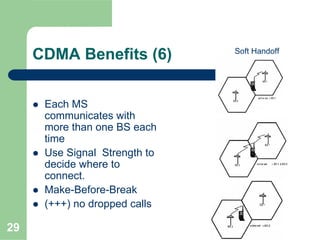
CDMA Benefits (6)
Each MS
communicates with
more than one BS each
time
Use Signal Strength to
decide where to
connect.
Make-Before-Break
(+++) no dropped calls
Soft Handoff
30
CDMA Benefits (7)
Capacity…
TDMA-FDMA: bandwidth limited
CDMA: interference limited
CDMA’s capacity is bigger.
How?
Long Story…
31
Conclusions
Back to the start…
Why do we need CDMA?
– Introduction
Which are its basic principles?
– CDMA Basics
– CDMA Deeper
What do we earn by using it?
– CDMA Problems
– CDMA Benefits
32
Ευχαριστώ!

Cdma introduction pr

  • 1.
    26/11/20071 CDMA: An Introduction ΒαγγέληςΔούρος EY0619 douros06@aueb.gr
  • 2.
    2 Motivation Why do weneed CDMA? Which are its basic principles? What do we earn by using it?
  • 3.
    3 Outline Introduction CDMA Basics CDMA Deeper CDMAProblems CDMA Benefits Conclusions
  • 4.
    4 Why Multiple Access? Goal:Multiple use of a shared medium. Multiplex channels in three dimensions: – Time (t) – Frequency (f) – Code (c)
  • 5.
    5 Frequency Division MultipleAccess (FDMA) Cocktail Party Analogy: People create teams and discuss. There is a distance among them. (-) Requires guard band between channels (-) Waste of bandwidth if traffic is distributed unevenly Example: broadcast radio
  • 6.
    6 Time Division MultipleAccess (TDMA) Cocktail Party Analogy: People have access to the same room but each of them waits for his turn to speak. (-) Precise synchronization necessary
  • 7.
    7 Time and FrequencyDivision Multiple Access (-) Precise coordination required Example: GSM
  • 8.
    8 Code Division MultipleAccess (CDMA) Cocktail Party Analogy: All people are in the same room together. They can all be talking the same time! Example: UMTS
  • 9.
    9 Spread Spectrum PN: Pseudo-Noisecode sequence spread/ despread the signal. Modulation: – FSK Frequency hopped (FH) multiple access) – PSK Direct sequence (DS) multiple access) D mD
  • 10.
    10 FHMA Bandwidth divides innon overlapping bands. Signal shifts from band to band in predefined intervals. Receiver is synchronized with the transmitter (+) less interference Use: Bluetooth
  • 11.
    11 CDMA Basics (1) Eachstation is assigned a unique m-bit code (chip sequence) To send bit 1, station sends chip sequence. To send bit 0, station sends the complement. Example: 1 MHz band with 100 stations. FDMA – Each station a 10kHz band – Rate:10 kbps (Assume that you can send 1bit/Hz) CDMA – Each station uses the whole 1MHz band 106 cps. – If <100 chips per bit Rate >10 kbps
  • 12.
    12 CDMA Basics (2) Letor Compare any pair of these sequences- vectors… Multiply any pair of these sequences- vectors… Two chips S,T are orthogonal IFF 0 0S T S T − • = ⇔ • = 0S T• = 1 1 0 m i i i S T S T m = • = =∑ 2 2 1 1 1 1 1 1 ( 1) 1 m m m i i i i i i S S S S S m m m= = = • = = = ± =∑ ∑ ∑ _ _ 1 1 1 1 1 ( 1) ( ) 1 m m ii i i S S S S m m m m= = • = = − = − = −∑ ∑
  • 13.
    13 CDMA Basics (3) LetA, B, C, D transmit correspondingly bit 1,0,1,_. Assume that: – All stations are perfectly synchronous. – All codes are pair wise orthogonal (aren’t they?). – If two or more stations transmit simultaneously, the bipolar signals add up linearly. Receiver “understands” How can the receiver “understand” what bit station C send? _ ( 1 1 3 3 1 1 1 1)S A B C= + + = − + − + + − − +
  • 14.
    14 CDMA Basics (4) Let’scompute the normalized inner product S•C Right! By accident?? Remember: All codes are pair wise orthogonal! 1 ( 1 +1 -3 +3 +1 -1 -1 +1) (-1 +1 -1 +1 +1 +1 -1 -1)= 8 1 1 = (1 1 3 3 1 1 1 1) 8 1 8 8 S C• = − ⋅ + + + + − + − = = ( ) 0 0 1 1S C A B C C A C B C C C − − • = + + • = • + • + • = + + =
  • 15.
    15 CDMA Basics (5) Reverseway… Think that each chip sequence arrives separately Receiver separately computes each inner product It keeps only the non-orthogonal pair, i.e. the right bit 0 (1) 0 (2) 1 (3) 0 0 1 1 A C B C C C S − • = • = • = = + + =
  • 16.
    16 CDMA Deeper (1) Moreadvanced analysis… Sender: Receiver: ( ) cos(2 ( )) ( ) {0, } ( ) { 1, 1} ( ) cos(2 ( )) ( ) d c c s t A f t t t c t s t A f t t c t π θ θ π π θ = + ∈ + ∈ − + = + ( ) ( ) cos(2 ( )) ( ) ( ) cos(2 ( )) ( ) c c d s t c t A f t t c t c t A f t t s t π θ π θ = + = = + =
  • 17.
    17 CDMA Deeper (2) Withorthogonal codes, we can safely decode the coding signals. Noise? R’=R+N, N: m-digit noise vector and N=(±a ±a…±a) Decode … No problem if chipping codes are balanced (same ±) R' S=(R+N) S=S S +(orthogonal codes) S +N S= 0 ?1+ +• • • • • R' S=(R+N) S=S S +(orthogonal codes) S +N S= =1+0+(a a a a)(+1+1-1-1)=1+0+0=1 • • • • •
  • 18.
    18 CDMA Deeper (3) Howmany codes can we construct with m chips? m (why?) If m=2k, Walsh-Hadamard codes can be constructed recursively! The set of codes of length 1 is For each code we have two codes Code Tree: 0 { }C = < + > kc C< >∈ _ k+1{ > <c c } Cc c< > ∈ 0 1 2 { } { , } { , - - , - - , - - } C C C = < + > = < + + > < + − > = < + + + + > < + + > < + + > < + + >
  • 19.
    19 CDMA Deeper (4) Correlation:Determines similarity between two sets of data. – Possible values 1 sequences are similar 0 no relationship between them. -1 one is the mirror of the other Cross correlation: Compare two sequences from different sources Auto correlation: Compare a sequence with itself after a time- interval Walsh Codes: No cross correlation – Low auto correlation PN sequences: Low cross correlation – Low auto Correlation
  • 20.
    20 CDMA Deeper (5) Wecannot have more than m orthogonal codes. Let m + k stations and m chips… Idea: Use PN Sequences. ?: the sum of the k random variables that are either 1 or -1. But PN Sequences = low cross correlation. ? should be 0. Experimental evaluation: For k=m=128, decoding is correct more than 80%. ( random codes) S+(m-1 orhogonal codes ? ) = 1+ +0 R S S S k S• = • + • •
  • 21.
    21 CDMA Problems (1) Allstations are received with the same power level… In reality… users may be received with very different powers! Near-far Problem Solutions: – Empirical rule: Each MS transmits with the reverse power that it receives from the BS – Power Control! Open Loop Fast Closed Loop
  • 22.
    22 CDMA Problems (2) BadProperties of Walsh Codes Perfect Synchronization of all users required. Impossible… …is nothing! Use a long enough known chip sequence. But…In a multipath channel, delayed copies may be received, which are not orthogonal any longer. Self-Interference.
  • 23.
    23 CDMA Problems (3) Sofar… (-)tight synchronization (-)self-interference (-)Near-far problem (-)Higher complexity of sender/ receiver … How did Qualcomm convince people to use this stuff??
  • 24.
    24 CDMA Benefits (1) UnlikeFDMA and TDMA, CDMA does not rely on orthogonal frequency and time slots!
  • 25.
    25 CDMA Benefits (2) InTDMA and FDMA systems – Nothing to send time/frequency slot is wasted – Dynamic allocation is very difficult In CDMA systems – Nothing to send less interference – Transmit ~half times doubles the capacity
  • 26.
    26 CDMA Benefits (3) FDMA-TDMAuse sectors to decrease the reuse distance CDMA use sectors to increase capacity (triple it)!
  • 27.
    27 CDMA Benefits (4) Whyhandoff? Types – “Hard” – “Soft”
  • 28.
    28 CDMA Benefits (5) Break-Before-Make EachMS communicates with only one BS each time (+)Reduced dropped calls Hard Handoff
  • 29.
    29 CDMA Benefits (6) EachMS communicates with more than one BS each time Use Signal Strength to decide where to connect. Make-Before-Break (+++) no dropped calls Soft Handoff
  • 30.
    30 CDMA Benefits (7) Capacity… TDMA-FDMA:bandwidth limited CDMA: interference limited CDMA’s capacity is bigger. How? Long Story…
  • 31.
    31 Conclusions Back to thestart… Why do we need CDMA? – Introduction Which are its basic principles? – CDMA Basics – CDMA Deeper What do we earn by using it? – CDMA Problems – CDMA Benefits
  • 32.