PRESENTATION
ON
7/25/2013
1
Contents:
1. GSM
1.1. What is GSM?
1.2. GSM Phases
1.3. GSM specifications
1.4. GSM system architecture
1.5. GSM network areas
1.6. GSM service area
1.7. Advantages of GSM over Analog system
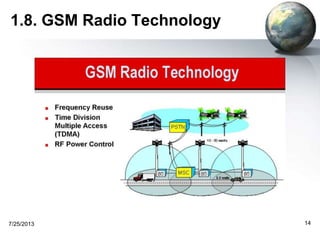
1.8. GSM Radio technology
2. Cell Planning
2.1. Cell Planning
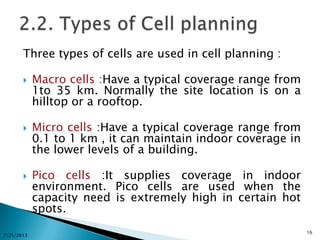
2.2. Types of cell planning
2.3. Cell Planning Process
2.4. Cell cluster
3.Frequency reuse
3.1.what is frequency reuse
3.2.Example of frequency reuse
7/25/2013
2
1. GSM
1.1 What is GSM ?
Global system for mobile communication (GSM) is a globally
accepted standard for digital cellular communication which is
based on Time Division Multiple Access (TDMA) technique.
GSM is a second generation cellular standard developed to
cater voice services and data delivery using digital
modulation.
7/25/2013 3
• GSM devices range from mobile telephones to data cards that allow devices to
connect and communicate with the GSM system.GSM mobile devices may
include the capability to use GSM radio channels on different frequency bands.
• Mobile Telephones - Portable devices that can be used for voice
communication.
• PCMCIA Air Cards - Cards that can slide into computers to provide data
services.
• Embedded Radio Modules - Radio assemblies that can be built-in or installed in
devices such as laptop computers, video cameras, or digital signage displays.
• External Radio Modems - Assemblies that can be connected to other devices
through USB, Ethernet, or other connection types to provide data services.
7/25/2013 4
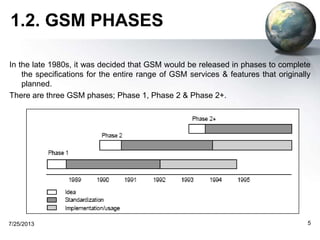
1.2. GSM PHASES
In the late 1980s, it was decided that GSM would be released in phases to complete
the specifications for the entire range of GSM services & features that originally
planned.
There are three GSM phases; Phase 1, Phase 2 & Phase 2+.
7/25/2013 5
1.3. GSM Specifications
Frequency bands:
– GSM 900:
• 890 – 915 MHz: Uplink (MS transmit)
• 935 - 960 MHz: Downlink (MS receive)
– GSM 1800:
• 1710 - 1885 MHz: Uplink
• 1805 - 1880 MHz: Downlink
7/25/2013 6
1.3. GSM Specification(cont.)
• Carrier Bandwidth : 200 Khz
• Duplex Distance : 45 Mhz
• Channels / carrier: 8
• No. of RF carriers : 124
• Access Method : TDMA/FDMA
• Modulation Method : GMSK
• Modulation data rate : 270.833 Kbps
7/25/2013 7
1.4. GSM network areas:
In a GSM network, the following areas are defined:
 Cell: Cell is the basic service area: one BTS covers one cell. Each cell is given a
Cell Global Identity (CGI), a number that uniquely identifies the cell.
 Location Area: A group of cells form a Location Area. This is the area that is
paged when a subscriber gets an incoming call. Each Location Area is assigned a
Location Area Identity (LAI). Each Location Area is served by one or more BSCs.
 MSC/VLR Service Area: The area covered by one MSC is called the MSC/VLR
service area.
 PLMN: The area covered by one network operator is called PLMN. A PLMN can
contain one or more MSCs.
7/25/2013 8
1.5. GSM SERVICE AREA
The GSM service area is the entire geographical area in which a subscriber
can gain access to a GSM network. The GSM service area increases as
more operators sign contracts agreeing to work together.
International roaming is the term applied when an MS moves from one PLMN
to another.
fig: relations between areas in GSM
7/25/2013
9
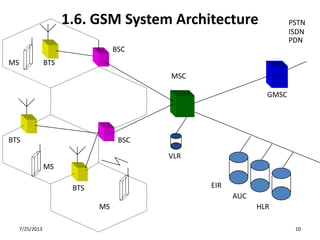
1.6. GSM System Architecture
BSC
BSC
MSC
MS
MS
MS BTS
BTS
BTS
GMSC
PSTN
ISDN
PDN
EIR
AUC
HLR
VLR
7/25/2013 10
1.6. GSM System Architecture(cont.)
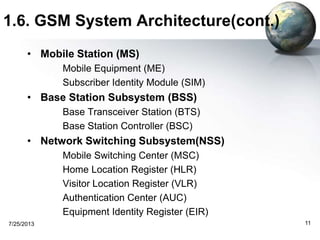
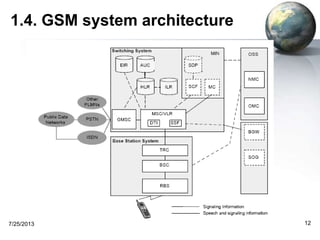
• Mobile Station (MS)
Mobile Equipment (ME)
Subscriber Identity Module (SIM)
• Base Station Subsystem (BSS)
Base Transceiver Station (BTS)
Base Station Controller (BSC)
• Network Switching Subsystem(NSS)
Mobile Switching Center (MSC)
Home Location Register (HLR)
Visitor Location Register (VLR)
Authentication Center (AUC)
Equipment Identity Register (EIR)
7/25/2013 11
1.4. GSM system architecture
7/25/2013 12
1.7. Advantages of GSM over
Analog system
• Capacity increases
• Reduced RF transmission power and longer battery life.
• International roaming capability.
• Better security against fraud (through terminal validation and
user authentication).
• Encryption capability for information security and privacy.
• Compatibility with ISDN, leading to wider range of services
7/25/2013 13
1.8. GSM Radio Technology
7/25/2013 14
2.1. What is Cell Planning?
•Cell planning means building a network able to
provide service to the customers wherever they
are.
•The main issue of the cellular network Planner
is achieving the maximum capacity whilst
maintaining an acceptable grade of service and
good speech quality.
7/25/2013
15
Three types of cells are used in cell planning :
 Macro cells :Have a typical coverage range from
1to 35 km. Normally the site location is on a
hilltop or a rooftop.
 Micro cells :Have a typical coverage range from
0.1 to 1 km , it can maintain indoor coverage in
the lower levels of a building.
 Pico cells :It supplies coverage in indoor
environment. Pico cells are used when the
capacity need is extremely high in certain hot
spots.
7/25/2013
16
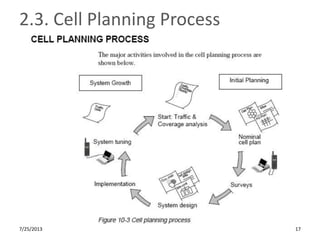
2.3. Cell Planning Process
7/25/2013 17
 There are four steps in cell planning:
1. Traffic And Coverage Analysis
2. Nominal Cell Plan
3. Surveys
4. System Design
7/25/2013
18
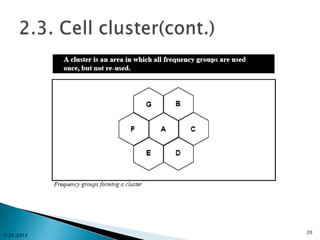
 A cellular system is based on re-use of
frequencies. All the available frequencies are
divided into different frequency groups so
that a certain frequency always belongs to a
certain frequency group. The frequency
groups together form a cluster.
 A group of neighboring cells using all the
frequencies available in the system frequency
band is called a cluster of cells.
 By repeating the cluster over and over again
a cellular network can be built.
7/25/2013
19
7/25/2013
20
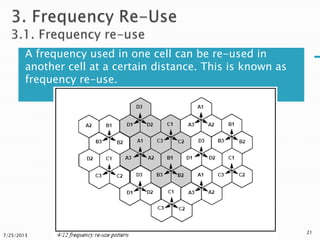
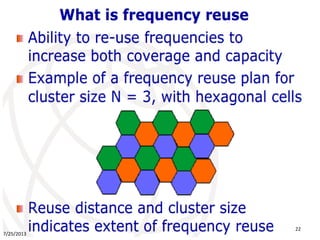
A frequency used in one cell can be re-used in
another cell at a certain distance. This is known as
frequency re-use.
7/25/2013
21
7/25/2013
22
7/25/2013 23
7/25/2013 24
7/25/2013 25
7/25/2013 26
7/25/2013 27
7/25/2013 28
7/25/2013 29
7/25/2013 30
References:
Wireless and Cellular Telecommunications
 Willium C.Y.Lee
GSM System Survey
 Ericsson
Wireless Communication
 Theodore S.Rappaport (2nd Edition)
7/25/2013
31

GSM, Cell Planning & Frequency Reuse

  • 1.
  • 2.
    Contents: 1. GSM 1.1. Whatis GSM? 1.2. GSM Phases 1.3. GSM specifications 1.4. GSM system architecture 1.5. GSM network areas 1.6. GSM service area 1.7. Advantages of GSM over Analog system 1.8. GSM Radio technology 2. Cell Planning 2.1. Cell Planning 2.2. Types of cell planning 2.3. Cell Planning Process 2.4. Cell cluster 3.Frequency reuse 3.1.what is frequency reuse 3.2.Example of frequency reuse 7/25/2013 2
  • 3.
    1. GSM 1.1 Whatis GSM ? Global system for mobile communication (GSM) is a globally accepted standard for digital cellular communication which is based on Time Division Multiple Access (TDMA) technique. GSM is a second generation cellular standard developed to cater voice services and data delivery using digital modulation. 7/25/2013 3
  • 4.
    • GSM devicesrange from mobile telephones to data cards that allow devices to connect and communicate with the GSM system.GSM mobile devices may include the capability to use GSM radio channels on different frequency bands. • Mobile Telephones - Portable devices that can be used for voice communication. • PCMCIA Air Cards - Cards that can slide into computers to provide data services. • Embedded Radio Modules - Radio assemblies that can be built-in or installed in devices such as laptop computers, video cameras, or digital signage displays. • External Radio Modems - Assemblies that can be connected to other devices through USB, Ethernet, or other connection types to provide data services. 7/25/2013 4
  • 5.
    1.2. GSM PHASES Inthe late 1980s, it was decided that GSM would be released in phases to complete the specifications for the entire range of GSM services & features that originally planned. There are three GSM phases; Phase 1, Phase 2 & Phase 2+. 7/25/2013 5
  • 6.
    1.3. GSM Specifications Frequencybands: – GSM 900: • 890 – 915 MHz: Uplink (MS transmit) • 935 - 960 MHz: Downlink (MS receive) – GSM 1800: • 1710 - 1885 MHz: Uplink • 1805 - 1880 MHz: Downlink 7/25/2013 6
  • 7.
    1.3. GSM Specification(cont.) •Carrier Bandwidth : 200 Khz • Duplex Distance : 45 Mhz • Channels / carrier: 8 • No. of RF carriers : 124 • Access Method : TDMA/FDMA • Modulation Method : GMSK • Modulation data rate : 270.833 Kbps 7/25/2013 7
  • 8.
    1.4. GSM networkareas: In a GSM network, the following areas are defined:  Cell: Cell is the basic service area: one BTS covers one cell. Each cell is given a Cell Global Identity (CGI), a number that uniquely identifies the cell.  Location Area: A group of cells form a Location Area. This is the area that is paged when a subscriber gets an incoming call. Each Location Area is assigned a Location Area Identity (LAI). Each Location Area is served by one or more BSCs.  MSC/VLR Service Area: The area covered by one MSC is called the MSC/VLR service area.  PLMN: The area covered by one network operator is called PLMN. A PLMN can contain one or more MSCs. 7/25/2013 8
  • 9.
    1.5. GSM SERVICEAREA The GSM service area is the entire geographical area in which a subscriber can gain access to a GSM network. The GSM service area increases as more operators sign contracts agreeing to work together. International roaming is the term applied when an MS moves from one PLMN to another. fig: relations between areas in GSM 7/25/2013 9
  • 10.
    1.6. GSM SystemArchitecture BSC BSC MSC MS MS MS BTS BTS BTS GMSC PSTN ISDN PDN EIR AUC HLR VLR 7/25/2013 10
  • 11.
    1.6. GSM SystemArchitecture(cont.) • Mobile Station (MS) Mobile Equipment (ME) Subscriber Identity Module (SIM) • Base Station Subsystem (BSS) Base Transceiver Station (BTS) Base Station Controller (BSC) • Network Switching Subsystem(NSS) Mobile Switching Center (MSC) Home Location Register (HLR) Visitor Location Register (VLR) Authentication Center (AUC) Equipment Identity Register (EIR) 7/25/2013 11
  • 12.
    1.4. GSM systemarchitecture 7/25/2013 12
  • 13.
    1.7. Advantages ofGSM over Analog system • Capacity increases • Reduced RF transmission power and longer battery life. • International roaming capability. • Better security against fraud (through terminal validation and user authentication). • Encryption capability for information security and privacy. • Compatibility with ISDN, leading to wider range of services 7/25/2013 13
  • 14.
    1.8. GSM RadioTechnology 7/25/2013 14
  • 15.
    2.1. What isCell Planning? •Cell planning means building a network able to provide service to the customers wherever they are. •The main issue of the cellular network Planner is achieving the maximum capacity whilst maintaining an acceptable grade of service and good speech quality. 7/25/2013 15
  • 16.
    Three types ofcells are used in cell planning :  Macro cells :Have a typical coverage range from 1to 35 km. Normally the site location is on a hilltop or a rooftop.  Micro cells :Have a typical coverage range from 0.1 to 1 km , it can maintain indoor coverage in the lower levels of a building.  Pico cells :It supplies coverage in indoor environment. Pico cells are used when the capacity need is extremely high in certain hot spots. 7/25/2013 16
  • 17.
    2.3. Cell PlanningProcess 7/25/2013 17
  • 18.
     There arefour steps in cell planning: 1. Traffic And Coverage Analysis 2. Nominal Cell Plan 3. Surveys 4. System Design 7/25/2013 18
  • 19.
     A cellularsystem is based on re-use of frequencies. All the available frequencies are divided into different frequency groups so that a certain frequency always belongs to a certain frequency group. The frequency groups together form a cluster.  A group of neighboring cells using all the frequencies available in the system frequency band is called a cluster of cells.  By repeating the cluster over and over again a cellular network can be built. 7/25/2013 19
  • 20.
  • 21.
    A frequency usedin one cell can be re-used in another cell at a certain distance. This is known as frequency re-use. 7/25/2013 21
  • 22.
  • 23.
  • 24.
  • 25.
  • 26.
  • 27.
  • 28.
  • 29.
  • 30.
  • 31.
    References: Wireless and CellularTelecommunications  Willium C.Y.Lee GSM System Survey  Ericsson Wireless Communication  Theodore S.Rappaport (2nd Edition) 7/25/2013 31