MULTIPLE ACCESS TECHNIQUES FOR WIRELESS COMMUNICATIONS  UNIT - IV
CONTENTS FDMA  TDMA SDMA SSMA
Introduction many users at same time share a finite amount of radio spectrum high performance duplexing generally required frequency domain time domain
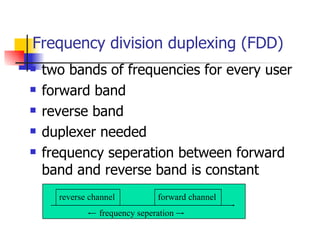
Frequency division duplexing (FDD) two bands of frequencies for every user forward band reverse band duplexer needed frequency seperation between forward band and reverse band is constant frequency seperation reverse channel forward channel f
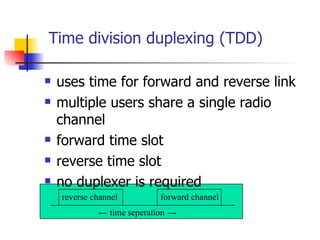
Time division duplexing (TDD) uses time for forward and reverse link multiple users share a single radio channel forward time slot reverse time slot no duplexer is required time seperation t forward channel reverse channel
Multiple Access Techniques Frequency division multiple access (FDMA) Time division multiple access (TDMA) Code division multiple access (CDMA) Space division multiple access (SDMA) grouped as: narrowband systems wideband systems
Narrowband systems large number of narrowband channels usually FDD Narrowband FDMA Narrowband TDMA FDMA/FDD FDMA/TDD TDMA/FDD TDMA/TDD
Wideband systems large number of transmitters on one channel TDMA techniques CDMA techniques FDD or TDD multiplexing techniques TDMA/FDD TDMA/TDD CDMA/FDD CDMA/TDD
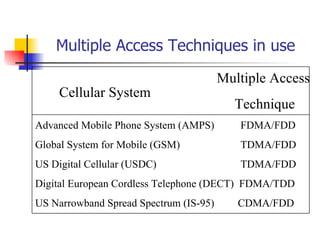
Multiple Access Techniques in use   Multiple Access    Technique Advanced Mobile Phone System (AMPS)   FDMA/FDD Global System for Mobile (GSM)   TDMA/FDD US Digital Cellular (USDC)   TDMA/FDD Digital European Cordless Telephone (DECT)  FDMA/TDD US Narrowband Spread Spectrum (IS-95)   CDMA/FDD Cellular System
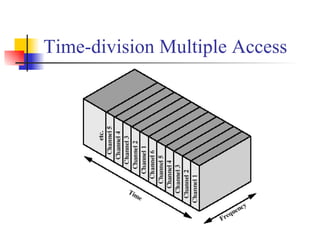
Time-division Multiple Access
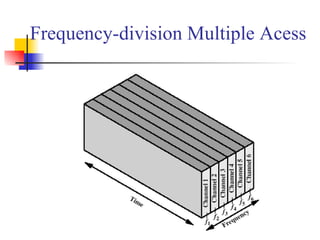
Frequency-division Multiple Acess
Frequency division multiple access FDMA one phone circuit per channel idle time causes wasting of resources simultaneously and continuously transmitting usually implemented in narrowband systems  for example: in AMPS is a FDMA bandwidth of 30 kHz implemented
FDMA compared to TDMA fewer bits for synchronization  fewer bits for framing higher cell site system costs higher costs for duplexer used in base station and subscriber units FDMA requires RF filtering to minimize adjacent channel interference
Nonlinear Effects in FDMA many channels - same antenna for maximum power efficiency operate near saturation near saturation power amplifiers are nonlinear nonlinearities causes signal spreading  intermodulation frequencies
Nonlinear Effects in FDMA IM are undesired harmonics interference with other channels in the FDMA system decreases user C/I - decreases performance interference outside the mobile radio band: adjacent-channel interference RF filters needed - higher costs
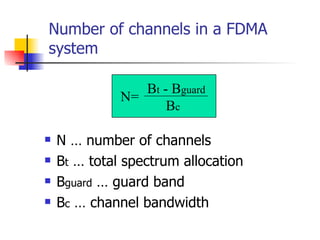
Number of channels in a FDMA system N … number of channels  B t  … total spectrum allocation B guard  … guard band B c  … channel bandwidth N= B t  - B guard B c
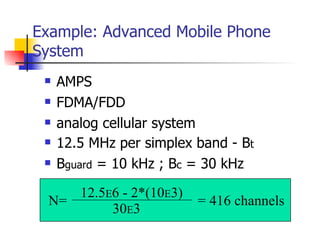
Example: Advanced Mobile Phone System AMPS FDMA/FDD analog cellular system 12.5 MHz per simplex band - B t B guard  = 10 kHz ; B c  = 30 kHz N= 12.5 E 6 - 2*(10 E 3) 30 E 3 = 416 channels
Time Division Multiple Access time slots one user per slot buffer and burst method noncontinuous transmission digital data digital modulation
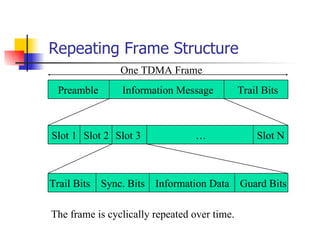
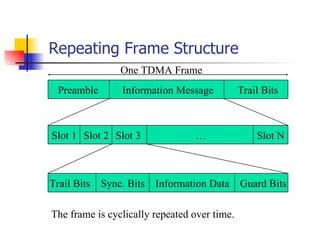
Repeating Frame Structure Slot 1 Slot 2 Slot 3   …    Slot N Preamble  Information Message  Trail Bits One TDMA Frame Trail Bits  Sync. Bits  Information Data  Guard Bits The frame is cyclically repeated over time.
Features of TDMA a single carrier frequency for several users transmission in bursts low battery consumption handoff process much simpler FDD : switch instead of duplexer very high transmission rate high synchronization overhead guard slots necessary
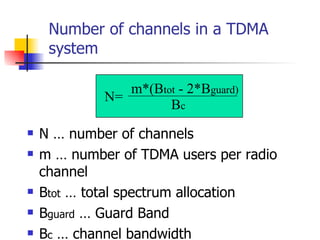
Number of channels in a TDMA system N … number of channels m … number of TDMA users per radio channel B tot  … total spectrum allocation B guard  … Guard Band B c  … channel bandwidth  N= m*(B tot  - 2*B guard) B c
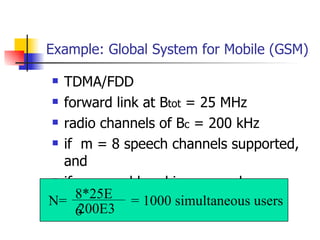
Example: Global System for Mobile (GSM) TDMA/FDD forward link at B tot  = 25 MHz  radio channels of B c  = 200 kHz if  m = 8 speech channels supported, and if no guard band is assumed : N= 8*25E6 200E3 = 1000 simultaneous users
Efficiency of TDMA percentage of transmitted data that contain information frame efficiency   f usually end user efficiency <   f , because of source and channel coding How get   f  ?
Repeating Frame Structure Slot 1 Slot 2 Slot 3   …    Slot N Preamble  Information Message  Trail Bits One TDMA Frame Trail Bits  Sync. Bits  Information Data  Guard Bits The frame is cyclically repeated over time.
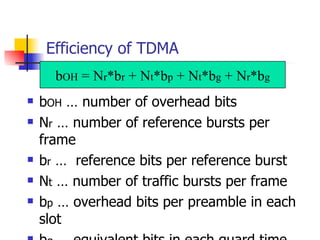
Efficiency of TDMA b OH  … number of overhead bits N r  … number of reference bursts per frame b r  …  reference bits per reference burst N t  … number of traffic bursts per frame b p  … overhead bits per preamble in each slot b g  … equivalent bits in each guard time    intervall b OH  = N r *b r  + N t *b p  + N t *b g  + N r *b g
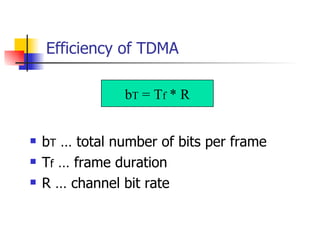
Efficiency of TDMA b T  … total number of bits per frame T f  … frame duration R … channel bit rate b T  = T f  * R
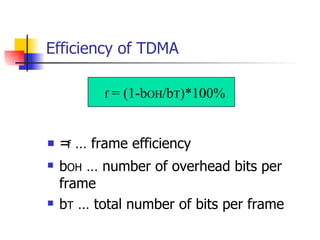
Efficiency of TDMA  f  … frame efficiency b OH  … number of overhead bits per frame b T  … total number of bits per frame  f  = (1-b OH /b T )*100%
Space Division Multiple Access Controls radiated energy for each user in space using spot beam antennas base station tracks user when moving cover areas with same frequency: TDMA or CDMA systems cover areas with same frequency: FDMA systems
Space Division Multiple Access primitive applications are  “Sectorized antennas”  in future adaptive antennas simultaneously  steer energy in the direction of many users at once
Reverse link problems general problem different propagation path from user to base dynamic control of transmitting power from each user to the base station required  limits by battery consumption of subscriber units possible solution is a filter for each user
Solution by SDMA systems adaptive antennas promise to mitigate reverse link problems limiting case of infinitesimal beamwidth limiting case of infinitely fast track ability thereby unique channel that is free from interference all user communicate at same time using the same channel
Disadvantage of SDMA perfect adaptive antenna system:  infinitely large antenna needed compromise needed
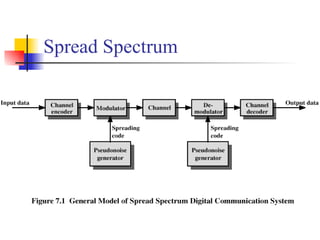
SPREAD SPECTRUM MULTIPLE ACCESS FHMA CDMA HYBRID SSMA  (FCDMA = FDMA + CDMA)
Spread Spectrum
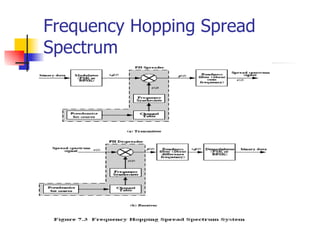
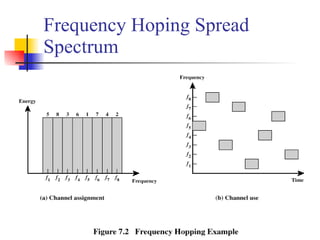
Frequency Hoping Spread Spectrum
Frequency Hopping Spread Spectrum
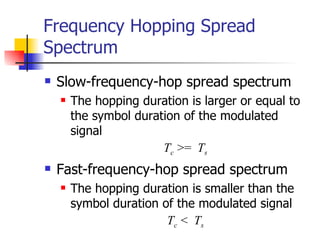
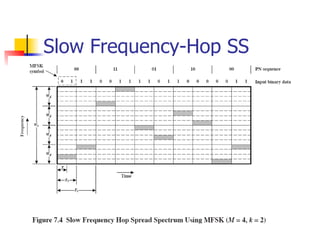
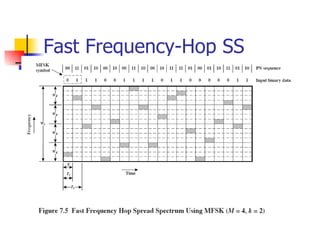
Frequency Hopping Spread Spectrum Slow-frequency-hop spread spectrum The hopping duration is larger or equal to the symbol duration of the modulated signal T c  >=  T s Fast-frequency-hop spread spectrum The hopping duration is smaller than the symbol duration of the modulated signal T c  <  T s
Slow Frequency-Hop SS
Fast Frequency-Hop SS
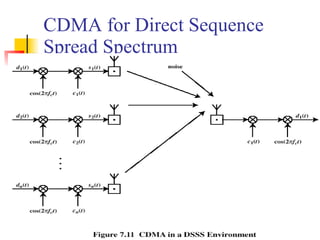
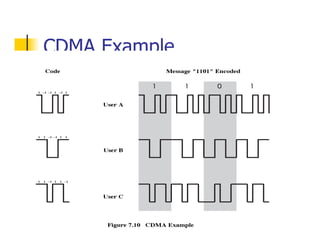
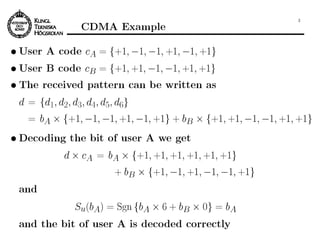
Code-Division Multiple Access (CDMA) CDMA is multiple access scheme that allows many users to share the same bandwidth 3G (WCDMA), IS-95 Basic Principles of CDMA Each user is assigned a unique spreading code The processing gain protects the useful signal and reduces interference between the different users PG = (Bandwidth after spreading)/(Bandwidth before spreading)
CDMA for Direct Sequence Spread Spectrum
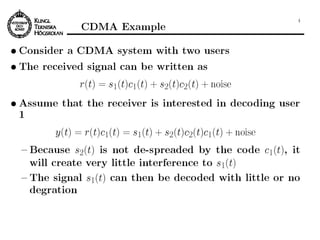
CDMA Example
 
 
CAPACITY of CELLULAR SYSTEMS .
Spreading in Cellular CDMA Systems Cellular CDMA systems use two layers of spreading Channelization codes (orthogonal codes) Provides orthogonality among users within the same cell Long PN sequences (scrambling code) Provides good randomness properties (low cross correlation)  Reduces interference from other cells
Capacity of Cellular Systems channel capacity: maximum number of users in a fixed frequency band radio capacity : value for  spectrum efficiency  reverse channel interference forward channel interference How determine the radio capacity?
Co-Channel Reuse Ratio Q Q … co-channel reuse ratio D … distance between two co-channel cells R … cell radius Q=D/R
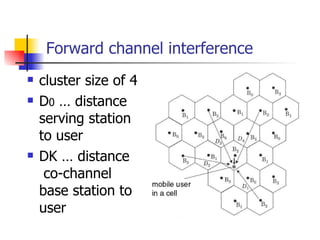
Forward channel interference cluster size of 4 D 0  … distance serving station  to user DK … distance  co-channel base station to user
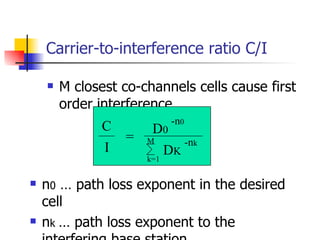
Carrier-to-interference ratio C/I M closest co-channels cells cause first order interference C  = I D 0 -n 0 M k=1 D K -n k n 0  … path loss exponent in the desired cell  n k  … path loss exponent to the interfering base station
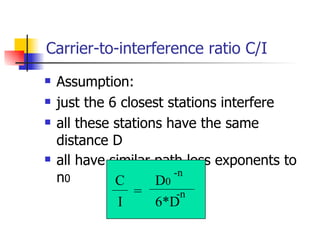
Carrier-to-interference ratio C/I Assumption: just the 6 closest stations interfere all these stations have the same distance D all have similar path loss exponents to n 0 C  I = D 0 -n 6*D -n
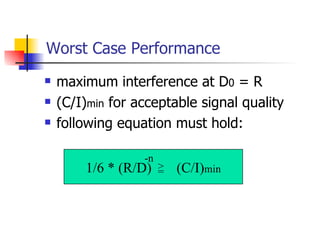
Worst Case Performance maximum interference at D 0  = R (C/I) min  for acceptable signal quality following equation must hold: 1/6 * (R/D)  (C/I) min = > -n
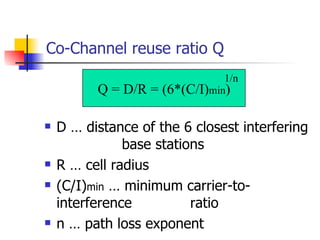
Co-Channel reuse ratio Q D … distance of the 6 closest interfering    base stations R … cell radius (C/I) min  … minimum carrier-to-interference    ratio n … path loss exponent Q = D/R = (6*(C/I) min ) 1/n
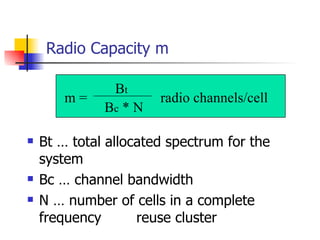
Radio Capacity m Bt … total allocated spectrum for the system Bc … channel bandwidth N … number of cells in a complete frequency    reuse cluster m = B t B c  * N radio channels/cell
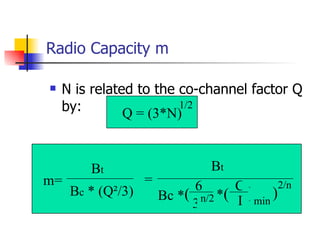
Radio Capacity m N is related to the co-channel factor Q by: Q = (3*N) 1/2 m= B t B c  * (Q²/3) = B t Bc * 6 C I 3 n/2 ( * ( ) min ) 2/n
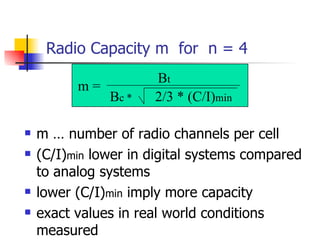
Radio Capacity m  for  n = 4 m … number of radio channels per cell (C/I) min  lower in digital systems compared to analog systems lower (C/I) min  imply more capacity exact values in real world conditions measured  m = B t B c * 2/3 * (C/I) min
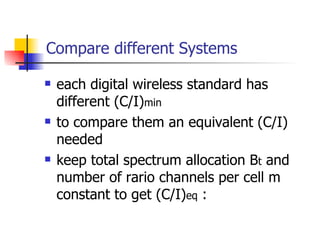
Compare different Systems each digital wireless standard has different (C/I) min to compare them an equivalent (C/I) needed keep total spectrum allocation B t  and number of rario channels per cell m constant to get (C/I) eq  :
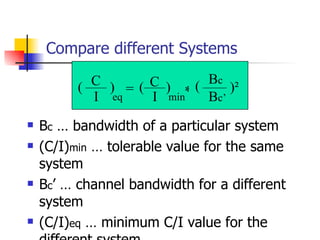
Compare different Systems B c  … bandwidth of a particular system (C/I) min  … tolerable value for the same system B c ’ … channel bandwidth for a different system (C/I) eq  … minimum C/I value for the different system C I = C I B c B c’ ( ) ( ) min )² eq * (
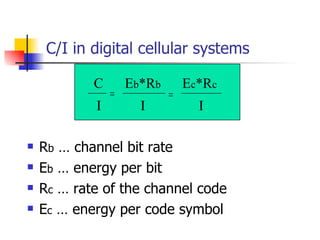
C/I in digital cellular systems R b  … channel bit rate E b  … energy per bit R c  … rate of the channel code E c  … energy per code symbol C  E b *R b   E c *R c I  I  I = =
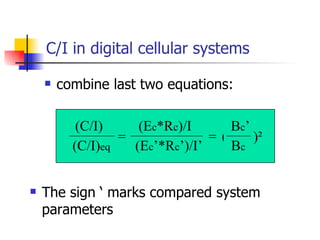
C/I in digital cellular systems combine last two equations: (C/I)  (E c *R c )/I  B c ’ (C/I) eq   (E c ’*R c ’)/I’  B c = = ( )² The sign ‘ marks compared system parameters
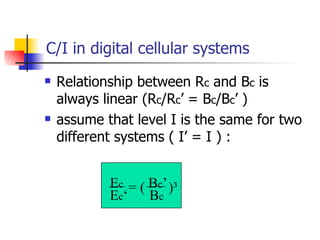
C/I in digital cellular systems Relationship between R c  and B c  is always linear (R c /R c ’ = B c /B c ’ ) assume that level I is the same for two different systems ( I’ = I ) : E c   B c ’ E c ‘  B c = ( )³
Compare C/I  between FDMA and TDMA Assume that multichannel FDMA system occupies same spectrum as a TDMA system  FDMA : C = E b  * R b   ;  I = I 0  * B c TDMA : C’ = E b  * R b ’  ;  I’ = I 0  * B c ’ E b  … Energy per bit I 0  … interference power per Hertz R b  … channel bit rate B c  … channel bandwidth
Example A FDMA system has 3 channels , each with a bandwidth of 10kHz and a transmission rate of 10 kbps. A TDMA system has 3 time slots, a channel bandwidth of 30kHz and a transmission rate of 30 kbps. What’s the received carrier-to-interference ratio for a user ?
Example In TDMA  system C’/I’ be measured in 333.3 ms per second - one time slot C’ = E b *R b ’ = 1/3*(E b *10 E 4 bits) = 3*R b *E b =3*C I’ = I0*Bc’ = I0*30kHz = 3*I In this example FDMA and TDMA have the same radio capacity (C/I leads to m)
Example Peak power of TDMA is 10logk higher then in FDMA ( k … time slots) in practice TDMA have a 3-6 times better capacity
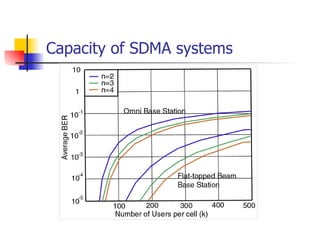
Capacity of SDMA systems one beam each user base station tracks each user as it moves adaptive antennas most powerful form beam pattern G(  ) has maximum gain in the direction of desired user beam is formed by N-element adaptive array antenna
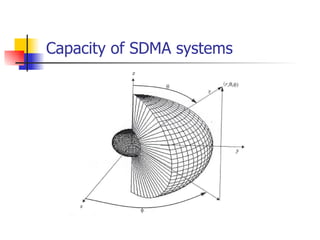
Capacity of SDMA systems G(  ) steered in the horizontal    -plane through 360° G(  ) has no variation in the elevation plane to account which are near to and far from the base station following picture shows a 60 degree beamwidth with a 6 dB sideslope level
Capacity of SDMA systems
Capacity of SDMA systems reverse link received signal power, from desired mobiles, is P r;0  interfering users i = 1,…,k-1 have received power P r;I average total interference power I seen by a single desired user:
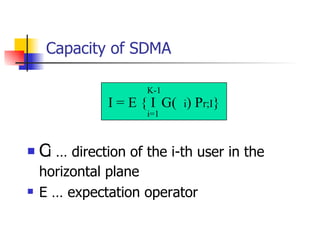
Capacity of SDMA  i … direction of the i-th user in the horizontal plane E … expectation operator I = E {    G(  i ) P r;I } K-1 i=1
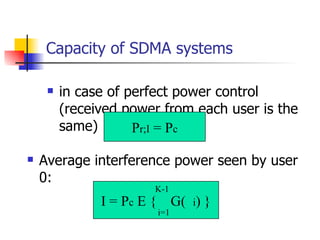
Capacity of SDMA systems in case of perfect power control (received power from each user is the same) : P r;I  = P c Average interference power seen by user 0: I = P c  E {    G(  i ) } K-1 i=1
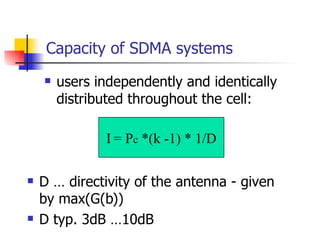
Capacity of SDMA systems users independently and identically distributed throughout the cell:  I   = P c  *(k -1) * 1/D D … directivity of the antenna - given by max(G(  ))  D typ. 3dB …10dB
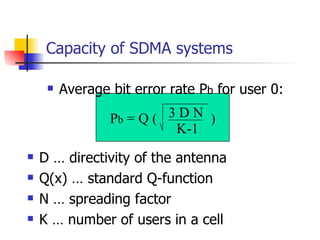
Capacity of SDMA systems Average bit error rate P b  for user 0: P b  = Q (  ) 3 D N K-1 D … directivity of the antenna Q(x) … standard Q-function N … spreading factor K … number of users in a cell
Capacity of SDMA systems

multiple access for wireless mobile communications

  • 1.
    MULTIPLE ACCESS TECHNIQUESFOR WIRELESS COMMUNICATIONS UNIT - IV
  • 2.
    CONTENTS FDMA TDMA SDMA SSMA
  • 3.
    Introduction many usersat same time share a finite amount of radio spectrum high performance duplexing generally required frequency domain time domain
  • 4.
    Frequency division duplexing(FDD) two bands of frequencies for every user forward band reverse band duplexer needed frequency seperation between forward band and reverse band is constant frequency seperation reverse channel forward channel f
  • 5.
    Time division duplexing(TDD) uses time for forward and reverse link multiple users share a single radio channel forward time slot reverse time slot no duplexer is required time seperation t forward channel reverse channel
  • 6.
    Multiple Access TechniquesFrequency division multiple access (FDMA) Time division multiple access (TDMA) Code division multiple access (CDMA) Space division multiple access (SDMA) grouped as: narrowband systems wideband systems
  • 7.
    Narrowband systems largenumber of narrowband channels usually FDD Narrowband FDMA Narrowband TDMA FDMA/FDD FDMA/TDD TDMA/FDD TDMA/TDD
  • 8.
    Wideband systems largenumber of transmitters on one channel TDMA techniques CDMA techniques FDD or TDD multiplexing techniques TDMA/FDD TDMA/TDD CDMA/FDD CDMA/TDD
  • 9.
    Multiple Access Techniquesin use Multiple Access Technique Advanced Mobile Phone System (AMPS) FDMA/FDD Global System for Mobile (GSM) TDMA/FDD US Digital Cellular (USDC) TDMA/FDD Digital European Cordless Telephone (DECT) FDMA/TDD US Narrowband Spread Spectrum (IS-95) CDMA/FDD Cellular System
  • 10.
  • 11.
  • 12.
    Frequency division multipleaccess FDMA one phone circuit per channel idle time causes wasting of resources simultaneously and continuously transmitting usually implemented in narrowband systems for example: in AMPS is a FDMA bandwidth of 30 kHz implemented
  • 13.
    FDMA compared toTDMA fewer bits for synchronization fewer bits for framing higher cell site system costs higher costs for duplexer used in base station and subscriber units FDMA requires RF filtering to minimize adjacent channel interference
  • 14.
    Nonlinear Effects inFDMA many channels - same antenna for maximum power efficiency operate near saturation near saturation power amplifiers are nonlinear nonlinearities causes signal spreading intermodulation frequencies
  • 15.
    Nonlinear Effects inFDMA IM are undesired harmonics interference with other channels in the FDMA system decreases user C/I - decreases performance interference outside the mobile radio band: adjacent-channel interference RF filters needed - higher costs
  • 16.
    Number of channelsin a FDMA system N … number of channels B t … total spectrum allocation B guard … guard band B c … channel bandwidth N= B t - B guard B c
  • 17.
    Example: Advanced MobilePhone System AMPS FDMA/FDD analog cellular system 12.5 MHz per simplex band - B t B guard = 10 kHz ; B c = 30 kHz N= 12.5 E 6 - 2*(10 E 3) 30 E 3 = 416 channels
  • 18.
    Time Division MultipleAccess time slots one user per slot buffer and burst method noncontinuous transmission digital data digital modulation
  • 19.
    Repeating Frame StructureSlot 1 Slot 2 Slot 3 … Slot N Preamble Information Message Trail Bits One TDMA Frame Trail Bits Sync. Bits Information Data Guard Bits The frame is cyclically repeated over time.
  • 20.
    Features of TDMAa single carrier frequency for several users transmission in bursts low battery consumption handoff process much simpler FDD : switch instead of duplexer very high transmission rate high synchronization overhead guard slots necessary
  • 21.
    Number of channelsin a TDMA system N … number of channels m … number of TDMA users per radio channel B tot … total spectrum allocation B guard … Guard Band B c … channel bandwidth N= m*(B tot - 2*B guard) B c
  • 22.
    Example: Global Systemfor Mobile (GSM) TDMA/FDD forward link at B tot = 25 MHz radio channels of B c = 200 kHz if m = 8 speech channels supported, and if no guard band is assumed : N= 8*25E6 200E3 = 1000 simultaneous users
  • 23.
    Efficiency of TDMApercentage of transmitted data that contain information frame efficiency  f usually end user efficiency <  f , because of source and channel coding How get  f ?
  • 24.
    Repeating Frame StructureSlot 1 Slot 2 Slot 3 … Slot N Preamble Information Message Trail Bits One TDMA Frame Trail Bits Sync. Bits Information Data Guard Bits The frame is cyclically repeated over time.
  • 25.
    Efficiency of TDMAb OH … number of overhead bits N r … number of reference bursts per frame b r … reference bits per reference burst N t … number of traffic bursts per frame b p … overhead bits per preamble in each slot b g … equivalent bits in each guard time intervall b OH = N r *b r + N t *b p + N t *b g + N r *b g
  • 26.
    Efficiency of TDMAb T … total number of bits per frame T f … frame duration R … channel bit rate b T = T f * R
  • 27.
    Efficiency of TDMA f … frame efficiency b OH … number of overhead bits per frame b T … total number of bits per frame  f = (1-b OH /b T )*100%
  • 28.
    Space Division MultipleAccess Controls radiated energy for each user in space using spot beam antennas base station tracks user when moving cover areas with same frequency: TDMA or CDMA systems cover areas with same frequency: FDMA systems
  • 29.
    Space Division MultipleAccess primitive applications are “Sectorized antennas” in future adaptive antennas simultaneously steer energy in the direction of many users at once
  • 30.
    Reverse link problemsgeneral problem different propagation path from user to base dynamic control of transmitting power from each user to the base station required limits by battery consumption of subscriber units possible solution is a filter for each user
  • 31.
    Solution by SDMAsystems adaptive antennas promise to mitigate reverse link problems limiting case of infinitesimal beamwidth limiting case of infinitely fast track ability thereby unique channel that is free from interference all user communicate at same time using the same channel
  • 32.
    Disadvantage of SDMAperfect adaptive antenna system: infinitely large antenna needed compromise needed
  • 33.
    SPREAD SPECTRUM MULTIPLEACCESS FHMA CDMA HYBRID SSMA (FCDMA = FDMA + CDMA)
  • 34.
  • 35.
  • 36.
  • 37.
    Frequency Hopping SpreadSpectrum Slow-frequency-hop spread spectrum The hopping duration is larger or equal to the symbol duration of the modulated signal T c >= T s Fast-frequency-hop spread spectrum The hopping duration is smaller than the symbol duration of the modulated signal T c < T s
  • 38.
  • 39.
  • 40.
    Code-Division Multiple Access(CDMA) CDMA is multiple access scheme that allows many users to share the same bandwidth 3G (WCDMA), IS-95 Basic Principles of CDMA Each user is assigned a unique spreading code The processing gain protects the useful signal and reduces interference between the different users PG = (Bandwidth after spreading)/(Bandwidth before spreading)
  • 41.
    CDMA for DirectSequence Spread Spectrum
  • 42.
  • 43.
  • 44.
  • 45.
  • 46.
    Spreading in CellularCDMA Systems Cellular CDMA systems use two layers of spreading Channelization codes (orthogonal codes) Provides orthogonality among users within the same cell Long PN sequences (scrambling code) Provides good randomness properties (low cross correlation) Reduces interference from other cells
  • 47.
    Capacity of CellularSystems channel capacity: maximum number of users in a fixed frequency band radio capacity : value for spectrum efficiency reverse channel interference forward channel interference How determine the radio capacity?
  • 48.
    Co-Channel Reuse RatioQ Q … co-channel reuse ratio D … distance between two co-channel cells R … cell radius Q=D/R
  • 49.
    Forward channel interferencecluster size of 4 D 0 … distance serving station to user DK … distance co-channel base station to user
  • 50.
    Carrier-to-interference ratio C/IM closest co-channels cells cause first order interference C = I D 0 -n 0 M k=1 D K -n k n 0 … path loss exponent in the desired cell n k … path loss exponent to the interfering base station
  • 51.
    Carrier-to-interference ratio C/IAssumption: just the 6 closest stations interfere all these stations have the same distance D all have similar path loss exponents to n 0 C I = D 0 -n 6*D -n
  • 52.
    Worst Case Performancemaximum interference at D 0 = R (C/I) min for acceptable signal quality following equation must hold: 1/6 * (R/D) (C/I) min = > -n
  • 53.
    Co-Channel reuse ratioQ D … distance of the 6 closest interfering base stations R … cell radius (C/I) min … minimum carrier-to-interference ratio n … path loss exponent Q = D/R = (6*(C/I) min ) 1/n
  • 54.
    Radio Capacity mBt … total allocated spectrum for the system Bc … channel bandwidth N … number of cells in a complete frequency reuse cluster m = B t B c * N radio channels/cell
  • 55.
    Radio Capacity mN is related to the co-channel factor Q by: Q = (3*N) 1/2 m= B t B c * (Q²/3) = B t Bc * 6 C I 3 n/2 ( * ( ) min ) 2/n
  • 56.
    Radio Capacity m for n = 4 m … number of radio channels per cell (C/I) min lower in digital systems compared to analog systems lower (C/I) min imply more capacity exact values in real world conditions measured m = B t B c * 2/3 * (C/I) min
  • 57.
    Compare different Systemseach digital wireless standard has different (C/I) min to compare them an equivalent (C/I) needed keep total spectrum allocation B t and number of rario channels per cell m constant to get (C/I) eq :
  • 58.
    Compare different SystemsB c … bandwidth of a particular system (C/I) min … tolerable value for the same system B c ’ … channel bandwidth for a different system (C/I) eq … minimum C/I value for the different system C I = C I B c B c’ ( ) ( ) min )² eq * (
  • 59.
    C/I in digitalcellular systems R b … channel bit rate E b … energy per bit R c … rate of the channel code E c … energy per code symbol C E b *R b E c *R c I I I = =
  • 60.
    C/I in digitalcellular systems combine last two equations: (C/I) (E c *R c )/I B c ’ (C/I) eq (E c ’*R c ’)/I’ B c = = ( )² The sign ‘ marks compared system parameters
  • 61.
    C/I in digitalcellular systems Relationship between R c and B c is always linear (R c /R c ’ = B c /B c ’ ) assume that level I is the same for two different systems ( I’ = I ) : E c B c ’ E c ‘ B c = ( )³
  • 62.
    Compare C/I between FDMA and TDMA Assume that multichannel FDMA system occupies same spectrum as a TDMA system FDMA : C = E b * R b ; I = I 0 * B c TDMA : C’ = E b * R b ’ ; I’ = I 0 * B c ’ E b … Energy per bit I 0 … interference power per Hertz R b … channel bit rate B c … channel bandwidth
  • 63.
    Example A FDMAsystem has 3 channels , each with a bandwidth of 10kHz and a transmission rate of 10 kbps. A TDMA system has 3 time slots, a channel bandwidth of 30kHz and a transmission rate of 30 kbps. What’s the received carrier-to-interference ratio for a user ?
  • 64.
    Example In TDMA system C’/I’ be measured in 333.3 ms per second - one time slot C’ = E b *R b ’ = 1/3*(E b *10 E 4 bits) = 3*R b *E b =3*C I’ = I0*Bc’ = I0*30kHz = 3*I In this example FDMA and TDMA have the same radio capacity (C/I leads to m)
  • 65.
    Example Peak powerof TDMA is 10logk higher then in FDMA ( k … time slots) in practice TDMA have a 3-6 times better capacity
  • 66.
    Capacity of SDMAsystems one beam each user base station tracks each user as it moves adaptive antennas most powerful form beam pattern G(  ) has maximum gain in the direction of desired user beam is formed by N-element adaptive array antenna
  • 67.
    Capacity of SDMAsystems G(  ) steered in the horizontal  -plane through 360° G(  ) has no variation in the elevation plane to account which are near to and far from the base station following picture shows a 60 degree beamwidth with a 6 dB sideslope level
  • 68.
  • 69.
    Capacity of SDMAsystems reverse link received signal power, from desired mobiles, is P r;0 interfering users i = 1,…,k-1 have received power P r;I average total interference power I seen by a single desired user:
  • 70.
    Capacity of SDMA i … direction of the i-th user in the horizontal plane E … expectation operator I = E {  G(  i ) P r;I } K-1 i=1
  • 71.
    Capacity of SDMAsystems in case of perfect power control (received power from each user is the same) : P r;I = P c Average interference power seen by user 0: I = P c E {  G(  i ) } K-1 i=1
  • 72.
    Capacity of SDMAsystems users independently and identically distributed throughout the cell: I = P c *(k -1) * 1/D D … directivity of the antenna - given by max(G(  )) D typ. 3dB …10dB
  • 73.
    Capacity of SDMAsystems Average bit error rate P b for user 0: P b = Q ( ) 3 D N K-1 D … directivity of the antenna Q(x) … standard Q-function N … spreading factor K … number of users in a cell
  • 74.