Lecture Topic
Electronic Spectroscopy – Part-II(b)
Franck-Condon Principle
By
Prof. Sunil Kumar Srivastava
Department of Physics
Mahatma Gandhi Central University
Motihari, Bihar-845401
Atomic and Molecular Physics
Course Code: PHYS4009
• What are Molecular Orbitals?
• Types of Molecular Orbitals
• Electronic Configuration of the Molecule
• Molecular Electronic States
• Electronic Transitions
• Rotational Fine Structure
• Fortrat Diagram
• Franck Condon Principle
• Application of Electronic Absorption
Spectroscopy
Outline
Part - I
Part – II(a)
Part – II(b)
Current
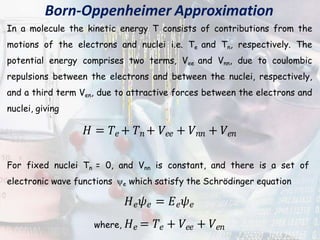
Born-Oppenheimer Approximation
In a molecule the kinetic energy T consists of contributions from the
motions of the electrons and nuclei i.e. Te and Tn, respectively. The
potential energy comprises two terms, Vee and Vnn, due to coulombic
repulsions between the electrons and between the nuclei, respectively,
and a third term Ven, due to attractive forces between the electrons and
nuclei, giving
𝐻 = 𝑇𝑒 + 𝑇𝑛 + 𝑉𝑒𝑒 + 𝑉𝑛𝑛 + 𝑉𝑒𝑛
For fixed nuclei Tn = 0, and Vnn is constant, and there is a set of
electronic wave functions e which satisfy the Schrödinger equation
𝐻𝑒𝜓𝑒 = 𝐸𝑒𝜓𝑒
where, 𝐻𝑒 = 𝑇𝑒 + 𝑉𝑒𝑒 + 𝑉𝑒𝑛
Since He depends on nuclear coordinates, because of the Ven term, so do
e and Ee but, in order to solve the Schrödinger equation, Born–
Oppenheimer proposed an approximation in 1927, where it is assumed
that vibrating nuclei move so slowly compared with electrons that e and
Ee involve the nuclear coordinates as parameters only. The result for a
diatomic molecule is that a curve of potential energy against internuclear
distance r (or the displacement from equilibrium) can be drawn for a
particular electronic state in which Te and Vee are constant. This is known
as “Born–Oppenheimer Approximation”
According to Born–Oppenheimer approximation that the total wave
function  can be factorized as:
𝜓 = 𝜓𝑒 (𝑞, 𝑄)𝜓𝑛 (𝑄)
where the q are electron coordinates and e is a function of nuclear
coordinates Q as well as q.
Franck Condon Principle
In 1925, before the development of the Schrödinger equation, Franck
put forward qualitative arguments to explain the various types of
intensity distributions found in vibronic transitions. His conclusions were
based on the fact that an electronic transition in a molecule takes place
much more rapidly than a vibrational motion of the nuclei that the
instantaneous internuclear distance and the velocity of the nuclei can be
considered remain unchanged during the electronic transition (later used
as Born-Oppenheimer Approximation).
This means in the diagrams showing the potential energy curve of the
two electronic states of the molecule, the transition must be
represented by the vertical lines, i,e. the most probable or most intense
transition will be those represented by the vertical lines.
Figure demonstrating the Franck principle: for re’ > re’’ (left) and re’ = re’’
(right). The vibronic transition A  B is the most probable in both cases.
Another important factor to be considered is the distributions of the
probability density 𝜓𝑛
2 in various vibrational level of each electronic
2
states. The greater the values of 𝜓𝑛 at a particular values of
internuclear distance r in a vibrational level, the greater the probability
of the nuclei to be found at that distance apart. It is evident that 𝜓𝑛
2 is
a maximum at the mid-point of the v = 0 level and near the turning points
of the higher energy levels.
𝜓𝑛
2
re
Accordingly, the
stated as
Frack-Condon
“The most
Principle is
probable vibrational transitions are
those in which one of the two turning
points of a vibrational level of one
electronic state lies at approximately
the same internuclear distance as one
of the two turning points of the level
of other electronic state, except in case of v = 0 level for which the
mid-point rather than the turning point must be substituted”.
QM formulation of Franck Condon Principle
In quantum mechanics, the intensity of a spectroscopic transition
between two states of total wavefunction ’ and ’’ is dependent on the
square of the corresponding transition moment R, given by
𝑅 = ‫׬‬
𝜓′∗𝑀𝜓′′ 𝑑𝑟
where, M is the electric dipole moment having components σ 𝑒𝑖𝑥𝑖, etc.
Ignoring the rotation and applying the Born-Oppenheimer approximation
the total wavefunction may be written as:
where,
𝜓 = 𝜓𝑒𝜓𝑣
𝜓𝑒 𝑎𝑛𝑑 𝜓𝑣 are the electronic and vibrational wavefunction,
respectively. Further, the dipole moment M can also be written interms
of electric and nuclear component as
𝑀 = 𝑀𝑒 + 𝑀𝑛
Therefore, the transition moment for the two vibronic states is given by:
𝑅 = ‫׬‬
𝜓′∗𝜓′∗ (𝑀 + 𝑀 )𝜓′′ 𝜓′′ 𝑑𝑟 𝑑𝑟
𝑒 𝑣 𝑒 𝑣 𝑒 𝑣 𝑒 𝑛
𝑅 = න𝜓′∗ 𝜓′∗ 𝑀 𝜓′′ 𝜓′′ 𝑑𝑟 𝑑𝑟 + න𝜓′∗ 𝜓′∗ 𝑀 𝜓′′ 𝜓′′ 𝑑𝑟 𝑑𝑟
𝑒 𝑣 𝑒 𝑒 𝑣 𝑒 𝑒 𝑣 𝑣 𝑒 𝑣 𝑒
𝑑𝑟𝑛 is replaced by 𝑑𝑟 because vibrational (nuclear) wavefunction 𝜓𝑣
depends on the internuclear distance r only.
Since, the nuclear dipole moment Mn is independent of the coordinates of
the electrons (depend only on r), the second integral may be written as:
‫׬‬[𝜓′∗𝜓′′ 𝑑𝑟 ]𝜓′∗ 𝑀 𝜓′′ 𝑑𝑟
zero,
𝑒 𝑒 𝑒 𝑣 𝑣 𝑣
because
which is
different states of a molecule are
the electronic wavefunction belonging to
orthogonal
[‫׬‬
𝜓′∗𝜓′′ 𝑑𝑟
𝑒 𝑒 𝑒
electronic
= 0], hence;
𝑅 = න𝜓′∗𝜓′∗ 𝑀 𝜓′′ 𝜓′′ 𝑑𝑟 𝑑𝑟
𝑒 𝑣 𝑒 𝑒 𝑣 𝑒
𝑅 = න𝜓′∗𝑀 𝜓′′ 𝑑𝑟
𝑒 𝑒 𝑒 𝑒
න𝜓′∗ 𝜓′′ 𝑑𝑟
𝑣 𝑣
𝑅𝑣𝘍, 𝑣𝘍𝘍 = 𝑅𝑒 න𝜓′∗ 𝜓′′ 𝑑𝑟
𝑣 𝑣
where, 𝑅𝑒 is electronic transition moment. As the variation of 𝑅𝑒 with r is
slow and therefore, 𝑅𝑒 may be approximated as 𝑅𝑒. Hence,
𝑅𝑣𝘍, 𝑣𝘍𝘍 = 𝑅𝑒 ‫׬‬
𝜓′∗ 𝜓′′ 𝑑𝑟
𝑣 𝑣
Factor” 𝑞𝑣𝘍, 𝑣𝘍
𝘍
;
𝑞𝑣𝘍, 𝑣𝘍𝘍 = න𝜓′∗ 𝜓′′ 𝑑𝑟
𝑣 𝑣
The average electronic transition moment 𝑅𝑒, governs the intensity of the
band-systems as a whole. The relative intensities of the various bands of
the system mainly depends on the square of the overlap integral
‫׬‬
𝜓′∗ 𝜓′′ 𝑑𝑟, which is the integral over the product of the vibrational
𝑣 𝑣
wavefunction of the two combining states. It is known as “Franck-Condon
2
Energy
re’ < re’’ re’ > re’’
CO
re’ >> re’’
I2
re’ = re’’
O2
(0, 0)
(1, 0)
(2, 0)
(3, 0)
(1, 0)
(0, 0)
(2, 0)
(3, 0)
(2, 0)
(1, 0) (3, 0)
(0, 0)
Intensity
Case-I: When re’ = re’’, the upper electronic state having the same
equilibrium internuclear distance as the lower. Now the Franck-Condon
principle suggests that a transition occurs vertically on this diagram,
since the internuclear distance does not change. Thus the strongest
spectral line of the v" = 0 progression will be the (0, 0). This observed in
O2 molecule.
Case-II: When re’ < re’’ or re’ > re’’ , where the excited electronic state
has a slightly smaller or larger internuclear separation than the ground
state. A vertical transition from the v" = 0 level will be most likely to
occur into the upper vibrational state v' = 2, transitions to lower and
higher v’ states being less likely; in general the upper state most probably
reached will depend on the difference between the equilibrium
separations in the lower and upper states. In case of CO molecule (re’ >
re’’) this type of band-system is observed.
Case-III: When re’ >> re’’, the upper state separation is drawn as
considerably greater than that of the lower state. We see that, the
vibrational level to which a vertical transition takes place has a high v'
value, here transitions can occur to a state where the excited molecule
has energy in excess of its own dissociation energy. From such states
the molecule will dissociate without any vibrations and, since the atoms
which are formed may take up any value of kinetic energy, the
transitions are not quantized and a continuum is observed. This type of
band-system is observed in I2 Molecule.
Books for Further Reading
1. Atomic and Molecular Spectra: Laser by Raj Kumar.
2. Fundamentals of Molecular Spectroscopy by C. N. Banwell
(McGraw Hill)
3. Modern Spectroscopy by J. M. Hollas (Wiley)
20200426003651a8fa38cb38.pptx

20200426003651a8fa38cb38.pptx

  • 1.
    Lecture Topic Electronic Spectroscopy– Part-II(b) Franck-Condon Principle By Prof. Sunil Kumar Srivastava Department of Physics Mahatma Gandhi Central University Motihari, Bihar-845401 Atomic and Molecular Physics Course Code: PHYS4009
  • 2.
    • What areMolecular Orbitals? • Types of Molecular Orbitals • Electronic Configuration of the Molecule • Molecular Electronic States • Electronic Transitions • Rotational Fine Structure • Fortrat Diagram • Franck Condon Principle • Application of Electronic Absorption Spectroscopy Outline Part - I Part – II(a) Part – II(b) Current
  • 3.
    Born-Oppenheimer Approximation In amolecule the kinetic energy T consists of contributions from the motions of the electrons and nuclei i.e. Te and Tn, respectively. The potential energy comprises two terms, Vee and Vnn, due to coulombic repulsions between the electrons and between the nuclei, respectively, and a third term Ven, due to attractive forces between the electrons and nuclei, giving 𝐻 = 𝑇𝑒 + 𝑇𝑛 + 𝑉𝑒𝑒 + 𝑉𝑛𝑛 + 𝑉𝑒𝑛 For fixed nuclei Tn = 0, and Vnn is constant, and there is a set of electronic wave functions e which satisfy the Schrödinger equation 𝐻𝑒𝜓𝑒 = 𝐸𝑒𝜓𝑒 where, 𝐻𝑒 = 𝑇𝑒 + 𝑉𝑒𝑒 + 𝑉𝑒𝑛
  • 4.
    Since He dependson nuclear coordinates, because of the Ven term, so do e and Ee but, in order to solve the Schrödinger equation, Born– Oppenheimer proposed an approximation in 1927, where it is assumed that vibrating nuclei move so slowly compared with electrons that e and Ee involve the nuclear coordinates as parameters only. The result for a diatomic molecule is that a curve of potential energy against internuclear distance r (or the displacement from equilibrium) can be drawn for a particular electronic state in which Te and Vee are constant. This is known as “Born–Oppenheimer Approximation” According to Born–Oppenheimer approximation that the total wave function  can be factorized as: 𝜓 = 𝜓𝑒 (𝑞, 𝑄)𝜓𝑛 (𝑄) where the q are electron coordinates and e is a function of nuclear coordinates Q as well as q.
  • 5.
    Franck Condon Principle In1925, before the development of the Schrödinger equation, Franck put forward qualitative arguments to explain the various types of intensity distributions found in vibronic transitions. His conclusions were based on the fact that an electronic transition in a molecule takes place much more rapidly than a vibrational motion of the nuclei that the instantaneous internuclear distance and the velocity of the nuclei can be considered remain unchanged during the electronic transition (later used as Born-Oppenheimer Approximation). This means in the diagrams showing the potential energy curve of the two electronic states of the molecule, the transition must be represented by the vertical lines, i,e. the most probable or most intense transition will be those represented by the vertical lines.
  • 6.
    Figure demonstrating theFranck principle: for re’ > re’’ (left) and re’ = re’’ (right). The vibronic transition A  B is the most probable in both cases.
  • 7.
    Another important factorto be considered is the distributions of the probability density 𝜓𝑛 2 in various vibrational level of each electronic 2 states. The greater the values of 𝜓𝑛 at a particular values of internuclear distance r in a vibrational level, the greater the probability of the nuclei to be found at that distance apart. It is evident that 𝜓𝑛 2 is a maximum at the mid-point of the v = 0 level and near the turning points of the higher energy levels. 𝜓𝑛 2 re Accordingly, the stated as Frack-Condon “The most Principle is probable vibrational transitions are those in which one of the two turning points of a vibrational level of one electronic state lies at approximately the same internuclear distance as one of the two turning points of the level of other electronic state, except in case of v = 0 level for which the mid-point rather than the turning point must be substituted”.
  • 8.
    QM formulation ofFranck Condon Principle In quantum mechanics, the intensity of a spectroscopic transition between two states of total wavefunction ’ and ’’ is dependent on the square of the corresponding transition moment R, given by 𝑅 = ‫׬‬ 𝜓′∗𝑀𝜓′′ 𝑑𝑟 where, M is the electric dipole moment having components σ 𝑒𝑖𝑥𝑖, etc. Ignoring the rotation and applying the Born-Oppenheimer approximation the total wavefunction may be written as: where, 𝜓 = 𝜓𝑒𝜓𝑣 𝜓𝑒 𝑎𝑛𝑑 𝜓𝑣 are the electronic and vibrational wavefunction, respectively. Further, the dipole moment M can also be written interms of electric and nuclear component as 𝑀 = 𝑀𝑒 + 𝑀𝑛
  • 9.
    Therefore, the transitionmoment for the two vibronic states is given by: 𝑅 = ‫׬‬ 𝜓′∗𝜓′∗ (𝑀 + 𝑀 )𝜓′′ 𝜓′′ 𝑑𝑟 𝑑𝑟 𝑒 𝑣 𝑒 𝑣 𝑒 𝑣 𝑒 𝑛 𝑅 = න𝜓′∗ 𝜓′∗ 𝑀 𝜓′′ 𝜓′′ 𝑑𝑟 𝑑𝑟 + න𝜓′∗ 𝜓′∗ 𝑀 𝜓′′ 𝜓′′ 𝑑𝑟 𝑑𝑟 𝑒 𝑣 𝑒 𝑒 𝑣 𝑒 𝑒 𝑣 𝑣 𝑒 𝑣 𝑒 𝑑𝑟𝑛 is replaced by 𝑑𝑟 because vibrational (nuclear) wavefunction 𝜓𝑣 depends on the internuclear distance r only. Since, the nuclear dipole moment Mn is independent of the coordinates of the electrons (depend only on r), the second integral may be written as: ‫׬‬[𝜓′∗𝜓′′ 𝑑𝑟 ]𝜓′∗ 𝑀 𝜓′′ 𝑑𝑟 zero, 𝑒 𝑒 𝑒 𝑣 𝑣 𝑣 because which is different states of a molecule are the electronic wavefunction belonging to orthogonal [‫׬‬ 𝜓′∗𝜓′′ 𝑑𝑟 𝑒 𝑒 𝑒 electronic = 0], hence; 𝑅 = න𝜓′∗𝜓′∗ 𝑀 𝜓′′ 𝜓′′ 𝑑𝑟 𝑑𝑟 𝑒 𝑣 𝑒 𝑒 𝑣 𝑒
  • 10.
    𝑅 = න𝜓′∗𝑀𝜓′′ 𝑑𝑟 𝑒 𝑒 𝑒 𝑒 න𝜓′∗ 𝜓′′ 𝑑𝑟 𝑣 𝑣 𝑅𝑣𝘍, 𝑣𝘍𝘍 = 𝑅𝑒 න𝜓′∗ 𝜓′′ 𝑑𝑟 𝑣 𝑣 where, 𝑅𝑒 is electronic transition moment. As the variation of 𝑅𝑒 with r is slow and therefore, 𝑅𝑒 may be approximated as 𝑅𝑒. Hence, 𝑅𝑣𝘍, 𝑣𝘍𝘍 = 𝑅𝑒 ‫׬‬ 𝜓′∗ 𝜓′′ 𝑑𝑟 𝑣 𝑣 Factor” 𝑞𝑣𝘍, 𝑣𝘍 𝘍 ; 𝑞𝑣𝘍, 𝑣𝘍𝘍 = න𝜓′∗ 𝜓′′ 𝑑𝑟 𝑣 𝑣 The average electronic transition moment 𝑅𝑒, governs the intensity of the band-systems as a whole. The relative intensities of the various bands of the system mainly depends on the square of the overlap integral ‫׬‬ 𝜓′∗ 𝜓′′ 𝑑𝑟, which is the integral over the product of the vibrational 𝑣 𝑣 wavefunction of the two combining states. It is known as “Franck-Condon 2
  • 11.
    Energy re’ < re’’re’ > re’’ CO re’ >> re’’ I2 re’ = re’’ O2 (0, 0) (1, 0) (2, 0) (3, 0) (1, 0) (0, 0) (2, 0) (3, 0) (2, 0) (1, 0) (3, 0) (0, 0) Intensity
  • 12.
    Case-I: When re’= re’’, the upper electronic state having the same equilibrium internuclear distance as the lower. Now the Franck-Condon principle suggests that a transition occurs vertically on this diagram, since the internuclear distance does not change. Thus the strongest spectral line of the v" = 0 progression will be the (0, 0). This observed in O2 molecule. Case-II: When re’ < re’’ or re’ > re’’ , where the excited electronic state has a slightly smaller or larger internuclear separation than the ground state. A vertical transition from the v" = 0 level will be most likely to occur into the upper vibrational state v' = 2, transitions to lower and higher v’ states being less likely; in general the upper state most probably reached will depend on the difference between the equilibrium separations in the lower and upper states. In case of CO molecule (re’ > re’’) this type of band-system is observed.
  • 13.
    Case-III: When re’>> re’’, the upper state separation is drawn as considerably greater than that of the lower state. We see that, the vibrational level to which a vertical transition takes place has a high v' value, here transitions can occur to a state where the excited molecule has energy in excess of its own dissociation energy. From such states the molecule will dissociate without any vibrations and, since the atoms which are formed may take up any value of kinetic energy, the transitions are not quantized and a continuum is observed. This type of band-system is observed in I2 Molecule.
  • 14.
    Books for FurtherReading 1. Atomic and Molecular Spectra: Laser by Raj Kumar. 2. Fundamentals of Molecular Spectroscopy by C. N. Banwell (McGraw Hill) 3. Modern Spectroscopy by J. M. Hollas (Wiley)