RESILIENCE, SUSTAINABILITY
AND EQUITY: COVID-19 AND
MOUNTAIN LIVELIHOODS
MANSHI ASHER PRAKASH
BHANDARI AND PARTIK
KUMAR
“If the livelihood interests of
mountain people have to be
protected along with the local
ecology, any economic agenda
cannot be based on economics
alone. It will have to revolve
around the principles of equity,
sustainability and resilience”.
The top grossers for the state’s economy was
1)Tourism
2)Hydropower
3) Pharma industry
TOURISM
• Himachal Pradesh gets over 1.5 crore
tourists annually contributing to 7% of
the state’s GDP.
• Many people lost their livelihood due to
Covid-19
• Youth engaged in taxi services and other
petty hotel jobs have returned to their
villages from tourist hotspots
PHARMA
INDUSTRIES
• Pharma units in the
state’s industrial hub
struggle to restart as
distressed migrant
workers headed back
home in the
thousands.
HYDROPOWER
• Losses are being faced
by hydropower projects
generating costly
electricity.
• Himachal Pradesh where 90% of the population is
rural, of which close to two thirds is dependent on
land-based livelihoods
• Lockdown has effected the farmers negatively
• Tribal people have also been effected
• Problems with animal husbandry
• Local markets have been impacted
• Many people lost their jobs
solutions
• Land-dependent communities need
to be central to planning and
decision-making and also be
recognised as owners.
• Marginalised communities need to
be given a secure tenure over the
land that is under their occupation
• Implementation of
community forest rights
under FRA.
• consolidation of fragmented
holdings.
• collective agroforestry
initiatives
• Integrated farming and
agroecology, in smaller
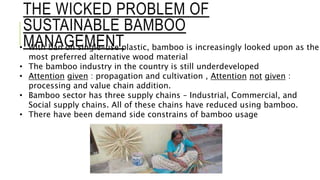
THE WICKED PROBLEM OF
SUSTAINABLE BAMBOO
MANAGEMENT
• With ban on single-use plastic, bamboo is increasingly looked upon as the
most preferred alternative wood material
• The bamboo industry in the country is still underdeveloped
• Attention given : propagation and cultivation , Attention not given :
processing and value chain addition.
• Bamboo sector has three supply chains – Industrial, Commercial, and
Social supply chains. All of these chains have reduced using bamboo.
• There have been demand side constrains of bamboo usage
WAY FORWARD:-
(In the present scenario the problem seems to be
less of a supply and more of a demand one)
• Mindset needs to be shifted from looking at bamboo as a poor person’s
timber and souvenir item to green gold and engineering material.
• Bamboo-based items should necessarily be procured by some of the key
government departments like tourism, tribal welfare, rural development, and
the forest department.
• Learning from the developed bamboo markets.
• planning and implementation should be done in a cluster development
approach in a targeted area where there is an abundance of raw material,
trained human resources, artisan base, and required market
• There is hardly anything that cannot be made or replaced by bamboo, would
not only help the planet but also the needy people in generating meaningful
livelihoods, green jobs, and impactful profits.
-THEREFORE, it has the potential to impact all the three pillars of sustainability,

Resilience, Sustainability and Equity.pptx

  • 1.
    RESILIENCE, SUSTAINABILITY AND EQUITY:COVID-19 AND MOUNTAIN LIVELIHOODS MANSHI ASHER PRAKASH BHANDARI AND PARTIK KUMAR
  • 2.
    “If the livelihoodinterests of mountain people have to be protected along with the local ecology, any economic agenda cannot be based on economics alone. It will have to revolve around the principles of equity, sustainability and resilience”.
  • 3.
    The top grossersfor the state’s economy was 1)Tourism 2)Hydropower 3) Pharma industry TOURISM • Himachal Pradesh gets over 1.5 crore tourists annually contributing to 7% of the state’s GDP. • Many people lost their livelihood due to Covid-19 • Youth engaged in taxi services and other petty hotel jobs have returned to their villages from tourist hotspots PHARMA INDUSTRIES • Pharma units in the state’s industrial hub struggle to restart as distressed migrant workers headed back home in the thousands. HYDROPOWER • Losses are being faced by hydropower projects generating costly electricity.
  • 4.
    • Himachal Pradeshwhere 90% of the population is rural, of which close to two thirds is dependent on land-based livelihoods • Lockdown has effected the farmers negatively • Tribal people have also been effected • Problems with animal husbandry • Local markets have been impacted • Many people lost their jobs solutions • Land-dependent communities need to be central to planning and decision-making and also be recognised as owners. • Marginalised communities need to be given a secure tenure over the land that is under their occupation • Implementation of community forest rights under FRA. • consolidation of fragmented holdings. • collective agroforestry initiatives • Integrated farming and agroecology, in smaller
  • 5.
    THE WICKED PROBLEMOF SUSTAINABLE BAMBOO MANAGEMENT • With ban on single-use plastic, bamboo is increasingly looked upon as the most preferred alternative wood material • The bamboo industry in the country is still underdeveloped • Attention given : propagation and cultivation , Attention not given : processing and value chain addition. • Bamboo sector has three supply chains – Industrial, Commercial, and Social supply chains. All of these chains have reduced using bamboo. • There have been demand side constrains of bamboo usage
  • 6.
    WAY FORWARD:- (In thepresent scenario the problem seems to be less of a supply and more of a demand one) • Mindset needs to be shifted from looking at bamboo as a poor person’s timber and souvenir item to green gold and engineering material. • Bamboo-based items should necessarily be procured by some of the key government departments like tourism, tribal welfare, rural development, and the forest department. • Learning from the developed bamboo markets. • planning and implementation should be done in a cluster development approach in a targeted area where there is an abundance of raw material, trained human resources, artisan base, and required market • There is hardly anything that cannot be made or replaced by bamboo, would not only help the planet but also the needy people in generating meaningful livelihoods, green jobs, and impactful profits. -THEREFORE, it has the potential to impact all the three pillars of sustainability,