The Smart Cities Mission
What is a Smart City?
 A Smart City has-
 basic infrastructure,
 uses ‘smart’ solutions to make
infrastructure and services better, and
 relies on Area based development.
Objectives
 Provide basic infrastructure.
 Quality of life.
 Clean and sustainable environment.
 Apply Smart Solutions.
 Set examples to be replicated both within
and outside the Smart City and catalyze
the creation of similar Smart Cities.
Smart Cities Mission Strategy
 Pan-city initiative in which at least one Smart
Solution is applied city-wide.
 Develop Areas step-by-step – three models of
area-based developments –
 Retrofitting,
 Redevelopment,
 Greenfield
What is basic infrastructure?
 Basic public infrastructure is built by dovetailing
and synergizing with other Missions and Schemes
– AMRUT
 Basic infrastructure includes,
 Assured water & electricity supply,
 Sanitation & Solid Waste Management,
 Efficient urban mobility & public transport,
 Affordable Housing,
 Robust IT connectivity,
 e-governance & citizen participation,
 Safety & security of citizens,
 Health & Education and
 Economic Activities & Livelihood Opportunities.
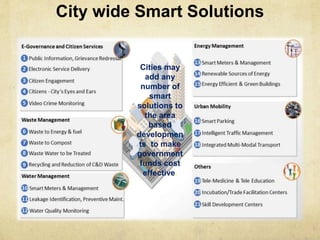
City wide Smart Solutions
Cities may
add any
number of
smart
solutions to
the area
based
developmen
ts to make
government
funds cost
effective.
What are ‘smart solutions’
 Smart solutions are application of IT&C to
municipal services and infrastructure to make
them better.
 Examples –
 Smart water meters and billing systems,
 Remotely controlled automatic distribution valves,
 Real time, online systems of monitoring water
quality,
 City-wide intelligent video surveillance network,
 Using mobile phones for cyber tour of worksites,
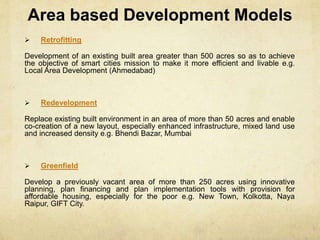
Area based Development Models
 Retrofitting
Development of an existing built area greater than 500 acres so as to achieve
the objective of smart cities mission to make it more efficient and livable e.g.
Local Area Development (Ahmedabad)
 Redevelopment
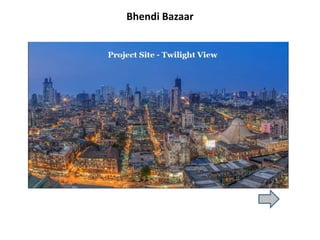
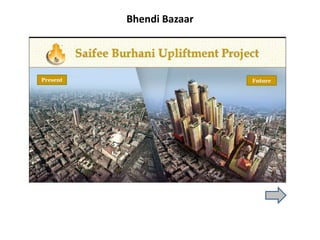
Replace existing built environment in an area of more than 50 acres and enable
co-creation of a new layout, especially enhanced infrastructure, mixed land use
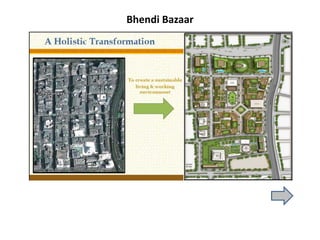
and increased density e.g. Bhendi Bazar, Mumbai
 Greenfield
Develop a previously vacant area of more than 250 acres using innovative
planning, plan financing and plan implementation tools with provision for
affordable housing, especially for the poor e.g. New Town, Kolkotta, Naya
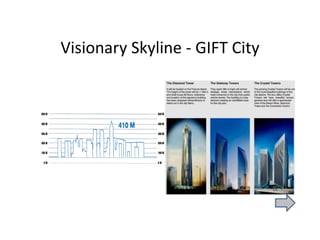
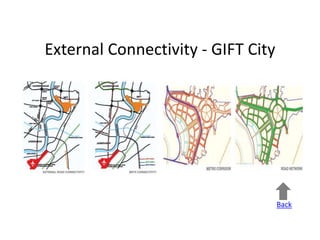
Raipur, GIFT City.
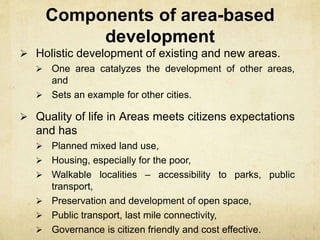
Components of area-based
development
 Holistic development of existing and new areas.
 One area catalyzes the development of other areas,
and
 Sets an example for other cities.
 Quality of life in Areas meets citizens expectations
and has
 Planned mixed land use,
 Housing, especially for the poor,
 Walkable localities – accessibility to parks, public
transport,
 Preservation and development of open space,
 Public transport, last mile connectivity,
 Governance is citizen friendly and cost effective.
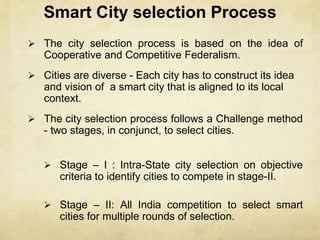
Smart City selection Process
 The city selection process is based on the idea of
Cooperative and Competitive Federalism.
 Cities are diverse - Each city has to construct its idea
and vision of a smart city that is aligned to its local
context.
 The city selection process follows a Challenge method
- two stages, in conjunct, to select cities.
 Stage – I : Intra-State city selection on objective
criteria to identify cities to compete in stage-II.
 Stage – II: All India competition to select smart
cities for multiple rounds of selection.
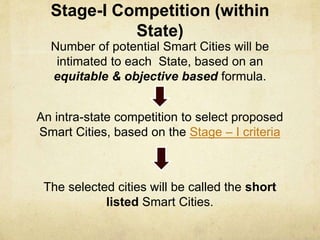
Stage-I Competition (within
State)
Number of potential Smart Cities will be
intimated to each State, based on an
equitable & objective based formula.
An intra-state competition to select proposed
Smart Cities, based on the Stage – I criteria
The selected cities will be called the short
listed Smart Cities.
Proposal of Stage 2
 No particular model prescribed – each city
has to develop its own idea of a smart city,
vision, and submit a Smart City Proposal
(SCP) during the All India competition.
 Convergence important.
 Proposal format is given in the Toolkit,
 The Proposal by the short listed city has to,
 Contain a retrofitting or redevelopment or
greenfield or a mix thereof plus a Pan-city
feature with Smart Solution(s),
 Area based developments should include some
essential elements.
Area based Development –
Essential Features
Applicable to all three type of area based developments
Adequate water supply including waste water recycling
and storm water reuse,
Assured electricity supply - least 10% of the energy
requirement coming from solar power,
Sanitation, including solid waste management,
Efficient urban mobility and public transport,
Affordable Housing, especially for poor,
Robust IT connectivity and digitalization,
Good Governance, especially e-Governance and
citizen participation,
Sustainable environment,
Ensuring safety of citizens, especially women and
elderly, and
Health and education.
Area based Development –
Essential Features (Cont..)
Additionally, for greenfield areas
80% buildings would be energy efficient green
building,
15% of the building will be in the affordable housing
category.
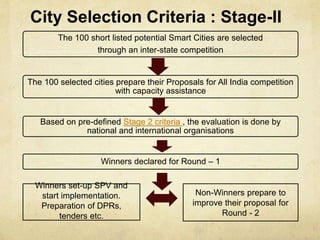
City Selection Criteria : Stage-II
The 100 short listed potential Smart Cities are selected
through an inter-state competition
The 100 selected cities prepare their Proposals for All India competition
with capacity assistance
Based on pre-defined Stage 2 criteria , the evaluation is done by
national and international organisations
Winners declared for Round – 1
Winners set-up SPV and
start implementation.
Preparation of DPRs,
tenders etc.
Non-Winners prepare to
improve their proposal for
Round - 2
Capacity Assistance for SCP
 Preparing Smart City Proposals is challenging and
assistance is required. For preparation of the SCP
financial assistance will be provided – Rs. 2 crore will
be released to shortlisted 100 cities. MoUD will assist
in two ways –
 Technically qualified firms and States/UTs are free to
draw upon this Panel using the RfP given in the Toolkit
– Scope is also given in Annexure 1 of Guidelines, OR
 Tying up arrangements to get Technical Assistance
from foreign Governments who have volunteered to
provide such support.
Implementation & Financing
 Each city will have a Special Purpose Vehicle (SPV).
The SPV will have complete flexibility to plan,
implement, manage & operate and will be headed by a
full time CEO. Articles of Association will be given in
Toolkit.
 Centre will invest a total of Rs. 48,000 crore in 100
cities across the country for 5 years – each Smart city
will get Rs. 100 crore each for five years.
 State / ULBs will mobilize additional resources required
of Rs. 48,000 crore as per 50:50 funding pattern.
 These funds will act as a catalyst to attract funding from
internal and external sources.
Funds release and distribution
 Funds can be used as follows –
 Project funds – 93%,
 State/ULB (Administrative & Office Expenses) – 5%,
 MoUD (Administrative & Office Expenses) – 2%,
 Advance of Rs. 2 crore to shortlisted cities to prepare
SCP.
 First year Rs. 200 crore, thereafter Rs. 100 crore
every year.
 Funds release – timely submission of Score Card,
satisfactory physical and financial progress as shown
from UC and Score Card, achievement of milestones
in the Proposal – to be certified.
Citizen collaboration
 At city level Smart City Advisory Forum will be
established.
 The Smart City Advisory Forum will include the
District Collector, MP, MLA, Mayor, CEO of SPV,
local youths, technical experts, and representative
of Associations.
 The CEO of the SPV will be the convener of the
Smart City Forum.
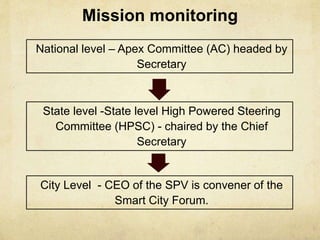
Mission monitoring
National level – Apex Committee (AC) headed by
Secretary
State level -State level High Powered Steering
Committee (HPSC) - chaired by the Chief
Secretary
City Level - CEO of the SPV is convener of the
Smart City Forum.
Challenges
 This is the first time a MoUD programme is using
the ‘Challenge’ or competition method to select
cities for funding.
 Strategy of area-based development.
 Citizen involvement is a key to the success of the
Smart Cities Mission. The involvement has to
start from beginning to the end.
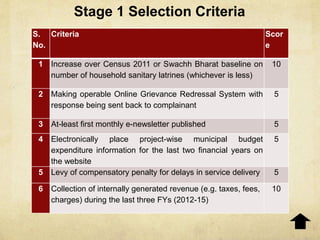
S.
No.
Criteria Scor
e
1 Increase over Census 2011 or Swachh Bharat baseline on
number of household sanitary latrines (whichever is less)
10
2 Making operable Online Grievance Redressal System with
response being sent back to complainant
5
3 At-least first monthly e-newsletter published 5
4 Electronically place project-wise municipal budget
expenditure information for the last two financial years on
the website
5
5 Levy of compensatory penalty for delays in service delivery 5
6 Collection of internally generated revenue (e.g. taxes, fees,
charges) during the last three FYs (2012-15)
10
Stage 1 Selection Criteria
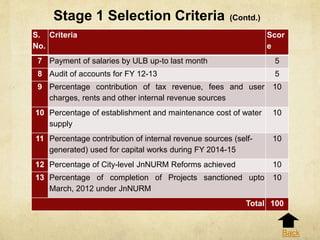
Stage 1 Selection Criteria (Contd.)
S.
No.
Criteria Scor
e
7 Payment of salaries by ULB up-to last month 5
8 Audit of accounts for FY 12-13 5
9 Percentage contribution of tax revenue, fees and user
charges, rents and other internal revenue sources
10
10 Percentage of establishment and maintenance cost of water
supply
10
11 Percentage contribution of internal revenue sources (self-
generated) used for capital works during FY 2014-15
10
12 Percentage of City-level JnNURM Reforms achieved 10
13 Percentage of completion of Projects sanctioned upto
March, 2012 under JnNURM
10
Total 100
Back
Stage 2 Selection Criteria
Challenge criteria developed after extensive
consultation
• City Level Evaluation Criteria………………………....30%
Credibility of Implementation
 % of JnNURM projects completed;
 Number of JnNURM reforms completed;
 Property tax collection as a % of annual demand;
 Water and Sewerage user charges collected as a % of
current annual demand, etc.
City Vision and Strategy
 How well does the vision come out of aspirations and
wishes of people;
 Does the vision show: why ? The big idea, picture of the
future;
 Does the vision show the city’s true purpose and is
connected to its economic base?
Stage 2 Selection Criteria (Cont..)
• Proposal based Evaluation criteria…………………..70%
Impact of Proposal
Do the vision flow from vision identified through citizen
consultation,
To what extent are the goals and objectives aligned, etc.
Cost Effectiveness
Does the proposal have smart component i.e. doing
something in more resourceful and efficient manner,
Are different sources of funding tapped, etc.
Innovation & Scalability
Have any best practices been used,
Is the project scalable to entire city, etc.
Process Followed
Details of process for co creating every step through an
extensive consultation,
Use of social media for citizen consultation, etc. Back
Bhendi Bazaar
Bhendi Bazaar
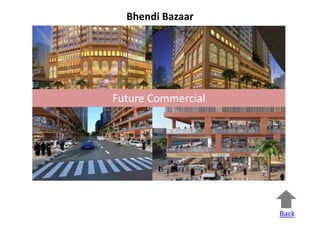
Bhendi Bazaar
Bhendi Bazaar
Future Commercial
Back
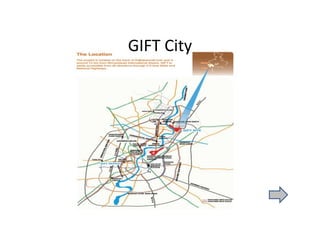
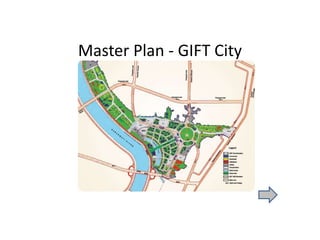
GIFT City
Master Plan - GIFT City
Visionary Skyline - GIFT City
External Connectivity - GIFT City
Back
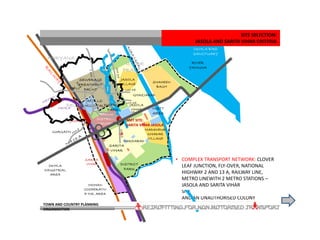
• DIVERSE LAND USES AND DEVELOPMENT
TYPOLOGIES: JASOLA DISTRICT CENTRE,
MOHAN CO-OP INDUSTRIAL AREA, APOLLO
HOSPITAL, PLOTTED ANDFLATTED
RESIDENTAIL COLONIES OF HIG, MIG, LIG,
EWS AND SFS FLATS AS WELL AS VILLAGES
AND AN UNAUTHORISED COLONY
• ENVIRONMENTALLY ACTIVE: RIVER
YAMUNA BORDERS THE SITE, AGRA CANAL
CUTS ACROSS THE SITE, STP IN THE
VICINITY AND DISTRICT PARK IN THE SITE
• OKHLA BIRD SANCTUARY BORDERS THE
SITE
SARITA
VIHAR
MOHAN
COOPERATIV
E IND. AREA
OKHLA
INDUSTRIAL
AREA
JASOLA
VIHAR
SARITA
VIHAR
OKHLA
JASOLA
DISTRICT
CENTRE
JASOLA
VILLAGE SHAHEEN
BAGH
MADANPUR
KHADAR
VILLAGE
APOLLO
HOSPITAL
RIVER
YAMUNA
SITE SELECTION:
JASOLA AND SARITA VIHAR CRITERIA
DELHI
HARYANA
UTTAR
PRADESH
GURGAON
FARIDABAD
NOIDA
GHAZIABAD
• ADMINISTRATIVE: BORDERS ANOTHER
STATE – UTTAR PRADESH, LIES ALONG NH 2,
TRUNK RAILWAY LINE
• COMPLEX TRANSPORT NETWORK: CLOVER
LEAF JUNCTION, FLY-OVER, NATIONAL
HIGHWAY 2 AND 13 A, RAILWAY LINE,
METRO LINEWITH 2 METRO STATIONS –
JASOLA AND SARITA VIHAR
DISTRICT
PARK
DISTRICT
PARK INSTT
AREA
OKHLA BIRD
SANCTUARY
NMT SITE:
SARITA VIHAR-JASOLA
SEWERAGE
TREATMENT
PALNT
JASOLA
TOWN AND COUNTRY PLANNING
ORGANISATION
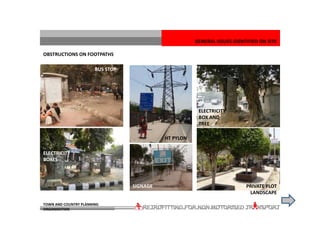
GENERAL ISSUES IDENTIFIED ON SITE
OBSTRUCTIONS ON FOOTPATHS
BUS STOP
HT PYLON
ELECTRICITY
BOX AND
TREE
ELECTRICITY
BOXES
SIGNAGE PRIVATE PLOT
LANDSCAPE
TOWN AND COUNTRY PLANNING
ORGANISATION
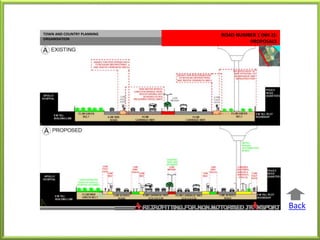
ROAD NUMBER 1 (NH 2):
PROPOSALS
TOWN AND COUNTRY PLANNING
ORGANISATION
Back
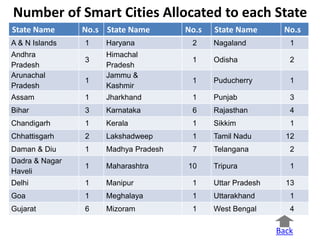
Number of Smart Cities Allocated to each State
State Name No.s State Name No.s State Name No.s
A & N Islands 1 Haryana 2 Nagaland 1
Andhra
Pradesh
3
Himachal
Pradesh
1 Odisha 2
Arunachal
Pradesh
1
Jammu &
Kashmir
1 Puducherry 1
Assam 1 Jharkhand 1 Punjab 3
Bihar 3 Karnataka 6 Rajasthan 4
Chandigarh 1 Kerala 1 Sikkim 1
Chhattisgarh 2 Lakshadweep 1 Tamil Nadu 12
Daman & Diu 1 Madhya Pradesh 7 Telangana 2
Dadra & Nagar
Haveli
1 Maharashtra 10 Tripura 1
Delhi 1 Manipur 1 Uttar Pradesh 13
Goa 1 Meghalaya 1 Uttarakhand 1
Gujarat 6 Mizoram 1 West Bengal 4
Back
Thank You

SMART CITY.pdf

  • 1.
  • 3.
    What is aSmart City?  A Smart City has-  basic infrastructure,  uses ‘smart’ solutions to make infrastructure and services better, and  relies on Area based development.
  • 4.
    Objectives  Provide basicinfrastructure.  Quality of life.  Clean and sustainable environment.  Apply Smart Solutions.  Set examples to be replicated both within and outside the Smart City and catalyze the creation of similar Smart Cities.
  • 5.
    Smart Cities MissionStrategy  Pan-city initiative in which at least one Smart Solution is applied city-wide.  Develop Areas step-by-step – three models of area-based developments –  Retrofitting,  Redevelopment,  Greenfield
  • 6.
    What is basicinfrastructure?  Basic public infrastructure is built by dovetailing and synergizing with other Missions and Schemes – AMRUT  Basic infrastructure includes,  Assured water & electricity supply,  Sanitation & Solid Waste Management,  Efficient urban mobility & public transport,  Affordable Housing,  Robust IT connectivity,  e-governance & citizen participation,  Safety & security of citizens,  Health & Education and  Economic Activities & Livelihood Opportunities.
  • 7.
    City wide SmartSolutions Cities may add any number of smart solutions to the area based developmen ts to make government funds cost effective.
  • 8.
    What are ‘smartsolutions’  Smart solutions are application of IT&C to municipal services and infrastructure to make them better.  Examples –  Smart water meters and billing systems,  Remotely controlled automatic distribution valves,  Real time, online systems of monitoring water quality,  City-wide intelligent video surveillance network,  Using mobile phones for cyber tour of worksites,
  • 9.
    Area based DevelopmentModels  Retrofitting Development of an existing built area greater than 500 acres so as to achieve the objective of smart cities mission to make it more efficient and livable e.g. Local Area Development (Ahmedabad)  Redevelopment Replace existing built environment in an area of more than 50 acres and enable co-creation of a new layout, especially enhanced infrastructure, mixed land use and increased density e.g. Bhendi Bazar, Mumbai  Greenfield Develop a previously vacant area of more than 250 acres using innovative planning, plan financing and plan implementation tools with provision for affordable housing, especially for the poor e.g. New Town, Kolkotta, Naya Raipur, GIFT City.
  • 10.
    Components of area-based development Holistic development of existing and new areas.  One area catalyzes the development of other areas, and  Sets an example for other cities.  Quality of life in Areas meets citizens expectations and has  Planned mixed land use,  Housing, especially for the poor,  Walkable localities – accessibility to parks, public transport,  Preservation and development of open space,  Public transport, last mile connectivity,  Governance is citizen friendly and cost effective.
  • 11.
    Smart City selectionProcess  The city selection process is based on the idea of Cooperative and Competitive Federalism.  Cities are diverse - Each city has to construct its idea and vision of a smart city that is aligned to its local context.  The city selection process follows a Challenge method - two stages, in conjunct, to select cities.  Stage – I : Intra-State city selection on objective criteria to identify cities to compete in stage-II.  Stage – II: All India competition to select smart cities for multiple rounds of selection.
  • 12.
    Stage-I Competition (within State) Numberof potential Smart Cities will be intimated to each State, based on an equitable & objective based formula. An intra-state competition to select proposed Smart Cities, based on the Stage – I criteria The selected cities will be called the short listed Smart Cities.
  • 13.
    Proposal of Stage2  No particular model prescribed – each city has to develop its own idea of a smart city, vision, and submit a Smart City Proposal (SCP) during the All India competition.  Convergence important.  Proposal format is given in the Toolkit,  The Proposal by the short listed city has to,  Contain a retrofitting or redevelopment or greenfield or a mix thereof plus a Pan-city feature with Smart Solution(s),  Area based developments should include some essential elements.
  • 14.
    Area based Development– Essential Features Applicable to all three type of area based developments Adequate water supply including waste water recycling and storm water reuse, Assured electricity supply - least 10% of the energy requirement coming from solar power, Sanitation, including solid waste management, Efficient urban mobility and public transport, Affordable Housing, especially for poor, Robust IT connectivity and digitalization, Good Governance, especially e-Governance and citizen participation, Sustainable environment, Ensuring safety of citizens, especially women and elderly, and Health and education.
  • 15.
    Area based Development– Essential Features (Cont..) Additionally, for greenfield areas 80% buildings would be energy efficient green building, 15% of the building will be in the affordable housing category.
  • 16.
    City Selection Criteria: Stage-II The 100 short listed potential Smart Cities are selected through an inter-state competition The 100 selected cities prepare their Proposals for All India competition with capacity assistance Based on pre-defined Stage 2 criteria , the evaluation is done by national and international organisations Winners declared for Round – 1 Winners set-up SPV and start implementation. Preparation of DPRs, tenders etc. Non-Winners prepare to improve their proposal for Round - 2
  • 17.
    Capacity Assistance forSCP  Preparing Smart City Proposals is challenging and assistance is required. For preparation of the SCP financial assistance will be provided – Rs. 2 crore will be released to shortlisted 100 cities. MoUD will assist in two ways –  Technically qualified firms and States/UTs are free to draw upon this Panel using the RfP given in the Toolkit – Scope is also given in Annexure 1 of Guidelines, OR  Tying up arrangements to get Technical Assistance from foreign Governments who have volunteered to provide such support.
  • 18.
    Implementation & Financing Each city will have a Special Purpose Vehicle (SPV). The SPV will have complete flexibility to plan, implement, manage & operate and will be headed by a full time CEO. Articles of Association will be given in Toolkit.  Centre will invest a total of Rs. 48,000 crore in 100 cities across the country for 5 years – each Smart city will get Rs. 100 crore each for five years.  State / ULBs will mobilize additional resources required of Rs. 48,000 crore as per 50:50 funding pattern.  These funds will act as a catalyst to attract funding from internal and external sources.
  • 19.
    Funds release anddistribution  Funds can be used as follows –  Project funds – 93%,  State/ULB (Administrative & Office Expenses) – 5%,  MoUD (Administrative & Office Expenses) – 2%,  Advance of Rs. 2 crore to shortlisted cities to prepare SCP.  First year Rs. 200 crore, thereafter Rs. 100 crore every year.  Funds release – timely submission of Score Card, satisfactory physical and financial progress as shown from UC and Score Card, achievement of milestones in the Proposal – to be certified.
  • 20.
    Citizen collaboration  Atcity level Smart City Advisory Forum will be established.  The Smart City Advisory Forum will include the District Collector, MP, MLA, Mayor, CEO of SPV, local youths, technical experts, and representative of Associations.  The CEO of the SPV will be the convener of the Smart City Forum.
  • 21.
    Mission monitoring National level– Apex Committee (AC) headed by Secretary State level -State level High Powered Steering Committee (HPSC) - chaired by the Chief Secretary City Level - CEO of the SPV is convener of the Smart City Forum.
  • 22.
    Challenges  This isthe first time a MoUD programme is using the ‘Challenge’ or competition method to select cities for funding.  Strategy of area-based development.  Citizen involvement is a key to the success of the Smart Cities Mission. The involvement has to start from beginning to the end.
  • 23.
    S. No. Criteria Scor e 1 Increaseover Census 2011 or Swachh Bharat baseline on number of household sanitary latrines (whichever is less) 10 2 Making operable Online Grievance Redressal System with response being sent back to complainant 5 3 At-least first monthly e-newsletter published 5 4 Electronically place project-wise municipal budget expenditure information for the last two financial years on the website 5 5 Levy of compensatory penalty for delays in service delivery 5 6 Collection of internally generated revenue (e.g. taxes, fees, charges) during the last three FYs (2012-15) 10 Stage 1 Selection Criteria
  • 24.

    Stage 1 SelectionCriteria (Contd.) S. No. Criteria Scor e 7 Payment of salaries by ULB up-to last month 5 8 Audit of accounts for FY 12-13 5 9 Percentage contribution of tax revenue, fees and user charges, rents and other internal revenue sources 10 10 Percentage of establishment and maintenance cost of water supply 10 11 Percentage contribution of internal revenue sources (self- generated) used for capital works during FY 2014-15 10 12 Percentage of City-level JnNURM Reforms achieved 10 13 Percentage of completion of Projects sanctioned upto March, 2012 under JnNURM 10 Total 100 Back
  • 25.
    Stage 2 SelectionCriteria Challenge criteria developed after extensive consultation • City Level Evaluation Criteria………………………....30% Credibility of Implementation  % of JnNURM projects completed;  Number of JnNURM reforms completed;  Property tax collection as a % of annual demand;  Water and Sewerage user charges collected as a % of current annual demand, etc. City Vision and Strategy  How well does the vision come out of aspirations and wishes of people;  Does the vision show: why ? The big idea, picture of the future;  Does the vision show the city’s true purpose and is connected to its economic base?
  • 26.
    Stage 2 SelectionCriteria (Cont..) • Proposal based Evaluation criteria…………………..70% Impact of Proposal Do the vision flow from vision identified through citizen consultation, To what extent are the goals and objectives aligned, etc. Cost Effectiveness Does the proposal have smart component i.e. doing something in more resourceful and efficient manner, Are different sources of funding tapped, etc. Innovation & Scalability Have any best practices been used, Is the project scalable to entire city, etc. Process Followed Details of process for co creating every step through an extensive consultation, Use of social media for citizen consultation, etc. Back
  • 27.
  • 28.
  • 29.
  • 30.
  • 31.
  • 32.
    Master Plan -GIFT City
  • 33.
  • 34.
  • 35.
    • DIVERSE LANDUSES AND DEVELOPMENT TYPOLOGIES: JASOLA DISTRICT CENTRE, MOHAN CO-OP INDUSTRIAL AREA, APOLLO HOSPITAL, PLOTTED ANDFLATTED RESIDENTAIL COLONIES OF HIG, MIG, LIG, EWS AND SFS FLATS AS WELL AS VILLAGES AND AN UNAUTHORISED COLONY • ENVIRONMENTALLY ACTIVE: RIVER YAMUNA BORDERS THE SITE, AGRA CANAL CUTS ACROSS THE SITE, STP IN THE VICINITY AND DISTRICT PARK IN THE SITE • OKHLA BIRD SANCTUARY BORDERS THE SITE SARITA VIHAR MOHAN COOPERATIV E IND. AREA OKHLA INDUSTRIAL AREA JASOLA VIHAR SARITA VIHAR OKHLA JASOLA DISTRICT CENTRE JASOLA VILLAGE SHAHEEN BAGH MADANPUR KHADAR VILLAGE APOLLO HOSPITAL RIVER YAMUNA SITE SELECTION: JASOLA AND SARITA VIHAR CRITERIA DELHI HARYANA UTTAR PRADESH GURGAON FARIDABAD NOIDA GHAZIABAD • ADMINISTRATIVE: BORDERS ANOTHER STATE – UTTAR PRADESH, LIES ALONG NH 2, TRUNK RAILWAY LINE • COMPLEX TRANSPORT NETWORK: CLOVER LEAF JUNCTION, FLY-OVER, NATIONAL HIGHWAY 2 AND 13 A, RAILWAY LINE, METRO LINEWITH 2 METRO STATIONS – JASOLA AND SARITA VIHAR DISTRICT PARK DISTRICT PARK INSTT AREA OKHLA BIRD SANCTUARY NMT SITE: SARITA VIHAR-JASOLA SEWERAGE TREATMENT PALNT JASOLA TOWN AND COUNTRY PLANNING ORGANISATION
  • 36.
    GENERAL ISSUES IDENTIFIEDON SITE OBSTRUCTIONS ON FOOTPATHS BUS STOP HT PYLON ELECTRICITY BOX AND TREE ELECTRICITY BOXES SIGNAGE PRIVATE PLOT LANDSCAPE TOWN AND COUNTRY PLANNING ORGANISATION
  • 37.
    ROAD NUMBER 1(NH 2): PROPOSALS TOWN AND COUNTRY PLANNING ORGANISATION Back
  • 38.
    Number of SmartCities Allocated to each State State Name No.s State Name No.s State Name No.s A & N Islands 1 Haryana 2 Nagaland 1 Andhra Pradesh 3 Himachal Pradesh 1 Odisha 2 Arunachal Pradesh 1 Jammu & Kashmir 1 Puducherry 1 Assam 1 Jharkhand 1 Punjab 3 Bihar 3 Karnataka 6 Rajasthan 4 Chandigarh 1 Kerala 1 Sikkim 1 Chhattisgarh 2 Lakshadweep 1 Tamil Nadu 12 Daman & Diu 1 Madhya Pradesh 7 Telangana 2 Dadra & Nagar Haveli 1 Maharashtra 10 Tripura 1 Delhi 1 Manipur 1 Uttar Pradesh 13 Goa 1 Meghalaya 1 Uttarakhand 1 Gujarat 6 Mizoram 1 West Bengal 4 Back
  • 39.