CRYSTAL FIELD THEORY
(CFT)
SPLITTING OF
OCTAHEDRAL COMPLEXES
BY
DR. A. MUSHIRA BANU
asSISTANT PROFESSOR OF CHEMISTRY
JAMAL MOHAMED COLLEGE, TRICHY-20.
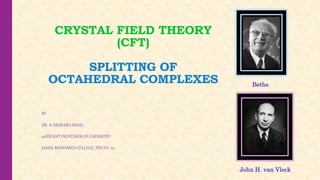
Bethe
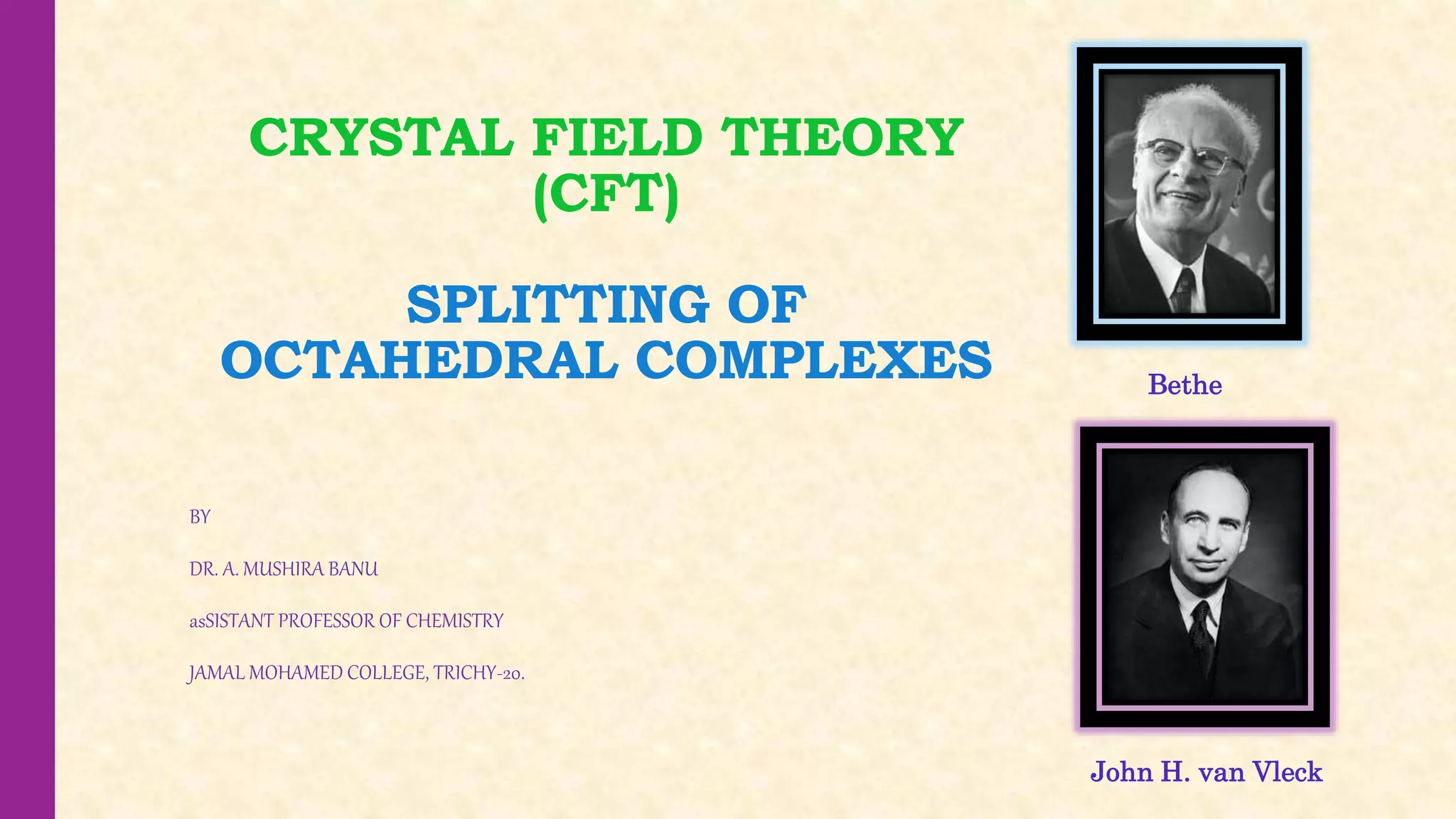
John H. van Vleck
WHY IT IS CALLED CFT ?
• Crystal field theory (CFT) describes the breaking of orbital
degeneracy in transition metal complexes due to the
presence of ligands. CFT qualitatively describes the
strength of the metal-ligand bonds.
• This may lead to a change in magnetic properties as well
as color.
• This theory was developed by Hans Bethe and John
Hasbrouck van Vleck .
Created
By,
Mrs.
A.
Mushira
Banu,
Assistant
Professor
of
Chemistry,
JMC,
Trichy-20.
Created
By,
Mrs.
A.
Mushira
Banu,
Assistant
Professor
of
Chemistry,
JMC,
Trichy-20.
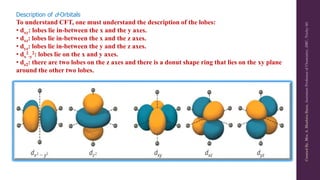
Description of d-Orbitals
To understand CFT, one must understand the description of the lobes:
• dxy: lobes lie in-between the x and the y axes.
• dxz: lobes lie in-between the x and the z axes.
• dyz: lobes lie in-between the y and the z axes.
• dx
2
-y
2: lobes lie on the x and y axes.
• dz2: there are two lobes on the z axes and there is a donut shape ring that lies on the xy plane
around the other two lobes.
Created
By,
Mrs.
A.
Mushira
Banu,
Assistant
Professor
of
Chemistry,
JMC,
Trichy-20.
CRYSTAL FIELD SPLITTING IN OCTAHEDRAL COMPLEXES
• In the case of an octahedral coordination compound having six
ligands surrounding the metal atom/ion, we observe repulsion
between the electrons in d orbitals and ligand electrons.
• This repulsion is experienced more in the case of dx
2
-y
2 and
dz
2 orbitals as they point towards the axes along the direction of the
ligand.
• Hence, they have higher energy than average energy in the spherical
crystal field.
• On the other hand, dxy, dyz, and dxz orbitals experience lower
repulsions as they are directed between the axes.
• Hence, these three orbitals have less energy than the average energy
in the spherical crystal field.
Created
By,
Mrs.
A.
Mushira
Banu,
Assistant
Professor
of
Chemistry,
JMC,
Trichy-20
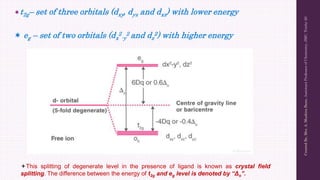
t2g– set of three orbitals (dxy, dyz and dxz) with lower energy
 eg – set of two orbitals (dx
2
-y
2 and dz
2) with higher energy
Created
By,
Mrs.
A.
Mushira
Banu,
Assistant
Professor
of
Chemistry,
JMC,
Trichy-20
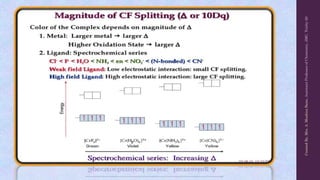
This splitting of degenerate level in the presence of ligand is known as crystal field
splitting. The difference between the energy of t2g and eg level is denoted by “Δo”.
Ligand Field Stabilization Energy
• The energy levels generally split as directed by the symmetry of the local field
surrounding the metal ion. The energy difference between the eg and t2g levels is
given as or 10Dq. It states that each electron that goes into the lower t2g level
stabilizes the system by an amount of -4Dq and the electron that goes into eg level
destabilizes the system by +6Dq. That is the t2g is lowered by 4Dq and the eg level is
raised by +6Dq.
• For example, the net change in energy for d5 and d10 systems will be zero as shown
below.
• d5 :- 3(-4Dq) + 2(+6Dq) = -12Dq + 12Dq = 0
• d10 :- 6(-4Dq) + 4(+6Dq) = -24Dq + 24Dq = 0
• The decrease in energy caused by the splitting of the energy levels is called
the “Ligand Field Stabilization Energy (LFSE)”.
Created
By,
Mrs.
A.
Mushira
Banu,
Assistant
Professor
of
Chemistry,
JMC,
Trichy-20
Created
By,
Mrs.
A.
Mushira
Banu,
Assistant
Professor
of
Chemistry,
JMC,
Trichy-20
2
Created
By,
Mrs.
A.
Mushira
Banu,
Assistant
Professor
of
Chemistry,
JMC,
Trichy-20
Created
By,
Mrs.
A.
Mushira
Banu,
Assistant
Professor
of
Chemistry,
JMC,
Trichy-20

CRYSTAL FIELD THEORY OCTAHEDRAL SPLITTING.pptx

  • 1.
    CRYSTAL FIELD THEORY (CFT) SPLITTINGOF OCTAHEDRAL COMPLEXES BY DR. A. MUSHIRA BANU asSISTANT PROFESSOR OF CHEMISTRY JAMAL MOHAMED COLLEGE, TRICHY-20. Bethe John H. van Vleck
  • 2.
    WHY IT ISCALLED CFT ? • Crystal field theory (CFT) describes the breaking of orbital degeneracy in transition metal complexes due to the presence of ligands. CFT qualitatively describes the strength of the metal-ligand bonds. • This may lead to a change in magnetic properties as well as color. • This theory was developed by Hans Bethe and John Hasbrouck van Vleck . Created By, Mrs. A. Mushira Banu, Assistant Professor of Chemistry, JMC, Trichy-20.
  • 3.
  • 4.
    Description of d-Orbitals Tounderstand CFT, one must understand the description of the lobes: • dxy: lobes lie in-between the x and the y axes. • dxz: lobes lie in-between the x and the z axes. • dyz: lobes lie in-between the y and the z axes. • dx 2 -y 2: lobes lie on the x and y axes. • dz2: there are two lobes on the z axes and there is a donut shape ring that lies on the xy plane around the other two lobes. Created By, Mrs. A. Mushira Banu, Assistant Professor of Chemistry, JMC, Trichy-20.
  • 5.
    CRYSTAL FIELD SPLITTINGIN OCTAHEDRAL COMPLEXES • In the case of an octahedral coordination compound having six ligands surrounding the metal atom/ion, we observe repulsion between the electrons in d orbitals and ligand electrons. • This repulsion is experienced more in the case of dx 2 -y 2 and dz 2 orbitals as they point towards the axes along the direction of the ligand. • Hence, they have higher energy than average energy in the spherical crystal field. • On the other hand, dxy, dyz, and dxz orbitals experience lower repulsions as they are directed between the axes. • Hence, these three orbitals have less energy than the average energy in the spherical crystal field. Created By, Mrs. A. Mushira Banu, Assistant Professor of Chemistry, JMC, Trichy-20
  • 6.
    t2g– set ofthree orbitals (dxy, dyz and dxz) with lower energy  eg – set of two orbitals (dx 2 -y 2 and dz 2) with higher energy Created By, Mrs. A. Mushira Banu, Assistant Professor of Chemistry, JMC, Trichy-20 This splitting of degenerate level in the presence of ligand is known as crystal field splitting. The difference between the energy of t2g and eg level is denoted by “Δo”.
  • 7.
    Ligand Field StabilizationEnergy • The energy levels generally split as directed by the symmetry of the local field surrounding the metal ion. The energy difference between the eg and t2g levels is given as or 10Dq. It states that each electron that goes into the lower t2g level stabilizes the system by an amount of -4Dq and the electron that goes into eg level destabilizes the system by +6Dq. That is the t2g is lowered by 4Dq and the eg level is raised by +6Dq. • For example, the net change in energy for d5 and d10 systems will be zero as shown below. • d5 :- 3(-4Dq) + 2(+6Dq) = -12Dq + 12Dq = 0 • d10 :- 6(-4Dq) + 4(+6Dq) = -24Dq + 24Dq = 0 • The decrease in energy caused by the splitting of the energy levels is called the “Ligand Field Stabilization Energy (LFSE)”. Created By, Mrs. A. Mushira Banu, Assistant Professor of Chemistry, JMC, Trichy-20
  • 8.
  • 9.
  • 10.