The free moving particle
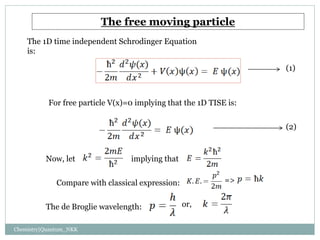
For free particle V(x)=0 implying that the 1D TISE is:
Now, let implying that
(1)
(2)
Compare with classical expression: =>
The de Broglie wavelength: or,
The 1D time independent Schrodinger Equation
is:
Chemistry|Quantum_NKK
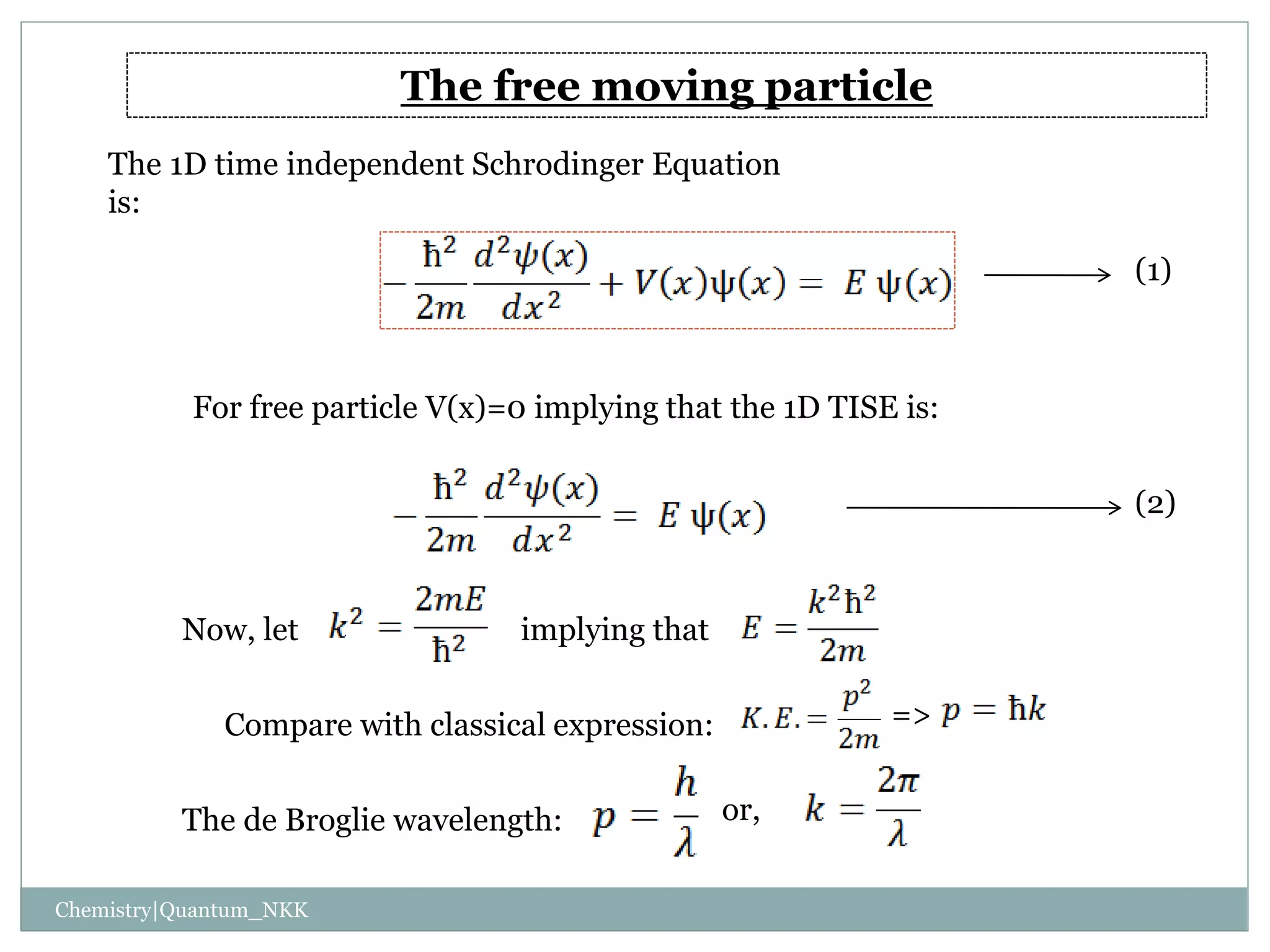
Substitution of the above in eqn. (1)
gives,
(3)
Eqn. (3) is a standard second order differential eqn. with the general solutions:
Other form of the general solution is:
For free particle , no boundary conditions are available and hence any A and B
values are possible and therefore any E possible.
Chemistry|Quantum_NKK
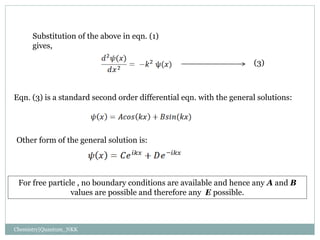
1. The particle can move freely inside the box (0 < x < L)
2. The potential energy of the electron inside the box is zero (V=0)
3. The potential energy at the edges is infinite, confining the electron to the box (V= α)
What we are looking for :
wave functions
energy of the particle
Particle in a One dimensional Box (PIB) model
m
x=0 x=L
V=α V=αV=0
V(x)
The wave function: ψ(x)
The energy: E
V(x)=α ; x<0, x>L
V(x)=0 ; x>0, x<L x
Chemistry|Quantum_NKK
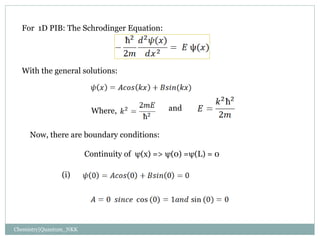
For 1D PIB: The Schrodinger Equation:
With the general solutions:
Where, and
Now, there are boundary conditions:
Continuity of ψ(x) => ψ(0) =ψ(L) = 0
(i)
Chemistry|Quantum_NKK
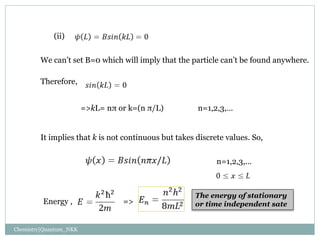
(ii)
We can’t set B=0 which will imply that the particle can’t be found anywhere.
Therefore,
=>kL= nπ or k=(n π/L) n=1,2,3,…
It implies that k is not continuous but takes discrete values. So,
n=1,2,3,…
Energy , =>
The energy of stationary
or time independent sate
Chemistry|Quantum_NKK
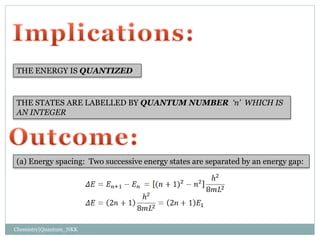
THE ENERGY IS QUANTIZED
THE STATES ARE LABELLED BY QUANTUM NUMBER ‘n’ WHICH IS
AN INTEGER
(a) Energy spacing: Two successive energy states are separated by an energy gap:
Chemistry|Quantum_NKK
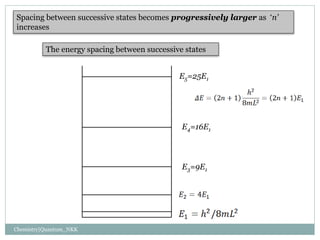
E3=9E1
E4=16E1
E5=25E1
The energy spacing between successive states
Spacing between successive states becomes progressively larger as ‘n’
increases
Chemistry|Quantum_NKK
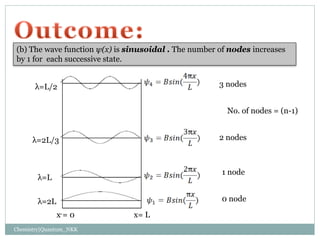
(b) The wave function ψ(x) is sinusoidal . The number of nodes increases
by 1 for each successive state.
λ=2L
λ=L
λ=2L/3
λ=L/2
No. of nodes = (n-1)
0 node
1 node
2 nodes
3 nodes
x = 0 x= L
Chemistry|Quantum_NKK
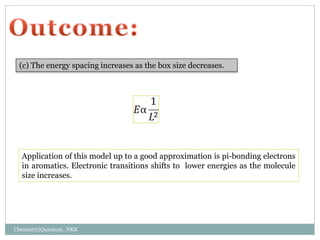
(c) The energy spacing increases as the box size decreases.
Application of this model up to a good approximation is pi-bonding electrons
in aromatics. Electronic transitions shifts to lower energies as the molecule
size increases.
Chemistry|Quantum_NKK
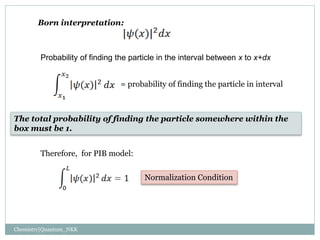
Born interpretation:
Probability of finding the particle in the interval between x to x+dx
= probability of finding the particle in interval
The total probability of finding the particle somewhere within the
box must be 1.
Normalization Condition
Therefore, for PIB model:
Chemistry|Quantum_NKK
The integral we need to calculate is:
or,
We used the standard integral:
Therefore the normalized wave function is:
n=1,2,3,…
Normalization constant
Chemistry|Quantum_NKK
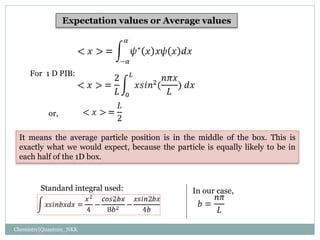
Expectation values or Average values
For 1 D PIB:
or,
Standard integral used: In our case,
It means the average particle position is in the middle of the box. This is
exactly what we would expect, because the particle is equally likely to be in
each half of the 1D box.
Chemistry|Quantum_NKK
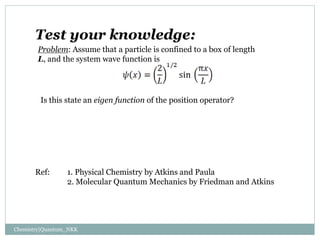
Test your knowledge:
Is this state an eigen function of the position operator?
Problem: Assume that a particle is confined to a box of length
L, and the system wave function is
Chemistry|Quantum_NKK
Ref: 1. Physical Chemistry by Atkins and Paula
2. Molecular Quantum Mechanics by Friedman and Atkins

Particle in a Box problem Quantum Chemistry

  • 1.
    The free movingparticle For free particle V(x)=0 implying that the 1D TISE is: Now, let implying that (1) (2) Compare with classical expression: => The de Broglie wavelength: or, The 1D time independent Schrodinger Equation is: Chemistry|Quantum_NKK
  • 2.
    Substitution of theabove in eqn. (1) gives, (3) Eqn. (3) is a standard second order differential eqn. with the general solutions: Other form of the general solution is: For free particle , no boundary conditions are available and hence any A and B values are possible and therefore any E possible. Chemistry|Quantum_NKK
  • 3.
    1. The particlecan move freely inside the box (0 < x < L) 2. The potential energy of the electron inside the box is zero (V=0) 3. The potential energy at the edges is infinite, confining the electron to the box (V= α) What we are looking for : wave functions energy of the particle Particle in a One dimensional Box (PIB) model m x=0 x=L V=α V=αV=0 V(x) The wave function: ψ(x) The energy: E V(x)=α ; x<0, x>L V(x)=0 ; x>0, x<L x Chemistry|Quantum_NKK
  • 4.
    For 1D PIB:The Schrodinger Equation: With the general solutions: Where, and Now, there are boundary conditions: Continuity of ψ(x) => ψ(0) =ψ(L) = 0 (i) Chemistry|Quantum_NKK
  • 5.
    (ii) We can’t setB=0 which will imply that the particle can’t be found anywhere. Therefore, =>kL= nπ or k=(n π/L) n=1,2,3,… It implies that k is not continuous but takes discrete values. So, n=1,2,3,… Energy , => The energy of stationary or time independent sate Chemistry|Quantum_NKK
  • 6.
    THE ENERGY ISQUANTIZED THE STATES ARE LABELLED BY QUANTUM NUMBER ‘n’ WHICH IS AN INTEGER (a) Energy spacing: Two successive energy states are separated by an energy gap: Chemistry|Quantum_NKK
  • 7.
    E3=9E1 E4=16E1 E5=25E1 The energy spacingbetween successive states Spacing between successive states becomes progressively larger as ‘n’ increases Chemistry|Quantum_NKK
  • 8.
    (b) The wavefunction ψ(x) is sinusoidal . The number of nodes increases by 1 for each successive state. λ=2L λ=L λ=2L/3 λ=L/2 No. of nodes = (n-1) 0 node 1 node 2 nodes 3 nodes x = 0 x= L Chemistry|Quantum_NKK
  • 9.
    (c) The energyspacing increases as the box size decreases. Application of this model up to a good approximation is pi-bonding electrons in aromatics. Electronic transitions shifts to lower energies as the molecule size increases. Chemistry|Quantum_NKK
  • 10.
    Born interpretation: Probability offinding the particle in the interval between x to x+dx = probability of finding the particle in interval The total probability of finding the particle somewhere within the box must be 1. Normalization Condition Therefore, for PIB model: Chemistry|Quantum_NKK
  • 11.
    The integral weneed to calculate is: or, We used the standard integral: Therefore the normalized wave function is: n=1,2,3,… Normalization constant Chemistry|Quantum_NKK
  • 12.
    Expectation values orAverage values For 1 D PIB: or, Standard integral used: In our case, It means the average particle position is in the middle of the box. This is exactly what we would expect, because the particle is equally likely to be in each half of the 1D box. Chemistry|Quantum_NKK
  • 13.
    Test your knowledge: Isthis state an eigen function of the position operator? Problem: Assume that a particle is confined to a box of length L, and the system wave function is Chemistry|Quantum_NKK Ref: 1. Physical Chemistry by Atkins and Paula 2. Molecular Quantum Mechanics by Friedman and Atkins