Paediatric trauma
2170356 Che Hafiqrie Idham Bin Che
Hafsham
2170339 Ahmad Faiz Bin As’ari
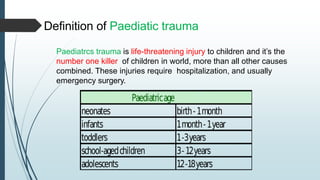
Definition of Paediatic trauma
Paediatrcs trauma is life-threatening injury to children and it’s the
number one killer of children in world, more than all other causes
combined. These injuries require hospitalization, and usually
emergency surgery.
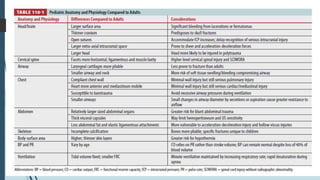
Unique Characteristics of
Pediatric Patients
according to system
System / anatomy Unique characteristic Relation to trauma How to overcome (if any)
Head • larger surface • is prone to injury from bleeding, fractures
or polytrauma
Laryngeal cartilages • more flexible (less
prone to fracture) and
protected
• can compromise airway due to soft tissue
swelling or expanding hematoma.
• Low threshold for
intubation
Chest wall • compliant and
vulnerable
tracheobronchial
structures and heart
lie anteriorly with
mobile mediastinal
structures
• predispose to intrathoracic injury
• less risk of rib fracture
Respiratory
structure
• smaller diameter
compared to adult
• predispose to airway obstruction when
change in inner diameter from aspirated
fluids or secretions.
• insert orotracheal tube to
secure the airway
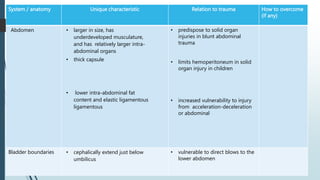
System / anatomy Unique characteristic Relation to trauma How to overcome
(if any)
Abdomen • larger in size, has
underdeveloped musculature,
and has relatively larger intra-
abdominal organs
• thick capsule
• lower intra-abdominal fat
content and elastic ligamentous
ligamentous
• predispose to solid organ
injuries in blunt abdominal
trauma
• limits hemoperitoneum in solid
organ injury in children
• increased vulnerability to injury
from acceleration-deceleration
or abdominal
Bladder boundaries • cephalically extend just below
umbilicus
• vulnerable to direct blows to the
lower abdomen
System / anatomy Unique characteristic Relation to trauma How to overcome (if any)
Skeleton • incompletely calcified ,
contains multiple active
growth centers, weaker
epiphysis and is more pliable
• internal organ damage is often
damage noted without bony
fractures
• pulmonary contusion is common
but rib fractures is not
The presence of skull and/or rib
fractures in a child
- suggests the transfer of a massive
amount of energy
- in this case, underlying organ
injuries, such as traumatic brain
injury and pulmonary
• High index of intrathoracic
injury without rib fractures
Surface area • ratio of a child’s body
surface area to body
volume is highest at birth
and diminishes as the child
child mature.
• Themal energy loss is a significant
stress factor such as hypothermia
in cold environments. (trauma
bay)
• - complicate the treatment of
pediatric patients with
hypotension
• Use warm IVD / blood
product
• Use warm blanket / body
warmer
Metabolic activity
• Metabolic demands in children are higher than in adults.
• Energy expenditure and caloric requirement is higher in
children at baseline.
• Hyperglycemia – stress-induced hyperglycemia is
common in polytrauma
• Hypoglycemia – can occur in younger children
ABCD APPROACH IN PEADIATRICS
TRAUMA
AIRWAY (3 P’s)
 Inability to establish and/or maintain a patent airway associated with
lack of oxygenation and ventilation
 Patency – use an oral airway to prevent obstruction by the tongue,
suction any blood, secretions, foreign bodies
 Position – towel under torso, occiput on bed
 Protection – cuffed ETT / uncuffed ETT
Airway: Evaluation and Management
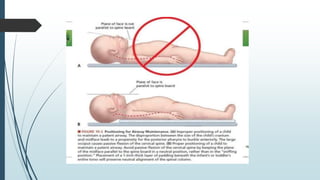
• passive flexion of cervical spine caused by the large occiput.
• plane of the midface be maintained parallel to the spine board in a
neutral position (as shown in the next slide)
• placement of a 1- 2.5 inch-thick layer of padding beneath the infant’s
(<1 years of age) or toddler’s (1-3 years of age) entire torso (as
shown in the next slide)
Airway: Evaluation and Management
• Spontaneous breathing– jaw thrust maneuver combined with bimanual inline
spinal motion restriction to open the airway.
• unconscious – fully pre oxygenate the child before doing mechanical
methods of maintaining the airway.
Oral Airway
• should be inserted only if a child is unconscious, because vomiting is likely to occur if the gag reflex is
intact.
• Insert the oral airway gently and directly into the oropharynx. Using a tongue blade to depress the
tongue may be helpful
• practice of inserting the airway backward and rotating it 180 degrees is not recommended
• Complication: trauma with resultant hemorrhage into soft tissue structures of the oropharynx
Orotracheal intubation
Indication:
• severe brain injury who requires controlled ventilation
• airway cannot be maintained
• signs of ventilatory failure
• suffered significant hypovolemia and has a depressed sensorium or requires operative
intervention
Airway: Evaluation and Management
• soft tissues in an infant’s oropharynx
relatively large
visualization of the larynx difficult
• A child’s larynx is funnel-shaped,
allowing secretions to accumulate in
the retropharyngeal area
• The larynx and vocal cords are more
cephalad and anterior in the neck.
• The head and occiput is relatively
large
• A disproportionately large tongue and
small mandible
Airway: Evaluation and Management
• The vocal cords are frequently more difficult to visualize when the
child’s head is in the normal, supine, anatomical position during
intubation than when it is in the neutral position required for
optimal cervical spine protection.
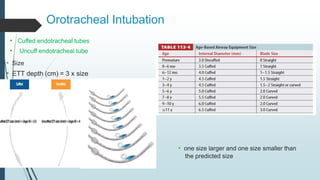
Orotracheal Intubation
• Cuffed endotracheal tubes
• Uncuff endotracheal tube
• Size
• ETT depth (cm) = 3 x size
• one size larger and one size smaller than
the predicted size
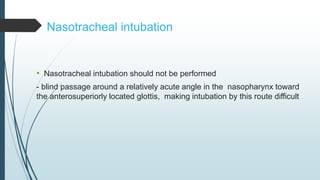
• Nasotracheal intubation should not be performed
- blind passage around a relatively acute angle in the nasopharynx toward
the anterosuperiorly located glottis, making intubation by this route difficult
Nasotracheal intubation
Cricothyrotomy
• A needle cricothyrotomy may be required
if orotracheal intubation is not possible due
to severe maxillofacial injuries and the
patient cannot be adequately ventilated and
oxygenated.
• Open surgical cricothyrotomy is not an
option in children <10 years old due to the
small cricothyroid membrane. Needle
cricothyrotomy is therefore recommended
in children <10 years old
• Needle-jet insufflation via the cricothyroid
membrane is an appropriate, temporizing
technique for oxygenation, but it does not
provide adequate ventilation, and
progressive hypercarbia will occur.
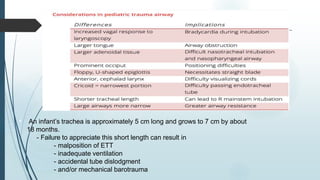
• An infant’s trachea is approximately 5 cm long and grows to 7 cm by about
18 months.
- Failure to appreciate this short length can result in
- malposition of ETT
- inadequate ventilation
- accidental tube dislodgment
- and/or mechanical barotrauma
Breathing: Evaluation and
Management
• excessive volume or pressure during assisted ventilation substantially
increases the potential for iatrogenic barotrauma
- fragile nature of the immature tracheobronchial tree and alveoli
• pediatric bag-mask: <30 kg
• volume of O2 in reservoir (self inflating bag size) : 250 ml for newborn or
small neonates, 500 ml for neonates – infants, 1500ml adults
• tension pneumothorax - needle decompression 14- to 18-gauge IV catheter
in the midclavicular line just above the third rib.
• orogastric tube can significantly improve their work of breathing for
increased intra-abdominal pressure
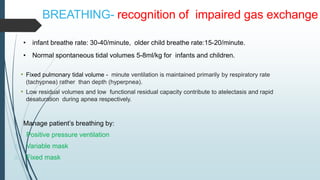
BREATHING- recognition of impaired gas exchange
• infant breathe rate: 30-40/minute, older child breathe rate:15-20/minute.
• Normal spontaneous tidal volumes 5-8ml/kg for infants and children.
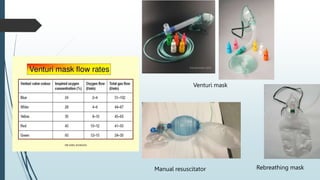
Manage patient’s breathing by:
1. Positive pressure ventilation
2. Variable mask
3. Fixed mask
• Fixed pulmonary tidal volume - minute ventilation is maintained primarily by respiratory rate
(tachypnea) rather than depth (hyperpnea).
• Low residual volumes and low functional residual capacity contribute to atelectasis and rapid
desaturation during apnea respectively.
Venturi mask
Manual resuscitator Rebreathing mask
Cont.
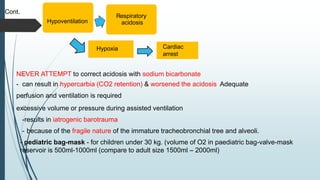
NEVER ATTEMPT to correct acidosis with sodium bicarbonate
- can result in hypercarbia (CO2 retention) & worsened the acidosis Adequate
perfusion and ventilation is required
excessive volume or pressure during assisted ventilation
-results in iatrogenic barotrauma
- because of the fragile nature of the immature tracheobronchial tree and alveoli.
- pediatric bag-mask - for children under 30 kg. (volume of O2 in paediatric bag-valve-mask
reservoir is 500ml-1000ml (compare to adult size 1500ml – 2000ml)
Hypoventilation
Respiratory
acidosis
Hypoxia Cardiac
arrest
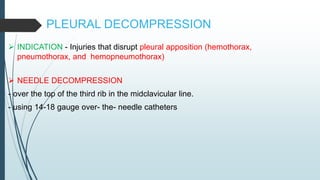
PLEURAL DECOMPRESSION
 INDICATION - Injuries that disrupt pleural apposition (hemothorax,
pneumothorax, and hemopneumothorax)
 NEEDLE DECOMPRESSION
- over the top of the third rib in the midclavicular line.
- using 14-18 gauge over- the- needle catheters
Circulation and Shock: Evaluation and
Management
• Catastrophic bleeding – addressed and control by applying direct pressure,
tourniquets, and pelvic binding are essential prehospital interventions
• Signs of circulatory compromise
-tachycardia and narrowing of the pulse pressure to <20 mm Hg
-poor skin perfusion, cool extremities relative to the torso, mottled skin
-weakening of peripheral pulses,
-altered sensorium including dulled response to pain,
-low BP and urinary output indicate inadequate organ perfusion
• children prone to get internal injury rather than rib fracture because the skeletal
incompletely calcified , contains multiple active growth centers, weaker epiphysis
and is more pliable
Circulation and Shock: Evaluation and
Management
• Vascular access – can be difficult especially in hypovolemic shock
• Place proximal large-bore IV branula intraosseous if fail in 90
sec
• pressure bag or multiple handheld syringes - used for rapid fluid resuscitation
• children tolerate initial boluses of 10 to 40 mL/kg.
• shock : bolus of 20 ml/kg of warmed crystalloids
• weight-based blood product resuscitation ( 10 to 20 mL/kg of packed red
blood cells for children <40 kg)
• tranexamic acid should be strongly considered within 3 hours of injury in
adolescents as well as children of all ages requiring a blood transfusion.
Dosage 15mg/kg bolus max 1g, followed by 2mg/kg/hr infusion for 8
hours for children <12 years old. >12 years to follow adult dose
Con’t
Evaluate and manage circulation in patient by:
1)accurately determining the patient’s weight and
circulatory volume
2)recognize circulatory compromise
3)obtaining venous access
4)administering resuscitation fluids and blood replacement
5)assessing the adequacy of resuscitation
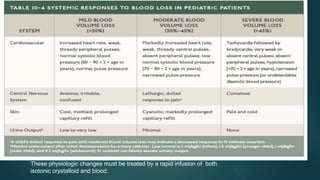
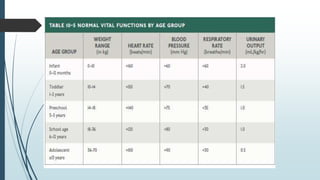
These physiologic changes must be treated by a rapid infusion of both
isotonic crystalloid and blood.
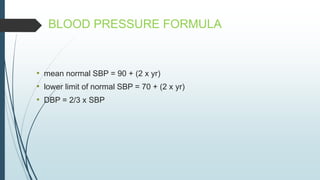
BLOOD PRESSURE FORMULA
• mean normal SBP = 90 + (2 x yr)
• lower limit of normal SBP = 70 + (2 x yr)
• DBP = 2/3 x SBP
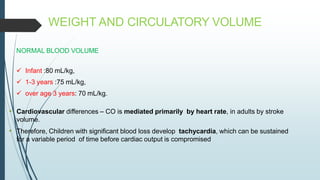
WEIGHT AND CIRCULATORY VOLUME
NORMAL BLOOD VOLUME
 Infant :80 mL/kg,
 1-3 years :75 mL/kg,
 over age 3 years: 70 mL/kg.
• Cardiovascular differences – CO is mediated primarily by heart rate, in adults by stroke
volume.
• Therefore, Children with significant blood loss develop tachycardia, which can be sustained
for a variable period of time before cardiac output is compromised
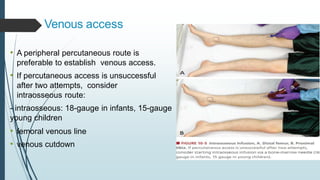
Venous access
• A peripheral percutaneous route is
preferable to establish venous access.
• If percutaneous access is unsuccessful
after two attempts, consider
intraosseous route:
- intraosseous: 18-gauge in infants, 15-gauge in
young children
• femoral venous line
• venous cutdown
PREVENTION OF SHOCK IN PEADS
PATIENTS
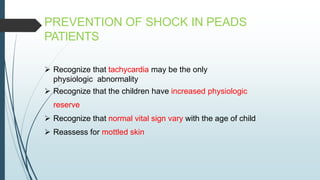
 Recognize that tachycardia may be the only
physiologic abnormality
 Recognize that the children have increased physiologic
reserve
 Recognize that normal vital sign vary with the age of child
 Reassess for mottled skin
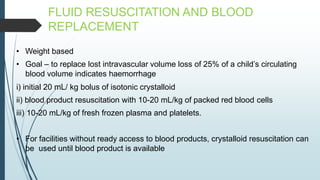
FLUID RESUSCITATION AND BLOOD
REPLACEMENT
• Weight based
• Goal – to replace lost intravascular volume loss of 25% of a child’s circulating
blood volume indicates haemorrhage
i) initial 20 mL/ kg bolus of isotonic crystalloid
ii) blood product resuscitation with 10-20 mL/kg of packed red blood cells
iii) 10-20 mL/kg of fresh frozen plasma and platelets.
• For facilities without ready access to blood products, crystalloid resuscitation can
be used until blood product is available
MONITOR :
• Slowing of the heart rate (age appropriate with improvement of other physiologic
signs)
• Clearing of the sensorium
• Return of peripheral pulses
• Return of normal skin color
• Increased warmth of extremities
• Increased systolic blood pressure with return to age-appropriate normal
• Increased pulse pressure (>20 mm Hg)
ASSESS THE ADEQUACY OF
RESUSCITATION
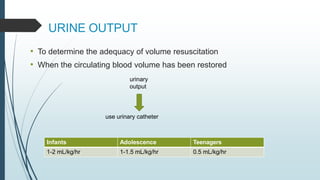
URINE OUTPUT
• To determine the adequacy of volume resuscitation
• When the circulating blood volume has been restored
Infants Adolescence Teenagers
1-2 mL/kg/hr 1-1.5 mL/kg/hr 0.5 mL/kg/hr
urinary
output
use urinary catheter
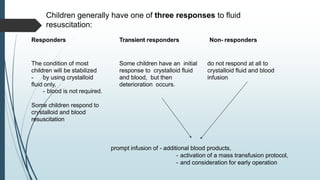
Children generally have one of three responses to fluid
resuscitation:
Responders Transient responders Non- responders
The condition of most
children will be stabilized
- by using crystalloid
fluid only,
- blood is not required.
Some children respond to
crystalloid and blood
resuscitation
Some children have an initial
response to crystalloid fluid
and blood, but then
deterioration occurs.
do not respond at all to
crystalloid fluid and blood
infusion
prompt infusion of - additional blood products,
- activation of a mass transfusion protocol,
- and consideration for early operation
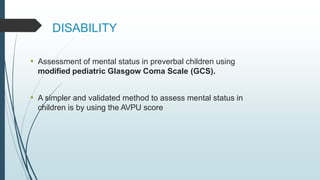
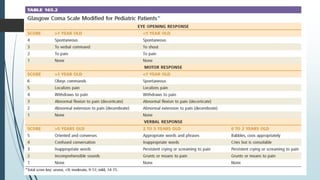
DISABILITY
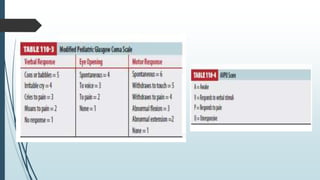
• Assessment of mental status in preverbal children using
modified pediatric Glasgow Coma Scale (GCS).
• A simpler and validated method to assess mental status in
children is by using the AVPU score
DISABILITY
EXPOSURE AND ENVIRONMENTAL
CONTROL
• Maintain a warm resuscitation environment, remove wet
clothing, and cover the child with warm blankets or an
external warming device as soon as the assessment is
complete to keep the child warm
• Give warmed crystalloids and blood products if remains
hypothermic
• Examine the back of the scalp for ongoing bleeding.
• The digital rectal exam is performed in serious spinal injury.
THERMOREGULATION
• The high ratio of body surface area to body mass in children
increases heat exchange with the environment
• Increased metabolic rates, thin skin, and the lack of
substantial subcutaneous tissue
• How to overcome issue: Usage of overhead heat lamps,
heaters, or thermal blankets
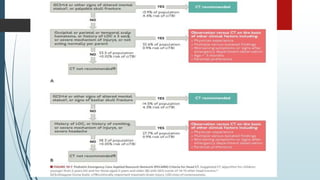
ASSESSMENT OF HEAD INJURY - PECARN
Management of head injury on paeditaric trauma
Rapid, early assessment and management of the ABCDEs :
 Appropriate neurosurgical involvement from the beginning of treatment.
 Appropriate sequential assessment and management of the brain injury focused on
preventing secondary brain injury—that is, hypoxia and hypoperfusion—is also critical.
 Early endotracheal intubation with adequate oxygenation and ventilation
 Orally intubating the trachea in an uncooperative child with a brain injury may be difficult
 Experienced clinician intubating such children, pharmacologic sedation and neuromuscular
blockade may be used to facilitate intubation.
 Hypertonic saline and mannitol
( create hyperosmolality and increased sodium levels in the brain, decreasing edema and pressure
within the injured cranial vault, rheostatic agents that improve blood flow and downregulate the
inflammatory response. )
 Continuously reassess all parameters
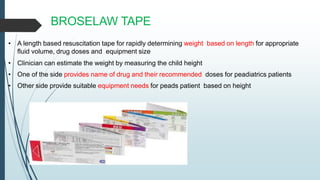
RESUSCITATION TAPE
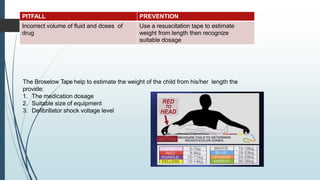
• A length based resuscitation tape for rapidly determining weight based on length for appropriate
fluid volume, drug doses and equipment size
• Clinician can estimate the weight by measuring the child height
• One of the side provides name of drug and their recommended doses for peadiatrics patients
• Other side provide suitable equipment needs for peads patient based on height
BROSELAW TAPE
PITFALL PREVENTION
Incorrect volume of fluid and doses of
drug
Use a resuscitation tape to estimate
weight from length then recognize
suitable dosage
The Broselow Tape help to estimate the weight of the child from his/her length the
provide:
1. The medication dosage
2. Suitable size of equipment
3. Defibrillator shock voltage level
SECONDARY SURVEY: AMPLE HISTORY
COMMON MECHANISM OF INJURY
MECHANISM OF INJURY COMMON PATTERNS OF INJURY
Struck by motor vehicle At low speed may cause lower extremity fractures while at high speed may
cause multiple trauma, head and neck injury plus lower-extremity fractures
Motor vehicle collision With safety seat belt ; multiple trauma, head and neck injuries, scalp and facial
lacerations
Without seat belt, chest and abdominal injuries, lower spine fractures
Fall from height • Low: Upper-extremity fractures
• Medium: Head and neck injuries, upper- and lower-extremity fractures
• High: Multiple trauma, head and neck injuries, upper- and lower extremity
fractures
Fall from bicycle Without safety helmet, knee and elbow pad: head, neck, scalp, facial, upper
and lower extremity laceration, upper and lower extremity fractures
With safety: upper extremity fractures Hit
handlebar: internal abdominal injuries
RECOGNITION OF NON-
ACCIDENTAL INJURY
• Child Maltreatment
- history and careful evaluation of the child in whom maltreatment is
suspected is critically important to prevent eventual death
Suspect
 A discrepancy exists between the history and the degree of
physical injury
 A prolonged interval has passed between the time of the injury
and presentation for medical care.
 The history includes repeated trauma, treated in the same or
different EDs.
 The history of injury changes or is different between parents
or guardians.
Suspect
 There is a history of hospital or doctor “shopping.”
 Parents respond inappropriately to or do not comply with medical advice
 The mechanism of injury is implausible based on the child’s
developmental stage.
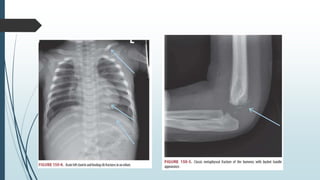
 Pattern of bone fracture :
- Rib fractures are rare in infants and young children and are generally seen
only in cases of severe trauma such as motor vehicle collisions
- Classic metaphyseal fractures are shear injuries to the immature ends of
growing bones in infants caused by the rapid acceleration and deceleration
associated with yanking or shaking
Findings
Multicolored bruises (bruises in
different stages of healing)
Evidence of frequent previous
injuries, typified by old scars or
healed fractures on x- ray
examination
Perioral injuries
Injuries to the genital or perianal area
Fractures of long bones in children <3
years of age
Findings
Ruptured internal viscera without
antecedent major blunt trauma
Multiple subdural hematomas,
especially without a fresh skull
fracture (suspect shaken baby
syndrome)
Retinal hemorrhages
Bizarre injuries, such as bites,
cigarette burns, or rope marks
Findings
Sharply demarcated 2nd & 3rd-degree burns
Skull fractures or rib fractures seen in children <24 months
of age
Fine, parallel linear
bruises that trace the
outline of fingers
‘Punched out’, circular and
deep burns are typical
Injuries to the neck and
bruises on the upper half of
the ear
Severe bruises
causes by a ruler
Human
bite
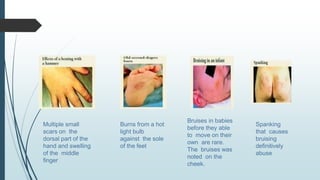
Multiple small
scars on the
dorsal part of the
hand and swelling
of the middle
finger
Burns from a hot
light bulb
against the sole
of the feet
Bruises in babies
before they able
to move on their
own are rare.
The bruises was
noted on the
cheek.
Spanking
that causes
bruising
definitively
abuse
References
1) Judith E. Tintinalli (ed), O. John Ma, Donald M. Yealy, Garth D. Meckler, J. Stephan
Stapczynski, David M. Cline, Stephen H. Thomas Tintinalli's Emergency Medicine:
A Comprehensive Study Guide, 9e
2) Advanced Trauma Life Support (ATLS) 10th edition
3) https://bda.org/childprotection/Recognising/Pages/Physical.aspx

CTH PAEDIATRIC TRAUMA.pptx

  • 1.
    Paediatric trauma 2170356 CheHafiqrie Idham Bin Che Hafsham 2170339 Ahmad Faiz Bin As’ari
  • 2.
    Definition of Paediatictrauma Paediatrcs trauma is life-threatening injury to children and it’s the number one killer of children in world, more than all other causes combined. These injuries require hospitalization, and usually emergency surgery.
  • 3.
  • 4.
    according to system System/ anatomy Unique characteristic Relation to trauma How to overcome (if any) Head • larger surface • is prone to injury from bleeding, fractures or polytrauma Laryngeal cartilages • more flexible (less prone to fracture) and protected • can compromise airway due to soft tissue swelling or expanding hematoma. • Low threshold for intubation Chest wall • compliant and vulnerable tracheobronchial structures and heart lie anteriorly with mobile mediastinal structures • predispose to intrathoracic injury • less risk of rib fracture Respiratory structure • smaller diameter compared to adult • predispose to airway obstruction when change in inner diameter from aspirated fluids or secretions. • insert orotracheal tube to secure the airway
  • 5.
    System / anatomyUnique characteristic Relation to trauma How to overcome (if any) Abdomen • larger in size, has underdeveloped musculature, and has relatively larger intra- abdominal organs • thick capsule • lower intra-abdominal fat content and elastic ligamentous ligamentous • predispose to solid organ injuries in blunt abdominal trauma • limits hemoperitoneum in solid organ injury in children • increased vulnerability to injury from acceleration-deceleration or abdominal Bladder boundaries • cephalically extend just below umbilicus • vulnerable to direct blows to the lower abdomen
  • 6.
    System / anatomyUnique characteristic Relation to trauma How to overcome (if any) Skeleton • incompletely calcified , contains multiple active growth centers, weaker epiphysis and is more pliable • internal organ damage is often damage noted without bony fractures • pulmonary contusion is common but rib fractures is not The presence of skull and/or rib fractures in a child - suggests the transfer of a massive amount of energy - in this case, underlying organ injuries, such as traumatic brain injury and pulmonary • High index of intrathoracic injury without rib fractures Surface area • ratio of a child’s body surface area to body volume is highest at birth and diminishes as the child child mature. • Themal energy loss is a significant stress factor such as hypothermia in cold environments. (trauma bay) • - complicate the treatment of pediatric patients with hypotension • Use warm IVD / blood product • Use warm blanket / body warmer
  • 8.
    Metabolic activity • Metabolicdemands in children are higher than in adults. • Energy expenditure and caloric requirement is higher in children at baseline. • Hyperglycemia – stress-induced hyperglycemia is common in polytrauma • Hypoglycemia – can occur in younger children
  • 9.
    ABCD APPROACH INPEADIATRICS TRAUMA AIRWAY (3 P’s)  Inability to establish and/or maintain a patent airway associated with lack of oxygenation and ventilation  Patency – use an oral airway to prevent obstruction by the tongue, suction any blood, secretions, foreign bodies  Position – towel under torso, occiput on bed  Protection – cuffed ETT / uncuffed ETT
  • 10.
    Airway: Evaluation andManagement • passive flexion of cervical spine caused by the large occiput. • plane of the midface be maintained parallel to the spine board in a neutral position (as shown in the next slide) • placement of a 1- 2.5 inch-thick layer of padding beneath the infant’s (<1 years of age) or toddler’s (1-3 years of age) entire torso (as shown in the next slide)
  • 12.
    Airway: Evaluation andManagement • Spontaneous breathing– jaw thrust maneuver combined with bimanual inline spinal motion restriction to open the airway. • unconscious – fully pre oxygenate the child before doing mechanical methods of maintaining the airway. Oral Airway • should be inserted only if a child is unconscious, because vomiting is likely to occur if the gag reflex is intact. • Insert the oral airway gently and directly into the oropharynx. Using a tongue blade to depress the tongue may be helpful • practice of inserting the airway backward and rotating it 180 degrees is not recommended • Complication: trauma with resultant hemorrhage into soft tissue structures of the oropharynx Orotracheal intubation Indication: • severe brain injury who requires controlled ventilation • airway cannot be maintained • signs of ventilatory failure • suffered significant hypovolemia and has a depressed sensorium or requires operative intervention
  • 13.
    Airway: Evaluation andManagement • soft tissues in an infant’s oropharynx relatively large visualization of the larynx difficult • A child’s larynx is funnel-shaped, allowing secretions to accumulate in the retropharyngeal area • The larynx and vocal cords are more cephalad and anterior in the neck. • The head and occiput is relatively large • A disproportionately large tongue and small mandible
  • 14.
    Airway: Evaluation andManagement • The vocal cords are frequently more difficult to visualize when the child’s head is in the normal, supine, anatomical position during intubation than when it is in the neutral position required for optimal cervical spine protection.
  • 15.
    Orotracheal Intubation • Cuffedendotracheal tubes • Uncuff endotracheal tube • Size • ETT depth (cm) = 3 x size • one size larger and one size smaller than the predicted size
  • 16.
    • Nasotracheal intubationshould not be performed - blind passage around a relatively acute angle in the nasopharynx toward the anterosuperiorly located glottis, making intubation by this route difficult Nasotracheal intubation
  • 17.
    Cricothyrotomy • A needlecricothyrotomy may be required if orotracheal intubation is not possible due to severe maxillofacial injuries and the patient cannot be adequately ventilated and oxygenated. • Open surgical cricothyrotomy is not an option in children <10 years old due to the small cricothyroid membrane. Needle cricothyrotomy is therefore recommended in children <10 years old • Needle-jet insufflation via the cricothyroid membrane is an appropriate, temporizing technique for oxygenation, but it does not provide adequate ventilation, and progressive hypercarbia will occur.
  • 18.
    • An infant’strachea is approximately 5 cm long and grows to 7 cm by about 18 months. - Failure to appreciate this short length can result in - malposition of ETT - inadequate ventilation - accidental tube dislodgment - and/or mechanical barotrauma
  • 19.
    Breathing: Evaluation and Management •excessive volume or pressure during assisted ventilation substantially increases the potential for iatrogenic barotrauma - fragile nature of the immature tracheobronchial tree and alveoli • pediatric bag-mask: <30 kg • volume of O2 in reservoir (self inflating bag size) : 250 ml for newborn or small neonates, 500 ml for neonates – infants, 1500ml adults • tension pneumothorax - needle decompression 14- to 18-gauge IV catheter in the midclavicular line just above the third rib. • orogastric tube can significantly improve their work of breathing for increased intra-abdominal pressure
  • 20.
    BREATHING- recognition ofimpaired gas exchange • infant breathe rate: 30-40/minute, older child breathe rate:15-20/minute. • Normal spontaneous tidal volumes 5-8ml/kg for infants and children. Manage patient’s breathing by: 1. Positive pressure ventilation 2. Variable mask 3. Fixed mask • Fixed pulmonary tidal volume - minute ventilation is maintained primarily by respiratory rate (tachypnea) rather than depth (hyperpnea). • Low residual volumes and low functional residual capacity contribute to atelectasis and rapid desaturation during apnea respectively.
  • 21.
  • 22.
    Cont. NEVER ATTEMPT tocorrect acidosis with sodium bicarbonate - can result in hypercarbia (CO2 retention) & worsened the acidosis Adequate perfusion and ventilation is required excessive volume or pressure during assisted ventilation -results in iatrogenic barotrauma - because of the fragile nature of the immature tracheobronchial tree and alveoli. - pediatric bag-mask - for children under 30 kg. (volume of O2 in paediatric bag-valve-mask reservoir is 500ml-1000ml (compare to adult size 1500ml – 2000ml) Hypoventilation Respiratory acidosis Hypoxia Cardiac arrest
  • 23.
    PLEURAL DECOMPRESSION  INDICATION- Injuries that disrupt pleural apposition (hemothorax, pneumothorax, and hemopneumothorax)  NEEDLE DECOMPRESSION - over the top of the third rib in the midclavicular line. - using 14-18 gauge over- the- needle catheters
  • 24.
    Circulation and Shock:Evaluation and Management • Catastrophic bleeding – addressed and control by applying direct pressure, tourniquets, and pelvic binding are essential prehospital interventions • Signs of circulatory compromise -tachycardia and narrowing of the pulse pressure to <20 mm Hg -poor skin perfusion, cool extremities relative to the torso, mottled skin -weakening of peripheral pulses, -altered sensorium including dulled response to pain, -low BP and urinary output indicate inadequate organ perfusion • children prone to get internal injury rather than rib fracture because the skeletal incompletely calcified , contains multiple active growth centers, weaker epiphysis and is more pliable
  • 25.
    Circulation and Shock:Evaluation and Management • Vascular access – can be difficult especially in hypovolemic shock • Place proximal large-bore IV branula intraosseous if fail in 90 sec • pressure bag or multiple handheld syringes - used for rapid fluid resuscitation • children tolerate initial boluses of 10 to 40 mL/kg. • shock : bolus of 20 ml/kg of warmed crystalloids • weight-based blood product resuscitation ( 10 to 20 mL/kg of packed red blood cells for children <40 kg) • tranexamic acid should be strongly considered within 3 hours of injury in adolescents as well as children of all ages requiring a blood transfusion. Dosage 15mg/kg bolus max 1g, followed by 2mg/kg/hr infusion for 8 hours for children <12 years old. >12 years to follow adult dose
  • 26.
    Con’t Evaluate and managecirculation in patient by: 1)accurately determining the patient’s weight and circulatory volume 2)recognize circulatory compromise 3)obtaining venous access 4)administering resuscitation fluids and blood replacement 5)assessing the adequacy of resuscitation
  • 27.
    These physiologic changesmust be treated by a rapid infusion of both isotonic crystalloid and blood.
  • 29.
    BLOOD PRESSURE FORMULA •mean normal SBP = 90 + (2 x yr) • lower limit of normal SBP = 70 + (2 x yr) • DBP = 2/3 x SBP
  • 30.
    WEIGHT AND CIRCULATORYVOLUME NORMAL BLOOD VOLUME  Infant :80 mL/kg,  1-3 years :75 mL/kg,  over age 3 years: 70 mL/kg. • Cardiovascular differences – CO is mediated primarily by heart rate, in adults by stroke volume. • Therefore, Children with significant blood loss develop tachycardia, which can be sustained for a variable period of time before cardiac output is compromised
  • 31.
    Venous access • Aperipheral percutaneous route is preferable to establish venous access. • If percutaneous access is unsuccessful after two attempts, consider intraosseous route: - intraosseous: 18-gauge in infants, 15-gauge in young children • femoral venous line • venous cutdown
  • 32.
    PREVENTION OF SHOCKIN PEADS PATIENTS  Recognize that tachycardia may be the only physiologic abnormality  Recognize that the children have increased physiologic reserve  Recognize that normal vital sign vary with the age of child  Reassess for mottled skin
  • 33.
    FLUID RESUSCITATION ANDBLOOD REPLACEMENT • Weight based • Goal – to replace lost intravascular volume loss of 25% of a child’s circulating blood volume indicates haemorrhage i) initial 20 mL/ kg bolus of isotonic crystalloid ii) blood product resuscitation with 10-20 mL/kg of packed red blood cells iii) 10-20 mL/kg of fresh frozen plasma and platelets. • For facilities without ready access to blood products, crystalloid resuscitation can be used until blood product is available
  • 34.
    MONITOR : • Slowingof the heart rate (age appropriate with improvement of other physiologic signs) • Clearing of the sensorium • Return of peripheral pulses • Return of normal skin color • Increased warmth of extremities • Increased systolic blood pressure with return to age-appropriate normal • Increased pulse pressure (>20 mm Hg) ASSESS THE ADEQUACY OF RESUSCITATION
  • 35.
    URINE OUTPUT • Todetermine the adequacy of volume resuscitation • When the circulating blood volume has been restored Infants Adolescence Teenagers 1-2 mL/kg/hr 1-1.5 mL/kg/hr 0.5 mL/kg/hr urinary output use urinary catheter
  • 36.
    Children generally haveone of three responses to fluid resuscitation: Responders Transient responders Non- responders The condition of most children will be stabilized - by using crystalloid fluid only, - blood is not required. Some children respond to crystalloid and blood resuscitation Some children have an initial response to crystalloid fluid and blood, but then deterioration occurs. do not respond at all to crystalloid fluid and blood infusion prompt infusion of - additional blood products, - activation of a mass transfusion protocol, - and consideration for early operation
  • 37.
    DISABILITY • Assessment ofmental status in preverbal children using modified pediatric Glasgow Coma Scale (GCS). • A simpler and validated method to assess mental status in children is by using the AVPU score
  • 40.
  • 41.
    EXPOSURE AND ENVIRONMENTAL CONTROL •Maintain a warm resuscitation environment, remove wet clothing, and cover the child with warm blankets or an external warming device as soon as the assessment is complete to keep the child warm • Give warmed crystalloids and blood products if remains hypothermic • Examine the back of the scalp for ongoing bleeding. • The digital rectal exam is performed in serious spinal injury.
  • 42.
    THERMOREGULATION • The highratio of body surface area to body mass in children increases heat exchange with the environment • Increased metabolic rates, thin skin, and the lack of substantial subcutaneous tissue • How to overcome issue: Usage of overhead heat lamps, heaters, or thermal blankets
  • 43.
    ASSESSMENT OF HEADINJURY - PECARN
  • 45.
    Management of headinjury on paeditaric trauma Rapid, early assessment and management of the ABCDEs :  Appropriate neurosurgical involvement from the beginning of treatment.  Appropriate sequential assessment and management of the brain injury focused on preventing secondary brain injury—that is, hypoxia and hypoperfusion—is also critical.  Early endotracheal intubation with adequate oxygenation and ventilation  Orally intubating the trachea in an uncooperative child with a brain injury may be difficult  Experienced clinician intubating such children, pharmacologic sedation and neuromuscular blockade may be used to facilitate intubation.  Hypertonic saline and mannitol ( create hyperosmolality and increased sodium levels in the brain, decreasing edema and pressure within the injured cranial vault, rheostatic agents that improve blood flow and downregulate the inflammatory response. )  Continuously reassess all parameters
  • 46.
  • 47.
    • A lengthbased resuscitation tape for rapidly determining weight based on length for appropriate fluid volume, drug doses and equipment size • Clinician can estimate the weight by measuring the child height • One of the side provides name of drug and their recommended doses for peadiatrics patients • Other side provide suitable equipment needs for peads patient based on height BROSELAW TAPE
  • 48.
    PITFALL PREVENTION Incorrect volumeof fluid and doses of drug Use a resuscitation tape to estimate weight from length then recognize suitable dosage The Broselow Tape help to estimate the weight of the child from his/her length the provide: 1. The medication dosage 2. Suitable size of equipment 3. Defibrillator shock voltage level
  • 49.
    SECONDARY SURVEY: AMPLEHISTORY COMMON MECHANISM OF INJURY MECHANISM OF INJURY COMMON PATTERNS OF INJURY Struck by motor vehicle At low speed may cause lower extremity fractures while at high speed may cause multiple trauma, head and neck injury plus lower-extremity fractures Motor vehicle collision With safety seat belt ; multiple trauma, head and neck injuries, scalp and facial lacerations Without seat belt, chest and abdominal injuries, lower spine fractures Fall from height • Low: Upper-extremity fractures • Medium: Head and neck injuries, upper- and lower-extremity fractures • High: Multiple trauma, head and neck injuries, upper- and lower extremity fractures Fall from bicycle Without safety helmet, knee and elbow pad: head, neck, scalp, facial, upper and lower extremity laceration, upper and lower extremity fractures With safety: upper extremity fractures Hit handlebar: internal abdominal injuries
  • 50.
    RECOGNITION OF NON- ACCIDENTALINJURY • Child Maltreatment - history and careful evaluation of the child in whom maltreatment is suspected is critically important to prevent eventual death
  • 51.
    Suspect  A discrepancyexists between the history and the degree of physical injury  A prolonged interval has passed between the time of the injury and presentation for medical care.  The history includes repeated trauma, treated in the same or different EDs.  The history of injury changes or is different between parents or guardians.
  • 52.
    Suspect  There isa history of hospital or doctor “shopping.”  Parents respond inappropriately to or do not comply with medical advice  The mechanism of injury is implausible based on the child’s developmental stage.  Pattern of bone fracture : - Rib fractures are rare in infants and young children and are generally seen only in cases of severe trauma such as motor vehicle collisions - Classic metaphyseal fractures are shear injuries to the immature ends of growing bones in infants caused by the rapid acceleration and deceleration associated with yanking or shaking
  • 54.
    Findings Multicolored bruises (bruisesin different stages of healing) Evidence of frequent previous injuries, typified by old scars or healed fractures on x- ray examination Perioral injuries Injuries to the genital or perianal area Fractures of long bones in children <3 years of age
  • 55.
    Findings Ruptured internal viscerawithout antecedent major blunt trauma Multiple subdural hematomas, especially without a fresh skull fracture (suspect shaken baby syndrome) Retinal hemorrhages Bizarre injuries, such as bites, cigarette burns, or rope marks
  • 56.
    Findings Sharply demarcated 2nd& 3rd-degree burns Skull fractures or rib fractures seen in children <24 months of age
  • 57.
    Fine, parallel linear bruisesthat trace the outline of fingers ‘Punched out’, circular and deep burns are typical Injuries to the neck and bruises on the upper half of the ear Severe bruises causes by a ruler Human bite
  • 58.
    Multiple small scars onthe dorsal part of the hand and swelling of the middle finger Burns from a hot light bulb against the sole of the feet Bruises in babies before they able to move on their own are rare. The bruises was noted on the cheek. Spanking that causes bruising definitively abuse
  • 59.
    References 1) Judith E.Tintinalli (ed), O. John Ma, Donald M. Yealy, Garth D. Meckler, J. Stephan Stapczynski, David M. Cline, Stephen H. Thomas Tintinalli's Emergency Medicine: A Comprehensive Study Guide, 9e 2) Advanced Trauma Life Support (ATLS) 10th edition 3) https://bda.org/childprotection/Recognising/Pages/Physical.aspx

Editor's Notes