What’s New With RSI Drugs?
State-Of-The-Art Review

   Michael Gibbs, MD, FACEP
   Department of Emergency Medicine
   Maine Medical Center
   Portland, Maine U.S.A.

            gibbsm@mmc.org
Rapid Sequence Intubation

Rapid sequence intubation (RSI) involves
  the rapid and simultaneous
  administration of a short-acting
  sedative and a paralytic agent to
  facilitate intubation and decrease the
  risk of aspiration.
The 7 P’s Of RSI

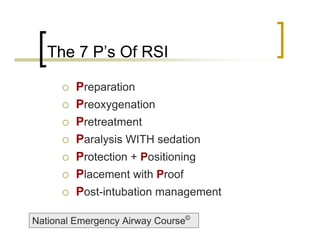
         Preparation
         Preoxygenation
         Pretreatment
         Paralysis WITH sedation
         Protection + Positioning
         Placement with Proof
         Post-intubation management

National Emergency Airway Course©
The 7 P’s Of RSI


         Pretreatment
         Paralysis WITH sedation


National Emergency Airway Course©
Pretreatment
   The delivery of drugs to reduce the “RSRL”

   [Reflex sympathetic response to
     laryngoscopy]


National Emergency Airway Course©
RSRL

 The RSRL results from physical
 manipulation of the airway
 Not eliminated by paralysis
 Consequences:
   Catecholamine release
   Hypertension, tachycardia
   Increased ICP in patients with impaired
   cerebral autoregulation
RSRL

Who is at risk?
 Medical intracranial hypertension
 Traumatic brain injury
 Vascular emergencies
 Cardiac ischemia
Pretreatment – “LOAD”

 Lidocaine                          1.0 mg/kg

 Opiates                            3-5 µg/kg

 Atropine                           0.02 mg/kg

 Defasculation   [eg: vecuronium]   0.01 mg/kg


National Emergency Airway Course©
Lidocaine: What Do We Know?

Do hemodynamic alterations during         YES
RSI have the potential to increase ICP?
Does lidocaine blunt this response?       YES

Is there evidence that lidocaine          NO
improves outcome in at-risk patients?


  Robinson N. Emerg Med J 2001; 18:453.
Fentanyl: What Do We Know?

Do hemodynamic alterations during         YES
RSI have the potential to increase ICP?
Does fentanyl blunt this response?        YES

Is there evidence that fentanyl           NO
improves outcome in at-risk patients?
Can fentanyl precipitate hypotension?     YES
Defasciculation: What Do We Know?

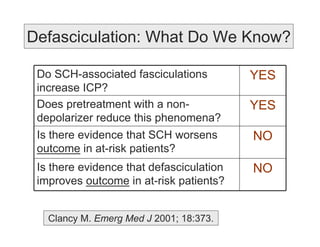
 Do SCH-associated fasciculations         YES
 increase ICP?
 Does pretreatment with a non-            YES
 depolarizer reduce this phenomena?
 Is there evidence that SCH worsens       NO
 outcome in at-risk patients?
 Is there evidence that defasciculation   NO
 improves outcome in at-risk patients?


   Clancy M. Emerg Med J 2001; 18:373.
Pretreatment


        Aneurysmal Subarachnoid Hemorrhage
Pretreatment


               Traumatic Brain Injury
Secondary Injury In TBI

      Prospective study of 717 patients with
      severe TBI at 4 centers.
      A single episode of hypotension (BP <90)
      or hypoxia (PaO2 <60) during the initial
      resuscitation was associated with a
      150% increase in mortality.


Chestnut RM. J Trauma 1993; 34:216.
Pretreatment


               Acute Aortic Dissection
Pretreatment


               Acute Myocardial Ischemia
Paralysis WITH Sedation
   Goal: optimal intubating conditions

      Administered simultaneously
      Agent synergy important
      Don’t be temped to omit sedation in
      the “comatose” patient!


National Emergency Airway Course©
RSI Induction Agents

Important side effects:
  Apnea
  Myocardial depression
  Hypotension
  Others, drug-specific
RSI Induction Agents

 Midazolam
 Thiopental
 Propofol
 Ketamine
 Etomidate
RSI Induction Agents

Midazolam:
    Commonly used if etomidate n/a
    Little effect on RSRL or ICP
    Dose-dependent respiratory depression
    & hypotension
    Often under-dosed [NEAR mean = 4 mg]


              0.1-0.3 mg/kg
RSI Induction Agents

Thiopental:
    Significant benefit in acute CNS pathology
    Decreases ICP at the expense of CPP
    Hypotension the major downside


                3-5 mg/kg adult
              5-6 mg/kg pediatric
RSI Induction Agents

Propofol:
    Pharmacologically similar to thiopental
    Decreases ICP at the expense of CPP
    Hypotension a significant risk


               0.5-1.2 mg/kg
RSI Induction Agents

Ketamine:
    Catecholamine release
    Typically augments blood pressure
    Direct bronchodilator
    Increased ICP in the setting of TBI?


       1-2 mg/kg IV, 2-4 mg/kg IM
Ketamine In TBI?

   Effects of IV ketamine on ICP/CPP/MAP
      in 8 ventilated TBI patients with ICP
      monitors in place:
      ICP reduced
      No alteration in CPP or MAP


Albanese J. Anesthesiology 1997; 87:1328.
Ketamine In TBI?

      Several authors have recently
      questioned the historical dogma.
      Ketamine potentially advantageous in
      the hypotensive head injury patient.
      No data in the ED RSI population.


Himmelseher S. Anesth Analog 2005;101:524.
Sehdev RS. Emerg Med Austral 2006; 18:37.
RSI Induction Agents

Etomidate:
    Minimal effect of hemodynamics
    Reduces ICP while maintaining CPP
    Side effects:
      Transient adrenal suppression
      Myoclonus – avoided by paralysis


               0.15-0.3 mg/kg
Etomidate In The ED

      Prospective study of 522 ED RSI
      cases using etomidate.
      Outcome measures:
         Ease of intubation
         Hemodynamics [BPS, BPD, HR] at the
         time of intubation, 5 minutes, 15 minutes


Zed PJ. Acad Emerg Med 2006; 13:378-383.
Etomidate In The ED

   Results:
     Intubation “excellent/good” in 96.9%
     BP & HR increased at 0, 5, 15 minute
     Similar findings in a subgroup of 80
     patients with an initial BPs <100 mmHg


Zed PJ. Acad Emerg Med 2006; 13:378-383.
“Should We Use Etomidate as an Induction Agent for
   Edotracheal Intubation in Patients With Septic Shock?:
                    A Critical Appraisal”

                Chest 2005; 127:1031-1038


Rationale:
 Single dose etomidate causes transient cortisol suppression
 Adrenal insufficiency is highly prevalent in sepsis
 Mortality is increased when adrenal insufficiency is present
 Outcome trails in the index population are lacking
Adrenal Suppression?

   Prospective evaluation of adrenal
   function in 31 ED patients receiving
   etomidate or midazolam for RSI
   Assessed at 4/12/24 hours:
      Cosyntropin stimulation test [CST]
      Serum cortisol levels


Schernarts C. Academ Emerg Med 2001; 8:1.
Adrenal Suppression?

Results:
  4-hr CST abnormal in 70% of patients
  receiving etomidate
  12 /24-hr CST normal and did not differ
  Serum cortisol levels in the normal
  range at every interval in both groups


Schernarts C. Academ Emerg Med 2001; 8:1.
Etomidate In Sepsis?
Upside:
  “Ideal” hemodynamic profile
  Predictable onset, effect, elimination

Downside:
  Risk probably not zero. Options:
     Change nothing
     Monitor adrenal function
     Administer steroids empirically
Succinylcholine

  Remains the drug of choice for the ED
  Intubation level paralysis in 45 sec
  Clinical duration 6-8 min
  The dark side:
    Fatal hyperkalemic risk
    Bradycardia [children, 2nd dose]
    Malignant hyperthermia
Risk In Renal Failure?

   Studies in adults & children with known
     renal failure and K+ above 5.5 mg/kg:
     Mean increase in K+ <0.5 mEq/L
     No dysrhythmia or other adverse effect
     So… not recommended but generally
     safe if renal failure is unrecognized

Schow AJ. Anesth Analog 2002; 95:119.
Thapa S. Anesth Analog 2000; 91:237.
Fatal Hyperkalemic Risk

         Receptor              Myopathic Process
         Upregulation               Muscular dystrophy
         Burns, crush               Rare idiopathic
         Prolonged ICU stay
         UMN [eg: stroke]
         LMN [eg: SC
         injury]

          Mortality 11%              Mortality 30%

Gronert GA. Anesthesiology 2001; 94:523.
Rocuronium

   At a dose of 1.0 mg/kg:
      95% of patients ready in 60 seconds
      Success rate comparable to SCH
      Average duration of action 45 minutes


Perry JJ . Acad Emerg Med 2002; 9:813.
Kirkegaard-Nielsen H. Anesthesiology 1999; 91:131.
RSI Paralytic Agents

             Fundamental Question…

       Is The Patient At Risk For An Important
        Succinylcholine-Related Complication?


              NO                  YES


Succinylcholine 1.5 mg/kg    Rocuronium 1.0 mg/kg
Take Home Essentials

#1:   First do no harm
#2:   5 drugs more complicated than 3
#3:   Very limited ED outcome data
#4:   Careful pretreatment if indicated
#5:   Induction agent selection crucial
#6:   State-of-the art care saves lives
Questions?
gibbsm@mmc.org

Rsi

  • 1.
    What’s New WithRSI Drugs? State-Of-The-Art Review Michael Gibbs, MD, FACEP Department of Emergency Medicine Maine Medical Center Portland, Maine U.S.A. gibbsm@mmc.org
  • 3.
    Rapid Sequence Intubation Rapidsequence intubation (RSI) involves the rapid and simultaneous administration of a short-acting sedative and a paralytic agent to facilitate intubation and decrease the risk of aspiration.
  • 4.
    The 7 P’sOf RSI Preparation Preoxygenation Pretreatment Paralysis WITH sedation Protection + Positioning Placement with Proof Post-intubation management National Emergency Airway Course©
  • 5.
    The 7 P’sOf RSI Pretreatment Paralysis WITH sedation National Emergency Airway Course©
  • 6.
    Pretreatment The delivery of drugs to reduce the “RSRL” [Reflex sympathetic response to laryngoscopy] National Emergency Airway Course©
  • 7.
    RSRL The RSRLresults from physical manipulation of the airway Not eliminated by paralysis Consequences: Catecholamine release Hypertension, tachycardia Increased ICP in patients with impaired cerebral autoregulation
  • 8.
    RSRL Who is atrisk? Medical intracranial hypertension Traumatic brain injury Vascular emergencies Cardiac ischemia
  • 9.
    Pretreatment – “LOAD” Lidocaine 1.0 mg/kg Opiates 3-5 µg/kg Atropine 0.02 mg/kg Defasculation [eg: vecuronium] 0.01 mg/kg National Emergency Airway Course©
  • 10.
    Lidocaine: What DoWe Know? Do hemodynamic alterations during YES RSI have the potential to increase ICP? Does lidocaine blunt this response? YES Is there evidence that lidocaine NO improves outcome in at-risk patients? Robinson N. Emerg Med J 2001; 18:453.
  • 11.
    Fentanyl: What DoWe Know? Do hemodynamic alterations during YES RSI have the potential to increase ICP? Does fentanyl blunt this response? YES Is there evidence that fentanyl NO improves outcome in at-risk patients? Can fentanyl precipitate hypotension? YES
  • 12.
    Defasciculation: What DoWe Know? Do SCH-associated fasciculations YES increase ICP? Does pretreatment with a non- YES depolarizer reduce this phenomena? Is there evidence that SCH worsens NO outcome in at-risk patients? Is there evidence that defasciculation NO improves outcome in at-risk patients? Clancy M. Emerg Med J 2001; 18:373.
  • 13.
    Pretreatment Aneurysmal Subarachnoid Hemorrhage
  • 14.
    Pretreatment Traumatic Brain Injury
  • 15.
    Secondary Injury InTBI Prospective study of 717 patients with severe TBI at 4 centers. A single episode of hypotension (BP <90) or hypoxia (PaO2 <60) during the initial resuscitation was associated with a 150% increase in mortality. Chestnut RM. J Trauma 1993; 34:216.
  • 16.
    Pretreatment Acute Aortic Dissection
  • 17.
    Pretreatment Acute Myocardial Ischemia
  • 18.
    Paralysis WITH Sedation Goal: optimal intubating conditions Administered simultaneously Agent synergy important Don’t be temped to omit sedation in the “comatose” patient! National Emergency Airway Course©
  • 19.
    RSI Induction Agents Importantside effects: Apnea Myocardial depression Hypotension Others, drug-specific
  • 20.
    RSI Induction Agents Midazolam Thiopental Propofol Ketamine Etomidate
  • 21.
    RSI Induction Agents Midazolam: Commonly used if etomidate n/a Little effect on RSRL or ICP Dose-dependent respiratory depression & hypotension Often under-dosed [NEAR mean = 4 mg] 0.1-0.3 mg/kg
  • 22.
    RSI Induction Agents Thiopental: Significant benefit in acute CNS pathology Decreases ICP at the expense of CPP Hypotension the major downside 3-5 mg/kg adult 5-6 mg/kg pediatric
  • 23.
    RSI Induction Agents Propofol: Pharmacologically similar to thiopental Decreases ICP at the expense of CPP Hypotension a significant risk 0.5-1.2 mg/kg
  • 24.
    RSI Induction Agents Ketamine: Catecholamine release Typically augments blood pressure Direct bronchodilator Increased ICP in the setting of TBI? 1-2 mg/kg IV, 2-4 mg/kg IM
  • 25.
    Ketamine In TBI? Effects of IV ketamine on ICP/CPP/MAP in 8 ventilated TBI patients with ICP monitors in place: ICP reduced No alteration in CPP or MAP Albanese J. Anesthesiology 1997; 87:1328.
  • 26.
    Ketamine In TBI? Several authors have recently questioned the historical dogma. Ketamine potentially advantageous in the hypotensive head injury patient. No data in the ED RSI population. Himmelseher S. Anesth Analog 2005;101:524. Sehdev RS. Emerg Med Austral 2006; 18:37.
  • 27.
    RSI Induction Agents Etomidate: Minimal effect of hemodynamics Reduces ICP while maintaining CPP Side effects: Transient adrenal suppression Myoclonus – avoided by paralysis 0.15-0.3 mg/kg
  • 28.
    Etomidate In TheED Prospective study of 522 ED RSI cases using etomidate. Outcome measures: Ease of intubation Hemodynamics [BPS, BPD, HR] at the time of intubation, 5 minutes, 15 minutes Zed PJ. Acad Emerg Med 2006; 13:378-383.
  • 29.
    Etomidate In TheED Results: Intubation “excellent/good” in 96.9% BP & HR increased at 0, 5, 15 minute Similar findings in a subgroup of 80 patients with an initial BPs <100 mmHg Zed PJ. Acad Emerg Med 2006; 13:378-383.
  • 30.
    “Should We UseEtomidate as an Induction Agent for Edotracheal Intubation in Patients With Septic Shock?: A Critical Appraisal” Chest 2005; 127:1031-1038 Rationale: Single dose etomidate causes transient cortisol suppression Adrenal insufficiency is highly prevalent in sepsis Mortality is increased when adrenal insufficiency is present Outcome trails in the index population are lacking
  • 31.
    Adrenal Suppression? Prospective evaluation of adrenal function in 31 ED patients receiving etomidate or midazolam for RSI Assessed at 4/12/24 hours: Cosyntropin stimulation test [CST] Serum cortisol levels Schernarts C. Academ Emerg Med 2001; 8:1.
  • 32.
    Adrenal Suppression? Results: 4-hr CST abnormal in 70% of patients receiving etomidate 12 /24-hr CST normal and did not differ Serum cortisol levels in the normal range at every interval in both groups Schernarts C. Academ Emerg Med 2001; 8:1.
  • 33.
    Etomidate In Sepsis? Upside: “Ideal” hemodynamic profile Predictable onset, effect, elimination Downside: Risk probably not zero. Options: Change nothing Monitor adrenal function Administer steroids empirically
  • 34.
    Succinylcholine Remainsthe drug of choice for the ED Intubation level paralysis in 45 sec Clinical duration 6-8 min The dark side: Fatal hyperkalemic risk Bradycardia [children, 2nd dose] Malignant hyperthermia
  • 35.
    Risk In RenalFailure? Studies in adults & children with known renal failure and K+ above 5.5 mg/kg: Mean increase in K+ <0.5 mEq/L No dysrhythmia or other adverse effect So… not recommended but generally safe if renal failure is unrecognized Schow AJ. Anesth Analog 2002; 95:119. Thapa S. Anesth Analog 2000; 91:237.
  • 36.
    Fatal Hyperkalemic Risk Receptor Myopathic Process Upregulation Muscular dystrophy Burns, crush Rare idiopathic Prolonged ICU stay UMN [eg: stroke] LMN [eg: SC injury] Mortality 11% Mortality 30% Gronert GA. Anesthesiology 2001; 94:523.
  • 37.
    Rocuronium At a dose of 1.0 mg/kg: 95% of patients ready in 60 seconds Success rate comparable to SCH Average duration of action 45 minutes Perry JJ . Acad Emerg Med 2002; 9:813. Kirkegaard-Nielsen H. Anesthesiology 1999; 91:131.
  • 38.
    RSI Paralytic Agents Fundamental Question… Is The Patient At Risk For An Important Succinylcholine-Related Complication? NO YES Succinylcholine 1.5 mg/kg Rocuronium 1.0 mg/kg
  • 39.
    Take Home Essentials #1: First do no harm #2: 5 drugs more complicated than 3 #3: Very limited ED outcome data #4: Careful pretreatment if indicated #5: Induction agent selection crucial #6: State-of-the art care saves lives
  • 40.