Gastro-Intestinal System
Children Adults
Tongue: Large
Nasal and oral passages are small
Small tongue
Large nasal and oral passages
Stomach: Cardiac sphincter is
relaxed
Tight
Emptying time of stomach is about
2-3 hrs in toddlers
Very slow
Food passes very rapidly in infants
and in neonates. [Loose stool]
Slowly and absorption takes
place
[Hard stool]
Liver is 4% of the total body weight
and occupies more space in
abdominal cavity.
Only little space is occupied
by liver.
Respiratory system
Children Adults
 In neonates and in infants respiratory
tract is very delicate and do not produce
mucus. [Older children produce mucus]
well developed
tissues
Eustachian tube is short and straight and
short distance b/w trachea and bronchi
Long
Tonsils and adenoids are large during
childhood, involved in the production of
antibodies.
Smaller tonsils
Respiratory tract obstruction occurs
commonly in children because of short
airway.
Less chances of
obstruction.
Respiratory rate is more Less
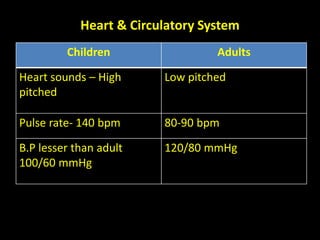
Heart & Circulatory System
Children Adults
Heart sounds – High
pitched
Low pitched
Pulse rate- 140 bpm 80-90 bpm
B.P lesser than adult
100/60 mmHg
120/80 mmHg
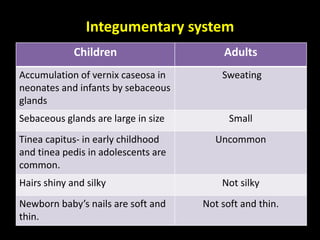
Integumentary system
Children Adults
Accumulation of vernix caseosa in
neonates and infants by sebaceous
glands
Sweating
Sebaceous glands are large in size Small
Tinea capitus- in early childhood
and tinea pedis in adolescents are
common.
Uncommon
Hairs shiny and silky Not silky
Newborn baby’s nails are soft and
thin.
Not soft and thin.
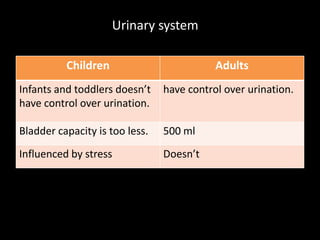
Urinary system
Children Adults
Infants and toddlers doesn’t
have control over urination.
Bladder capacity is too less. 500 ml
Influenced by stress Doesn’t
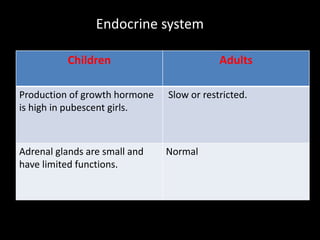
Endocrine system
Children Adults
Production of growth hormone
is high in pubescent girls.
Slow or restricted.
Adrenal glands are small and
have limited functions.
Normal
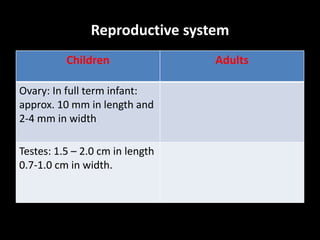
Reproductive system
Children Adults
Ovary: In full term infant:
approx. 10 mm in length and
2-4 mm in width
Testes: 1.5 – 2.0 cm in length
0.7-1.0 cm in width.
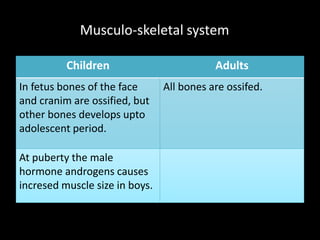
Musculo-skeletal system
Children Adults
In fetus bones of the face
and cranim are ossified, but
other bones develops upto
adolescent period.
All bones are ossifed.
At puberty the male
hormone androgens causes
incresed muscle size in boys.
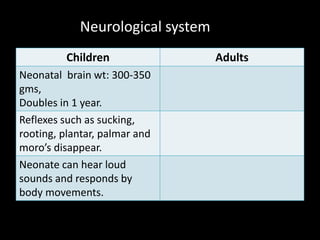
Neurological system
Children Adults
Neonatal brain wt: 300-350
gms,
Doubles in 1 year.
Reflexes such as sucking,
rooting, plantar, palmar and
moro’s disappear.
Neonate can hear loud
sounds and responds by
body movements.
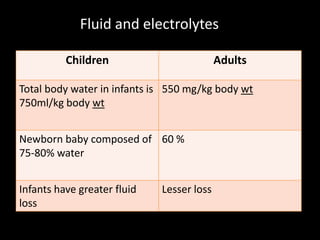
Fluid and electrolytes
Children Adults
Total body water in infants is
750ml/kg body wt
550 mg/kg body wt
Newborn baby composed of
75-80% water
60 %
Infants have greater fluid
loss
Lesser loss
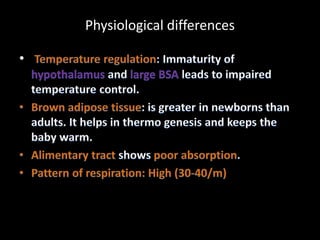
Physiological differences
•

Anatomical and physiological differences

  • 2.
    Gastro-Intestinal System Children Adults Tongue:Large Nasal and oral passages are small Small tongue Large nasal and oral passages Stomach: Cardiac sphincter is relaxed Tight Emptying time of stomach is about 2-3 hrs in toddlers Very slow Food passes very rapidly in infants and in neonates. [Loose stool] Slowly and absorption takes place [Hard stool] Liver is 4% of the total body weight and occupies more space in abdominal cavity. Only little space is occupied by liver.
  • 3.
    Respiratory system Children Adults In neonates and in infants respiratory tract is very delicate and do not produce mucus. [Older children produce mucus] well developed tissues Eustachian tube is short and straight and short distance b/w trachea and bronchi Long Tonsils and adenoids are large during childhood, involved in the production of antibodies. Smaller tonsils Respiratory tract obstruction occurs commonly in children because of short airway. Less chances of obstruction. Respiratory rate is more Less
  • 4.
    Heart & CirculatorySystem Children Adults Heart sounds – High pitched Low pitched Pulse rate- 140 bpm 80-90 bpm B.P lesser than adult 100/60 mmHg 120/80 mmHg
  • 5.
    Integumentary system Children Adults Accumulationof vernix caseosa in neonates and infants by sebaceous glands Sweating Sebaceous glands are large in size Small Tinea capitus- in early childhood and tinea pedis in adolescents are common. Uncommon Hairs shiny and silky Not silky Newborn baby’s nails are soft and thin. Not soft and thin.
  • 6.
    Urinary system Children Adults Infantsand toddlers doesn’t have control over urination. have control over urination. Bladder capacity is too less. 500 ml Influenced by stress Doesn’t
  • 7.
    Endocrine system Children Adults Productionof growth hormone is high in pubescent girls. Slow or restricted. Adrenal glands are small and have limited functions. Normal
  • 8.
    Reproductive system Children Adults Ovary:In full term infant: approx. 10 mm in length and 2-4 mm in width Testes: 1.5 – 2.0 cm in length 0.7-1.0 cm in width.
  • 9.
    Musculo-skeletal system Children Adults Infetus bones of the face and cranim are ossified, but other bones develops upto adolescent period. All bones are ossifed. At puberty the male hormone androgens causes incresed muscle size in boys.
  • 10.
    Neurological system Children Adults Neonatalbrain wt: 300-350 gms, Doubles in 1 year. Reflexes such as sucking, rooting, plantar, palmar and moro’s disappear. Neonate can hear loud sounds and responds by body movements.
  • 11.
    Fluid and electrolytes ChildrenAdults Total body water in infants is 750ml/kg body wt 550 mg/kg body wt Newborn baby composed of 75-80% water 60 % Infants have greater fluid loss Lesser loss
  • 12.