
Pediatric Airway
Management

Pediatrics
Objectives
•By the end of this PowerPoint the learner will
be able to:
‐ Restate at least…
•5 complications associated with the use of
airway adjuncts
•3 complications associated with bag-valve-mask
ventilation (BVM) ventilation
‐ Choose an appropriately sized airway adjunct and
BMV facemask according to anatomic landmarks

Pediatrics

Page 2
xxx00.#####.ppt 11/14/13 09:29 PM
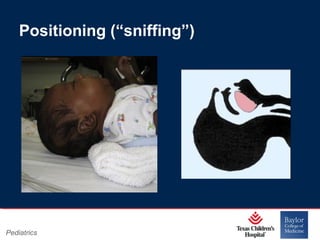
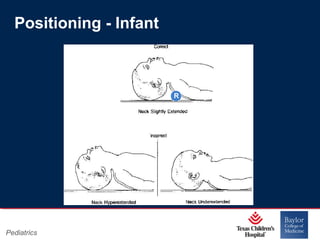
Positioning (“sniffing”)

Pediatrics

Page 3
xxx00.#####.ppt 11/14/13 09:29 PM
Positioning - Infant

R

Pediatrics

Page 4
xxx00.#####.ppt 11/14/13 09:29 PM
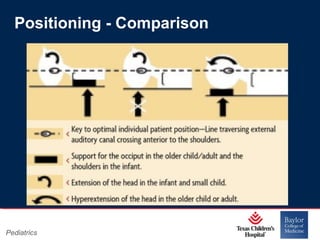
Positioning - Comparison

Pediatrics

Page 5
xxx00.#####.ppt 11/14/13 09:29 PM
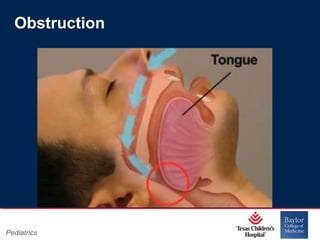
Obstruction

Pediatrics

Page 6
xxx00.#####.ppt 11/14/13 09:29 PM
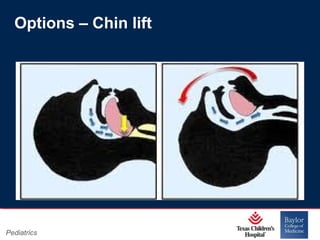
Options – Chin lift

Pediatrics

Page 7
xxx00.#####.ppt 11/14/13 09:29 PM
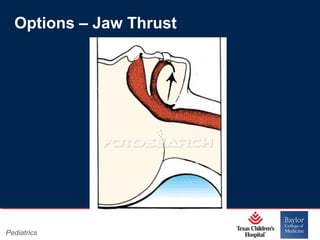
Options – Jaw Thrust

Pediatrics

Page 8
xxx00.#####.ppt 11/14/13 09:29 PM
Options - Oral Airway
•Prevents upper airway obstruction
•May make Bag-valve-mask ventilation more
effective
•Should not be used in semi comatose of alert
patients

Pediatrics

Page 9
xxx00.#####.ppt 11/14/13 09:29 PM
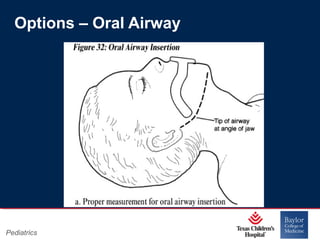
Options – Oral Airway

Pediatrics

Page 10
xxx00.#####.ppt 11/14/13 09:29 PM
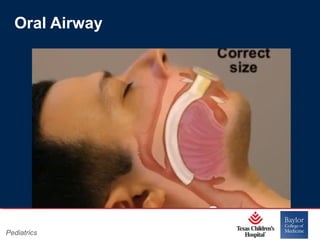
Oral Airway

Pediatrics

Page 11
xxx00.#####.ppt 11/14/13 09:29 PM
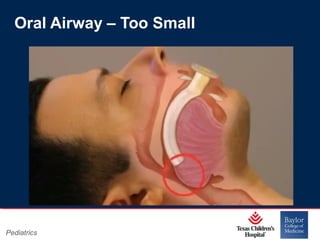
Oral Airway – Too Small

Pediatrics

Page 12
xxx00.#####.ppt 11/14/13 09:29 PM
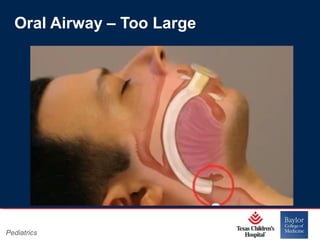
Oral Airway – Too Large

Pediatrics

Page 13
xxx00.#####.ppt 11/14/13 09:29 PM
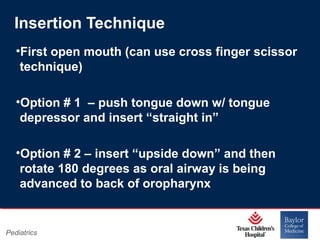
Insertion Technique
•First open mouth (can use cross finger scissor
technique)
•Option # 1 – push tongue down w/ tongue
depressor and insert “straight in”
•Option # 2 – insert “upside down” and then
rotate 180 degrees as oral airway is being
advanced to back of oropharynx

Pediatrics

Page 14
xxx00.#####.ppt 11/14/13 09:29 PM
Oral Airway Complications
•Yak*$%! (ie the gag reflex)
•Aspiration
•Obstruction (not really your desired effect)
•Laryngospasm
•Tooth/mouth injury
Pediatrics

Page 15
xxx00.#####.ppt 11/14/13 09:29 PM
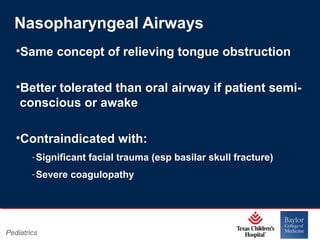
Nasopharyngeal Airways
•Same concept of relieving tongue obstruction
•Better tolerated than oral airway if patient semiconscious or awake
•Contraindicated with:
‐ Significant facial trauma (esp basilar skull fracture)
‐ Severe coagulopathy

Pediatrics

Page 16
xxx00.#####.ppt 11/14/13 09:29 PM
Nasopharyngeal Airways Complications
•Laryngospasm and coughing (esp if too long)
•Nosebleeds
•Sinus infection

Pediatrics

Page 17
xxx00.#####.ppt 11/14/13 09:29 PM
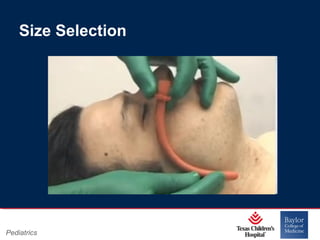
Size Selection

Pediatrics

Page 18
xxx00.#####.ppt 11/14/13 09:29 PM
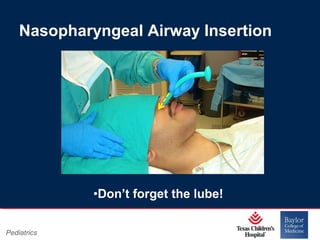
Nasopharyngeal Airway Insertion

•Don’t forget the lube!
Pediatrics

Page 19
xxx00.#####.ppt 11/14/13 09:29 PM
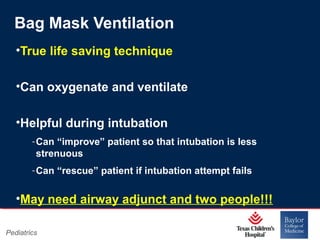
Bag Mask Ventilation
•True life saving technique
•Can oxygenate and ventilate
•Helpful during intubation
‐ Can “improve” patient so that intubation is less
strenuous
‐ Can “rescue” patient if intubation attempt fails

•May need airway adjunct and two people!!!
Pediatrics

Page 20
xxx00.#####.ppt 11/14/13 09:29 PM
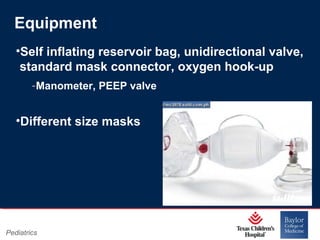
Equipment
•Self inflating reservoir bag, unidirectional valve,
standard mask connector, oxygen hook-up
‐ Manometer, PEEP valve

•Different size masks

Pediatrics

Page 21
xxx00.#####.ppt 11/14/13 09:29 PM
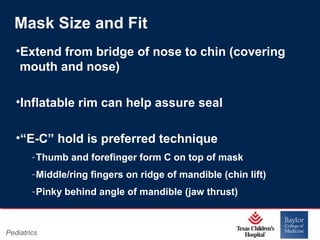
Mask Size and Fit
•Extend from bridge of nose to chin (covering
mouth and nose)
•Inflatable rim can help assure seal
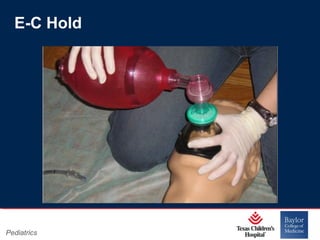
•“E-C” hold is preferred technique
‐ Thumb and forefinger form C on top of mask
‐ Middle/ring fingers on ridge of mandible (chin lift)
‐ Pinky behind angle of mandible (jaw thrust)

Pediatrics

Page 22
xxx00.#####.ppt 11/14/13 09:29 PM
E-C Hold

Pediatrics

Page 23
xxx00.#####.ppt 11/14/13 09:29 PM
Successful BMV
•Chest rise
•Chest rise
•Chest rise
•Increased O2 sats, auscultation, condensation
in mask

Pediatrics

Page 24
xxx00.#####.ppt 11/14/13 09:29 PM
Complications of BMV
•Excessive air in stomach
‐ Aspiration risk
‐ Decreases lung volume/requires higher PIPs

•Corneal abrasions
•Injury to lips/gums and nasal bridge
•Excessive bagging due to user exuberance
Pediatrics

Page 25
xxx00.#####.ppt 11/14/13 09:29 PM
NOW WATCH IT DONE

Pediatrics

App aw adj&bvm

Editor's Notes

  • #2 Different motif, more science Text Text Text
  • #7 May be relieved by jaw thrust or chin lift
  • #19 2 options – one measured to tragus of ear. Other to mandible angle
  • #24 Careful not to compress soft-tissue and airway!