PEDIATRIC AIRWAY AND
ANAESTHETIC IMPLICATIONS
 PRESENTER: DR ABHISHEK
 MODERATOR:DR NAGESHA
AIRWAY ANATOMY:
 The pediatric patients have significant anatomical and physiological
differences compared with adults, which impact on the techniques and tools
that the anesthesiologist might choose to provide safe and effective control of
the airway.
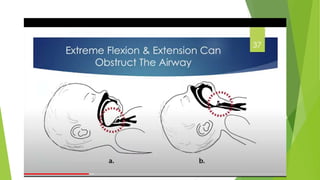
 The first anatomical difference between the pediatric and adult patient
becomes important when positioning the child prior to or immediately after
the induction of anesthesia.
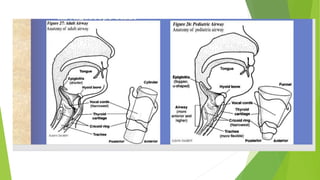
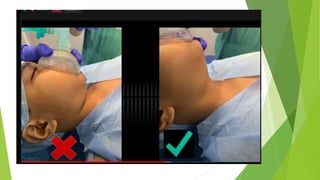
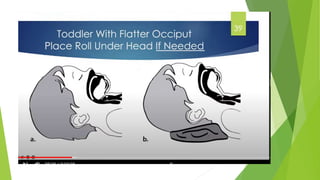
 The head of a pediatric patient is larger relative to body size, with a
prominent occiput. This predisposes to airway obstruction in asleep children.
 The tongue is larger and the mandible shorter in the young child. In infancy, the
child is an obligate nasal breather until 5 months of age.
 Prominent adenoids and tonsils are frequently found in preschool age children and
are a frequent reason to present for elective ENT surgery.
 These factors all contribute to loss of upper airway space which can lead to
difficulty with mask ventilation, obstruction during spontaneous ventilation, and
can make laryngoscopy more difficult.
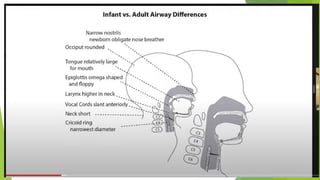
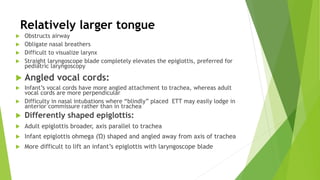
Relatively larger tongue
 Obstructs airway
 Obligate nasal breathers
 Difficult to visualize larynx
 Straight laryngoscope blade completely elevates the epiglottis, preferred for
pediatric laryngoscopy
 Angled vocal cords:
 Infant’s vocal cords have more angled attachment to trachea, whereas adult
vocal cords are more perpendicular
 Difficulty in nasal intubations where “blindly” placed ETT may easily lodge in
anterior commissure rather than in trachea
 Differently shaped epiglottis:
 Adult epiglottis broader, axis parallel to trachea
 Infant epiglottis ohmega (Ώ) shaped and angled away from axis of trachea
 More difficult to lift an infant’s epiglottis with laryngoscope blade
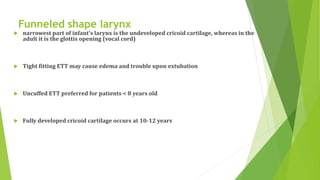
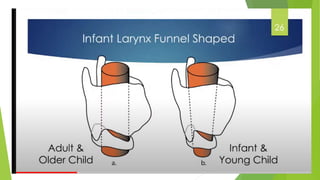
Funneled shape larynx
 narrowest part of infant’s larynx is the undeveloped cricoid cartilage, whereas in the
adult it is the glottis opening (vocal cord)
 Tight fitting ETT may cause edema and trouble upon extubation
 Uncuffed ETT preferred for patients < 8 years old
 Fully developed cricoid cartilage occurs at 10-12 years
Physiology:
 The pediatric patient has a number of physiological challenges which can predispose
to hypoxemia.
 Oxygen consumption of an infant is relatively greater than an adult .
 This combined with a somewhat lower functional residual capacity can lead to rapid
desaturation during apnea, such as during laryngoscopy or a rapid sequence
induction, despite best efforts at preoxygenation.
 Oxygen consumption of infant (6 ml/kg/min) is twice that of an adult (3 ml/kg/min)
 Greater oxygen consumption = increased respiratory rate
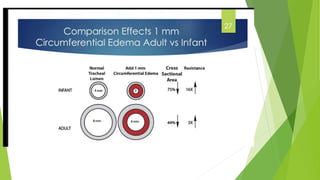
 The resistance to flow in the airway is governed by Poiseulle's law: R =8ƞL/πr4.
The resistance to flow is inversely related to the radius of the airway raised to the
fourth power, a small amount of narrowing (due to edema, inflammation, etc.,) in
the already small pediatric airway could have severe consequences on respiratory
function.
 A number of disease processes that could result in such narrowing of the airway
include growths within the airway such as hemangiomas or papillomas, aberrant
embryological development such as tracheomalacia, laryngomalacia, and laryngeal
clefts, iatrogenic causes like vocal cord paralysis and subglottic stenosis, or
compression of the airway structures by a mass located outside the airway
AIRWAY ASSESSMENT:
 The initial airway assessment starts with a good history. Questions are directed toward
eliciting indications of a potentially difficult airway.
 This would include any complications of birth or delivery, any history of prior trauma or
surgery to the airway or adjacent structures, or of prior anesthetics.
 Additionally, one should inquire about current or recent symptoms suggesting upper
respiratory infection (URI), difficulty in speaking, difficulty breathing, difficulty feeding,
hoarseness, and noisy breathing.
 Questions such as a history of snoring, day time drowsiness, or stopping breathing during
sleep, may help to identify children with obstructive sleep apnea
BAG AND MASK VENTILATION:
 Clear, plastic mask with inflatable rim provides atraumatic seal
 Proper area for mask application-bridge of nose extend to chin
 Place fingers on mandible to avoid compressing pharyngeal space
 Hand on ventilating bag at all times to monitor effectiveness of spontaneous
breaths
 Continous postitive pressure when needed to maintain airway patency
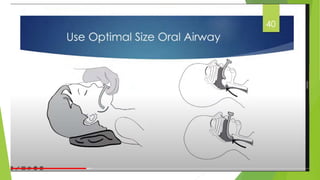
 NASOPHARYNGEAL AIRWAY:
 Distance from nares to angle of mandible approximates the proper
length
 Nasopharyngeal airway available in 12F to 36F sizes
 Shortened endotracheal tube may be used in infants or small children
 Avoid placement in cases of hypertrophied adenoids - bleeding and
trauma
Selection of laryngoscope blade:
Miller vs. Macintosh:
 Miller blade is preferred for infants and younger children

 Facilitates lifting of the epiglottis and exposing the glottic opening
 Care must be taken to avoid using the blade as a fulcrum with pressure on the
teeth and gums
 Macintosh blades are generally used in older children
 Blade size dependent on body mass of the patient and the preference of the
anesthesiologist
Endotracheal Tube:
Age Wt ETT(mm ID) Length(cm)
Preterm 1 kg 2.5 6
1-2.5 kg 3.0 7-9
Neonate-6mo 3.0-3.5 10
6 mo-1 3.5-4.0 11
1-2 yrs 4.0-5.0 12
 New AHA Formulas:
 Uncuffed ETT: (age in years/4) + 4
 Cuffed ETT: (age in years/4) +3
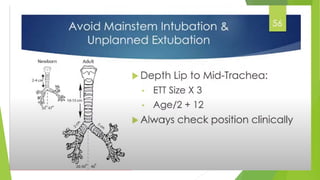
 ETT depth (lip): ETT size x 3
Cuff vs Uncuffed Endotracheal Tube:
 Controversial issue
 Traditionally, uncuffed ETT recommended in children < 8 yrs old to avoid post-extubation
stridor and subglottic stenosis
 Arguments against cuffed ETT: smaller size increases airway resistance, increase work of
breathing, poorly designed for pediatric pts, need to keep cuff pressure < 25 cm H2O
 Arguments against uncuffed ETT: more tube changes for long-term intubation, leak of
anesthetic agent into environment, require more fresh gas flow > 2L/min, higher risk for
aspiration
-Concluding Recommendations-
 For “short” cases when ETT size >4.0, choice of cuff vs uncuffed probably does not matter
 Cuffed ETT preferable in cases of: high risk of aspiration (ie. Bowel obstruction), low lung
compliance (ie. ARDS, pneumoperitoneum, CO2 insufflation of the thorax, CABG), precise
control of ventilation and pCO2 (ie. increased intracranial pressure, single ventricle
physiology)
Laryngeal Mask Airway:
 Supraglottic airway device developed by Dr. Archie Brain
 Flexible bronchoscopy, radiotherapy, radiologic procedures, urologic, orthopedic, ENT
and ophthalmologic cases are most common pediatric indications for LMA
 Useful in difficult airway situations, and as a conduit of drug administration (ie.
Surfactant)
 Different types of LMAs: Classic LMA, Flexible LMA, ProSeal LMA, Intubating LMA
 Disadvantages: Laryngospasm, aspiration
Difficult Airway Management
Techniques
 Rigid bronchoscopy
 Flexible bronchoscopy
 Direct laryngoscopy
 Intubating LMA
 Lighted stylet
 Bullardscope
 Fiberoptic intubation
 Surgical airway
CONCLUSION
 The airway of the pediatric patient has a number of significant differences when
compared to the adult airway and presents some unique challenges.
 Awareness of anatomical and physiological differences, important pathological
conditions affecting children, and a knowledge of the available airway techniques
and tools will allow the anesthesiologist to formulate and execute safe and
effective management of the pediatric airway.
THANK YOU

PEDIATRIC AIRWAY comparison between adults

  • 1.
    PEDIATRIC AIRWAY AND ANAESTHETICIMPLICATIONS  PRESENTER: DR ABHISHEK  MODERATOR:DR NAGESHA
  • 2.
    AIRWAY ANATOMY:  Thepediatric patients have significant anatomical and physiological differences compared with adults, which impact on the techniques and tools that the anesthesiologist might choose to provide safe and effective control of the airway.  The first anatomical difference between the pediatric and adult patient becomes important when positioning the child prior to or immediately after the induction of anesthesia.  The head of a pediatric patient is larger relative to body size, with a prominent occiput. This predisposes to airway obstruction in asleep children.
  • 3.
     The tongueis larger and the mandible shorter in the young child. In infancy, the child is an obligate nasal breather until 5 months of age.  Prominent adenoids and tonsils are frequently found in preschool age children and are a frequent reason to present for elective ENT surgery.  These factors all contribute to loss of upper airway space which can lead to difficulty with mask ventilation, obstruction during spontaneous ventilation, and can make laryngoscopy more difficult.
  • 6.
    Relatively larger tongue Obstructs airway  Obligate nasal breathers  Difficult to visualize larynx  Straight laryngoscope blade completely elevates the epiglottis, preferred for pediatric laryngoscopy  Angled vocal cords:  Infant’s vocal cords have more angled attachment to trachea, whereas adult vocal cords are more perpendicular  Difficulty in nasal intubations where “blindly” placed ETT may easily lodge in anterior commissure rather than in trachea  Differently shaped epiglottis:  Adult epiglottis broader, axis parallel to trachea  Infant epiglottis ohmega (Ώ) shaped and angled away from axis of trachea  More difficult to lift an infant’s epiglottis with laryngoscope blade
  • 7.
    Funneled shape larynx narrowest part of infant’s larynx is the undeveloped cricoid cartilage, whereas in the adult it is the glottis opening (vocal cord)  Tight fitting ETT may cause edema and trouble upon extubation  Uncuffed ETT preferred for patients < 8 years old  Fully developed cricoid cartilage occurs at 10-12 years
  • 9.
    Physiology:  The pediatricpatient has a number of physiological challenges which can predispose to hypoxemia.  Oxygen consumption of an infant is relatively greater than an adult .  This combined with a somewhat lower functional residual capacity can lead to rapid desaturation during apnea, such as during laryngoscopy or a rapid sequence induction, despite best efforts at preoxygenation.  Oxygen consumption of infant (6 ml/kg/min) is twice that of an adult (3 ml/kg/min)
  • 10.
     Greater oxygenconsumption = increased respiratory rate  The resistance to flow in the airway is governed by Poiseulle's law: R =8ƞL/πr4. The resistance to flow is inversely related to the radius of the airway raised to the fourth power, a small amount of narrowing (due to edema, inflammation, etc.,) in the already small pediatric airway could have severe consequences on respiratory function.  A number of disease processes that could result in such narrowing of the airway include growths within the airway such as hemangiomas or papillomas, aberrant embryological development such as tracheomalacia, laryngomalacia, and laryngeal clefts, iatrogenic causes like vocal cord paralysis and subglottic stenosis, or compression of the airway structures by a mass located outside the airway
  • 12.
    AIRWAY ASSESSMENT:  Theinitial airway assessment starts with a good history. Questions are directed toward eliciting indications of a potentially difficult airway.  This would include any complications of birth or delivery, any history of prior trauma or surgery to the airway or adjacent structures, or of prior anesthetics.  Additionally, one should inquire about current or recent symptoms suggesting upper respiratory infection (URI), difficulty in speaking, difficulty breathing, difficulty feeding, hoarseness, and noisy breathing.  Questions such as a history of snoring, day time drowsiness, or stopping breathing during sleep, may help to identify children with obstructive sleep apnea
  • 13.
    BAG AND MASKVENTILATION:  Clear, plastic mask with inflatable rim provides atraumatic seal  Proper area for mask application-bridge of nose extend to chin  Place fingers on mandible to avoid compressing pharyngeal space  Hand on ventilating bag at all times to monitor effectiveness of spontaneous breaths  Continous postitive pressure when needed to maintain airway patency  NASOPHARYNGEAL AIRWAY:  Distance from nares to angle of mandible approximates the proper length  Nasopharyngeal airway available in 12F to 36F sizes  Shortened endotracheal tube may be used in infants or small children  Avoid placement in cases of hypertrophied adenoids - bleeding and trauma
  • 15.
    Selection of laryngoscopeblade: Miller vs. Macintosh:  Miller blade is preferred for infants and younger children   Facilitates lifting of the epiglottis and exposing the glottic opening  Care must be taken to avoid using the blade as a fulcrum with pressure on the teeth and gums  Macintosh blades are generally used in older children  Blade size dependent on body mass of the patient and the preference of the anesthesiologist
  • 17.
    Endotracheal Tube: Age WtETT(mm ID) Length(cm) Preterm 1 kg 2.5 6 1-2.5 kg 3.0 7-9 Neonate-6mo 3.0-3.5 10 6 mo-1 3.5-4.0 11 1-2 yrs 4.0-5.0 12  New AHA Formulas:  Uncuffed ETT: (age in years/4) + 4  Cuffed ETT: (age in years/4) +3  ETT depth (lip): ETT size x 3
  • 18.
    Cuff vs UncuffedEndotracheal Tube:  Controversial issue  Traditionally, uncuffed ETT recommended in children < 8 yrs old to avoid post-extubation stridor and subglottic stenosis  Arguments against cuffed ETT: smaller size increases airway resistance, increase work of breathing, poorly designed for pediatric pts, need to keep cuff pressure < 25 cm H2O  Arguments against uncuffed ETT: more tube changes for long-term intubation, leak of anesthetic agent into environment, require more fresh gas flow > 2L/min, higher risk for aspiration -Concluding Recommendations-  For “short” cases when ETT size >4.0, choice of cuff vs uncuffed probably does not matter  Cuffed ETT preferable in cases of: high risk of aspiration (ie. Bowel obstruction), low lung compliance (ie. ARDS, pneumoperitoneum, CO2 insufflation of the thorax, CABG), precise control of ventilation and pCO2 (ie. increased intracranial pressure, single ventricle physiology)
  • 23.
    Laryngeal Mask Airway: Supraglottic airway device developed by Dr. Archie Brain  Flexible bronchoscopy, radiotherapy, radiologic procedures, urologic, orthopedic, ENT and ophthalmologic cases are most common pediatric indications for LMA  Useful in difficult airway situations, and as a conduit of drug administration (ie. Surfactant)  Different types of LMAs: Classic LMA, Flexible LMA, ProSeal LMA, Intubating LMA  Disadvantages: Laryngospasm, aspiration
  • 24.
    Difficult Airway Management Techniques Rigid bronchoscopy  Flexible bronchoscopy  Direct laryngoscopy  Intubating LMA  Lighted stylet  Bullardscope  Fiberoptic intubation  Surgical airway
  • 25.
    CONCLUSION  The airwayof the pediatric patient has a number of significant differences when compared to the adult airway and presents some unique challenges.  Awareness of anatomical and physiological differences, important pathological conditions affecting children, and a knowledge of the available airway techniques and tools will allow the anesthesiologist to formulate and execute safe and effective management of the pediatric airway.
  • 26.