Pediatric Airway Management
      Sunsiree Santana MD
      Pediatric Critical Care
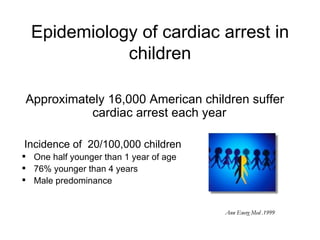
Epidemiology of cardiac arrest in
             children
Approximately 16,000 American children suffer
           cardiac arrest each year

Incidence of 20/100,000 children
 One half younger than 1 year of age
 76% younger than 4 years
 Male predominance


                                        Ann Energ Med .1999
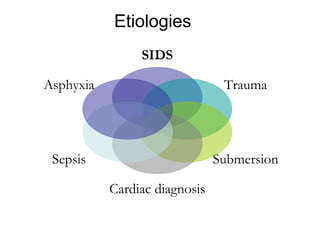
Etiologies
                SIDS

Asphyxia                        Trauma


 Sepsis                        Submersion

           Cardiac diagnosis
Almost all pediatric “codes” are
 of respiratory origin


   Internal Data. B.C. Children’s Hospital, Vancouver. 1989.
Pediatric cardiac arrest


Most often secondary to evolving
respiratory failure, with cardiac arrest
resulting from lack of cellular substrate
rather than from a sudden cardiac event.
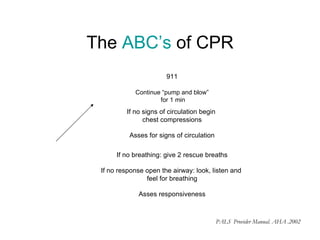
The ABC’s of CPR
                       911

            Continue “pump and blow”
                    for 1 min
         If no signs of circulation begin
               chest compressions

          Asses for signs of circulation

      If no breathing: give 2 rescue breaths

 If no response open the airway: look, listen and
                feel for breathing

             Asses responsiveness


                                            PALS Provider Manual. AHA .2002
Airway
• Stabilization of airway is of primary
  importance during the initial resuscitation of
  the critically or injured child.

• No matter the cause or underlying condition,
  further attempts at resuscitation or treatment
  will fail without proper control of the airway.
Goals of airway management
• Relieve anatomic obstruction
• Prevent aspiration of gastric contents
• Promote adequate gas exchange
Airway management
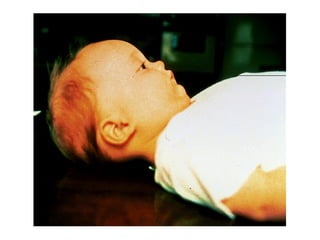
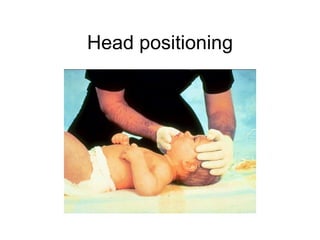
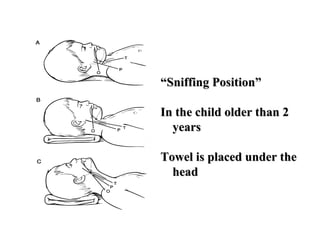
1. Proper positioning of the head

  – Protection of cervical spine

  – The most common cause of airway
    obstruction in children: collapse of the
    tongue and soft tissues
Proper head positioning
Head positioning
“Sniffing Position”

In the child older than 2
  years

Towel is placed under the
  head
Airway adjuncts
• Nasopharyngeal airway
  – Used if the patient is semiconscious


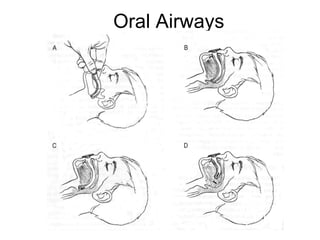
• Oral airway

• Relieve obstruction by lifting the tongue
  from the soft tissues of the posterior
  pharynx
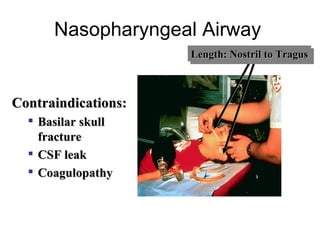
Nasopharyngeal Airway
                     Length: Nostril to Tragus


Contraindications:
   Basilar skull
    fracture
   CSF leak
   Coagulopathy
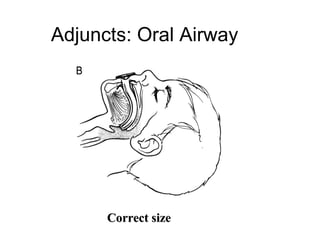
Oral Airways
Adjuncts: Oral Airway


      Correct size
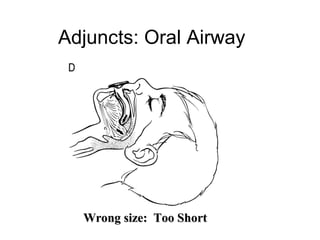
Adjuncts: Oral Airway


  Wrong size: Too Short
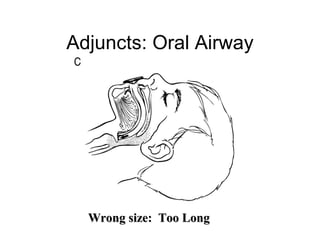
Adjuncts: Oral Airway


  Wrong size: Too Long
Tracheal intubation
• Indications
  – Respiratory failure
  – Upper airway obstruction
  – Shock or hemodynamic instability
  – Neuromuscular weakness
  – Absent protective airway reflexes
  – Cardiac arrest (drugs administration)
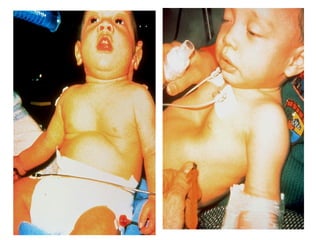
Signs of Respiratory Failure

• Tachypnea          •   Retractions
• Tachycardia        •   Access muscles
• Grunting           •   Wheezing
• Stridor            •   Sweating
• Head bobbing       •   Prolonged
• Flaring                expiration
• Inability to lie   •   Apnea
  down               •   Cyanosis
• Agitation
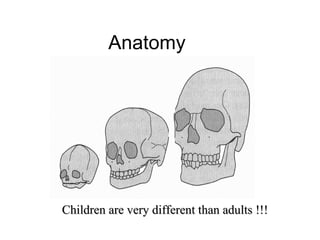
Anatomy


Children are very different than adults !!!
Anatomy
• Tongue

• Larynx
  • High position
     • Infants : C2-C3
     • Adults: C4-C5
  • Anterior position
• Tracheal intubation
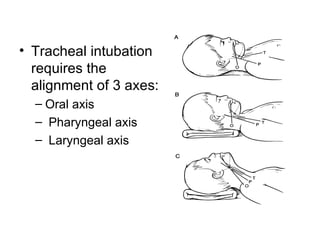
  requires the
  alignment of 3 axes:
  – Oral axis
  – Pharyngeal axis
  – Laryngeal axis
Anatomy : Epiglottis

• Relatively large size in children
  – Short, narrow
• Floppy – not much cartilage
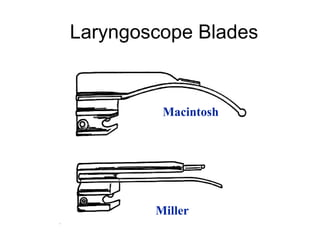
Laryngoscope Blades


         Macintosh


        Miller
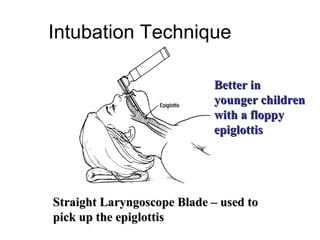
Intubation Technique

                             Better in
                             younger children
                             with a floppy
                             epiglottis


Straight Laryngoscope Blade – used to
pick up the epiglottis
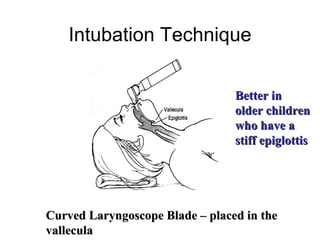
Intubation Technique

                                 Better in
                                 older children
                                 who have a
                                 stiff epiglottis


Curved Laryngoscope Blade – placed in the
vallecula
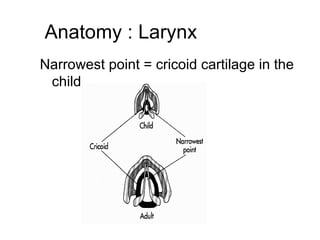
Anatomy : Larynx
Narrowest point = cricoid cartilage in the
 child
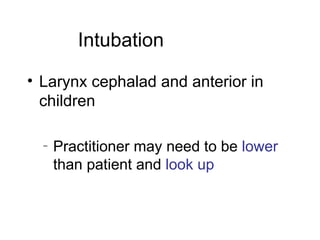
Intubation

• Larynx cephalad and anterior in
  children
  –   Practitioner may need to be lower
      than patient and look up
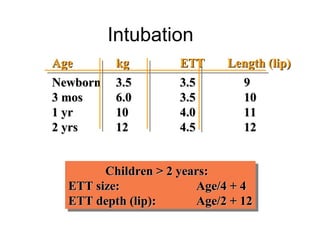
Intubation
Age       kg         ETT     Length (lip)
Newborn   3.5        3.5        9
3 mos     6.0        3.5        10
1 yr      10         4.0        11
2 yrs     12         4.5        12


        Children > 2 years:
  ETT size:             Age/4 + 4
  ETT depth (lip):      Age/2 + 12
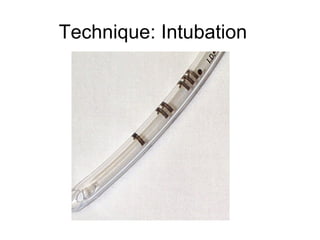
Technique: Intubation
Critically ill or injured child should
    be assumed to have a full
    stomach and are at risk for
 regurgitation and aspiration of
           gastric content.


       Rapid sequence intubation
Rapid sequence intubation

• Keys
 1. Pre-oxygenation
 2. Sellick’s maneuver
 3. Medications
     Rapid-acting neuromuscular blocker
     Sedation
Medications
Benzodiazepines
  Midazolam (Versed): 0.1-0.2mg/kg

Narcotics
 Fentanyl : 1-2 mg/kg
 Morphine: 0.1mg/kg
Medications
Ketamine: 1mg/kg
  Bronchodilator
  Increases BP, cerebral blood flow & ICP

Etomidate
Thiopental
Neuromuscular blocking agents
  Vecuronium(Norcuron): 0.1mg/kg
Deterioration after intubation

•   Displaced tube
•   Obstructed tube
•   Pneumothorax
•   Equipment
Thanks!

Airway management

  • 1.
    Pediatric Airway Management Sunsiree Santana MD Pediatric Critical Care
  • 2.
    Epidemiology of cardiacarrest in children Approximately 16,000 American children suffer cardiac arrest each year Incidence of 20/100,000 children  One half younger than 1 year of age  76% younger than 4 years  Male predominance Ann Energ Med .1999
  • 3.
    Etiologies SIDS Asphyxia Trauma Sepsis Submersion Cardiac diagnosis
  • 4.
    Almost all pediatric“codes” are of respiratory origin Internal Data. B.C. Children’s Hospital, Vancouver. 1989.
  • 5.
    Pediatric cardiac arrest Mostoften secondary to evolving respiratory failure, with cardiac arrest resulting from lack of cellular substrate rather than from a sudden cardiac event.
  • 6.
    The ABC’s ofCPR 911 Continue “pump and blow” for 1 min If no signs of circulation begin chest compressions Asses for signs of circulation If no breathing: give 2 rescue breaths If no response open the airway: look, listen and feel for breathing Asses responsiveness PALS Provider Manual. AHA .2002
  • 8.
    Airway • Stabilization ofairway is of primary importance during the initial resuscitation of the critically or injured child. • No matter the cause or underlying condition, further attempts at resuscitation or treatment will fail without proper control of the airway.
  • 9.
    Goals of airwaymanagement • Relieve anatomic obstruction • Prevent aspiration of gastric contents • Promote adequate gas exchange
  • 10.
    Airway management 1. Properpositioning of the head – Protection of cervical spine – The most common cause of airway obstruction in children: collapse of the tongue and soft tissues
  • 12.
  • 13.
  • 14.
    “Sniffing Position” In thechild older than 2 years Towel is placed under the head
  • 15.
    Airway adjuncts • Nasopharyngealairway – Used if the patient is semiconscious • Oral airway • Relieve obstruction by lifting the tongue from the soft tissues of the posterior pharynx
  • 16.
    Nasopharyngeal Airway Length: Nostril to Tragus Contraindications:  Basilar skull fracture  CSF leak  Coagulopathy
  • 17.
  • 18.
  • 19.
    Adjuncts: Oral Airway Wrong size: Too Short
  • 20.
    Adjuncts: Oral Airway Wrong size: Too Long
  • 21.
    Tracheal intubation • Indications – Respiratory failure – Upper airway obstruction – Shock or hemodynamic instability – Neuromuscular weakness – Absent protective airway reflexes – Cardiac arrest (drugs administration)
  • 22.
    Signs of RespiratoryFailure • Tachypnea • Retractions • Tachycardia • Access muscles • Grunting • Wheezing • Stridor • Sweating • Head bobbing • Prolonged • Flaring expiration • Inability to lie • Apnea down • Cyanosis • Agitation
  • 25.
    Anatomy Children are verydifferent than adults !!!
  • 26.
    Anatomy • Tongue • Larynx • High position • Infants : C2-C3 • Adults: C4-C5 • Anterior position
  • 27.
    • Tracheal intubation requires the alignment of 3 axes: – Oral axis – Pharyngeal axis – Laryngeal axis
  • 28.
    Anatomy : Epiglottis •Relatively large size in children – Short, narrow • Floppy – not much cartilage
  • 29.
    Laryngoscope Blades Macintosh Miller
  • 30.
    Intubation Technique Better in younger children with a floppy epiglottis Straight Laryngoscope Blade – used to pick up the epiglottis
  • 31.
    Intubation Technique Better in older children who have a stiff epiglottis Curved Laryngoscope Blade – placed in the vallecula
  • 32.
    Anatomy : Larynx Narrowestpoint = cricoid cartilage in the child
  • 33.
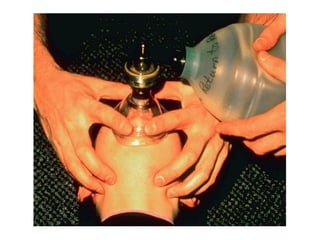
    Intubation • Larynx cephaladand anterior in children – Practitioner may need to be lower than patient and look up
  • 34.
    Intubation Age kg ETT Length (lip) Newborn 3.5 3.5 9 3 mos 6.0 3.5 10 1 yr 10 4.0 11 2 yrs 12 4.5 12 Children > 2 years: ETT size: Age/4 + 4 ETT depth (lip): Age/2 + 12
  • 35.
  • 37.
    Critically ill orinjured child should be assumed to have a full stomach and are at risk for regurgitation and aspiration of gastric content. Rapid sequence intubation
  • 38.
    Rapid sequence intubation •Keys 1. Pre-oxygenation 2. Sellick’s maneuver 3. Medications Rapid-acting neuromuscular blocker Sedation
  • 39.
    Medications Benzodiazepines Midazolam(Versed): 0.1-0.2mg/kg Narcotics Fentanyl : 1-2 mg/kg Morphine: 0.1mg/kg
  • 40.
    Medications Ketamine: 1mg/kg Bronchodilator Increases BP, cerebral blood flow & ICP Etomidate Thiopental Neuromuscular blocking agents Vecuronium(Norcuron): 0.1mg/kg
  • 41.
    Deterioration after intubation • Displaced tube • Obstructed tube • Pneumothorax • Equipment
  • 42.

Editor's Notes

  • #3 The true incidence of ped pulseless arrest is difficult to estimate because of the inconsistency of the terminology in the literature and difficulty in assesing pulselessness in children. Recent collective review of the literature on pediatric CPA, Young and Seidel identified 44 studies with survival data on pediatric patients who received CPR. Approximately one half of pediatric patients who suffered cardiopulmonary arrest were younger than 1 year of age. Sixty-two percent of the victims were male. Similar demographic information was obtained in a recent prospective population-based study that did use the pediatric Utstein style criteria for reporting some of their data. [131] They looked at 300 children (ages 0–17) with CPA over a 3 1/2-year period. They found an overall annual incidence of 19.7/100,00 population at risk. Fifty-four percent were younger than 1 year, and 76% were younger than 4 years of age. Sixty percent were male, and sixty percent of arrests occurred at home. Of those cases, only 22% received bystander CPR.
  • #4 Etiology of CPA was also looked at in these studies. In the collective review by Young and Seidel, the most common etiologies in order of incidence (when reported) were: Sudden infant death syndrome (SIDS), trauma, submersion, cardiac diagnosis, and sepsis. [152] Individual studies that have looked at the causes of CPA in patients have shown similar results. (8–14) In the population-based study by Sirbaugh et al, trauma, SIDS, submersion, pulmonary disease, asphyxia aspiration, and cardiac disease were the most commonly reported causes of CPA. In 68% of the nontrauma cases, the patients were younger than 12 months of age. Most of those patients suffered from SIDS. [131] SIDS affects 1.5-2 in 1000 infants in this country and has a peak incidence at 5 months. Its etiology is still not well defined. It has been consistently found to be the most common cause of CPA in infants. In children older than 1 year, trauma has been consistently the most common cause of CPA and death. Toxic ingestion and drug overdose are other causes that should be considered, especially in the adolescent and young adult populations.
  • #5 3
  • #6 The causes of ped arrest are usually secondary to profound hypoxia or asphyxia due to respiratory failure or ciculatory shock. Prolonged hypoxia and acidosis impair cardiac function and ultimately lead to cardiac arrest. By the time the arrest occurs, key organs of the body have generally suffered significant hypoxic-ischemic insults.
  • #7 Chain of Survival: “Phone Fast” Versus “Phone First” Previous resuscitation guidelines have differentiated the initial sequence of interventions when one encounters a patient in CPA based on the patient's age. For patients older than age 8, rescuers are advised to `phone first' (ie, activate the EMS system prior to performing CPR). The rational for this is that defibrillation is known to be the most effective resuscitative intervention currently available, and ensuring early access to defibrillation is most likely to result in a good outcome. In children, reported rates of VF in CPA are much lower and most instances of CPA are a result of progression from respiratory arrest and hypoxia. Therefore, access to defibrillation is less important, and early CPR can be more important. Recommendations were to provide CPR and then activate EMS (“phone fast”) in children less than 8 years old. This age based differentiation in the recommended sequence has been questioned by some. As discussed previously, cause of arrest could be a better predictor of presenting rhythm than age. This evidence, in combination with the dismal outcome of patients in CPA who do not receive defibrillation, has led some to suggest that probable cause of arrest rather than age alone should be the determining factor in whether one “phone first” rather than “phones fast.” An example of this is submersion victims. In these victims, regardless of age, immediate CPR is associated with improved outcome, regardless of the victim's age. [75] [118] Other instances were victims older than 8 years old may benefit from immediate CPR versus immediate EMS activation are victims of trauma, respiratory arrests, or drug overdoses. In children with a sudden witnessed arrest or history of cardiac disease, however, VF/VT is more likely, and it could be more effective to phone first, even if the victim is less than 8 years old. For single-rescuer scenarios in children younger than 8 years, initial rescue breathing and initiation of CPR for up to 1 minute is recommended, followed by a call to activate the EMS system (“phone fast”). For children older than 8 years, “phone first”, to activate the EMS system immediately is recommended (Class indeterminate). In all scenarios, if more than one rescuer is present, one remains with the patient and one should begin the activation of the EMS system. Etiologically based exceptions to this should be taught to professional rescuers and selected lay rescuers (ie, parents of children with heart disease) and described in ALS and BLS texts. For example, in a submersion/near-drowning scenario, regardless of the victim's age a “phone fast” approach should be taught to professional rescuers. In a child with known cardiac disease who has a sudden collapse, the lone professional rescuer should be taught to “phone first.”
  • #19 17
  • #23 15
  • #26 7 Upper airway assumes the characteristics of the adult airway by 8 years of age approx.
  • #27 8 Tongue more easily apposes the palate and represents one of the more common causes of upper airway obstruction in unconscious infants and children. Jaw-trust Airways Cephalad
  • #28 The cephalad position of the infants larynx effectively shortens the length over which these 3 axes are superimposed, thereby creating more of an acute angle between the base of the tongue and the glottic openning. For this reason,straight laryngoscope blades are used in infants.
  • #29 Epiglotis in children difficult to control via vallecular suspension with a curved laryngoscope.
  • #33 9 The narrowest portionThe pediatric airway is funnel shaped as a result
  • #35 (Edad + 16) / 4