
ANESTHETIC
CONSIDERATION IN
SMOKERS
ALCOHOLICS
&
DRUG ADDICTS
Dr.zikrullah mallick
Smoking
 Smoking is a risk factor for intra operative pulmonary
complications and a wide range of post-operative
pulmonary, cardiovascular and wound related
complications.
 It is associated with poorer outcomes in patients.
 Cigarette smoking causes cough, mucous hyper-secretion
and airflow obstruction.
 Passive smokers also have an increased incidence of
adverse events.
Cardiovascular effect of
smoking
 Nicotine stimulates the adrenal medulla to secrete adrenaline.
 It resets the aortic and carotid body receptor----- maintain a
higher blood pressure.
 Stimulates the sympathetic system.
 Myocardial contractility is increased.
 Decrease in the intracellular oxygen transport and utilization.
 Negative ionotropic effect----- chronic tissue hypoxia.
Pulmonary effects of
smoking
 Irritants in smoke increase mucus secretion. The mucus becomes
hyperviscous, with altered elasticity.
 Cilia become inactive- impaired tracheobronchial clearance.
 The integrity of the epithelium is lost --- result in increased reactivity.
 Smoking leads to narrowing of small airways increase in closing
volume.
 There is also an increase in proteolytic and elastolytic enzymes
leading to loss of elasticity and emphysema.
 The risk of lung infection is increased. 25% of smokers suffer from
chronic bronchitis.
Pulmonary effect of
smoking
 Carboxyhaemoglobin levels maybe up to 15% in smokers.
 Carbon monoxide and oxygen both bind to the alpha chain
of haemoglobin, but the affinity of carbon monoxide is 250
times greater than oxygen.
 This results in a reduction in the availability of oxygen
binding sites and a reduction in oxygen carrying capacity.
 The half-life of carboxy-haemoglobin depends on
pulmonary ventilation. At rest, the half-life is about 4-6
hours.
Effect of smoking on other
system
 Smoking has no effect on the gastric volume or the pH of
gastric secretions.
 Smoking relaxes the gastro-oesophageal sphincter but
returns to normal within minutes after stopping.
 Impaired immunity ----- increased risk of infection.
 It also decreases immunoglobulins and leucocyte activity.
 Smoking also results in increased secretion of anti-diuretic
hormone (ADH)---- dilutional hyponatremia.
Benefits of smoking
Smoking is found to reduce risk of :
 PONV
 Ulcerative colitis
 Schizophrenia
 Deep vein thrombosis
Anaesthetic
consideration
 Patients are advised to quit smoking at least four to six
weeks prior to surgery.
 Abstinence for 12 hr. is sufficient to get rid of carbon
monoxide.
 Ciliary function improves -- 12-24 hours.
 Laryngeal and bronchial activity is better-- 5-10 days.
 Return sputum volume to normal levels– 2 weeks
 Improvement in small airway narrowing is seen in 4 weeks
but it takes 3 months to see changes in tracheobronchial
clearance.
Anaesthetic
consideration
 Airway complications on induction, particularly
during facemask ventilation or LMA insertion are
common------ the need for intubation should
always be anticipated.
 Pre-oxygenation should be routine.
 Adequate anaesthesia should be administered for
intubation to minimise the risk of provoking
bronchospasm.
Anaesthetic
consideration
 Regional anaesthesia has advantages for patients
with long term respiratory complications of
smoking.
 Underlying ischaemic heart disease and
hypertension should be identified, to minimise the
risk from these factors.
 Early mobilisation is important to improve lung
function and sputum clearance.
ALCOHOLISM
Effect of Alcoholism
Vitamin deficiencies
 Alcohol abuse is the leading cause of thiamine (vitamin B1)
deficiency.
 Wernicke’s encephalopathy, a syndrome characterised by
the classic triad of encephalopathy,ophthalmoplegia and
ataxia.
Metabolic abnormalities
 Acidosis--- Up to 25% of patients with an alcohol use
disorder will have metabolic acidosis on admission.
Effect of Alcoholism
Magnesium
 The main causes are poor dietary intake and increased
urinary and faecal losses.
Phosphate
 Hypophosphataemia arises as a result of increased renal
excretion.
Rhabodomyolysis
 non-traumatic rhabdomyolysis occurs in patients with
alcoholism, especially after acute intoxication.
Effect of Alcoholism
Alcoholic liver disease
 Alcoholic liver disease can be characterised alcoholic fatty liver,
alcoholic hepatitis or alcohol-related cirrhosis.
Pancreatitis
 Alcohol is the major causative factor of acute pancreatitis in
about 32% of cases.
Immune dysfunction
 Patients with AUD have a three to five-fold increased
postoperative infection rate compared to nonalcoholic patients.
Effect of Alcoholism
Alcoholic cardiac dysfunction
 Chronic alcohol ingestion leads to alcoholic
cardiomyopathy.
 Increased risk of stroke and hypertension
Haemostatic disturbances
 Evidence in the literature suggests both platelet
activation and platelet inhibition by alcohol.
Pre-operative
 Evidence suggests that a period of
abstinence in the preoperative period
decreases postoperative morbidity.
 Extensive history.
 Full physical examination, with special
attention to cardiac and respiratory systems
Preoperative
 CXR and ECG
 Electrolyte and biochemical profile
 Full blood count, INR and PT/PTT
 Consider local or regional anaesthetic
techniques.
Peri-operative period
 Altered induction agent dose.
 Rapid sequence intubation if acute intoxication.
 Intraoperative - Lower MAC of inhaled agents
in acute intoxication.
 Careful opioid administration.
Peri-operative period
 Paracetamol dose adjustment.
 Muscle relaxants with organ independent
metabolism.
 Postoperative – Risk alcohol withdrawal
syndrome.
 Choose analgesia carefully.
Anaesthetic drugs
 Propofol - Decreased dosing requirement in acute
intoxication.
 Increased dosing requirement in chronic
alcoholism.
 Thiopentone - Decreased dosing requirement in
acute intoxication.
Anaesthetic drugs
 Etomidate - No evidence of altered doses.
 Neuromuscular Blocking agents- Altered
pharmacokinetics with increased volume of
distribution and decreased binding proteins in
alcoholic liver disease.
 Inhalation anaesthetics- Decreased MAC in acute
intoxication.
Anaesthetic drugs
 Decreased clearance of halothane in
alcoholic liver dysfunction
 Opioids - Decrease metabolism of
morphine, pethidine and fentanyl in chronic
alcoholism
 Risk of accumulation with repeated doses.
Alcohol withdrawal
syndrome
 It is important for anaesthesiologists to know the
symptoms, clinical signs and management of
alcohol withdrawal symptoms.
 One of the cause of post operative delirium.
 Develop in alcohol dependant individuals within 6
to 24 hours from their last drink. It typically
presents after 2 to 4 days of abstinence and can
persist for up to two weeks.
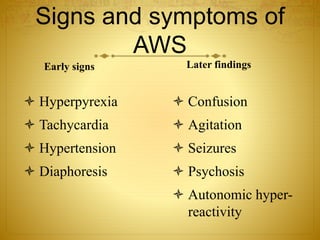
Signs and symptoms of
AWS
Early signs
 Hyperpyrexia
 Tachycardia
 Hypertension
 Diaphoresis
Later findings
 Confusion
 Agitation
 Seizures
 Psychosis
 Autonomic hyper-
reactivity
Drug abuse
 As anesthesiologists we need to be aware of the use
of illicit drugs impacts on anesthetic care.
 Medical adverse effects range from pulmonary and
cardiovascular effects, to irreversible brain damage.
 May manifest or worsen under anesthesia.
 Injected drugs and high-risk sexual behaviors are
risk factors for the transmission of HIV/AIDS and
hepatitis C.
Cannabis
 Autonomic nervous system-- low or moderate
doses --- an increase in sympathetic activity occurs
with a reduction of parasympathetic activity
 If high doses are ingested---- inhibition of the
sympathetic activity but not of the parasympathetic
activity
 Marijuana causes increased myocardial
depression and tachycardia.
Cannabis (contd.)
 In patients with acute marijuana abuse, drugs
increasing heart rate (such as ketamine,
pancuronium, atropine and epinephrine) should be
avoided.
 Cannabis inhalation affects lung function.
 In pregnant patients chronic use of marijuana may
reduce uteroplacental perfusion- result in fetal
IUGR.
Cocaine
 Serious complications are associated with
both regional and general anesthesia when
administered to cocaine abusers.
 Cocaine-induced thrombocytopenia can
occur.
 Regional anesthesia--- hemodynamic
consequences of cocaine.
Cocaine (contd.)
 Hypertension may occur, as well as hypotension,
which may lead to cardiac arrhythmias.
 Ephedrine-resistant hypotension may be
encountered.
 Patients under regional anesthesia may also show
combative behavior and altered pain perception,
due to changes in opioid receptor.
Cocaine (contd.)
 Cocaine-abusing patients under general anesthesia
may also exhibit hypertension and cardiac
arrhythmias.
 Severe hypertension may also occur--result of
direct laryngoscopy in cocaine intoxicated
patients.
 Beta blockers, such as propanolol, are
contraindicated in these patients.
Cocaine (contd.)
 Volatile anesthetics may produce cardiac
arrhythmias and increase the systemic vascular
resistance in patients.
 Halothane is avoided-- sensitizing effects on the
myocardium to catecholamines.
 Ketamine should be used with caution or avoided-
- stimulate the CNS and increase catecholamine
levels, potentiating cardiac effects.
Cocaine (contd.)
 The combination of hypertension and
proteinuria with or without seizures from
their acute intake may be mistaken for
preeclampsia or eclampsia.
 Etomidate should also be used with caution
because of possible myoclonus, seizures and
hyperreflexia.
Cocaine (contd.)
 Propofol and thiopental has proven to be
safe in cocaine-abusing patients.
 Rapid transplacental diffusion due to its
solubility and high fetal-blood and -tissue
cocaine levels.
 Decreased uteroplacental blood flow may
lead to uteroplacental insufficiency, acidosis,
hypoxia and fetal distress.
Opioids
 Opioid antagonists or agonist–antagonists
administered ,must be avoided in addicts---
precipitate acute withdrawal syndrome.
 Treated with clonidine, replaces opioid-
mediated inhibition.
 The withdrawal syndrome may be reversed
by administration of an opioid or
methadone.
Opioids
 Regional anesthesia can be administered
safely to these patients. An increased
tendency for hypotension, should be
anticipated.
 It has been reported that these patients have
an increased incidence of spinal, epidural
and disc-space infection.
Opioids
 Opioid addicts may have difficult peripheral and
central venous access.
 Sepsis, coagulopathy and hemodynamic instability
increase the risk associated with general anesthesia.
 May have concomitant liver disease, malnutrition
and reduced intravascular fluid volume which may
require adjustments in anesthetic drug doses.
Opioids
 Chronic opioid abuse leads to cross-
tolerance of anesthetic drugs, usually a
result of chronic receptor stimulation.
 Postoperatively, due to decreased pain
tolerance secondary to decreased production
of endogenous opioids, these patients may
experience exaggerated pain.
Hallucinogenic drugs
 The hallucinogen group of drugs includes
lysergic acid diethylamide (LSD),
phencyclidine (PCP), psilocybin and
mescaline.
 They activate the sympathetic nervous
system by causing hypertension and
tachycardia, increase body temperature and
dilate pupils.
Hallucinogenic drugs
 The effects of acute ingestion develop over
1–2 hr and last for approximately 12 hr.
 Wide swings in blood pressure and
tachycardia.
 Increased risk of cardiomyopathy, coronary
and cerebral vasospasm.
Hallucinogenic drugs
 Sympathomimetic stimulation effects, extreme
caution when using vasopressors such as
ephedrine.
 Hallucinogens may prolong the analgesic and
ventilatory depressant effects of opioids.
 In parturients, these amphetamine-like medications
may pose a problem from their initial presentation.
Solvents
 Inhalants include a variety of substances, such as
organic solvents and volatile agents, that affect the
CNS.
 Toluene is the most commonly used solvent and a
major component of household paints, glue, rubber
cement and cleaning agents.
 These drugs can be sniffed or ingested orally.
Solvents
 Patients are at an increased risk of developing
cardiac arrhythmias due to autonomic cardiac
dysfunction caused by the abuse of these solvents.
 Myocardial infarction and labile blood pressures
might also be encountered.
 In acutely intoxicated patients, general anesthesia
is sometimes the best option.
Solvents
 Pulmonary complications may reflect increased
airway resistance.
 When regional anesthesia is considered, it is
important to consider the patient’s altered
perception and combative behavior.
 Distal and proximal acidosis could be of concern
in these patients
Conclusion
 Smoking ,alcoholism and substance abuse remains one of
the biggest societal problems around the world despite
education on prevention and rehabilitation of illicit drugs.
 Anesthesiologists should be aware of this problem and the
most likely effects and potential risks associated with the
abuse of these substances.
 Some of these patients may present at preadmission testing,
emergency situations (even critical care) or in the obstetric
suite for anesthesia or analgesia.
Thank you.
 Due to the diverse clinical presentations that
may arise from there abuse, the anesthetic
management should be tailored to each
individual and universal precautions should
always be followed when providing care.

ANESTHETIC CONSIDERATION IN SMOKERS.pptx

  • 1.
  • 2.
    Smoking  Smoking isa risk factor for intra operative pulmonary complications and a wide range of post-operative pulmonary, cardiovascular and wound related complications.  It is associated with poorer outcomes in patients.  Cigarette smoking causes cough, mucous hyper-secretion and airflow obstruction.  Passive smokers also have an increased incidence of adverse events.
  • 3.
    Cardiovascular effect of smoking Nicotine stimulates the adrenal medulla to secrete adrenaline.  It resets the aortic and carotid body receptor----- maintain a higher blood pressure.  Stimulates the sympathetic system.  Myocardial contractility is increased.  Decrease in the intracellular oxygen transport and utilization.  Negative ionotropic effect----- chronic tissue hypoxia.
  • 4.
    Pulmonary effects of smoking Irritants in smoke increase mucus secretion. The mucus becomes hyperviscous, with altered elasticity.  Cilia become inactive- impaired tracheobronchial clearance.  The integrity of the epithelium is lost --- result in increased reactivity.  Smoking leads to narrowing of small airways increase in closing volume.  There is also an increase in proteolytic and elastolytic enzymes leading to loss of elasticity and emphysema.  The risk of lung infection is increased. 25% of smokers suffer from chronic bronchitis.
  • 5.
    Pulmonary effect of smoking Carboxyhaemoglobin levels maybe up to 15% in smokers.  Carbon monoxide and oxygen both bind to the alpha chain of haemoglobin, but the affinity of carbon monoxide is 250 times greater than oxygen.  This results in a reduction in the availability of oxygen binding sites and a reduction in oxygen carrying capacity.  The half-life of carboxy-haemoglobin depends on pulmonary ventilation. At rest, the half-life is about 4-6 hours.
  • 6.
    Effect of smokingon other system  Smoking has no effect on the gastric volume or the pH of gastric secretions.  Smoking relaxes the gastro-oesophageal sphincter but returns to normal within minutes after stopping.  Impaired immunity ----- increased risk of infection.  It also decreases immunoglobulins and leucocyte activity.  Smoking also results in increased secretion of anti-diuretic hormone (ADH)---- dilutional hyponatremia.
  • 7.
    Benefits of smoking Smokingis found to reduce risk of :  PONV  Ulcerative colitis  Schizophrenia  Deep vein thrombosis
  • 8.
    Anaesthetic consideration  Patients areadvised to quit smoking at least four to six weeks prior to surgery.  Abstinence for 12 hr. is sufficient to get rid of carbon monoxide.  Ciliary function improves -- 12-24 hours.  Laryngeal and bronchial activity is better-- 5-10 days.  Return sputum volume to normal levels– 2 weeks  Improvement in small airway narrowing is seen in 4 weeks but it takes 3 months to see changes in tracheobronchial clearance.
  • 9.
    Anaesthetic consideration  Airway complicationson induction, particularly during facemask ventilation or LMA insertion are common------ the need for intubation should always be anticipated.  Pre-oxygenation should be routine.  Adequate anaesthesia should be administered for intubation to minimise the risk of provoking bronchospasm.
  • 10.
    Anaesthetic consideration  Regional anaesthesiahas advantages for patients with long term respiratory complications of smoking.  Underlying ischaemic heart disease and hypertension should be identified, to minimise the risk from these factors.  Early mobilisation is important to improve lung function and sputum clearance.
  • 11.
  • 12.
    Effect of Alcoholism Vitamindeficiencies  Alcohol abuse is the leading cause of thiamine (vitamin B1) deficiency.  Wernicke’s encephalopathy, a syndrome characterised by the classic triad of encephalopathy,ophthalmoplegia and ataxia. Metabolic abnormalities  Acidosis--- Up to 25% of patients with an alcohol use disorder will have metabolic acidosis on admission.
  • 13.
    Effect of Alcoholism Magnesium The main causes are poor dietary intake and increased urinary and faecal losses. Phosphate  Hypophosphataemia arises as a result of increased renal excretion. Rhabodomyolysis  non-traumatic rhabdomyolysis occurs in patients with alcoholism, especially after acute intoxication.
  • 14.
    Effect of Alcoholism Alcoholicliver disease  Alcoholic liver disease can be characterised alcoholic fatty liver, alcoholic hepatitis or alcohol-related cirrhosis. Pancreatitis  Alcohol is the major causative factor of acute pancreatitis in about 32% of cases. Immune dysfunction  Patients with AUD have a three to five-fold increased postoperative infection rate compared to nonalcoholic patients.
  • 15.
    Effect of Alcoholism Alcoholiccardiac dysfunction  Chronic alcohol ingestion leads to alcoholic cardiomyopathy.  Increased risk of stroke and hypertension Haemostatic disturbances  Evidence in the literature suggests both platelet activation and platelet inhibition by alcohol.
  • 16.
    Pre-operative  Evidence suggeststhat a period of abstinence in the preoperative period decreases postoperative morbidity.  Extensive history.  Full physical examination, with special attention to cardiac and respiratory systems
  • 17.
    Preoperative  CXR andECG  Electrolyte and biochemical profile  Full blood count, INR and PT/PTT  Consider local or regional anaesthetic techniques.
  • 18.
    Peri-operative period  Alteredinduction agent dose.  Rapid sequence intubation if acute intoxication.  Intraoperative - Lower MAC of inhaled agents in acute intoxication.  Careful opioid administration.
  • 19.
    Peri-operative period  Paracetamoldose adjustment.  Muscle relaxants with organ independent metabolism.  Postoperative – Risk alcohol withdrawal syndrome.  Choose analgesia carefully.
  • 20.
    Anaesthetic drugs  Propofol- Decreased dosing requirement in acute intoxication.  Increased dosing requirement in chronic alcoholism.  Thiopentone - Decreased dosing requirement in acute intoxication.
  • 21.
    Anaesthetic drugs  Etomidate- No evidence of altered doses.  Neuromuscular Blocking agents- Altered pharmacokinetics with increased volume of distribution and decreased binding proteins in alcoholic liver disease.  Inhalation anaesthetics- Decreased MAC in acute intoxication.
  • 22.
    Anaesthetic drugs  Decreasedclearance of halothane in alcoholic liver dysfunction  Opioids - Decrease metabolism of morphine, pethidine and fentanyl in chronic alcoholism  Risk of accumulation with repeated doses.
  • 23.
    Alcohol withdrawal syndrome  Itis important for anaesthesiologists to know the symptoms, clinical signs and management of alcohol withdrawal symptoms.  One of the cause of post operative delirium.  Develop in alcohol dependant individuals within 6 to 24 hours from their last drink. It typically presents after 2 to 4 days of abstinence and can persist for up to two weeks.
  • 24.
    Signs and symptomsof AWS Early signs  Hyperpyrexia  Tachycardia  Hypertension  Diaphoresis Later findings  Confusion  Agitation  Seizures  Psychosis  Autonomic hyper- reactivity
  • 25.
    Drug abuse  Asanesthesiologists we need to be aware of the use of illicit drugs impacts on anesthetic care.  Medical adverse effects range from pulmonary and cardiovascular effects, to irreversible brain damage.  May manifest or worsen under anesthesia.  Injected drugs and high-risk sexual behaviors are risk factors for the transmission of HIV/AIDS and hepatitis C.
  • 26.
    Cannabis  Autonomic nervoussystem-- low or moderate doses --- an increase in sympathetic activity occurs with a reduction of parasympathetic activity  If high doses are ingested---- inhibition of the sympathetic activity but not of the parasympathetic activity  Marijuana causes increased myocardial depression and tachycardia.
  • 27.
    Cannabis (contd.)  Inpatients with acute marijuana abuse, drugs increasing heart rate (such as ketamine, pancuronium, atropine and epinephrine) should be avoided.  Cannabis inhalation affects lung function.  In pregnant patients chronic use of marijuana may reduce uteroplacental perfusion- result in fetal IUGR.
  • 28.
    Cocaine  Serious complicationsare associated with both regional and general anesthesia when administered to cocaine abusers.  Cocaine-induced thrombocytopenia can occur.  Regional anesthesia--- hemodynamic consequences of cocaine.
  • 29.
    Cocaine (contd.)  Hypertensionmay occur, as well as hypotension, which may lead to cardiac arrhythmias.  Ephedrine-resistant hypotension may be encountered.  Patients under regional anesthesia may also show combative behavior and altered pain perception, due to changes in opioid receptor.
  • 30.
    Cocaine (contd.)  Cocaine-abusingpatients under general anesthesia may also exhibit hypertension and cardiac arrhythmias.  Severe hypertension may also occur--result of direct laryngoscopy in cocaine intoxicated patients.  Beta blockers, such as propanolol, are contraindicated in these patients.
  • 31.
    Cocaine (contd.)  Volatileanesthetics may produce cardiac arrhythmias and increase the systemic vascular resistance in patients.  Halothane is avoided-- sensitizing effects on the myocardium to catecholamines.  Ketamine should be used with caution or avoided- - stimulate the CNS and increase catecholamine levels, potentiating cardiac effects.
  • 32.
    Cocaine (contd.)  Thecombination of hypertension and proteinuria with or without seizures from their acute intake may be mistaken for preeclampsia or eclampsia.  Etomidate should also be used with caution because of possible myoclonus, seizures and hyperreflexia.
  • 33.
    Cocaine (contd.)  Propofoland thiopental has proven to be safe in cocaine-abusing patients.  Rapid transplacental diffusion due to its solubility and high fetal-blood and -tissue cocaine levels.  Decreased uteroplacental blood flow may lead to uteroplacental insufficiency, acidosis, hypoxia and fetal distress.
  • 34.
    Opioids  Opioid antagonistsor agonist–antagonists administered ,must be avoided in addicts--- precipitate acute withdrawal syndrome.  Treated with clonidine, replaces opioid- mediated inhibition.  The withdrawal syndrome may be reversed by administration of an opioid or methadone.
  • 35.
    Opioids  Regional anesthesiacan be administered safely to these patients. An increased tendency for hypotension, should be anticipated.  It has been reported that these patients have an increased incidence of spinal, epidural and disc-space infection.
  • 36.
    Opioids  Opioid addictsmay have difficult peripheral and central venous access.  Sepsis, coagulopathy and hemodynamic instability increase the risk associated with general anesthesia.  May have concomitant liver disease, malnutrition and reduced intravascular fluid volume which may require adjustments in anesthetic drug doses.
  • 37.
    Opioids  Chronic opioidabuse leads to cross- tolerance of anesthetic drugs, usually a result of chronic receptor stimulation.  Postoperatively, due to decreased pain tolerance secondary to decreased production of endogenous opioids, these patients may experience exaggerated pain.
  • 38.
    Hallucinogenic drugs  Thehallucinogen group of drugs includes lysergic acid diethylamide (LSD), phencyclidine (PCP), psilocybin and mescaline.  They activate the sympathetic nervous system by causing hypertension and tachycardia, increase body temperature and dilate pupils.
  • 39.
    Hallucinogenic drugs  Theeffects of acute ingestion develop over 1–2 hr and last for approximately 12 hr.  Wide swings in blood pressure and tachycardia.  Increased risk of cardiomyopathy, coronary and cerebral vasospasm.
  • 40.
    Hallucinogenic drugs  Sympathomimeticstimulation effects, extreme caution when using vasopressors such as ephedrine.  Hallucinogens may prolong the analgesic and ventilatory depressant effects of opioids.  In parturients, these amphetamine-like medications may pose a problem from their initial presentation.
  • 41.
    Solvents  Inhalants includea variety of substances, such as organic solvents and volatile agents, that affect the CNS.  Toluene is the most commonly used solvent and a major component of household paints, glue, rubber cement and cleaning agents.  These drugs can be sniffed or ingested orally.
  • 42.
    Solvents  Patients areat an increased risk of developing cardiac arrhythmias due to autonomic cardiac dysfunction caused by the abuse of these solvents.  Myocardial infarction and labile blood pressures might also be encountered.  In acutely intoxicated patients, general anesthesia is sometimes the best option.
  • 43.
    Solvents  Pulmonary complicationsmay reflect increased airway resistance.  When regional anesthesia is considered, it is important to consider the patient’s altered perception and combative behavior.  Distal and proximal acidosis could be of concern in these patients
  • 44.
    Conclusion  Smoking ,alcoholismand substance abuse remains one of the biggest societal problems around the world despite education on prevention and rehabilitation of illicit drugs.  Anesthesiologists should be aware of this problem and the most likely effects and potential risks associated with the abuse of these substances.  Some of these patients may present at preadmission testing, emergency situations (even critical care) or in the obstetric suite for anesthesia or analgesia.
  • 45.
    Thank you.  Dueto the diverse clinical presentations that may arise from there abuse, the anesthetic management should be tailored to each individual and universal precautions should always be followed when providing care.

Editor's Notes

  • #4 2. an increase in heart rate, blood pressure and peripheral vascular resistance. 3. - increase in oxygen demand and consumption.
  • #5 The integrity of the epithelium is lost because of the irritants in the smoke which result in increased reactivity
  • #6 The amount of carbon monoxide present in the blood of smokers depends on the frequency, method and the type of cigarette smoked
  • #7 humoral and cell mediated
  • #16 1and is characterised by cardiomegaly, myocardial contractility, decreased ejection fraction
  • #26 when these substances interact with the anesthetics provided
  • #27 ---- tachycardia and increased cardiac output. , leading to possible hypotension and bradycardia- may potentiate the effect of anesthetic drugs that affect blood pressure and heart rate Cannabis can affect numerous body systems.
  • #28 as it is smoked unfiltered. Its association with upper-airway irritability, predisposes to chronic cough, bronchitis, emphysema and bronchospasm.
  • #29 Blood pressure be controlled with medications prior to induction. Thrombogenic activity plasminogen activator,incresed platelet aggregation, platelet count, platelet hyperagglutibility.
  • #30 and abnormal endorphin levels or myocardial dysfunction
  • #31 patients because of the potential for unopposed a -adrenergic stimulation.
  • #32 acutely intoxicated with cocaine. May cause myocardial depression in the absence of catecholamines.
  • #34 which may affect fetal blood vessels and uterine blood flow
  • #35 with a-2 agonist-mediated inhibition of the CNS.
  • #43 due to their respiratory compromise and increased incidence of nausea and vomiting