








Julia Lawrence RRT-NPS
 By the end of this workshop, the learner will be
able to compare and contrast the various types
of oxygen delivery devices according to flow
requirements and fractional inspired oxygen
delivered
 By the end of this workshop, the learner will be
able to discuss and determine which oxygen
delivery device(s) would be most appropriate
given case-based examples  
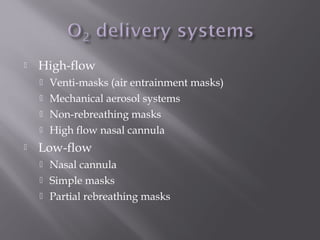
 High-flow
 Venti-masks (air entrainment masks)
 Mechanical aerosol systems
 Non-rebreathing masks
 High flow nasal cannula
 Low-flow
 Nasal cannula
 Simple masks
 Partial rebreathing masks
oxygen
room air
exhaled gas
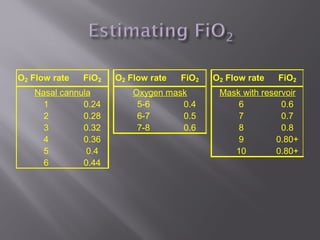
O2 Flow rate FiO2 O2 Flow rate FiO2 O2 Flow rate FiO2
Nasal cannula Oxygen mask Mask with reservoir
1 0.24 5-6 0.4 6 0.6
2 0.28 6-7 0.5 7 0.7
3 0.32 7-8 0.6 8 0.8
4 0.36 9 0.80+
5 0.4 10 0.80+
6 0.44
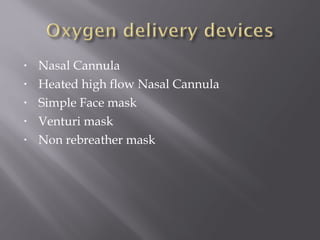
• Nasal Cannula
• Heated high flow Nasal Cannula
• Simple Face mask
• Venturi mask
• Non rebreather mask
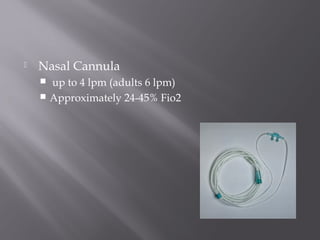
 Nasal Cannula
 up to 4 lpm (adults 6 lpm)
 Approximately 24-45% Fio2
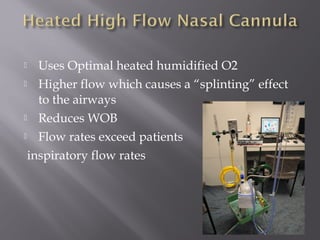
 Uses Optimal heated humidified O2
 Higher flow which causes a “splinting” effect
to the airways
 Reduces WOB
 Flow rates exceed patients
inspiratory flow rates
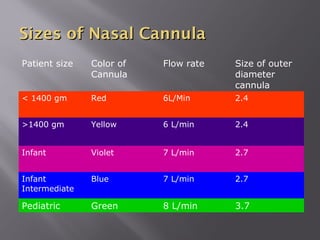
Patient size Color of
Cannula
Flow rate Size of outer
diameter
cannula
< 1400 gm Red 6L/Min 2.4
>1400 gm Yellow 6 L/min 2.4
Infant Violet 7 L/min 2.7
Infant
Intermediate
Blue 7 L/min 2.7
Pediatric Green 8 L/min 3.7
Sizes of Nasal CannulaSizes of Nasal Cannula
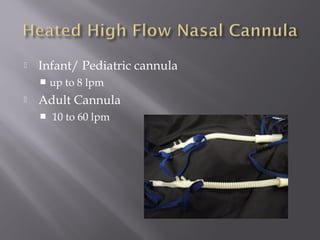
 Infant/ Pediatric cannula
 up to 8 lpm
 Adult Cannula
 10 to 60 lpm
 The following criteria are for patients being
admitted to the acute care floors.
 < 4 CRS (Clinical Respiratory Score)
 < 40% FiO2
 > 4kg
 > 4 weeks
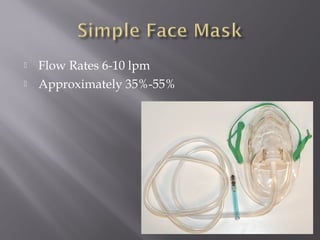
 Flow Rates 6-10 lpm
 Approximately 35%-55%
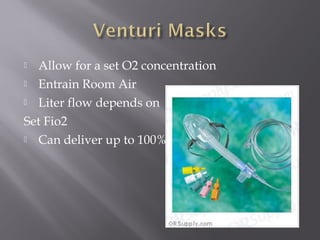
 Allow for a set O2 concentration
 Entrain Room Air
 Liter flow depends on
Set Fio2
 Can deliver up to 100%
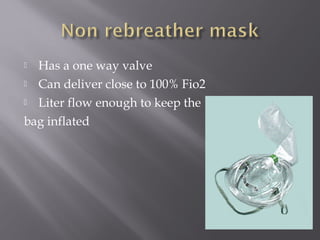
 Has a one way valve
 Can deliver close to 100% Fio2
 Liter flow enough to keep the
bag inflated
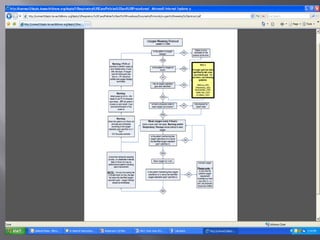
Weaning Highflow Nasal Cannula on Acute Care
Is patient on
pediatric or
adult circuit?
Pediatric Adult
Wean FiO2 to keep saturation
> pre set saturation limit
Once FiO2 is decreased to 40%
begin to wean liter flow
(Note: In CVICU wean according to
MDs order to maintain saturation,
may be to 21%)
If CRS is <4 wean flow by at least 1
lpm every 4 hours to a minimum of
4LPM
When at a flow of 4 lpm then
transition to a bubble humidifier.
Wean FiO2 to keep saturation >
pre set saturation limit
Once FiO2 is decreased to 40%
begin to wean liter flow
(Note: In CVICU wean according to
MDs order to maintain saturation,
may be to 21%)
If CRS is < 4 wean flow by 5 lpm
until you reach an end point of 10
lpm (Circuit RT 202 has a low flow
limit of 10 lpm)
Once at 10 liters transition to
another Oxygen delivery device.
Pre-determined Sat limit
Asthma > 92%
Pneumonia > 90%
Bronchiolitis > 90%
Sickle Cell > 94%
All others > 92%
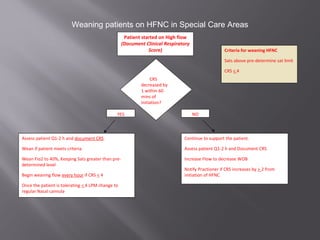
Weaning patients on HFNC in Special Care Areas
Patient started on High flow
(Document Clinical Respiratory
Score)
Has CRS
decreased by
1 within 60
mins of
initiation?
YES NO
Continue to support the patient.
Assess patient Q1-2 h and Document CRS
Increase Flow to decrease WOB
Notify Practioner if CRS increases by > 2 from
initiation of HFNC
Assess patient Q1-2 h and document CRS
Wean if patient meets criteria.
Wean Fio2 to 40%, Keeping Sats greater than pre-
determined level
Begin weaning flow every hour if CRS < 4
Once the patient is tolerating < 4 LPM change to
regular Nasal cannula
Criteria for weaning HFNC
Sats above pre-determine sat limit
CRS < 4
 Intervention
 Why
 Liter flow
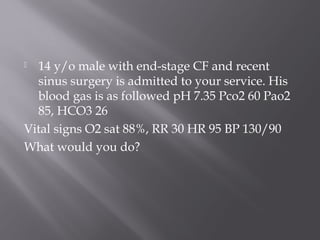
 14 y/o male with end-stage CF and recent
sinus surgery is admitted to your service. His
blood gas is as followed pH 7.35 Pco2 60 Pao2
85, HCO3 26
Vital signs O2 sat 88%, RR 30 HR 95 BP 130/90
What would you do?
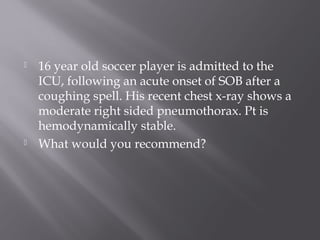
 16 year old soccer player is admitted to the
ICU, following an acute onset of SOB after a
coughing spell. His recent chest x-ray shows a
moderate right sided pneumothorax. Pt is
hemodynamically stable.
 What would you recommend?
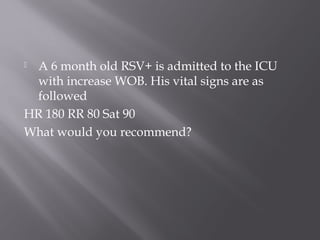
 A 6 month old RSV+ is admitted to the ICU
with increase WOB. His vital signs are as
followed
HR 180 RR 80 Sat 90
What would you recommend?

2013 Pediatric Fellows Boot Camp_Oxygen Delivery Devices

  • 1.
  • 2.
     By theend of this workshop, the learner will be able to compare and contrast the various types of oxygen delivery devices according to flow requirements and fractional inspired oxygen delivered  By the end of this workshop, the learner will be able to discuss and determine which oxygen delivery device(s) would be most appropriate given case-based examples  
  • 3.
     High-flow  Venti-masks(air entrainment masks)  Mechanical aerosol systems  Non-rebreathing masks  High flow nasal cannula  Low-flow  Nasal cannula  Simple masks  Partial rebreathing masks
  • 4.
  • 5.
    O2 Flow rateFiO2 O2 Flow rate FiO2 O2 Flow rate FiO2 Nasal cannula Oxygen mask Mask with reservoir 1 0.24 5-6 0.4 6 0.6 2 0.28 6-7 0.5 7 0.7 3 0.32 7-8 0.6 8 0.8 4 0.36 9 0.80+ 5 0.4 10 0.80+ 6 0.44
  • 6.
    • Nasal Cannula •Heated high flow Nasal Cannula • Simple Face mask • Venturi mask • Non rebreather mask
  • 7.
     Nasal Cannula up to 4 lpm (adults 6 lpm)  Approximately 24-45% Fio2
  • 8.
     Uses Optimalheated humidified O2  Higher flow which causes a “splinting” effect to the airways  Reduces WOB  Flow rates exceed patients inspiratory flow rates
  • 9.
    Patient size Colorof Cannula Flow rate Size of outer diameter cannula < 1400 gm Red 6L/Min 2.4 >1400 gm Yellow 6 L/min 2.4 Infant Violet 7 L/min 2.7 Infant Intermediate Blue 7 L/min 2.7 Pediatric Green 8 L/min 3.7 Sizes of Nasal CannulaSizes of Nasal Cannula
  • 10.
     Infant/ Pediatriccannula  up to 8 lpm  Adult Cannula  10 to 60 lpm
  • 11.
     The followingcriteria are for patients being admitted to the acute care floors.  < 4 CRS (Clinical Respiratory Score)  < 40% FiO2  > 4kg  > 4 weeks
  • 13.
     Flow Rates6-10 lpm  Approximately 35%-55%
  • 14.
     Allow fora set O2 concentration  Entrain Room Air  Liter flow depends on Set Fio2  Can deliver up to 100%
  • 16.
     Has aone way valve  Can deliver close to 100% Fio2  Liter flow enough to keep the bag inflated
  • 19.
    Weaning Highflow NasalCannula on Acute Care Is patient on pediatric or adult circuit? Pediatric Adult Wean FiO2 to keep saturation > pre set saturation limit Once FiO2 is decreased to 40% begin to wean liter flow (Note: In CVICU wean according to MDs order to maintain saturation, may be to 21%) If CRS is <4 wean flow by at least 1 lpm every 4 hours to a minimum of 4LPM When at a flow of 4 lpm then transition to a bubble humidifier. Wean FiO2 to keep saturation > pre set saturation limit Once FiO2 is decreased to 40% begin to wean liter flow (Note: In CVICU wean according to MDs order to maintain saturation, may be to 21%) If CRS is < 4 wean flow by 5 lpm until you reach an end point of 10 lpm (Circuit RT 202 has a low flow limit of 10 lpm) Once at 10 liters transition to another Oxygen delivery device. Pre-determined Sat limit Asthma > 92% Pneumonia > 90% Bronchiolitis > 90% Sickle Cell > 94% All others > 92%
  • 20.
    Weaning patients onHFNC in Special Care Areas Patient started on High flow (Document Clinical Respiratory Score) Has CRS decreased by 1 within 60 mins of initiation? YES NO Continue to support the patient. Assess patient Q1-2 h and Document CRS Increase Flow to decrease WOB Notify Practioner if CRS increases by > 2 from initiation of HFNC Assess patient Q1-2 h and document CRS Wean if patient meets criteria. Wean Fio2 to 40%, Keeping Sats greater than pre- determined level Begin weaning flow every hour if CRS < 4 Once the patient is tolerating < 4 LPM change to regular Nasal cannula Criteria for weaning HFNC Sats above pre-determine sat limit CRS < 4
  • 22.
  • 23.
     14 y/omale with end-stage CF and recent sinus surgery is admitted to your service. His blood gas is as followed pH 7.35 Pco2 60 Pao2 85, HCO3 26 Vital signs O2 sat 88%, RR 30 HR 95 BP 130/90 What would you do?
  • 24.
     16 yearold soccer player is admitted to the ICU, following an acute onset of SOB after a coughing spell. His recent chest x-ray shows a moderate right sided pneumothorax. Pt is hemodynamically stable.  What would you recommend?
  • 25.
     A 6month old RSV+ is admitted to the ICU with increase WOB. His vital signs are as followed HR 180 RR 80 Sat 90 What would you recommend?

Editor's Notes

  • #4 High flow gas delivery systems supply all the gas the patient needs.