Airway ManagementAirway Management
Augusto Torres, MDAugusto Torres, MD
Department of AnesthesiologyDepartment of Anesthesiology
MetroHealth Medical CenterMetroHealth Medical Center
OutlineOutline
Review of airway anatomyReview of airway anatomy
Airway evaluationAirway evaluation
Mask ventilationMask ventilation
Endotracheal intubationEndotracheal intubation
The difficult airwayThe difficult airway
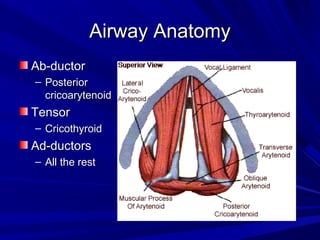
Airway AnatomyAirway Anatomy
Ab-ductorAb-ductor
– PosteriorPosterior
cricoarytenoidcricoarytenoid
TensorTensor
– CricothyroidCricothyroid
Ad-ductorsAd-ductors
– All the restAll the rest
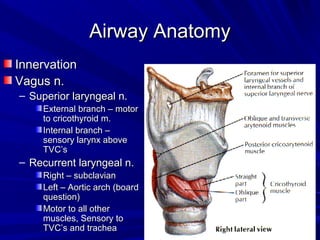
Airway AnatomyAirway Anatomy
InnervationInnervation
Vagus n.Vagus n.
– Superior laryngeal n.Superior laryngeal n.
External branch – motorExternal branch – motor
to cricothyroid m.to cricothyroid m.
Internal branch –Internal branch –
sensory larynx abovesensory larynx above
TVC’sTVC’s
– Recurrent laryngeal n.Recurrent laryngeal n.
Right – subclavianRight – subclavian
Left – Aortic arch (boardLeft – Aortic arch (board
question)question)
Motor to all otherMotor to all other
muscles, Sensory tomuscles, Sensory to
TVC’s and tracheaTVC’s and trachea
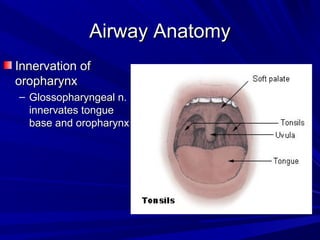
Airway AnatomyAirway Anatomy
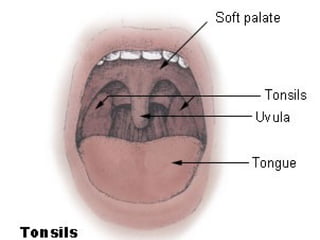
Innervation ofInnervation of
oropharynxoropharynx
– Glossopharyngeal n.Glossopharyngeal n.
innervates tongueinnervates tongue
base and oropharynxbase and oropharynx
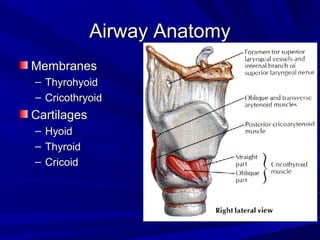
Airway AnatomyAirway Anatomy
MembranesMembranes
– ThyrohyoidThyrohyoid
– CricothryoidCricothryoid
CartilagesCartilages
– HyoidHyoid
– ThyroidThyroid
– CricoidCricoid
Airway EvaluationAirway Evaluation
Take very seriouslyTake very seriously
history of prior difficultyhistory of prior difficulty
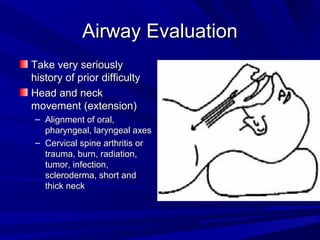
Head and neckHead and neck
movement (extension)movement (extension)
– Alignment of oral,Alignment of oral,
pharyngeal, laryngeal axespharyngeal, laryngeal axes
– Cervical spine arthritis orCervical spine arthritis or
trauma, burn, radiation,trauma, burn, radiation,
tumor, infection,tumor, infection,
scleroderma, short andscleroderma, short and
thick neckthick neck
Airway EvaluationAirway Evaluation
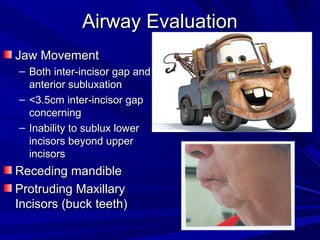
Jaw MovementJaw Movement
– Both inter-incisor gap andBoth inter-incisor gap and
anterior subluxationanterior subluxation
– <3.5cm inter-incisor gap<3.5cm inter-incisor gap
concerningconcerning
– Inability to sublux lowerInability to sublux lower
incisors beyond upperincisors beyond upper
incisorsincisors
Receding mandibleReceding mandible
Protruding MaxillaryProtruding Maxillary
Incisors (buck teeth)Incisors (buck teeth)
Airway EvaluationAirway Evaluation
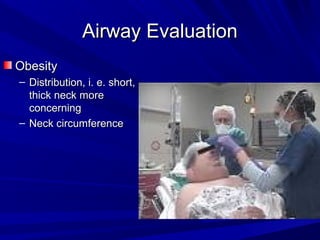
ObesityObesity
– Distribution, i. e. short,Distribution, i. e. short,
thick neck morethick neck more
concerningconcerning
– Neck circumferenceNeck circumference
Airway EvaluationAirway Evaluation
Thyromental distance:Thyromental distance:
bony point onbony point on
mentum (mandible) tomentum (mandible) to
thyroid notchthyroid notch
If short (<3FB’s orIf short (<3FB’s or
6cm), pharyngeal and6cm), pharyngeal and
laryngeal axis offlaryngeal axis off
Airway EvaluationAirway Evaluation
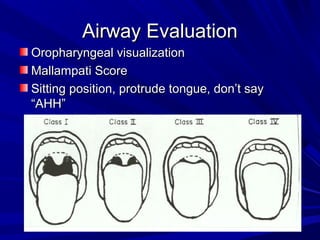
Oropharyngeal visualizationOropharyngeal visualization
Mallampati ScoreMallampati Score
Sitting position, protrude tongue, don’t saySitting position, protrude tongue, don’t say
“AHH”“AHH”
Airway EvaluationAirway Evaluation
Difficulty ventilatingDifficulty ventilating
– Age >55Age >55
– BeardBeard
– History of snoringHistory of snoring
– Lack of teethLack of teeth
– BMI >26BMI >26
PreoxygenationPreoxygenation
Replaces the nitrogen volume of the lungsReplaces the nitrogen volume of the lungs
(69% of FRC) with oxygen(69% of FRC) with oxygen
Functional residual capacity (residualFunctional residual capacity (residual
volume and expiratory reserve volume)volume and expiratory reserve volume)
Preoxygenation with 100% oxygen viaPreoxygenation with 100% oxygen via
tight-fitting mask for 5 minutestight-fitting mask for 5 minutes  up to 10up to 10
min of oxygen reserve following apneamin of oxygen reserve following apnea
Four vital capacity breaths over 30Four vital capacity breaths over 30
seconds (time to desaturation quicker)seconds (time to desaturation quicker)
Patient PositioningPatient Positioning
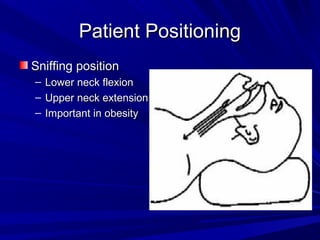
Sniffing positionSniffing position
– Lower neck flexionLower neck flexion
– Upper neck extensionUpper neck extension
– Important in obesityImportant in obesity
Mask VentilationMask Ventilation
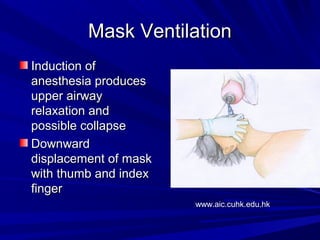
Induction ofInduction of
anesthesia producesanesthesia produces
upper airwayupper airway
relaxation andrelaxation and
possible collapsepossible collapse
DownwardDownward
displacement of maskdisplacement of mask
with thumb and indexwith thumb and index
fingerfinger
www.aic.cuhk.edu.hk
Mask VentilationMask Ventilation
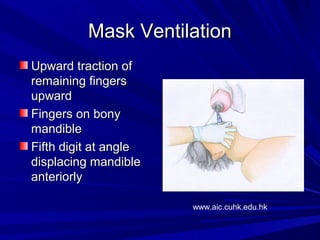
Upward traction ofUpward traction of
remaining fingersremaining fingers
upwardupward
Fingers on bonyFingers on bony
mandiblemandible
Fifth digit at angleFifth digit at angle
displacing mandibledisplacing mandible
anteriorlyanteriorly
www.aic.cuhk.edu.hk
Mask VentilationMask Ventilation
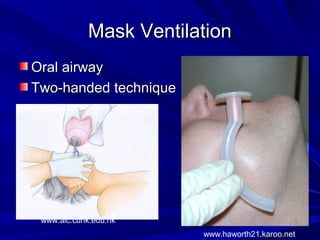
Oral airwayOral airway
Two-handed techniqueTwo-handed technique
www.aic.cuhk.edu.hk
www.haworth21.karoo.net
LMA PlacementLMA Placement
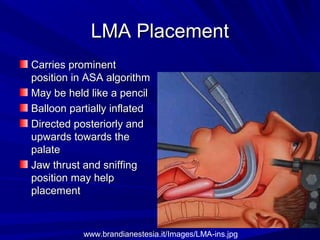
Carries prominentCarries prominent
position in ASA algorithmposition in ASA algorithm
May be held like a pencilMay be held like a pencil
Balloon partially inflatedBalloon partially inflated
Directed posteriorly andDirected posteriorly and
upwards towards theupwards towards the
palatepalate
Jaw thrust and sniffingJaw thrust and sniffing
position may helpposition may help
placementplacement
www.brandianestesia.it/Images/LMA-ins.jpg
LMA PlacementLMA Placement
Verify placement by ventilatingVerify placement by ventilating
– Check for good chest rise, ETCO2, andCheck for good chest rise, ETCO2, and
adequate tidal volumesadequate tidal volumes
– Check for leak – if significant leak at aroundCheck for leak – if significant leak at around
10cm H2O problematic10cm H2O problematic
– May try size larger or smallerMay try size larger or smaller
– May try to inflate/deflate cuff to obtain betterMay try to inflate/deflate cuff to obtain better
sealseal
– If difficulty passing may try inserting upsideIf difficulty passing may try inserting upside
down and then flipping arounddown and then flipping around
Endotracheal IntubationEndotracheal Intubation
Open the mouth with rightOpen the mouth with right
handhand
– Scissor techniqueScissor technique
Gently insertGently insert
laryngoscope into rightlaryngoscope into right
side of mouth pushingside of mouth pushing
tongue to the lefttongue to the left
Careful with insertion notCareful with insertion not
to hit teethto hit teeth
Advance laryngoscopeAdvance laryngoscope
further into oropharynxfurther into oropharynx
with applied traction 45with applied traction 45
degreesdegrees
Endotracheal IntubationEndotracheal Intubation
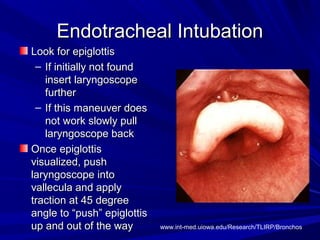
Look for epiglottisLook for epiglottis
– If initially not foundIf initially not found
insert laryngoscopeinsert laryngoscope
furtherfurther
– If this maneuver doesIf this maneuver does
not work slowly pullnot work slowly pull
laryngoscope backlaryngoscope back
Once epiglottisOnce epiglottis
visualized, pushvisualized, push
laryngoscope intolaryngoscope into
vallecula and applyvallecula and apply
traction at 45 degreetraction at 45 degree
angle to “push” epiglottisangle to “push” epiglottis
up and out of the wayup and out of the way www.int-med.uiowa.edu/Research/TLIRP/Bronchos
Endotracheal IntubationEndotracheal Intubation
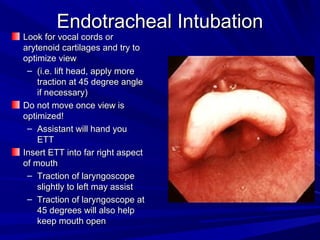
Look for vocal cords orLook for vocal cords or
arytenoid cartilages and try toarytenoid cartilages and try to
optimize viewoptimize view
– (i.e. lift head, apply more(i.e. lift head, apply more
traction at 45 degree angletraction at 45 degree angle
if necessary)if necessary)
Do not move once view isDo not move once view is
optimized!optimized!
– Assistant will hand youAssistant will hand you
ETTETT
Insert ETT into far right aspectInsert ETT into far right aspect
of mouthof mouth
– Traction of laryngoscopeTraction of laryngoscope
slightly to left may assistslightly to left may assist
– Traction of laryngoscope atTraction of laryngoscope at
45 degrees will also help45 degrees will also help
keep mouth openkeep mouth open
Endotracheal IntubationEndotracheal Intubation
Insert ETT above and between arytenoidsInsert ETT above and between arytenoids
and through vocal cordsand through vocal cords
Try to visualize the ETT passing betweenTry to visualize the ETT passing between
the vocal cordsthe vocal cords
– If this is not possible, then you must visualizeIf this is not possible, then you must visualize
the ETT passing above and between thethe ETT passing above and between the
arytenoidsarytenoids
Endotracheal IntubationEndotracheal Intubation
Common problems:Common problems:
– ““I can’t see anything!”I can’t see anything!”
Make sure tongue isMake sure tongue is
swept to the leftswept to the left
You are probably tooYou are probably too
shallow or too deep.shallow or too deep.
Even with difficultEven with difficult
intubations theintubations the
epiglottis can beepiglottis can be
visualizedvisualized
Insert laryngoscope inInsert laryngoscope in
further looking forfurther looking for
epiglottisepiglottis
Pull laryngoscope backPull laryngoscope back
if this failsif this fails
Endotracheal IntubationEndotracheal Intubation
Common problemsCommon problems
– ““I can’t see the cords!”I can’t see the cords!”
– Epiglottis is visualized, vocal cords are notEpiglottis is visualized, vocal cords are not
– Removing the epiglottis partly from view isRemoving the epiglottis partly from view is
necessary to visualize the vocal cords belownecessary to visualize the vocal cords below
– Push the end of the laryngoscope bladePush the end of the laryngoscope blade
further into the vallecula and “toe up”further into the vallecula and “toe up”
– Lifting the patient’s head with your other handLifting the patient’s head with your other hand
may improve the sniffing position and bringmay improve the sniffing position and bring
the vocal cords into viewthe vocal cords into view
Endotracheal IntubationEndotracheal Intubation
Common problemsCommon problems
– ““I can see the cords. But I can’t get the tubeI can see the cords. But I can’t get the tube
there!”there!”
– You may not be giving yourself adequateYou may not be giving yourself adequate
room in the oral cavityroom in the oral cavity
– Push up and to the left with the laryngoscopePush up and to the left with the laryngoscope
to make sure the mouth is still fully openedto make sure the mouth is still fully opened
and the tongue adequately swept awayand the tongue adequately swept away
– Slide the ETT in the mouth all the way to theSlide the ETT in the mouth all the way to the
right side, perhaps even sidewaysright side, perhaps even sideways
Difficult IntubationDifficult Intubation
ASA Difficult Airway AlgorithmASA Difficult Airway Algorithm
www.metrohealthanesthesia.comwww.metrohealthanesthesia.com
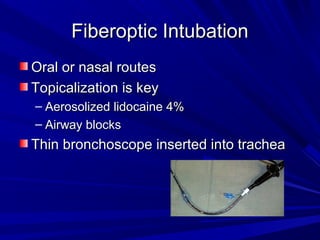
Fiberoptic IntubationFiberoptic Intubation
Oral or nasal routesOral or nasal routes
Topicalization is keyTopicalization is key
– Aerosolized lidocaine 4%Aerosolized lidocaine 4%
– Airway blocksAirway blocks
Thin bronchoscope inserted into tracheaThin bronchoscope inserted into trachea
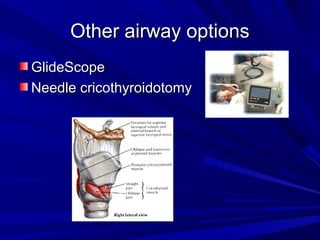
Other airway optionsOther airway options
GlideScopeGlideScope
Needle cricothyroidotomyNeedle cricothyroidotomy
ConclusionConclusion
Airway management is an extremely importantAirway management is an extremely important
aspect of the practice of anesthesiology andaspect of the practice of anesthesiology and
critical carecritical care
A firm basis in airway anatomy is neededA firm basis in airway anatomy is needed
Skills such as mask ventilation, endotrachealSkills such as mask ventilation, endotracheal
intubation, LMA placement are necessaryintubation, LMA placement are necessary
In the case of a difficult airway, a logicalIn the case of a difficult airway, a logical
algorithm and airway equipment assist thealgorithm and airway equipment assist the
physician in safely managing the situationphysician in safely managing the situation

Airway management

  • 1.
    Airway ManagementAirway Management AugustoTorres, MDAugusto Torres, MD Department of AnesthesiologyDepartment of Anesthesiology MetroHealth Medical CenterMetroHealth Medical Center
  • 2.
    OutlineOutline Review of airwayanatomyReview of airway anatomy Airway evaluationAirway evaluation Mask ventilationMask ventilation Endotracheal intubationEndotracheal intubation The difficult airwayThe difficult airway
  • 3.
    Airway AnatomyAirway Anatomy Ab-ductorAb-ductor –PosteriorPosterior cricoarytenoidcricoarytenoid TensorTensor – CricothyroidCricothyroid Ad-ductorsAd-ductors – All the restAll the rest
  • 4.
    Airway AnatomyAirway Anatomy InnervationInnervation Vagusn.Vagus n. – Superior laryngeal n.Superior laryngeal n. External branch – motorExternal branch – motor to cricothyroid m.to cricothyroid m. Internal branch –Internal branch – sensory larynx abovesensory larynx above TVC’sTVC’s – Recurrent laryngeal n.Recurrent laryngeal n. Right – subclavianRight – subclavian Left – Aortic arch (boardLeft – Aortic arch (board question)question) Motor to all otherMotor to all other muscles, Sensory tomuscles, Sensory to TVC’s and tracheaTVC’s and trachea
  • 5.
    Airway AnatomyAirway Anatomy InnervationofInnervation of oropharynxoropharynx – Glossopharyngeal n.Glossopharyngeal n. innervates tongueinnervates tongue base and oropharynxbase and oropharynx
  • 6.
    Airway AnatomyAirway Anatomy MembranesMembranes –ThyrohyoidThyrohyoid – CricothryoidCricothryoid CartilagesCartilages – HyoidHyoid – ThyroidThyroid – CricoidCricoid
  • 8.
    Airway EvaluationAirway Evaluation Takevery seriouslyTake very seriously history of prior difficultyhistory of prior difficulty Head and neckHead and neck movement (extension)movement (extension) – Alignment of oral,Alignment of oral, pharyngeal, laryngeal axespharyngeal, laryngeal axes – Cervical spine arthritis orCervical spine arthritis or trauma, burn, radiation,trauma, burn, radiation, tumor, infection,tumor, infection, scleroderma, short andscleroderma, short and thick neckthick neck
  • 9.
    Airway EvaluationAirway Evaluation JawMovementJaw Movement – Both inter-incisor gap andBoth inter-incisor gap and anterior subluxationanterior subluxation – <3.5cm inter-incisor gap<3.5cm inter-incisor gap concerningconcerning – Inability to sublux lowerInability to sublux lower incisors beyond upperincisors beyond upper incisorsincisors Receding mandibleReceding mandible Protruding MaxillaryProtruding Maxillary Incisors (buck teeth)Incisors (buck teeth)
  • 10.
    Airway EvaluationAirway Evaluation ObesityObesity –Distribution, i. e. short,Distribution, i. e. short, thick neck morethick neck more concerningconcerning – Neck circumferenceNeck circumference
  • 11.
    Airway EvaluationAirway Evaluation Thyromentaldistance:Thyromental distance: bony point onbony point on mentum (mandible) tomentum (mandible) to thyroid notchthyroid notch If short (<3FB’s orIf short (<3FB’s or 6cm), pharyngeal and6cm), pharyngeal and laryngeal axis offlaryngeal axis off
  • 12.
    Airway EvaluationAirway Evaluation OropharyngealvisualizationOropharyngeal visualization Mallampati ScoreMallampati Score Sitting position, protrude tongue, don’t saySitting position, protrude tongue, don’t say “AHH”“AHH”
  • 13.
    Airway EvaluationAirway Evaluation DifficultyventilatingDifficulty ventilating – Age >55Age >55 – BeardBeard – History of snoringHistory of snoring – Lack of teethLack of teeth – BMI >26BMI >26
  • 14.
    PreoxygenationPreoxygenation Replaces the nitrogenvolume of the lungsReplaces the nitrogen volume of the lungs (69% of FRC) with oxygen(69% of FRC) with oxygen Functional residual capacity (residualFunctional residual capacity (residual volume and expiratory reserve volume)volume and expiratory reserve volume) Preoxygenation with 100% oxygen viaPreoxygenation with 100% oxygen via tight-fitting mask for 5 minutestight-fitting mask for 5 minutes  up to 10up to 10 min of oxygen reserve following apneamin of oxygen reserve following apnea Four vital capacity breaths over 30Four vital capacity breaths over 30 seconds (time to desaturation quicker)seconds (time to desaturation quicker)
  • 15.
    Patient PositioningPatient Positioning SniffingpositionSniffing position – Lower neck flexionLower neck flexion – Upper neck extensionUpper neck extension – Important in obesityImportant in obesity
  • 16.
    Mask VentilationMask Ventilation InductionofInduction of anesthesia producesanesthesia produces upper airwayupper airway relaxation andrelaxation and possible collapsepossible collapse DownwardDownward displacement of maskdisplacement of mask with thumb and indexwith thumb and index fingerfinger www.aic.cuhk.edu.hk
  • 17.
    Mask VentilationMask Ventilation Upwardtraction ofUpward traction of remaining fingersremaining fingers upwardupward Fingers on bonyFingers on bony mandiblemandible Fifth digit at angleFifth digit at angle displacing mandibledisplacing mandible anteriorlyanteriorly www.aic.cuhk.edu.hk
  • 18.
    Mask VentilationMask Ventilation OralairwayOral airway Two-handed techniqueTwo-handed technique www.aic.cuhk.edu.hk www.haworth21.karoo.net
  • 19.
    LMA PlacementLMA Placement CarriesprominentCarries prominent position in ASA algorithmposition in ASA algorithm May be held like a pencilMay be held like a pencil Balloon partially inflatedBalloon partially inflated Directed posteriorly andDirected posteriorly and upwards towards theupwards towards the palatepalate Jaw thrust and sniffingJaw thrust and sniffing position may helpposition may help placementplacement www.brandianestesia.it/Images/LMA-ins.jpg
  • 20.
    LMA PlacementLMA Placement Verifyplacement by ventilatingVerify placement by ventilating – Check for good chest rise, ETCO2, andCheck for good chest rise, ETCO2, and adequate tidal volumesadequate tidal volumes – Check for leak – if significant leak at aroundCheck for leak – if significant leak at around 10cm H2O problematic10cm H2O problematic – May try size larger or smallerMay try size larger or smaller – May try to inflate/deflate cuff to obtain betterMay try to inflate/deflate cuff to obtain better sealseal – If difficulty passing may try inserting upsideIf difficulty passing may try inserting upside down and then flipping arounddown and then flipping around
  • 21.
    Endotracheal IntubationEndotracheal Intubation Openthe mouth with rightOpen the mouth with right handhand – Scissor techniqueScissor technique Gently insertGently insert laryngoscope into rightlaryngoscope into right side of mouth pushingside of mouth pushing tongue to the lefttongue to the left Careful with insertion notCareful with insertion not to hit teethto hit teeth Advance laryngoscopeAdvance laryngoscope further into oropharynxfurther into oropharynx with applied traction 45with applied traction 45 degreesdegrees
  • 22.
    Endotracheal IntubationEndotracheal Intubation Lookfor epiglottisLook for epiglottis – If initially not foundIf initially not found insert laryngoscopeinsert laryngoscope furtherfurther – If this maneuver doesIf this maneuver does not work slowly pullnot work slowly pull laryngoscope backlaryngoscope back Once epiglottisOnce epiglottis visualized, pushvisualized, push laryngoscope intolaryngoscope into vallecula and applyvallecula and apply traction at 45 degreetraction at 45 degree angle to “push” epiglottisangle to “push” epiglottis up and out of the wayup and out of the way www.int-med.uiowa.edu/Research/TLIRP/Bronchos
  • 23.
    Endotracheal IntubationEndotracheal Intubation Lookfor vocal cords orLook for vocal cords or arytenoid cartilages and try toarytenoid cartilages and try to optimize viewoptimize view – (i.e. lift head, apply more(i.e. lift head, apply more traction at 45 degree angletraction at 45 degree angle if necessary)if necessary) Do not move once view isDo not move once view is optimized!optimized! – Assistant will hand youAssistant will hand you ETTETT Insert ETT into far right aspectInsert ETT into far right aspect of mouthof mouth – Traction of laryngoscopeTraction of laryngoscope slightly to left may assistslightly to left may assist – Traction of laryngoscope atTraction of laryngoscope at 45 degrees will also help45 degrees will also help keep mouth openkeep mouth open
  • 24.
    Endotracheal IntubationEndotracheal Intubation InsertETT above and between arytenoidsInsert ETT above and between arytenoids and through vocal cordsand through vocal cords Try to visualize the ETT passing betweenTry to visualize the ETT passing between the vocal cordsthe vocal cords – If this is not possible, then you must visualizeIf this is not possible, then you must visualize the ETT passing above and between thethe ETT passing above and between the arytenoidsarytenoids
  • 25.
    Endotracheal IntubationEndotracheal Intubation Commonproblems:Common problems: – ““I can’t see anything!”I can’t see anything!” Make sure tongue isMake sure tongue is swept to the leftswept to the left You are probably tooYou are probably too shallow or too deep.shallow or too deep. Even with difficultEven with difficult intubations theintubations the epiglottis can beepiglottis can be visualizedvisualized Insert laryngoscope inInsert laryngoscope in further looking forfurther looking for epiglottisepiglottis Pull laryngoscope backPull laryngoscope back if this failsif this fails
  • 26.
    Endotracheal IntubationEndotracheal Intubation CommonproblemsCommon problems – ““I can’t see the cords!”I can’t see the cords!” – Epiglottis is visualized, vocal cords are notEpiglottis is visualized, vocal cords are not – Removing the epiglottis partly from view isRemoving the epiglottis partly from view is necessary to visualize the vocal cords belownecessary to visualize the vocal cords below – Push the end of the laryngoscope bladePush the end of the laryngoscope blade further into the vallecula and “toe up”further into the vallecula and “toe up” – Lifting the patient’s head with your other handLifting the patient’s head with your other hand may improve the sniffing position and bringmay improve the sniffing position and bring the vocal cords into viewthe vocal cords into view
  • 27.
    Endotracheal IntubationEndotracheal Intubation CommonproblemsCommon problems – ““I can see the cords. But I can’t get the tubeI can see the cords. But I can’t get the tube there!”there!” – You may not be giving yourself adequateYou may not be giving yourself adequate room in the oral cavityroom in the oral cavity – Push up and to the left with the laryngoscopePush up and to the left with the laryngoscope to make sure the mouth is still fully openedto make sure the mouth is still fully opened and the tongue adequately swept awayand the tongue adequately swept away – Slide the ETT in the mouth all the way to theSlide the ETT in the mouth all the way to the right side, perhaps even sidewaysright side, perhaps even sideways
  • 28.
    Difficult IntubationDifficult Intubation ASADifficult Airway AlgorithmASA Difficult Airway Algorithm www.metrohealthanesthesia.comwww.metrohealthanesthesia.com
  • 29.
    Fiberoptic IntubationFiberoptic Intubation Oralor nasal routesOral or nasal routes Topicalization is keyTopicalization is key – Aerosolized lidocaine 4%Aerosolized lidocaine 4% – Airway blocksAirway blocks Thin bronchoscope inserted into tracheaThin bronchoscope inserted into trachea
  • 30.
    Other airway optionsOtherairway options GlideScopeGlideScope Needle cricothyroidotomyNeedle cricothyroidotomy
  • 31.
    ConclusionConclusion Airway management isan extremely importantAirway management is an extremely important aspect of the practice of anesthesiology andaspect of the practice of anesthesiology and critical carecritical care A firm basis in airway anatomy is neededA firm basis in airway anatomy is needed Skills such as mask ventilation, endotrachealSkills such as mask ventilation, endotracheal intubation, LMA placement are necessaryintubation, LMA placement are necessary In the case of a difficult airway, a logicalIn the case of a difficult airway, a logical algorithm and airway equipment assist thealgorithm and airway equipment assist the physician in safely managing the situationphysician in safely managing the situation