LBBB Pacing
Introduction
• Traditional right ventricular apical pacing
(RVAP) has been widely used for 50 years.
However, RVAP can lead to ventricular
electrical and mechanical asynchrony in
patients who need frequent pacing.
• As a consequence, RVAP is associated with an
increased risk of heart failure, mitral valve
dysfunction, and atrial fibrillation.
• Pacing at alternative right ventricular sites,
such as the septum or outflow tract, has not
been shown to be superior to RVAP.
• Accordingly, there has been increased interest
in physiological pacing techniques. His bundle
pacing (HBP) is the most commonly used
approach with multiple studies demonstrating
feasibility and clinical benefits.
• However, HBP also has some limitations,
including high and unstable pacing threshold,
low R-wave amplitude, damage to the His
bundle during implantation, and potential
limitations in long-term performance.
• To help address these issues, techniques for
pacing the left bundle branch were developed
• left bundle branch pacing (LBBP) is achieved
by a trans-ventricular-septal approach in
patients with bradycardia, which
demonstrated a low and stable pacing
threshold and large R-wave amplitude and
shorter paced QRS duration (QRSd) compared
to RV septal and apical pacing.
Today I will discuss rate, safety, pacing
characteristics, and midterm outcomes of
LBBP.
Methods
• From October 2017 to October 2018, patients
who had symptomatic bradycardia with an
indication for pacemaker implantation
according to 2013 ESC guidelines underwent
LBBP attempts at Beijing Fuwai Hospital after
informed written consent was obtained.
Lead implantation
• LBBP was achieved by the trans-ventricular-
septal method in the basal ventricular septum
and performed by using the Select-Secure
pacing lead (model 3830 69 cm, Medtronic)
delivered through a fixed curve sheath (C315
HIS, Medtronic Inc., Minneapolis, MN).
• There are 2 methods of LBBP lead
implantation.
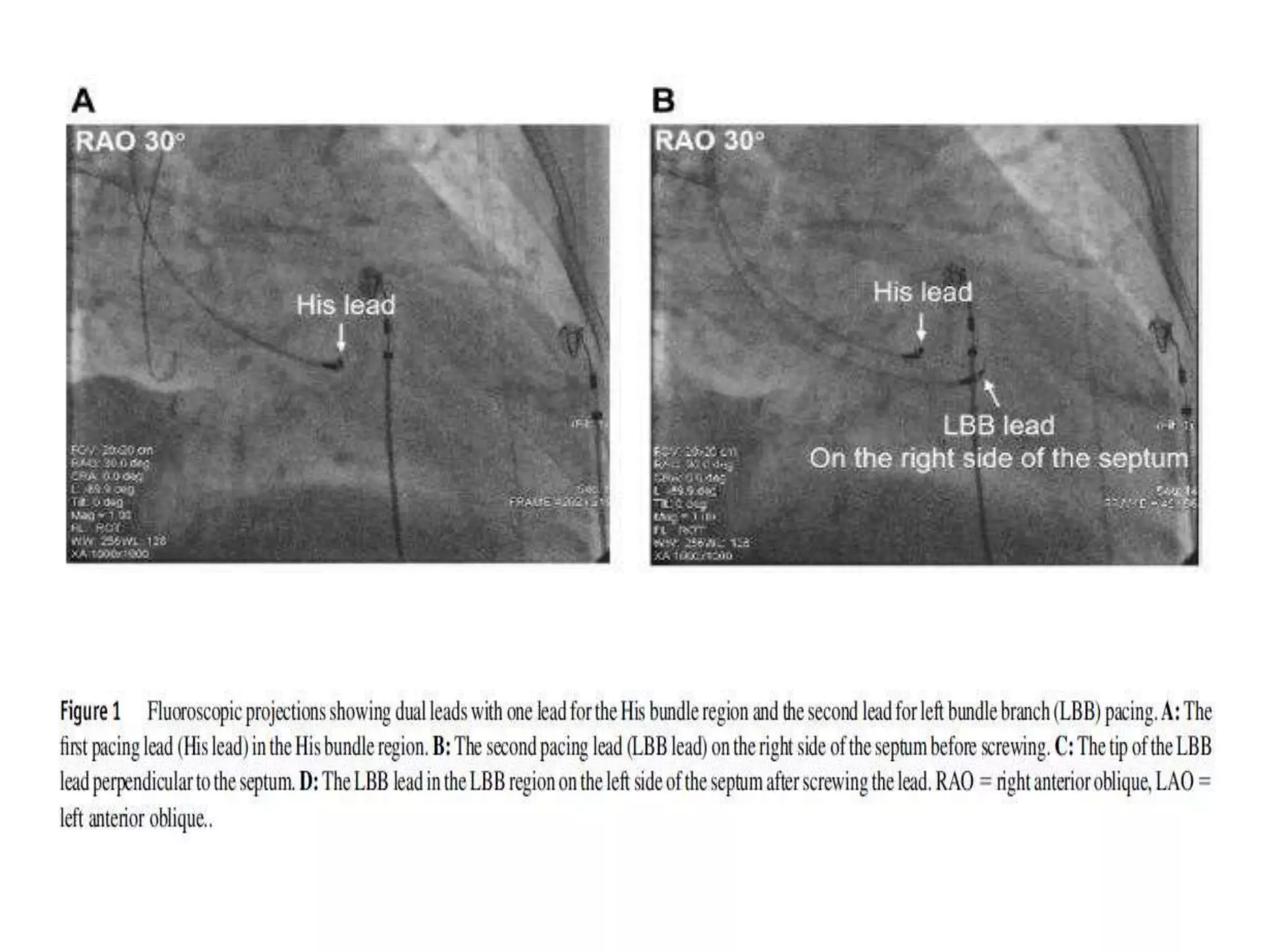
• The first technique uses the His bundle region
as an anatomical marker. Briefly, the delivery
sheath with the lead tip just beyond the distal
part of the sheath in the right anterior oblique
(RAO) 30 projection is first inserted into the
His bundle region where the His bundle
potential is recorded.
• The His bundle region is referred as a marker,
and the sheath with the lead is further
advanced toward the ventricular septum.
• Once the lead touches the right side of the
septum and the paced QRS morphology shows
ECG LBBB morphology during pacing with an
output of 5V/0.5 ms, the lead is pointed
toward the left side of the septum and
screwed in place.
• Once the paced QRS morphology shows right
bundle branch delay (RBBD; usually QR or rSR
in ECG lead V1/2) or near-normal QRS
complex, the lead advancement is stopped.
• In the second technique, the sheath is directly
inserted into the right ventricle and the pacing
lead is advanced through the sheath such that
only the distal part is beyond the tip of the
sheath. Subsequently, the sheath and the lead
touched the right side of the septum and
pacing with an output of 2.0 V/0.5 ms is
applied.
• Once the paced ECG QRS morphology
presented as LBBB morphology frequently
with a notch (also called “W” waveform) at
the nadir of the QRS waveform in ECG lead V1,
the lead is fixed at this position with 4–5
clockwise rotations. A high-quality
fluoroscopic radiograph confirm the tip of the
lead toward the septum in the left anterior
oblique (LAO) 30 projection.
• Then the lead is screwed toward the left side of
the septum in the RAO 30 projection. Once the
paced QRS morphology became RBB or near-
normal QRS complex, the lead advancement is
stopped.
• The depth of the lead inside the ventricular
septum could be estimated by fluoroscopic
imaging with contrast injection.
• If an acceptable LBBP could not be achieved after
attempts at 3 locations, the lead is placed in the
right ventricular septum.
Definitions
• The criteria for LBBP is defined as:
(1) a left bundle branch potential could be
recorded;
(2) the interval from pacing to ECG QRS onset is
significantly shorter than the interval of His
pacing to ECG QRS onset reported Previously.
(3) the 12-lead ECG shows the pattern of RBB
during LBBP or correction of LBBB if the patient
had ECG LBBB
(4) a fast left ventricular (LV) peak activation time in
ECG lead V5/6 is observed.
• Selective LBBP is defined as follows:
• 1. There is an isoelectric interval between
pacing spike and ECG QRS complex.
• 2. The pacing spike–QRS interval is almost
identical with the left bundle potential–QRS
interval.
• 3. A local ventricular EGM is present as a
discrete component.
• Nonselective LBBP is defined by the following
criteria:
• 1. There is no isoelectric interval between
pacing spike and ECG QRS complex.
• 2. The local ventricular EGM shows direct
capture of local tissue by the pacing stimulus.
Data collection and follow-up
• Demographic data and medical history were
collected at enrollment. Pacing electrical parameters
(pacing threshold, lead impedance, and R-wave
amplitude), ECG and intracardiac EGM pattern, QRSd,
LV peak activation time, the pacing spike-QRS
interval, the amplitude of the left bundle branch
potential, the interval from the left bundle branch
potential to the beginning of ECG QRS complex,
fluoroscopy exposure time, and imaging data were
recorded during implantation.
• Patients were followed at predischarge and 3
months. Pacing electrical parameters were
recorded at outpatient visit. Complications
such as significant increases in pacing
threshold, loss of capture, and lead
dislodgment were tracked during follow-up
visits.
Results
• Between October 2017 and October 2018, a
total of 87 patients with bradycardia
underwent LBBP attempts.
Implantation results
• LBBP was successful in 80.5% (70/87) of
patients, and the remaining 17 patients
received right ventricular septal pacing (RVSP).
For LBBP, a single-chamber pacemaker was
implanted in 2.9% (2/70) of patients and a
dual-chamber pacemaker in 97.1% (68/70) of
patients.
• The mean procedure time of LBBP
implantation was 18.0 +- 8.8 minutes with a
fluoroscopic exposure time of 3.9 +- 2.7
minutes. The cause of unsuccessful LBBP
implantation was the failure of the lead tip to
advance successfully to the left side of the
septum.
• In these instances, the lead tip remained on
the right side of the septum or in the middle
of the septum but could not reach the left
side of the septum. Possible causes of these
failures may be related to the direction that
the tip advanced with deployment, lead
design limitation, or local hypertrophied
myocardium.
ECG characteristics
• There is a typical transition of ECG
morphology during the lead implantation for
LBBP. During the process of deploying the
pacing lead from the right to the left side of
the septum, the paced ECG morphology
changes from LBBB to RBBD with a gradual
change in the notch morphology in lead V1.
• The mean QRSd was 105.5 +_ 22.2 ms, and
the paced QRSd was 113.2 +_ 9.9 ms (P , .05).
During the implantation procedure, the paced
QRSd during LBBP was significantly shorter
than during pacing at the right side of the
septum (113.2 6 9.9 ms vs 139.5 6 12.8 ms; P ,
.001).
• Moreover, QRSd was ,120 ms in 80% (56/70)
of patients with LBBP and no patient with
RVSP (0%) (P - .001).
• The LV peak activation time was 79.7 +- 8.5 ms
during LBBP, which is shorter than during
pacing at the right sideof the septum (103.3 +-
11.4 ms; P , .001).
• During selective LBBP, the pacing-QRS interval
was 28.0 +-5.0 ms, which was similar to the
left bundle potential–QRS interval (25.6 +- 4.7
ms). During nonselective LBBP, there was no
delay in the onset of the QRS with no
isoelectric interval.
Discussion
• High success rate of LBBP (80.5%)
• The QRSd on the surface ECG is a surrogate of
ventricular activation time. It is interesting that
the mean QRSd was 120 ms despite selective
LBBP, which would be expected to produce
complete right bundle branch block.
• This finding may be due to retrograde activation
of the right bundle with pacing or connections
between the main right and left bundles.
Possible explanations for failure to achieve LBB
capture include the following:
(1) the inability of the lead to penetrate sufficiently
deep in the septum to reach the left bundle;
(2) the sheath being malpositioned such that the
lead is not advanced perpendicular to the
ventricular septum;
(3) the failure of the lead tip to be deployed to the
left side of the septum because of lead design
limitation or local hypertrophied myocardium.
Advantages of LBBP over HBP.
• First, high pacing threshold and threshold
increase over time are relatively frequent with
HBP, likely because of the anatomical
characteristics of the His bundle, inadequate
fixation, local fibrosis, tricuspid valve motion,
and pathological progression in the His bundle
region. The HBP capture threshold shows a
clinically significant increase over time in 10%
patients.
• LBBP is achieved by the trans-ventricular-
septal method, and the pacing lead is
positioned in the basal ventricular septum.
The left bundle branch usually spreads below
the membranous septum with well-defined
dimensions, and there is less fibrosis wrapped
than the His bundle. Thus, it is not surprising
that a lower pacing threshold is noted.
• Second, because the pacing lead tip of LBBP
bypasses the vulnerable region of the His
bundle, the pacing threshold is stable.
• Third, since the pacing tip is fixed at or near
the left bundle branch with nearby myocardial
tissue and the myocardium can be captured at
the pacing output, there is no need to implant
a backup lead in case of loss of capture.
• Finally, the R-wave amplitude recorded at the
site of LBBP is high, which is important for
appropriate sensing and capture management
by a pacemaker.
Conclusion
• successfully performed LBBP in 80.5% of patients.
• The accurate location for LBBP can be targeted
during implantation given the characteristic
changes in paced QRS morphology during lead
deployment.
• The low pacing output and high R-wave
amplitude during LBBP favor long-term pacing
management and device longevity.
• LBBP produces a narrow QRSd and short LV peak
activation time, suggesting synchronized
ventricular activation.
• So more studies are needed to see long term
benefit of LBBP and its use for cardiac
resynchronisation therapy.
Thank you

Lbbb pacing

  • 1.
  • 2.
    Introduction • Traditional rightventricular apical pacing (RVAP) has been widely used for 50 years. However, RVAP can lead to ventricular electrical and mechanical asynchrony in patients who need frequent pacing. • As a consequence, RVAP is associated with an increased risk of heart failure, mitral valve dysfunction, and atrial fibrillation.
  • 3.
    • Pacing atalternative right ventricular sites, such as the septum or outflow tract, has not been shown to be superior to RVAP. • Accordingly, there has been increased interest in physiological pacing techniques. His bundle pacing (HBP) is the most commonly used approach with multiple studies demonstrating feasibility and clinical benefits.
  • 4.
    • However, HBPalso has some limitations, including high and unstable pacing threshold, low R-wave amplitude, damage to the His bundle during implantation, and potential limitations in long-term performance.
  • 5.
    • To helpaddress these issues, techniques for pacing the left bundle branch were developed • left bundle branch pacing (LBBP) is achieved by a trans-ventricular-septal approach in patients with bradycardia, which demonstrated a low and stable pacing threshold and large R-wave amplitude and shorter paced QRS duration (QRSd) compared to RV septal and apical pacing.
  • 6.
    Today I willdiscuss rate, safety, pacing characteristics, and midterm outcomes of LBBP.
  • 7.
    Methods • From October2017 to October 2018, patients who had symptomatic bradycardia with an indication for pacemaker implantation according to 2013 ESC guidelines underwent LBBP attempts at Beijing Fuwai Hospital after informed written consent was obtained.
  • 8.
    Lead implantation • LBBPwas achieved by the trans-ventricular- septal method in the basal ventricular septum and performed by using the Select-Secure pacing lead (model 3830 69 cm, Medtronic) delivered through a fixed curve sheath (C315 HIS, Medtronic Inc., Minneapolis, MN). • There are 2 methods of LBBP lead implantation.
  • 9.
    • The firsttechnique uses the His bundle region as an anatomical marker. Briefly, the delivery sheath with the lead tip just beyond the distal part of the sheath in the right anterior oblique (RAO) 30 projection is first inserted into the His bundle region where the His bundle potential is recorded.
  • 10.
    • The Hisbundle region is referred as a marker, and the sheath with the lead is further advanced toward the ventricular septum. • Once the lead touches the right side of the septum and the paced QRS morphology shows ECG LBBB morphology during pacing with an output of 5V/0.5 ms, the lead is pointed toward the left side of the septum and screwed in place.
  • 11.
    • Once thepaced QRS morphology shows right bundle branch delay (RBBD; usually QR or rSR in ECG lead V1/2) or near-normal QRS complex, the lead advancement is stopped.
  • 12.
    • In thesecond technique, the sheath is directly inserted into the right ventricle and the pacing lead is advanced through the sheath such that only the distal part is beyond the tip of the sheath. Subsequently, the sheath and the lead touched the right side of the septum and pacing with an output of 2.0 V/0.5 ms is applied.
  • 13.
    • Once thepaced ECG QRS morphology presented as LBBB morphology frequently with a notch (also called “W” waveform) at the nadir of the QRS waveform in ECG lead V1, the lead is fixed at this position with 4–5 clockwise rotations. A high-quality fluoroscopic radiograph confirm the tip of the lead toward the septum in the left anterior oblique (LAO) 30 projection.
  • 14.
    • Then thelead is screwed toward the left side of the septum in the RAO 30 projection. Once the paced QRS morphology became RBB or near- normal QRS complex, the lead advancement is stopped. • The depth of the lead inside the ventricular septum could be estimated by fluoroscopic imaging with contrast injection. • If an acceptable LBBP could not be achieved after attempts at 3 locations, the lead is placed in the right ventricular septum.
  • 18.
    Definitions • The criteriafor LBBP is defined as: (1) a left bundle branch potential could be recorded; (2) the interval from pacing to ECG QRS onset is significantly shorter than the interval of His pacing to ECG QRS onset reported Previously. (3) the 12-lead ECG shows the pattern of RBB during LBBP or correction of LBBB if the patient had ECG LBBB (4) a fast left ventricular (LV) peak activation time in ECG lead V5/6 is observed.
  • 19.
    • Selective LBBPis defined as follows: • 1. There is an isoelectric interval between pacing spike and ECG QRS complex. • 2. The pacing spike–QRS interval is almost identical with the left bundle potential–QRS interval. • 3. A local ventricular EGM is present as a discrete component.
  • 20.
    • Nonselective LBBPis defined by the following criteria: • 1. There is no isoelectric interval between pacing spike and ECG QRS complex. • 2. The local ventricular EGM shows direct capture of local tissue by the pacing stimulus.
  • 22.
    Data collection andfollow-up • Demographic data and medical history were collected at enrollment. Pacing electrical parameters (pacing threshold, lead impedance, and R-wave amplitude), ECG and intracardiac EGM pattern, QRSd, LV peak activation time, the pacing spike-QRS interval, the amplitude of the left bundle branch potential, the interval from the left bundle branch potential to the beginning of ECG QRS complex, fluoroscopy exposure time, and imaging data were recorded during implantation.
  • 23.
    • Patients werefollowed at predischarge and 3 months. Pacing electrical parameters were recorded at outpatient visit. Complications such as significant increases in pacing threshold, loss of capture, and lead dislodgment were tracked during follow-up visits.
  • 24.
    Results • Between October2017 and October 2018, a total of 87 patients with bradycardia underwent LBBP attempts.
  • 26.
    Implantation results • LBBPwas successful in 80.5% (70/87) of patients, and the remaining 17 patients received right ventricular septal pacing (RVSP). For LBBP, a single-chamber pacemaker was implanted in 2.9% (2/70) of patients and a dual-chamber pacemaker in 97.1% (68/70) of patients.
  • 27.
    • The meanprocedure time of LBBP implantation was 18.0 +- 8.8 minutes with a fluoroscopic exposure time of 3.9 +- 2.7 minutes. The cause of unsuccessful LBBP implantation was the failure of the lead tip to advance successfully to the left side of the septum.
  • 28.
    • In theseinstances, the lead tip remained on the right side of the septum or in the middle of the septum but could not reach the left side of the septum. Possible causes of these failures may be related to the direction that the tip advanced with deployment, lead design limitation, or local hypertrophied myocardium.
  • 29.
    ECG characteristics • Thereis a typical transition of ECG morphology during the lead implantation for LBBP. During the process of deploying the pacing lead from the right to the left side of the septum, the paced ECG morphology changes from LBBB to RBBD with a gradual change in the notch morphology in lead V1.
  • 30.
    • The meanQRSd was 105.5 +_ 22.2 ms, and the paced QRSd was 113.2 +_ 9.9 ms (P , .05). During the implantation procedure, the paced QRSd during LBBP was significantly shorter than during pacing at the right side of the septum (113.2 6 9.9 ms vs 139.5 6 12.8 ms; P , .001).
  • 31.
    • Moreover, QRSdwas ,120 ms in 80% (56/70) of patients with LBBP and no patient with RVSP (0%) (P - .001). • The LV peak activation time was 79.7 +- 8.5 ms during LBBP, which is shorter than during pacing at the right sideof the septum (103.3 +- 11.4 ms; P , .001).
  • 32.
    • During selectiveLBBP, the pacing-QRS interval was 28.0 +-5.0 ms, which was similar to the left bundle potential–QRS interval (25.6 +- 4.7 ms). During nonselective LBBP, there was no delay in the onset of the QRS with no isoelectric interval.
  • 35.
    Discussion • High successrate of LBBP (80.5%) • The QRSd on the surface ECG is a surrogate of ventricular activation time. It is interesting that the mean QRSd was 120 ms despite selective LBBP, which would be expected to produce complete right bundle branch block. • This finding may be due to retrograde activation of the right bundle with pacing or connections between the main right and left bundles.
  • 36.
    Possible explanations forfailure to achieve LBB capture include the following: (1) the inability of the lead to penetrate sufficiently deep in the septum to reach the left bundle; (2) the sheath being malpositioned such that the lead is not advanced perpendicular to the ventricular septum; (3) the failure of the lead tip to be deployed to the left side of the septum because of lead design limitation or local hypertrophied myocardium.
  • 37.
    Advantages of LBBPover HBP. • First, high pacing threshold and threshold increase over time are relatively frequent with HBP, likely because of the anatomical characteristics of the His bundle, inadequate fixation, local fibrosis, tricuspid valve motion, and pathological progression in the His bundle region. The HBP capture threshold shows a clinically significant increase over time in 10% patients.
  • 38.
    • LBBP isachieved by the trans-ventricular- septal method, and the pacing lead is positioned in the basal ventricular septum. The left bundle branch usually spreads below the membranous septum with well-defined dimensions, and there is less fibrosis wrapped than the His bundle. Thus, it is not surprising that a lower pacing threshold is noted.
  • 39.
    • Second, becausethe pacing lead tip of LBBP bypasses the vulnerable region of the His bundle, the pacing threshold is stable. • Third, since the pacing tip is fixed at or near the left bundle branch with nearby myocardial tissue and the myocardium can be captured at the pacing output, there is no need to implant a backup lead in case of loss of capture.
  • 40.
    • Finally, theR-wave amplitude recorded at the site of LBBP is high, which is important for appropriate sensing and capture management by a pacemaker.
  • 41.
    Conclusion • successfully performedLBBP in 80.5% of patients. • The accurate location for LBBP can be targeted during implantation given the characteristic changes in paced QRS morphology during lead deployment. • The low pacing output and high R-wave amplitude during LBBP favor long-term pacing management and device longevity. • LBBP produces a narrow QRSd and short LV peak activation time, suggesting synchronized ventricular activation.
  • 42.
    • So morestudies are needed to see long term benefit of LBBP and its use for cardiac resynchronisation therapy.
  • 43.