Complex SVT
 with differentiation
Advanced Cardiac Arrhythmia
      Training Course
    ( 中華民國心律醫學會 )

   謝敏雄 醫師
台北醫學大學醫學系副教授
 萬芳醫院心臟內科主任
    April 15, 2012 於台北國賓飯店
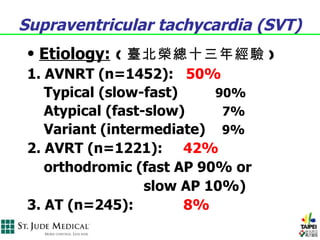
Supraventricular tachycardia (SVT)
 • Etiology: ( 臺北榮總十三年經驗 )
 1. AVNRT (n=1452): 50%
    Typical (slow-fast)     90%
    Atypical (fast-slow)     7%
    Variant (intermediate) 9%
 2. AVRT (n=1221): 42%
    orthodromic (fast AP 90% or
                   slow AP 10%)
 3. AT (n=245):         8%
12-lead ECG for
differential diagnosis
 of SVTs (important!)
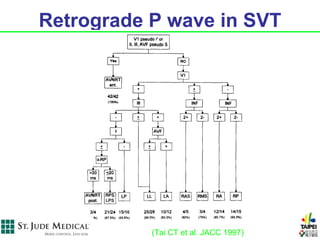
Retrograde P wave in SVT


           (Tai CT et al. JACC 1997)
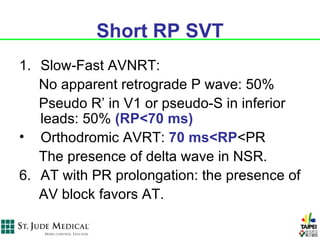
Short RP SVT
1. Slow-Fast AVNRT:
   No apparent retrograde P wave: 50%
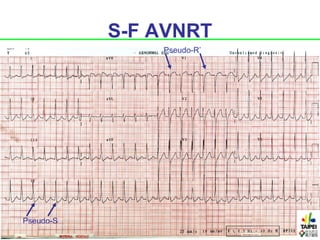
   Pseudo R’ in V1 or pseudo-S in inferior
   leads: 50% (RP<70 ms)
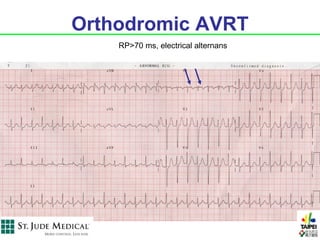
• Orthodromic AVRT: 70 ms<RP<PR
   The presence of delta wave in NSR.
6. AT with PR prolongation: the presence of
   AV block favors AT.
S-F AVNRT
               Pseudo-R’


Pseudo-S
Orthodromic AVRT
    RP>70 ms, electrical alternans
SVT with Electrical Alternans
• Electrical (QRS) alternans during narrow
  QRS tachycardias is a rate-related
  phenomenon.
• It depends on an abrupt increase to a
  critical rate.
• It is independent of the tachycardia
  mechanism.


                       (Morady F et al. JACC 1987)
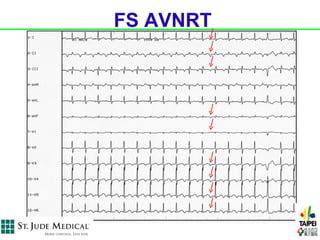
Long RP SVT
1. Fast-Slow AVNRT:
   Positive p wave in V1 and negative p
   wave in inferior leads.
• Are the P waves of SF and FS AVNRT
   different?
4. Orthodromic AVRT using decremental
   (slow) APs.
3. AT with normal PR interval.
FS AVNRT
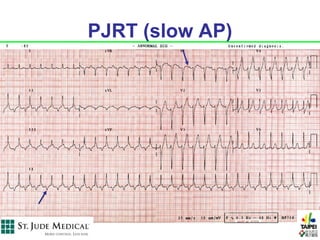
PJRT (slow AP)
PJRT
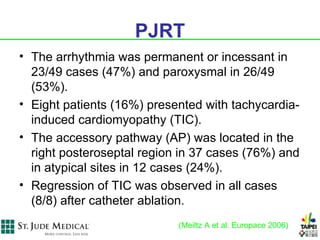
• The arrhythmia was permanent or incessant in
  23/49 cases (47%) and paroxysmal in 26/49
  (53%).
• Eight patients (16%) presented with tachycardia-
  induced cardiomyopathy (TIC).
• The accessory pathway (AP) was located in the
  right posteroseptal region in 37 cases (76%) and
  in atypical sites in 12 cases (24%).
• Regression of TIC was observed in all cases
  (8/8) after catheter ablation.
                            (Meiltz A et al. Europace 2006)
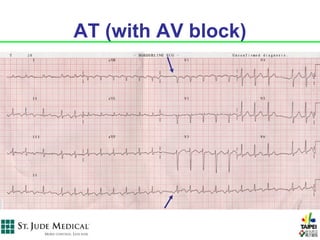
AT (with AV block)
EP study for
differential diagnosis
        of SVTs
Favors AVNRT
1. The presence of dual AVN physiology:
   upper or lower common pathway.
2. The critical prolongation (jump) of AH
   interval during the initiation of SVT.
3. The concentric atrial activation:
   especially a straight line from ECG-A-V
   or A before V (SF AVNRT)
AVNRT
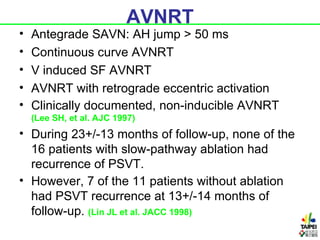
•   Antegrade SAVN: AH jump > 50 ms
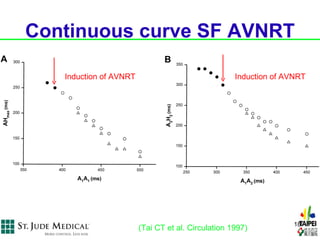
•   Continuous curve AVNRT
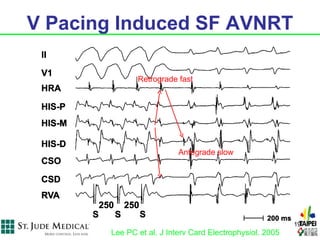
•   V induced SF AVNRT
•   AVNRT with retrograde eccentric activation
•   Clinically documented, non-inducible AVNRT
    (Lee SH, et al. AJC 1997)
• During 23+/-13 months of follow-up, none of the
  16 patients with slow-pathway ablation had
  recurrence of PSVT.
• However, 7 of the 11 patients without ablation
  had PSVT recurrence at 13+/-14 months of
  follow-up. (Lin JL et al. JACC 1998)
Definitions
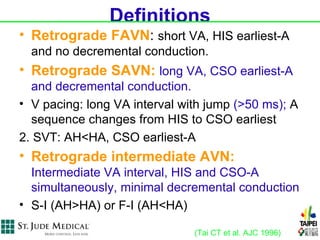
• Retrograde FAVN: short VA, HIS earliest-A
  and no decremental conduction.
• Retrograde SAVN: long VA, CSO earliest-A
  and decremental conduction.
• V pacing: long VA interval with jump (>50 ms); A
  sequence changes from HIS to CSO earliest
2. SVT: AH<HA, CSO earliest-A
• Retrograde intermediate AVN:
  Intermediate VA interval, HIS and CSO-A
  simultaneously, minimal decremental conduction
• S-I (AH>HA) or F-I (AH<HA)

                               (Tai CT et al. AJC 1996)
Continuous curve SF AVNRT

   Induction of AVNRT                               Induction of AVNRT


                                                                   18
                        (Tai CT et al. Circulation 1997)
V Pacing Induced SF AVNRT

              Retrograde fast


                          Antegrade slow


                                                          19
       Lee PC et al. J Interv Card Electrophysiol. 2005
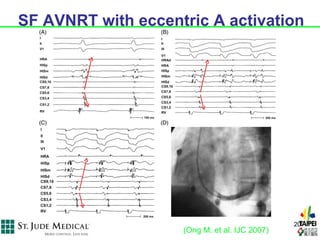
SF AVNRT with eccentric A activation


                                               20
                    (Ong M. et al. IJC 2007)
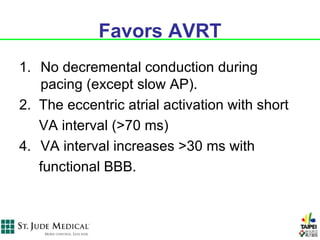
Favors AVRT
1. No decremental conduction during
   pacing (except slow AP).
2. The eccentric atrial activation with short
   VA interval (>70 ms)
4. VA interval increases >30 ms with
   functional BBB.
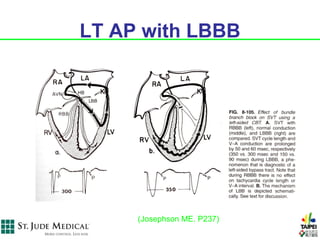
LT AP with LBBB


     (Josephson ME. P237)
Single VPC reset SVT
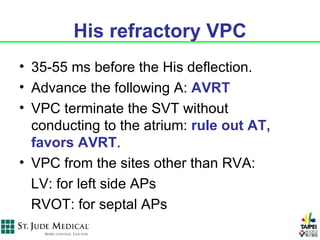
His refractory VPC
• 35-55 ms before the His deflection.
• Advance the following A: AVRT
• VPC terminate the SVT without
  conducting to the atrium: rule out AT,
  favors AVRT.
• VPC from the sites other than RVA:
  LV: for left side APs
  RVOT: for septal APs
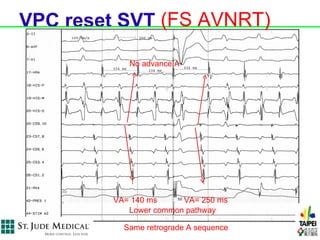
VPC reset SVT (FS AVNRT)

           No advance A


        VA= 140 ms     VA= 250 ms
           Lower common pathway

          Same retrograde A sequence
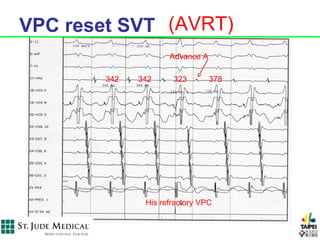
VPC reset SVT (AVRT)
                     Advance A

        342   342     323        378


               His refractory VPC
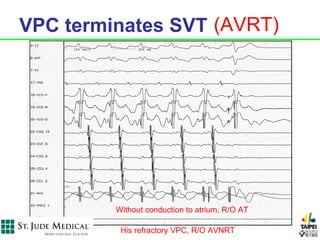
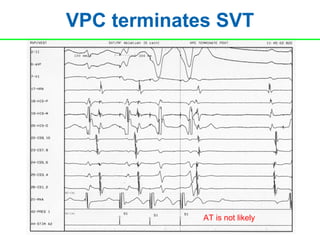
VPC terminates SVT (AVRT)


         Without conduction to atrium, R/O AT

          His refractory VPC, R/O AVNRT
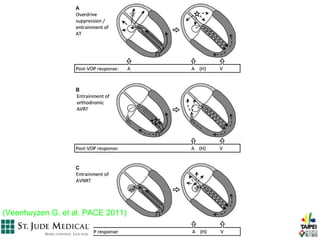
Ventricular Overdrive
 Pacing (VOP) (10-40 ms
shorter than tachycardia)
       during SVT
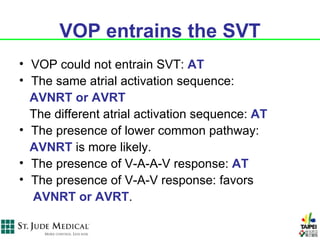
VOP entrains the SVT
• VOP could not entrain SVT: AT
• The same atrial activation sequence:
  AVNRT or AVRT
  The different atrial activation sequence: AT
• The presence of lower common pathway:
  AVNRT is more likely.
• The presence of V-A-A-V response: AT
• The presence of V-A-V response: favors
  AVNRT or AVRT.
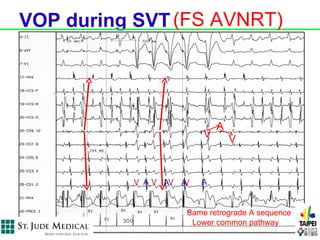
VOP during SVT (FS AVNRT)


                            A
                        V       V


          V A V AV AV   A


                    Same retrograde A sequence
                     Lower common pathway
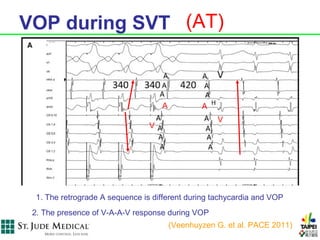
VOP during SVT (AT)


                                     A           A
                                                     V
                                 V


  1. The retrograde A sequence is different during tachycardia and VOP
 2. The presence of V-A-A-V response during VOP
                                         (Veenhuyzen G. et al. PACE 2011)
(Veenhuyzen G. et al. PACE 2011)
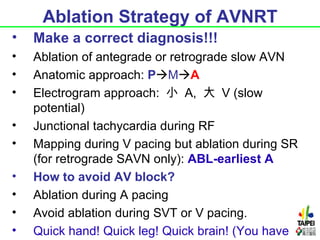
Ablation Strategy of AVNRT
•   Make a correct diagnosis!!!
•   Ablation of antegrade or retrograde slow AVN
•   Anatomic approach: PMA
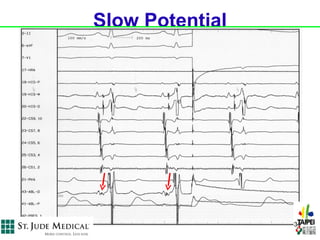
•   Electrogram approach: 小 A, 大 V (slow
    potential)
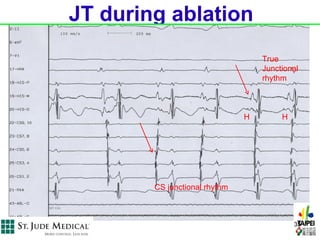
•   Junctional tachycardia during RF
•   Mapping during V pacing but ablation during SR
    (for retrograde SAVN only): ABL-earliest A
•   How to avoid AV block?
•   Ablation during A pacing
•   Avoid ablation during SVT or V pacing.
•   Quick hand! Quick leg! Quick brain! (You have
Slow Potential


                 34
JT during ablation
                                   True
                                   Junctional
                                   rhythm


                               H        H


        CS junctional rhythm


                                            35
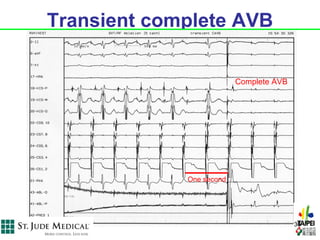
Transient complete AVB

                          Complete AVB


             One second


                                         36
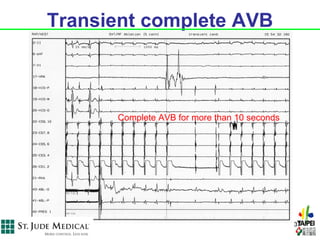
Transient complete AVB


      Complete AVB for more than 10 seconds


                                              37
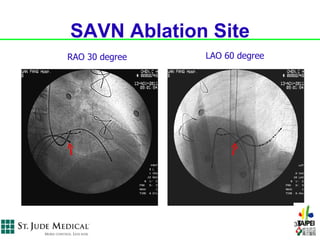
SAVN Ablation Site
RAO 30 degree   LAO 60 degree


                                38
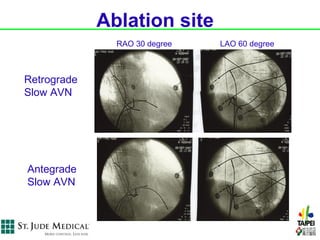
Ablation site
               RAO 30 degree   LAO 60 degree


Retrograde
Slow AVN


Antegrade
Slow AVN
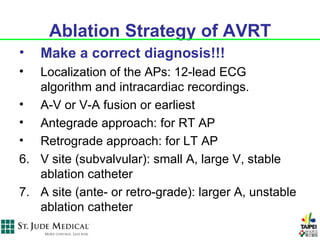
Ablation Strategy of AVRT
•   Make a correct diagnosis!!!
•  Localization of the APs: 12-lead ECG
   algorithm and intracardiac recordings.
• A-V or V-A fusion or earliest
• Antegrade approach: for RT AP
• Retrograde approach: for LT AP
6. V site (subvalvular): small A, large V, stable
   ablation catheter
7. A site (ante- or retro-grade): larger A, unstable
   ablation catheter
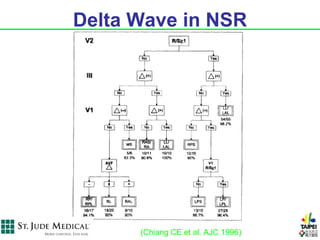
Delta Wave in NSR


      (Chiang CE et al. AJC 1996)
Cases Discussion
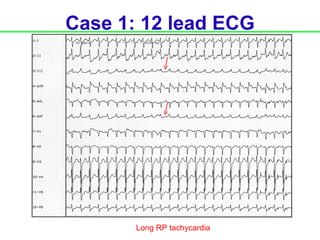
Case 1: 12 lead ECG


       Long RP tachycardia
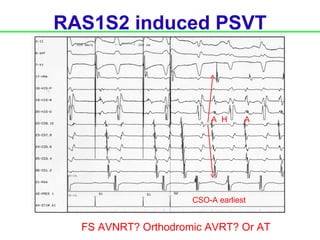
RAS1S2 induced PSVT


                         A H      A


                     CSO-A earliest


  FS AVNRT? Orthodromic AVRT? Or AT
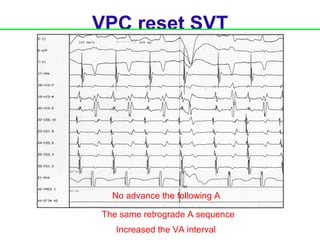
VPC reset SVT


  No advance the following A

The same retrograde A sequence
   Increased the VA interval
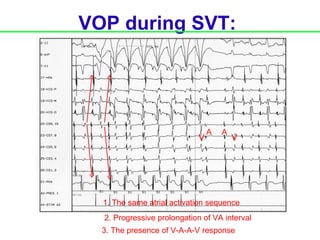
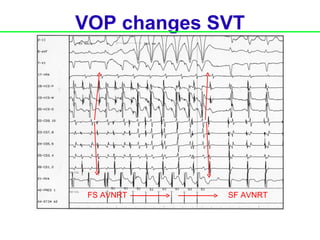
VOP during SVT:


                                A   A
                            V           V


  1. The same atrial activation sequence
  2. Progressive prolongation of VA interval
  3. The presence of V-A-A-V response
VOP changes SVT


 FS AVNRT    SF AVNRT
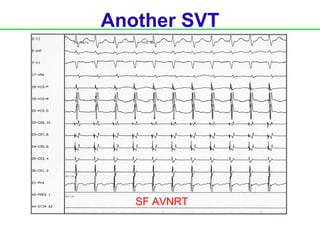
Another SVT


   SF AVNRT
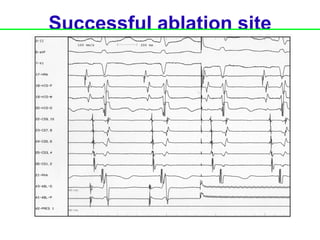
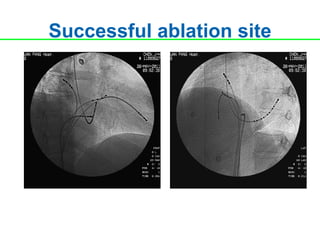
Successful ablation site
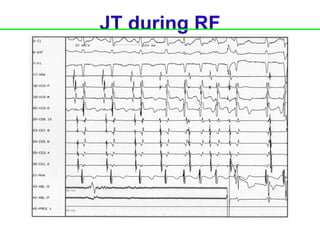
JT during RF
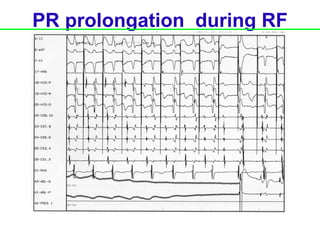
PR prolongation during RF
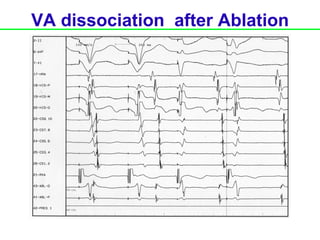
VA dissociation after Ablation
Successful ablation site
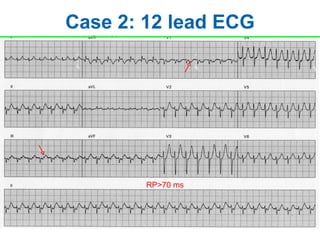
Case 2: 12 lead ECG


        RP>70 ms
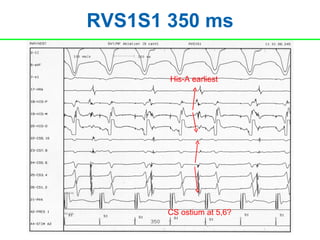
RVS1S1 350 ms

       His-A earliest


       CS ostium at 5,6?
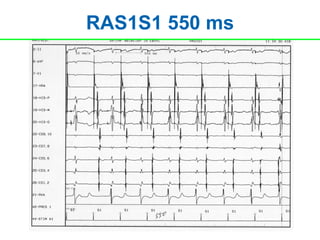
RAS1S1 550 ms
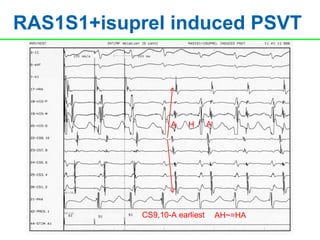
RAS1S1+isuprel induced PSVT


                   A    H       A


            CS9,10-A earliest       AH~=HA
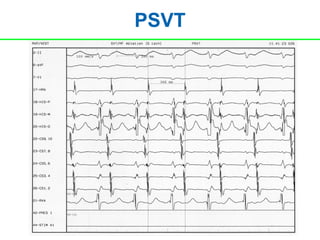
PSVT
VPC terminates SVT


             AT is not likely
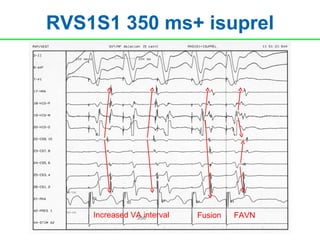
RVS1S1 350 ms+ isuprel


    Increased VA interval   Fusion   FAVN
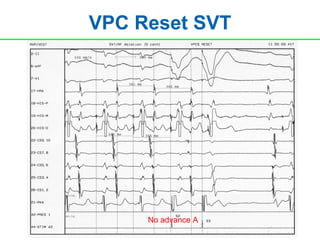
VPC Reset SVT


     No advance A
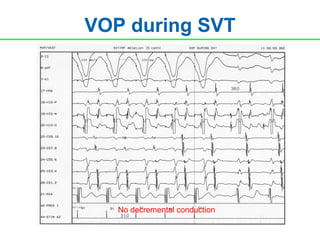
VOP during SVT


   No decremental conduction
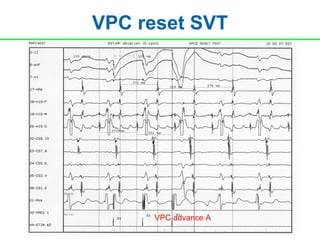
VPC reset SVT


     VPC advance A
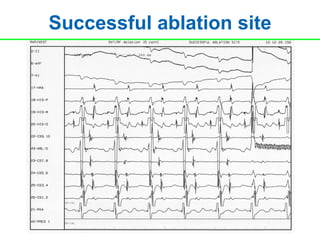
Successful ablation site
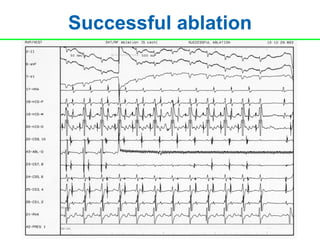
Successful ablation
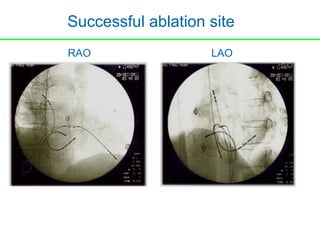
Successful ablation site
RAO                 LAO
Unknown Tracings
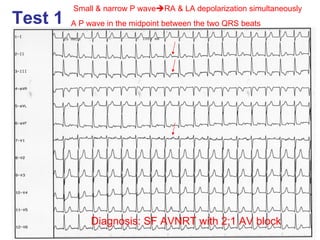
Small & narrow P waveRA & LA depolarization simultaneously
Test 1   A P wave in the midpoint between the two QRS beats


              Diagnosis: SF AVNRT with 2:1 AV block
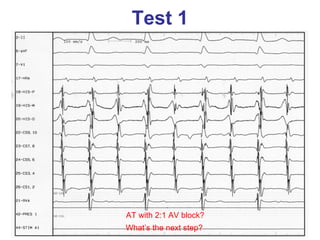
Test 1


AT with 2:1 AV block?
What’s the next step?
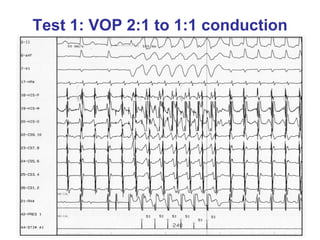
Test 1: VOP 2:1 to 1:1 conduction
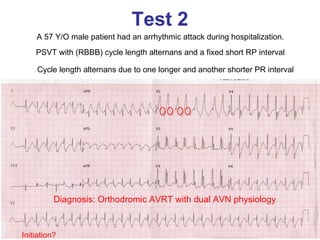
Test 2
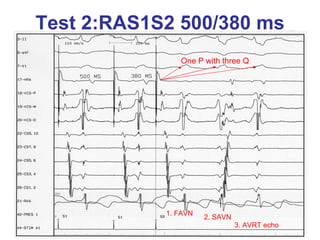
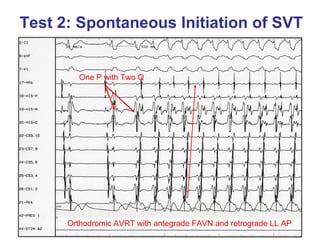
    A 57 Y/O male patient had an arrhythmic attack during hospitalization.
    PSVT with (RBBB) cycle length alternans and a fixed short RP interval

    Cycle length alternans due to one longer and another shorter PR interval


          Diagnosis: Orthodromic AVRT with dual AVN physiology


Initiation?
Test 2:RAS1S2 500/380 ms
               One P with three Q


            1. FAVN
                      2. SAVN
                                3. AVRT echo
Test 2: Spontaneous Initiation of SVT


        One P with Two Q


      Orthodromic AVRT with antegrade FAVN and retrograde LL AP
謝謝聆聽
敬請指教

Complex svt with differentiation

  • 1.
    Complex SVT withdifferentiation Advanced Cardiac Arrhythmia Training Course ( 中華民國心律醫學會 ) 謝敏雄 醫師 台北醫學大學醫學系副教授 萬芳醫院心臟內科主任 April 15, 2012 於台北國賓飯店
  • 2.
    Supraventricular tachycardia (SVT) • Etiology: ( 臺北榮總十三年經驗 ) 1. AVNRT (n=1452): 50% Typical (slow-fast) 90% Atypical (fast-slow) 7% Variant (intermediate) 9% 2. AVRT (n=1221): 42% orthodromic (fast AP 90% or slow AP 10%) 3. AT (n=245): 8%
  • 3.
    12-lead ECG for differentialdiagnosis of SVTs (important!)
  • 4.
    Retrograde P wavein SVT (Tai CT et al. JACC 1997)
  • 5.
    Short RP SVT 1.Slow-Fast AVNRT: No apparent retrograde P wave: 50% Pseudo R’ in V1 or pseudo-S in inferior leads: 50% (RP<70 ms) • Orthodromic AVRT: 70 ms<RP<PR The presence of delta wave in NSR. 6. AT with PR prolongation: the presence of AV block favors AT.
  • 6.
    S-F AVNRT Pseudo-R’ Pseudo-S
  • 7.
    Orthodromic AVRT RP>70 ms, electrical alternans
  • 8.
    SVT with ElectricalAlternans • Electrical (QRS) alternans during narrow QRS tachycardias is a rate-related phenomenon. • It depends on an abrupt increase to a critical rate. • It is independent of the tachycardia mechanism. (Morady F et al. JACC 1987)
  • 9.
    Long RP SVT 1.Fast-Slow AVNRT: Positive p wave in V1 and negative p wave in inferior leads. • Are the P waves of SF and FS AVNRT different? 4. Orthodromic AVRT using decremental (slow) APs. 3. AT with normal PR interval.
  • 10.
  • 11.
  • 12.
    PJRT • The arrhythmiawas permanent or incessant in 23/49 cases (47%) and paroxysmal in 26/49 (53%). • Eight patients (16%) presented with tachycardia- induced cardiomyopathy (TIC). • The accessory pathway (AP) was located in the right posteroseptal region in 37 cases (76%) and in atypical sites in 12 cases (24%). • Regression of TIC was observed in all cases (8/8) after catheter ablation. (Meiltz A et al. Europace 2006)
  • 13.
  • 14.
    EP study for differentialdiagnosis of SVTs
  • 15.
    Favors AVNRT 1. Thepresence of dual AVN physiology: upper or lower common pathway. 2. The critical prolongation (jump) of AH interval during the initiation of SVT. 3. The concentric atrial activation: especially a straight line from ECG-A-V or A before V (SF AVNRT)
  • 16.
    AVNRT • Antegrade SAVN: AH jump > 50 ms • Continuous curve AVNRT • V induced SF AVNRT • AVNRT with retrograde eccentric activation • Clinically documented, non-inducible AVNRT (Lee SH, et al. AJC 1997) • During 23+/-13 months of follow-up, none of the 16 patients with slow-pathway ablation had recurrence of PSVT. • However, 7 of the 11 patients without ablation had PSVT recurrence at 13+/-14 months of follow-up. (Lin JL et al. JACC 1998)
  • 17.
    Definitions • Retrograde FAVN:short VA, HIS earliest-A and no decremental conduction. • Retrograde SAVN: long VA, CSO earliest-A and decremental conduction. • V pacing: long VA interval with jump (>50 ms); A sequence changes from HIS to CSO earliest 2. SVT: AH<HA, CSO earliest-A • Retrograde intermediate AVN: Intermediate VA interval, HIS and CSO-A simultaneously, minimal decremental conduction • S-I (AH>HA) or F-I (AH<HA) (Tai CT et al. AJC 1996)
  • 18.
    Continuous curve SFAVNRT Induction of AVNRT Induction of AVNRT 18 (Tai CT et al. Circulation 1997)
  • 19.
    V Pacing InducedSF AVNRT Retrograde fast Antegrade slow 19 Lee PC et al. J Interv Card Electrophysiol. 2005
  • 20.
    SF AVNRT witheccentric A activation 20 (Ong M. et al. IJC 2007)
  • 21.
    Favors AVRT 1. Nodecremental conduction during pacing (except slow AP). 2. The eccentric atrial activation with short VA interval (>70 ms) 4. VA interval increases >30 ms with functional BBB.
  • 22.
    LT AP withLBBB (Josephson ME. P237)
  • 23.
  • 24.
    His refractory VPC •35-55 ms before the His deflection. • Advance the following A: AVRT • VPC terminate the SVT without conducting to the atrium: rule out AT, favors AVRT. • VPC from the sites other than RVA: LV: for left side APs RVOT: for septal APs
  • 25.
    VPC reset SVT(FS AVNRT) No advance A VA= 140 ms VA= 250 ms Lower common pathway Same retrograde A sequence
  • 26.
    VPC reset SVT(AVRT) Advance A 342 342 323 378 His refractory VPC
  • 27.
    VPC terminates SVT(AVRT) Without conduction to atrium, R/O AT His refractory VPC, R/O AVNRT
  • 28.
    Ventricular Overdrive Pacing(VOP) (10-40 ms shorter than tachycardia) during SVT
  • 29.
    VOP entrains theSVT • VOP could not entrain SVT: AT • The same atrial activation sequence: AVNRT or AVRT The different atrial activation sequence: AT • The presence of lower common pathway: AVNRT is more likely. • The presence of V-A-A-V response: AT • The presence of V-A-V response: favors AVNRT or AVRT.
  • 30.
    VOP during SVT(FS AVNRT) A V V V A V AV AV A Same retrograde A sequence Lower common pathway
  • 31.
    VOP during SVT(AT) A A V V 1. The retrograde A sequence is different during tachycardia and VOP 2. The presence of V-A-A-V response during VOP (Veenhuyzen G. et al. PACE 2011)
  • 32.
    (Veenhuyzen G. etal. PACE 2011)
  • 33.
    Ablation Strategy ofAVNRT • Make a correct diagnosis!!! • Ablation of antegrade or retrograde slow AVN • Anatomic approach: PMA • Electrogram approach: 小 A, 大 V (slow potential) • Junctional tachycardia during RF • Mapping during V pacing but ablation during SR (for retrograde SAVN only): ABL-earliest A • How to avoid AV block? • Ablation during A pacing • Avoid ablation during SVT or V pacing. • Quick hand! Quick leg! Quick brain! (You have
  • 34.
  • 35.
    JT during ablation True Junctional rhythm H H CS junctional rhythm 35
  • 36.
    Transient complete AVB Complete AVB One second 36
  • 37.
    Transient complete AVB Complete AVB for more than 10 seconds 37
  • 38.
    SAVN Ablation Site RAO30 degree LAO 60 degree 38
  • 39.
    Ablation site RAO 30 degree LAO 60 degree Retrograde Slow AVN Antegrade Slow AVN
  • 40.
    Ablation Strategy ofAVRT • Make a correct diagnosis!!! • Localization of the APs: 12-lead ECG algorithm and intracardiac recordings. • A-V or V-A fusion or earliest • Antegrade approach: for RT AP • Retrograde approach: for LT AP 6. V site (subvalvular): small A, large V, stable ablation catheter 7. A site (ante- or retro-grade): larger A, unstable ablation catheter
  • 41.
    Delta Wave inNSR (Chiang CE et al. AJC 1996)
  • 42.
  • 43.
    Case 1: 12lead ECG Long RP tachycardia
  • 44.
    RAS1S2 induced PSVT A H A CSO-A earliest FS AVNRT? Orthodromic AVRT? Or AT
  • 45.
    VPC reset SVT No advance the following A The same retrograde A sequence Increased the VA interval
  • 46.
    VOP during SVT: A A V V 1. The same atrial activation sequence 2. Progressive prolongation of VA interval 3. The presence of V-A-A-V response
  • 47.
    VOP changes SVT FS AVNRT SF AVNRT
  • 48.
    Another SVT SF AVNRT
  • 49.
  • 50.
  • 51.
  • 52.
  • 53.
  • 54.
    Case 2: 12lead ECG RP>70 ms
  • 55.
    RVS1S1 350 ms His-A earliest CS ostium at 5,6?
  • 56.
  • 57.
    RAS1S1+isuprel induced PSVT A H A CS9,10-A earliest AH~=HA
  • 58.
  • 59.
    VPC terminates SVT AT is not likely
  • 60.
    RVS1S1 350 ms+isuprel Increased VA interval Fusion FAVN
  • 61.
    VPC Reset SVT No advance A
  • 62.
    VOP during SVT No decremental conduction
  • 63.
    VPC reset SVT VPC advance A
  • 64.
  • 65.
  • 66.
  • 67.
  • 68.
    Small & narrowP waveRA & LA depolarization simultaneously Test 1 A P wave in the midpoint between the two QRS beats Diagnosis: SF AVNRT with 2:1 AV block
  • 69.
    Test 1 AT with2:1 AV block? What’s the next step?
  • 70.
    Test 1: VOP2:1 to 1:1 conduction
  • 71.
    Test 2 A 57 Y/O male patient had an arrhythmic attack during hospitalization. PSVT with (RBBB) cycle length alternans and a fixed short RP interval Cycle length alternans due to one longer and another shorter PR interval Diagnosis: Orthodromic AVRT with dual AVN physiology Initiation?
  • 72.
    Test 2:RAS1S2 500/380ms One P with three Q 1. FAVN 2. SAVN 3. AVRT echo
  • 73.
    Test 2: SpontaneousInitiation of SVT One P with Two Q Orthodromic AVRT with antegrade FAVN and retrograde LL AP
  • 74.