Electrophysiological
diagnosis and
management of AVRT
Satyam Rajvanshi
W
P
W
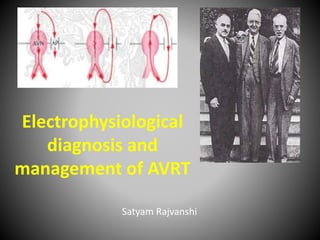
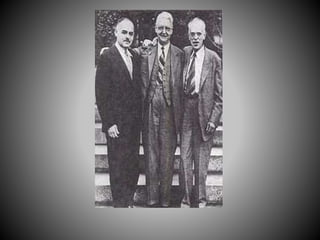
Louis Wolff
John Parkinson
Paul Dudley White
• In 1930, published article
describing 11 patients
who suffered from
attacks of tachycardia
associated with a sinus
rhythm with pattern of
bundle branch block with
a short PR interval
• Later k/a WPW
syndrome!
Louis Wolff
John Parkinson
Paul Dudley White
MECHANISMS OF
TACHYARRHYTHMIAS
• Disorders of Impulse formation
• Disorders of impulse conduction
• Combination of both
• Enhanced impulse formation
– Abnormal automaticity (Phase 4)
• Least affected by Extrastimulus testing
• Overdrive pacing – either overdrive suppression or
No effect
• Enhanced impulse formation
– Triggered activity (Phase 3)
• Least common mech of SVT – eg. Digitalis induced
• Initiated by overdrive pacing without conduction delay
or block
• Overdrive pacing – Acceleration
• Disorders of Impulse formation
• Automaticity
• Triggered activity – EAD/DAD
• Disorders of impulse conduction
• Reentry
• Combination of both
• Disorders of impulse conduction
– Reentry
• Pathway - Anatomic, Functional, Both
• MC mechanism of SVTs
REENTRY
The 3 conditions for reentry
• Atleast 2 functional (or anatomic) distinct
pathways
– Joining proximally and distally
– Forming a closed circuit of conduction
The 3 conditions for reentry
• Unidirectional block in 1 of the pathways
The 3 conditions for reentry
• Slow conduction down the unblocked
pathway – allowing the previously blocked
pathway time to recover excitability
Sites of re-entry in SVT
AVRT: INTRODUCTION
AVRT
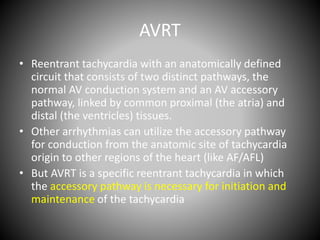
• Reentrant tachycardia with an anatomically defined
circuit that consists of two distinct pathways, the
normal AV conduction system and an AV accessory
pathway, linked by common proximal (the atria) and
distal (the ventricles) tissues.
• Other arrhythmias can utilize the accessory pathway
for conduction from the anatomic site of tachycardia
origin to other regions of the heart (like AF/AFL)
• But AVRT is a specific reentrant tachycardia in which
the accessory pathway is necessary for initiation and
maintenance of the tachycardia
AVRT
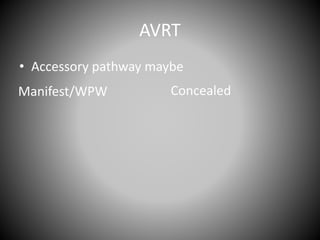
• Accessory pathway maybe
Manifest/WPW Concealed
AVRT
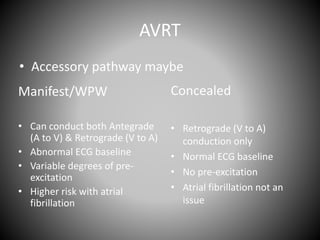
• Accessory pathway maybe
Manifest/WPW
• Can conduct both Antegrade
(A to V) & Retrograde (V to A)
• Abnormal ECG baseline
• Variable degrees of pre-
excitation
• Higher risk with atrial
fibrillation
Concealed
• Retrograde (V to A)
conduction only
• Normal ECG baseline
• No pre-excitation
• Atrial fibrillation not an
issue
AVRT
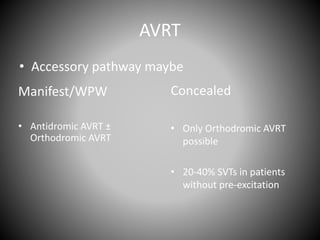
• Accessory pathway maybe
Manifest/WPW
• Antidromic AVRT ±
Orthodromic AVRT
Concealed
• Only Orthodromic AVRT
possible
• 20-40% SVTs in patients
without pre-excitation
AVRT
• Accessory pathway maybe
Manifest/WPW
• Antidromic AVRT ±
Orthodromic AVRT
Concealed
• Only Orthodromic AVRT
possible
• 90% - Fast conducting
• 10% - Slow (decremental)
conduction - PJRT
AV conduction in concealed AP
Vn – normal ventricular activation
AV conduction in manifest AP
Vn – normal ventricular activation
Vp – ventricular activation via AP
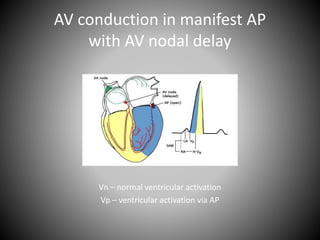
AV conduction in manifest AP
with AV nodal delay
Vn – normal ventricular activation
Vp – ventricular activation via AP
Pre excitation syndromes
• Preexcitation
– Exists when in relation to atrial events, all or some
part of ventricle is activated sooner than would be
expected if the impulse reached ventricle by
normal AV conduction
Pre excitation syndromes
• Old classification – various eponyms
– Kent fibre (A-V)
– James fibre (Atrio-nodal)
– Mahaim fibre (Atrio-Fasc or Nodo-Fasc)
• Antidromic AVRT with LBBB + superior axis
• Progressive increase in the AV interval in response to atrial
overdrive pacing (oppositeto the behavior of the usual AP, in
which preexcitation occurs with short AV intervals)
– WPW syndrome
– LGL syndrome
Pre excitation syndromes
• New classification – No eponyms
– Atrioventricular bypass tract
– Nodoventricular bypass tract
– Fasciculoventricular bypass tract
– AV nodal bypass tract – atrionodal/atriofascicular
Pre excitation syndromes
• New + Old classification
– Atrioventricular bypass tract: WPW syndrome
– Nodoventricular bypass tract: WPW variant
– Fasciculoventricular bypass tract: WPW variant
– Atrionodal bypass tract: LGL syndrome
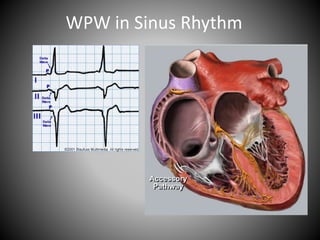
WPW in Sinus Rhythm
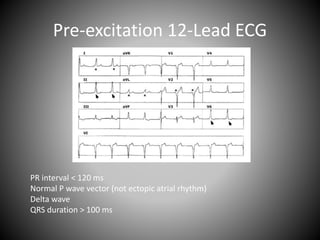
Pre-excitation 12-Lead ECG
PR interval < 120 ms
Normal P wave vector (not ectopic atrial rhythm)
Delta wave
QRS duration > 100 ms
Orthodromic AVRT
Initiated by a closely coupled APC or
VPC
Blocks in the accessory pathway but
conducts through the AV node
Retrograde conduction via accessory
pathway
Inverted P wave produced by
retrograde conduction visible in the
inferior ECG leads
Antidromic AVRT
• Retrograde conduction via AV node
• Antegrade via AP
Orthodromic AVRT: 12-Lead ECG
Ventricular rate typically 150 – 250/min (or greater) beats per minute, regular
Narrow QRS complexes (in the absence of underlying IVCD)
Inverted P waves with an RP interval usually <50% the tachycardia RR interval (RP < PR)
Constant RP interval regardless of the tachycardia cycle length
Beat-to-beat oscillation in QRS amplitude (QRS alternans) sometimes occurs, most
commonly seen when the rate is very rapid
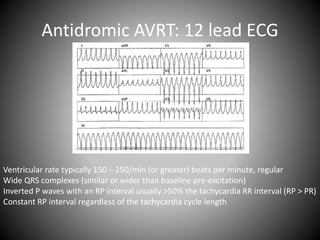
Antidromic AVRT: 12 lead ECG
Ventricular rate typically 150 – 250/min (or greater) beats per minute, regular
Wide QRS complexes (similar or wider than baseline pre-excitation)
Inverted P waves with an RP interval usually >50% the tachycardia RR interval (RP > PR)
Constant RP interval regardless of the tachycardia cycle length
AP Location
• Anywhere along the muscular portion of the posterior and lateral
aspects of the mitral and tricuspid annuli.
Schematic from base of heart From LAO view
AP Location
• None of the various algorithm is perfect
• Simplest algorithm, Fitzpatrick -
EP DIAGNOSIS OF AVRT
The 3 characteristics of reentry
• Initiated by timed extrastimulus – more
effectively than rapid pacing
• Programmed stimulation can also terminate
Tachy
The 3 characteristics of reentry
• No direct relation of pacing cycle length to the
tachy cycle length
The 3 characteristics of reentry
• Extrastimulus can reset or entrain the
Tachycardia in presence of fusion
6 TENETS OF SVT EVALUATION
1
• Mode of initiation
Relation of
– Basic drive cycle length
– ES coupling interval
– Onset of tachy
– Tachy cycle length
• Differentiates triggered activity from reentry
2
• Atrial activation sequence
• P-QRS relation
3
• Effect of BBB during Tachy
– Spontaneous or induced BBB
– On cycle length
– V-A conduction time
4
• Requirement of atria, HB, Ventricle
– in initation and maintenance of tachy
– Effect of AV dissociation on tachy
5
• Effect of atrial or ventricular stimulation
during tachy
6
• Effect of drugs or physiological maneuvers
during Tachy
AVRT: Baseline observation during NSR
• H-V < 35 ms, may be negative
• His potential can be buried in the local ventricular EGM
• Site of earliest ventricular activation is near the
ventricular insertion site of the AP (i.e., near the
tricuspid annulus or mitral annulus at the base of the
heart)
• Slowing of conduction in the AVN by carotid sinus
massage, AVN blockers, or rapid atrial pacing unmasks
and increases the degree of preexcitation, because
these maneuvers do not affect the conduction over the
AP.
• HV -11 ms at AES 600 ms
• HV -65 ms at AES 440 ms
• HV -93 ms at AES 350 ms
• Less preexcitation on sinus beat
AES during NSR
• In the presence of a manifest AV-AP, atrial stimulation from any
atrial site can help unmask preexcitation if it is not manifest during
NSR caused by fast AVN conduction.
• Incremental rate atrial pacing and progressively premature AES
produce decremental conduction over the AVN (but not over the
AP), increasing the degree of preexcitation and shortening the HV
interval, until the His potential is inscribed within the QRS.
• The His potential is still activated anterogradely over the AVN until
anterograde block in the AVN occurs; the QRS then becomes fully
preexcited, and the His potential becomes retrogradely activated
• Atrial stimulation close to or at the AV AP insertion site results in
maximal preexcitation and the shortest P-delta Interval
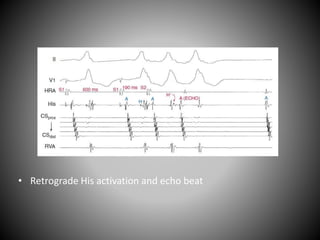
• Retrograde His activation and echo beat
AES during NSR
• The failure of atrial stimulation to increase the
amount of preexcitation can be caused by
– markedly enhanced AVN conduction
– presence of another AV-AP
– pacing-induced block in the AV AP because of a
long ERP of the AP (longer than that of the AVN)
– total preexcitation already present at the basal
state caused by prolonged or absent AVN-HPS
conduction, and/or decremental conduction in the
AP
VES during NSR
Indicators of the presence of a retrogradely conducting
AV AP
• VES resulting in retrograde VA conduction – eccentric
atrial activation sequence
• VES delivered when the HB is refractory that results in
atrial activation
However, if a VES delivered when the HB is refractory
does not result in atrial activation, this does not
necessarily exclude the presence of a retrogradely
conducting AP, because such a VES can be associated
with retrograde block in the AP itself, or presence of
unidirectional (anterograde-only) APs
VES during NSR
• In the presence of a retrogradely conducting AV BT
(whether manifest or concealed), VES during NSR can result
in VA conduction over the BT, AVN, both, or neither
• Conduction over the AP alone is the most common pattern
at short pacing CLs or short VES coupling intervals. In this
case, the VA conduction time is constant over a wide range
of pacing CLs and VES coupling intervals, (in the absence of
intraventricular conduction abnormalities or additional
Aps)
• On the other hand, retrograde conduction over the BT and
HPS-AVN is common when RV pacing is performed in the
presence of a left-sided BT at long pacing CLs or long VES
coupling intervals
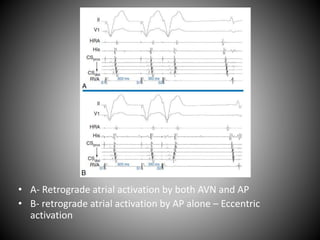
• A- Retrograde atrial activation by both AVN and AP
• B- retrograde atrial activation by AP alone – Eccentric
activation
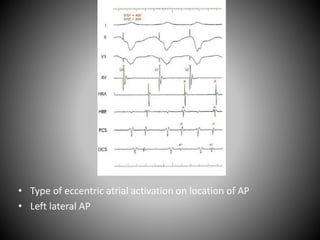
• Type of eccentric atrial activation on location of AP
• Left lateral AP
• Right lateral AP – A in HRA before CS
• Posterosepatal AP – A in PCS before HBE
AVRT induction: Orthodromic AVRT
Initiation of orthodromic AVRT with an AES requires
• Anterograde block in the AV-BT
• Anterograde conduction over the AVN-HPS
• Slow conduction over the AVN-HPS, with adequate delay to allow for the recovery
of the atrium and AV BT
• Subsequent retrograde conduction over the BT
• The reason this occurs is because, whereas the BT conducts more rapidly than the
AVN, it has a longer ERP, so the early atrial impulse blocks anterogradely in the BT
but conducts over the AVN.
• The site of AV delay is less important; it is most commonly in the AVN, but it can
occur also in the HB, bundle branches, or ventricular myocardium.
• BBB ipsilateral to the AV BT provides an additional AV delay that can facilitate
tachycardia initiation.
• Induction of orthodromic AVRT is easier with AES near the AV BT insertion site; the
closer the stimulation site to the BT, the easier it is to encroach on the refractory
period of the BT and achieve block
If SVT induction fails by AES
• use of multiple AESs
• Rapid atrial pacing
• pacing closer to the BT
would achieve block in the BT and produce adequate AV delay
• Orthodromic AVRT in patients with concealed BTs is identical to that in
patients with WPW.
• The only difference is that in patients with concealed BTs anterograde
block in the BT is already present.
• Because the AV BT does not conduct anterogradely, the only condition
needed to induce orthodromic AVRT is adequate AV delay
• Therefore, orthodromic AVRT initiation requires less premature coupling
intervals of the AESs in patients with concealed BTs than in patients with
WPW.
AVRT is more easily induced by VES
Orthodromic AVRT:
Tachycardia features
• Atrial activation sequence – first activation closest to AP insertion site
• Fast conduction in AP - Short RP interval (50-120 ms) but longer than
AVNRT
• BBB much more common in AVRT (than AVNRT or AT) – 90% of sustained
SVTs with BBB – AVRT
• CSM can terminate orthodromic AVRT by gradual slowing and then block
in the AVN.
• Adenosine, digoxin, CCB, and BB terminate orthodromic AVRT by block in
the AVN - therefore, SVT terminates with a P wave not followed by a QRS
Antidromic AVRT:
Tachycardia features
• RP > PR interval – PR short and fixed
• Rest features similar to Orthodromic AVRT
AES/VES during tachycardia
• Close coupled AES/VES affect AVRT
– Entrainment
– Fusion
– Termination
• Ability of AES/VES to affect the SVT depends on the distance
between site of stimulation to the AP and coupling interval
Exclusion of AVNRT
PPI – post pacing interval
Location of AP
• Pacing from Multiple Atrial Sites. The closer the pacing site
to the BT atrial insertion, the more rapidly the impulse will
reach the BT relative to the AVN and thus the greater the
degree of preexcitation and the shorter the P-delta interval.
• Effects of Bundle Branch Block During Orthodromic AVRT
• Earliest atrial and ventricular activation sites
• Direct recording of BT potential
ABLATION
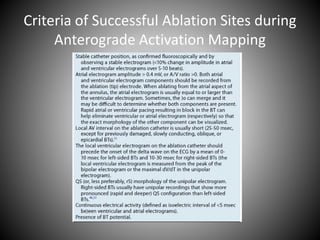
Criteria of Successful Ablation Sites during
Anterograde Activation Mapping
Additional criteria during retrograde
Activation Mapping
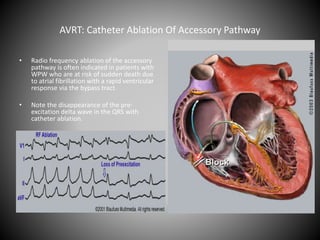
AVRT: Catheter Ablation Of Accessory Pathway
• Radio frequency ablation of the accessory
pathway is often indicated in patients with
WPW who are at risk of sudden death due
to atrial fibrillation with a rapid ventricular
response via the bypass tract.
• Note the disappearance of the pre-
excitation delta wave in the QRS with
catheter ablation.
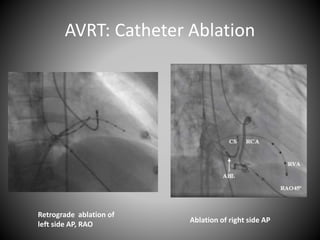
AVRT: Catheter Ablation
Retrograde ablation of
left side AP, RAO
Ablation of right side AP
• Precise location of the accessory pathway is determined by the rove catheter. Retrograde conduction over the AP is seen as a
small spike between the V and A waves. These "Kent potentials" are so named because of the original denomination of
accessory pathways as "Kent bundles," after the investigator Stanley Kent, who first proposed the existence of accessory AV
connections.
AVRT: Catheter Ablation - Location of
AP
Ablation technique
• If preexcitation present (Manifest AP) – ablation performed
during NSR or, preferably, atrial pacing – allows detection of
delta wave
• For concealed AP – Ablation during ventricular pacing,
allows for detection of an eccentric atrial activation
sequence.
• RF energy delivery during AVRT avoided because of
potential catheter dislodgment from its critical position on
abrupt tachycardia termination – can cause transient loss of
conduction in AP for a variable period of time without
resulting in permanent damage to the AP
• For incessant AVRT, energy may be delivered during
ventricular pacing entraining the tachycardia
Ablation technique
• 4 mm tip ablation catheter sufficient
• Power 50 W
• Temperature 60 degree
– AP functional loss at 50 degrees
– AP permanent loss at 60 degrees – do not stop till 55-60
degrees is achieved by good contact (larger tip catheter
are rarely needed)
Ablation technique
• Loss of BT conduction is expected within 1 to 6 seconds of RF
application (once the target temperature and power delivery
have been reached) for most successful lesions.
• If no effect is seen after 15 seconds of RF delivery, energy
delivery should be discontinued because it is unlikely to be
beneficial, and mapping criteria and catheter contact should
be reexamined.
• If BT conduction is eliminated during the application, RF
delivery should be continued for up to 60 seconds.
Ablation technique
• If BT function is not eliminated at a site with apparent favorable
electrographic features, catheter contact with the tissue may be
inadequate.
• Adequacy of catheter contact can be verified by evaluating the
electrode temperature, catheter stability on fluoroscopy,
electrogram stability, and ST elevation on the unipolar electrogram.
• If electrode temperature is consistently more than 50°C with more
than 25 W energy delivered to the tissue during the RF application -
good catheter contact
• If electrode temperature is lower than 20°C with more than 25 W
energy – bad catheter contact
• If electrode temperature reaches more than 50°C but with very low
power (less than 10 W) - coagulum at the catheter tip
AVRT: Catheter Ablation
ENDPOINTS OF ABLATION
Successful ablation
• Confirmation of complete loss of BT function, and not just
noninducibility of tachycardias, is essential.
• Confirmation of complete loss of anterograde BT function using AES
and atrial pacing – no preexcitation
• Marked prolongation of the local AV interval at the ablation site.
• Confirmation of complete loss of retrograde BT function using VES
and ventricular pacing - concentric and decremental retrograde
atrial activation – normal VA conduction over the AVN
• Marked prolongation of the local VA interval at the ablation site.
OUTCOME
• RF ablation is a highly effective and curative treatment for
AVRT (more than 90%)
• Initially successful RF ablation is persistent and late
recurrence of BT conduction after ablation is rare (4%)
• Short runs of palpitations are frequent post RFA, usually
caused by isolated or short runs of PACs or PVCs and not by
recurrence of BT conduction, and can be easily managed with
symptomatic treatment without further investigation.
• Recurrence of AP-mediated tachycardia is usually observed
during the first month after ablation
• Later symptoms (palpitations appearing more than 3 months
after the ablation) are highly suggestive of SVTs not related to
the ablated AP – 10 to 30% patients with AVRT have multiple
pathways for tachycardias
• Repeat procedures 2-4%
• Serious complication (e.g., cardiac tamponade, AV block,
coronary artery injury, retroperitoneal hemorrhage, stroke)
<1%
• Mortality – 0.02%
Right free wall BT
Success rate of 93% to 98%, a recurrence rate of 21%, and a
complication rate less than that with other BT locations.
Posteroseptal BTs
Success rate (98%) and a recurrence rate of 12%.
Transaortic ablation of left free wall BTs
Success rate 86% to 100%, recurrence rate is 2% to 5%, less
frequent than for BTs at other locations.
Complications of this approach include vascular
complications (50% of all complications: groin hematoma,
aortic dissection, and thrombosis), cardiac tamponade,
stroke, coronary dissection (from direct catheter trauma),
injury to the left circumflex coronary artery (from
subannular RF application), valvular damage, and systemic
embolism
The transseptal approach
Success rate of 85% to 100%, a recurrence rate of 3%
to6.6%, and a complication rate of 0% to 6%
Electrophysiology AVRT

Electrophysiology AVRT

  • 1.
  • 3.
  • 4.
  • 5.
    • In 1930,published article describing 11 patients who suffered from attacks of tachycardia associated with a sinus rhythm with pattern of bundle branch block with a short PR interval • Later k/a WPW syndrome! Louis Wolff John Parkinson Paul Dudley White
  • 6.
  • 7.
    • Disorders ofImpulse formation • Disorders of impulse conduction • Combination of both
  • 8.
    • Enhanced impulseformation – Abnormal automaticity (Phase 4) • Least affected by Extrastimulus testing • Overdrive pacing – either overdrive suppression or No effect
  • 9.
    • Enhanced impulseformation – Triggered activity (Phase 3) • Least common mech of SVT – eg. Digitalis induced • Initiated by overdrive pacing without conduction delay or block • Overdrive pacing – Acceleration
  • 10.
    • Disorders ofImpulse formation • Automaticity • Triggered activity – EAD/DAD • Disorders of impulse conduction • Reentry • Combination of both
  • 11.
    • Disorders ofimpulse conduction – Reentry • Pathway - Anatomic, Functional, Both • MC mechanism of SVTs
  • 12.
  • 13.
    The 3 conditionsfor reentry • Atleast 2 functional (or anatomic) distinct pathways – Joining proximally and distally – Forming a closed circuit of conduction
  • 14.
    The 3 conditionsfor reentry • Unidirectional block in 1 of the pathways
  • 15.
    The 3 conditionsfor reentry • Slow conduction down the unblocked pathway – allowing the previously blocked pathway time to recover excitability
  • 16.
  • 17.
  • 18.
    AVRT • Reentrant tachycardiawith an anatomically defined circuit that consists of two distinct pathways, the normal AV conduction system and an AV accessory pathway, linked by common proximal (the atria) and distal (the ventricles) tissues. • Other arrhythmias can utilize the accessory pathway for conduction from the anatomic site of tachycardia origin to other regions of the heart (like AF/AFL) • But AVRT is a specific reentrant tachycardia in which the accessory pathway is necessary for initiation and maintenance of the tachycardia
  • 19.
    AVRT • Accessory pathwaymaybe Manifest/WPW Concealed
  • 20.
    AVRT • Accessory pathwaymaybe Manifest/WPW • Can conduct both Antegrade (A to V) & Retrograde (V to A) • Abnormal ECG baseline • Variable degrees of pre- excitation • Higher risk with atrial fibrillation Concealed • Retrograde (V to A) conduction only • Normal ECG baseline • No pre-excitation • Atrial fibrillation not an issue
  • 21.
    AVRT • Accessory pathwaymaybe Manifest/WPW • Antidromic AVRT ± Orthodromic AVRT Concealed • Only Orthodromic AVRT possible • 20-40% SVTs in patients without pre-excitation
  • 22.
    AVRT • Accessory pathwaymaybe Manifest/WPW • Antidromic AVRT ± Orthodromic AVRT Concealed • Only Orthodromic AVRT possible • 90% - Fast conducting • 10% - Slow (decremental) conduction - PJRT
  • 23.
    AV conduction inconcealed AP Vn – normal ventricular activation
  • 24.
    AV conduction inmanifest AP Vn – normal ventricular activation Vp – ventricular activation via AP
  • 25.
    AV conduction inmanifest AP with AV nodal delay Vn – normal ventricular activation Vp – ventricular activation via AP
  • 26.
    Pre excitation syndromes •Preexcitation – Exists when in relation to atrial events, all or some part of ventricle is activated sooner than would be expected if the impulse reached ventricle by normal AV conduction
  • 27.
    Pre excitation syndromes •Old classification – various eponyms – Kent fibre (A-V) – James fibre (Atrio-nodal) – Mahaim fibre (Atrio-Fasc or Nodo-Fasc) • Antidromic AVRT with LBBB + superior axis • Progressive increase in the AV interval in response to atrial overdrive pacing (oppositeto the behavior of the usual AP, in which preexcitation occurs with short AV intervals) – WPW syndrome – LGL syndrome
  • 28.
    Pre excitation syndromes •New classification – No eponyms – Atrioventricular bypass tract – Nodoventricular bypass tract – Fasciculoventricular bypass tract – AV nodal bypass tract – atrionodal/atriofascicular
  • 29.
    Pre excitation syndromes •New + Old classification – Atrioventricular bypass tract: WPW syndrome – Nodoventricular bypass tract: WPW variant – Fasciculoventricular bypass tract: WPW variant – Atrionodal bypass tract: LGL syndrome
  • 30.
  • 31.
    Pre-excitation 12-Lead ECG PRinterval < 120 ms Normal P wave vector (not ectopic atrial rhythm) Delta wave QRS duration > 100 ms
  • 32.
    Orthodromic AVRT Initiated bya closely coupled APC or VPC Blocks in the accessory pathway but conducts through the AV node Retrograde conduction via accessory pathway Inverted P wave produced by retrograde conduction visible in the inferior ECG leads
  • 33.
    Antidromic AVRT • Retrogradeconduction via AV node • Antegrade via AP
  • 34.
    Orthodromic AVRT: 12-LeadECG Ventricular rate typically 150 – 250/min (or greater) beats per minute, regular Narrow QRS complexes (in the absence of underlying IVCD) Inverted P waves with an RP interval usually <50% the tachycardia RR interval (RP < PR) Constant RP interval regardless of the tachycardia cycle length Beat-to-beat oscillation in QRS amplitude (QRS alternans) sometimes occurs, most commonly seen when the rate is very rapid
  • 35.
    Antidromic AVRT: 12lead ECG Ventricular rate typically 150 – 250/min (or greater) beats per minute, regular Wide QRS complexes (similar or wider than baseline pre-excitation) Inverted P waves with an RP interval usually >50% the tachycardia RR interval (RP > PR) Constant RP interval regardless of the tachycardia cycle length
  • 36.
    AP Location • Anywherealong the muscular portion of the posterior and lateral aspects of the mitral and tricuspid annuli. Schematic from base of heart From LAO view
  • 37.
    AP Location • Noneof the various algorithm is perfect • Simplest algorithm, Fitzpatrick -
  • 38.
  • 39.
    The 3 characteristicsof reentry • Initiated by timed extrastimulus – more effectively than rapid pacing • Programmed stimulation can also terminate Tachy
  • 40.
    The 3 characteristicsof reentry • No direct relation of pacing cycle length to the tachy cycle length
  • 41.
    The 3 characteristicsof reentry • Extrastimulus can reset or entrain the Tachycardia in presence of fusion
  • 42.
    6 TENETS OFSVT EVALUATION
  • 43.
    1 • Mode ofinitiation Relation of – Basic drive cycle length – ES coupling interval – Onset of tachy – Tachy cycle length • Differentiates triggered activity from reentry
  • 44.
    2 • Atrial activationsequence • P-QRS relation
  • 45.
    3 • Effect ofBBB during Tachy – Spontaneous or induced BBB – On cycle length – V-A conduction time
  • 46.
    4 • Requirement ofatria, HB, Ventricle – in initation and maintenance of tachy – Effect of AV dissociation on tachy
  • 47.
    5 • Effect ofatrial or ventricular stimulation during tachy
  • 48.
    6 • Effect ofdrugs or physiological maneuvers during Tachy
  • 49.
    AVRT: Baseline observationduring NSR • H-V < 35 ms, may be negative • His potential can be buried in the local ventricular EGM • Site of earliest ventricular activation is near the ventricular insertion site of the AP (i.e., near the tricuspid annulus or mitral annulus at the base of the heart) • Slowing of conduction in the AVN by carotid sinus massage, AVN blockers, or rapid atrial pacing unmasks and increases the degree of preexcitation, because these maneuvers do not affect the conduction over the AP.
  • 50.
    • HV -11ms at AES 600 ms • HV -65 ms at AES 440 ms
  • 51.
    • HV -93ms at AES 350 ms • Less preexcitation on sinus beat
  • 52.
    AES during NSR •In the presence of a manifest AV-AP, atrial stimulation from any atrial site can help unmask preexcitation if it is not manifest during NSR caused by fast AVN conduction. • Incremental rate atrial pacing and progressively premature AES produce decremental conduction over the AVN (but not over the AP), increasing the degree of preexcitation and shortening the HV interval, until the His potential is inscribed within the QRS. • The His potential is still activated anterogradely over the AVN until anterograde block in the AVN occurs; the QRS then becomes fully preexcited, and the His potential becomes retrogradely activated • Atrial stimulation close to or at the AV AP insertion site results in maximal preexcitation and the shortest P-delta Interval
  • 53.
    • Retrograde Hisactivation and echo beat
  • 54.
    AES during NSR •The failure of atrial stimulation to increase the amount of preexcitation can be caused by – markedly enhanced AVN conduction – presence of another AV-AP – pacing-induced block in the AV AP because of a long ERP of the AP (longer than that of the AVN) – total preexcitation already present at the basal state caused by prolonged or absent AVN-HPS conduction, and/or decremental conduction in the AP
  • 55.
    VES during NSR Indicatorsof the presence of a retrogradely conducting AV AP • VES resulting in retrograde VA conduction – eccentric atrial activation sequence • VES delivered when the HB is refractory that results in atrial activation However, if a VES delivered when the HB is refractory does not result in atrial activation, this does not necessarily exclude the presence of a retrogradely conducting AP, because such a VES can be associated with retrograde block in the AP itself, or presence of unidirectional (anterograde-only) APs
  • 56.
    VES during NSR •In the presence of a retrogradely conducting AV BT (whether manifest or concealed), VES during NSR can result in VA conduction over the BT, AVN, both, or neither • Conduction over the AP alone is the most common pattern at short pacing CLs or short VES coupling intervals. In this case, the VA conduction time is constant over a wide range of pacing CLs and VES coupling intervals, (in the absence of intraventricular conduction abnormalities or additional Aps) • On the other hand, retrograde conduction over the BT and HPS-AVN is common when RV pacing is performed in the presence of a left-sided BT at long pacing CLs or long VES coupling intervals
  • 57.
    • A- Retrogradeatrial activation by both AVN and AP • B- retrograde atrial activation by AP alone – Eccentric activation
  • 58.
    • Type ofeccentric atrial activation on location of AP • Left lateral AP
  • 59.
    • Right lateralAP – A in HRA before CS
  • 60.
    • Posterosepatal AP– A in PCS before HBE
  • 61.
    AVRT induction: OrthodromicAVRT Initiation of orthodromic AVRT with an AES requires • Anterograde block in the AV-BT • Anterograde conduction over the AVN-HPS • Slow conduction over the AVN-HPS, with adequate delay to allow for the recovery of the atrium and AV BT • Subsequent retrograde conduction over the BT • The reason this occurs is because, whereas the BT conducts more rapidly than the AVN, it has a longer ERP, so the early atrial impulse blocks anterogradely in the BT but conducts over the AVN. • The site of AV delay is less important; it is most commonly in the AVN, but it can occur also in the HB, bundle branches, or ventricular myocardium. • BBB ipsilateral to the AV BT provides an additional AV delay that can facilitate tachycardia initiation. • Induction of orthodromic AVRT is easier with AES near the AV BT insertion site; the closer the stimulation site to the BT, the easier it is to encroach on the refractory period of the BT and achieve block
  • 62.
    If SVT inductionfails by AES • use of multiple AESs • Rapid atrial pacing • pacing closer to the BT would achieve block in the BT and produce adequate AV delay
  • 63.
    • Orthodromic AVRTin patients with concealed BTs is identical to that in patients with WPW. • The only difference is that in patients with concealed BTs anterograde block in the BT is already present. • Because the AV BT does not conduct anterogradely, the only condition needed to induce orthodromic AVRT is adequate AV delay • Therefore, orthodromic AVRT initiation requires less premature coupling intervals of the AESs in patients with concealed BTs than in patients with WPW. AVRT is more easily induced by VES
  • 64.
    Orthodromic AVRT: Tachycardia features •Atrial activation sequence – first activation closest to AP insertion site • Fast conduction in AP - Short RP interval (50-120 ms) but longer than AVNRT • BBB much more common in AVRT (than AVNRT or AT) – 90% of sustained SVTs with BBB – AVRT • CSM can terminate orthodromic AVRT by gradual slowing and then block in the AVN. • Adenosine, digoxin, CCB, and BB terminate orthodromic AVRT by block in the AVN - therefore, SVT terminates with a P wave not followed by a QRS
  • 65.
    Antidromic AVRT: Tachycardia features •RP > PR interval – PR short and fixed • Rest features similar to Orthodromic AVRT
  • 66.
    AES/VES during tachycardia •Close coupled AES/VES affect AVRT – Entrainment – Fusion – Termination • Ability of AES/VES to affect the SVT depends on the distance between site of stimulation to the AP and coupling interval
  • 67.
    Exclusion of AVNRT PPI– post pacing interval
  • 68.
    Location of AP •Pacing from Multiple Atrial Sites. The closer the pacing site to the BT atrial insertion, the more rapidly the impulse will reach the BT relative to the AVN and thus the greater the degree of preexcitation and the shorter the P-delta interval. • Effects of Bundle Branch Block During Orthodromic AVRT • Earliest atrial and ventricular activation sites • Direct recording of BT potential
  • 69.
  • 70.
    Criteria of SuccessfulAblation Sites during Anterograde Activation Mapping
  • 71.
    Additional criteria duringretrograde Activation Mapping
  • 72.
    AVRT: Catheter AblationOf Accessory Pathway • Radio frequency ablation of the accessory pathway is often indicated in patients with WPW who are at risk of sudden death due to atrial fibrillation with a rapid ventricular response via the bypass tract. • Note the disappearance of the pre- excitation delta wave in the QRS with catheter ablation.
  • 73.
    AVRT: Catheter Ablation Retrogradeablation of left side AP, RAO Ablation of right side AP
  • 74.
    • Precise locationof the accessory pathway is determined by the rove catheter. Retrograde conduction over the AP is seen as a small spike between the V and A waves. These "Kent potentials" are so named because of the original denomination of accessory pathways as "Kent bundles," after the investigator Stanley Kent, who first proposed the existence of accessory AV connections. AVRT: Catheter Ablation - Location of AP
  • 75.
    Ablation technique • Ifpreexcitation present (Manifest AP) – ablation performed during NSR or, preferably, atrial pacing – allows detection of delta wave • For concealed AP – Ablation during ventricular pacing, allows for detection of an eccentric atrial activation sequence. • RF energy delivery during AVRT avoided because of potential catheter dislodgment from its critical position on abrupt tachycardia termination – can cause transient loss of conduction in AP for a variable period of time without resulting in permanent damage to the AP • For incessant AVRT, energy may be delivered during ventricular pacing entraining the tachycardia
  • 76.
    Ablation technique • 4mm tip ablation catheter sufficient • Power 50 W • Temperature 60 degree – AP functional loss at 50 degrees – AP permanent loss at 60 degrees – do not stop till 55-60 degrees is achieved by good contact (larger tip catheter are rarely needed)
  • 77.
    Ablation technique • Lossof BT conduction is expected within 1 to 6 seconds of RF application (once the target temperature and power delivery have been reached) for most successful lesions. • If no effect is seen after 15 seconds of RF delivery, energy delivery should be discontinued because it is unlikely to be beneficial, and mapping criteria and catheter contact should be reexamined. • If BT conduction is eliminated during the application, RF delivery should be continued for up to 60 seconds.
  • 78.
    Ablation technique • IfBT function is not eliminated at a site with apparent favorable electrographic features, catheter contact with the tissue may be inadequate. • Adequacy of catheter contact can be verified by evaluating the electrode temperature, catheter stability on fluoroscopy, electrogram stability, and ST elevation on the unipolar electrogram. • If electrode temperature is consistently more than 50°C with more than 25 W energy delivered to the tissue during the RF application - good catheter contact • If electrode temperature is lower than 20°C with more than 25 W energy – bad catheter contact • If electrode temperature reaches more than 50°C but with very low power (less than 10 W) - coagulum at the catheter tip
  • 79.
  • 80.
  • 81.
    Successful ablation • Confirmationof complete loss of BT function, and not just noninducibility of tachycardias, is essential. • Confirmation of complete loss of anterograde BT function using AES and atrial pacing – no preexcitation • Marked prolongation of the local AV interval at the ablation site. • Confirmation of complete loss of retrograde BT function using VES and ventricular pacing - concentric and decremental retrograde atrial activation – normal VA conduction over the AVN • Marked prolongation of the local VA interval at the ablation site.
  • 82.
  • 83.
    • RF ablationis a highly effective and curative treatment for AVRT (more than 90%) • Initially successful RF ablation is persistent and late recurrence of BT conduction after ablation is rare (4%) • Short runs of palpitations are frequent post RFA, usually caused by isolated or short runs of PACs or PVCs and not by recurrence of BT conduction, and can be easily managed with symptomatic treatment without further investigation.
  • 84.
    • Recurrence ofAP-mediated tachycardia is usually observed during the first month after ablation • Later symptoms (palpitations appearing more than 3 months after the ablation) are highly suggestive of SVTs not related to the ablated AP – 10 to 30% patients with AVRT have multiple pathways for tachycardias
  • 85.
    • Repeat procedures2-4% • Serious complication (e.g., cardiac tamponade, AV block, coronary artery injury, retroperitoneal hemorrhage, stroke) <1% • Mortality – 0.02%
  • 86.
    Right free wallBT Success rate of 93% to 98%, a recurrence rate of 21%, and a complication rate less than that with other BT locations. Posteroseptal BTs Success rate (98%) and a recurrence rate of 12%.
  • 87.
    Transaortic ablation ofleft free wall BTs Success rate 86% to 100%, recurrence rate is 2% to 5%, less frequent than for BTs at other locations. Complications of this approach include vascular complications (50% of all complications: groin hematoma, aortic dissection, and thrombosis), cardiac tamponade, stroke, coronary dissection (from direct catheter trauma), injury to the left circumflex coronary artery (from subannular RF application), valvular damage, and systemic embolism The transseptal approach Success rate of 85% to 100%, a recurrence rate of 3% to6.6%, and a complication rate of 0% to 6%

Editor's Notes

  • #31 Wolff-Parkinson-White syndrome: Preexcitation Wolff-Parkinson-White syndrome is a form of anomalous AV conduction or ventricular pre-excitation. Ventricular pre-excitation is said to exist when conduction of a supraventricular impulses occurs via an accessory pathway which bypasses the AV node. Conduction through the accessory pathway allows premature activation of the ventricular myocardium, which is evidenced by the short PR interval and the initial slurring or notching of the QRS (the delta wave). ECG requirements for diagnosis of WPW syndrome • Short P-R interval (< 120 ms) • Normal P wave vector (to exclude junctional rhythm) • Presence of a delta wave, slurring or notching of the first portion of the QRS complex • QRS duration greater than 100 ms Note that in this example, right-sided pre-excitation is followed by normal activation via the left bundle branch, producing a "fusion" complex.
  • #32 AVRT: WPW syndrome: Preexcitation 12-Lead ECG ECG requirements for diagnosis of WPW syndrome • Short P-R interval (< 120 ms) • Normal P wave vector (to exclude junctional rhythm) • Presence of a delta wave, slurring or notching of the first portion of the QRS complex • QRS duration greater than 100 ms Note that in this example, right-sided pre-excitation is followed by normal activation via the left bundle branch, producing a "fusion" complex.
  • #33 Wolff-Parkinson-White syndrome: Initiation of AVRT An episode of supraventricular tachycardia can be initiated by a closely coupled premature atrial complex (PAC) which blocks in the accessory pathway, but conducts through the AV node. The rapidly conducting accessory pathway is slower to recover than the AV node, but by the time ventricular depolarization is nearly complete, the bypass tract has recovered to allow retrograde conduction back to the atria. This retrograde atrial impulse is in turn conducted to the ventricles via the AV node, and the re-entrant circuit is established. The P wave produced by retrograde conduction during AV reentry tachycardia is inverted in the inferior ECG leads, since atrial depolarization begins in the lower right atrium and proceeds superiorly and leftward. Rapid retrograde conduction over the accessory pathway results in a short R-P interval, usually less than one-half of the R-R interval.
  • #35 Wolff-Parkinson-White syndrome: AV Reentry Tachycardia The P wave produced by retrograde conduction during AV reentry tachycardia is inverted in the inferior ECG leads, since atrial depolarization begins in the lower right atrium and proceeds superiorly and leftward. Rapid retrograde conduction over the accessory pathway results in a short R-P interval, usually less than one-half of the R-R interval.
  • #37 Wolff-Parkinson-White syndrome Extra-nodal AV conduction pathways Atrioventricular bypass tracts, or accessory pathways, can be found anywhere along the muscular portion of the posterior and lateral aspects of the mitral and tricuspid annuli. They can be classified by their anatomic location as either • right-sided, • left-sided, • posteroseptal, or • anteroseptal. Patients with Wolff-Parkinson-White syndrome have an accessory pathway that can conduct in both an anterograde or retrograde direction. As we will see on the next page, anterograde conduction via the accessory pathway during sinus rhythm bypasses the AV node, pre-exciting the ventricle and producing the characteristic “delta wave.” Patients with an accessory pathway capable only of retrograde conduction are said to have a concealed bypass tract, because a delta wave is not seen during sinus rhythm.
  • #73 Wolff-Parkinson-White syndrome: Ablation of Accessory Pathway Radio frequency ablation of the accessory pathway is often indicated in patients with WPW who are at risk of sudden death due to atrial fibrillation with a rapid ventricular response via the bypass tract. Note the disappearance of the preexcitation delta wave in the QRS with catheter ablation.
  • #74 SDSD
  • #75 AV Reentry Tachycardia: Mapping of Kent Potentials Precise location of the accessory pathway is determined by a mapping catheter. Retrograde conduction over the AP is seen as a small spike between the V and A waves. These "Kent potentials" are so named because of the original denomination of accessory pathways as "Kent bundles," after the investigator Stanley Kent, who first proposed the existence of accessory AV connections.
  • #80 Wolff-Parkinson-White syndrome: Ablation of Accessory Pathway Radio frequency ablation of the accessory pathway is often indicated in patients with WPW who are at risk of sudden death due to atrial fibrillation with a rapid ventricular response via the bypass tract. Note the disappearance of the preexcitation delta wave in the QRS with catheter ablation.