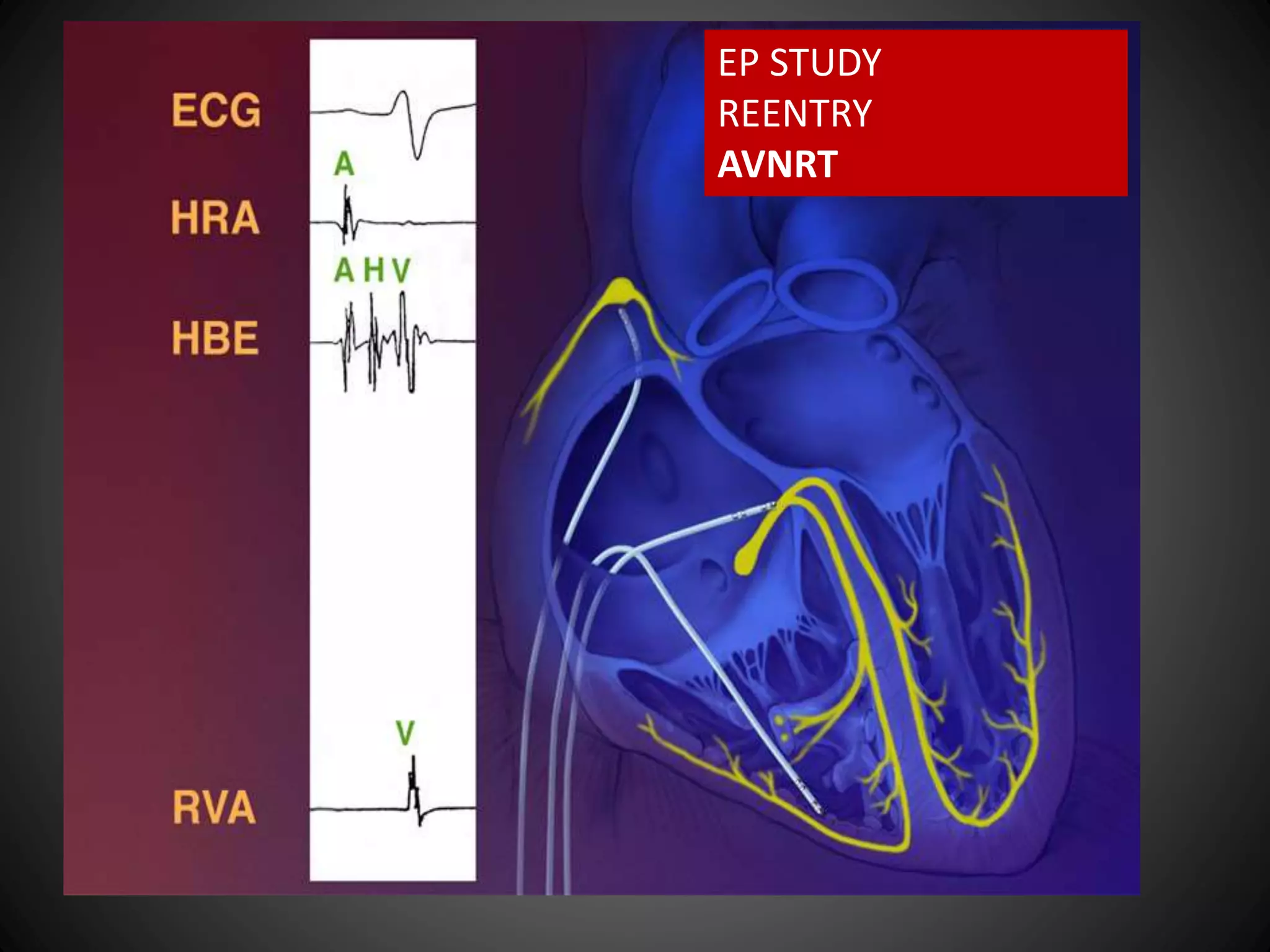
EP STUDY
REENTRY
AVNRT
WE’VE TALKED ABOUT…
EQUIPMENT
RELEVANT ANATOMY
CATHETERS and PLACEMENT
BASIC INTERVALS
TESTS OF SN FUNCTION
EXTRASTIMULUS TESTING
REFRACTORY PERIODS
INCREMENTAL PACING
MINIMUM PROTOCOL FOR DIAGNOSTIC EPS
AND NOW…
TACHYARRHYTHMIA MECH
REENTRY MECH
SVT
AVNRT
TACHYARRHYTHMIAS
• Basic mechanisms of tachyarrhythmias
– Enhanced impulse formation
– Abnormal conduction
• Enhanced impulse formation
– Abnormal automaticity (Phase 4)
• Least affected by Extrastimulus testing
• Overdrive pacing – either overdrive suppression or
No effect
• Enhanced impulse formation
– Triggered activity (Phase 3)
• Least common mech of SVT – eg. Digitalis induced
• Initiated by overdrive pacing without conduction delay
or block
• Overdrive pacing – Acceleration
• Abnormal conduction – impulse propagation
– Reentry
• Pathway - Anatomic, Functional, Both
REENTRY
3 conditions for reentry
• Atleast 2 functional (or anatomic) distinct
pathways
• Joining proximally and distally
• Forming a closed circuit of conduction
3 conditions for reentry
• Unidirectional block in 1 of the pathways
3 conditions for reentry
• Slow conduction down the unblocked
pathway – allowing the previously blocked
pathway time to recover excitability
3 characteristics of reentry
• Initiated by timed extrastimulus – more
effectively than rapid pacing
• Programmed stimulation can also terminate
Tachy
3 characteristics of reentry
• No direct relation of pacing cycle length to the
tachy cycle length
3 characteristics of reentry
• Extrastimulus can reset or entrain the Tachy in
presence of fusion
Reentry is the MC mech of SVTs
EP EVALUATION OF SVT
6 TENETS
1
• Mode of initiation
Relation of
– Basic drive cycle length
– ES coupling interval
– Onset of tachy
– Tachy cycle length
• Differentiates triggered activity from reentry
2
• Atrial activation sequence
• P-QRS relation
3
• Effect of BBB during Tachy
– Spontaneous or induced BBB
– On cycle length
– V-A conduction time
4
• Requirement of atria, HB, Ventricle
– in initation and maintenance of tachy
– Effect of AV dissociation on tachy
5
• Effect of atrial or ventricular stimulation
during tachy
• Differentiates AT, AVNRT, CBT
• EXCITABLE GAP
6
• Effect of drugs or physiological maneuvers
during Tachy
AVNRT
• MC SVT
• >50% SVTs
• Concept by Mines in 1913
• Moe demonstrated on rabbit AVN! – Dual AVN
pathways
Typical or Common AVNRT
Alpha Beta
Atypical or uncommon AVNRT
Evidence of dual AVN pathways
• 2 PR or AH intervals during NSR or at similar
paced cycle length
• Double response to an APC or VPC
• Ability to preempt Atrial echo by VPC during
Slow pathway conduction during SVT
Definition of Dual AVN pathway
Definition of ‘JUMP’
• > 50 ms increment in A-H interval with a small
(~10 ms) decrease in coupling interval of Atrial
extrastimulus
Definition of ‘JUMP’
• > 50 ms increment in A-H interval with a small
(~10 ms) decrease in coupling interval of Atrial
extrastimulus
• Usually 70-100 ms jump
• Maybe upto 500ms or more!
Apart from the typical JUMP by AES
Other markers of dual AVN pathways
– Jump during NSR/Drive pacing
– Beat to beat change of > 50 ms in AH during
pacing
– Pacing induced increase in AH > PCL!
Apart from the typical JUMP by AES
Other markers of dual AVN pathways
– Jump during NSR/Drive pacing
– Beat to beat change of > 50 ms in AH during pacing
– Pacing induced increase in AH > PCL!
– Double response to an APC or VPC
Apart from the typical JUMP by AES
Other markers of dual AVN pathways
– Jump during NSR/Drive pacing
– Beat to beat change of > 50 ms in AH during pacing
– Pacing induced increase in AH > PCL!
– Double response to an APC or VPC
– May even lead to 1:2 Nonreentrant Tachy!
• AV nodal conduction delay (A-H) is of prime
importance in AVNRT – Not coupling interval
of AES
‘CRITICAL AV DELAY’ or ‘CRITICAL AH INTERVAL’
AES from CS vs HRA
• Site of stimulation can affect ability to induce
Dual pathway conduction and AVNRT
• Critical AV nodal delay (A-H)required to
initiate reentry – is shorter in CS stimulation vs
HRA
AES from CS vs HRA
• Dual pathway conduction and AVNRT
• EASIER to induce from HRA
AES from CS vs HRA
• Dual pathway conduction and AVNRT
• EASIER to induce from HRA
• Implication
– Pace from CS if no induction from HRA
– Post RFA check induction from both HRA and CS
Induction
If single AES doesn’t increase AH sufficiently
– Double APC
– Atrial pacing
– Shorter drive cycle length
– Isoproterenol, Atropine
– CS stimulation
Induction
85% Typical AVNRT
Dual pathway seen in response to single HRA AES
Induction
85% Typical AVNRT
Dual pathway seen in response to single HRA AES
Using all above methods
Dual Pathway seen in 95% patients
Induction
5-10% show MULTIPLE pathways
Multiple jumps of >50 ms with shorter
coupling intervals
AVNRT of different rates
Induction
Upto 25% Non-AVNRT population also – Dual
pathway seen by these protocols
But
Only ‘JUMP’ seen
Induction
Upto 25% Non-AVNRT population also – Dual
pathway seen by these protocols
But
Only ‘JUMP’ seen
No Echo
No Reentry over fast pathway
No AVNRT
Induction
Upto 25% Non-AVNRT population also – Dual pathway seen by these protocols
But
Only ‘JUMP’ seen
No Echo
No Reentry over fast pathway
No AVNRT
Therefore,
LIMITATION IS RETROGRADE CONDUCTION
OVER FAST PATHWAY
Induction by VES
Ventricular stimulation inducing AVNRT
10-40% Typical AVNRT patients
Ventr PACING more effective than VES
Only 10% induction by single VES
Due to H-P refractoriness
Induction by VES
Typical AVNRT patients – retrograde conduction
over FP very good
Ventr PACING more effective than VES
Only 10% induction by single VES
Due to H-P refractoriness
Induction by V Pacing – Mechanism
• Retrograde over fast, concealed over slow
– Dual pathway not seen – No critical VA delay
BEFORE AVNRT – VA increases only when AVNRT
induced
Induction by V Pacing – Mechanism
• FP retrograde refractory period > Slow
pathway
– Dual AV pathway seen
– Atypical AVNRT induced
DETERMINANTS OF INDUCTION OF AVNRT
• Rapid retograde conduction in FP
– Typical AVNRT patients – 1:1 VA conduction at
<400ms PCL
DETERMINANTS OF INDUCTION OF AVNRT
• Rapid retograde conduction in FP
– Typical AVNRT patients – 1:1 VA conduction at
<400ms PCL
• Critical “A-H” – due to SP
DETERMINANTS OF INDUCTION OF AVNRT
• Rapid retograde conduction in FP
– Typical AVNRT patients – 1:1 VA conduction at
<400ms PCL
• Critical “A-H” – due to SP
• Ability to sustain repetitive antegrade
conduction in SP
– Typical AVNRT - 1:1 AV conduction at <350ms PCL
DETERMINANTS OF INDUCTION OF AVNRT
Low inducibility
No VA conduction
VA conduction worse than AV – VA WCL at PCL
> 500 ms
DETERMINANTS OF INDUCTION OF AVNRT
Shorter the AH at NSR/Pacing
Shorter the critical AH increment needed to
induce AVNRT
Better the VA conduction
So called LGL syndome!
AVNRT: SURFACE ECG AND EPS
AVNRT HBE
• 70% - atrial activation before or at onset of
QRS
• 25% - buried within QRS
AVNRT Surface ECG
AVNRT Surface ECG
• 40% - No P waves seen
AVNRT Surface ECG
• 40% - No P waves seen
• 55% - Terminal QRS distorted by P
Pseudo R in V1
Pseudo S in Inferior leads
Nonsp. Terminal QRS notching
AVNRT Surface ECG
• 40% - No P waves seen
• 55% - Terminal QRS distorted by P
Pseudo R in V1
Pseudo S in Inferior leads
Nonsp. Terminal QRS notching
• 1-2% - Very early P – Pseudo Q in Inferior leads
Rare but specific
AVNRT Surface ECG
• Basic
– Atrial activation arising in MIDLINE
– Requires atleast 50 ms to complete atrial
depolarization
Therefore these typical ECGs
Make Bypass tracts less likely
Atrial activation is from midline (likely from AVN)
Atypical AVNRT Surface ECG
• <5% AVNRTs
• R-P / P-R is >1
• Difference from bypass tract needed
• More Common in Post ablation pts.
EFFECT OF BBB ON AVNRT
Effect of BBB on AVNRT
• No effect on A-A of AVNRT
• No effect on H-H of AVNRT
Effect of BBB on AVNRT
• No effect on A-A of AVNRT
• No effect on H-H of AVNRT
• H-V may prolong during BBB – increase V-V by
equal amount – but no effect on AVNRT
Effect of BBB on AVNRT
• No effect on A-A of AVNRT
• No effect on H-H of AVNRT
• H-V may prolong during BBB – increase V-V by
equal amount – but no effect on AVNRT
• VES during AVNRT – can produce BBB (usually
LBBB) – but no effect on AVNRT
Atria not needed
• Retrograde VA blocks
• 2:1 block
• AV dissociation
• No atrial activation at all
Response to APC during SVT
Excitable GAP
Pharmacology/Maneuvers
• Propranolol
• Isoproterenol/Atropine
• Vagal maneuvers
6 TENETS
1
• Mode of initiation
Relation of
– Basic drive cycle length
– ES coupling interval
– Onset of tachy
– Tachy cycle length
• Differentiates triggered activity from reentry
2
• Atrial activation sequence
• P-QRS relation
3
• Effect of BBB during Tachy
– Spontaneous or induced BBB
– On cycle length
– V-A conduction time
4
• Requirement of atria, HB, Ventricle
– in initation and maintenance of tachy
– Effect of AV dissociation on tachy
5
• Effect of atrial or ventricular stimulation
during tachy
• Differentiates AT, AVNRT, CBT
• EXCITABLE GAP
6
• Effect of drugs or physiological maneuvers
during Tachy
TO BE CONTINUED….
….NEXT presentations
• AVRT
• Ventricular Pre-excitation
• Atrial Tachycardia
• Ventricular arrhythmias
• Catheter ablation
Electrophysiology AVNRT

Electrophysiology AVNRT

  • 1.
  • 2.
    WE’VE TALKED ABOUT… EQUIPMENT RELEVANTANATOMY CATHETERS and PLACEMENT BASIC INTERVALS TESTS OF SN FUNCTION EXTRASTIMULUS TESTING REFRACTORY PERIODS INCREMENTAL PACING MINIMUM PROTOCOL FOR DIAGNOSTIC EPS
  • 3.
  • 4.
  • 5.
    • Basic mechanismsof tachyarrhythmias – Enhanced impulse formation – Abnormal conduction
  • 6.
    • Enhanced impulseformation – Abnormal automaticity (Phase 4) • Least affected by Extrastimulus testing • Overdrive pacing – either overdrive suppression or No effect
  • 7.
    • Enhanced impulseformation – Triggered activity (Phase 3) • Least common mech of SVT – eg. Digitalis induced • Initiated by overdrive pacing without conduction delay or block • Overdrive pacing – Acceleration
  • 8.
    • Abnormal conduction– impulse propagation – Reentry • Pathway - Anatomic, Functional, Both
  • 9.
  • 10.
    3 conditions forreentry • Atleast 2 functional (or anatomic) distinct pathways • Joining proximally and distally • Forming a closed circuit of conduction
  • 11.
    3 conditions forreentry • Unidirectional block in 1 of the pathways
  • 12.
    3 conditions forreentry • Slow conduction down the unblocked pathway – allowing the previously blocked pathway time to recover excitability
  • 13.
    3 characteristics ofreentry • Initiated by timed extrastimulus – more effectively than rapid pacing • Programmed stimulation can also terminate Tachy
  • 14.
    3 characteristics ofreentry • No direct relation of pacing cycle length to the tachy cycle length
  • 15.
    3 characteristics ofreentry • Extrastimulus can reset or entrain the Tachy in presence of fusion Reentry is the MC mech of SVTs
  • 16.
  • 17.
  • 18.
    1 • Mode ofinitiation Relation of – Basic drive cycle length – ES coupling interval – Onset of tachy – Tachy cycle length • Differentiates triggered activity from reentry
  • 19.
    2 • Atrial activationsequence • P-QRS relation
  • 20.
    3 • Effect ofBBB during Tachy – Spontaneous or induced BBB – On cycle length – V-A conduction time
  • 21.
    4 • Requirement ofatria, HB, Ventricle – in initation and maintenance of tachy – Effect of AV dissociation on tachy
  • 22.
    5 • Effect ofatrial or ventricular stimulation during tachy • Differentiates AT, AVNRT, CBT • EXCITABLE GAP
  • 23.
    6 • Effect ofdrugs or physiological maneuvers during Tachy
  • 24.
  • 25.
    • MC SVT •>50% SVTs • Concept by Mines in 1913 • Moe demonstrated on rabbit AVN! – Dual AVN pathways
  • 26.
  • 27.
    Typical or CommonAVNRT Alpha Beta
  • 28.
  • 29.
    Evidence of dualAVN pathways • 2 PR or AH intervals during NSR or at similar paced cycle length • Double response to an APC or VPC • Ability to preempt Atrial echo by VPC during Slow pathway conduction during SVT
  • 30.
    Definition of DualAVN pathway
  • 31.
  • 32.
    Definition of ‘JUMP’ •> 50 ms increment in A-H interval with a small (~10 ms) decrease in coupling interval of Atrial extrastimulus
  • 33.
    Definition of ‘JUMP’ •> 50 ms increment in A-H interval with a small (~10 ms) decrease in coupling interval of Atrial extrastimulus • Usually 70-100 ms jump • Maybe upto 500ms or more!
  • 35.
    Apart from thetypical JUMP by AES Other markers of dual AVN pathways – Jump during NSR/Drive pacing – Beat to beat change of > 50 ms in AH during pacing – Pacing induced increase in AH > PCL!
  • 37.
    Apart from thetypical JUMP by AES Other markers of dual AVN pathways – Jump during NSR/Drive pacing – Beat to beat change of > 50 ms in AH during pacing – Pacing induced increase in AH > PCL! – Double response to an APC or VPC
  • 39.
    Apart from thetypical JUMP by AES Other markers of dual AVN pathways – Jump during NSR/Drive pacing – Beat to beat change of > 50 ms in AH during pacing – Pacing induced increase in AH > PCL! – Double response to an APC or VPC – May even lead to 1:2 Nonreentrant Tachy!
  • 41.
    • AV nodalconduction delay (A-H) is of prime importance in AVNRT – Not coupling interval of AES ‘CRITICAL AV DELAY’ or ‘CRITICAL AH INTERVAL’
  • 42.
    AES from CSvs HRA • Site of stimulation can affect ability to induce Dual pathway conduction and AVNRT • Critical AV nodal delay (A-H)required to initiate reentry – is shorter in CS stimulation vs HRA
  • 43.
    AES from CSvs HRA • Dual pathway conduction and AVNRT • EASIER to induce from HRA
  • 44.
    AES from CSvs HRA • Dual pathway conduction and AVNRT • EASIER to induce from HRA • Implication – Pace from CS if no induction from HRA – Post RFA check induction from both HRA and CS
  • 45.
    Induction If single AESdoesn’t increase AH sufficiently – Double APC – Atrial pacing – Shorter drive cycle length – Isoproterenol, Atropine – CS stimulation
  • 46.
    Induction 85% Typical AVNRT Dualpathway seen in response to single HRA AES
  • 47.
    Induction 85% Typical AVNRT Dualpathway seen in response to single HRA AES Using all above methods Dual Pathway seen in 95% patients
  • 48.
    Induction 5-10% show MULTIPLEpathways Multiple jumps of >50 ms with shorter coupling intervals AVNRT of different rates
  • 49.
    Induction Upto 25% Non-AVNRTpopulation also – Dual pathway seen by these protocols But Only ‘JUMP’ seen
  • 50.
    Induction Upto 25% Non-AVNRTpopulation also – Dual pathway seen by these protocols But Only ‘JUMP’ seen No Echo No Reentry over fast pathway No AVNRT
  • 51.
    Induction Upto 25% Non-AVNRTpopulation also – Dual pathway seen by these protocols But Only ‘JUMP’ seen No Echo No Reentry over fast pathway No AVNRT Therefore, LIMITATION IS RETROGRADE CONDUCTION OVER FAST PATHWAY
  • 52.
    Induction by VES Ventricularstimulation inducing AVNRT 10-40% Typical AVNRT patients Ventr PACING more effective than VES Only 10% induction by single VES Due to H-P refractoriness
  • 53.
    Induction by VES TypicalAVNRT patients – retrograde conduction over FP very good Ventr PACING more effective than VES Only 10% induction by single VES Due to H-P refractoriness
  • 54.
    Induction by VPacing – Mechanism • Retrograde over fast, concealed over slow – Dual pathway not seen – No critical VA delay BEFORE AVNRT – VA increases only when AVNRT induced
  • 55.
    Induction by VPacing – Mechanism • FP retrograde refractory period > Slow pathway – Dual AV pathway seen – Atypical AVNRT induced
  • 58.
  • 59.
    DETERMINANTS OF INDUCTIONOF AVNRT • Rapid retograde conduction in FP – Typical AVNRT patients – 1:1 VA conduction at <400ms PCL
  • 60.
    DETERMINANTS OF INDUCTIONOF AVNRT • Rapid retograde conduction in FP – Typical AVNRT patients – 1:1 VA conduction at <400ms PCL • Critical “A-H” – due to SP
  • 61.
    DETERMINANTS OF INDUCTIONOF AVNRT • Rapid retograde conduction in FP – Typical AVNRT patients – 1:1 VA conduction at <400ms PCL • Critical “A-H” – due to SP • Ability to sustain repetitive antegrade conduction in SP – Typical AVNRT - 1:1 AV conduction at <350ms PCL
  • 62.
    DETERMINANTS OF INDUCTIONOF AVNRT Low inducibility No VA conduction VA conduction worse than AV – VA WCL at PCL > 500 ms
  • 63.
    DETERMINANTS OF INDUCTIONOF AVNRT Shorter the AH at NSR/Pacing Shorter the critical AH increment needed to induce AVNRT Better the VA conduction So called LGL syndome!
  • 64.
  • 65.
    AVNRT HBE • 70%- atrial activation before or at onset of QRS • 25% - buried within QRS
  • 66.
  • 67.
    AVNRT Surface ECG •40% - No P waves seen
  • 68.
    AVNRT Surface ECG •40% - No P waves seen • 55% - Terminal QRS distorted by P Pseudo R in V1 Pseudo S in Inferior leads Nonsp. Terminal QRS notching
  • 69.
    AVNRT Surface ECG •40% - No P waves seen • 55% - Terminal QRS distorted by P Pseudo R in V1 Pseudo S in Inferior leads Nonsp. Terminal QRS notching • 1-2% - Very early P – Pseudo Q in Inferior leads Rare but specific
  • 70.
    AVNRT Surface ECG •Basic – Atrial activation arising in MIDLINE – Requires atleast 50 ms to complete atrial depolarization Therefore these typical ECGs Make Bypass tracts less likely Atrial activation is from midline (likely from AVN)
  • 71.
    Atypical AVNRT SurfaceECG • <5% AVNRTs • R-P / P-R is >1 • Difference from bypass tract needed • More Common in Post ablation pts.
  • 72.
    EFFECT OF BBBON AVNRT
  • 73.
    Effect of BBBon AVNRT • No effect on A-A of AVNRT • No effect on H-H of AVNRT
  • 74.
    Effect of BBBon AVNRT • No effect on A-A of AVNRT • No effect on H-H of AVNRT • H-V may prolong during BBB – increase V-V by equal amount – but no effect on AVNRT
  • 75.
    Effect of BBBon AVNRT • No effect on A-A of AVNRT • No effect on H-H of AVNRT • H-V may prolong during BBB – increase V-V by equal amount – but no effect on AVNRT • VES during AVNRT – can produce BBB (usually LBBB) – but no effect on AVNRT
  • 77.
    Atria not needed •Retrograde VA blocks • 2:1 block • AV dissociation • No atrial activation at all
  • 82.
    Response to APCduring SVT
  • 85.
  • 86.
  • 87.
  • 88.
    1 • Mode ofinitiation Relation of – Basic drive cycle length – ES coupling interval – Onset of tachy – Tachy cycle length • Differentiates triggered activity from reentry
  • 89.
    2 • Atrial activationsequence • P-QRS relation
  • 90.
    3 • Effect ofBBB during Tachy – Spontaneous or induced BBB – On cycle length – V-A conduction time
  • 91.
    4 • Requirement ofatria, HB, Ventricle – in initation and maintenance of tachy – Effect of AV dissociation on tachy
  • 92.
    5 • Effect ofatrial or ventricular stimulation during tachy • Differentiates AT, AVNRT, CBT • EXCITABLE GAP
  • 93.
    6 • Effect ofdrugs or physiological maneuvers during Tachy
  • 94.
  • 95.
    ….NEXT presentations • AVRT •Ventricular Pre-excitation • Atrial Tachycardia • Ventricular arrhythmias • Catheter ablation