Ventilation- Basics
Dr. Anil Gupta
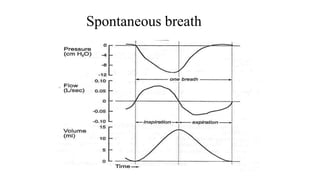
Spontaneous breath
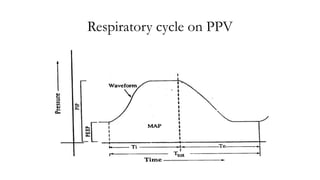
Respiratory cycle on PPV
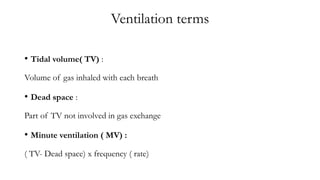
Ventilation terms
• Tidal volume( TV) :
Volume of gas inhaled with each breath
• Dead space :
Part of TV not involved in gas exchange
• Minute ventilation ( MV) :
( TV- Dead space) x frequency ( rate)
Normal ventilation
Term neonate
• TV = 4-8 ml/kg
• MV = 200 -480 ml/kg/min
• On PPV , aim for TV of 4-5 ml/kg
Lung mechanics
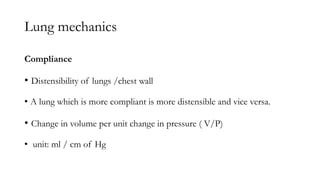
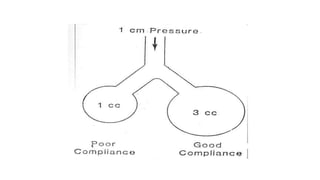
Compliance
• Distensibility of lungs /chest wall
• A lung which is more compliant is more distensible and vice versa.
• Change in volume per unit change in pressure ( V/P)
• unit: ml / cm of Hg
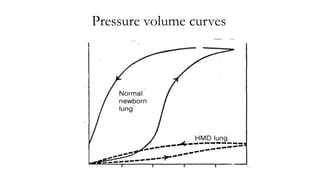
Pressure volume curves
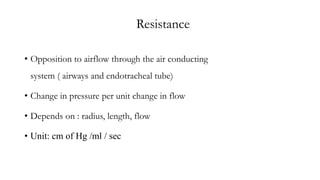
Resistance
• Opposition to airflow through the air conducting
system ( airways and endotracheal tube)
• Change in pressure per unit change in flow
• Depends on : radius, length, flow
• Unit: cm of Hg /ml / sec
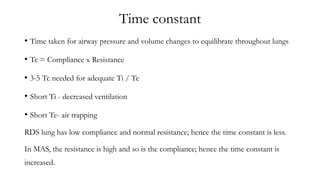
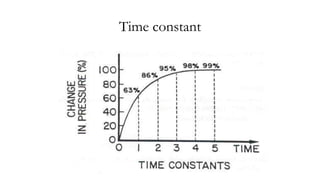
Time constant
• Time taken for airway pressure and volume changes to equilibrate throughout lungs
• Tc = Compliance x Resistance
• 3-5 Tc needed for adequate Ti / Te
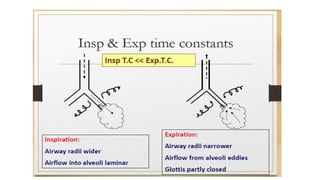
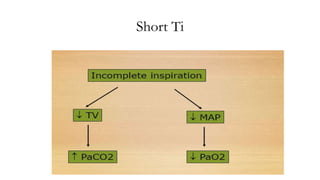
• Short Ti - decreased ventilation
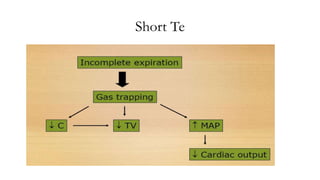
• Short Te- air trapping
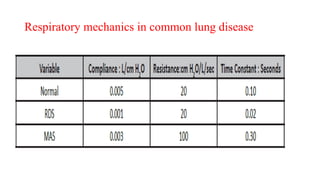
RDS lung has low compliance and normal resistance; hence the time constant is less.
In MAS, the resistance is high and so is the compliance; hence the time constant is
increased.
Time constant
Short Ti
Short Te
Respiratory mechanics in common lung disease
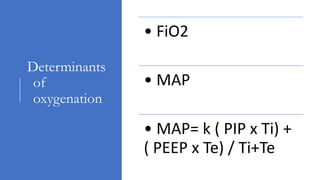
Determinants
of
oxygenation
• FiO2
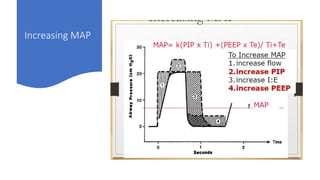
• MAP
• MAP= k ( PIP x Ti) +
( PEEP x Te) / Ti+Te
Increasing MAP
Determinants
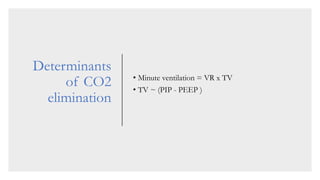
of CO2
elimination
• Minute ventilation = VR x TV
• TV ~ (PIP - PEEP )
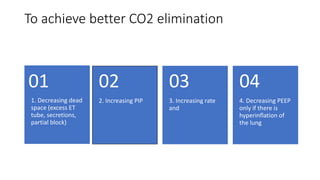
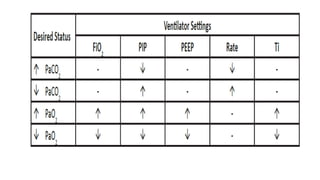
To achieve better CO2 elimination
1. Decreasing dead
space (excess ET
tube, secretions,
partial block)
01
2. Increasing PIP
02
3. Increasing rate
and
03
4. Decreasing PEEP
only if there is
hyperinflation of
the lung
04
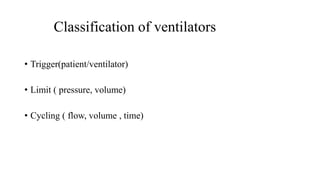
Classification of ventilators
• Trigger(patient/ventilator)
• Limit ( pressure, volume)
• Cycling ( flow, volume , time)
Limit:
That ventilator variable which cannot be exceeded.
Most newborns are managed on pressure limited modes of ventilation.
However, with the advent better flow sensors, volume ventilation is also
possible in newborns.
Currently, hybrid modes of ventilation with pressure and volume limit are
available.
Cycling:
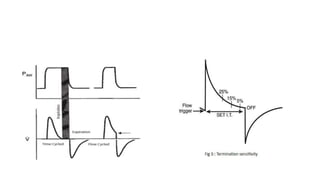
• It is a method by which the ventilator terminates the inspiratory phase.
• Conventionally, inspiration is stopped and the infant is allowed to
breathe out after a fixed time (inspiratory time).
• However, this often results in expiratory asynchrony.
Modes of Ventilation
Pressure triggered ventilation includes:
Synchronized intermittent mandatory ventilation (SIMV)
Assist control (A/C)
Pressure support ventilation (PSV)
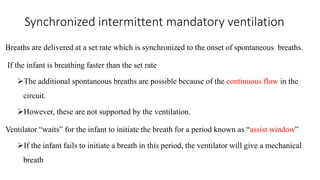
Synchronized intermittent mandatory ventilation
Breaths are delivered at a set rate which is synchronized to the onset of spontaneous breaths.
If the infant is breathing faster than the set rate
The additional spontaneous breaths are possible because of the continuous flow in the
circuit.
However, these are not supported by the ventilation.
Ventilator “waits” for the infant to initiate the breath for a period known as “assist window”
If the infant fails to initiate a breath in this period, the ventilator will give a mechanical
breath
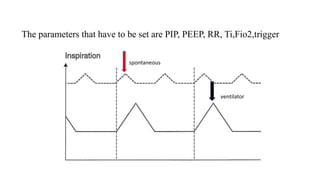
The parameters that have to be set are PIP, PEEP, RR, Ti,Fio2,trigger
spontaneous
ventilator
Assist-Control
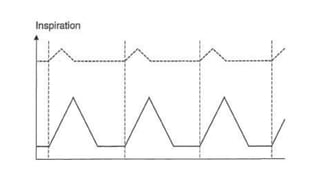
Delivery of a synchronized mechanical breath
Each time a spontaneous patient breath is detected (assist) or
 If the patient fails to initiate a breath, there is delivery of breaths at a pre set rate(control)
Thus complete inspiratory synchronization occurs, but not expiratory synchrony.
The rate is decided by the patient, however a back up ventilatory rate has to be set.
If the infant’s spontaneous respiratory rate is very high,
This mode results in hyperventilation which may reduce the time for
Expiration and thereby result in air trapping.
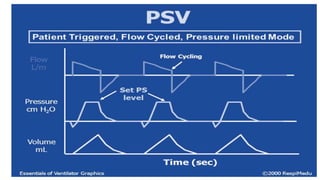
Pressure support ventilation (PSV)
Patient triggered, pressure limited and flow cycled.
Designed to assist the patient’s spontaneous effort with a pressure boost.
There is a good weaning mode.
The patient initiates inspiration, controls flow and the inspiratory time.
The patient has control over the rate, because it is patient triggered, and the
inspiratory time, because it is flow cycled.
The termination sensitivity should be set appropriately
 Keeping it at one extreme of 25% can reduce the Ti and can cause hypoventilation
 At the other extreme of 5% can result in occasional asynchrony.
PSV can be used as a primary mode of ventilation provided the infant has
reliable respiratory effort.
It is a good weaning mode or can be used as an adjunct to SIMV
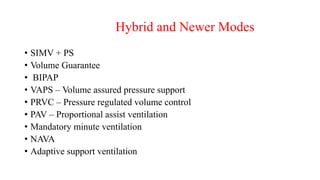
Hybrid and Newer Modes
• SIMV + PS
• Volume Guarantee
• BIPAP
• VAPS – Volume assured pressure support
• PRVC – Pressure regulated volume control
• PAV – Proportional assist ventilation
• Mandatory minute ventilation
• NAVA
• Adaptive support ventilation
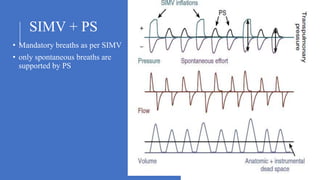
SIMV + PS
• Mandatory breaths as per SIMV
• only spontaneous breaths are
supported by PS
Volume Guarantee
The major limitation of any VC ventilator is that
 what is controlled is the volume injected into the ventilator circuit
 NOT the VT that enters the patient’s lungs
VG is an option available on the Dräger Babylog 8000+, the VN 500
VG may be combined with any of the basic ventilator modes AC,SIMV & PS
It is a volume-targeted, time- or flow-cycled, pressure-controlled form of
ventilation
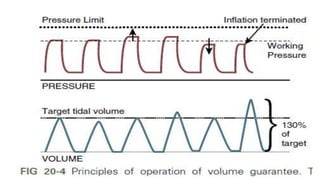
Volume Guarantee
The operator chooses a target VT and a pressure limit up to which the ventilator
operating pressure (working pressure) may be adjusted
The microprocessor compares the exhaled VT of the previous inflation and
adjusts the working pressure up or down to target the set VT
An obvious advantage of VG is that weaning occurs automatically, in real time,
and requires fewer blood gas measurements.
Volume ventilation plus
Complex mode that combines two different dual-mode volume-targeted inflation
types:
volume control plus, for delivery of mandatory inflations in AC and SIMV, and
 volume support, for support of spontaneous breaths in the spontaneous ventilation mode.
The ventilator adjusts inflation pressure to target desired VT.
Because VT is not routinely measured at the ETT, it is functionally similar to the
VC and PRVC modes described above
Pressure-regulated Volume Control
Time cycled pressure-controlled assist control mode
It uses s the VT of the previous cycle, measured at the ventilator (proximal) end of the
circuit, to regulate the inflation pressure needed to achieve the desired VT.
Pressure increment is limited to 3 cm H2O.
Because pressure adjustment is based on the previous breath, regardless of whether it
was an assisted breath or an untriggered inflation, variable and/or intermittent patient
respiratory effort will cause fluctuations in VT
Limitation:
 overestimation of VT measured proximally (at the ventilator end of the
circuit), rather than at the airway opening.
An optional flow sensor at the ET allows for more accurate monitoring of VT
 but the servo regulation of inflation pressure is still based on the proximal
flow measurement
BIPAP(Biphasic Positive Airway Pressure)
– pressure-controlled
– time cycled
– machine- or patient-triggered
– inspiration and expiration synchronized
– permitted spontaneous breathing during the whole breathing cycle
PEEP
Determines the FRC, V/Q matching and prevents the alveolar collapse
Ideal PEEP is that maintains good lung inflation (6 to 8 rib spaces on the
CXR) & minimizes the intercostal and subcostal recessions
Increasing PEEP increases MAP and improves oxygenation (PaO2)
Increasing PEEP:
When alveoli are collapsed improves ventilation (lowers PaCO2)
when there is hyperinflation, increasing PEEP decreases tidal volume and hence
worsens ventilation (increases PaCO2)
PEEP of 3 is for normal lungs, 4 to 7 cm for diseased lungs and > 7 is
used rarely
Very high PEEP could impair venous return and hence decrease the
cardiac output and thus the tissue oxygenation
High PEEP also increases PVR and thus may contribute to decreased
oxygenation
PIP
PIP is used to recruit alveoli and to drive gas flow into the lungs
Increasing PIP increases MAP and tidal volume and thus improves oxygenation and CO2
removal
PIP is adjusted to obtain chest wall movements (observed from the side of the patient) or to
obtain tidal volumes of 4 to 6 ml/kg
High PIP is causes barotraumas and may result in air leaks
High PIP also impairs venous return and hence decrease the cardiac output and thus the
tissue oxygenation
Most of the neonatal lung diseases the initial PIP is often between 16 to 20 cm of water
Rate and I: E ratio
Rate and I: E ratio are adjusted to achieve ideal minute volume
When lung inflation is adequate improve ventilation by increasing rates.
If hyperinflation, air trapping and auto PEEP use long Te and higher I:E ratio to
decrease PaCO2
Norma rates for neonatal lung disease is 40 to 60/min. As a general guideline choose
40/min for a term infant and 50/min as the initial rate for a preterm
Adequacy of inspiratory and expiratory times can be judged from the flow time or
pressure time graphs
Gas Flows
• In modern ventilators gas flows are auto-regulated to generate adequate
pressures (PIP and PEEP)
• Gas flows of 6 to 8 liters/min are sufficient for neonatal ventilations
• Higher requirement of gas flow occurs when there are leaks either in the
circuit or in the patient interface
• Increasing gas flow will increase the MAP by converting the pressure time
graph to a square wave pattern from a sine wave
• High flows could lead to turbulence, increased resistance and thus air-leaks
FiO2
FiO2 is adjusted to alter oxygenation
FiO2 is adjusted to maintain SpO2 between 90 to 94% and PaO2 between 50 to 80
mm of Hg
FiO2 and MAP go hand and hand. Improving oxygenation should to be titrated
between FiO2 and MAP
FiO2 of 25 % to 40% may be appropriate for PIP requirements between 16 to 20
cm of Hg where FiO2 of 50 to 100% would be appropriate for PIP between 20 to
24 cm of water
Disproportionate FiO2 with MAP occurs with acidosis, PPHN and heart disease
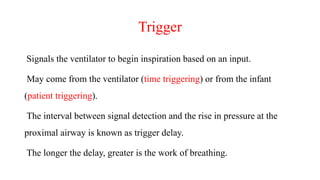
Trigger
Signals the ventilator to begin inspiration based on an input.
May come from the ventilator (time triggering) or from the infant
(patient triggering).
The interval between signal detection and the rise in pressure at the
proximal airway is known as trigger delay.
The longer the delay, greater is the work of breathing.
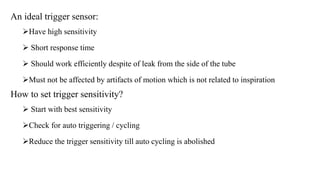
An ideal trigger sensor:
Have high sensitivity
 Short response time
 Should work efficiently despite of leak from the side of the tube
Must not be affected by artifacts of motion which is not related to inspiration
How to set trigger sensitivity?
 Start with best sensitivity
Check for auto triggering / cycling
Reduce the trigger sensitivity till auto cycling is abolished
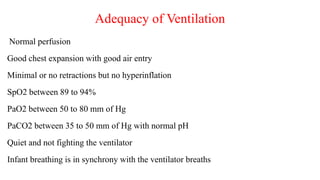
Adequacy of Ventilation
Normal perfusion
Good chest expansion with good air entry
Minimal or no retractions but no hyperinflation
SpO2 between 89 to 94%
PaO2 between 50 to 80 mm of Hg
PaCO2 between 35 to 50 mm of Hg with normal pH
Quiet and not fighting the ventilator
Infant breathing is in synchrony with the ventilator breaths
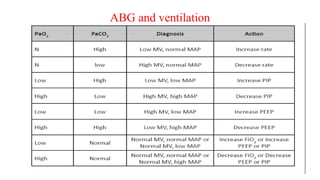
ABG and ventilation
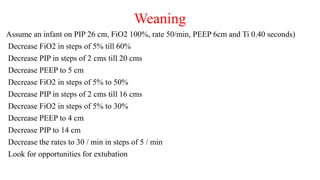
Weaning
Assume an infant on PIP 26 cm, FiO2 100%, rate 50/min, PEEP 6cm and Ti 0.40 seconds)
Decrease FiO2 in steps of 5% till 60%
Decrease PIP in steps of 2 cms till 20 cms
Decrease PEEP to 5 cm
Decrease FiO2 in steps of 5% to 50%
Decrease PIP in steps of 2 cms till 16 cms
Decrease FiO2 in steps of 5% to 30%
Decrease PEEP to 4 cm
Decrease PIP to 14 cm
Decrease the rates to 30 / min in steps of 5 / min
Look for opportunities for extubation
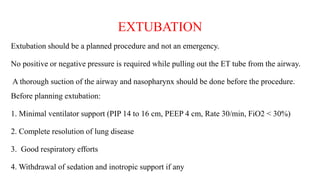
EXTUBATION
Extubation should be a planned procedure and not an emergency.
No positive or negative pressure is required while pulling out the ET tube from the airway.
A thorough suction of the airway and nasopharynx should be done before the procedure.
Before planning extubation:
1. Minimal ventilator support (PIP 14 to 16 cm, PEEP 4 cm, Rate 30/min, FiO2 < 30%)
2. Complete resolution of lung disease
3. Good respiratory efforts
4. Withdrawal of sedation and inotropic support if any
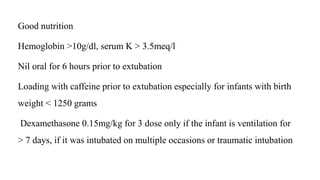
Good nutrition
Hemoglobin >10g/dl, serum K > 3.5meq/l
Nil oral for 6 hours prior to extubation
Loading with caffeine prior to extubation especially for infants with birth
weight < 1250 grams
Dexamethasone 0.15mg/kg for 3 dose only if the infant is ventilation for
> 7 days, if it was intubated on multiple occasions or traumatic intubation
Thank you

Ventilation basics in neonate

  • 1.
  • 6.
  • 7.
  • 8.
    Ventilation terms • Tidalvolume( TV) : Volume of gas inhaled with each breath • Dead space : Part of TV not involved in gas exchange • Minute ventilation ( MV) : ( TV- Dead space) x frequency ( rate)
  • 9.
    Normal ventilation Term neonate •TV = 4-8 ml/kg • MV = 200 -480 ml/kg/min • On PPV , aim for TV of 4-5 ml/kg
  • 10.
    Lung mechanics Compliance • Distensibilityof lungs /chest wall • A lung which is more compliant is more distensible and vice versa. • Change in volume per unit change in pressure ( V/P) • unit: ml / cm of Hg
  • 12.
  • 13.
    Resistance • Opposition toairflow through the air conducting system ( airways and endotracheal tube) • Change in pressure per unit change in flow • Depends on : radius, length, flow • Unit: cm of Hg /ml / sec
  • 14.
    Time constant • Timetaken for airway pressure and volume changes to equilibrate throughout lungs • Tc = Compliance x Resistance • 3-5 Tc needed for adequate Ti / Te • Short Ti - decreased ventilation • Short Te- air trapping RDS lung has low compliance and normal resistance; hence the time constant is less. In MAS, the resistance is high and so is the compliance; hence the time constant is increased.
  • 15.
  • 17.
  • 18.
  • 19.
    Respiratory mechanics incommon lung disease
  • 20.
    Determinants of oxygenation • FiO2 • MAP •MAP= k ( PIP x Ti) + ( PEEP x Te) / Ti+Te
  • 21.
  • 22.
    Determinants of CO2 elimination • Minuteventilation = VR x TV • TV ~ (PIP - PEEP )
  • 23.
    To achieve betterCO2 elimination 1. Decreasing dead space (excess ET tube, secretions, partial block) 01 2. Increasing PIP 02 3. Increasing rate and 03 4. Decreasing PEEP only if there is hyperinflation of the lung 04
  • 24.
    Classification of ventilators •Trigger(patient/ventilator) • Limit ( pressure, volume) • Cycling ( flow, volume , time)
  • 25.
    Limit: That ventilator variablewhich cannot be exceeded. Most newborns are managed on pressure limited modes of ventilation. However, with the advent better flow sensors, volume ventilation is also possible in newborns. Currently, hybrid modes of ventilation with pressure and volume limit are available.
  • 26.
    Cycling: • It isa method by which the ventilator terminates the inspiratory phase. • Conventionally, inspiration is stopped and the infant is allowed to breathe out after a fixed time (inspiratory time). • However, this often results in expiratory asynchrony.
  • 28.
    Modes of Ventilation Pressuretriggered ventilation includes: Synchronized intermittent mandatory ventilation (SIMV) Assist control (A/C) Pressure support ventilation (PSV)
  • 29.
    Synchronized intermittent mandatoryventilation Breaths are delivered at a set rate which is synchronized to the onset of spontaneous breaths. If the infant is breathing faster than the set rate The additional spontaneous breaths are possible because of the continuous flow in the circuit. However, these are not supported by the ventilation. Ventilator “waits” for the infant to initiate the breath for a period known as “assist window” If the infant fails to initiate a breath in this period, the ventilator will give a mechanical breath
  • 30.
    The parameters thathave to be set are PIP, PEEP, RR, Ti,Fio2,trigger spontaneous ventilator
  • 31.
    Assist-Control Delivery of asynchronized mechanical breath Each time a spontaneous patient breath is detected (assist) or  If the patient fails to initiate a breath, there is delivery of breaths at a pre set rate(control) Thus complete inspiratory synchronization occurs, but not expiratory synchrony. The rate is decided by the patient, however a back up ventilatory rate has to be set. If the infant’s spontaneous respiratory rate is very high, This mode results in hyperventilation which may reduce the time for Expiration and thereby result in air trapping.
  • 33.
    Pressure support ventilation(PSV) Patient triggered, pressure limited and flow cycled. Designed to assist the patient’s spontaneous effort with a pressure boost. There is a good weaning mode. The patient initiates inspiration, controls flow and the inspiratory time.
  • 34.
    The patient hascontrol over the rate, because it is patient triggered, and the inspiratory time, because it is flow cycled. The termination sensitivity should be set appropriately  Keeping it at one extreme of 25% can reduce the Ti and can cause hypoventilation  At the other extreme of 5% can result in occasional asynchrony. PSV can be used as a primary mode of ventilation provided the infant has reliable respiratory effort. It is a good weaning mode or can be used as an adjunct to SIMV
  • 36.
    Hybrid and NewerModes • SIMV + PS • Volume Guarantee • BIPAP • VAPS – Volume assured pressure support • PRVC – Pressure regulated volume control • PAV – Proportional assist ventilation • Mandatory minute ventilation • NAVA • Adaptive support ventilation
  • 37.
    SIMV + PS •Mandatory breaths as per SIMV • only spontaneous breaths are supported by PS
  • 38.
    Volume Guarantee The majorlimitation of any VC ventilator is that  what is controlled is the volume injected into the ventilator circuit  NOT the VT that enters the patient’s lungs VG is an option available on the Dräger Babylog 8000+, the VN 500 VG may be combined with any of the basic ventilator modes AC,SIMV & PS It is a volume-targeted, time- or flow-cycled, pressure-controlled form of ventilation
  • 39.
    Volume Guarantee The operatorchooses a target VT and a pressure limit up to which the ventilator operating pressure (working pressure) may be adjusted The microprocessor compares the exhaled VT of the previous inflation and adjusts the working pressure up or down to target the set VT An obvious advantage of VG is that weaning occurs automatically, in real time, and requires fewer blood gas measurements.
  • 41.
    Volume ventilation plus Complexmode that combines two different dual-mode volume-targeted inflation types: volume control plus, for delivery of mandatory inflations in AC and SIMV, and  volume support, for support of spontaneous breaths in the spontaneous ventilation mode. The ventilator adjusts inflation pressure to target desired VT. Because VT is not routinely measured at the ETT, it is functionally similar to the VC and PRVC modes described above
  • 42.
    Pressure-regulated Volume Control Timecycled pressure-controlled assist control mode It uses s the VT of the previous cycle, measured at the ventilator (proximal) end of the circuit, to regulate the inflation pressure needed to achieve the desired VT. Pressure increment is limited to 3 cm H2O. Because pressure adjustment is based on the previous breath, regardless of whether it was an assisted breath or an untriggered inflation, variable and/or intermittent patient respiratory effort will cause fluctuations in VT
  • 43.
    Limitation:  overestimation ofVT measured proximally (at the ventilator end of the circuit), rather than at the airway opening. An optional flow sensor at the ET allows for more accurate monitoring of VT  but the servo regulation of inflation pressure is still based on the proximal flow measurement
  • 44.
    BIPAP(Biphasic Positive AirwayPressure) – pressure-controlled – time cycled – machine- or patient-triggered – inspiration and expiration synchronized – permitted spontaneous breathing during the whole breathing cycle
  • 45.
    PEEP Determines the FRC,V/Q matching and prevents the alveolar collapse Ideal PEEP is that maintains good lung inflation (6 to 8 rib spaces on the CXR) & minimizes the intercostal and subcostal recessions Increasing PEEP increases MAP and improves oxygenation (PaO2) Increasing PEEP: When alveoli are collapsed improves ventilation (lowers PaCO2) when there is hyperinflation, increasing PEEP decreases tidal volume and hence worsens ventilation (increases PaCO2)
  • 46.
    PEEP of 3is for normal lungs, 4 to 7 cm for diseased lungs and > 7 is used rarely Very high PEEP could impair venous return and hence decrease the cardiac output and thus the tissue oxygenation High PEEP also increases PVR and thus may contribute to decreased oxygenation
  • 47.
    PIP PIP is usedto recruit alveoli and to drive gas flow into the lungs Increasing PIP increases MAP and tidal volume and thus improves oxygenation and CO2 removal PIP is adjusted to obtain chest wall movements (observed from the side of the patient) or to obtain tidal volumes of 4 to 6 ml/kg High PIP is causes barotraumas and may result in air leaks High PIP also impairs venous return and hence decrease the cardiac output and thus the tissue oxygenation Most of the neonatal lung diseases the initial PIP is often between 16 to 20 cm of water
  • 48.
    Rate and I:E ratio Rate and I: E ratio are adjusted to achieve ideal minute volume When lung inflation is adequate improve ventilation by increasing rates. If hyperinflation, air trapping and auto PEEP use long Te and higher I:E ratio to decrease PaCO2 Norma rates for neonatal lung disease is 40 to 60/min. As a general guideline choose 40/min for a term infant and 50/min as the initial rate for a preterm Adequacy of inspiratory and expiratory times can be judged from the flow time or pressure time graphs
  • 49.
    Gas Flows • Inmodern ventilators gas flows are auto-regulated to generate adequate pressures (PIP and PEEP) • Gas flows of 6 to 8 liters/min are sufficient for neonatal ventilations • Higher requirement of gas flow occurs when there are leaks either in the circuit or in the patient interface • Increasing gas flow will increase the MAP by converting the pressure time graph to a square wave pattern from a sine wave • High flows could lead to turbulence, increased resistance and thus air-leaks
  • 50.
    FiO2 FiO2 is adjustedto alter oxygenation FiO2 is adjusted to maintain SpO2 between 90 to 94% and PaO2 between 50 to 80 mm of Hg FiO2 and MAP go hand and hand. Improving oxygenation should to be titrated between FiO2 and MAP FiO2 of 25 % to 40% may be appropriate for PIP requirements between 16 to 20 cm of Hg where FiO2 of 50 to 100% would be appropriate for PIP between 20 to 24 cm of water Disproportionate FiO2 with MAP occurs with acidosis, PPHN and heart disease
  • 51.
    Trigger Signals the ventilatorto begin inspiration based on an input. May come from the ventilator (time triggering) or from the infant (patient triggering). The interval between signal detection and the rise in pressure at the proximal airway is known as trigger delay. The longer the delay, greater is the work of breathing.
  • 52.
    An ideal triggersensor: Have high sensitivity  Short response time  Should work efficiently despite of leak from the side of the tube Must not be affected by artifacts of motion which is not related to inspiration How to set trigger sensitivity?  Start with best sensitivity Check for auto triggering / cycling Reduce the trigger sensitivity till auto cycling is abolished
  • 53.
    Adequacy of Ventilation Normalperfusion Good chest expansion with good air entry Minimal or no retractions but no hyperinflation SpO2 between 89 to 94% PaO2 between 50 to 80 mm of Hg PaCO2 between 35 to 50 mm of Hg with normal pH Quiet and not fighting the ventilator Infant breathing is in synchrony with the ventilator breaths
  • 55.
  • 56.
    Weaning Assume an infanton PIP 26 cm, FiO2 100%, rate 50/min, PEEP 6cm and Ti 0.40 seconds) Decrease FiO2 in steps of 5% till 60% Decrease PIP in steps of 2 cms till 20 cms Decrease PEEP to 5 cm Decrease FiO2 in steps of 5% to 50% Decrease PIP in steps of 2 cms till 16 cms Decrease FiO2 in steps of 5% to 30% Decrease PEEP to 4 cm Decrease PIP to 14 cm Decrease the rates to 30 / min in steps of 5 / min Look for opportunities for extubation
  • 57.
    EXTUBATION Extubation should bea planned procedure and not an emergency. No positive or negative pressure is required while pulling out the ET tube from the airway. A thorough suction of the airway and nasopharynx should be done before the procedure. Before planning extubation: 1. Minimal ventilator support (PIP 14 to 16 cm, PEEP 4 cm, Rate 30/min, FiO2 < 30%) 2. Complete resolution of lung disease 3. Good respiratory efforts 4. Withdrawal of sedation and inotropic support if any
  • 58.
    Good nutrition Hemoglobin >10g/dl,serum K > 3.5meq/l Nil oral for 6 hours prior to extubation Loading with caffeine prior to extubation especially for infants with birth weight < 1250 grams Dexamethasone 0.15mg/kg for 3 dose only if the infant is ventilation for > 7 days, if it was intubated on multiple occasions or traumatic intubation
  • 59.