NEONATAL INTENSIVE CARENEONATAL INTENSIVE CARE
UNIT (NICU)UNIT (NICU)
BY
SURENDRA SHARMA
Steps organization ofSteps organization of
Neonatal Intensive CareNeonatal Intensive Care
Reorganization of existing neonatal
care facilities
Developing the units should be
Basic level – II
High level II
Level III
PHYSICAL FACILITIESPHYSICAL FACILITIES
The neonatologist and the
nurse in charge must be
involved while planning the
unit.
LOCATIONLOCATION
• Neonatal unit should be located as close as
possible to the labour rooms and obsteric
operation theatre
• Adequate sunlight for illumination
• Fair degree of ventilation of fresh air
SPACESPACE
500-600 Gross square feet per bed.
Space includes patient care area,
storage area, space for doctors, nurses,
other staff, office area, seminar room
area, laboratory area and space for
families
6 Feet gap between two incubators for
adequate circulation and keeping the
essential lifesaving equipment
FLOOR PLANFLOOR PLAN
Open encumbered space
The walls should be made of washable
glazed tiles and windows should have
two layers of glass panes.
Wash basins with elbow or floor operated
taps facility having constant round-the-
clock water supply should be provided.
The doors should be provided with
automatic door closers.
Isolation room
VENTILATIONVENTILATION
Effective air ventilation
Central air conditioning
LIGHTINGLIGHTING
The whole unit must be well
illuminated and painted white
The lighting arrangement should
provided uniform shadow-free,
illumination of 100 foot candles
at the baby’s level
ENVIRONMANTAL TEMPERATUREENVIRONMANTAL TEMPERATURE
AND HUMIDITYAND HUMIDITY
• The temperature inside the unit should be
maintained at 28’ +_2’C, while the humidity
must be above 50%.
• Portable radiant heater, infra red lamp can
be used
ACOUSTIC CHARACTERISTICSACOUSTIC CHARACTERISTICS
• The ventilation system, incubators, air
compressors, suction pumps and many
other devices used in the nursery produce
noise.
• Sound intensity in the unit should be
exceed 75 decibels.
• Telephone rings and equipment alarms
should be replaced by blinking lights.
COMMUNICATION SYSTEMCOMMUNICATION SYSTEM
• The unit should also have an
intercom & a direct outside
telephone line
ELECTRICAL OUTLETSELECTRICAL OUTLETS
• Each patient station should have 12 to 16
central voltage – stabilized electrical outlets
sufficient to handle all pieces of equipment
• An additional power plug point
• There should be round-the-clock power
back up including provision of UPS system.
STAFFSTAFF
• A direct who is a full time neonatologist
• One neonatal physician is required for
every 6-10 patients
• One resident doctor should be present in
the unit round-the-clock.
• Anesthetist - pediatric surgeon and
pediatric pathologist are essential persons
in establishment of a good quality NICU
NURSESNURSES
• A nurse : patient ratio of 1:1 maintained thought out
day and night is absolutely essential for babies on
multi system support including ventilatory therapy.
• For special care neonatal unit and intermediate care,
nurse to patient ratio of 1:3 is ideal but 1:5 per shift is
manageable.
• Head nurse is the overall in-charge
• In addition to basic nursing training for level-II car,
tertiary care requires, staff nurse need to be trained in
handling equipment, use of ventilators and initiation of
life-support like use of bag and mask resuscitation,
endotracheal intubations, arterial sampling and so-on.
• The staff must have a minimum of 3 years work
experience in special care neonatal unit in addition to
having 3 months hand-on-training in an intensive care
neonatal unit.
OTHER STAFFOTHER STAFF
• Respiratory therapist
• Laboratory technician
• Public health nurse or social worker
• Biomedical engineer
• Clark
EQUIPMENTEQUIPMENT
• Equipment and supplies should including all
that is necessary for resuscitation and
intermediate care areas.
• Supplies should be kept close to the patient
station so that nurses do not have to go
away from the neonate unnecessarily and
nurses time & skills are used efficiently.
• There should be servo-controlled
incubators and open care systems for
providing adequate warmth
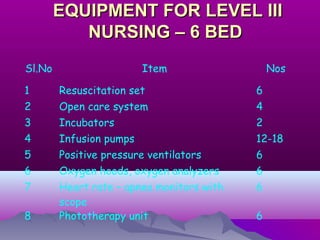
EQUIPMENT FOR LEVEL IIIEQUIPMENT FOR LEVEL III
NURSING – 6 BEDNURSING – 6 BED
Sl.No Item Nos
1 Resuscitation set 6
2 Open care system 4
3 Incubators 2
4 Infusion pumps 12-18
5 Positive pressure ventilators 6
6 Oxygen hoods, oxygen analyzers 6
7 Heart rate – apnea monitors with
scope
6
8 Phototherapy unit 6
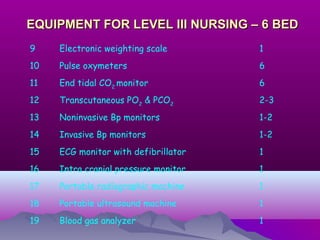
EQUIPMENT FOR LEVEL III NURSING – 6 BEDEQUIPMENT FOR LEVEL III NURSING – 6 BED
9 Electronic weighting scale 1
10 Pulse oxymeters 6
11 End tidal CO2
monitor 6
12 Transcutaneous PO2
& PCO2
2-3
13 Noninvasive Bp monitors 1-2
14 Invasive Bp monitors 1-2
15 ECG monitor with defibrillator 1
16 Intra cranial pressure monitor 1
17 Portable radiographic machine 1
18 Portable ultrasound machine 1
19 Blood gas analyzer 1
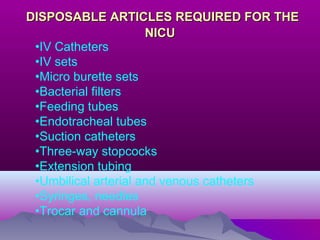
DISPOSABLE ARTICLES REQUIRED FOR THEDISPOSABLE ARTICLES REQUIRED FOR THE
NICUNICU
•IV Catheters
•IV sets
•Micro burette sets
•Bacterial filters
•Feeding tubes
•Endotracheal tubes
•Suction catheters
•Three-way stopcocks
•Extension tubing
•Umbilical arterial and venous catheters
•Syringes, needles
•Trocar and cannula
LABORATORY FACILITIESLABORATORY FACILITIES
•Microchemistry laboratory
•Well equipped to provide
quick and reliable
•Facilities for creative protein,
total leukocyte counts and
microscopic examination of
peripheral blood
TOWARDS A GENTLE AND FRIENDLY NICU ENVIRONMENTTOWARDS A GENTLE AND FRIENDLY NICU ENVIRONMENT
•It has been realized that physical and social environment
of nursery affect the recovery and long term morbidity of
the neonate.
•Attempts should be made to reduce unnecessary noise
and light.
•Avoid excess of light
•Handling should be gentle
•Neonates including pre terms feel pain and painful stimuli
can cause deleterious physiological responses. Analgesia
should be provided during all procedure including
ventilation.
•Parent should be allowed unrestricted entry to the nursery,
•They should be explained about various tubing and
attachments to the baby and should be involved in care of
their baby.
INDICATIONS FOR THE ADMINSSION TO NICUINDICATIONS FOR THE ADMINSSION TO NICU
•Babies less then 30 weeks
•Very low birth weight baby of less then
1500 gms
•Cardiopulmonary monitoring
•Surfactant therapy
•Convulsions
•Severe birth asphyxia
•Assisted ventilation
•Total parenteral nutrition
•Major surgery
LEVELS OF NEONATAL CARELEVELS OF NEONATAL CARE
LEVEL I CARELEVEL I CARE
•The minimal care
•Provided by the mother under the
supervision of basic health professionals.
• Neonates weighting more than 2000 gm
or having gestational age maturity of 37
weeks or more belong to this care.
•This care can be includes care of
delivery, provision of the warmth,
maintenance of asepsis, and promotion of
breast feeding.
LEVELS OF NEONATAL CARELEVELS OF NEONATAL CARE
LEVEL II CARELEVEL II CARE
•This care includes requirement for
resuscitation, maintenance of thermo neutral
temperature, intravenous infusion, gavage
feeding phototherapy and exchange
transfusion.
•10-15 percent of the newborn require this
care
• This care s is anticipated for the infants
weighing in between 1500 & 1800 gm or
having gestational age maturity of 32 to 36
weeks.
LEVELS OF NEONATAL CARELEVELS OF NEONATAL CARE
LEVEL III CARELEVEL III CARE
•This care includes life saving support system
like ventilator and best suited special
intensive neonatal care.
•Three to five percent of newborn require
care of this level.
•This level of care is for critically ill babies, for
those weighing less than 1500 gm or having
gestational age maturity of less than 32
weeks.
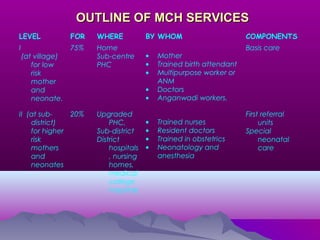
OUTLINE OF MCH SERVICESOUTLINE OF MCH SERVICES
LEVEL FOR WHERE BY WHOM COMPONENTS
I
(at village)
for low
risk
mother
and
neonate.
75% Home
Sub-centre
PHC
• Mother
• Trained birth attendant
• Multipurpose worker or
ANM
• Doctors
• Anganwadi workers.
Basis care
II (at sub-
district)
for higher
risk
mothers
and
neonates
.
20% Upgraded
PHC,
Sub-district
District
hospitals
, nursing
homes,
medical
college
hospitals
• Trained nurses
• Resident doctors
• Trained in obstetrics
• Neonatology and
anesthesia
First referral
units
Special
neonatal
care
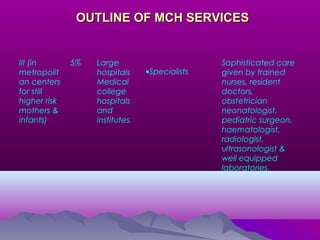
OUTLINE OF MCH SERVICESOUTLINE OF MCH SERVICES
III (in
metropolit
an centers
for still
higher risk
mothers &
infants)
5% Large
hospitals
Medical
college
hospitals
and
institutes.
•Specialists
Sophisticated care
given by trained
nurses, resident
doctors,
obstetrician
neonatologist,
pediatric surgeon,
haematologist,
radiologist,
ultrasonologist &
well equipped
laboratories.
THE MCH SERVICESTHE MCH SERVICES
DIFFERENT LEVELSDIFFERENT LEVELS
Level I Care:
Prenatal care:
Early detection of pregnancy.
•Identification of high risk pregnancy.
•Immunization against tetanus.
•Nutrition supplements with iron & folic acid.
•Antenatal assessments at 20,30,34 & 38 weeks
of pregnancy.
•Assessment of pelosis.
•Early detection of fortal growth failure.
THE MCH SERVICESTHE MCH SERVICES
DIFFERENT LEVELSDIFFERENT LEVELS
INTERNAL CARE :
•Proper management of labour and delivery.
•Adequate support of establishment of respiration
oropharyngeal suction and warmth.
•Identification of low birth weight, preterm birth &
malformations requiring immediate correction and
their referral.
THE MCH SERVICESTHE MCH SERVICES
DIFFERENT LEVELSDIFFERENT LEVELS
LEVEL II CARE:
Prenatal care:
This must be offered to mothers “at risk” identified
through the high risk approach or mothers developing
complications during pregnancy and / or labour.
Intranatal and neonatal care:
Deliveries of all “at risk” mothers must be attended by a
trained obstetrician and neonatologist at first referral units.
The new-born are expected to get special care for anoxia
hyperbilirubinaemia, respiratory distress syndrome and
septicaemia.
THE MCH SERVICESTHE MCH SERVICES
DIFFERENT LEVELSDIFFERENT LEVELS
LEVEL III CARE:
This level of care is meant for high risk pregnant women &
neonates.
•Low birth weight babies
•Severe respiratory distress
•Serve anoxia at birth
•Shock & metabolic problems
Intensive neonatal care unit having a full time neonatologist,
trained nursing staff and resident doctors, equipped with
biochemical laboratory support, ultra sound, electronic
monitory of foetal condition, ventilation and respiratory support,
blood transfusion arrangement & monitoring.
SUMMARYSUMMARY
So far we have seen about neonatal intensive
care unit, its organization, physical facilities,
personnel, equipment necessary, laboratory facilities
and level of neonatal are and MCH services available
at different level.
CONCLUSIONCONCLUSION
Thought NICU services require high
technology input and expensive one should not
lose sight of the human approach towards the
fragile and sick babies & their anguished
parents. To obtain best results from neonatal
intensive care we need a well equipped unit.
Nicu

Nicu

  • 2.
    NEONATAL INTENSIVE CARENEONATALINTENSIVE CARE UNIT (NICU)UNIT (NICU) BY SURENDRA SHARMA
  • 3.
    Steps organization ofStepsorganization of Neonatal Intensive CareNeonatal Intensive Care Reorganization of existing neonatal care facilities Developing the units should be Basic level – II High level II Level III
  • 4.
    PHYSICAL FACILITIESPHYSICAL FACILITIES Theneonatologist and the nurse in charge must be involved while planning the unit.
  • 5.
    LOCATIONLOCATION • Neonatal unitshould be located as close as possible to the labour rooms and obsteric operation theatre • Adequate sunlight for illumination • Fair degree of ventilation of fresh air
  • 6.
    SPACESPACE 500-600 Gross squarefeet per bed. Space includes patient care area, storage area, space for doctors, nurses, other staff, office area, seminar room area, laboratory area and space for families 6 Feet gap between two incubators for adequate circulation and keeping the essential lifesaving equipment
  • 7.
    FLOOR PLANFLOOR PLAN Openencumbered space The walls should be made of washable glazed tiles and windows should have two layers of glass panes. Wash basins with elbow or floor operated taps facility having constant round-the- clock water supply should be provided. The doors should be provided with automatic door closers. Isolation room
  • 8.
  • 9.
    LIGHTINGLIGHTING The whole unitmust be well illuminated and painted white The lighting arrangement should provided uniform shadow-free, illumination of 100 foot candles at the baby’s level
  • 10.
    ENVIRONMANTAL TEMPERATUREENVIRONMANTAL TEMPERATURE ANDHUMIDITYAND HUMIDITY • The temperature inside the unit should be maintained at 28’ +_2’C, while the humidity must be above 50%. • Portable radiant heater, infra red lamp can be used
  • 11.
    ACOUSTIC CHARACTERISTICSACOUSTIC CHARACTERISTICS •The ventilation system, incubators, air compressors, suction pumps and many other devices used in the nursery produce noise. • Sound intensity in the unit should be exceed 75 decibels. • Telephone rings and equipment alarms should be replaced by blinking lights.
  • 12.
    COMMUNICATION SYSTEMCOMMUNICATION SYSTEM •The unit should also have an intercom & a direct outside telephone line
  • 13.
    ELECTRICAL OUTLETSELECTRICAL OUTLETS •Each patient station should have 12 to 16 central voltage – stabilized electrical outlets sufficient to handle all pieces of equipment • An additional power plug point • There should be round-the-clock power back up including provision of UPS system.
  • 14.
    STAFFSTAFF • A directwho is a full time neonatologist • One neonatal physician is required for every 6-10 patients • One resident doctor should be present in the unit round-the-clock. • Anesthetist - pediatric surgeon and pediatric pathologist are essential persons in establishment of a good quality NICU
  • 15.
    NURSESNURSES • A nurse: patient ratio of 1:1 maintained thought out day and night is absolutely essential for babies on multi system support including ventilatory therapy. • For special care neonatal unit and intermediate care, nurse to patient ratio of 1:3 is ideal but 1:5 per shift is manageable. • Head nurse is the overall in-charge • In addition to basic nursing training for level-II car, tertiary care requires, staff nurse need to be trained in handling equipment, use of ventilators and initiation of life-support like use of bag and mask resuscitation, endotracheal intubations, arterial sampling and so-on. • The staff must have a minimum of 3 years work experience in special care neonatal unit in addition to having 3 months hand-on-training in an intensive care neonatal unit.
  • 16.
    OTHER STAFFOTHER STAFF •Respiratory therapist • Laboratory technician • Public health nurse or social worker • Biomedical engineer • Clark
  • 17.
    EQUIPMENTEQUIPMENT • Equipment andsupplies should including all that is necessary for resuscitation and intermediate care areas. • Supplies should be kept close to the patient station so that nurses do not have to go away from the neonate unnecessarily and nurses time & skills are used efficiently. • There should be servo-controlled incubators and open care systems for providing adequate warmth
  • 18.
    EQUIPMENT FOR LEVELIIIEQUIPMENT FOR LEVEL III NURSING – 6 BEDNURSING – 6 BED Sl.No Item Nos 1 Resuscitation set 6 2 Open care system 4 3 Incubators 2 4 Infusion pumps 12-18 5 Positive pressure ventilators 6 6 Oxygen hoods, oxygen analyzers 6 7 Heart rate – apnea monitors with scope 6 8 Phototherapy unit 6
  • 19.
    EQUIPMENT FOR LEVELIII NURSING – 6 BEDEQUIPMENT FOR LEVEL III NURSING – 6 BED 9 Electronic weighting scale 1 10 Pulse oxymeters 6 11 End tidal CO2 monitor 6 12 Transcutaneous PO2 & PCO2 2-3 13 Noninvasive Bp monitors 1-2 14 Invasive Bp monitors 1-2 15 ECG monitor with defibrillator 1 16 Intra cranial pressure monitor 1 17 Portable radiographic machine 1 18 Portable ultrasound machine 1 19 Blood gas analyzer 1
  • 20.
    DISPOSABLE ARTICLES REQUIREDFOR THEDISPOSABLE ARTICLES REQUIRED FOR THE NICUNICU •IV Catheters •IV sets •Micro burette sets •Bacterial filters •Feeding tubes •Endotracheal tubes •Suction catheters •Three-way stopcocks •Extension tubing •Umbilical arterial and venous catheters •Syringes, needles •Trocar and cannula
  • 21.
    LABORATORY FACILITIESLABORATORY FACILITIES •Microchemistrylaboratory •Well equipped to provide quick and reliable •Facilities for creative protein, total leukocyte counts and microscopic examination of peripheral blood
  • 22.
    TOWARDS A GENTLEAND FRIENDLY NICU ENVIRONMENTTOWARDS A GENTLE AND FRIENDLY NICU ENVIRONMENT •It has been realized that physical and social environment of nursery affect the recovery and long term morbidity of the neonate. •Attempts should be made to reduce unnecessary noise and light. •Avoid excess of light •Handling should be gentle •Neonates including pre terms feel pain and painful stimuli can cause deleterious physiological responses. Analgesia should be provided during all procedure including ventilation. •Parent should be allowed unrestricted entry to the nursery, •They should be explained about various tubing and attachments to the baby and should be involved in care of their baby.
  • 23.
    INDICATIONS FOR THEADMINSSION TO NICUINDICATIONS FOR THE ADMINSSION TO NICU •Babies less then 30 weeks •Very low birth weight baby of less then 1500 gms •Cardiopulmonary monitoring •Surfactant therapy •Convulsions •Severe birth asphyxia •Assisted ventilation •Total parenteral nutrition •Major surgery
  • 24.
    LEVELS OF NEONATALCARELEVELS OF NEONATAL CARE LEVEL I CARELEVEL I CARE •The minimal care •Provided by the mother under the supervision of basic health professionals. • Neonates weighting more than 2000 gm or having gestational age maturity of 37 weeks or more belong to this care. •This care can be includes care of delivery, provision of the warmth, maintenance of asepsis, and promotion of breast feeding.
  • 25.
    LEVELS OF NEONATALCARELEVELS OF NEONATAL CARE LEVEL II CARELEVEL II CARE •This care includes requirement for resuscitation, maintenance of thermo neutral temperature, intravenous infusion, gavage feeding phototherapy and exchange transfusion. •10-15 percent of the newborn require this care • This care s is anticipated for the infants weighing in between 1500 & 1800 gm or having gestational age maturity of 32 to 36 weeks.
  • 26.
    LEVELS OF NEONATALCARELEVELS OF NEONATAL CARE LEVEL III CARELEVEL III CARE •This care includes life saving support system like ventilator and best suited special intensive neonatal care. •Three to five percent of newborn require care of this level. •This level of care is for critically ill babies, for those weighing less than 1500 gm or having gestational age maturity of less than 32 weeks.
  • 27.
    OUTLINE OF MCHSERVICESOUTLINE OF MCH SERVICES LEVEL FOR WHERE BY WHOM COMPONENTS I (at village) for low risk mother and neonate. 75% Home Sub-centre PHC • Mother • Trained birth attendant • Multipurpose worker or ANM • Doctors • Anganwadi workers. Basis care II (at sub- district) for higher risk mothers and neonates . 20% Upgraded PHC, Sub-district District hospitals , nursing homes, medical college hospitals • Trained nurses • Resident doctors • Trained in obstetrics • Neonatology and anesthesia First referral units Special neonatal care
  • 28.
    OUTLINE OF MCHSERVICESOUTLINE OF MCH SERVICES III (in metropolit an centers for still higher risk mothers & infants) 5% Large hospitals Medical college hospitals and institutes. •Specialists Sophisticated care given by trained nurses, resident doctors, obstetrician neonatologist, pediatric surgeon, haematologist, radiologist, ultrasonologist & well equipped laboratories.
  • 29.
    THE MCH SERVICESTHEMCH SERVICES DIFFERENT LEVELSDIFFERENT LEVELS Level I Care: Prenatal care: Early detection of pregnancy. •Identification of high risk pregnancy. •Immunization against tetanus. •Nutrition supplements with iron & folic acid. •Antenatal assessments at 20,30,34 & 38 weeks of pregnancy. •Assessment of pelosis. •Early detection of fortal growth failure.
  • 30.
    THE MCH SERVICESTHEMCH SERVICES DIFFERENT LEVELSDIFFERENT LEVELS INTERNAL CARE : •Proper management of labour and delivery. •Adequate support of establishment of respiration oropharyngeal suction and warmth. •Identification of low birth weight, preterm birth & malformations requiring immediate correction and their referral.
  • 31.
    THE MCH SERVICESTHEMCH SERVICES DIFFERENT LEVELSDIFFERENT LEVELS LEVEL II CARE: Prenatal care: This must be offered to mothers “at risk” identified through the high risk approach or mothers developing complications during pregnancy and / or labour. Intranatal and neonatal care: Deliveries of all “at risk” mothers must be attended by a trained obstetrician and neonatologist at first referral units. The new-born are expected to get special care for anoxia hyperbilirubinaemia, respiratory distress syndrome and septicaemia.
  • 32.
    THE MCH SERVICESTHEMCH SERVICES DIFFERENT LEVELSDIFFERENT LEVELS LEVEL III CARE: This level of care is meant for high risk pregnant women & neonates. •Low birth weight babies •Severe respiratory distress •Serve anoxia at birth •Shock & metabolic problems Intensive neonatal care unit having a full time neonatologist, trained nursing staff and resident doctors, equipped with biochemical laboratory support, ultra sound, electronic monitory of foetal condition, ventilation and respiratory support, blood transfusion arrangement & monitoring.
  • 33.
    SUMMARYSUMMARY So far wehave seen about neonatal intensive care unit, its organization, physical facilities, personnel, equipment necessary, laboratory facilities and level of neonatal are and MCH services available at different level.
  • 34.
    CONCLUSIONCONCLUSION Thought NICU servicesrequire high technology input and expensive one should not lose sight of the human approach towards the fragile and sick babies & their anguished parents. To obtain best results from neonatal intensive care we need a well equipped unit.