Basic Principle of Mechanical
   Ventilation in Pediatric
   Mohamed Salim Kabbani, M.D
  Pediatric intensive care consultant
    Head, Pediatric Cardiac ICU
    King Abdulaziz Medical City
Objectives
Definition: normal and artificial ventilation
Indication
Classification of different modes of ventilation
Troubleshooting and complication
High frequency ventilation
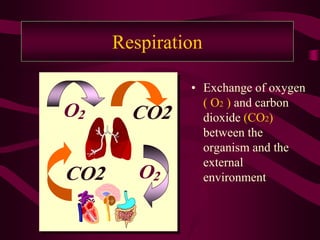
Respiration

               • Exchange of oxygen
                 ( O2 ) and carbon
O2      CO2      dioxide (CO2)
                 between the
                 organism and the
                 external
CO2      O2      environment
Respiratory Failure

•   Inability of the pulmonary system to meet the metabolic
    demands of the body through adequate gas exchange.
•   Two types of respiratory failure:
      Hypoxemic
      Hypercarbic
•   Each can be acute and chronic.
•   Both can be present in the same patient.
•   Management of this condition required assisted mechanical
    ventilation
What dose Mechanical ventilation mean?

• “Assisted Ventilation involves the
  Delivery of Flow and Pressure to the
  Patient’s Airway in Order to Effect
  Change in Lung Volume”
• A mechanical ventilator is a machine
  that generates controlled flow of gas
  into a patient’s airway
Mechanical Ventilation / Normal ventilation


                                           -

                                   -                  -


 Positive pressure ventilation   Normal ventilation
Objectives
Definition: normal and artificial ventilation
Indication
Classification of different modes of ventilation
Troubleshooting and complication
Examples and Scenarios
Goals of Mechanical Ventilation
                     (End-result)


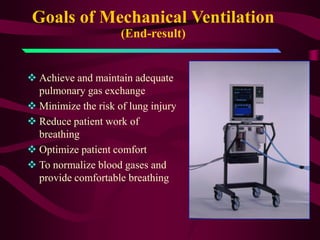
 Achieve and maintain adequate
  pulmonary gas exchange
 Minimize the risk of lung injury
 Reduce patient work of
  breathing
 Optimize patient comfort
 To normalize blood gases and
  provide comfortable breathing
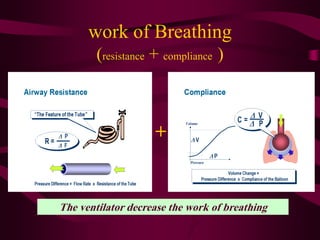
What is the work of Breathing?
                               (Compliance & Resistance)

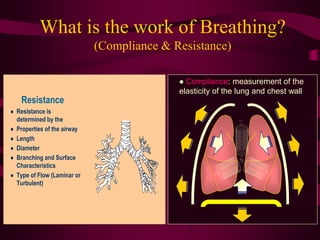
                                               Compliance: measurement of the
                                              elasticity of the lung and chest wall
     Resistance
   Resistance is
    determined by the
   Properties of the airway
   Length
   Diameter
   Branching and Surface
    Characteristics
   Type of Flow (Laminar or
    Turbulent)
work of Breathing
        (resistance + compliance )


                    +


The ventilator decrease the work of breathing
Objectives
Definition: normal and artificial ventilation
Indication
Classification of different modes of ventilation
Troubleshooting and complication
Examples and Scenarios
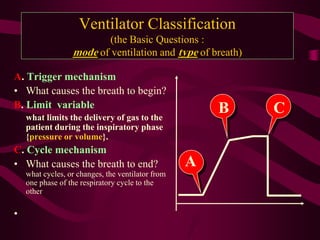
Ventilator Classification
                          (the Basic Questions :
                  mode of ventilation and type of breath)

A. Trigger mechanism
• What causes the breath to begin?
B. Limit variable                                      B    C
    what limits the delivery of gas to the
    patient during the inspiratory phase
    {pressure or volume}.
C. Cycle mechanism
• What causes the breath to end?                   A
    what cycles, or changes, the ventilator from
    one phase of the respiratory cycle to the
    other

•
Ventilation Modes
                 (Attitude)
 How mechanical ventilation are delivered to
 the patient?

What are the relationship between
 spontaneous breath and the mechanical
 breath?
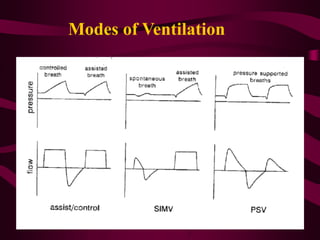
Modes of Ventilation
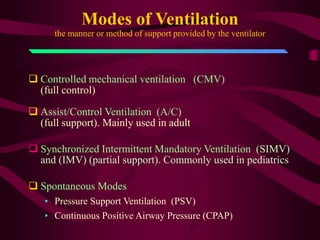
      the manner or method of support provided by the ventilator


 Controlled mechanical ventilation (CMV)
  (full control)

 Assist/Control Ventilation (A/C)
  (full support). Mainly used in adult

 Synchronized Intermittent Mandatory Ventilation (SIMV)
  and (IMV) (partial support). Commonly used in pediatrics

 Spontaneous Modes
   • Pressure Support Ventilation (PSV)
   • Continuous Positive Airway Pressure (CPAP)
Modes of Ventilation
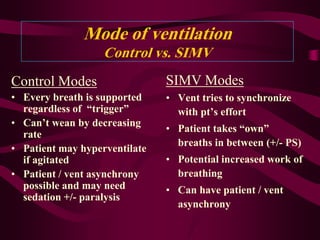
Mode of ventilation
                   Control vs. SIMV
Control Modes                  SIMV Modes
• Every breath is supported    • Vent tries to synchronize
  regardless of “trigger”        with pt’s effort
• Can’t wean by decreasing
                               • Patient takes “own”
  rate
                                 breaths in between (+/- PS)
• Patient may hyperventilate
  if agitated                  • Potential increased work of
• Patient / vent asynchrony      breathing
  possible and may need        • Can have patient / vent
  sedation +/- paralysis
                                 asynchrony
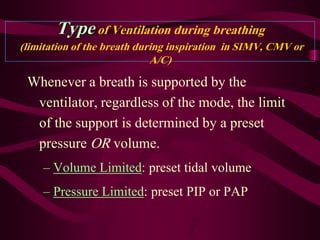
Type of Ventilation during breathing
(limitation of the breath during inspiration in SIMV, CMV or
                             A/C)

 Whenever a breath is supported by the
  ventilator, regardless of the mode, the limit
  of the support is determined by a preset
  pressure OR volume.
    – Volume Limited: preset tidal volume
    – Pressure Limited: preset PIP or PAP
Mechanical Ventilation
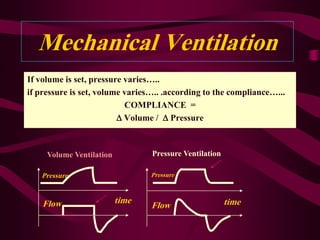
If volume is set, pressure varies…..
if pressure is set, volume varies….. .according to the compliance…...
                           COMPLIANCE =
                          Volume /  Pressure


     Volume Ventilation          Pressure Ventilation

   Pressure                      Pressure


    Flow                  time                          time
                                 Flow
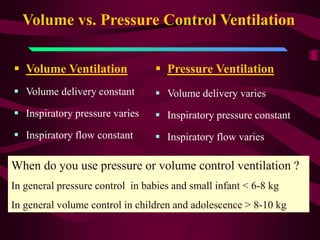
Volume vs. Pressure Control Ventilation

 Volume Ventilation              Pressure Ventilation
 Volume delivery constant        Volume delivery varies
 Inspiratory pressure varies     Inspiratory pressure constant
 Inspiratory flow constant       Inspiratory flow varies

When do you use pressure or volume control ventilation ?
In general pressure control in babies and small infant < 6-8 kg
In general volume control in children and adolescence > 8-10 kg
What is pressure support ventilation
                      Need a hand??
Pressure Support
• “Triggering” vent requires certain amount of work by patient

• Can decrease work of breathing by providing flow during
  inspiration for patient triggered breaths  increase pressure

• The amount of flow increase is limited by set pressure. (5-10)

• Can be given with spontaneous breaths, in IMV modes or as
  stand alone mode without set rate

• Flow-cycled
How can we set the ventilator?
          (Ventilator Basics parameters)
• FIO2 - fraction of inspired oxygen

• Rate - number of breaths per minute

• Tidal Volume - volume of each breath

• Sensitivity - how responsive the ventilator is to the patient’s efforts

• PIP : maximum amount of pressured delivered during each breath

• Inspiratory Time (I time)- the time spent in the inspiratory phase of the
  ventilatory cycle

• I:E Ratio - the inspiratory time compared to the expiratory time;
  I + E = total cycle time

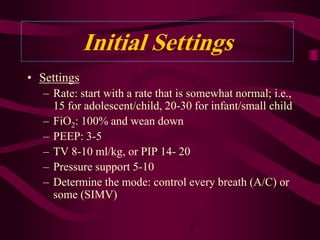
• PEEP: positive end expiratory pressure
Initial Settings
• Settings
   – Rate: start with a rate that is somewhat normal; i.e.,
     15 for adolescent/child, 20-30 for infant/small child
   – FiO2: 100% and wean down
   – PEEP: 3-5
   – TV 8-10 ml/kg, or PIP 14- 20
   – Pressure support 5-10
   – Determine the mode: control every breath (A/C) or
     some (SIMV)
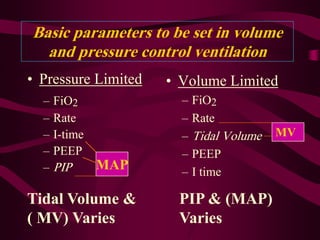
Basic parameters to be set in volume
  and pressure control ventilation
• Pressure Limited   • Volume Limited
  –   FiO2             –   FiO2
  –   Rate             –   Rate
  –   I-time           –   Tidal Volume   MV
  –   PEEP             –   PEEP
  –   PIP      MAP     –   I time

Tidal Volume &        PIP & (MAP)
( MV) Varies          Varies
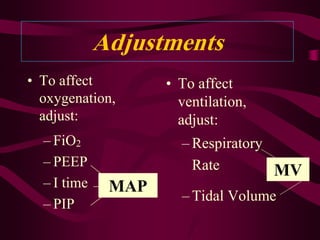
Adjustments
• To affect         • To affect
  oxygenation,        ventilation,
  adjust:             adjust:
  – FiO2              – Respiratory
  – PEEP                Rate        MV
  – I time    MAP
                      – Tidal Volume
  – PIP
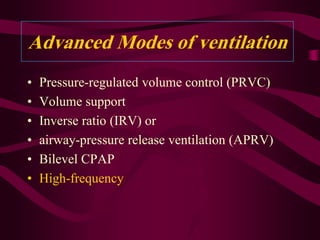
Advanced Modes of ventilation
•   Pressure-regulated volume control (PRVC)
•   Volume support
•   Inverse ratio (IRV) or
•   airway-pressure release ventilation (APRV)
•   Bilevel CPAP
•   High-frequency
Advanced Modes
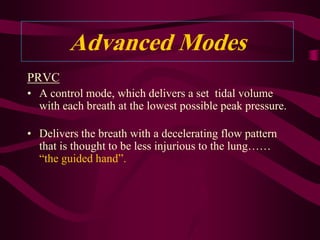
PRVC
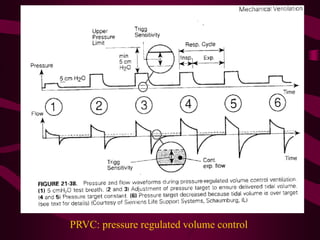
• A control mode, which delivers a set tidal volume
  with each breath at the lowest possible peak pressure.

• Delivers the breath with a decelerating flow pattern
  that is thought to be less injurious to the lung……
  “the guided hand”.
PRVC: pressure regulated volume control
Advanced Modes
Inverse Ratio Ventilation
  – Pressure Control Mode
  – I:E > 1
  – Can increase MAP without increasing PIP:
    improve oxygenation but limit barotrauma
  – Significant risk for air trapping
  – Patient will need to be deeply sedated and
    perhaps paralyzed as well
Advanced mode of ventilation
          High frequency ventilation
• Definition: Ventilator rate > 150 per minute
• TV is < dead space
  – High frequency positive pressure ventilation:
    Rate 60-100 per minute
  – High frequency jet ventilation:
    60-600 per minute
  – High frequency oscillatory ventilation
    180-1800 per minute ( Ventilation rate is given by Hertz {1
    HZ = 60 cycle })
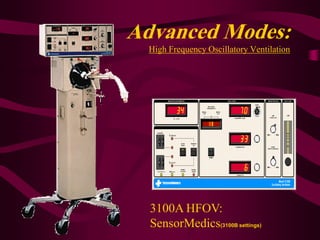
Advanced Modes:
  High Frequency Oscillatory Ventilation


  3100A HFOV:
  SensorMedics(3100B settings)
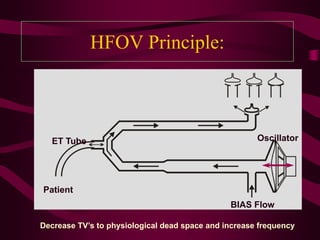
HFOV Principle:


  ET Tube                                             Oscillator


Patient
                                               BIAS Flow

Decrease TV’s to physiological dead space and increase frequency
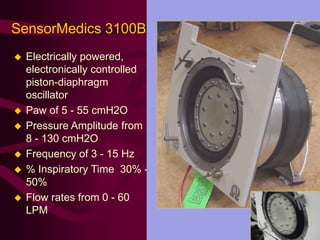
SensorMedics 3100B
   Electrically powered,
    electronically controlled
    piston-diaphragm
    oscillator
   Paw of 5 - 55 cmH2O
   Pressure Amplitude from
    8 - 130 cmH2O
   Frequency of 3 - 15 Hz
   % Inspiratory Time 30% -
    50%
   Flow rates from 0 - 60
    LPM
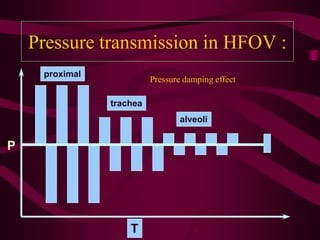
Pressure transmission in HFOV :
     proximal
                          Pressure damping effect

                trachea
                                  alveoli


P


                    T
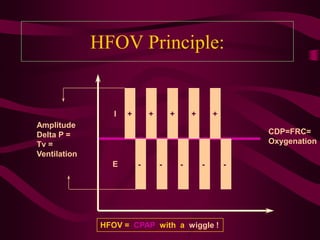
HFOV Principle:


                  I   +       +       +       +       +
Amplitude
Delta P =                                                     CDP=FRC=
Tv =                                                          Oxygenation
Ventilation
                 E        -       -       -       -       -


               HFOV = CPAP with a wiggle !
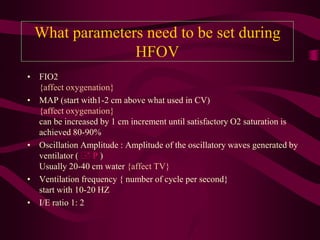
What parameters need to be set during
               HFOV
• FIO2
  {affect oxygenation}
• MAP (start with1-2 cm above what used in CV)
  {affect oxygenation}
  can be increased by 1 cm increment until satisfactory O2 saturation is
  achieved 80-90%
• Oscillation Amplitude : Amplitude of the oscillatory waves generated by
  ventilator (  P )
  Usually 20-40 cm water {affect TV}
• Ventilation frequency { number of cycle per second}
  start with 10-20 HZ
• I/E ratio 1: 2
Some indications of HFOV
•   Indications:
•   RDS in newborns
•   PPHN
•   PIE
•   Air leak syndrome
•   Meconium aspiration
•   Acute hypoxic
    respiratory failure
Troubleshooting during
             ventilation
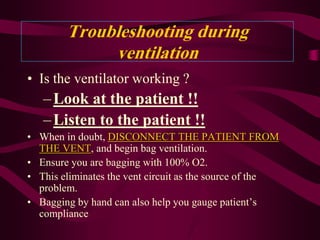
• Is the ventilator working ?
   – Look at the patient !!
   – Listen to the patient !!
• When in doubt, DISCONNECT THE PATIENT FROM
  THE VENT, and begin bag ventilation.
• Ensure you are bagging with 100% O2.
• This eliminates the vent circuit as the source of the
  problem.
• Bagging by hand can also help you gauge patient’s
  compliance
Extubation
                                       • Extubation
• Weaning                                 – Control of airway reflexes
  – Is the cause of respiratory           – Patent upper airway (air leak
    failure gone or getting better ?        around tube?)
  – Is the patient well oxygenated        – Minimal oxygen requirement
    and ventilated ?                      – Minimal rate
  – Can the heart tolerate the
                                          – Minimize pressure support (0-
    increased work of breathing?
                                            10)
                                          – “Awake ” patient
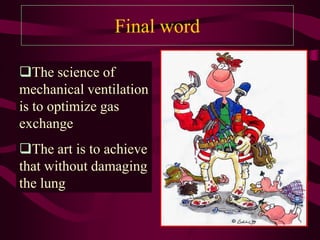
Final word

The science of
mechanical ventilation
is to optimize gas
exchange
The art is to achieve
that without damaging
the lung
Peds basicprinciplesmechanicalventilation

  • 1.
    Basic Principle ofMechanical Ventilation in Pediatric Mohamed Salim Kabbani, M.D Pediatric intensive care consultant Head, Pediatric Cardiac ICU King Abdulaziz Medical City
  • 2.
    Objectives Definition: normal andartificial ventilation Indication Classification of different modes of ventilation Troubleshooting and complication High frequency ventilation
  • 3.
    Respiration • Exchange of oxygen ( O2 ) and carbon O2 CO2 dioxide (CO2) between the organism and the external CO2 O2 environment
  • 4.
    Respiratory Failure • Inability of the pulmonary system to meet the metabolic demands of the body through adequate gas exchange. • Two types of respiratory failure:  Hypoxemic  Hypercarbic • Each can be acute and chronic. • Both can be present in the same patient. • Management of this condition required assisted mechanical ventilation
  • 5.
    What dose Mechanicalventilation mean? • “Assisted Ventilation involves the Delivery of Flow and Pressure to the Patient’s Airway in Order to Effect Change in Lung Volume” • A mechanical ventilator is a machine that generates controlled flow of gas into a patient’s airway
  • 6.
    Mechanical Ventilation /Normal ventilation - - - Positive pressure ventilation Normal ventilation
  • 7.
    Objectives Definition: normal andartificial ventilation Indication Classification of different modes of ventilation Troubleshooting and complication Examples and Scenarios
  • 8.
    Goals of MechanicalVentilation (End-result)  Achieve and maintain adequate pulmonary gas exchange  Minimize the risk of lung injury  Reduce patient work of breathing  Optimize patient comfort  To normalize blood gases and provide comfortable breathing
  • 9.
    What is thework of Breathing? (Compliance & Resistance)  Compliance: measurement of the elasticity of the lung and chest wall Resistance  Resistance is determined by the  Properties of the airway  Length  Diameter  Branching and Surface Characteristics  Type of Flow (Laminar or Turbulent)
  • 10.
    work of Breathing (resistance + compliance ) + The ventilator decrease the work of breathing
  • 11.
    Objectives Definition: normal andartificial ventilation Indication Classification of different modes of ventilation Troubleshooting and complication Examples and Scenarios
  • 12.
    Ventilator Classification (the Basic Questions : mode of ventilation and type of breath) A. Trigger mechanism • What causes the breath to begin? B. Limit variable B C what limits the delivery of gas to the patient during the inspiratory phase {pressure or volume}. C. Cycle mechanism • What causes the breath to end? A what cycles, or changes, the ventilator from one phase of the respiratory cycle to the other •
  • 13.
    Ventilation Modes (Attitude)  How mechanical ventilation are delivered to the patient? What are the relationship between spontaneous breath and the mechanical breath?
  • 14.
    Modes of Ventilation the manner or method of support provided by the ventilator  Controlled mechanical ventilation (CMV) (full control)  Assist/Control Ventilation (A/C) (full support). Mainly used in adult  Synchronized Intermittent Mandatory Ventilation (SIMV) and (IMV) (partial support). Commonly used in pediatrics  Spontaneous Modes • Pressure Support Ventilation (PSV) • Continuous Positive Airway Pressure (CPAP)
  • 15.
  • 16.
    Mode of ventilation Control vs. SIMV Control Modes SIMV Modes • Every breath is supported • Vent tries to synchronize regardless of “trigger” with pt’s effort • Can’t wean by decreasing • Patient takes “own” rate breaths in between (+/- PS) • Patient may hyperventilate if agitated • Potential increased work of • Patient / vent asynchrony breathing possible and may need • Can have patient / vent sedation +/- paralysis asynchrony
  • 17.
    Type of Ventilationduring breathing (limitation of the breath during inspiration in SIMV, CMV or A/C) Whenever a breath is supported by the ventilator, regardless of the mode, the limit of the support is determined by a preset pressure OR volume. – Volume Limited: preset tidal volume – Pressure Limited: preset PIP or PAP
  • 18.
    Mechanical Ventilation If volumeis set, pressure varies….. if pressure is set, volume varies….. .according to the compliance…... COMPLIANCE =  Volume /  Pressure Volume Ventilation Pressure Ventilation Pressure Pressure Flow time time Flow
  • 19.
    Volume vs. PressureControl Ventilation  Volume Ventilation  Pressure Ventilation  Volume delivery constant  Volume delivery varies  Inspiratory pressure varies  Inspiratory pressure constant  Inspiratory flow constant  Inspiratory flow varies When do you use pressure or volume control ventilation ? In general pressure control in babies and small infant < 6-8 kg In general volume control in children and adolescence > 8-10 kg
  • 20.
    What is pressuresupport ventilation Need a hand?? Pressure Support • “Triggering” vent requires certain amount of work by patient • Can decrease work of breathing by providing flow during inspiration for patient triggered breaths  increase pressure • The amount of flow increase is limited by set pressure. (5-10) • Can be given with spontaneous breaths, in IMV modes or as stand alone mode without set rate • Flow-cycled
  • 21.
    How can weset the ventilator? (Ventilator Basics parameters) • FIO2 - fraction of inspired oxygen • Rate - number of breaths per minute • Tidal Volume - volume of each breath • Sensitivity - how responsive the ventilator is to the patient’s efforts • PIP : maximum amount of pressured delivered during each breath • Inspiratory Time (I time)- the time spent in the inspiratory phase of the ventilatory cycle • I:E Ratio - the inspiratory time compared to the expiratory time; I + E = total cycle time • PEEP: positive end expiratory pressure
  • 22.
    Initial Settings • Settings – Rate: start with a rate that is somewhat normal; i.e., 15 for adolescent/child, 20-30 for infant/small child – FiO2: 100% and wean down – PEEP: 3-5 – TV 8-10 ml/kg, or PIP 14- 20 – Pressure support 5-10 – Determine the mode: control every breath (A/C) or some (SIMV)
  • 23.
    Basic parameters tobe set in volume and pressure control ventilation • Pressure Limited • Volume Limited – FiO2 – FiO2 – Rate – Rate – I-time – Tidal Volume MV – PEEP – PEEP – PIP MAP – I time Tidal Volume & PIP & (MAP) ( MV) Varies Varies
  • 24.
    Adjustments • To affect • To affect oxygenation, ventilation, adjust: adjust: – FiO2 – Respiratory – PEEP Rate MV – I time MAP – Tidal Volume – PIP
  • 25.
    Advanced Modes ofventilation • Pressure-regulated volume control (PRVC) • Volume support • Inverse ratio (IRV) or • airway-pressure release ventilation (APRV) • Bilevel CPAP • High-frequency
  • 26.
    Advanced Modes PRVC • Acontrol mode, which delivers a set tidal volume with each breath at the lowest possible peak pressure. • Delivers the breath with a decelerating flow pattern that is thought to be less injurious to the lung…… “the guided hand”.
  • 27.
  • 28.
    Advanced Modes Inverse RatioVentilation – Pressure Control Mode – I:E > 1 – Can increase MAP without increasing PIP: improve oxygenation but limit barotrauma – Significant risk for air trapping – Patient will need to be deeply sedated and perhaps paralyzed as well
  • 29.
    Advanced mode ofventilation High frequency ventilation • Definition: Ventilator rate > 150 per minute • TV is < dead space – High frequency positive pressure ventilation: Rate 60-100 per minute – High frequency jet ventilation: 60-600 per minute – High frequency oscillatory ventilation 180-1800 per minute ( Ventilation rate is given by Hertz {1 HZ = 60 cycle })
  • 30.
    Advanced Modes: High Frequency Oscillatory Ventilation 3100A HFOV: SensorMedics(3100B settings)
  • 31.
    HFOV Principle: ET Tube Oscillator Patient BIAS Flow Decrease TV’s to physiological dead space and increase frequency
  • 32.
    SensorMedics 3100B  Electrically powered, electronically controlled piston-diaphragm oscillator  Paw of 5 - 55 cmH2O  Pressure Amplitude from 8 - 130 cmH2O  Frequency of 3 - 15 Hz  % Inspiratory Time 30% - 50%  Flow rates from 0 - 60 LPM
  • 33.
    Pressure transmission inHFOV : proximal Pressure damping effect trachea alveoli P T
  • 34.
    HFOV Principle: I + + + + + Amplitude Delta P = CDP=FRC= Tv = Oxygenation Ventilation E - - - - - HFOV = CPAP with a wiggle !
  • 35.
    What parameters needto be set during HFOV • FIO2 {affect oxygenation} • MAP (start with1-2 cm above what used in CV) {affect oxygenation} can be increased by 1 cm increment until satisfactory O2 saturation is achieved 80-90% • Oscillation Amplitude : Amplitude of the oscillatory waves generated by ventilator (  P ) Usually 20-40 cm water {affect TV} • Ventilation frequency { number of cycle per second} start with 10-20 HZ • I/E ratio 1: 2
  • 36.
    Some indications ofHFOV • Indications: • RDS in newborns • PPHN • PIE • Air leak syndrome • Meconium aspiration • Acute hypoxic respiratory failure
  • 37.
    Troubleshooting during ventilation • Is the ventilator working ? – Look at the patient !! – Listen to the patient !! • When in doubt, DISCONNECT THE PATIENT FROM THE VENT, and begin bag ventilation. • Ensure you are bagging with 100% O2. • This eliminates the vent circuit as the source of the problem. • Bagging by hand can also help you gauge patient’s compliance
  • 38.
    Extubation • Extubation • Weaning – Control of airway reflexes – Is the cause of respiratory – Patent upper airway (air leak failure gone or getting better ? around tube?) – Is the patient well oxygenated – Minimal oxygen requirement and ventilated ? – Minimal rate – Can the heart tolerate the – Minimize pressure support (0- increased work of breathing? 10) – “Awake ” patient
  • 39.
    Final word The scienceof mechanical ventilation is to optimize gas exchange The art is to achieve that without damaging the lung