By,
Mr. Abhijit Bhoyar
Fatty Acids
LIPIDS
Specific Learning objectives
At the end of the lecture students will be able to
• Define fatty acids.
• Enumerate the categories of fatty acids.
• Classify fatty acids.
• Explain the properties of fatty acids.
• Biological importance of fatty acids.
• Identify the dangerous facts of fatty acids
Introduction
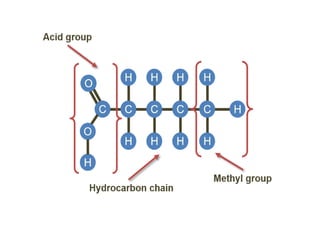
• Fatty acids are carboxylic acids with hydrocarbon side
chain. They are the simplest form of lipids.
• Fatty acids are also called “Carboxylic acids” due to the
presence of carboxyl group (-COOH).
• Basic building units of lipids and principal constituents of
body fat.
Cont.….
• There are more than 100 different fatty acids
occurring naturally.
• 90% of the fatty acids in our body occur in the form of
esters of triglycerides, glycolipids, phospholipids,
sphingolipids etc.
• Most of the fatty acids contain an even no. of carbon
atoms, (because of the process of biosynthesis and
concentration of C2 units.
Cont.….
• There are fatty acids with 2 to 30 carbon atoms or
more, but the most common and important ones
have 12 to 22 carbon atoms and are found in many
different animal and plant fats.
• They are rarely found free in nature and are the
primary constituents of
Triacylglycerols (or triglycerides)
Diacylglycerols;
Cont…
Monoacylglycerols (the last two families of
compounds are often added to processed foods)
Phospholipids of cell membranes
Sterol esters.
• Fatty acids are the building blocks of fat in our
bodies and the food we consume.
• During digestion, the body converts fats into fatty
acids, which are then absorbed into the
bloodstream.
Cont…
• Fatty acid molecules are typically joined in groups of
three to form a molecule known as a triglyceride.
• Triglycerides are also produced in our bodies as a
result of the carbohydrates we consume.
• Fatty acids perform a variety of vital functions in
the body, including energy storage. When glucose (a
type of sugar) is unavailable for energy, the body
turns to fatty acids to power the cells.
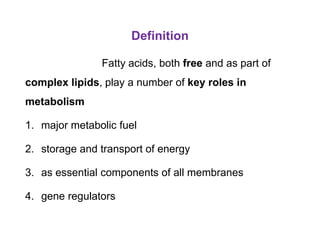
Definition
Fatty acids, both free and as part of
complex lipids, play a number of key roles in
metabolism
1. major metabolic fuel
2. storage and transport of energy
3. as essential components of all membranes
4. gene regulators
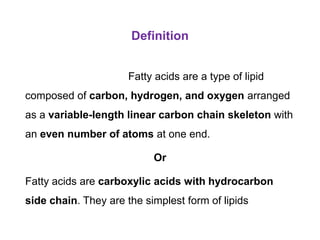
Definition
Fatty acids are a type of lipid
composed of carbon, hydrogen, and oxygen arranged
as a variable-length linear carbon chain skeleton with
an even number of atoms at one end.
Or
Fatty acids are carboxylic acids with hydrocarbon
side chain. They are the simplest form of lipids
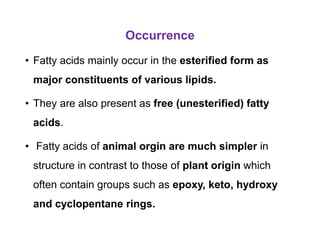
Occurrence
• Fatty acids mainly occur in the esterified form as
major constituents of various lipids.
• They are also present as free (unesterified) fatty
acids.
• Fatty acids of animal orgin are much simpler in
structure in contrast to those of plant origin which
often contain groups such as epoxy, keto, hydroxy
and cyclopentane rings.
3 different categories of fatty acids
1. Major fatty acids- are present in large quantities and are
very common. Constitutes for about 95% of fatty acids
present in most commonly used fats and oils.
2. Minor fatty acids- occur as the secondary constituents of
fats and oils. These are present as either Homologues of
major fatty acids or are Isologous to them.
3. Uncommon fatty acids are usually isolated from rare
sources containing them as their major constituents.
These are most commonly from plant origin.
Classification of Fatty Acids
• Properties of fatty acids varies due to the difference in chain
length, chain structure, degree of unsaturation, position of
double bonds, etc.
• On the basis of various characteristics, fatty acids are
classified into different categories
1. According to the chain length
2. According to the body requirement
3. According to the degree of unsaturation
4. According to the position of H-atoms
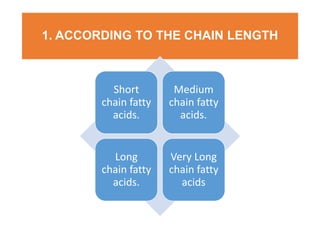
1. ACCORDING TO THE CHAIN LENGTH
Short
chain fatty
acids.
Medium
chain fatty
acids.
Long
chain fatty
acids.
Very Long
chain fatty
acids
Short chain fatty acids
• Fatty acids with <6 C-atoms in their hydrocarbon chain
are called, “Short chain fatty acids.”
• Short chain fatty acids are liquid at room temperature.
• By the hydrolysis of triglycerides, fatty acids produced,
give a rancid butter flavor.
For example, Butyric acid (C-4)
Medium chain fatty acids
Fatty acids with 6-12 C-atoms in their hydrocarbon
chain are called, “Medium chain fatty acids.”
For example, Caproic acid (C- 6), Caprylic acid (C-8)
Long chain fatty acids
• Fatty acids with 14 -20 C-atoms in their hydrocarbon
chain are called, “Long chain fatty acids.”
• Found as a major part of a few vegetable oils.
For example, Myristic fatty acid (C-14), Palmitic acid
(C-16), etc.
Very long chain fatty acids
• Fatty acids with 22 or more C-atoms in their
hydrocarbon chain are called, “Very long chain fatty
acids.”
• These fatty acids can’t be metabolize by
mitochondria, they are metabolized in peroxisomes.
• These may be physio pathologically harmful for
human.
• For example, Erucic acid (C-22)
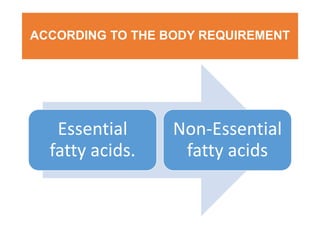
ACCORDING TO THE BODY REQUIREMENT
Essential
fatty acids.
Non-Essential
fatty acids
Essential fatty acids
• the fatty acids that cannot be prepared by the body
and are obtained from diet.
• Our body is not capable to synthesize them.
For example, linoleic acid, linolenic acid, arachidonic
acid.
Non-Essential fatty acids
• Fatty acids that can be synthesized by our body and
are not required from diet.
For example, Palmitic acid, Stearic acid.
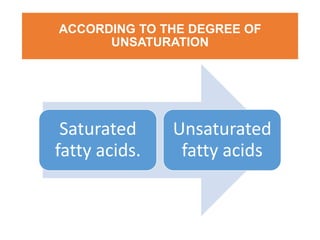
ACCORDING TO THE DEGREE OF
UNSATURATION
Saturated
fatty acids.
Unsaturated
fatty acids
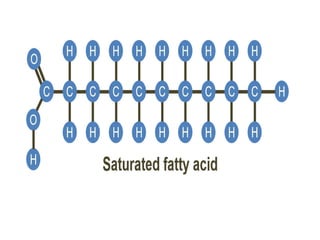
Saturated fatty acids
• Saturated fatty acids are the fatty acids that contain
no double bond in their hydrocarbon chain.
• They are solid at room temperature.
• Saturated fatty acids can increase the risk of
coronary heart diseases.
Examples, Butyric acid, Caproic acid.
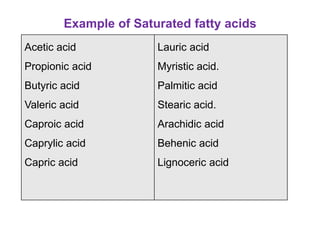
Example of Saturated fatty acids
Acetic acid
Propionic acid
Butyric acid
Valeric acid
Caproic acid
Caprylic acid
Capric acid
Lauric acid
Myristic acid.
Palmitic acid
Stearic acid.
Arachidic acid
Behenic acid
Lignoceric acid
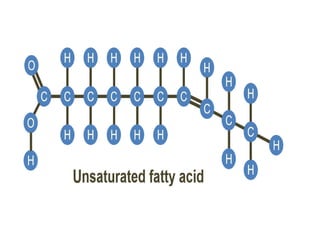
Unsaturated fatty acids
• Unsaturated fatty acids are the fatty acids that contain one
or more double bond in their aliphatic chain.
These may either be
a. Monounsaturated fatty acids (MUFA)
b. Poly unsaturated fatty acids (PUFA).
• They are liquid at room temperature.
• Abundant in fish and vegetable oils and reduce the risk of
coronary heart diseases.
Examples, Stearic acid, oleic acid
Example of unsaturated fatty acids
• Palmitoleic acid
• Oleic acid
• Linoleic acid- essential fatty acids
• Linolenic acid- essential fatty acids
• Arachidonic acid
Classification of MUFAs Monounsaturated
Fatty acids
Two types
1) Cis- unsaturated fatty acids
2) Trans- unsaturated fatty acids
According To the Configuration of H-atom
(adjacent to the double bond)
a) Cis-Fatty acids
b) Trans-Fatty acid
Cis-Fatty acids
• Cis- fatty acids are the fatty acids in which the
adjacent hydrogen atoms are attached on the same
side of the double bond.
• The chain with a significant number cis-bonds, tend
to be slightly curved.
Cont….
• Natural unsaturated fatty acids have Cis- double
bonds.
• The unsaturated fatty acids can’t bunch tightly together.
• The bend helps the fat stay liquid rather than solid.
Significance
• Decreases total cholesterol and TGs level.
• Increases HDL level.
Trans-Fatty acid
• Fatty acids in which H-atoms are attached on the
opposite sides of the double bond.
• The chain with a significant number of Trans-fatty
acids, don’t bend much and maintain the shape.
Cont….
• Unsaturated fatty acids (MUFAs and PUFAs)
containing one or more double bonds in trans
configuration are called trans fatty acids (TFAs).
• Hydrogen atoms are on the opposite sides of the
molecule.
• It produced during partial hydrogenation of vegetable
oils.
Cont….
• Partially hydrogenation of vegetable oil results in longer
shelf life of a product.
• less rancidity and oxidation when exposed to heat and
light.
• Also developed in vegetable oils during frying and
heating.
• Sources: “Formation of trans fatty acids in edible oils
during the frying and heating process”
Why trans fatty acids are harmful
• Trans fatty acids are much more linear than cis fatty
acids, so their melting points are higher and trans fats
may act similarly to saturated fats.
• Increases the ratio of total cholesterol to HDL
cholesterol, a powerful predictor of the risk of CHD.
• Trans fats harm the cardiovascular system by
triggering inflammation in blood vessels.
• Trans fat may increase risk for cancers of the breast
and prostate.
Sources
1.Spreads: Butter, margarine (Cooking Oil)
2. Package foods: Cake mixes, Biscuits
3. Soups: Plain soups, Noodle soups
4. Fast foods: Deep fried Fish and Chicken, Pancakes
5. Frozen foods: Frozen pies, pot pies, wafers
6. Backed foods: Cakes, doughnuts
7. Chips and Crackers: Potato chips
8. Cookies and Candy: Chocolate bars, Cream filled
cookies
RDA for Trans fatty acid
• Less than 1 percent of our total daily calories, which
means less than 2 grams per day for many people.
• Naturally occurring trans fat in red meat and dairy, we
need to cut trans fat from other foods to zero. That
means checking every ingredient list and bypassing
foods that declare any hydrogenated oils or partially
hydrogenated oils, even if it states "trans fat 0 g" on the
nutrition panel.
Properties of Fatty Acids
• Oils and fats are liquids or solids having a greasy feel.
• When pure, they are colorless, odorless and tasteless.
• They are insoluble in water but soluble in organic solvents such as
ether, chloroform, benzene and hot alcohol.
• They have lower specific gravity than water and consequently will
float on the surface when mixed with it.
Cont…
• Fatty acids undergo the same reactions as other carboxylic
acids, such as esterification and acid-base reactions.
• The acidities of fatty acids do not vary greatly, as indicated
by their pKa values.
• The solubility of fatty acids in water decreases as chain
length increases so that longer-chain fatty acids have little
effect on the pH of an aqueous solution.
Cont….
• Fatty acids exist at their conjugate bases, such as oleate, near
neutral pH.
• Auto-oxidation occurs when unsaturated fatty acids undergo a
chemical change. The presence of trace metals speeds up the
process, which requires oxygen (air).
• Ozonolysis- Ozone is capable of degrading unsaturated fatty
acids. This reaction is used in the synthesis of azelaic acid from
oleic acid.
Biological Importance of Fatty Acids
• Unsaturated fatty acids are found in membranes as
phosphoglycerides (also known as phospholipids).
• Without Fatty acids the Phospholipids can’t formed. So
the bilayer can’t be construct.
Cont….
• However polyunsaturation of cell membranes occur in
response to chronic cold temperatures. In fish
increasingly cold environments lead to increasingly
high cell membrane content of both monounsaturated
and polyunsaturated fatty acids, to maintain greater
membrane fluidity (and functionality) at the lower
temperatures.
Cont….
• Essential fatty acids, or EFAs, are fatty acids that
humans and other animals must ingest because the
body requires them for good health but cannot
synthesize them.
• Only two fatty acids are known to be essential for
humans: alpha-linolenic acid (an omega-3 fatty acid)
and linoleic acid (an omega-6 fatty acid).
Cont….
Omega 3 Fatty acid- Omega 6 Fatty acid-
• They act on DNA (activating or inhibiting transcription
factors such as NF-κB, which is linked to pro-
inflammatory cytokine production) .
• High intakes of omega-3 fatty acids are linked to
decreased rates of major depression.
Cont….
• Without omega 3 and omega 6 human or animal will suffer in sick.
• Omega-3 fatty acids in algal oil, fish oil, fish and seafood have
been shown to lower the risk of heart attacks.
• Omega-6 fatty acids in sunflower oil and safflower oil may also
reduce the risk of cardiovascular disease.
Cont….
• Cell Membranes: Require (50%) fatty acids to be
“waterproof” and function properly.
• Heart: Prefers saturated long chain 16-carbon palmitic
and 18-c stearic acid (over carbohydrates) for energy.
• Bones: Need fats to assimilate calcium effectively.
• Liver: They protect it from the adverse effects of
alcohol and medications like acetaminophen.
Cont….
• Lungs: Lung surfactant, which prevents asthma and
other breathing disorders, is composed entirely of 16-c
palmitic acids.
• Hormones: They function as signaling messengers for
hormone production.
• Immune system: Saturated fatty acids play an important
role here. They prime white blood cells to destroy
invading bacteria, viruses and fungi and to fight tumors.
Medium chain 12-c lauric acids and 14-c myristic acid(in
butter) kill bacteria and candida in the gut.
Dangerous Fact of Fatty Acids
• High Fat, low fiber in diet can create “Bowel, Pancreas,
Prostate and Breast” CANCER.
• Polyunsaturated fatty acid can lead to greater risk of
decreased accretion of brain DHA in offspring.
• Consumption of omega-3 fatty acids during pregnancy
is critical to fetal development.
Cont….
• Consumption of trans fats has shown to increase the
risk of coronary heart disease in part by raising levels
of the lipoprotein LDL (so-called "bad cholesterol"),
lowering levels of the lipoprotein HDL ("good
cholesterol").
• The intake of both trans fats and saturated fats
promote the development of Alzheimer disease.
• Type 2 diabetes, Liver Dysfunction, Infertility in women
etc. are caused by trans fatty acids.
Expected Questions
Essay/ Situational type
• Define fatty acids and classify it.
Short
• Classify fatty acids.
• Describe the properties of fatty acids.
• Explain the biological importance of fatty acids.
THANK YOU

2. LIPIDS (Fatty Acids).pptx

  • 1.
  • 2.
    Specific Learning objectives Atthe end of the lecture students will be able to • Define fatty acids. • Enumerate the categories of fatty acids. • Classify fatty acids. • Explain the properties of fatty acids. • Biological importance of fatty acids. • Identify the dangerous facts of fatty acids
  • 3.
    Introduction • Fatty acidsare carboxylic acids with hydrocarbon side chain. They are the simplest form of lipids. • Fatty acids are also called “Carboxylic acids” due to the presence of carboxyl group (-COOH). • Basic building units of lipids and principal constituents of body fat.
  • 4.
    Cont.…. • There aremore than 100 different fatty acids occurring naturally. • 90% of the fatty acids in our body occur in the form of esters of triglycerides, glycolipids, phospholipids, sphingolipids etc. • Most of the fatty acids contain an even no. of carbon atoms, (because of the process of biosynthesis and concentration of C2 units.
  • 5.
    Cont.…. • There arefatty acids with 2 to 30 carbon atoms or more, but the most common and important ones have 12 to 22 carbon atoms and are found in many different animal and plant fats. • They are rarely found free in nature and are the primary constituents of Triacylglycerols (or triglycerides) Diacylglycerols;
  • 6.
    Cont… Monoacylglycerols (the lasttwo families of compounds are often added to processed foods) Phospholipids of cell membranes Sterol esters. • Fatty acids are the building blocks of fat in our bodies and the food we consume. • During digestion, the body converts fats into fatty acids, which are then absorbed into the bloodstream.
  • 7.
    Cont… • Fatty acidmolecules are typically joined in groups of three to form a molecule known as a triglyceride. • Triglycerides are also produced in our bodies as a result of the carbohydrates we consume. • Fatty acids perform a variety of vital functions in the body, including energy storage. When glucose (a type of sugar) is unavailable for energy, the body turns to fatty acids to power the cells.
  • 8.
    Definition Fatty acids, bothfree and as part of complex lipids, play a number of key roles in metabolism 1. major metabolic fuel 2. storage and transport of energy 3. as essential components of all membranes 4. gene regulators
  • 9.
    Definition Fatty acids area type of lipid composed of carbon, hydrogen, and oxygen arranged as a variable-length linear carbon chain skeleton with an even number of atoms at one end. Or Fatty acids are carboxylic acids with hydrocarbon side chain. They are the simplest form of lipids
  • 11.
    Occurrence • Fatty acidsmainly occur in the esterified form as major constituents of various lipids. • They are also present as free (unesterified) fatty acids. • Fatty acids of animal orgin are much simpler in structure in contrast to those of plant origin which often contain groups such as epoxy, keto, hydroxy and cyclopentane rings.
  • 12.
    3 different categoriesof fatty acids 1. Major fatty acids- are present in large quantities and are very common. Constitutes for about 95% of fatty acids present in most commonly used fats and oils. 2. Minor fatty acids- occur as the secondary constituents of fats and oils. These are present as either Homologues of major fatty acids or are Isologous to them. 3. Uncommon fatty acids are usually isolated from rare sources containing them as their major constituents. These are most commonly from plant origin.
  • 13.
    Classification of FattyAcids • Properties of fatty acids varies due to the difference in chain length, chain structure, degree of unsaturation, position of double bonds, etc. • On the basis of various characteristics, fatty acids are classified into different categories 1. According to the chain length 2. According to the body requirement 3. According to the degree of unsaturation 4. According to the position of H-atoms
  • 14.
    1. ACCORDING TOTHE CHAIN LENGTH Short chain fatty acids. Medium chain fatty acids. Long chain fatty acids. Very Long chain fatty acids
  • 15.
    Short chain fattyacids • Fatty acids with <6 C-atoms in their hydrocarbon chain are called, “Short chain fatty acids.” • Short chain fatty acids are liquid at room temperature. • By the hydrolysis of triglycerides, fatty acids produced, give a rancid butter flavor. For example, Butyric acid (C-4)
  • 16.
    Medium chain fattyacids Fatty acids with 6-12 C-atoms in their hydrocarbon chain are called, “Medium chain fatty acids.” For example, Caproic acid (C- 6), Caprylic acid (C-8)
  • 17.
    Long chain fattyacids • Fatty acids with 14 -20 C-atoms in their hydrocarbon chain are called, “Long chain fatty acids.” • Found as a major part of a few vegetable oils. For example, Myristic fatty acid (C-14), Palmitic acid (C-16), etc.
  • 18.
    Very long chainfatty acids • Fatty acids with 22 or more C-atoms in their hydrocarbon chain are called, “Very long chain fatty acids.” • These fatty acids can’t be metabolize by mitochondria, they are metabolized in peroxisomes. • These may be physio pathologically harmful for human. • For example, Erucic acid (C-22)
  • 19.
    ACCORDING TO THEBODY REQUIREMENT Essential fatty acids. Non-Essential fatty acids
  • 20.
    Essential fatty acids •the fatty acids that cannot be prepared by the body and are obtained from diet. • Our body is not capable to synthesize them. For example, linoleic acid, linolenic acid, arachidonic acid.
  • 21.
    Non-Essential fatty acids •Fatty acids that can be synthesized by our body and are not required from diet. For example, Palmitic acid, Stearic acid.
  • 22.
    ACCORDING TO THEDEGREE OF UNSATURATION Saturated fatty acids. Unsaturated fatty acids
  • 23.
    Saturated fatty acids •Saturated fatty acids are the fatty acids that contain no double bond in their hydrocarbon chain. • They are solid at room temperature. • Saturated fatty acids can increase the risk of coronary heart diseases. Examples, Butyric acid, Caproic acid.
  • 25.
    Example of Saturatedfatty acids Acetic acid Propionic acid Butyric acid Valeric acid Caproic acid Caprylic acid Capric acid Lauric acid Myristic acid. Palmitic acid Stearic acid. Arachidic acid Behenic acid Lignoceric acid
  • 26.
    Unsaturated fatty acids •Unsaturated fatty acids are the fatty acids that contain one or more double bond in their aliphatic chain. These may either be a. Monounsaturated fatty acids (MUFA) b. Poly unsaturated fatty acids (PUFA). • They are liquid at room temperature. • Abundant in fish and vegetable oils and reduce the risk of coronary heart diseases. Examples, Stearic acid, oleic acid
  • 28.
    Example of unsaturatedfatty acids • Palmitoleic acid • Oleic acid • Linoleic acid- essential fatty acids • Linolenic acid- essential fatty acids • Arachidonic acid
  • 29.
    Classification of MUFAsMonounsaturated Fatty acids Two types 1) Cis- unsaturated fatty acids 2) Trans- unsaturated fatty acids
  • 30.
    According To theConfiguration of H-atom (adjacent to the double bond) a) Cis-Fatty acids b) Trans-Fatty acid
  • 31.
    Cis-Fatty acids • Cis-fatty acids are the fatty acids in which the adjacent hydrogen atoms are attached on the same side of the double bond. • The chain with a significant number cis-bonds, tend to be slightly curved.
  • 32.
    Cont…. • Natural unsaturatedfatty acids have Cis- double bonds. • The unsaturated fatty acids can’t bunch tightly together. • The bend helps the fat stay liquid rather than solid. Significance • Decreases total cholesterol and TGs level. • Increases HDL level.
  • 33.
    Trans-Fatty acid • Fattyacids in which H-atoms are attached on the opposite sides of the double bond. • The chain with a significant number of Trans-fatty acids, don’t bend much and maintain the shape.
  • 34.
    Cont…. • Unsaturated fattyacids (MUFAs and PUFAs) containing one or more double bonds in trans configuration are called trans fatty acids (TFAs). • Hydrogen atoms are on the opposite sides of the molecule. • It produced during partial hydrogenation of vegetable oils.
  • 35.
    Cont…. • Partially hydrogenationof vegetable oil results in longer shelf life of a product. • less rancidity and oxidation when exposed to heat and light. • Also developed in vegetable oils during frying and heating. • Sources: “Formation of trans fatty acids in edible oils during the frying and heating process”
  • 36.
    Why trans fattyacids are harmful • Trans fatty acids are much more linear than cis fatty acids, so their melting points are higher and trans fats may act similarly to saturated fats. • Increases the ratio of total cholesterol to HDL cholesterol, a powerful predictor of the risk of CHD. • Trans fats harm the cardiovascular system by triggering inflammation in blood vessels. • Trans fat may increase risk for cancers of the breast and prostate.
  • 37.
    Sources 1.Spreads: Butter, margarine(Cooking Oil) 2. Package foods: Cake mixes, Biscuits 3. Soups: Plain soups, Noodle soups 4. Fast foods: Deep fried Fish and Chicken, Pancakes 5. Frozen foods: Frozen pies, pot pies, wafers 6. Backed foods: Cakes, doughnuts 7. Chips and Crackers: Potato chips 8. Cookies and Candy: Chocolate bars, Cream filled cookies
  • 38.
    RDA for Transfatty acid • Less than 1 percent of our total daily calories, which means less than 2 grams per day for many people. • Naturally occurring trans fat in red meat and dairy, we need to cut trans fat from other foods to zero. That means checking every ingredient list and bypassing foods that declare any hydrogenated oils or partially hydrogenated oils, even if it states "trans fat 0 g" on the nutrition panel.
  • 39.
    Properties of FattyAcids • Oils and fats are liquids or solids having a greasy feel. • When pure, they are colorless, odorless and tasteless. • They are insoluble in water but soluble in organic solvents such as ether, chloroform, benzene and hot alcohol. • They have lower specific gravity than water and consequently will float on the surface when mixed with it.
  • 40.
    Cont… • Fatty acidsundergo the same reactions as other carboxylic acids, such as esterification and acid-base reactions. • The acidities of fatty acids do not vary greatly, as indicated by their pKa values. • The solubility of fatty acids in water decreases as chain length increases so that longer-chain fatty acids have little effect on the pH of an aqueous solution.
  • 41.
    Cont…. • Fatty acidsexist at their conjugate bases, such as oleate, near neutral pH. • Auto-oxidation occurs when unsaturated fatty acids undergo a chemical change. The presence of trace metals speeds up the process, which requires oxygen (air). • Ozonolysis- Ozone is capable of degrading unsaturated fatty acids. This reaction is used in the synthesis of azelaic acid from oleic acid.
  • 42.
    Biological Importance ofFatty Acids • Unsaturated fatty acids are found in membranes as phosphoglycerides (also known as phospholipids). • Without Fatty acids the Phospholipids can’t formed. So the bilayer can’t be construct.
  • 43.
    Cont…. • However polyunsaturationof cell membranes occur in response to chronic cold temperatures. In fish increasingly cold environments lead to increasingly high cell membrane content of both monounsaturated and polyunsaturated fatty acids, to maintain greater membrane fluidity (and functionality) at the lower temperatures.
  • 44.
    Cont…. • Essential fattyacids, or EFAs, are fatty acids that humans and other animals must ingest because the body requires them for good health but cannot synthesize them. • Only two fatty acids are known to be essential for humans: alpha-linolenic acid (an omega-3 fatty acid) and linoleic acid (an omega-6 fatty acid).
  • 45.
    Cont…. Omega 3 Fattyacid- Omega 6 Fatty acid- • They act on DNA (activating or inhibiting transcription factors such as NF-κB, which is linked to pro- inflammatory cytokine production) . • High intakes of omega-3 fatty acids are linked to decreased rates of major depression.
  • 46.
    Cont…. • Without omega3 and omega 6 human or animal will suffer in sick. • Omega-3 fatty acids in algal oil, fish oil, fish and seafood have been shown to lower the risk of heart attacks. • Omega-6 fatty acids in sunflower oil and safflower oil may also reduce the risk of cardiovascular disease.
  • 47.
    Cont…. • Cell Membranes:Require (50%) fatty acids to be “waterproof” and function properly. • Heart: Prefers saturated long chain 16-carbon palmitic and 18-c stearic acid (over carbohydrates) for energy. • Bones: Need fats to assimilate calcium effectively. • Liver: They protect it from the adverse effects of alcohol and medications like acetaminophen.
  • 48.
    Cont…. • Lungs: Lungsurfactant, which prevents asthma and other breathing disorders, is composed entirely of 16-c palmitic acids. • Hormones: They function as signaling messengers for hormone production. • Immune system: Saturated fatty acids play an important role here. They prime white blood cells to destroy invading bacteria, viruses and fungi and to fight tumors. Medium chain 12-c lauric acids and 14-c myristic acid(in butter) kill bacteria and candida in the gut.
  • 49.
    Dangerous Fact ofFatty Acids • High Fat, low fiber in diet can create “Bowel, Pancreas, Prostate and Breast” CANCER. • Polyunsaturated fatty acid can lead to greater risk of decreased accretion of brain DHA in offspring. • Consumption of omega-3 fatty acids during pregnancy is critical to fetal development.
  • 50.
    Cont…. • Consumption oftrans fats has shown to increase the risk of coronary heart disease in part by raising levels of the lipoprotein LDL (so-called "bad cholesterol"), lowering levels of the lipoprotein HDL ("good cholesterol"). • The intake of both trans fats and saturated fats promote the development of Alzheimer disease. • Type 2 diabetes, Liver Dysfunction, Infertility in women etc. are caused by trans fatty acids.
  • 51.
    Expected Questions Essay/ Situationaltype • Define fatty acids and classify it. Short • Classify fatty acids. • Describe the properties of fatty acids. • Explain the biological importance of fatty acids.
  • 52.