

CARBOHYDRATEs
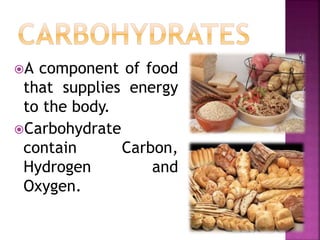
A component of food
that supplies energy
to the body.
Carbohydrate
contain Carbon,
Hydrogen and
Oxygen.
Depends on the chemical structure of the
food:
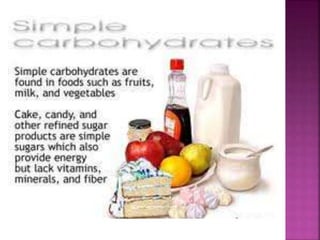
Simple carbohydrates include mono and
disaccharides. These are small molecules
which dissolve in water and are absorbed
very quickly in the body.
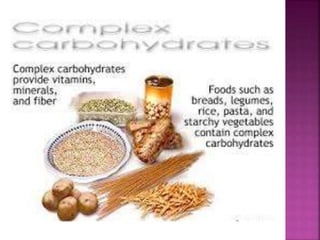
Complex carbohydrates include
polysaccharides. Starches and dietary fibres
are very large, complex molecules and
absorbed slowly.
Carbohydrates are classified
in to three major classes on
the basis of behavior on
hydrolysis:-
1) Monosaccharide
2) Disaccharides
3) Polysaccharides
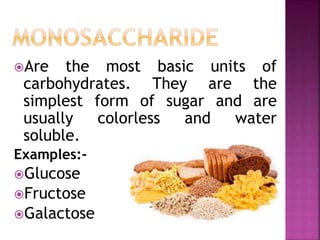
Are the most basic units of
carbohydrates. They are the
simplest form of sugar and are
usually colorless and water
soluble.
Examples:-
Glucose
Fructose
Galactose
Also known as dextrose, grape sugar,
or corn sugar.
It is found in sweet fruits such as
grapes, and oranges and in some
vegetable such as sweet corn and
carrots.
Fruit sugar is highly soluble sugar.
 It is found in honey, ripe fruits and
some vegetables.
In humans, fructose produce during
the hydrolysis of sucrose.
Galactose is not found free in
nature.
Its only source is lactose which on
hydrolysis yields glucose and
galactose.
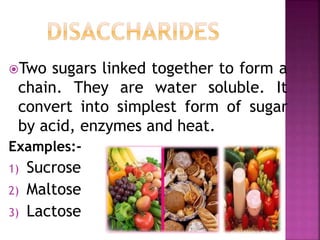
Two sugars linked together to form a
chain. They are water soluble. It
convert into simplest form of sugar
by acid, enzymes and heat.
Examples:-
1) Sucrose
2) Maltose
3) Lactose
Is found in cane or beet sugar, and
maple sugar.
Many fruits and some vegetables
contain small amounts of sucrose.
SUCROSE------GLUCOSE + FRUCTOSE
Also known as malt sugar and is
found in cereals.
It is intermediate product in the
hydrolysis of starch and
fermentation of grain and is present
in beer.
In corn sugar 4% maltose is present.
MALTOSE------GLUCOSE + GLUCOSE
Lactose or milk sugar is
disaccharides.
The enzyme lactase is needed to
digest lactose.
Cow’s Milk  6.8g/100 ml.
Mother’s Milk  4.8g/100 ml.
LACTOSE ----- GLUCOSE + GALACTOSE
Carbohydrates made up of long
chain of sugars are called
polysaccharides (poly = many).
They are very large, complex
molecules and insoluble in water.
It constructed by joining
monosaccharide units together by
glycosidic bonds.
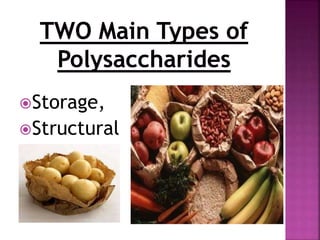
Storage,
Structural
Glycogen
Also known as animal
starch.
A polysaccharide that
humans and animals store
in the liver and muscles.
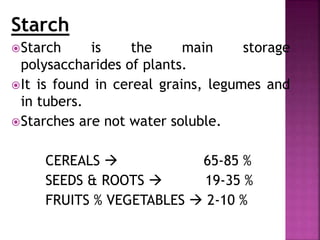
Starch
Starch is the main storage
polysaccharides of plants.
It is found in cereal grains, legumes and
in tubers.
Starches are not water soluble.
CEREALS  65-85 %
SEEDS & ROOTS  19-35 %
FRUITS % VEGETABLES  2-10 %
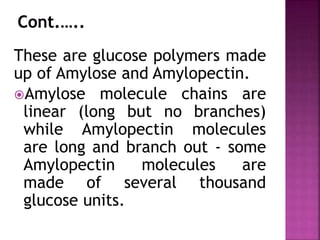
These are glucose polymers made
up of Amylose and Amylopectin.
Amylose molecule chains are
linear (long but no branches)
while Amylopectin molecules
are long and branch out - some
Amylopectin molecules are
made of several thousand
glucose units.
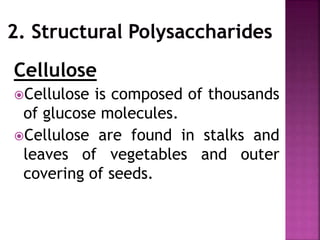
Cellulose
Cellulose is composed of thousands
of glucose molecules.
Cellulose are found in stalks and
leaves of vegetables and outer
covering of seeds.
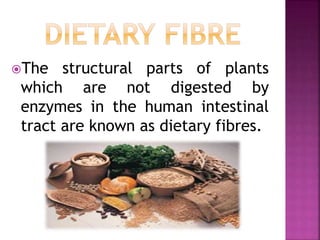
The structural parts of plants
which are not digested by
enzymes in the human intestinal
tract are known as dietary fibres.
Soluble Fibres
Viscous plants fibres are
soluble in water.
These include pectin, and
gums.
Found in fruits, oats, legumes
and beans.
Insoluble Fibres
Structural parts of the plants cell
wall( cellulose, hemicelluloses)
which are not soluble in water.
Found in wheat, seeds, nuts and
vegetables.
Ability to absorb water
Feeling of fullness
Insoluble fibres needs chewing and may
improve mastication of food
These indigestible substances serve a
useful purpose in helping the
elimination of intestinal wastes
They stimulates the peristaltic
movements of the gastrointestinal tract
by adding bulk
Source of Energy: The primary
function of carbohydrate in the
body is to supply energy. Each
gram of carbohydrate, as starch
or sugar, provides 4 kcal/g.
Role in liver :- Liver rich in
glycogen and is more resistant to
certain poisons such as carbon,
alcohol and toxins of bacteria.
Role in Muscle
Carbohydrate are the major source of
energy for muscular work.
During muscular contraction, glycogen is
broken down to lactic acid through
glycolysis.
Lactic acid oxidized to pyruvic acid then
to Acetyl CoA which is oxidized to
carbon dioxide and water, thus
producing energy for muscular work.
Protein Sparing Action
Oxidation of fats
Conversion of fat
Reserve fuel supply
To prevent dehydration
Indispensability for nervous system
Source of energy in heart muscles
Promote growth of desirable bacteria
Contribution of dietary fibres
Add flavor to the diet
Eating too many Carbohydrate leads to
weight gain.
Risk of obesity
Atherosclerosis
Dental caries
Other conditions
Excess calories from carbohydrate are
stored as fat, which contribute to obesity
and its risk including Diabetes, heart
disease, hyperglycemia.
 Lack of energy
 Physical fatigue
 Dizziness
 Headaches
 Weakness
 Mental Fatigue
 Nutrients deficiencies
 Nausea
 Diarrhea
 Constipation
 Sleep disturbances
 Malnutrition
• Hypoglycemia: Low blood sugar is most
common in people who have diabetes.
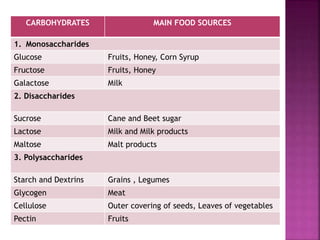
CARBOHYDRATES MAIN FOOD SOURCES
1. Monosaccharides
Glucose Fruits, Honey, Corn Syrup
Fructose Fruits, Honey
Galactose Milk
2. Disaccharides
Sucrose Cane and Beet sugar
Lactose Milk and Milk products
Maltose Malt products
3. Polysaccharides
Starch and Dextrins Grains , Legumes
Glycogen Meat
Cellulose Outer covering of seeds, Leaves of vegetables
Pectin Fruits
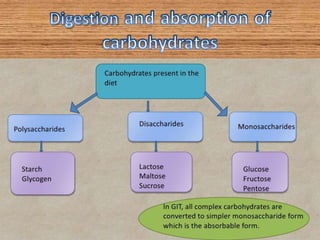
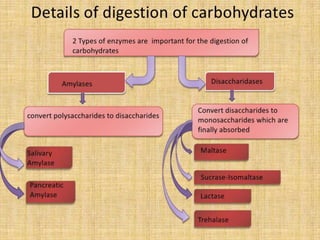
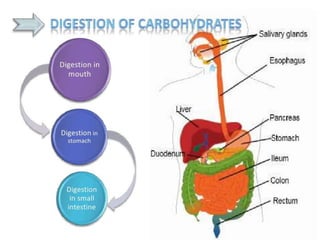
• Maltose, sucrose and lactose are
hydrolyzed by maltase, sucrase
and lactase of intestinal juice for
conversion to simplest sugar
(glucose, fructose, galactose).
Digestion in Small Intestine
• Carbohydrates, not digested in the small
intestine including cellulose, pectin (foods
such as potatoes, beans, wheat flour and
starch).
• They are digested and converted in variable
such as lactic acid, butyric acid, acidic acid,
carbon dioxide, and hydrogen when they
reach the large intestine.
Digestion in Large Intestine
Carbohydrate

Carbohydrate

  • 1.
  • 2.
    A component offood that supplies energy to the body. Carbohydrate contain Carbon, Hydrogen and Oxygen.
  • 3.
    Depends on thechemical structure of the food: Simple carbohydrates include mono and disaccharides. These are small molecules which dissolve in water and are absorbed very quickly in the body. Complex carbohydrates include polysaccharides. Starches and dietary fibres are very large, complex molecules and absorbed slowly.
  • 6.
    Carbohydrates are classified into three major classes on the basis of behavior on hydrolysis:- 1) Monosaccharide 2) Disaccharides 3) Polysaccharides
  • 7.
    Are the mostbasic units of carbohydrates. They are the simplest form of sugar and are usually colorless and water soluble. Examples:- Glucose Fructose Galactose
  • 8.
    Also known asdextrose, grape sugar, or corn sugar. It is found in sweet fruits such as grapes, and oranges and in some vegetable such as sweet corn and carrots.
  • 9.
    Fruit sugar ishighly soluble sugar.  It is found in honey, ripe fruits and some vegetables. In humans, fructose produce during the hydrolysis of sucrose.
  • 10.
    Galactose is notfound free in nature. Its only source is lactose which on hydrolysis yields glucose and galactose.
  • 11.
    Two sugars linkedtogether to form a chain. They are water soluble. It convert into simplest form of sugar by acid, enzymes and heat. Examples:- 1) Sucrose 2) Maltose 3) Lactose
  • 12.
    Is found incane or beet sugar, and maple sugar. Many fruits and some vegetables contain small amounts of sucrose. SUCROSE------GLUCOSE + FRUCTOSE
  • 13.
    Also known asmalt sugar and is found in cereals. It is intermediate product in the hydrolysis of starch and fermentation of grain and is present in beer. In corn sugar 4% maltose is present. MALTOSE------GLUCOSE + GLUCOSE
  • 14.
    Lactose or milksugar is disaccharides. The enzyme lactase is needed to digest lactose. Cow’s Milk  6.8g/100 ml. Mother’s Milk  4.8g/100 ml. LACTOSE ----- GLUCOSE + GALACTOSE
  • 15.
    Carbohydrates made upof long chain of sugars are called polysaccharides (poly = many). They are very large, complex molecules and insoluble in water. It constructed by joining monosaccharide units together by glycosidic bonds.
  • 16.
  • 17.
    Glycogen Also known asanimal starch. A polysaccharide that humans and animals store in the liver and muscles.
  • 18.
    Starch Starch is themain storage polysaccharides of plants. It is found in cereal grains, legumes and in tubers. Starches are not water soluble. CEREALS  65-85 % SEEDS & ROOTS  19-35 % FRUITS % VEGETABLES  2-10 %
  • 19.
    These are glucosepolymers made up of Amylose and Amylopectin. Amylose molecule chains are linear (long but no branches) while Amylopectin molecules are long and branch out - some Amylopectin molecules are made of several thousand glucose units.
  • 20.
    Cellulose Cellulose is composedof thousands of glucose molecules. Cellulose are found in stalks and leaves of vegetables and outer covering of seeds.
  • 21.
    The structural partsof plants which are not digested by enzymes in the human intestinal tract are known as dietary fibres.
  • 22.
    Soluble Fibres Viscous plantsfibres are soluble in water. These include pectin, and gums. Found in fruits, oats, legumes and beans.
  • 23.
    Insoluble Fibres Structural partsof the plants cell wall( cellulose, hemicelluloses) which are not soluble in water. Found in wheat, seeds, nuts and vegetables.
  • 24.
    Ability to absorbwater Feeling of fullness Insoluble fibres needs chewing and may improve mastication of food These indigestible substances serve a useful purpose in helping the elimination of intestinal wastes They stimulates the peristaltic movements of the gastrointestinal tract by adding bulk
  • 25.
    Source of Energy:The primary function of carbohydrate in the body is to supply energy. Each gram of carbohydrate, as starch or sugar, provides 4 kcal/g. Role in liver :- Liver rich in glycogen and is more resistant to certain poisons such as carbon, alcohol and toxins of bacteria.
  • 26.
    Role in Muscle Carbohydrateare the major source of energy for muscular work. During muscular contraction, glycogen is broken down to lactic acid through glycolysis. Lactic acid oxidized to pyruvic acid then to Acetyl CoA which is oxidized to carbon dioxide and water, thus producing energy for muscular work.
  • 27.
    Protein Sparing Action Oxidationof fats Conversion of fat Reserve fuel supply To prevent dehydration Indispensability for nervous system Source of energy in heart muscles Promote growth of desirable bacteria Contribution of dietary fibres Add flavor to the diet
  • 28.
    Eating too manyCarbohydrate leads to weight gain. Risk of obesity Atherosclerosis Dental caries Other conditions Excess calories from carbohydrate are stored as fat, which contribute to obesity and its risk including Diabetes, heart disease, hyperglycemia.
  • 29.
     Lack ofenergy  Physical fatigue  Dizziness  Headaches  Weakness  Mental Fatigue  Nutrients deficiencies  Nausea  Diarrhea  Constipation  Sleep disturbances  Malnutrition • Hypoglycemia: Low blood sugar is most common in people who have diabetes.
  • 30.
    CARBOHYDRATES MAIN FOODSOURCES 1. Monosaccharides Glucose Fruits, Honey, Corn Syrup Fructose Fruits, Honey Galactose Milk 2. Disaccharides Sucrose Cane and Beet sugar Lactose Milk and Milk products Maltose Malt products 3. Polysaccharides Starch and Dextrins Grains , Legumes Glycogen Meat Cellulose Outer covering of seeds, Leaves of vegetables Pectin Fruits
  • 38.
    • Maltose, sucroseand lactose are hydrolyzed by maltase, sucrase and lactase of intestinal juice for conversion to simplest sugar (glucose, fructose, galactose). Digestion in Small Intestine
  • 39.
    • Carbohydrates, notdigested in the small intestine including cellulose, pectin (foods such as potatoes, beans, wheat flour and starch). • They are digested and converted in variable such as lactic acid, butyric acid, acidic acid, carbon dioxide, and hydrogen when they reach the large intestine. Digestion in Large Intestine