LIPIDS & PROPERTIES OF
FATTY ACIDS
BY
KAVIYA PRIYA A
23PBT007
LIPIDS
• Lipids are fatty compounds that perform a variety of functions in
your body.
• They help with moving and storing energy, absorbing vitamins and
making hormones. Having too much of some lipids is harmful.
• Lipids are molecules that contain hydrocarbons and make up the
building blocks of the structure and function of living cells.
• Examples of lipids include fats, oils, waxes, certain vitamins (such
as A, D, E and K), hormones and most of the cell membrane that is
not made up of protein.
• Lipids are not soluble in water as they are non-polar, but are thus
soluble in non-polar solvents such as chloroform.
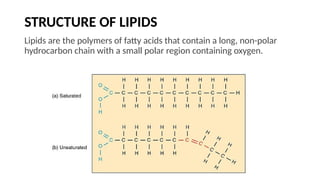
STRUCTURE OF LIPIDS
Lipids are the polymers of fatty acids that contain a long, non-polar
hydrocarbon chain with a small polar region containing oxygen.
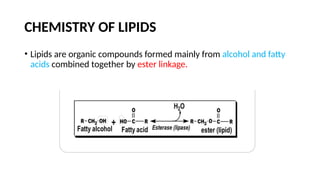
CHEMISTRY OF LIPIDS
• Lipids are organic compounds formed mainly from alcohol and fatty
acids combined together by ester linkage.
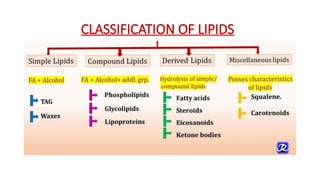
CLASSIFICATION OF LIPIDS
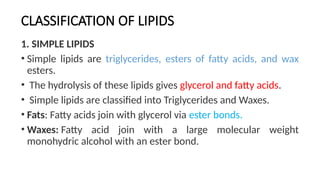
1. SIMPLE LIPIDS
• Simple lipids are triglycerides, esters of fatty acids, and wax
esters.
• The hydrolysis of these lipids gives glycerol and fatty acids.
• Simple lipids are classified into Triglycerides and Waxes.
• Fats: Fatty acids join with glycerol via ester bonds.
• Waxes: Fatty acid join with a large molecular weight
monohydric alcohol with an ester bond.
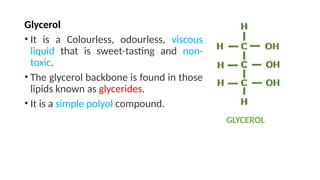
Glycerol
• It is a Colourless, odourless, viscous
liquid that is sweet-tasting and non-
toxic.
• The glycerol backbone is found in those
lipids known as glycerides.
• It is a simple polyol compound.
GLYCEROL
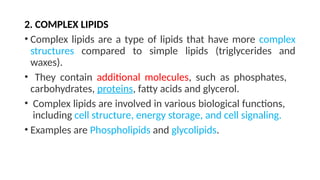
2. COMPLEX LIPIDS
• Complex lipids are a type of lipids that have more complex
structures compared to simple lipids (triglycerides and
waxes).
• They contain additional molecules, such as phosphates,
carbohydrates, proteins, fatty acids and glycerol.
• Complex lipids are involved in various biological functions,
including cell structure, energy storage, and cell signaling.
• Examples are Phospholipids and glycolipids.
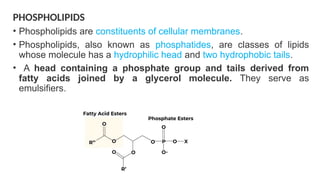
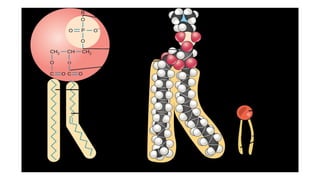
PHOSPHOLIPIDS
• Phospholipids are constituents of cellular membranes.
• Phospholipids, also known as phosphatides, are classes of lipids
whose molecule has a hydrophilic head and two hydrophobic tails.
• A head containing a phosphate group and tails derived from
fatty acids joined by a glycerol molecule. They serve as
emulsifiers.
3. DERIVED LIPIDS
• Derived lipids are the hydrolyzed compounds of simple and
complex lipids.
• Examples are fatty acids, steroids, fatty aldehydes, ketone
bodies, lipid-soluble vitamins, and hormones.
4. MISCELLANEOUS LIPIDS
• A large number of compounds possess characteristics of
lipids, such compounds come under this category.
• Example: carotenoids, squalene, hydrocarbons like
pentacosone and terpenes etc.
PROPERTIES OF LIPIDS
• Lipids stored in kidney.
• Lipids are generally hydrophobic, meaning they repel water and
do not dissolve in it.
• Lipids are formed from hydrocarbon chains, and they are
heterogeneous in nature.
• Fats and oils, in the form of triglycerides, are efficient energy
storage molecules, providing a concentrated source of energy
when broken down.
• Phospholipids are essential components of cell membranes,
forming the lipid bilayer that defines cellular boundaries. They
help in the selective permeability of a cell membrane.
• Lipids like cholesterol and steroid hormones consists of four-
ring structure and function in membrane fluidity and cellular
signaling.
• Lipids provide essential fatty acids that the body cannot
produce on its own and allow the absorption of fat-soluble
vitamins.
FUNCTIONS OF LIPIDS
• Lipids, like adipose tissue, act as insulators and help to
maintain body temperature by reducing heat loss.
• Lipids, especially triglycerides, act as energy storage in
organisms, providing a reserve of metabolic fuel.
• Phospholipids form the lipid bilayers of cell membranes and
regulate the passage of molecules in and out of cells.
• Steroid hormones, derived from cholesterol, play vital roles
in regulating various physiological processes, including
metabolism, growth, and reproduction.
• In plants, lipids can be stored as oils in seeds, providing a
source of energy for germination and early growth.
• It provides colour to many fruits and vegetables with the
presence of carotenoid pigment.
FATTY ACIDS
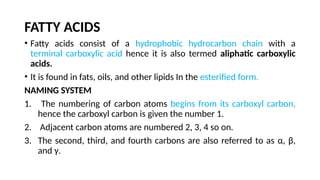
• Fatty acids consist of a hydrophobic hydrocarbon chain with a
terminal carboxylic acid hence it is also termed aliphatic carboxylic
acids.
• It is found in fats, oils, and other lipids In the esterified form.
NAMING SYSTEM
1. The numbering of carbon atoms begins from its carboxyl carbon,
hence the carboxyl carbon is given the number 1.
2. Adjacent carbon atoms are numbered 2, 3, 4 so on.
3. The second, third, and fourth carbons are also referred to as α, β,
and γ.
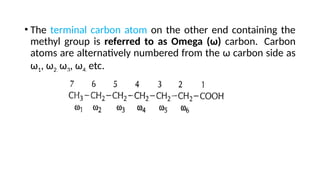
• The terminal carbon atom on the other end containing the
methyl group is referred to as Omega (ω) carbon. Carbon
atoms are alternatively numbered from the ω carbon side as
ω1, ω2, ω3, ω4, etc.
CLASSIFICATION OF FATTY ACIDS
ACCORDING TO THE CHAIN LENGTH
Short chain fatty acids
• Fatty acids with <6 C-atoms in their hydrocarbon chain are
called, "Short chain fatty acids."
• Short chain fatty acids are liquid at room temperature.
• By the hydrolysis of triglycerides, fatty acids produced, give a
rancid butter flavor.
• For example, Butyric acid (C-4)
MEDIUM CHAIN FATTY ACIDS
• Fatty acids with 6-12 C-atoms in their hydrocarbon chain are
called, "Medium chain fatty acids."
• For example, Caproic acid (C- 6), Caprylic acid (C-8)
LONG CHAIN FATTY ACIDS
• Fatty acids with 14-20 C-atoms in their hydrocarbon chain
are called, "Long chain fatty acids.“
• Found as a major part of a few vegetable oils.
• For example, Myristic fatty acid (C-14), Palmitic acid (C-16),
etc.
VERY LONG CHAIN FATTY ACIDS
• Fatty acids with 22 or more C-atoms in their hydrocarbon
chain are called, "Very long chain fatty acids.“
• These fatty acids can't be metabolize by mitochondria, they
are metabolized in peroxisomes.
• These may be physio pathologically harmful for human.
• For example, Erucic acid (C-22)
ACCORDING TO THE DEGREE OF UNSATURATION
SATURATED FATTY ACIDS
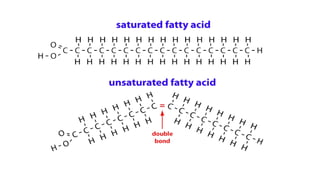
• Saturated fatty acids are the fatty acids that contain no
double bond their hydrocarbon chain.
• They are solid at room temperature.
• Saturated fatty acids can increase the risk of coronary heart
diseases.
• Examples, Butyric acid, Caproic acid.
UNSATURATED FATTY ACIDS
• Unsaturated fatty acids are the fatty acids that contain one or
more double bond in their aliphatic chain.
• These may either be Monounsaturated fatty acids (MUFA) or
Poly unsaturated fatty acids (PUFA).
• They are liquid at room temperature. Abundant in fish and
vegetable oils and reduce the risk of coronary heart diseases.
• Examples, Stearic acid, oleic acid, etc.
ACCORDING TO THE CONFIGURATION OF H-
ATOM (ADJACENT TO THE DOUBLE BOND)
CIS-FATTY ACIDS
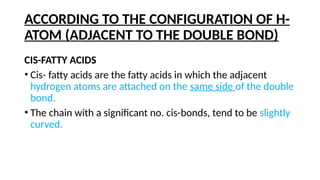
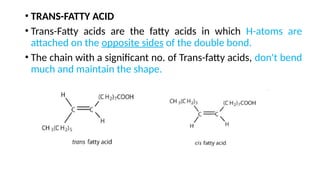
• Cis- fatty acids are the fatty acids in which the adjacent
hydrogen atoms are attached on the same side of the double
bond.
• The chain with a significant no. cis-bonds, tend to be slightly
curved.
• TRANS-FATTY ACID
• Trans-Fatty acids are the fatty acids in which H-atoms are
attached on the opposite sides of the double bond.
• The chain with a significant no. of Trans-fatty acids, don't bend
much and maintain the shape.
PHYSICAL PROPERTIES
• Fatty acids are soluble in organic solvents such as benzene,
chloroform, and alcohol .
• They are bad conductors of heat.
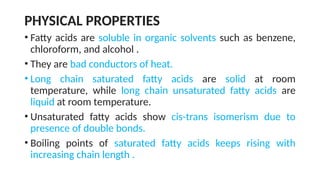
• Long chain saturated fatty acids are solid at room
temperature, while long chain unsaturated fatty acids are
liquid at room temperature.
• Unsaturated fatty acids show cis-trans isomerism due to
presence of double bonds.
• Boiling points of saturated fatty acids keeps rising with
increasing chain length .
CHEMICAL PROPERTIES
• Hydrolysis: Hydrolysis by alkalis such as NaOH or KOH
generates sodium or potassium salts of fatty acids
• Hydrogenation: Oils containing unsaturated fatty acids
undergo hydrogenation when exposed to high temperature,
pressure, and finely divided nickel. This process converts oils
into solid fats.
• Hydrogenolysis: Hydrogenolysis involves the splitting of fat by
hydrogen. In this process, hydrogen is passed through fat
under pressure in the presence of copper-chromium catalyst.
• Halogenation: Halogenation involves treating unsaturated fatty
acids with halogens such as chlorine and iodine. During this
process, the unsaturated fatty acid takes up iodine or other
halogens at their double bond site, which is an indication of its
unsaturated state.
• Rancidity: When fats that are stored for long periods of time
come in contact with light, moisture, heat, and air, they undergo
chemical changes that result in them developing an unpleasant
rancid odour.
• Emulsification: Emulsifying agents such as bile juice secreted by
the liver, water, proteins, soaps, and gums, break down large-
sized fat molecules into smaller molecules in a process known as
emulsification.
THANK YOU

LIPIDS AND FATTY ACIDS - CLASSIFICATION, PROPERTYAND FUNCTIONS

  • 1.
    LIPIDS & PROPERTIESOF FATTY ACIDS BY KAVIYA PRIYA A 23PBT007
  • 2.
    LIPIDS • Lipids arefatty compounds that perform a variety of functions in your body. • They help with moving and storing energy, absorbing vitamins and making hormones. Having too much of some lipids is harmful. • Lipids are molecules that contain hydrocarbons and make up the building blocks of the structure and function of living cells. • Examples of lipids include fats, oils, waxes, certain vitamins (such as A, D, E and K), hormones and most of the cell membrane that is not made up of protein. • Lipids are not soluble in water as they are non-polar, but are thus soluble in non-polar solvents such as chloroform.
  • 3.
    STRUCTURE OF LIPIDS Lipidsare the polymers of fatty acids that contain a long, non-polar hydrocarbon chain with a small polar region containing oxygen.
  • 4.
    CHEMISTRY OF LIPIDS •Lipids are organic compounds formed mainly from alcohol and fatty acids combined together by ester linkage.
  • 5.
  • 6.
    CLASSIFICATION OF LIPIDS 1.SIMPLE LIPIDS • Simple lipids are triglycerides, esters of fatty acids, and wax esters. • The hydrolysis of these lipids gives glycerol and fatty acids. • Simple lipids are classified into Triglycerides and Waxes. • Fats: Fatty acids join with glycerol via ester bonds. • Waxes: Fatty acid join with a large molecular weight monohydric alcohol with an ester bond.
  • 7.
    Glycerol • It isa Colourless, odourless, viscous liquid that is sweet-tasting and non- toxic. • The glycerol backbone is found in those lipids known as glycerides. • It is a simple polyol compound. GLYCEROL
  • 8.
    2. COMPLEX LIPIDS •Complex lipids are a type of lipids that have more complex structures compared to simple lipids (triglycerides and waxes). • They contain additional molecules, such as phosphates, carbohydrates, proteins, fatty acids and glycerol. • Complex lipids are involved in various biological functions, including cell structure, energy storage, and cell signaling. • Examples are Phospholipids and glycolipids.
  • 9.
    PHOSPHOLIPIDS • Phospholipids areconstituents of cellular membranes. • Phospholipids, also known as phosphatides, are classes of lipids whose molecule has a hydrophilic head and two hydrophobic tails. • A head containing a phosphate group and tails derived from fatty acids joined by a glycerol molecule. They serve as emulsifiers.
  • 11.
    3. DERIVED LIPIDS •Derived lipids are the hydrolyzed compounds of simple and complex lipids. • Examples are fatty acids, steroids, fatty aldehydes, ketone bodies, lipid-soluble vitamins, and hormones. 4. MISCELLANEOUS LIPIDS • A large number of compounds possess characteristics of lipids, such compounds come under this category. • Example: carotenoids, squalene, hydrocarbons like pentacosone and terpenes etc.
  • 12.
    PROPERTIES OF LIPIDS •Lipids stored in kidney. • Lipids are generally hydrophobic, meaning they repel water and do not dissolve in it. • Lipids are formed from hydrocarbon chains, and they are heterogeneous in nature. • Fats and oils, in the form of triglycerides, are efficient energy storage molecules, providing a concentrated source of energy when broken down. • Phospholipids are essential components of cell membranes, forming the lipid bilayer that defines cellular boundaries. They help in the selective permeability of a cell membrane.
  • 13.
    • Lipids likecholesterol and steroid hormones consists of four- ring structure and function in membrane fluidity and cellular signaling. • Lipids provide essential fatty acids that the body cannot produce on its own and allow the absorption of fat-soluble vitamins. FUNCTIONS OF LIPIDS • Lipids, like adipose tissue, act as insulators and help to maintain body temperature by reducing heat loss. • Lipids, especially triglycerides, act as energy storage in organisms, providing a reserve of metabolic fuel.
  • 14.
    • Phospholipids formthe lipid bilayers of cell membranes and regulate the passage of molecules in and out of cells. • Steroid hormones, derived from cholesterol, play vital roles in regulating various physiological processes, including metabolism, growth, and reproduction. • In plants, lipids can be stored as oils in seeds, providing a source of energy for germination and early growth. • It provides colour to many fruits and vegetables with the presence of carotenoid pigment.
  • 15.
    FATTY ACIDS • Fattyacids consist of a hydrophobic hydrocarbon chain with a terminal carboxylic acid hence it is also termed aliphatic carboxylic acids. • It is found in fats, oils, and other lipids In the esterified form. NAMING SYSTEM 1. The numbering of carbon atoms begins from its carboxyl carbon, hence the carboxyl carbon is given the number 1. 2. Adjacent carbon atoms are numbered 2, 3, 4 so on. 3. The second, third, and fourth carbons are also referred to as α, β, and γ.
  • 16.
    • The terminalcarbon atom on the other end containing the methyl group is referred to as Omega (ω) carbon. Carbon atoms are alternatively numbered from the ω carbon side as ω1, ω2, ω3, ω4, etc.
  • 17.
    CLASSIFICATION OF FATTYACIDS ACCORDING TO THE CHAIN LENGTH Short chain fatty acids • Fatty acids with <6 C-atoms in their hydrocarbon chain are called, "Short chain fatty acids." • Short chain fatty acids are liquid at room temperature. • By the hydrolysis of triglycerides, fatty acids produced, give a rancid butter flavor. • For example, Butyric acid (C-4)
  • 18.
    MEDIUM CHAIN FATTYACIDS • Fatty acids with 6-12 C-atoms in their hydrocarbon chain are called, "Medium chain fatty acids." • For example, Caproic acid (C- 6), Caprylic acid (C-8) LONG CHAIN FATTY ACIDS • Fatty acids with 14-20 C-atoms in their hydrocarbon chain are called, "Long chain fatty acids.“ • Found as a major part of a few vegetable oils. • For example, Myristic fatty acid (C-14), Palmitic acid (C-16), etc.
  • 19.
    VERY LONG CHAINFATTY ACIDS • Fatty acids with 22 or more C-atoms in their hydrocarbon chain are called, "Very long chain fatty acids.“ • These fatty acids can't be metabolize by mitochondria, they are metabolized in peroxisomes. • These may be physio pathologically harmful for human. • For example, Erucic acid (C-22)
  • 20.
    ACCORDING TO THEDEGREE OF UNSATURATION SATURATED FATTY ACIDS • Saturated fatty acids are the fatty acids that contain no double bond their hydrocarbon chain. • They are solid at room temperature. • Saturated fatty acids can increase the risk of coronary heart diseases. • Examples, Butyric acid, Caproic acid.
  • 21.
    UNSATURATED FATTY ACIDS •Unsaturated fatty acids are the fatty acids that contain one or more double bond in their aliphatic chain. • These may either be Monounsaturated fatty acids (MUFA) or Poly unsaturated fatty acids (PUFA). • They are liquid at room temperature. Abundant in fish and vegetable oils and reduce the risk of coronary heart diseases. • Examples, Stearic acid, oleic acid, etc.
  • 23.
    ACCORDING TO THECONFIGURATION OF H- ATOM (ADJACENT TO THE DOUBLE BOND) CIS-FATTY ACIDS • Cis- fatty acids are the fatty acids in which the adjacent hydrogen atoms are attached on the same side of the double bond. • The chain with a significant no. cis-bonds, tend to be slightly curved.
  • 24.
    • TRANS-FATTY ACID •Trans-Fatty acids are the fatty acids in which H-atoms are attached on the opposite sides of the double bond. • The chain with a significant no. of Trans-fatty acids, don't bend much and maintain the shape.
  • 25.
    PHYSICAL PROPERTIES • Fattyacids are soluble in organic solvents such as benzene, chloroform, and alcohol . • They are bad conductors of heat. • Long chain saturated fatty acids are solid at room temperature, while long chain unsaturated fatty acids are liquid at room temperature. • Unsaturated fatty acids show cis-trans isomerism due to presence of double bonds. • Boiling points of saturated fatty acids keeps rising with increasing chain length .
  • 26.
    CHEMICAL PROPERTIES • Hydrolysis:Hydrolysis by alkalis such as NaOH or KOH generates sodium or potassium salts of fatty acids • Hydrogenation: Oils containing unsaturated fatty acids undergo hydrogenation when exposed to high temperature, pressure, and finely divided nickel. This process converts oils into solid fats. • Hydrogenolysis: Hydrogenolysis involves the splitting of fat by hydrogen. In this process, hydrogen is passed through fat under pressure in the presence of copper-chromium catalyst.
  • 27.
    • Halogenation: Halogenationinvolves treating unsaturated fatty acids with halogens such as chlorine and iodine. During this process, the unsaturated fatty acid takes up iodine or other halogens at their double bond site, which is an indication of its unsaturated state. • Rancidity: When fats that are stored for long periods of time come in contact with light, moisture, heat, and air, they undergo chemical changes that result in them developing an unpleasant rancid odour. • Emulsification: Emulsifying agents such as bile juice secreted by the liver, water, proteins, soaps, and gums, break down large- sized fat molecules into smaller molecules in a process known as emulsification.
  • 28.