Lipids consist of two parts
1. Glycerol
2. Fatty Acids
a. Saturated fatty acids
b. Unsaturated fatty acids
.Monounsaturated . Polyunsaturated
Figure 3 : Formation
of TG
Table 1 : Saturated fatty acids
Table 2 : Unsaturated fatty acids
Lipid metabolism
• Almost all the fats of the diet except short
chain fatty acids are absorbed from the
intestine in to the lymph.
• During digestion most triglycerides are split in
to monoglycerides & fatty acids.
• Once they reached the intestinal tract they are
re synthesized as triglycicleserides.
• From the intestinal tract they are transported in
to the blood in the form of chylomicrons.
• Lipo protein lipase is enzyme present in the
blood which hydrolysis triglycerides &
phospholipids in to fatty acid & Glycerol for its
storage in adipose & liver cells.
• Lipo proteins
• They are small particles much smaller than
chylomicrons but similar in composition
(TAG,cholesterol,phospholipids,&prtn)
• 1/3rd
or 1/4th
protein & remaining lipids
Major classes of Lipo Protein
• Very low density lipo protein
• Contains high conc of triglycerides & moderate
conc of cholesterol & TAG.
• Intermediate density lipoprotein
• Large share of TAG removed so Conc of
cholesterol & phospholipids ↑ses.
• Low density lipoprtn
• All the triglycerides are removed so high conc
of cholesterol & moderate amount of
phopholipids are seen.
• High density lipoprtn
• Which contain a high concentration of
protein but smaller conc of cholesterol &
Phospo lipids seen.
Phospholipids
• Phospholipids – contains one or more fatty
acid molecules & one phosphoric acid
radical they usually they contain a
nitrogenous base.
• The major types of phospholipids are
lecithin, cephalins & sphingo myelins.
Lipids are classified as simple or
complex
1. Simple lipid
a. Fatty acids
b. neutral fats (monoglyceride,
diglycerde, and triglyceride)
c. waxes
2. Complex lipids
a. Phospholipids
b. Glycolipids
c. Lipoproteins
Figure 1 :
Triglyceride
Figure 2 :
Phosphatidic acid
Omega Fatty acid
Cis- Trans Fatty
acid
Function of
Fat
. Energy
. Essential nutrient
. Flavor and Satisfaction
. Adipose Tissue
. Cell membrane Structure
Fat in Food
Fat in Body
Food Sources of
Fat
. Meat Fat (bacon, sausage….)
. Dairy Fats and products (cream, butter,
cheese..)
. Egg yolk
. Monounsaturated , polyunsaturated Fatty acid
. Vegetable oil (safflower, corn, soybean,
cottonseed, olive oil)
Animal Fats
Plant Fat
Characteristics Of Food Fat
Sources
. Butter, margarin, salad oils and
dressing,shirteninig fat meat
. Chees, cream portion of homogenised milk, egg
yolk, nuts, seeds, olives…..
Visible Fat
Invisible Fat
Digestion of
lipids
1. In mouth
mechanical digestion
Lingual Lipase
2. In stomach
mechanical digestion
Gastric lipase
3. In small intestine
Bile acid, Pancreatic Lipase,
Cholesterol esterase,
Phospholipase
Triglycerid
es
2 fatty acids + Mono
glycerides
3 fatty acids + glycerolTriglycerid
es
Triglycerid
es
1 fatty acids +
Diglycerides
Absorption of
lipids
Figure 4 : Absorption of fat.
Transportation of
lipids
Source Destination Major lipids Functions
Chylomicron
s
Intestine Many organs Triglycerides,
other lipids
Deliver lipids
of dietary
origin to
body cell.
VLDLs Liver Many organs Triglycerides,
Cholesterol
Deliver
endogenously
produced
triglycerides
to body cells.
LDLs Intraviscular
removal of
triglycerides
from VLDL
Blood vessels,
Liver
Cholesterol Deliver
endogenously
produced
cholesterol
to various
organs.
HDLs Liver and
intestine
Liver and
steroid-
hormone-
Cholesterol Remove and
degrade
Cholesterol.
Table 3 Lipids are transported in the plasma as
lipoproteins.
Lipids
Metabolism
. Liver and Adipose tissue play a central role in
lipid metabolism.
. Adipose tissue is the main store of
triglyceride in the body.
. Lipid metabolism either lipolysis or
lipogenesis.
. Fatty acids are both oxidized to acetyl CoA
and synthesized from acetyl CoA.
Lipolys
is
. Complete hydorlysis of triglyceride yeild
gelycerol and 3 fatty acids.
. Fatty acids oxidiation take place in the
mitochonderia.
. Fatty acids are activated before being
catabolized (oxidized).
Fatty acid + ATP + CoA Acyl CoA + AMP
+ PPi
Long chain fatty acids penetrate the inner
-Mitochinderial membrane as carnitine derivatives.
Figure 5 : Role of carnitine in the transport
of long chain fatty acids.
- oxidation pathway of fattyβ
acids
. Many tissues are capable of oxidizing fatty
acids in the mitochondria by - oxidationβ
pathway.
. The chain is broken between the (2) and (3)α β
carbon atoms.
Figure 6 : Overview of - oxidation pathway of fattyβ
acids
- oxidation of fatty acids (β Figure 7)
The products of oxidation of fatty
acidsOxidation of fatty acids produces a large quantity of
ATP,
.example : Palmitic acid (C:16 )
7 cycles from 7 NADH + 7 FADH2
(7 x5 = 35 ATP)
7 cycles from 8 Acetyl CoA
(8 x 12 = 96 ATP)
2 ATP for the initial activation
of fatty acid
( 35 +96 – 2 = 129 molecule of ATP)
Figure 8 : acetyl
CoA product
Oxidation of unsaturated fatty acids occurs by
amodified - oxidation pathway (figure9)β
Ketonebodie
sKetogenesis occurs when there is a high rate of
fatty acid oxidation in the Liver (figure 10).
Aceto acetyl CoA
Acetyl CoA
Acetoacetate
Acetone-β hydroxy butyrate
Acetyl CoA
CoA
CoA
Lipogenesi
s
. The body is capable of synthesizing fatty acids in
the cytoplast of the cell from starter ( acetyl CoA +
malonyl CoA).
. Malonyl CoA is formed from Acetyl CoA
Figure 11 : Biosynthesis of Malonyl
CoA
. Acetyl CoA transfer to the cytoplast across the
mitochondrial membrane in the form of citrate
Figure 12 : Conversion the citrate to
Oxaloacetate and Acetyl CoA.
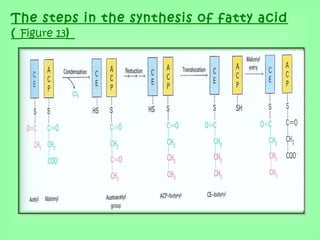
. The enzymes involved in fatty acid synthesis are
arranged in a complex called the fatty acid synthase
system.
The steps in the synthesis of fatty acid
( Figure 13)
Cholester
ol
Figure 14 : Cholesterol
. Cholesterol is not an energy
producing nutrient.
. It is an essential structural
component of membrane of the outer layer of plasma
lipoprotien.
• Bile acids and steriod hormones are formed from
cholesterol.
. Cholesteryl ester is a storage form of cholesterol which
is found in most tissues.
Acetyl CoA is the source of all carbon atoms in cholesterol
Squalene
-hydroxy- - methylglutaryl CoAβ β
Mevalonate
Farmesyl pyrophosphate
Acetyl CoA
CoA
Acetoacetyl CoA
CoA
Acetyl CoA
HMG-CoA
reductase
Cyclization
Reference
s
Brene, R., Levy, M., Koeppen, B., Stanton, B., (2004)
Physiology, Fifth edition. Mosby.
 
Fox, S., (2004) Human Physiology, Eighth edition. Mc
Graw Hill.
 
Hunt, S., Groff, J., (1997) Advanced Nutrition and Human
Metabolism, West Puplishing Company.
 
Lehninger, A., Nelson, D., Cox, M.,(1993) Principles of
Biochemistry, 2nd
edtion. Worth Puplishers.
 
Murray, R., Granner, D., Mayes, P., Rodwell, V., (1996)
Haper’s Biochemistry, 24th
edition, Prentic-Hall
International, Inc.
 
Seeley, R., Stephens, T., Tate, P., (1992) Anatomy and
Physiology,Mosby Yearbook.
 lipids

lipids

  • 2.
    Lipids consist oftwo parts 1. Glycerol 2. Fatty Acids a. Saturated fatty acids b. Unsaturated fatty acids .Monounsaturated . Polyunsaturated Figure 3 : Formation of TG
  • 3.
    Table 1 :Saturated fatty acids
  • 4.
    Table 2 :Unsaturated fatty acids
  • 5.
    Lipid metabolism • Almostall the fats of the diet except short chain fatty acids are absorbed from the intestine in to the lymph. • During digestion most triglycerides are split in to monoglycerides & fatty acids. • Once they reached the intestinal tract they are re synthesized as triglycicleserides. • From the intestinal tract they are transported in to the blood in the form of chylomicrons.
  • 6.
    • Lipo proteinlipase is enzyme present in the blood which hydrolysis triglycerides & phospholipids in to fatty acid & Glycerol for its storage in adipose & liver cells. • Lipo proteins • They are small particles much smaller than chylomicrons but similar in composition (TAG,cholesterol,phospholipids,&prtn) • 1/3rd or 1/4th protein & remaining lipids
  • 7.
    Major classes ofLipo Protein • Very low density lipo protein • Contains high conc of triglycerides & moderate conc of cholesterol & TAG. • Intermediate density lipoprotein • Large share of TAG removed so Conc of cholesterol & phospholipids ↑ses. • Low density lipoprtn • All the triglycerides are removed so high conc of cholesterol & moderate amount of phopholipids are seen.
  • 8.
    • High densitylipoprtn • Which contain a high concentration of protein but smaller conc of cholesterol & Phospo lipids seen.
  • 9.
    Phospholipids • Phospholipids –contains one or more fatty acid molecules & one phosphoric acid radical they usually they contain a nitrogenous base. • The major types of phospholipids are lecithin, cephalins & sphingo myelins.
  • 10.
    Lipids are classifiedas simple or complex 1. Simple lipid a. Fatty acids b. neutral fats (monoglyceride, diglycerde, and triglyceride) c. waxes 2. Complex lipids a. Phospholipids b. Glycolipids c. Lipoproteins Figure 1 : Triglyceride Figure 2 : Phosphatidic acid
  • 11.
  • 12.
  • 13.
    Function of Fat . Energy .Essential nutrient . Flavor and Satisfaction . Adipose Tissue . Cell membrane Structure Fat in Food Fat in Body
  • 14.
    Food Sources of Fat .Meat Fat (bacon, sausage….) . Dairy Fats and products (cream, butter, cheese..) . Egg yolk . Monounsaturated , polyunsaturated Fatty acid . Vegetable oil (safflower, corn, soybean, cottonseed, olive oil) Animal Fats Plant Fat
  • 15.
    Characteristics Of FoodFat Sources . Butter, margarin, salad oils and dressing,shirteninig fat meat . Chees, cream portion of homogenised milk, egg yolk, nuts, seeds, olives….. Visible Fat Invisible Fat
  • 16.
    Digestion of lipids 1. Inmouth mechanical digestion Lingual Lipase 2. In stomach mechanical digestion Gastric lipase
  • 17.
    3. In smallintestine Bile acid, Pancreatic Lipase, Cholesterol esterase, Phospholipase Triglycerid es 2 fatty acids + Mono glycerides 3 fatty acids + glycerolTriglycerid es Triglycerid es 1 fatty acids + Diglycerides
  • 18.
    Absorption of lipids Figure 4: Absorption of fat.
  • 19.
    Transportation of lipids Source DestinationMajor lipids Functions Chylomicron s Intestine Many organs Triglycerides, other lipids Deliver lipids of dietary origin to body cell. VLDLs Liver Many organs Triglycerides, Cholesterol Deliver endogenously produced triglycerides to body cells. LDLs Intraviscular removal of triglycerides from VLDL Blood vessels, Liver Cholesterol Deliver endogenously produced cholesterol to various organs. HDLs Liver and intestine Liver and steroid- hormone- Cholesterol Remove and degrade Cholesterol. Table 3 Lipids are transported in the plasma as lipoproteins.
  • 20.
    Lipids Metabolism . Liver andAdipose tissue play a central role in lipid metabolism. . Adipose tissue is the main store of triglyceride in the body. . Lipid metabolism either lipolysis or lipogenesis. . Fatty acids are both oxidized to acetyl CoA and synthesized from acetyl CoA.
  • 21.
    Lipolys is . Complete hydorlysisof triglyceride yeild gelycerol and 3 fatty acids. . Fatty acids oxidiation take place in the mitochonderia. . Fatty acids are activated before being catabolized (oxidized). Fatty acid + ATP + CoA Acyl CoA + AMP + PPi
  • 22.
    Long chain fattyacids penetrate the inner -Mitochinderial membrane as carnitine derivatives. Figure 5 : Role of carnitine in the transport of long chain fatty acids.
  • 23.
    - oxidation pathwayof fattyβ acids . Many tissues are capable of oxidizing fatty acids in the mitochondria by - oxidationβ pathway. . The chain is broken between the (2) and (3)α β carbon atoms. Figure 6 : Overview of - oxidation pathway of fattyβ acids
  • 24.
    - oxidation offatty acids (β Figure 7)
  • 25.
    The products ofoxidation of fatty acidsOxidation of fatty acids produces a large quantity of ATP, .example : Palmitic acid (C:16 ) 7 cycles from 7 NADH + 7 FADH2 (7 x5 = 35 ATP) 7 cycles from 8 Acetyl CoA (8 x 12 = 96 ATP) 2 ATP for the initial activation of fatty acid ( 35 +96 – 2 = 129 molecule of ATP) Figure 8 : acetyl CoA product
  • 26.
    Oxidation of unsaturatedfatty acids occurs by amodified - oxidation pathway (figure9)β
  • 27.
    Ketonebodie sKetogenesis occurs whenthere is a high rate of fatty acid oxidation in the Liver (figure 10). Aceto acetyl CoA Acetyl CoA Acetoacetate Acetone-β hydroxy butyrate Acetyl CoA CoA CoA
  • 28.
    Lipogenesi s . The bodyis capable of synthesizing fatty acids in the cytoplast of the cell from starter ( acetyl CoA + malonyl CoA). . Malonyl CoA is formed from Acetyl CoA Figure 11 : Biosynthesis of Malonyl CoA
  • 29.
    . Acetyl CoAtransfer to the cytoplast across the mitochondrial membrane in the form of citrate Figure 12 : Conversion the citrate to Oxaloacetate and Acetyl CoA. . The enzymes involved in fatty acid synthesis are arranged in a complex called the fatty acid synthase system.
  • 31.
    The steps inthe synthesis of fatty acid ( Figure 13)
  • 32.
    Cholester ol Figure 14 :Cholesterol . Cholesterol is not an energy producing nutrient. . It is an essential structural component of membrane of the outer layer of plasma lipoprotien. • Bile acids and steriod hormones are formed from cholesterol. . Cholesteryl ester is a storage form of cholesterol which is found in most tissues.
  • 33.
    Acetyl CoA isthe source of all carbon atoms in cholesterol Squalene -hydroxy- - methylglutaryl CoAβ β Mevalonate Farmesyl pyrophosphate Acetyl CoA CoA Acetoacetyl CoA CoA Acetyl CoA HMG-CoA reductase Cyclization
  • 34.
    Reference s Brene, R., Levy,M., Koeppen, B., Stanton, B., (2004) Physiology, Fifth edition. Mosby.   Fox, S., (2004) Human Physiology, Eighth edition. Mc Graw Hill.   Hunt, S., Groff, J., (1997) Advanced Nutrition and Human Metabolism, West Puplishing Company.   Lehninger, A., Nelson, D., Cox, M.,(1993) Principles of Biochemistry, 2nd edtion. Worth Puplishers.   Murray, R., Granner, D., Mayes, P., Rodwell, V., (1996) Haper’s Biochemistry, 24th edition, Prentic-Hall International, Inc.   Seeley, R., Stephens, T., Tate, P., (1992) Anatomy and Physiology,Mosby Yearbook.