Chemical Constituents of Cells Chapter 2: Chemical Basis of Life Unit 1: Levels of Organization
Chemicals     Chemicals that enter into metabolic reactions or are produced by them can be divided into two large groups. Organic Substances Inorganic Substances
Let Us Compare! Inorganic Substances : dissolve in water or react with water to release ions They are electrolytes Organic Substances : can dissolve in water, but are more likely to dissolve in organic liquids like ether or alcohol. They are non-electrolytes because they usually do not release ions
Inorganic Substances There are 4 key inorganic substances common in cells: Water Oxygen Carbon Dioxide Salts
Water This is the most abundant compound in living material and accounts for roughly 2/3 of the weight of an adult human. It is a major component of blood and other body fluids (including those within cells)
What Does H 2 O Do? It is an important  solvent , allowing for most biochemical reactions to occur in water. Plays a key role in moving chemicals within the body. The aqueous portion of blood!!!
What Does H 2 O Do? Has a high  specific heat It helps to  regulate  body temperature by absorbing and transporting  heat . When sweat evaporates, it takes heat with it Blood moves heat around the body
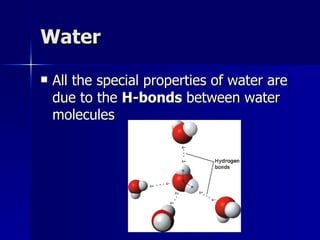
Water All the special properties of water are due to the  H-bonds  between water molecules
Oxygen Molecules of oxygen enter the body through the respiratory organs and are transported throughout the body by blood. Cellular organelles use oxygen to release energy from the sugar glucose and other nutrients.  The released energy drives the cell’s metabolic activities.
Carbon Dioxide It is produced as a waste product when cellular respiration releases energy Exhaled from the lungs. Reacts with water to form  carbonic acid
Salts Salts are actually a group of inorganic compounds. Provide many ions for important metabolic processes, including transport of substances into and out of the cell, muscle contractions, and nerve impulses.
Organic Substances These are the four major  macromolecules  (polymers) of life! Carbohydrates Lipids Proteins Nucleic Acids
Carbohydrates This molecule provides most of the  energy  that cells require to participate in metabolism. Supply materials to  build  cellular structures and are stored as  reserve  energy supplies
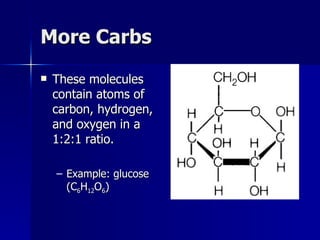
More Carbs These molecules contain atoms of carbon, hydrogen, and oxygen in a 1:2:1 ratio. Example: glucose (C 6 H 12 O 6 )
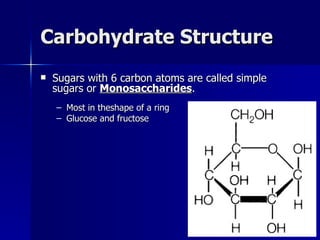
Carbohydrate Structure Sugars with 6 carbon atoms are called simple sugars or  Monosaccharides . Most in the shape of a ring Glucose and fructose
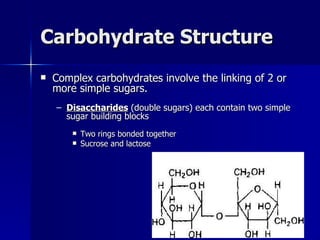
Carbohydrate Structure Complex carbohydrates involve the linking of 2 or more simple sugars. Disaccharides  (double sugars) each contain two simple sugar building blocks Two rings bonded together Sucrose and lactose
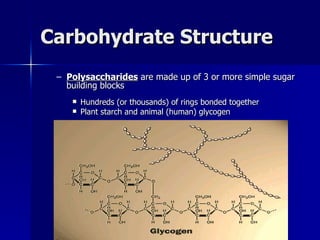
Carbohydrate Structure Polysaccharides  are made up of 3 or more simple sugar building blocks Hundreds (or thousands) of rings bonded together Plant starch and animal (human) glycogen
Lipids Lipids are organic substances that are  insoluble  in water. Include fats, phospholipids, and steroids. Fatty acids are the building blocks All of these compounds have vital functions in cells.
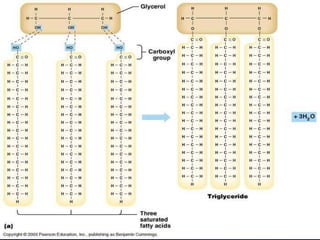
Fats Used primarily to  store energy  for cellular activities. Provide about 3x more energy (gram for gram) than carbohydrate molecules. 3 fatty acid molecules and 1 glycerol combine to produce a single fat ( Triglyceride ) molecule.
 
Fat Types Fatty acid molecules differ in the length of their carbon atom chains, and the way the carbon atoms combine. Saturated Unsaturated Polysaturated
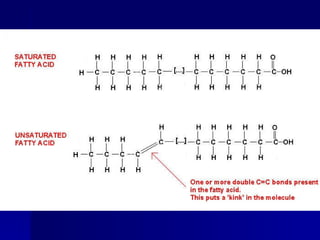
Saturated Fats Fatty acids that contain carbon atoms all joined by single carbon-carbon bonds. Each carbon atom is bound to as many hydrogen atoms as possible, and is thus “saturated” with hydrogen atoms. These fats are solid at room temp.
Unsaturated Fats These fatty acids are not bound by the maximum number of hydrogen atoms possible because they contain one or more  double-bonds  between carbon atoms. Fatty acid molecules with many double-bonded carbon atoms are called  Polyunsaturated These fats are liquid at room temp.
 
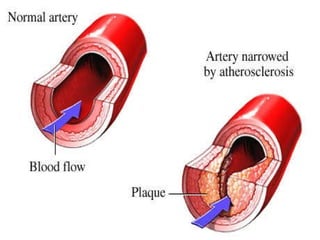
Health Connection A diet high in saturated fats increases the change of developing  Atherosclerosis , which obstructs arteries.
 
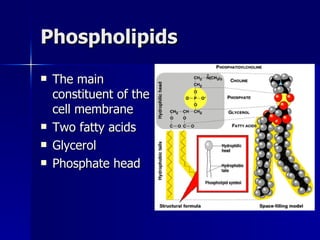
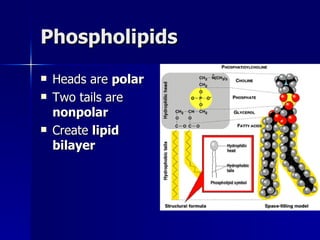
Phospholipids The main constituent of the cell membrane Two fatty acids Glycerol Phosphate head
Phospholipids Heads are  polar Two tails are  nonpolar Create  lipid bilayer
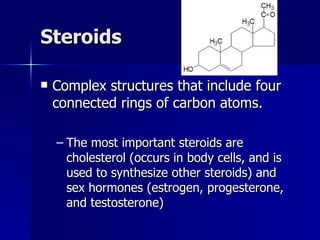
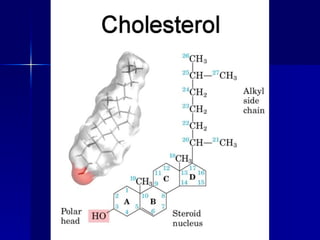
Steroids Complex structures that include four connected rings of carbon atoms. The most important steroids are cholesterol (occurs in body cells, and is used to synthesize other steroids) and sex hormones (estrogen, progesterone, and testosterone)
 
Proteins Composed of carbon, hydrogen, oxygen, nitrogen, and sulfur. Proteins serve as structural materials, energy sources, and hormones. Some proteins combine with carbs ( Glycoproteins ) and function on cell surfaces as  Receptors Some acts as  Antibodies  in your immune response. Some act as catalysts and are called  Enzymes
Proteins Continued The building blocks of proteins are  Amino Acids 20 different kinds of amino acids occur commonly in the proteins of life Proteins are formed by joining amino acids with peptide bonds to form a chain (polypeptide chain) that varies in length from less than 100 to more than 5,000 amino acids. A human body has more than 100,000 different types of proteins.
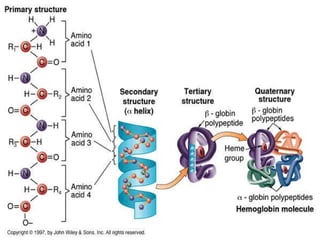
Protein Structure Proteins have several levels of structures:  Primary, Secondary,  and  Tertiary  levels.  Animation Hydrogen and covalent bonding between atoms in different parts of the polypeptide give the final protein a complicated 3-D shape or  Conformation . THE CONFORMATION OF A PROTEIN DETERMINES ITS FUNCTION!!!
 
Examples of Conformation Long and fibrous:  Keratin  protein forms hair, and  Fibrin  knits a blood clot. Many proteins are globular and function as enzymes, ion channels, carrier proteins, or receptors. Examples: Myoglobin and hemoglobin
A Change in Shape When hydrogen bonds break, the unique shape of the protein is altered  Called  Denatured . This causes the protein to lose its special properties. Example: heat denatures the protein in egg white (albumin), changing it from a liquid to a solid.
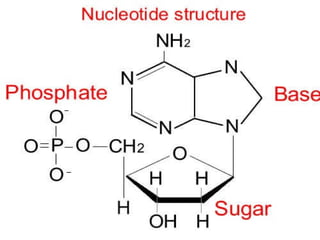
Nucleic Acids Nucleic Acids  act as the molecules of heredity. Contain atoms of carbon, hydrogen, oxygen, nitrogen, and phosphorous. The building blocks of nucleic acids are  Nucleotides
 
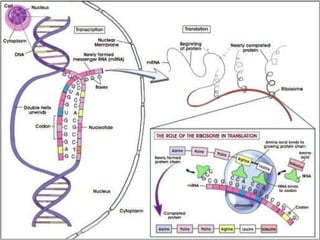
Types of Nucleic Acids RNA  (ribonucleic acid) is composed of molecules whose nucleotides contain the sugar ribose Single stranded molecule used in protein synthesis DNA  (deoxyribonucleic acid) is composed of molecules whose nucleotides contain the sugar deoxyribose. Double stranded molecule that stores the information needed to synthesize protein molecules.
 
Clinical Connection The discovery of  Prion Proteins  overturned the long-held idea that a protein can only assume one conformation. A prion can assume up to a dozen different conformations. Some prions are infectious, and can bind to “normal” proteins converting them into infectious prions as well.
Abnormal Prions Abnormal prions cause diseases called  Transmissible Spongiform Encephalopathies . More than 80 species of mammals are subject to these diseases. Examples: bovine spongiform encephalopathy (mad cow disease) and  Creutzfeldt-Jakob disease Both turn parts of the brain into spongy masses with steady loss of mental function.

Chemical constituents of_cells

  • 1.
    Chemical Constituents ofCells Chapter 2: Chemical Basis of Life Unit 1: Levels of Organization
  • 2.
    Chemicals  Chemicals that enter into metabolic reactions or are produced by them can be divided into two large groups. Organic Substances Inorganic Substances
  • 3.
    Let Us Compare!Inorganic Substances : dissolve in water or react with water to release ions They are electrolytes Organic Substances : can dissolve in water, but are more likely to dissolve in organic liquids like ether or alcohol. They are non-electrolytes because they usually do not release ions
  • 4.
    Inorganic Substances Thereare 4 key inorganic substances common in cells: Water Oxygen Carbon Dioxide Salts
  • 5.
    Water This isthe most abundant compound in living material and accounts for roughly 2/3 of the weight of an adult human. It is a major component of blood and other body fluids (including those within cells)
  • 6.
    What Does H2 O Do? It is an important solvent , allowing for most biochemical reactions to occur in water. Plays a key role in moving chemicals within the body. The aqueous portion of blood!!!
  • 7.
    What Does H2 O Do? Has a high specific heat It helps to regulate body temperature by absorbing and transporting heat . When sweat evaporates, it takes heat with it Blood moves heat around the body
  • 8.
    Water All thespecial properties of water are due to the H-bonds between water molecules
  • 9.
    Oxygen Molecules ofoxygen enter the body through the respiratory organs and are transported throughout the body by blood. Cellular organelles use oxygen to release energy from the sugar glucose and other nutrients. The released energy drives the cell’s metabolic activities.
  • 10.
    Carbon Dioxide Itis produced as a waste product when cellular respiration releases energy Exhaled from the lungs. Reacts with water to form carbonic acid
  • 11.
    Salts Salts areactually a group of inorganic compounds. Provide many ions for important metabolic processes, including transport of substances into and out of the cell, muscle contractions, and nerve impulses.
  • 12.
    Organic Substances Theseare the four major macromolecules (polymers) of life! Carbohydrates Lipids Proteins Nucleic Acids
  • 13.
    Carbohydrates This moleculeprovides most of the energy that cells require to participate in metabolism. Supply materials to build cellular structures and are stored as reserve energy supplies
  • 14.
    More Carbs Thesemolecules contain atoms of carbon, hydrogen, and oxygen in a 1:2:1 ratio. Example: glucose (C 6 H 12 O 6 )
  • 15.
    Carbohydrate Structure Sugarswith 6 carbon atoms are called simple sugars or Monosaccharides . Most in the shape of a ring Glucose and fructose
  • 16.
    Carbohydrate Structure Complexcarbohydrates involve the linking of 2 or more simple sugars. Disaccharides (double sugars) each contain two simple sugar building blocks Two rings bonded together Sucrose and lactose
  • 17.
    Carbohydrate Structure Polysaccharides are made up of 3 or more simple sugar building blocks Hundreds (or thousands) of rings bonded together Plant starch and animal (human) glycogen
  • 18.
    Lipids Lipids areorganic substances that are insoluble in water. Include fats, phospholipids, and steroids. Fatty acids are the building blocks All of these compounds have vital functions in cells.
  • 19.
    Fats Used primarilyto store energy for cellular activities. Provide about 3x more energy (gram for gram) than carbohydrate molecules. 3 fatty acid molecules and 1 glycerol combine to produce a single fat ( Triglyceride ) molecule.
  • 20.
  • 21.
    Fat Types Fattyacid molecules differ in the length of their carbon atom chains, and the way the carbon atoms combine. Saturated Unsaturated Polysaturated
  • 22.
    Saturated Fats Fattyacids that contain carbon atoms all joined by single carbon-carbon bonds. Each carbon atom is bound to as many hydrogen atoms as possible, and is thus “saturated” with hydrogen atoms. These fats are solid at room temp.
  • 23.
    Unsaturated Fats Thesefatty acids are not bound by the maximum number of hydrogen atoms possible because they contain one or more double-bonds between carbon atoms. Fatty acid molecules with many double-bonded carbon atoms are called Polyunsaturated These fats are liquid at room temp.
  • 24.
  • 25.
    Health Connection Adiet high in saturated fats increases the change of developing Atherosclerosis , which obstructs arteries.
  • 26.
  • 27.
    Phospholipids The mainconstituent of the cell membrane Two fatty acids Glycerol Phosphate head
  • 28.
    Phospholipids Heads are polar Two tails are nonpolar Create lipid bilayer
  • 29.
    Steroids Complex structuresthat include four connected rings of carbon atoms. The most important steroids are cholesterol (occurs in body cells, and is used to synthesize other steroids) and sex hormones (estrogen, progesterone, and testosterone)
  • 30.
  • 31.
    Proteins Composed ofcarbon, hydrogen, oxygen, nitrogen, and sulfur. Proteins serve as structural materials, energy sources, and hormones. Some proteins combine with carbs ( Glycoproteins ) and function on cell surfaces as Receptors Some acts as Antibodies in your immune response. Some act as catalysts and are called Enzymes
  • 32.
    Proteins Continued Thebuilding blocks of proteins are Amino Acids 20 different kinds of amino acids occur commonly in the proteins of life Proteins are formed by joining amino acids with peptide bonds to form a chain (polypeptide chain) that varies in length from less than 100 to more than 5,000 amino acids. A human body has more than 100,000 different types of proteins.
  • 33.
    Protein Structure Proteinshave several levels of structures: Primary, Secondary, and Tertiary levels. Animation Hydrogen and covalent bonding between atoms in different parts of the polypeptide give the final protein a complicated 3-D shape or Conformation . THE CONFORMATION OF A PROTEIN DETERMINES ITS FUNCTION!!!
  • 34.
  • 35.
    Examples of ConformationLong and fibrous: Keratin protein forms hair, and Fibrin knits a blood clot. Many proteins are globular and function as enzymes, ion channels, carrier proteins, or receptors. Examples: Myoglobin and hemoglobin
  • 36.
    A Change inShape When hydrogen bonds break, the unique shape of the protein is altered Called Denatured . This causes the protein to lose its special properties. Example: heat denatures the protein in egg white (albumin), changing it from a liquid to a solid.
  • 37.
    Nucleic Acids NucleicAcids act as the molecules of heredity. Contain atoms of carbon, hydrogen, oxygen, nitrogen, and phosphorous. The building blocks of nucleic acids are Nucleotides
  • 38.
  • 39.
    Types of NucleicAcids RNA (ribonucleic acid) is composed of molecules whose nucleotides contain the sugar ribose Single stranded molecule used in protein synthesis DNA (deoxyribonucleic acid) is composed of molecules whose nucleotides contain the sugar deoxyribose. Double stranded molecule that stores the information needed to synthesize protein molecules.
  • 40.
  • 41.
    Clinical Connection Thediscovery of Prion Proteins overturned the long-held idea that a protein can only assume one conformation. A prion can assume up to a dozen different conformations. Some prions are infectious, and can bind to “normal” proteins converting them into infectious prions as well.
  • 42.
    Abnormal Prions Abnormalprions cause diseases called Transmissible Spongiform Encephalopathies . More than 80 species of mammals are subject to these diseases. Examples: bovine spongiform encephalopathy (mad cow disease) and Creutzfeldt-Jakob disease Both turn parts of the brain into spongy masses with steady loss of mental function.