Monounsaturated Fatty Acids (MUFA)
and
Polyunsaturated Fatty Acids (PUFA) &
Essential Fatty Acids
LIPIDS
CLASSIFICATION
Monounsaturated Fatty Acids (MUFA)
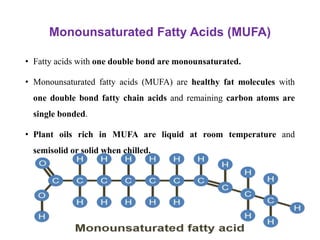
• Fatty acids with one double bond are monounsaturated.
• Monounsaturated fatty acids (MUFA) are healthy fat molecules with
one double bond fatty chain acids and remaining carbon atoms are
single bonded.
• Plant oils rich in MUFA are liquid at room temperature and
semisolid or solid when chilled.
Cont….
• Natural food sources abundant in MUFA are dairy products, nuts, seeds,
olives and avocados and it is the main part of the Mediterranean diet.
• Sunflower oil contains 85% MUFA, while olive Oil has 75% and canola oil
has 58%.
• Some of the other good sources of MUFA are almond, corn, sesame, peanut,
grapeseed, safflower and whole grain wheat.
• MUFAs are so important dietary is because they have anti-inflammatory
properties that contribute to the overall health of the body.
• Fatty acid containing one point of Unsaturation.
• They are considered as beneficial for human health.
Cont….
• Replacing SFA with MUFA reduces LDL cholesterol
concentration and total cholesterol / HDL cholesterol ratio.
• Replacing carbohydrate with MUFAs increases HDL cholesterol
concentration.
• Sources: vegetable oils such as olive, canola, and peanut.
Classification of MUFAs Monounsaturated
Fatty acids
Two types
1) Cis- unsaturated fatty acids
2) Trans- unsaturated fatty acids
Cis-Fatty acids
• Cis- fatty acids are the fatty acids in which the adjacent hydrogen atoms are
attached on the same side of the double bond.
• The chain with a significant number cis-bonds, tend to be slightly curved.
• Natural unsaturated fatty acids have Cis- double bonds.
• The unsaturated fatty acids can’t bunch tightly together.
• The bend helps the fat stay liquid rather than solid.
Significance
• Decreases total cholesterol and TGs level.
• Increases HDL level.
Trans-Fatty acid
• Fatty acids in which H-atoms are attached on the opposite sides of the
double bond.
• The chain with a significant number of Trans-fatty acids, don’t bend
much and maintain the shape.
• Unsaturated fatty acids (MUFAs and PUFAs) containing one or more
double bonds in trans configuration are called trans fatty acids (TFAs).
• Hydrogen atoms are on the opposite sides of the molecule.
Cont….
• It produced during partial hydrogenation of vegetable oils.
• Partially hydrogenation of vegetable oil results in longer shelf life of a
product.
• less rancidity and oxidation when exposed to heat and light.
• Also developed in vegetable oils during frying and heating.
• Sources: “Formation of trans fatty acids in edible oils during the frying and
heating process”
Why trans fatty acids are harmful
• Trans fatty acids are much more linear than cis fatty acids, so their
melting points are higher and trans fats may act similarly to saturated
fats.
• Increases the ratio of total cholesterol to HDL cholesterol, a powerful
predictor of the risk of CHD.
• Trans fats harm the cardiovascular system by triggering inflammation in
blood vessels.
• Trans fat may increase risk for cancers of the breast and prostate.
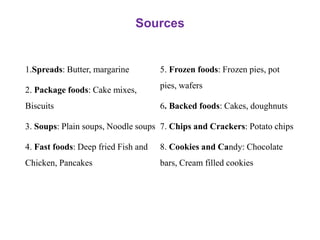
Sources
1.Spreads: Butter, margarine
2. Package foods: Cake mixes,
Biscuits
3. Soups: Plain soups, Noodle soups
4. Fast foods: Deep fried Fish and
Chicken, Pancakes
5. Frozen foods: Frozen pies, pot
pies, wafers
6. Backed foods: Cakes, doughnuts
7. Chips and Crackers: Potato chips
8. Cookies and Candy: Chocolate
bars, Cream filled cookies
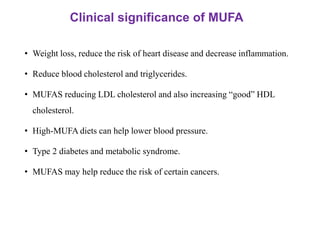
Clinical significance of MUFA
• Weight loss, reduce the risk of heart disease and decrease inflammation.
• Reduce blood cholesterol and triglycerides.
• MUFAS reducing LDL cholesterol and also increasing “good” HDL
cholesterol.
• High-MUFA diets can help lower blood pressure.
• Type 2 diabetes and metabolic syndrome.
• MUFAS may help reduce the risk of certain cancers.
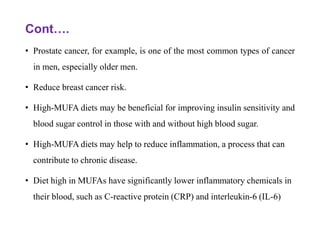
Cont….
• Prostate cancer, for example, is one of the most common types of cancer
in men, especially older men.
• Reduce breast cancer risk.
• High-MUFA diets may be beneficial for improving insulin sensitivity and
blood sugar control in those with and without high blood sugar.
• High-MUFA diets may help to reduce inflammation, a process that can
contribute to chronic disease.
• Diet high in MUFAs have significantly lower inflammatory chemicals in
their blood, such as C-reactive protein (CRP) and interleukin-6 (IL-6)
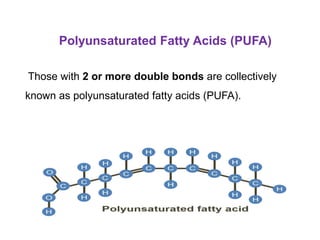
Those with 2 or more double bonds are collectively
known as polyunsaturated fatty acids (PUFA).
Polyunsaturated Fatty Acids (PUFA)
Cont…
• Polyunsaturated fatty acids are those fatty acids where unsaturation occur
more than two points.
• They possess protective role on human health. considered as beneficial for
consumption.
• Increase esterification process of cholesterol & prevents its absorption.
• By increasing the synthesis of eicosanoids, acts as an anti platelet
aggregating factor, so decreases the chances of clot formation.
• Decreases the synthesis of the precursor of VLDL AND TGs.
• Increases clearance of LDL cholesterol.
Sources
• Found in nuts and vegetable oils such as safflower, sunflower, and
soybean, and in fatty fish.
• RDA: 6-10% of total energy intake per day.
Types of PUFAS
There are several types of PUFAs, primarily
• Omega-3 and omega-6 fatty acids.
• Omega-9s and omega-12s are also PUFAs, but they
are less common.
Omega-3s
• Omega-3 fatty acids are essential for the functioning
of the body’s cells. They help with energy
production and play important roles in the heart,
lungs, blood vessels, and immune system.
There are three main types of omega-3s:
• Eicosapentaenoic acid (EPA)
• Docosahexaenoic acid (DHA)
• Alpha-linolenic acid (ALA)
Cont….
Eicosapentaenoic acid (EPA)
and Docosahexaenoic acid (DHA) mainly come from
animal-based foods and are important for heart and
brain health. these omega-3s are present in:
Fish – Salmon, Tuna and Mackerel
• Some Eggs
• Fish Oil
• Algal Oil, A Vegan Source
Cont….
• ALA comes from plants. The body must convert ALA
into Eicosapentaenoic acid (EPA) and
Docosahexaenoic acid (DHA) , but this conversion is
not easy, and the body only converts a small amount.
• People should focus on getting enough EPA and DHA
in their diet.
Cont….
Good food sources of Alpha-linolenic acid
(ALA) include
• Flaxseeds
• Chia seeds
• Walnuts
• Canola oil
Omega-6 fatty acids
Foods high in omega-6 fatty acids include:
• Safflower oil
• Mayonnaise
• Tofu
• Soybean oil
Clinical significance of PUFA
• Preventing heart disease- lower levels of unhealthy
cholesterol and prevent cardiovascular disease.
• Pregnancy and fetal development- omega-3s are
important for the fetal development of the brain and
eyes.
• Brain function- slow cognitive decline in older
adults.
Introduction
• Essential fatty acids are fatty acids that cannot be synthesized
within the human body, and therefore must be obtained from the
diet.
• Definition Essential fatty acids are fatty acids that cannot be
synthesized within the human body, and therefore must be
obtained from the diet.
Essential fatty acids
Types of essential fatty acids
• There are two families of essential fatty acids:
a) Omega-3 (n−3)
b) omega-6 (n−6) fatty acids.
• As these fatty acids are not saturated with hydrogen (H) atoms
(and contain more than one double bond between the atoms) they
are called ' Polyunsaturated Fatty acids ' (PUFAs).
• Most PUFAs are of plant and fatty fish origin.
Omega -3 and omega -6 FATTY ACIDS
• The food sources of Omega -3 and Omega-6 fatty acids
are fish and shellfish, flaxseed (linseed) and flaxseed
oil, hemp seed, olive oil, soya oil, canola (rapeseed)
oil, chia seeds, pumpkin seeds, sunflower seeds,
leafy vegetables, and walnuts.
Omega -3 and omega -6 FATTY ACIDS
• In all Omega -6 fatty acids (FA) , the first double bond
is located between the sixth and seventh carbon
atom from the methyl end of the fatty acid and in all
Omega-3 FA, the first double bond is located between
the third and fourth carbon atom counting from the
methyl end of the fatty acid.
Example : Alpha-linolenic acid (ALA).
Linoleic acid (LA).
Function Of Essential Fatty Acids
• Formation of healthy cell membranes.
• Proper development and functioning of the brain and nervous system.
• Production of hormone-like substances called eicosanoids,
Thromboxanes
Leukotrienes
Prostaglandins
• Responsible for regulating blood pressure, blood viscosity,
vasoconstriction, immune and Inflammatory responses.
Cont….
• Essential fatty acids are required for the membrane
structure and function.
• Transport of cholesterol
• Formation of lipoproteins
• Prevention of fatty liver
• They are also needed for the synthesis of another
important group of compounds, namely eicosanoids.
Biochemical basis for essentiality
• Linoleic acid and linolenic acid are essential since
humans lack the enzymes that can introduce
double bonds beyond carbons 9 to 10.
Deficiency of EFA
The deficiency of EFA results in
phrynoderma or toad skin, characterized by the
presence of horny eruptions on the posterior and
lateral parts of limbs, on the back and buttocks, loss
of hair and poor wound healing.
Uses of Fatty Acids
• They are used in the production of many food
products.
• In the production of soaps, detergents, and cosmetics.
• Soaps are fatty acid sodium and potassium salts.
• Some skin-care products contain fatty acids, which can
help maintain the appearance and function of healthy
skin.
Cont….
• Dietary supplements containing fatty acids, particularly
omega-3 fatty acids, are also widely available.
• Fatty acids are also converted to fatty alcohols and fatty
amines via their methyl esters, which are factors in the
development of surfactants, detergents, and
lubricants.
• Emulsifiers, texturizing agents, wetting agents, anti-foam
agents, and stabilising agents are all examples of fatty
acids.
Clinical significance
• Relieve the discomforts of PMS, endometriosis, and
fibrocystic breasts.
• Reduce the symptoms of eczema and psoriasis.
• Clear up acne and rosacea.
• Prevent and improve diabetic neuropathy.
• Formation of healthy cell membranes
• Proper development and functioning of the brain and
nervous system
Cont.….
• Proper thyroid and adrenal activity
• Hormone production
• Regulation of blood pressure, liver function, immune and
inflammatory responses
• Regulation of blood clotting: Omega-6 FAs encourage blood clot
formation, whereas Omega-3 oil reduces clotting. The ideal is to
achieve a balance between omega-6 and omega-3 FAs
• Crucial for the transport and breakdown of cholesterol
• Support healthy skin and hair
Expected Questions
Short
• Describe the Monounsaturated Fatty Acids (MUFA) and
its significance.
• Explain the Polyunsaturated Fatty Acids (PUFA) its
significance.
Expected Questions
Short-
• Explain the essential fatty acids.
• Identify the clinical significance of essential fatty acids.

Lipids Classification, Essential.pptx

  • 1.
    Monounsaturated Fatty Acids(MUFA) and Polyunsaturated Fatty Acids (PUFA) & Essential Fatty Acids LIPIDS CLASSIFICATION
  • 2.
    Monounsaturated Fatty Acids(MUFA) • Fatty acids with one double bond are monounsaturated. • Monounsaturated fatty acids (MUFA) are healthy fat molecules with one double bond fatty chain acids and remaining carbon atoms are single bonded. • Plant oils rich in MUFA are liquid at room temperature and semisolid or solid when chilled.
  • 3.
    Cont…. • Natural foodsources abundant in MUFA are dairy products, nuts, seeds, olives and avocados and it is the main part of the Mediterranean diet. • Sunflower oil contains 85% MUFA, while olive Oil has 75% and canola oil has 58%. • Some of the other good sources of MUFA are almond, corn, sesame, peanut, grapeseed, safflower and whole grain wheat. • MUFAs are so important dietary is because they have anti-inflammatory properties that contribute to the overall health of the body. • Fatty acid containing one point of Unsaturation. • They are considered as beneficial for human health.
  • 4.
    Cont…. • Replacing SFAwith MUFA reduces LDL cholesterol concentration and total cholesterol / HDL cholesterol ratio. • Replacing carbohydrate with MUFAs increases HDL cholesterol concentration. • Sources: vegetable oils such as olive, canola, and peanut.
  • 5.
    Classification of MUFAsMonounsaturated Fatty acids Two types 1) Cis- unsaturated fatty acids 2) Trans- unsaturated fatty acids
  • 6.
    Cis-Fatty acids • Cis-fatty acids are the fatty acids in which the adjacent hydrogen atoms are attached on the same side of the double bond. • The chain with a significant number cis-bonds, tend to be slightly curved. • Natural unsaturated fatty acids have Cis- double bonds. • The unsaturated fatty acids can’t bunch tightly together. • The bend helps the fat stay liquid rather than solid. Significance • Decreases total cholesterol and TGs level. • Increases HDL level.
  • 7.
    Trans-Fatty acid • Fattyacids in which H-atoms are attached on the opposite sides of the double bond. • The chain with a significant number of Trans-fatty acids, don’t bend much and maintain the shape. • Unsaturated fatty acids (MUFAs and PUFAs) containing one or more double bonds in trans configuration are called trans fatty acids (TFAs). • Hydrogen atoms are on the opposite sides of the molecule.
  • 8.
    Cont…. • It producedduring partial hydrogenation of vegetable oils. • Partially hydrogenation of vegetable oil results in longer shelf life of a product. • less rancidity and oxidation when exposed to heat and light. • Also developed in vegetable oils during frying and heating. • Sources: “Formation of trans fatty acids in edible oils during the frying and heating process”
  • 9.
    Why trans fattyacids are harmful • Trans fatty acids are much more linear than cis fatty acids, so their melting points are higher and trans fats may act similarly to saturated fats. • Increases the ratio of total cholesterol to HDL cholesterol, a powerful predictor of the risk of CHD. • Trans fats harm the cardiovascular system by triggering inflammation in blood vessels. • Trans fat may increase risk for cancers of the breast and prostate.
  • 10.
    Sources 1.Spreads: Butter, margarine 2.Package foods: Cake mixes, Biscuits 3. Soups: Plain soups, Noodle soups 4. Fast foods: Deep fried Fish and Chicken, Pancakes 5. Frozen foods: Frozen pies, pot pies, wafers 6. Backed foods: Cakes, doughnuts 7. Chips and Crackers: Potato chips 8. Cookies and Candy: Chocolate bars, Cream filled cookies
  • 11.
    Clinical significance ofMUFA • Weight loss, reduce the risk of heart disease and decrease inflammation. • Reduce blood cholesterol and triglycerides. • MUFAS reducing LDL cholesterol and also increasing “good” HDL cholesterol. • High-MUFA diets can help lower blood pressure. • Type 2 diabetes and metabolic syndrome. • MUFAS may help reduce the risk of certain cancers.
  • 12.
    Cont…. • Prostate cancer,for example, is one of the most common types of cancer in men, especially older men. • Reduce breast cancer risk. • High-MUFA diets may be beneficial for improving insulin sensitivity and blood sugar control in those with and without high blood sugar. • High-MUFA diets may help to reduce inflammation, a process that can contribute to chronic disease. • Diet high in MUFAs have significantly lower inflammatory chemicals in their blood, such as C-reactive protein (CRP) and interleukin-6 (IL-6)
  • 13.
    Those with 2or more double bonds are collectively known as polyunsaturated fatty acids (PUFA). Polyunsaturated Fatty Acids (PUFA)
  • 14.
    Cont… • Polyunsaturated fattyacids are those fatty acids where unsaturation occur more than two points. • They possess protective role on human health. considered as beneficial for consumption. • Increase esterification process of cholesterol & prevents its absorption. • By increasing the synthesis of eicosanoids, acts as an anti platelet aggregating factor, so decreases the chances of clot formation. • Decreases the synthesis of the precursor of VLDL AND TGs. • Increases clearance of LDL cholesterol.
  • 15.
    Sources • Found innuts and vegetable oils such as safflower, sunflower, and soybean, and in fatty fish. • RDA: 6-10% of total energy intake per day.
  • 16.
    Types of PUFAS Thereare several types of PUFAs, primarily • Omega-3 and omega-6 fatty acids. • Omega-9s and omega-12s are also PUFAs, but they are less common.
  • 17.
    Omega-3s • Omega-3 fattyacids are essential for the functioning of the body’s cells. They help with energy production and play important roles in the heart, lungs, blood vessels, and immune system. There are three main types of omega-3s: • Eicosapentaenoic acid (EPA) • Docosahexaenoic acid (DHA) • Alpha-linolenic acid (ALA)
  • 18.
    Cont…. Eicosapentaenoic acid (EPA) andDocosahexaenoic acid (DHA) mainly come from animal-based foods and are important for heart and brain health. these omega-3s are present in: Fish – Salmon, Tuna and Mackerel • Some Eggs • Fish Oil • Algal Oil, A Vegan Source
  • 19.
    Cont…. • ALA comesfrom plants. The body must convert ALA into Eicosapentaenoic acid (EPA) and Docosahexaenoic acid (DHA) , but this conversion is not easy, and the body only converts a small amount. • People should focus on getting enough EPA and DHA in their diet.
  • 20.
    Cont…. Good food sourcesof Alpha-linolenic acid (ALA) include • Flaxseeds • Chia seeds • Walnuts • Canola oil
  • 21.
    Omega-6 fatty acids Foodshigh in omega-6 fatty acids include: • Safflower oil • Mayonnaise • Tofu • Soybean oil
  • 22.
    Clinical significance ofPUFA • Preventing heart disease- lower levels of unhealthy cholesterol and prevent cardiovascular disease. • Pregnancy and fetal development- omega-3s are important for the fetal development of the brain and eyes. • Brain function- slow cognitive decline in older adults.
  • 23.
    Introduction • Essential fattyacids are fatty acids that cannot be synthesized within the human body, and therefore must be obtained from the diet. • Definition Essential fatty acids are fatty acids that cannot be synthesized within the human body, and therefore must be obtained from the diet. Essential fatty acids
  • 24.
    Types of essentialfatty acids • There are two families of essential fatty acids: a) Omega-3 (n−3) b) omega-6 (n−6) fatty acids. • As these fatty acids are not saturated with hydrogen (H) atoms (and contain more than one double bond between the atoms) they are called ' Polyunsaturated Fatty acids ' (PUFAs). • Most PUFAs are of plant and fatty fish origin.
  • 25.
    Omega -3 andomega -6 FATTY ACIDS • The food sources of Omega -3 and Omega-6 fatty acids are fish and shellfish, flaxseed (linseed) and flaxseed oil, hemp seed, olive oil, soya oil, canola (rapeseed) oil, chia seeds, pumpkin seeds, sunflower seeds, leafy vegetables, and walnuts.
  • 26.
    Omega -3 andomega -6 FATTY ACIDS • In all Omega -6 fatty acids (FA) , the first double bond is located between the sixth and seventh carbon atom from the methyl end of the fatty acid and in all Omega-3 FA, the first double bond is located between the third and fourth carbon atom counting from the methyl end of the fatty acid. Example : Alpha-linolenic acid (ALA). Linoleic acid (LA).
  • 27.
    Function Of EssentialFatty Acids • Formation of healthy cell membranes. • Proper development and functioning of the brain and nervous system. • Production of hormone-like substances called eicosanoids, Thromboxanes Leukotrienes Prostaglandins • Responsible for regulating blood pressure, blood viscosity, vasoconstriction, immune and Inflammatory responses.
  • 28.
    Cont…. • Essential fattyacids are required for the membrane structure and function. • Transport of cholesterol • Formation of lipoproteins • Prevention of fatty liver • They are also needed for the synthesis of another important group of compounds, namely eicosanoids.
  • 29.
    Biochemical basis foressentiality • Linoleic acid and linolenic acid are essential since humans lack the enzymes that can introduce double bonds beyond carbons 9 to 10.
  • 30.
    Deficiency of EFA Thedeficiency of EFA results in phrynoderma or toad skin, characterized by the presence of horny eruptions on the posterior and lateral parts of limbs, on the back and buttocks, loss of hair and poor wound healing.
  • 31.
    Uses of FattyAcids • They are used in the production of many food products. • In the production of soaps, detergents, and cosmetics. • Soaps are fatty acid sodium and potassium salts. • Some skin-care products contain fatty acids, which can help maintain the appearance and function of healthy skin.
  • 32.
    Cont…. • Dietary supplementscontaining fatty acids, particularly omega-3 fatty acids, are also widely available. • Fatty acids are also converted to fatty alcohols and fatty amines via their methyl esters, which are factors in the development of surfactants, detergents, and lubricants. • Emulsifiers, texturizing agents, wetting agents, anti-foam agents, and stabilising agents are all examples of fatty acids.
  • 33.
    Clinical significance • Relievethe discomforts of PMS, endometriosis, and fibrocystic breasts. • Reduce the symptoms of eczema and psoriasis. • Clear up acne and rosacea. • Prevent and improve diabetic neuropathy. • Formation of healthy cell membranes • Proper development and functioning of the brain and nervous system
  • 34.
    Cont.…. • Proper thyroidand adrenal activity • Hormone production • Regulation of blood pressure, liver function, immune and inflammatory responses • Regulation of blood clotting: Omega-6 FAs encourage blood clot formation, whereas Omega-3 oil reduces clotting. The ideal is to achieve a balance between omega-6 and omega-3 FAs • Crucial for the transport and breakdown of cholesterol • Support healthy skin and hair
  • 35.
    Expected Questions Short • Describethe Monounsaturated Fatty Acids (MUFA) and its significance. • Explain the Polyunsaturated Fatty Acids (PUFA) its significance.
  • 36.
    Expected Questions Short- • Explainthe essential fatty acids. • Identify the clinical significance of essential fatty acids.