Lipids
M. ShoaibAslam
Lecturer
Contents
Classes of Lipids
Fatty Acids and Triglycerides
Saturated, Monounsaturated, and Polyunsaturated Fatty Acids
Classification of Lipoproteins
RDA for fat with food sources
Omeg-3 fatty Acids & Cardiovascular disease
Trans Fats and Chronic Diseases
Digestion, Absorption and Metabolism
Introduction
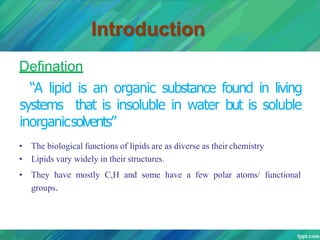
Defination
“A lipid is an organic substance found in living
systems that is insoluble in water but is soluble
inorganicsolvents”
• The biological functions of lipids are as diverse as theirchemistry
• Lipids vary widely in their structures.
• They have mostly C,H and some have a few polar atoms/ functional
groups.
Classification
Fats & Oils
Lipids include:
• Fats and oils
• Steroids
• Fats & oils make up 95% of the nutritional lipids, the
other 5% are steroids.
• Fats and oils are the principal stored forms of energy in
many organisms
Difference between fats and
oils
• Fats and oils are triglycerides with varying
degrees of saturated and unsaturated fatty
acids
– Fats – generally solid at room temperatures
and high in saturated fatty acids
– Oils –generally liquid at room temperatures
and low in saturated fatty acids
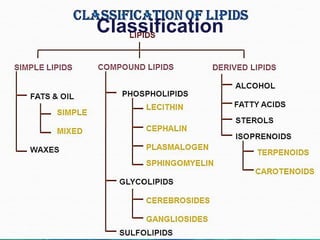
Classification of Lipids
Simple Lipids
• These are esters of fatty acids with various alcohols
• They include neutral fats and waxes
Neutral Fats or Triacylglycerols (tags):
• TAGs are the esters of the fatty acids with glycerol
• The fatty acids moiety in lipid esters is called ‘acyl’group
• TAGs are the major storage and transport form of lipids
• TAGs with different fatty acid compositions are known as
mixed TAGs
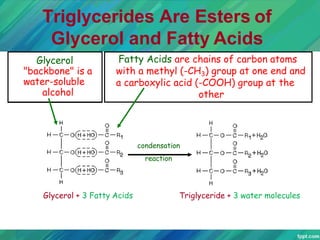
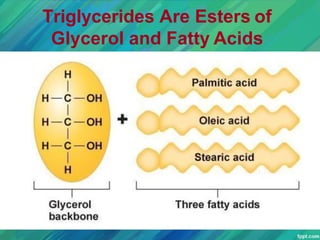
Triglycerides Are Esters of
Glycerol and Fatty Acids
condensation
reaction
Glycerol
"backbone" is a
water-soluble
alcohol
Fatty Acids are chains of carbon atoms
with a methyl (-CH3) group at one end and
a carboxylic acid (-COOH) group at the
other
Glycerol + 3 Fatty Acids Triglyceride + 3 water molecules
Triglycerides Are Esters of
Glycerol and Fatty Acids
A. Triacylglycerols (tags):
Fatty Acids
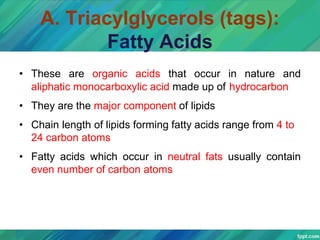
• These are organic acids that occur in nature and
aliphatic monocarboxylic acid made up of hydrocarbon
• They are the major component of lipids
• Chain length of lipids forming fatty acids range from 4 to
24 carbon atoms
• Fatty acids which occur in neutral fats usually contain
even number of carbon atoms
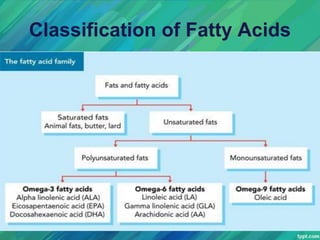
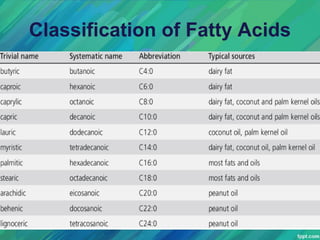
Classification of Fatty Acids
Fatty Acids
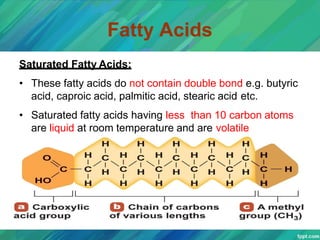
Saturated Fatty Acids:
• These fatty acids do not contain double bond e.g. butyric
acid, caproic acid, palmitic acid, stearic acid etc.
• Saturated fatty acids having less than 10 carbon atoms
are liquid at room temperature and are volatile
Fatty Acids
Fatty Acids
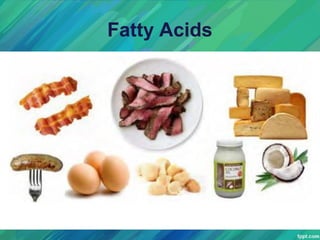
• Saturated fatty acids, especially palmitic and stearic
acids are found in animal products such as cream,
cheese, butter, other whole milk dairy products and fatty
meats which also contain dietary cholesterol.
• Certain vegetable products have high saturated fat
content, such as coconut oil and palm kernel oil.
• Many prepared foods are high in saturated fat content,
such as pizza, dairy desserts and sausage.
Fatty Acids
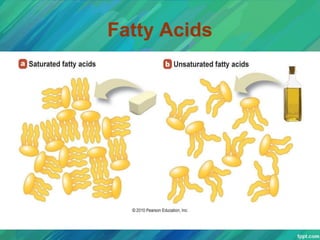
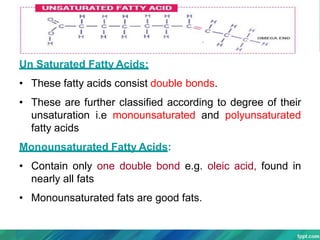
Un Saturated Fatty Acids:
• These fatty acids consist double bonds.
• These are further classified according to degree of their
unsaturation i.e monounsaturated and polyunsaturated
fatty acids
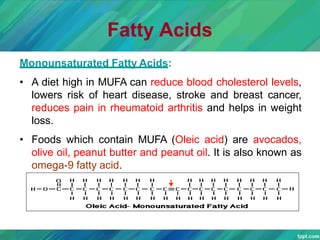
Monounsaturated Fatty Acids:
• Contain only one double bond e.g. oleic acid, found in
nearly all fats
• Monounsaturated fats are good fats.
Fatty Acids
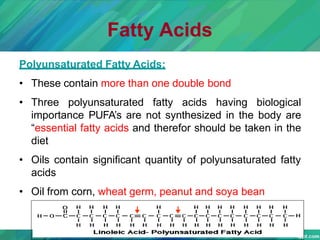
Polyunsaturated Fatty Acids:
• These contain more than one double bond
• Three polyunsaturated fatty acids having biological
importance PUFA’s are not synthesized in the body are
“essential fatty acids and therefor should be taken in the
diet
• Oils contain significant quantity of polyunsaturated fatty
acids
• Oil from corn, wheat germ, peanut and soya bean
Fatty Acids
Monounsaturated Fatty Acids:
• A diet high in MUFA can reduce blood cholesterol levels,
lowers risk of heart disease, stroke and breast cancer,
reduces pain in rheumatoid arthritis and helps in weight
loss.
• Foods which contain MUFA (Oleic acid) are avocados,
olive oil, peanut butter and peanut oil. It is also known as
omega-9 fatty acid.
Polyunsaturated Fatty Acids
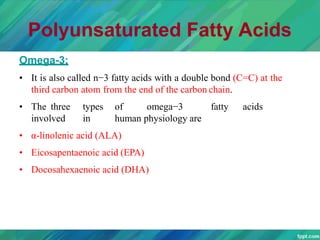
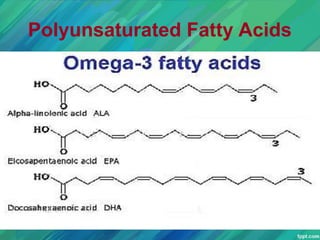
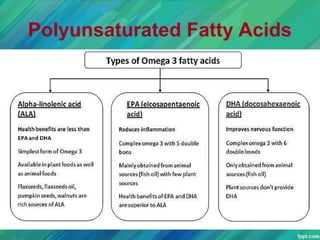
Omega-3:
• It is also called n−3 fatty acids with a double bond (C=C) at the
third carbon atom from the end of the carbon chain.
• The three types of omega−3 fatty acids
involved in human physiology are
• α-linolenic acid (ALA)
• Eicosapentaenoic acid (EPA)
• Docosahexaenoic acid (DHA)
Polyunsaturated Fatty Acids
Omega-3:
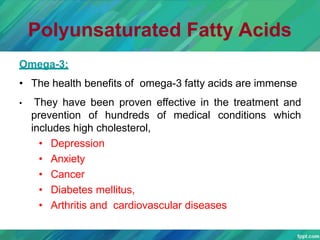
• The health benefits of omega-3 fatty acids are immense
• They have been proven effective in the treatment and
prevention of hundreds of medical conditions which
includes high cholesterol,
• Depression
• Anxiety
• Cancer
• Diabetes mellitus,
• Arthritis and cardiovascular diseases
Polyunsaturated Fatty Acids
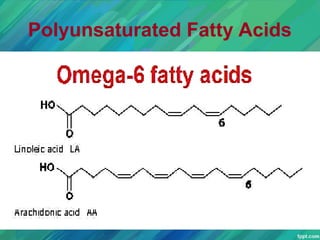
Omega-6:
• Omega-6 fatty acids (also referred to as n-6 fatty acids)
• A family of pro- inflammatory and anti-inflammatory
polyunsaturated fatty acids that have in common a final carbon-
carbon double bond in the n-6 position, that is the sixth bond,
counting from the methyl end.
• Omega-6 fats, also known as linoleic acid, are available only in
food.
• The human body cannot make them, so they are considered
essential fats. They support brain function, bone health, reproductive
health, hair growth and regulation of metabolism.
• Good sources of linoleic acid include vegetable oils.
Classification
On the Basis of Requirement
1. Essential fatty acids
•Fatty acids which are essential to be taken in our diet because
they cannot be synthesized in our body are known as essential
fatty acids.(eg.) Linoleic, linolenic and arachidonic acids.
2. Non-essential fatty acids
•Non-essential fatty acids are those which can be synthesized by
the body and which need not be supplied through the diet.
Palmitic acid, oleic acid and butyric acid are examples of non–
essential fatty acids.
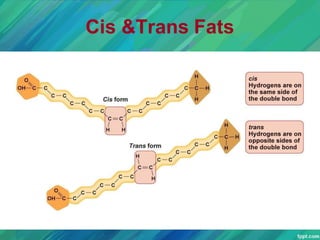
Cis Fats
• When a mono- or polyunsaturated oil is hydrogenated, it is not
possible to control where the hydrogen atoms are added to the
structure.
• If both hydrogen atoms are added to the same side of the
structure, it is called a "Cis" fat. Cis (means ‘on the sameside’)
Trans Fats
• Trans fats.
• Trans fats are unique, in that they are unsaturated lipids that
function much like their saturated counterparts.
• While small amounts of trans fats are naturally occurring in
some foods, such as butter, they primarily are produced
through partial hydrogenation of unsaturated oils, such as
soybean oil.
Cis &Trans Fats
Trans Fat & CVD
•But the price the consumer pays for the benefit of the food
industry is a cardiovascular risk, in the form of trans fats,
which is why the government required the amount of trans
fats to be listed on labels starting in January 2006.
•Even with the same caloric intake (including fat calories)
in two groups, the group with the higher trans fats intake
gained more weight.
•Giving the “apple” shape, which has been implicated in
giving rise to an increased cardiovascular risk.
•The bad news about trans fats has been gathering for
years, but commercial interests would rather bury the
information
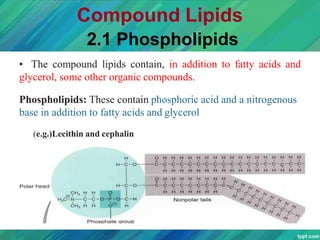
Compound Lipids
2.1 Phospholipids
• The compound lipids contain, in addition to fatty acids and
glycerol, some other organic compounds.
Phospholipids: These contain phosphoric acid and a nitrogenous
base in addition to fatty acids and glycerol
(e.g.)Lecithin and cephalin
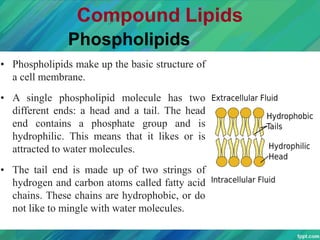
Compound Lipids
Phospholipids
• Phospholipids make up the basic structure of
a cell membrane.
• A single phospholipid molecule has two
different ends: a head and a tail. The head
end contains a phosphate group and is
hydrophilic. This means that it likes or is
attracted to water molecules.
• The tail end is made up of two strings of
hydrogen and carbon atoms called fatty acid
chains. These chains are hydrophobic, or do
not like to mingle with water molecules.
Compound Lipids
Phospholipids
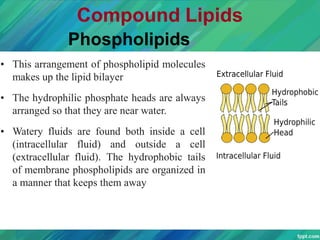
• This arrangement of phospholipid molecules
makes up the lipid bilayer
• The hydrophilic phosphate heads are always
arranged so that they are near water.
• Watery fluids are found both inside a cell
(intracellular fluid) and outside a cell
(extracellular fluid). The hydrophobic tails
of membrane phospholipids are organized in
a manner that keeps them away
2. Compound lipids
(i) Phospholipids
• Phospholipids and sterols are major structural components of
biological membranes as well as in serum lipoproteins, bile
•They play an important role in electron transport, oxidative
phosphorylation and energy linked transport of ions across
membranes.
2. Compound lipids
Chylomicron
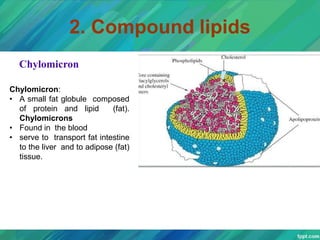
Chylomicron:
• A small fat globule composed
of protein and lipid (fat).
Chylomicrons
• Found in the blood
• serve to transport fat intestine
to the liver and to adipose (fat)
tissue.
2. Compound lipids
LDL
• LDL (low-density lipoprotein): A molecule that is a
combination of lipid (fat) and protein. Lipoproteins are the
form in which lipids are transported in the blood.
• Low-density lipoprotein (LDL) transports cholesterol from the
liver to the tissues of the body.
• LDL cholesterol is therefore considered the "bad" cholesterol.
2. Compound lipids
HDL
• HDL cholesterol: High density lipoprotein cholesterol.
Lipoproteins, which are combinations of fats (lipids) and
proteins, are the form in which lipids are transported in the
blood.
• HDLs transport cholesterol from the tissues of the body to the
liver.
• HDL cholesterol is therefore considered the 'good' cholesterol:
The higher the HDL cholesterol level, the lower the risk of
coronary artery disease..
2. Compound lipids
Functions of Lipids
• They are the components of cells and cell organelles
membrane.
• They are the major storage forms of energy
• They are good emulsifying agents
• In the body, 1 gram of fat produces about 9 kilocalories
• They have a high satiety value
• Lipids are the precursors of other important compounds e.g.
cholesterol, prostaglandins and ketone bodies.
• Cholesterol is the precursor of bile acids and steroid hormones.
• 7-dehydrocholesterol is the precursor of vitaminD3.
• Prostaglandins have hormone like actions in the body.
Functions of Lipids
• Ketones bodies act as a reserve fuel.
• Lipids provide insulation to the nervous system against
atmospheric heat and cold.
• They provide anatomical stability to the internal organs and
protect them against physical shocks.
• Lipids under the skin prevent excessive loss of water and
electrolytes.
• They help in transportation of fat soluble vitamins and other
fat soluble compounds across the membrane.
• They protect the body against the injurious effects of water
soluble substances.
Functions of Lipids
• The fats that we get from food are vital to good health.
• They provide energy and essentialfatty acids for healthy skin
and important hormone like substances.
• Fats also carry and help the body absorb the fat-soluble
vitamins A, D, E and K.
• What’s more, dietary fats help us feel satisfied following
meals.

Lipids.pdf

  • 1.
  • 2.
    Contents Classes of Lipids FattyAcids and Triglycerides Saturated, Monounsaturated, and Polyunsaturated Fatty Acids Classification of Lipoproteins RDA for fat with food sources Omeg-3 fatty Acids & Cardiovascular disease Trans Fats and Chronic Diseases Digestion, Absorption and Metabolism
  • 3.
    Introduction Defination “A lipid isan organic substance found in living systems that is insoluble in water but is soluble inorganicsolvents” • The biological functions of lipids are as diverse as theirchemistry • Lipids vary widely in their structures. • They have mostly C,H and some have a few polar atoms/ functional groups.
  • 4.
  • 5.
    Fats & Oils Lipidsinclude: • Fats and oils • Steroids • Fats & oils make up 95% of the nutritional lipids, the other 5% are steroids. • Fats and oils are the principal stored forms of energy in many organisms
  • 6.
    Difference between fatsand oils • Fats and oils are triglycerides with varying degrees of saturated and unsaturated fatty acids – Fats – generally solid at room temperatures and high in saturated fatty acids – Oils –generally liquid at room temperatures and low in saturated fatty acids
  • 7.
    Classification of Lipids SimpleLipids • These are esters of fatty acids with various alcohols • They include neutral fats and waxes Neutral Fats or Triacylglycerols (tags): • TAGs are the esters of the fatty acids with glycerol • The fatty acids moiety in lipid esters is called ‘acyl’group • TAGs are the major storage and transport form of lipids • TAGs with different fatty acid compositions are known as mixed TAGs
  • 8.
    Triglycerides Are Estersof Glycerol and Fatty Acids condensation reaction Glycerol "backbone" is a water-soluble alcohol Fatty Acids are chains of carbon atoms with a methyl (-CH3) group at one end and a carboxylic acid (-COOH) group at the other Glycerol + 3 Fatty Acids Triglyceride + 3 water molecules
  • 9.
    Triglycerides Are Estersof Glycerol and Fatty Acids
  • 10.
    A. Triacylglycerols (tags): FattyAcids • These are organic acids that occur in nature and aliphatic monocarboxylic acid made up of hydrocarbon • They are the major component of lipids • Chain length of lipids forming fatty acids range from 4 to 24 carbon atoms • Fatty acids which occur in neutral fats usually contain even number of carbon atoms
  • 11.
  • 12.
  • 13.
    Fatty Acids Saturated FattyAcids: • These fatty acids do not contain double bond e.g. butyric acid, caproic acid, palmitic acid, stearic acid etc. • Saturated fatty acids having less than 10 carbon atoms are liquid at room temperature and are volatile
  • 14.
  • 15.
    Fatty Acids • Saturatedfatty acids, especially palmitic and stearic acids are found in animal products such as cream, cheese, butter, other whole milk dairy products and fatty meats which also contain dietary cholesterol. • Certain vegetable products have high saturated fat content, such as coconut oil and palm kernel oil. • Many prepared foods are high in saturated fat content, such as pizza, dairy desserts and sausage.
  • 16.
  • 17.
    Un Saturated FattyAcids: • These fatty acids consist double bonds. • These are further classified according to degree of their unsaturation i.e monounsaturated and polyunsaturated fatty acids Monounsaturated Fatty Acids: • Contain only one double bond e.g. oleic acid, found in nearly all fats • Monounsaturated fats are good fats.
  • 18.
    Fatty Acids Polyunsaturated FattyAcids: • These contain more than one double bond • Three polyunsaturated fatty acids having biological importance PUFA’s are not synthesized in the body are “essential fatty acids and therefor should be taken in the diet • Oils contain significant quantity of polyunsaturated fatty acids • Oil from corn, wheat germ, peanut and soya bean
  • 19.
    Fatty Acids Monounsaturated FattyAcids: • A diet high in MUFA can reduce blood cholesterol levels, lowers risk of heart disease, stroke and breast cancer, reduces pain in rheumatoid arthritis and helps in weight loss. • Foods which contain MUFA (Oleic acid) are avocados, olive oil, peanut butter and peanut oil. It is also known as omega-9 fatty acid.
  • 20.
    Polyunsaturated Fatty Acids Omega-3: •It is also called n−3 fatty acids with a double bond (C=C) at the third carbon atom from the end of the carbon chain. • The three types of omega−3 fatty acids involved in human physiology are • α-linolenic acid (ALA) • Eicosapentaenoic acid (EPA) • Docosahexaenoic acid (DHA)
  • 21.
    Polyunsaturated Fatty Acids Omega-3: •The health benefits of omega-3 fatty acids are immense • They have been proven effective in the treatment and prevention of hundreds of medical conditions which includes high cholesterol, • Depression • Anxiety • Cancer • Diabetes mellitus, • Arthritis and cardiovascular diseases
  • 22.
  • 23.
  • 24.
  • 25.
    Polyunsaturated Fatty Acids Omega-6: •Omega-6 fatty acids (also referred to as n-6 fatty acids) • A family of pro- inflammatory and anti-inflammatory polyunsaturated fatty acids that have in common a final carbon- carbon double bond in the n-6 position, that is the sixth bond, counting from the methyl end. • Omega-6 fats, also known as linoleic acid, are available only in food. • The human body cannot make them, so they are considered essential fats. They support brain function, bone health, reproductive health, hair growth and regulation of metabolism. • Good sources of linoleic acid include vegetable oils.
  • 26.
    Classification On the Basisof Requirement 1. Essential fatty acids •Fatty acids which are essential to be taken in our diet because they cannot be synthesized in our body are known as essential fatty acids.(eg.) Linoleic, linolenic and arachidonic acids. 2. Non-essential fatty acids •Non-essential fatty acids are those which can be synthesized by the body and which need not be supplied through the diet. Palmitic acid, oleic acid and butyric acid are examples of non– essential fatty acids.
  • 27.
    Cis Fats • Whena mono- or polyunsaturated oil is hydrogenated, it is not possible to control where the hydrogen atoms are added to the structure. • If both hydrogen atoms are added to the same side of the structure, it is called a "Cis" fat. Cis (means ‘on the sameside’)
  • 28.
    Trans Fats • Transfats. • Trans fats are unique, in that they are unsaturated lipids that function much like their saturated counterparts. • While small amounts of trans fats are naturally occurring in some foods, such as butter, they primarily are produced through partial hydrogenation of unsaturated oils, such as soybean oil.
  • 29.
  • 30.
    Trans Fat &CVD •But the price the consumer pays for the benefit of the food industry is a cardiovascular risk, in the form of trans fats, which is why the government required the amount of trans fats to be listed on labels starting in January 2006. •Even with the same caloric intake (including fat calories) in two groups, the group with the higher trans fats intake gained more weight. •Giving the “apple” shape, which has been implicated in giving rise to an increased cardiovascular risk. •The bad news about trans fats has been gathering for years, but commercial interests would rather bury the information
  • 31.
    Compound Lipids 2.1 Phospholipids •The compound lipids contain, in addition to fatty acids and glycerol, some other organic compounds. Phospholipids: These contain phosphoric acid and a nitrogenous base in addition to fatty acids and glycerol (e.g.)Lecithin and cephalin
  • 32.
    Compound Lipids Phospholipids • Phospholipidsmake up the basic structure of a cell membrane. • A single phospholipid molecule has two different ends: a head and a tail. The head end contains a phosphate group and is hydrophilic. This means that it likes or is attracted to water molecules. • The tail end is made up of two strings of hydrogen and carbon atoms called fatty acid chains. These chains are hydrophobic, or do not like to mingle with water molecules.
  • 33.
    Compound Lipids Phospholipids • Thisarrangement of phospholipid molecules makes up the lipid bilayer • The hydrophilic phosphate heads are always arranged so that they are near water. • Watery fluids are found both inside a cell (intracellular fluid) and outside a cell (extracellular fluid). The hydrophobic tails of membrane phospholipids are organized in a manner that keeps them away
  • 34.
    2. Compound lipids (i)Phospholipids • Phospholipids and sterols are major structural components of biological membranes as well as in serum lipoproteins, bile •They play an important role in electron transport, oxidative phosphorylation and energy linked transport of ions across membranes.
  • 35.
    2. Compound lipids Chylomicron Chylomicron: •A small fat globule composed of protein and lipid (fat). Chylomicrons • Found in the blood • serve to transport fat intestine to the liver and to adipose (fat) tissue.
  • 36.
    2. Compound lipids LDL •LDL (low-density lipoprotein): A molecule that is a combination of lipid (fat) and protein. Lipoproteins are the form in which lipids are transported in the blood. • Low-density lipoprotein (LDL) transports cholesterol from the liver to the tissues of the body. • LDL cholesterol is therefore considered the "bad" cholesterol.
  • 37.
    2. Compound lipids HDL •HDL cholesterol: High density lipoprotein cholesterol. Lipoproteins, which are combinations of fats (lipids) and proteins, are the form in which lipids are transported in the blood. • HDLs transport cholesterol from the tissues of the body to the liver. • HDL cholesterol is therefore considered the 'good' cholesterol: The higher the HDL cholesterol level, the lower the risk of coronary artery disease..
  • 38.
  • 39.
    Functions of Lipids •They are the components of cells and cell organelles membrane. • They are the major storage forms of energy • They are good emulsifying agents • In the body, 1 gram of fat produces about 9 kilocalories • They have a high satiety value • Lipids are the precursors of other important compounds e.g. cholesterol, prostaglandins and ketone bodies. • Cholesterol is the precursor of bile acids and steroid hormones. • 7-dehydrocholesterol is the precursor of vitaminD3. • Prostaglandins have hormone like actions in the body.
  • 40.
    Functions of Lipids •Ketones bodies act as a reserve fuel. • Lipids provide insulation to the nervous system against atmospheric heat and cold. • They provide anatomical stability to the internal organs and protect them against physical shocks. • Lipids under the skin prevent excessive loss of water and electrolytes. • They help in transportation of fat soluble vitamins and other fat soluble compounds across the membrane. • They protect the body against the injurious effects of water soluble substances.
  • 41.
    Functions of Lipids •The fats that we get from food are vital to good health. • They provide energy and essentialfatty acids for healthy skin and important hormone like substances. • Fats also carry and help the body absorb the fat-soluble vitamins A, D, E and K. • What’s more, dietary fats help us feel satisfied following meals.