VITAMIN-A
VITAMIN-D
VITAMIN-E
VITAMIN-K
ASCORBIC ACID
B-COMPLEX
VITAMINS
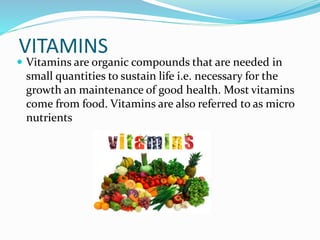
 Vitamins are organic compounds that are needed in
small quantities to sustain life i.e. necessary for the
growth an maintenance of good health. Most vitamins
come from food. Vitamins are also referred to as micro
nutrients
CLASSIFICATION OF VITAMINS
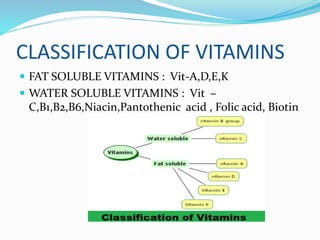
 FAT SOLUBLE VITAMINS : Vit-A,D,E,K
 WATER SOLUBLE VITAMINS : Vit –
C,B1,B2,B6,Niacin,Pantothenic acid , Folic acid, Biotin
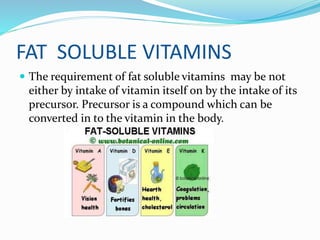
FAT SOLUBLE VITAMINS
 The requirement of fat soluble vitamins may be not
either by intake of vitamin itself on by the intake of its
precursor. Precursor is a compound which can be
converted in to the vitamin in the body.
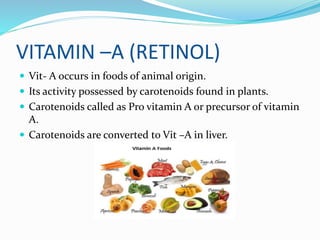
VITAMIN –A (RETINOL)
 Vit- A occurs in foods of animal origin.
 Its activity possessed by carotenoids found in plants.
 Carotenoids called as Pro vitamin A or precursor of vitamin
A.
 Carotenoids are converted to Vit –A in liver.
 FUNCTIONS
 Vit –A is essential for
vision
 Immune response
 Bone growth ,
Reproduction
 Maintenance of the
surface linings of the
eyes , epithelial cell
growth and repair.
 Embryonic development
and the regulation of
adult genes.
 SOURCES
 Liver , Cod liver , Oil ,
Carrots , Bruccoli ,
Milk , Meat , Fish ,
Green leafy vegetables
.
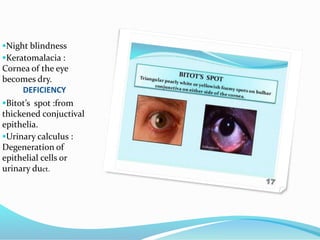
DEFICIENCY
Night blindness
Keratomalacia :
Cornea of the eye
becomes dry.
Bitot’s spot :from
thickened conjuctival
epithelia.
Urinary calculus :
Degeneration of
epithelial cells or
urinary duct.
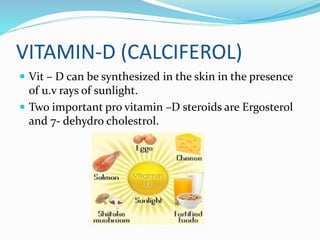
VITAMIN-D (CALCIFEROL)
 Vit – D can be synthesized in the skin in the presence
of u.v rays of sunlight.
 Two important pro vitamin –D steroids are Ergosterol
and 7- dehydro cholestrol.
 FUNCTIONS
 Maintenance of normal
bone formation.
 Essential for proper
absorption and
utilization of Ca and p for
the bone formation.
 Promotes cell growth.
 SOURCES
 Exposure to sunlight in
the early morning.
 Fish , cod liver oil , milk ,
cheese , margarine , liver
, meat.
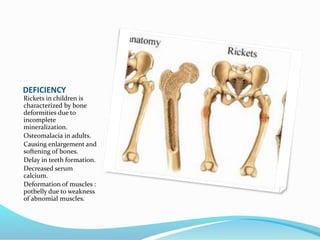
DEFICIENCY
Rickets in children is
characterized by bone
deformities due to
incomplete
mineralization.
Osteomalacia in adults.
Causing enlargement and
softening of bones.
Delay in teeth formation.
Decreased serum
calcium.
Deformation of muscles :
potbelly due to weakness
of abnomial muscles.
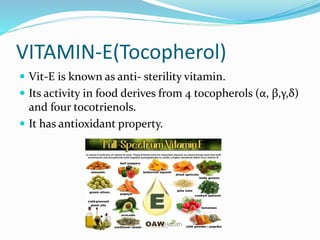
VITAMIN-E(Tocopherol)
 Vit-E is known as anti- sterility vitamin.
 Its activity in food derives from 4 tocopherols (α, β,γ,δ)
and four tocotrienols.
 It has antioxidant property.
 FUNCTIONS
 Essential for normal
reproduction.
 Act as an electron acceptor in
electron transport system in
mitochondria.
 Involved in the protein and
nucleic acid metabolism.
 Has anti- inflammatory role .
 Acts as co enzyme at the
molecular level.
 SOURCES
 Vegetable oils includes
germ oil ,sunflower oil ,
corn oil , margarine.
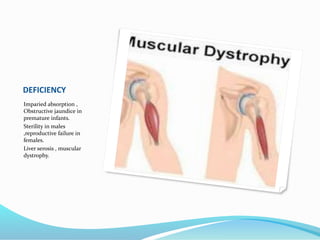
DEFICIENCY
Imparied absorption ,
Obstructive jaundice in
premature infants.
Sterility in males
,reproductive failure in
females.
Liver serosis , muscular
dystrophy.
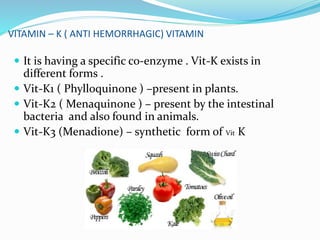
VITAMIN – K ( ANTI HEMORRHAGIC) VITAMIN
 It is having a specific co-enzyme . Vit-K exists in
different forms .
 Vit-K1 ( Phylloquinone ) –present in plants.
 Vit-K2 ( Menaquinone ) – present by the intestinal
bacteria and also found in animals.
 Vit-K3 (Menadione) – synthetic form of Vit K
 FUNCTIONS
 Vit –K concerned with blood
clotting factors
 It brings post translational
modification of certain blood
clotting factors.
 The clotting factors II,VII, IX, X,
are synthesized as inactive
precursors in the liver.
 Synthesis pro thrombin mainly.
 SOURCE
 Vit – K1: Green leafy
vegetables.
 Vit –K2: Intestinal
bacteria.
 Vit-K3:Vegetable oil.
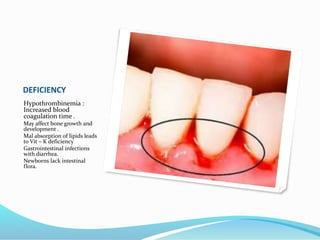
DEFICIENCY
Hypothrombinemia :
Increased blood
coagulation time .
May affect bone growth and
development .
Mal absorption of lipids leads
to Vit – K deficiency
Gastrointestinal infections
with diarrhea.
Newborns lack intestinal
flora.
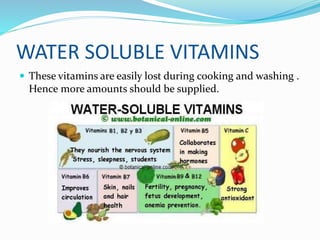
WATER SOLUBLE VITAMINS
 These vitamins are easily lost during cooking and washing .
Hence more amounts should be supplied.
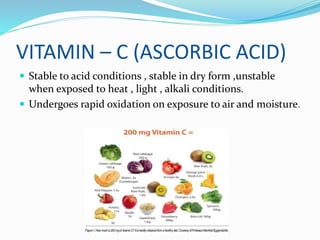
VITAMIN – C (ASCORBIC ACID)
 Stable to acid conditions , stable in dry form ,unstable
when exposed to heat , light , alkali conditions.
 Undergoes rapid oxidation on exposure to air and moisture.
 FUNCTIONS
 Formation of collagen.
 Involved in wound healing
process.
 Involved in the
metabolism of tyrosine.
 Involved in lipid –
cholesterol metabolism.
 SOURCE
 Amla
 Guava
 Citrus Fruits
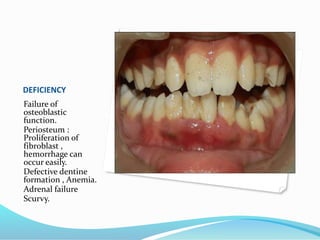
DEFICIENCY
Failure of
osteoblastic
function.
Periosteum :
Proliferation of
fibroblast ,
hemorrhage can
occur easily.
Defective dentine
formation , Anemia.
Adrenal failure
Scurvy.
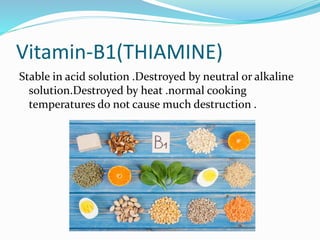
Vitamin-B1(THIAMINE)
Stable in acid solution .Destroyed by neutral or alkaline
solution.Destroyed by heat .normal cooking
temperatures do not cause much destruction .
 FUNCTIONS
 Essential for growth and
maintenance
 Coenzyme TTP(thiamine
pyro phosphate)
involved in release of
energy from
carbohydrates.
 Essential for breakdown
of pyruvic acid.
 Maintenance of muscle
tone , appetite , healthy
mental attitude.
 SOURCE
 Unrefined cereal
grains(rice,wheat),
legumes(beans),liver,
kidney,milk
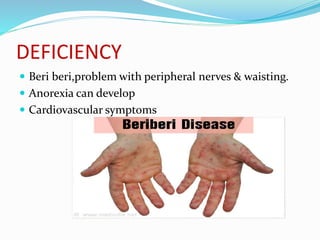
DEFICIENCY
 Beri beri,problem with peripheral nerves & waisting.
 Anorexia can develop
 Cardiovascular symptoms
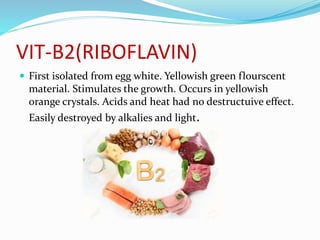
VIT-B2(RIBOFLAVIN)
 First isolated from egg white. Yellowish green flourscent
material. Stimulates the growth. Occurs in yellowish
orange crystals. Acids and heat had no destructuive effect.
Easily destroyed by alkalies and light.
 FUNCTIONS
 It is called as growth
promoting factor
 Two co-enzymes forms
are FMN( flavin mono
nucleotide) and FAD (
flavin adenine
dinucleotide) they are
concerned in electron
transport chain.
 Retina contains B2,it
stimulates optic nerve
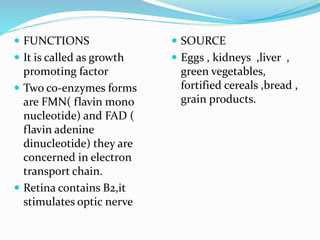
 SOURCE
 Eggs , kidneys ,liver ,
green vegetables,
fortified cereals ,bread ,
grain products.
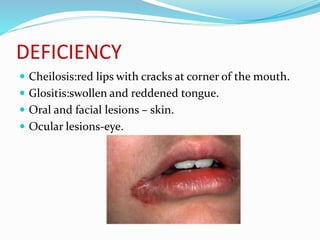
DEFICIENCY
 Cheilosis:red lips with cracks at corner of the mouth.
 Glositis:swollen and reddened tongue.
 Oral and facial lesions – skin.
 Ocular lesions-eye.
VITAMIN-B3(NIACIN)
Occurs in colorless ,needless like that have a bitter taste.
It is not destroyed by acids,alkalies,light,air or heat.
FUNCTIONS
it is a component of two
co-enzyme
NAD(nicotinamide
adenine dineucleotide
phosphate)
components of niacine
are involved in glycolysis,
tissue respiration and fat
synthesis
normal functioning of
skin,intestinal
tract,nervous system
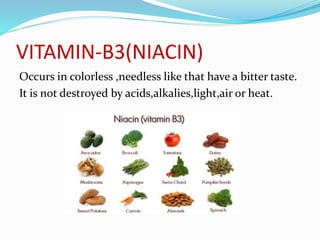
SOURCE
yeast,liver,ground
nut,cereals,legumes,mea
t,fish
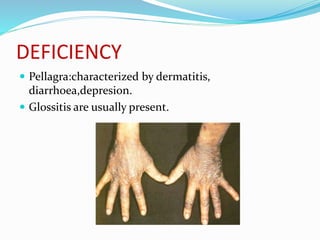
DEFICIENCY
 Pellagra:characterized by dermatitis,
diarrhoea,depresion.
 Glossitis are usually present.
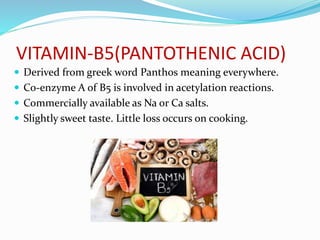
VITAMIN-B5(PANTOTHENIC ACID)
 Derived from greek word Panthos meaning everywhere.
 Co-enzyme A of B5 is involved in acetylation reactions.
 Commercially available as Na or Ca salts.
 Slightly sweet taste. Little loss occurs on cooking.
 FUNCTIONS
 Synthesis of fatty
acids,cholestrol,sterol,po
rpherin
 Essential for growth
 Necessary for making
blood cells.
 Conversions of proteins ,
carbohydrates, fats into
energy.
 SOURCE
 Liver, kidney, yeast , egg
yolk, fresh vegetables,
cereals , milk
DEFICIENCY
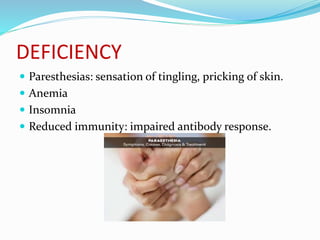
 Paresthesias: sensation of tingling, pricking of skin.
 Anemia
 Insomnia
 Reduced immunity: impaired antibody response.
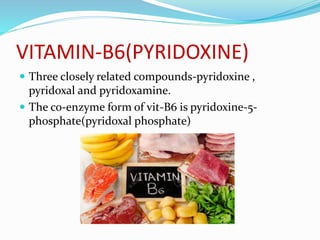
VITAMIN-B6(PYRIDOXINE)
 Three closely related compounds-pyridoxine ,
pyridoxal and pyridoxamine.
 The co-enzyme form of vit-B6 is pyridoxine-5-
phosphate(pyridoxal phosphate)
 FUNCTIONS
 Essential for conversion
of tryptophan to niacin.
 Helps in removal of
oxalates in urine
(oxaluria).
 Normal reproduction.
 Involved in immune
function.
 Helps in the lowering the
cholestrol level.
 SOURCE
 Dried yeast,meat,wheat
bran.
DEFICIENCY
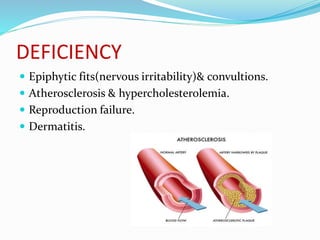
 Epiphytic fits(nervous irritability)& convultions.
 Atherosclerosis & hypercholesterolemia.
 Reproduction failure.
 Dermatitis.
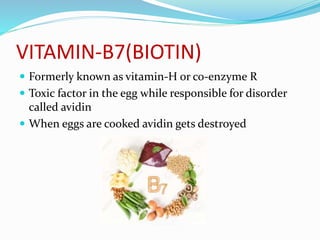
VITAMIN-B7(BIOTIN)
 Formerly known as vitamin-H or co-enzyme R
 Toxic factor in the egg while responsible for disorder
called avidin
 When eggs are cooked avidin gets destroyed
 FUNCTIONS
 Lipid synthesis from
acetate
 Propionic acid synthesis
by rumen bacteria
 Leucine catabolisim
 Conversion of amino
acids and propionate to
glucose in liver
 Liver gluconeogenesis
 SOURCES
 Dried yeast, grain cereals
, liver , peanuts ,
soyabean , legumes ,
milk.
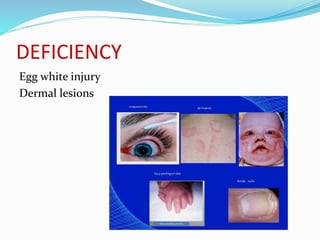
DEFICIENCY
Egg white injury
Dermal lesions
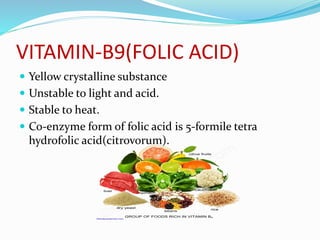
VITAMIN-B9(FOLIC ACID)
 Yellow crystalline substance
 Unstable to light and acid.
 Stable to heat.
 Co-enzyme form of folic acid is 5-formile tetra
hydrofolic acid(citrovorum).
 FUNCTION
 Maturation of RBC
 Megaloblastic anemia
develops
 Muco protein synthesis
 Synthesis of nuclic
acids,methionine and
serine
 SOURCE
 Yeast,chicken
liver,pulses,oil
seeds,milk
powder,spinach
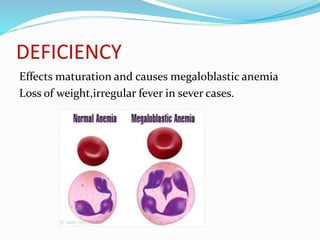
DEFICIENCY
Effects maturation and causes megaloblastic anemia
Loss of weight,irregular fever in sever cases.
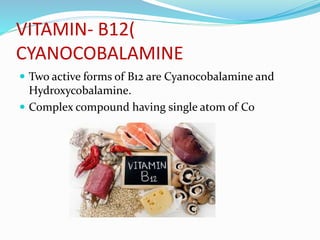
VITAMIN- B12(
CYANOCOBALAMINE
 Two active forms of B12 are Cyanocobalamine and
Hydroxycobalamine.
 Complex compound having single atom of Co
 FUNCTIONS
 Metabolizing fats and
protiens.
 Proper nerve function.
 Production of RBC
 Synthesis of DNA &
nucleic acids.
 SOURCE
 Liver of
goat,ox,pig,sheep,meat
of goat,sheep ,fish,egg.
 Plant foods supply NO
VIT-B12.
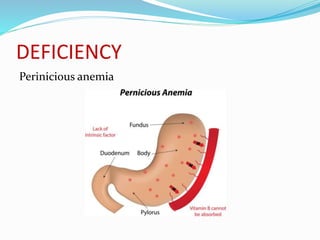
DEFICIENCY
Perinicious anemia
BY
K.NEHA ANANYA
111718012036

Vitamins

  • 1.
  • 2.
    VITAMINS  Vitamins areorganic compounds that are needed in small quantities to sustain life i.e. necessary for the growth an maintenance of good health. Most vitamins come from food. Vitamins are also referred to as micro nutrients
  • 3.
    CLASSIFICATION OF VITAMINS FAT SOLUBLE VITAMINS : Vit-A,D,E,K  WATER SOLUBLE VITAMINS : Vit – C,B1,B2,B6,Niacin,Pantothenic acid , Folic acid, Biotin
  • 4.
    FAT SOLUBLE VITAMINS The requirement of fat soluble vitamins may be not either by intake of vitamin itself on by the intake of its precursor. Precursor is a compound which can be converted in to the vitamin in the body.
  • 5.
    VITAMIN –A (RETINOL) Vit- A occurs in foods of animal origin.  Its activity possessed by carotenoids found in plants.  Carotenoids called as Pro vitamin A or precursor of vitamin A.  Carotenoids are converted to Vit –A in liver.
  • 6.
     FUNCTIONS  Vit–A is essential for vision  Immune response  Bone growth , Reproduction  Maintenance of the surface linings of the eyes , epithelial cell growth and repair.  Embryonic development and the regulation of adult genes.  SOURCES  Liver , Cod liver , Oil , Carrots , Bruccoli , Milk , Meat , Fish , Green leafy vegetables .
  • 7.
    DEFICIENCY Night blindness Keratomalacia : Corneaof the eye becomes dry. Bitot’s spot :from thickened conjuctival epithelia. Urinary calculus : Degeneration of epithelial cells or urinary duct.
  • 8.
    VITAMIN-D (CALCIFEROL)  Vit– D can be synthesized in the skin in the presence of u.v rays of sunlight.  Two important pro vitamin –D steroids are Ergosterol and 7- dehydro cholestrol.
  • 9.
     FUNCTIONS  Maintenanceof normal bone formation.  Essential for proper absorption and utilization of Ca and p for the bone formation.  Promotes cell growth.  SOURCES  Exposure to sunlight in the early morning.  Fish , cod liver oil , milk , cheese , margarine , liver , meat.
  • 10.
    DEFICIENCY Rickets in childrenis characterized by bone deformities due to incomplete mineralization. Osteomalacia in adults. Causing enlargement and softening of bones. Delay in teeth formation. Decreased serum calcium. Deformation of muscles : potbelly due to weakness of abnomial muscles.
  • 11.
    VITAMIN-E(Tocopherol)  Vit-E isknown as anti- sterility vitamin.  Its activity in food derives from 4 tocopherols (α, β,γ,δ) and four tocotrienols.  It has antioxidant property.
  • 12.
     FUNCTIONS  Essentialfor normal reproduction.  Act as an electron acceptor in electron transport system in mitochondria.  Involved in the protein and nucleic acid metabolism.  Has anti- inflammatory role .  Acts as co enzyme at the molecular level.  SOURCES  Vegetable oils includes germ oil ,sunflower oil , corn oil , margarine.
  • 13.
    DEFICIENCY Imparied absorption , Obstructivejaundice in premature infants. Sterility in males ,reproductive failure in females. Liver serosis , muscular dystrophy.
  • 14.
    VITAMIN – K( ANTI HEMORRHAGIC) VITAMIN  It is having a specific co-enzyme . Vit-K exists in different forms .  Vit-K1 ( Phylloquinone ) –present in plants.  Vit-K2 ( Menaquinone ) – present by the intestinal bacteria and also found in animals.  Vit-K3 (Menadione) – synthetic form of Vit K
  • 15.
     FUNCTIONS  Vit–K concerned with blood clotting factors  It brings post translational modification of certain blood clotting factors.  The clotting factors II,VII, IX, X, are synthesized as inactive precursors in the liver.  Synthesis pro thrombin mainly.  SOURCE  Vit – K1: Green leafy vegetables.  Vit –K2: Intestinal bacteria.  Vit-K3:Vegetable oil.
  • 16.
    DEFICIENCY Hypothrombinemia : Increased blood coagulationtime . May affect bone growth and development . Mal absorption of lipids leads to Vit – K deficiency Gastrointestinal infections with diarrhea. Newborns lack intestinal flora.
  • 17.
    WATER SOLUBLE VITAMINS These vitamins are easily lost during cooking and washing . Hence more amounts should be supplied.
  • 18.
    VITAMIN – C(ASCORBIC ACID)  Stable to acid conditions , stable in dry form ,unstable when exposed to heat , light , alkali conditions.  Undergoes rapid oxidation on exposure to air and moisture.
  • 19.
     FUNCTIONS  Formationof collagen.  Involved in wound healing process.  Involved in the metabolism of tyrosine.  Involved in lipid – cholesterol metabolism.  SOURCE  Amla  Guava  Citrus Fruits
  • 20.
    DEFICIENCY Failure of osteoblastic function. Periosteum : Proliferationof fibroblast , hemorrhage can occur easily. Defective dentine formation , Anemia. Adrenal failure Scurvy.
  • 21.
    Vitamin-B1(THIAMINE) Stable in acidsolution .Destroyed by neutral or alkaline solution.Destroyed by heat .normal cooking temperatures do not cause much destruction .
  • 22.
     FUNCTIONS  Essentialfor growth and maintenance  Coenzyme TTP(thiamine pyro phosphate) involved in release of energy from carbohydrates.  Essential for breakdown of pyruvic acid.  Maintenance of muscle tone , appetite , healthy mental attitude.  SOURCE  Unrefined cereal grains(rice,wheat), legumes(beans),liver, kidney,milk
  • 23.
    DEFICIENCY  Beri beri,problemwith peripheral nerves & waisting.  Anorexia can develop  Cardiovascular symptoms
  • 24.
    VIT-B2(RIBOFLAVIN)  First isolatedfrom egg white. Yellowish green flourscent material. Stimulates the growth. Occurs in yellowish orange crystals. Acids and heat had no destructuive effect. Easily destroyed by alkalies and light.
  • 25.
     FUNCTIONS  Itis called as growth promoting factor  Two co-enzymes forms are FMN( flavin mono nucleotide) and FAD ( flavin adenine dinucleotide) they are concerned in electron transport chain.  Retina contains B2,it stimulates optic nerve  SOURCE  Eggs , kidneys ,liver , green vegetables, fortified cereals ,bread , grain products.
  • 26.
    DEFICIENCY  Cheilosis:red lipswith cracks at corner of the mouth.  Glositis:swollen and reddened tongue.  Oral and facial lesions – skin.  Ocular lesions-eye.
  • 27.
    VITAMIN-B3(NIACIN) Occurs in colorless,needless like that have a bitter taste. It is not destroyed by acids,alkalies,light,air or heat.
  • 28.
    FUNCTIONS it is acomponent of two co-enzyme NAD(nicotinamide adenine dineucleotide phosphate) components of niacine are involved in glycolysis, tissue respiration and fat synthesis normal functioning of skin,intestinal tract,nervous system SOURCE yeast,liver,ground nut,cereals,legumes,mea t,fish
  • 29.
    DEFICIENCY  Pellagra:characterized bydermatitis, diarrhoea,depresion.  Glossitis are usually present.
  • 30.
    VITAMIN-B5(PANTOTHENIC ACID)  Derivedfrom greek word Panthos meaning everywhere.  Co-enzyme A of B5 is involved in acetylation reactions.  Commercially available as Na or Ca salts.  Slightly sweet taste. Little loss occurs on cooking.
  • 31.
     FUNCTIONS  Synthesisof fatty acids,cholestrol,sterol,po rpherin  Essential for growth  Necessary for making blood cells.  Conversions of proteins , carbohydrates, fats into energy.  SOURCE  Liver, kidney, yeast , egg yolk, fresh vegetables, cereals , milk
  • 32.
    DEFICIENCY  Paresthesias: sensationof tingling, pricking of skin.  Anemia  Insomnia  Reduced immunity: impaired antibody response.
  • 33.
    VITAMIN-B6(PYRIDOXINE)  Three closelyrelated compounds-pyridoxine , pyridoxal and pyridoxamine.  The co-enzyme form of vit-B6 is pyridoxine-5- phosphate(pyridoxal phosphate)
  • 34.
     FUNCTIONS  Essentialfor conversion of tryptophan to niacin.  Helps in removal of oxalates in urine (oxaluria).  Normal reproduction.  Involved in immune function.  Helps in the lowering the cholestrol level.  SOURCE  Dried yeast,meat,wheat bran.
  • 35.
    DEFICIENCY  Epiphytic fits(nervousirritability)& convultions.  Atherosclerosis & hypercholesterolemia.  Reproduction failure.  Dermatitis.
  • 36.
    VITAMIN-B7(BIOTIN)  Formerly knownas vitamin-H or co-enzyme R  Toxic factor in the egg while responsible for disorder called avidin  When eggs are cooked avidin gets destroyed
  • 37.
     FUNCTIONS  Lipidsynthesis from acetate  Propionic acid synthesis by rumen bacteria  Leucine catabolisim  Conversion of amino acids and propionate to glucose in liver  Liver gluconeogenesis  SOURCES  Dried yeast, grain cereals , liver , peanuts , soyabean , legumes , milk.
  • 38.
  • 39.
    VITAMIN-B9(FOLIC ACID)  Yellowcrystalline substance  Unstable to light and acid.  Stable to heat.  Co-enzyme form of folic acid is 5-formile tetra hydrofolic acid(citrovorum).
  • 40.
     FUNCTION  Maturationof RBC  Megaloblastic anemia develops  Muco protein synthesis  Synthesis of nuclic acids,methionine and serine  SOURCE  Yeast,chicken liver,pulses,oil seeds,milk powder,spinach
  • 41.
    DEFICIENCY Effects maturation andcauses megaloblastic anemia Loss of weight,irregular fever in sever cases.
  • 42.
    VITAMIN- B12( CYANOCOBALAMINE  Twoactive forms of B12 are Cyanocobalamine and Hydroxycobalamine.  Complex compound having single atom of Co
  • 43.
     FUNCTIONS  Metabolizingfats and protiens.  Proper nerve function.  Production of RBC  Synthesis of DNA & nucleic acids.  SOURCE  Liver of goat,ox,pig,sheep,meat of goat,sheep ,fish,egg.  Plant foods supply NO VIT-B12.
  • 44.
  • 45.