DR SHAHNAWAZ F SHAH
MD, FPM, FIAPM,FCPM (MUHS)
Interventional Spine & Pain Physician
Surat
CLASSIFICATION
Water Soluble Vitamins
(C & B Complex)
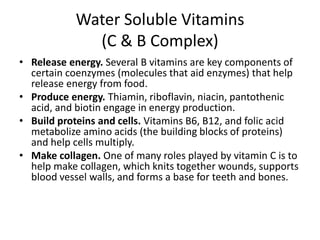
• Release energy. Several B vitamins are key components of
certain coenzymes (molecules that aid enzymes) that help
release energy from food.
• Produce energy. Thiamin, riboflavin, niacin, pantothenic
acid, and biotin engage in energy production.
• Build proteins and cells. Vitamins B6, B12, and folic acid
metabolize amino acids (the building blocks of proteins)
and help cells multiply.
• Make collagen. One of many roles played by vitamin C is to
help make collagen, which knits together wounds, supports
blood vessel walls, and forms a base for teeth and bones.
WATER SOLUBLE VITAMINS
• Essential co- enzymes required in energy releasing
mechanisms.
• Act as co- enzymes for metabolism of proteins, carbohydrates
and fats.
• They include-
B1- Thiamine B6 –Pyridoxine
B2 - Riboflavin B7 – Biotin
B3 – Niacin B 9- Folic acid
B5 – pantothenic acid B12 –Cobalamin
Vitamin C (ascorbic acid)
VITAMIN B1 (THIAMINE)
• Anti Beri-Beri factor
• Anti Neuritic factor
• Aneurin
Characteristics
• Colorless basic organic compound composed
of a sulfated pyramidin ring.
• All living organisms use thiamine, but it is
synthesized only in bacteria, fungi, and plants.
• Contains sulfur and nitrogen group
• Destroyed by alkaline and heat
• Active form- Thiamine pyrophosphate
DIETARY SOURCES OF VITAMIN B1
• Foods high in thiamin
– pork,
– fish,
– seeds, nuts,
– beans, green peas,
– tofu,
– brown rice,
– squash,
– asparagus,
– seafood
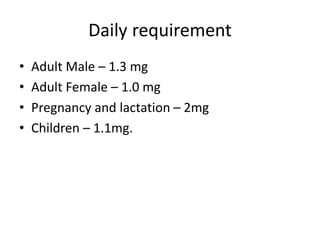
Daily requirement
• Adult Male – 1.3 mg
• Adult Female – 1.0 mg
• Pregnancy and lactation – 2mg
• Children – 1.1mg.
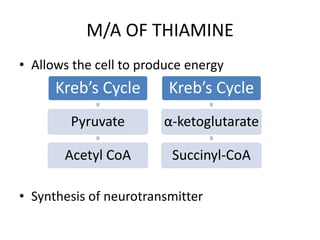
M/A OF THIAMINE
• Allows the cell to produce energy
• Synthesis of neurotransmitter
Kreb’s Cycle
Pyruvate
Acetyl CoA
Kreb’s Cycle
α-ketoglutarate
Succinyl-CoA
FUNCTIONS OF THIAMINE
• Converting carbohydrate into energy. (ATP
production)
• Maintaining Peripheral Nerve Conduction
• Necessary for healthy mucous membranes.
• Helps in the digestion of food.
• Provides strength to muscles.
• It is very useful for the proper functioning of
heart.
VITAMIN B1 DEFICIENCY
Who’s at risk?
 Excessive loss
Hemodialysis
Diuretic therapy
 Chronic Alcoholism
VITAMIN B1 DEFICIENCY
• Beri-Beri
• Wernicke-Korsakoff Syndrome
• Muscle Weakness & Wasting
• Ophthalmoplegia
Beri-Beri
• Symptoms include:
– Dry Beri-Beri: No Edema
– Wet Beri-Beri: Pitting Edema on Trunk, Limbs and
Face
– Progressive Wasting of Muscles
– Tachycardia,
– Laboured Breathing
– Numbing and weakening of Extremities
– tingling or burning sensation in the hands and feet
Beri-Beri
• Symptoms similar to Congestive Heart Failure
• Slowly Progressive Course
• Rapid Deterioration and Fatal Circulatory
Collapse
Beri-Beri
Wernicke-Korsakoff Syndrome
• Wernicke’s Encephalopathy (WET BRAIN)
– G- Global Confusion
– O- Ophthamoplegia & Horizontal Nystagmus
– A- Ataxia
• Wernicke’s-Korsakoff Syndrome-
– Above symptoms with: - Confabulatory Psychosis,
Loss of Memory
Treatment
• In Acute Thiamine Deficiency (Wet Brain)-
– 200mg of Thiamine IV three times a day until
improvement of acute symptoms.
– f/b Oral Thiamine 10mg/d given until complete
recovery.
VITAMIN B2 (RIBOFLAVIN)
• also called as beauty vitamin.
• Yellowish green fluorescent compound soluble
in water.
• The word “Riboflavin” is derived from 2
sources-
– Ribose – ribose sugar
– Flavin – yellow.
• widely involved in oxidation- reduction
reaction.
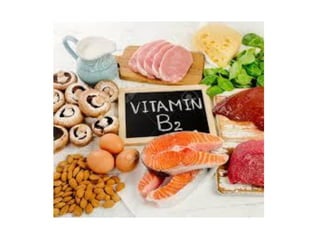
DIETARY SOURCES OF VITAMIN B2
Daily requirement
• Adult Male – 1.5mg
• Adult female – 1.2 mg
• Pregnancy and lactation – 2 to 2.3 mg
• Children – 1.3mg.
FUNCTIONS OF RIBOFLAVIN
• Essential for normal growth.
• Metabolism – It is involved in the metabolism
of carbohydrates, fat & proteins.
• Digestion – it helps in digestion
• Nervous system – it helps in proper
functioning of Nervous system
FUNCTIONS OF RIBOFLAVIN
• Very useful for normal tissue respiration.
• Necessary for healthy mucous membranes
• Good for skin, nails and eyes
• helps in protects the body against cancer
RIBOFLAVIN DEFICIENCY
• Magenta Tongue.
• Angular Stomatis.
• Dermatitis and Cheilosis.
• Cracks and sores in mouth and lips.
VITAMIN B3
• Also known as Niacin
• Essential for metabolism of carbohydrate,
protein & fat.
• It is a colorless, water-soluble solid derivative
of pyridine, with a carboxyl group (COOH) at
the 3-position
• It is a pyridine derivative and is a precursor of
the coenzyme NAD (Nicotinamide adenine
dinucleotide)
DIETARY SOURCES OF NIACIN
• yeast, meat, poultry, red fish (e.g.,
tuna, salmon), cereals, legumes, and seeds
Milk, green leafy vegetables
Daily requirement
• Adult Male – 17mg
• Adult Female – 13 mg
• Pregnancy and lactation – 12 to 15 mg
• Children – 15mg.
FUNCTIONS OF NIACIN (VIT B3)
• Releasing energy from carbohydrates, fats and
protiens.
• DNA synthesis.
• production of estrogen progesterone &
testosterone
• Necessary for healthy skin, nerves and digestive
system.
• Helps to detoxify the body.
• Vitamin B3, is very essential for the proper
digestion of the food
• may improve arthritis symptoms, including
increasing joint mobility and reducing the
amount of anti-inflammatory medications
needed
• helpful in reducing migraine headaches
• High doses of niacin medications are used to
prevent development of atherosclerosis and
to reduce recurrent complications such as
heart attack and peripheral vascular disease
VITAMIN B3 DEFICIENCY
• PELLAGRA -
• Characterised by 4D’s
– Diarrhoea
– Dermatitis
– Dementia
– Death
VITAMIN B3 DEFICIENCY
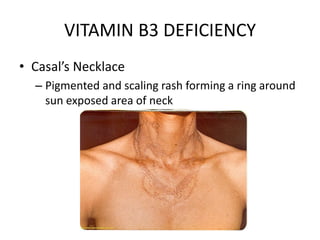
• Casal’s Necklace
– Pigmented and scaling rash forming a ring around
sun exposed area of neck
Treatment
• 100-200mg of nicotinamide 3 times a day for 5
days
VITAMIN B5
• PANTOTHENIC ACID
• water-soluble vitamin.
• It was discovered by Roger J. Williams in 1919.
• This word derived from
– greek word pantos meaning everywhere.
• Part of Coenzyme-A
• Essential for metabolism of CHO, fat, protein
DIETARY SOURCES OF VIT B5
Daily requirement
• Adult male – 10 mg
• Adult Female – 10 mg
• Children – 5.5mg
FUNCTIONS OF VIT B5
• plays an important role in helping release energy
from sugars, starches, and fats.
• They are essential for the cell metabolism.
• They are very helpful in the cholesterol
metabolism.
• Accelerates wound healing.
• It is also used as anti-stress factor.
• Allergies, headaches, arthritis, psoriasis,
insomnia, asthma, and infections have all been
treated with some effectiveness using vitamin B5.
VITAMIN B6 (PYRIDOXINE)
• Vitamin B6 is part of the vitamin B complex
group, and its active form, Pyridoxal 5'-
phosphate (PLP) serves as a cofactor in many
enzyme reactions in amino acid, glucose, and
lipid metabolism.
• It is white crystalline substance soluble in
water and alcohol.
DIETARY SOURCE OF VIT B6
• Milk, Fish, Vegetables, Beans, Eggs, Peanuts,
sunflower seeds
Daily requirement.
• Adults– 2 mg
• Children – 1.7 mg
• Infant – 0.1-0.4 mg
FUNCTIONS OF VITAMIN B6
• Make antibodies. Antibodies are needed to fight
many diseases.
• Maintain normal nerve function
• Promotes RBC production & hemoglobin.
• Break down proteins.
• Keep blood sugar (glucose) in normal ranges
• Assists in the balancing of Sodium and Potassium
levels.
• Production of Serotonin, Dopamine,
Noradrenaline and Adrenaline
DEFICIENCY OF VITAMIN B6
• Peripheral Neuropathy and Depression
• Microcytic Hypochromic Anemia
• Loss of muscle control, muscle weakness,
cramps and numbness
• Hyperhomocysteinemia and Cardiovascular
Risk
• Treatment of deficiency- 50mg/d until
resolution of symptoms
VITAMIN B7 (BIOTIN)
• Also known as
– Biotin
– Vitamin H
– coenzyme R
• Biotin is a coenzyme for carboxylase enzymes,
involved in the synthesis of fatty acids,
isoleucine, and valine, and in gluconeogenesis
Daily requirement
• Adults– 100- 200 mcg
• Children – 50-200 mcg.
• Infant – 35 mcg
FUNCTIONS OF VITAMIN B7
• convert food into glucose, which is used to
produce energy
• produce fatty acids and amino acids (the
building blocks of protein)
• activate protein/amino acid metabolism in the
hair roots and fingernail cells.
FUNCTIONS OF VITAMIN B7
• Maintenance of
– normal skin and mucous membranes
– normal function of the nervous system
– normal hair
– normal psychological functions.
VITAMIN-B7 DEFICIENCY
• Nausea, Anorexia, scaling seborrheic
erythematous rash around eyes, nose and
mouth.
• In infants- Alopecia, Rash involving Ears and
hypotonia.
• Treatment of deficiency- 10mg/d of biotin 60
VITAMIN B9 (FOLIC ACID)
• also known as folic acid, folacin or folate.
• It is a water soluble vitamin.
• It is a yellow crystalline substance.
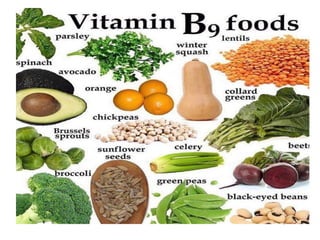
DIETARY SOURCE
FUNCTIONS OF VIT B9
• Formation of RBC – folic acid in combination with vitamin
B12 is essential for formation, maturation of RBCs.
• Nerve – it is necessary for growth & division of all body
cells,
• Hair & Skin – it is essential for the health of skin & hair
• Pregnancy – it is an important nutrient for the pregnant
women & her developing fetus.
• Improves the lactation.
• DNA synthesis, DNA and RNA replication
• Homocysteine metabolism
• Neurotransmitter formation
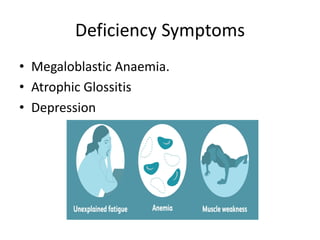
Deficiency Symptoms
• Megaloblastic Anaemia.
• Atrophic Glossitis
• Depression
VITAMIN B12 (COBALAMIN)
• Complex organomatrix compound called as
COBALAMIN which is cobalt containing
porphyrin.
• It is freely soluble in water.
SOURCES
• Vitamin B12 is mostly found in animal
products such as meat, shellfish, milk, cheese,
and eggs.
FUNCTIONS OF VITAMIN B12
• Red Blood Cells – it is essential for production
of RBCs
• Nervous – It improves concentration, memory,
& balance.
• Metabolism of fat, carbohydrate ,proteins,
folic acid.
• Promotes growth and increases apatite.
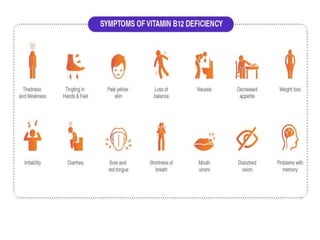
VITAMIN- B12 DEFICIENCY
• Megaloblastic Anemia.
• Pernicious anemia
• Demyelination & irreversible nerve cell death
• Loss of Vibratory and Position Senses
• Abnormal Gait
• Dementia
• Loss of Bladder and Bowel Control
Treatment
• To replenish body stores.
– 1000μg of Hydroxocobalamin
– at 3 to 7 days interval
– Six IM injections
• For maintainence therapy-
– 1000μg of Hydroxocobalamin every 3 months
For more updates:
thepainkillerMD

Vitamins B Complex

  • 1.
    DR SHAHNAWAZ FSHAH MD, FPM, FIAPM,FCPM (MUHS) Interventional Spine & Pain Physician Surat
  • 2.
  • 3.
    Water Soluble Vitamins (C& B Complex) • Release energy. Several B vitamins are key components of certain coenzymes (molecules that aid enzymes) that help release energy from food. • Produce energy. Thiamin, riboflavin, niacin, pantothenic acid, and biotin engage in energy production. • Build proteins and cells. Vitamins B6, B12, and folic acid metabolize amino acids (the building blocks of proteins) and help cells multiply. • Make collagen. One of many roles played by vitamin C is to help make collagen, which knits together wounds, supports blood vessel walls, and forms a base for teeth and bones.
  • 4.
    WATER SOLUBLE VITAMINS •Essential co- enzymes required in energy releasing mechanisms. • Act as co- enzymes for metabolism of proteins, carbohydrates and fats. • They include- B1- Thiamine B6 –Pyridoxine B2 - Riboflavin B7 – Biotin B3 – Niacin B 9- Folic acid B5 – pantothenic acid B12 –Cobalamin Vitamin C (ascorbic acid)
  • 6.
    VITAMIN B1 (THIAMINE) •Anti Beri-Beri factor • Anti Neuritic factor • Aneurin
  • 7.
    Characteristics • Colorless basicorganic compound composed of a sulfated pyramidin ring. • All living organisms use thiamine, but it is synthesized only in bacteria, fungi, and plants. • Contains sulfur and nitrogen group • Destroyed by alkaline and heat • Active form- Thiamine pyrophosphate
  • 8.
    DIETARY SOURCES OFVITAMIN B1 • Foods high in thiamin – pork, – fish, – seeds, nuts, – beans, green peas, – tofu, – brown rice, – squash, – asparagus, – seafood
  • 9.
    Daily requirement • AdultMale – 1.3 mg • Adult Female – 1.0 mg • Pregnancy and lactation – 2mg • Children – 1.1mg.
  • 10.
    M/A OF THIAMINE •Allows the cell to produce energy • Synthesis of neurotransmitter Kreb’s Cycle Pyruvate Acetyl CoA Kreb’s Cycle α-ketoglutarate Succinyl-CoA
  • 11.
    FUNCTIONS OF THIAMINE •Converting carbohydrate into energy. (ATP production) • Maintaining Peripheral Nerve Conduction • Necessary for healthy mucous membranes. • Helps in the digestion of food. • Provides strength to muscles. • It is very useful for the proper functioning of heart.
  • 12.
    VITAMIN B1 DEFICIENCY Who’sat risk?  Excessive loss Hemodialysis Diuretic therapy  Chronic Alcoholism
  • 13.
    VITAMIN B1 DEFICIENCY •Beri-Beri • Wernicke-Korsakoff Syndrome • Muscle Weakness & Wasting • Ophthalmoplegia
  • 14.
    Beri-Beri • Symptoms include: –Dry Beri-Beri: No Edema – Wet Beri-Beri: Pitting Edema on Trunk, Limbs and Face – Progressive Wasting of Muscles – Tachycardia, – Laboured Breathing – Numbing and weakening of Extremities – tingling or burning sensation in the hands and feet
  • 15.
    Beri-Beri • Symptoms similarto Congestive Heart Failure • Slowly Progressive Course • Rapid Deterioration and Fatal Circulatory Collapse
  • 16.
  • 18.
    Wernicke-Korsakoff Syndrome • Wernicke’sEncephalopathy (WET BRAIN) – G- Global Confusion – O- Ophthamoplegia & Horizontal Nystagmus – A- Ataxia • Wernicke’s-Korsakoff Syndrome- – Above symptoms with: - Confabulatory Psychosis, Loss of Memory
  • 20.
    Treatment • In AcuteThiamine Deficiency (Wet Brain)- – 200mg of Thiamine IV three times a day until improvement of acute symptoms. – f/b Oral Thiamine 10mg/d given until complete recovery.
  • 22.
    VITAMIN B2 (RIBOFLAVIN) •also called as beauty vitamin. • Yellowish green fluorescent compound soluble in water. • The word “Riboflavin” is derived from 2 sources- – Ribose – ribose sugar – Flavin – yellow. • widely involved in oxidation- reduction reaction.
  • 23.
  • 24.
    Daily requirement • AdultMale – 1.5mg • Adult female – 1.2 mg • Pregnancy and lactation – 2 to 2.3 mg • Children – 1.3mg.
  • 25.
    FUNCTIONS OF RIBOFLAVIN •Essential for normal growth. • Metabolism – It is involved in the metabolism of carbohydrates, fat & proteins. • Digestion – it helps in digestion • Nervous system – it helps in proper functioning of Nervous system
  • 26.
    FUNCTIONS OF RIBOFLAVIN •Very useful for normal tissue respiration. • Necessary for healthy mucous membranes • Good for skin, nails and eyes • helps in protects the body against cancer
  • 27.
    RIBOFLAVIN DEFICIENCY • MagentaTongue. • Angular Stomatis. • Dermatitis and Cheilosis. • Cracks and sores in mouth and lips.
  • 29.
    VITAMIN B3 • Alsoknown as Niacin • Essential for metabolism of carbohydrate, protein & fat.
  • 30.
    • It isa colorless, water-soluble solid derivative of pyridine, with a carboxyl group (COOH) at the 3-position • It is a pyridine derivative and is a precursor of the coenzyme NAD (Nicotinamide adenine dinucleotide)
  • 31.
    DIETARY SOURCES OFNIACIN • yeast, meat, poultry, red fish (e.g., tuna, salmon), cereals, legumes, and seeds Milk, green leafy vegetables
  • 32.
    Daily requirement • AdultMale – 17mg • Adult Female – 13 mg • Pregnancy and lactation – 12 to 15 mg • Children – 15mg.
  • 33.
    FUNCTIONS OF NIACIN(VIT B3) • Releasing energy from carbohydrates, fats and protiens. • DNA synthesis. • production of estrogen progesterone & testosterone • Necessary for healthy skin, nerves and digestive system. • Helps to detoxify the body. • Vitamin B3, is very essential for the proper digestion of the food
  • 34.
    • may improvearthritis symptoms, including increasing joint mobility and reducing the amount of anti-inflammatory medications needed • helpful in reducing migraine headaches • High doses of niacin medications are used to prevent development of atherosclerosis and to reduce recurrent complications such as heart attack and peripheral vascular disease
  • 35.
    VITAMIN B3 DEFICIENCY •PELLAGRA - • Characterised by 4D’s – Diarrhoea – Dermatitis – Dementia – Death
  • 36.
    VITAMIN B3 DEFICIENCY •Casal’s Necklace – Pigmented and scaling rash forming a ring around sun exposed area of neck
  • 37.
    Treatment • 100-200mg ofnicotinamide 3 times a day for 5 days
  • 39.
    VITAMIN B5 • PANTOTHENICACID • water-soluble vitamin. • It was discovered by Roger J. Williams in 1919. • This word derived from – greek word pantos meaning everywhere. • Part of Coenzyme-A • Essential for metabolism of CHO, fat, protein
  • 40.
  • 41.
    Daily requirement • Adultmale – 10 mg • Adult Female – 10 mg • Children – 5.5mg
  • 42.
    FUNCTIONS OF VITB5 • plays an important role in helping release energy from sugars, starches, and fats. • They are essential for the cell metabolism. • They are very helpful in the cholesterol metabolism. • Accelerates wound healing. • It is also used as anti-stress factor. • Allergies, headaches, arthritis, psoriasis, insomnia, asthma, and infections have all been treated with some effectiveness using vitamin B5.
  • 45.
    VITAMIN B6 (PYRIDOXINE) •Vitamin B6 is part of the vitamin B complex group, and its active form, Pyridoxal 5'- phosphate (PLP) serves as a cofactor in many enzyme reactions in amino acid, glucose, and lipid metabolism. • It is white crystalline substance soluble in water and alcohol.
  • 46.
    DIETARY SOURCE OFVIT B6 • Milk, Fish, Vegetables, Beans, Eggs, Peanuts, sunflower seeds
  • 47.
    Daily requirement. • Adults–2 mg • Children – 1.7 mg • Infant – 0.1-0.4 mg
  • 48.
    FUNCTIONS OF VITAMINB6 • Make antibodies. Antibodies are needed to fight many diseases. • Maintain normal nerve function • Promotes RBC production & hemoglobin. • Break down proteins. • Keep blood sugar (glucose) in normal ranges • Assists in the balancing of Sodium and Potassium levels. • Production of Serotonin, Dopamine, Noradrenaline and Adrenaline
  • 49.
    DEFICIENCY OF VITAMINB6 • Peripheral Neuropathy and Depression • Microcytic Hypochromic Anemia • Loss of muscle control, muscle weakness, cramps and numbness • Hyperhomocysteinemia and Cardiovascular Risk • Treatment of deficiency- 50mg/d until resolution of symptoms
  • 51.
    VITAMIN B7 (BIOTIN) •Also known as – Biotin – Vitamin H – coenzyme R • Biotin is a coenzyme for carboxylase enzymes, involved in the synthesis of fatty acids, isoleucine, and valine, and in gluconeogenesis
  • 53.
    Daily requirement • Adults–100- 200 mcg • Children – 50-200 mcg. • Infant – 35 mcg
  • 54.
    FUNCTIONS OF VITAMINB7 • convert food into glucose, which is used to produce energy • produce fatty acids and amino acids (the building blocks of protein) • activate protein/amino acid metabolism in the hair roots and fingernail cells.
  • 55.
    FUNCTIONS OF VITAMINB7 • Maintenance of – normal skin and mucous membranes – normal function of the nervous system – normal hair – normal psychological functions.
  • 56.
    VITAMIN-B7 DEFICIENCY • Nausea,Anorexia, scaling seborrheic erythematous rash around eyes, nose and mouth. • In infants- Alopecia, Rash involving Ears and hypotonia. • Treatment of deficiency- 10mg/d of biotin 60
  • 58.
    VITAMIN B9 (FOLICACID) • also known as folic acid, folacin or folate. • It is a water soluble vitamin. • It is a yellow crystalline substance.
  • 59.
  • 60.
    FUNCTIONS OF VITB9 • Formation of RBC – folic acid in combination with vitamin B12 is essential for formation, maturation of RBCs. • Nerve – it is necessary for growth & division of all body cells, • Hair & Skin – it is essential for the health of skin & hair • Pregnancy – it is an important nutrient for the pregnant women & her developing fetus. • Improves the lactation. • DNA synthesis, DNA and RNA replication • Homocysteine metabolism • Neurotransmitter formation
  • 61.
    Deficiency Symptoms • MegaloblasticAnaemia. • Atrophic Glossitis • Depression
  • 63.
    VITAMIN B12 (COBALAMIN) •Complex organomatrix compound called as COBALAMIN which is cobalt containing porphyrin. • It is freely soluble in water.
  • 64.
    SOURCES • Vitamin B12is mostly found in animal products such as meat, shellfish, milk, cheese, and eggs.
  • 65.
    FUNCTIONS OF VITAMINB12 • Red Blood Cells – it is essential for production of RBCs • Nervous – It improves concentration, memory, & balance. • Metabolism of fat, carbohydrate ,proteins, folic acid. • Promotes growth and increases apatite.
  • 66.
    VITAMIN- B12 DEFICIENCY •Megaloblastic Anemia. • Pernicious anemia • Demyelination & irreversible nerve cell death • Loss of Vibratory and Position Senses • Abnormal Gait • Dementia • Loss of Bladder and Bowel Control
  • 68.
    Treatment • To replenishbody stores. – 1000μg of Hydroxocobalamin – at 3 to 7 days interval – Six IM injections • For maintainence therapy- – 1000μg of Hydroxocobalamin every 3 months
  • 69.