LIPIDS AND ITS
CLASSIFICATION
DEFINATION
Lipids may be regarded as
organic substances relatively
insoluble in water, soluble in
organic solvents(alcohol,ester
etc) actually or potentially
related to fatty acids and utalized
by the living cells.
CLASSIFICATION OF
LIPIDS
Lipids are classified into 3
types:
1.Simple lipids.
2.Complex lipids.
3.Derived and
miscellaneous lipids.
SIMPLE LIPIDS
• Simple lipids are the esters of fatty acids with alcohols.
• Types of simple lipids:
simple lipids are mainly of two types
1. Fats and oils
2. Waxes
• Fats and oils:
These are the esters of fatty acids with glycerol.
The difference between fat and oil is only physical.
Oil is liquid while fat is soild at room temperature.
CONT…..
• Waxes:
Esters of fatty acids with
alcohols other than glycerol.
These alcohols may be aliphatic or
alicyclic.
. Cetyl alcohol is most commonly
found in waxes.
. Waxes are used in preparation of
candles, lubricants, cosmetics,
ointments,polishes ete.
COMPLEX LIPIDS
• These are esters of fatty acids with
alcohols containing additional
groups such as phosphate,
nitrogenous base, carbohydrates,
protein etc.
• Types
1. Phospholipids
2.Glycolipids
3. Lipoproteins
CONT …..
• Phospholipid:
They contain phosphoric acid and frequently a nitrogenous
base.ThIs is in addition to alcohol and fatty acids.
• Phospholipids are subdivided into two types.
1. Glycerophospholipids
2. Sphingophospholipid
• Glycerophospholipids:
These phospholipids contain Glycerol as the alcohol.
Example: lecithin and cephalin
• Sphingophospholipids:
Sphingosine is the alcohol in this group of
phospholipid.
Example: sphingomyelin
CONT…..
• Glycolipids:
These lipids contain a fatty acid,
carbohydrates and nitrogenous base.
The alcohol Is sphingosine,hence they are also
called as glycosphingolipids
Example: cerebrosides and gangliosides
• Lipoproteins:
These are the macromolecular
complexes of lipids with proteins.
• Other complex lipids:
Sulfolipids,aminolipids and
lipopolysaccharides are the other complex lipids.
DERIVED LIPIDS
• These are the derivatives
obtained on the hydrolysis of
group 1 and group 2 lipids
which possess the
characteristics of lipids
• These includes glycerol and
other alcohols,fatty
acids,monoacylglycerols and
diacylglycerols,lipids(fat)
soluble vitamins,seroids
hormones,hydrocarbons and
ketone bodies
MISCELLANEOUS LIPIDS
• These includes a large number of compounds processing
the characteristics of lipids
• Example:
Carotenoids,sqalene, hydrocarbons such as
pantacosane (in bee wax),terpenes etc
Neutral lipids
• The lipids which are uncharged are referred to as neutral
lipids.
• These are monoacylglycerols, diacylglycerols and
triacylyglycerol, cholesterol and cholesteryl esters.
FUNCTIONS OF LIPIDS
• Energy storage:lipids are the Important source of energy.
• Digestion and absorption:lipids facilitate the digestion and absorption
of the nutrients in the gut.
• Structural components: lipids are essential component of cell
membrane, providing structural support and maintaining cell shape.
• Hormone regulation:lipids are involve in hormone production and
regulation.
• Cushioning and protection: Lipids provide cushoining and protection to
organs and tissues.
• Cell signalling:lipids Participate in cell signaling pathway.
• Modulation of immune response:Lipids are involve in the regulation of
immune response and inflammation.
• Brain function:lipids partially cholesterol play an important role in brain
function and development.
• Insulation: lipids help regulate body temperature and maintain
insulation.
FATTY ACIDS
• Defination
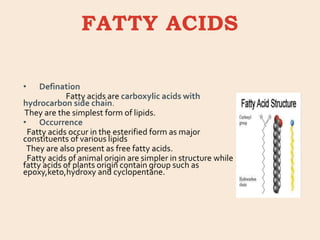
Fatty acids are carboxylic acids with
hydrocarbon side chain.
They are the simplest form of lipids.
• Occurrence
Fatty acids occur in the esterified form as major
constituents of various lipids
They are also present as free fatty acids.
Fatty acids of animal origin are simpler in structure while
fatty acids of plants origin contain group such as
epoxy,keto,hydroxy and cyclopentane.
DIFFERENCE BETWEEN
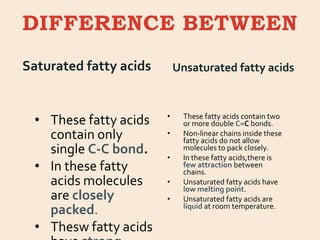
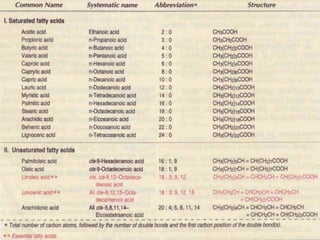
Saturated fatty acids
• These fatty acids
contain only
single C-C bond.
• In these fatty
acids molecules
are closely
packed.
• Thesw fatty acids
Unsaturated fatty acids
• These fatty acids contain two
or more double C=C bonds.
• Non-linear chains inside these
fatty acids do not allow
molecules to pack closely.
• In these fatty acids,there is
few attraction between
chains.
• Unsaturated fatty acids have
low melting point.
• Unsaturated fatty acids are
liquid at room temperature.
ESSENTIAL FATTY ACIDS
• Defination
The fatty acids that cannot be
synthesized by the body and,
therefore,should be supplied in the diet are
known as essential fatty acids (EFA)
chemically,they are polyunsaturated fatty
acids
• Biochemical basis of essentiality:
linoleic acid
and linolenic acid Are essential since humans
lack the enzymes that can introduce double
bonds beyond carbons 9 to 10
CONT …
• Function of EFA:
1. Essential fatty acids are required for
the membrane structure and function,
transport of cholesterol.
2. These are required for formation of
lipoproteins
3. They are essential for prevention of
fatty liver.
4. They are also needed for the
synthesis of another important group
of compounds,namely eicosanoids.
CONT …
• Deficiency of EFA:
The deficiency of EFA results in phrynoderma or
toad skin, characterized by the presence of horny
eruptions on the posterior and lateral parts of
limbs,on the back and buttocks of hair and poor
wound healing.
• Conditionally essential fatty acids:
Certain fatty acids that become essential under
some developmental or disease conditions are
referred as conditionally essential fatty acids.
The most important among these is
docosahexaenoic acid (DHA).
CONT…
• Isomerism in unsaturated fatty
acids:
Unsaturated fatty acids exhibit
geometric isomerism depending on
the orientation of the groups around
the double bond axis.
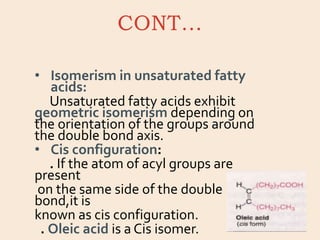
• Cis configuration:
. If the atom of acyl groups are
present
on the same side of the double
bond,it is
known as cis configuration.
. Oleic acid is a Cis isomer.
CONT…
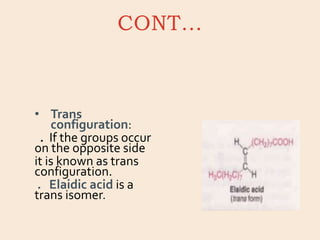
• Trans
configuration:
. If the groups occur
on the opposite side
it is known as trans
configuration.
. Elaidic acid is a
trans isomer.
CONT….
• Hydroxy fatty acids
Some of the fatty acids are hydroxylated.
B-hydroxybutyric acid,one of the
ketone bodies produce in metabolism,is the
simple example of hydroxy fatty acids.
• Cyclic fatty acids
Fatty acids with cyclic stuctures are cyclic
fatty acids..
Example:chaulmoogric acid found in
chaulmoogra oil.
TRANS FATTY ACID
• Trans fatty acidsTFA posses double
bonds and are formed during
hydrogenation of natural oils
• Their small amount is also formed in
human by the action of
microorganisms on fat containingTFA
• Tfa are widely used in food industries.
• Margarine is the most commonly used
TFA containing fat in food industries.
TRIACYLYGLYC
EROL
• Triacylyglycerol are the esters of glycerolsWith
fatty acids
• The fats and oils are widely distributed in both
plants and animals are chemicaly triacylyglycerol
• They are soluble in water and non-polar in
character and commonly known as neutral fats
FATS AS STORED
FUEL
• Triacylglycerol are
the most abundant group of lipids
that primarily function as fuel
reserves of animals
• The fat reserve of normal humans
(men 20%,women25% by weight)
Us sufficient to meet the body’s
caloric requirements for 2-3 months
FATS PRIMARILY
OCCURE IN
ADIPOSE TISSUE:
• Adipocytes od adipose tissue-predominantly found in
the subcutaneous layer and in the abdominal cavity are
specialized for storage of triacylyglycerol
• The fat is stored in the form of glubules dispersed in
the entire cytoplasm
• And surprisingly, triacylyglycerol are not the structural
components od biological membranes
STRUCTURE
OF
ACYLGLYCER
OLS:
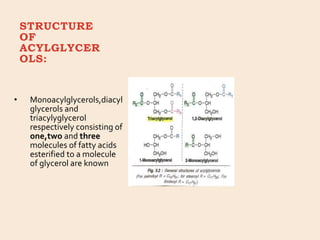
• Monoacylglycerols,diacyl
glycerols and
triacylyglycerol
respectively consisting of
one,two and three
molecules of fatty acids
esterified to a molecule
of glycerol are known
CLASSIFICATION OF
TRIACYLYGLYCERO
L
• Simple triacylyglycerol:
Contain the same type of fatty acids
residue at all the three carbons.
For example:
tristearoyl glycerol or tristearin.
• Mixed triacylyglycerol:
Are most common.
. They contain 2 or 3 different types of fatty qcid residue.
. Fatty acid attached to C1 is saturated,that attached to C2
is unsaturated while that on C3 can be either
.triacylglyceroles are named according to placement of
acyl radical on glycerol
For example:
1,3-palmitoyl 2-linoleoyl glycerol
PROPERTIES OD
TRIACYLYGLYCEROL
A few important properties of tryacylglycerols, which have
biochemical relevance,are discussed bellow
. Hydrolysis:
Triacylyglycerol undergo stepwise enzymatic
hydrolysis to finally liberate free fatty acids and glycerols.
The process of hydrolysis, catalysed by lipase is
important for digestion of fat in the gastrointestinal trac
and fat mobilization from the adipose tissue.
. Saponification:
The hydrolysis of triacylyglycerols hy alkali to
produce glycerol and soaps is known as saponification.
.
• RANCIDITY:
• Rancidy is the term used to represent the
deterioration of fats and oils resulting in an
unpleasant taste.
• Fats containing unsaturated fatty acids are
more susceptible to rancidity.
• Rancidity occures when fats and oils are
exposed to air, moisture,light,bacteria etc.
• Hydrolytic rancidity occures due to partial
hydrolysis of triacylyglycerols by bacterial
enzymes.
• Oxidative rancidity is due to oxidation of
unsaturated fatty acids.
• This results in the formation of unpleasant
products such as dicarboxylic acids,
aldehydes,ketones etc.
• Rancid fats and oils are unsuitable for human
consumption.
• ANTIOXIDANTS:
. The substances which can prevent the occurrence of
oxidation rancidity are known as antioxidants.
. Trace amount of oxidants such as tocopherols (vitamin E),
hydroquinone,gallic acid are added to the commercial
preparation of fats and oils to prevent rancidity
. Proyl Gallate,butylates hydroxyanisole(BHA) and butylated
hydroxytoluene are the antioxidants used in food preservation.
. Lipids peroxidation in vivo:
. In the living cells,lipids undergo oxidation to produce
peroxides and free radicals which can damage the tissue.
. The free radicals are believed to causs inflammatory disease,
ageing,cancer, atherosclerosis etc
. It is fortunate that the cells possess antioxidants such as
vitamin E,urate and superoxide dismutase to prevent in vivo
lipid peroxidation.
These are complex or compound lipids containing
phosphoric acid, in addition to fatty acid, nitrogenous
base and alcohol.
There are two classes of phospholipids
Glycerophospholipids (or phosphoglyce-rides) that
contain glycerol as the alcohol.
Sphingophospholipids (or sphingomyelins ) that contain
sphingosine as the alcohol.
GLYCEROPHOSPHOLIPIDS :
are the major lipids
that occure in biological membranes. They consist of
glycerol 3-phosphate esterified at its C1 and C2 with
fatty acids. Usually , C1 contains a saturated fatty acid
while C2 contain an unsaturated fatty acid.
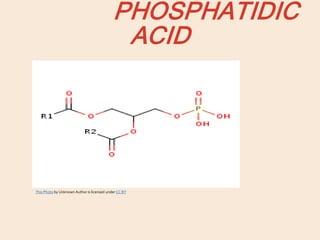
1. PHOSPHATIDIC :
This is the simplest
phospholipid. It doesnot occur in good concentration
PHOSPHATIDIC
ACID
This Photo by Unknown Author is licensed under CC BY
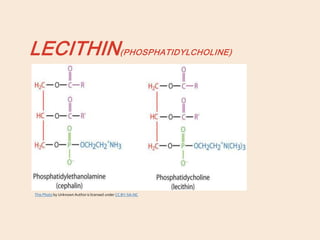
LECITHIN(PHOSPHATIDYLCHOLINE)
This Photo by Unknown Author is licensed under CC BY-SA-NC
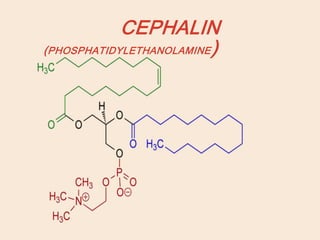
CEPHALIN
(PHOSPHATIDYLETHANOLAMINE)
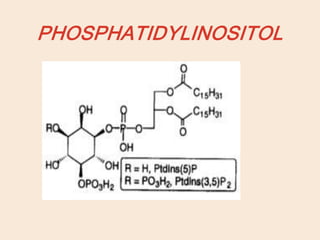
PHOSPHATIDYLINOSITOL
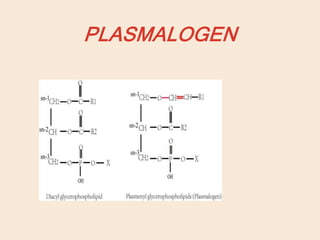
PLASMALOGEN
CARDIOLIPIN
SPHINGOMYELIN
LENCITHINS:
These are the most abundant group of
phospholipids in the cell membranes.
Chemically, lecithin is a phosphatidic acid
with choline as the base .
Phosphatidylcholines represent the
storage from of body choline.
a) Dipalmitoyl Lecithin :
is an
important phosphatidylcholine found in
lungs that act as a surfactant .
b) Lysolecithin:
is formed by removal
of the fatty acid either at C1 or C2 of
CEPHALINS
Ethanolamine is
the nitrogenous
base present in
cephalins. Thus,
lecithin and
PHOSPHATIDYLSERINE
 The amino acid serine is
present in the group of
glycerophospholipids.
Phosphatidylthreonine is
also found certain tissue
and plays a role in
apoptosis
PLASMALOGENS
 When a fatty acid is attached by an
ether linkage at C1 of glycerol in the
glycerophospholipids, the resultant
compound is plasmalogen.
Phosphatidal-ethanolamine is the
most important which is similar in
structure to
phosphatidylethanolamine but for
the ether linkage. An unsaturated
fatty acid occure at C1. Choline,
inositol to give other plasmalogens.
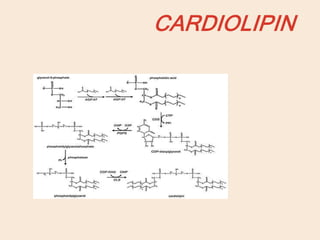
CARDIOLIPIN
 It is so named as it was first isolated from heart
muscle. Structurally, a cardiolipin acid held by
an additional glycerol through phosphate
groups. It is an important component of inner
mitochondrial member and essential for
mitochondrial function.
Cardiolipin is the only phospho-glyceride that
possess antigenic propertities.
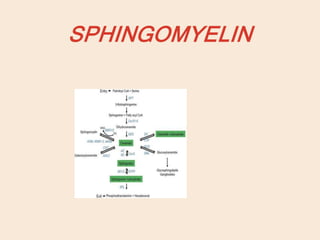
SPHINGOMYELINS
 Sphingosine is an amino alcohol
present in sphingomyelin. They do
not glycerol at all. Sphingosine is
attached by an amid linkage to fatty
acid to produce ceramide. The
alcohol group of sphingosine is bound
to phosphorylcholine in
sphingomyelin structure.
Sphingomyelin are important
FUNCTION OF
PHOSPHOLIPIDS
SOME FUNCTIONS ARE GIVEN BELOW:
Arachidonic is an unsaturated fatty acid
liberated from phospholipids, serves as a
precursor for the synthesis of eicosanoids.
Phospholipids participate in the reverse
cholesterol transport and thus help in the
removel of cholesterol from the body.
Phospholipids act as surfactants. For
instance, dipalmitoyl phosphatidylcholine s
an important lung surfactant.
Cephalins, an important group of
phospholipids participate in blood clothing.
Phosphatidylinositol is the source of second
messenger-inositol triphosphate and
GLYCOLIPIDS
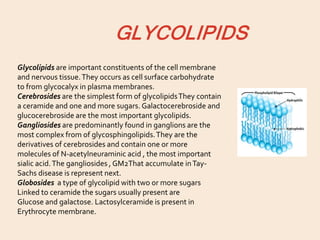
Glycolipids are important constituents of the cell membrane
and nervous tissue.They occurs as cell surface carbohydrate
to from glycocalyx in plasma membranes.
Cerebrosides are the simplest form of glycolipidsThey contain
a ceramide and one and more sugars. Galactocerebroside and
glucocerebroside are the most important glycolipids.
Gangliosides are predominantly found in ganglions are the
most complex from of glycosphingolipids.They are the
derivatives of cerebrosides and contain one or more
molecules of N-acetylneuraminic acid , the most important
sialic acid.The gangliosides , GM2That accumulate inTay-
Sachs disease is represent next.
Globosides a type of glycolipid with two or more sugars
Linked to ceramide the sugars usually present are
Glucose and galactose. Lactosylceramide is present in
Erythrocyte membrane.

Lipids with its classification and detail.pptx

  • 1.
  • 2.
    DEFINATION Lipids may beregarded as organic substances relatively insoluble in water, soluble in organic solvents(alcohol,ester etc) actually or potentially related to fatty acids and utalized by the living cells.
  • 3.
    CLASSIFICATION OF LIPIDS Lipids areclassified into 3 types: 1.Simple lipids. 2.Complex lipids. 3.Derived and miscellaneous lipids.
  • 4.
    SIMPLE LIPIDS • Simplelipids are the esters of fatty acids with alcohols. • Types of simple lipids: simple lipids are mainly of two types 1. Fats and oils 2. Waxes • Fats and oils: These are the esters of fatty acids with glycerol. The difference between fat and oil is only physical. Oil is liquid while fat is soild at room temperature.
  • 5.
    CONT….. • Waxes: Esters offatty acids with alcohols other than glycerol. These alcohols may be aliphatic or alicyclic. . Cetyl alcohol is most commonly found in waxes. . Waxes are used in preparation of candles, lubricants, cosmetics, ointments,polishes ete.
  • 6.
    COMPLEX LIPIDS • Theseare esters of fatty acids with alcohols containing additional groups such as phosphate, nitrogenous base, carbohydrates, protein etc. • Types 1. Phospholipids 2.Glycolipids 3. Lipoproteins
  • 7.
    CONT ….. • Phospholipid: Theycontain phosphoric acid and frequently a nitrogenous base.ThIs is in addition to alcohol and fatty acids. • Phospholipids are subdivided into two types. 1. Glycerophospholipids 2. Sphingophospholipid • Glycerophospholipids: These phospholipids contain Glycerol as the alcohol. Example: lecithin and cephalin • Sphingophospholipids: Sphingosine is the alcohol in this group of phospholipid. Example: sphingomyelin
  • 8.
    CONT….. • Glycolipids: These lipidscontain a fatty acid, carbohydrates and nitrogenous base. The alcohol Is sphingosine,hence they are also called as glycosphingolipids Example: cerebrosides and gangliosides • Lipoproteins: These are the macromolecular complexes of lipids with proteins. • Other complex lipids: Sulfolipids,aminolipids and lipopolysaccharides are the other complex lipids.
  • 9.
    DERIVED LIPIDS • Theseare the derivatives obtained on the hydrolysis of group 1 and group 2 lipids which possess the characteristics of lipids • These includes glycerol and other alcohols,fatty acids,monoacylglycerols and diacylglycerols,lipids(fat) soluble vitamins,seroids hormones,hydrocarbons and ketone bodies
  • 10.
    MISCELLANEOUS LIPIDS • Theseincludes a large number of compounds processing the characteristics of lipids • Example: Carotenoids,sqalene, hydrocarbons such as pantacosane (in bee wax),terpenes etc Neutral lipids • The lipids which are uncharged are referred to as neutral lipids. • These are monoacylglycerols, diacylglycerols and triacylyglycerol, cholesterol and cholesteryl esters.
  • 11.
    FUNCTIONS OF LIPIDS •Energy storage:lipids are the Important source of energy. • Digestion and absorption:lipids facilitate the digestion and absorption of the nutrients in the gut. • Structural components: lipids are essential component of cell membrane, providing structural support and maintaining cell shape. • Hormone regulation:lipids are involve in hormone production and regulation. • Cushioning and protection: Lipids provide cushoining and protection to organs and tissues. • Cell signalling:lipids Participate in cell signaling pathway. • Modulation of immune response:Lipids are involve in the regulation of immune response and inflammation. • Brain function:lipids partially cholesterol play an important role in brain function and development. • Insulation: lipids help regulate body temperature and maintain insulation.
  • 12.
    FATTY ACIDS • Defination Fattyacids are carboxylic acids with hydrocarbon side chain. They are the simplest form of lipids. • Occurrence Fatty acids occur in the esterified form as major constituents of various lipids They are also present as free fatty acids. Fatty acids of animal origin are simpler in structure while fatty acids of plants origin contain group such as epoxy,keto,hydroxy and cyclopentane.
  • 13.
    DIFFERENCE BETWEEN Saturated fattyacids • These fatty acids contain only single C-C bond. • In these fatty acids molecules are closely packed. • Thesw fatty acids Unsaturated fatty acids • These fatty acids contain two or more double C=C bonds. • Non-linear chains inside these fatty acids do not allow molecules to pack closely. • In these fatty acids,there is few attraction between chains. • Unsaturated fatty acids have low melting point. • Unsaturated fatty acids are liquid at room temperature.
  • 15.
    ESSENTIAL FATTY ACIDS •Defination The fatty acids that cannot be synthesized by the body and, therefore,should be supplied in the diet are known as essential fatty acids (EFA) chemically,they are polyunsaturated fatty acids • Biochemical basis of essentiality: linoleic acid and linolenic acid Are essential since humans lack the enzymes that can introduce double bonds beyond carbons 9 to 10
  • 16.
    CONT … • Functionof EFA: 1. Essential fatty acids are required for the membrane structure and function, transport of cholesterol. 2. These are required for formation of lipoproteins 3. They are essential for prevention of fatty liver. 4. They are also needed for the synthesis of another important group of compounds,namely eicosanoids.
  • 17.
    CONT … • Deficiencyof EFA: The deficiency of EFA results in phrynoderma or toad skin, characterized by the presence of horny eruptions on the posterior and lateral parts of limbs,on the back and buttocks of hair and poor wound healing. • Conditionally essential fatty acids: Certain fatty acids that become essential under some developmental or disease conditions are referred as conditionally essential fatty acids. The most important among these is docosahexaenoic acid (DHA).
  • 18.
    CONT… • Isomerism inunsaturated fatty acids: Unsaturated fatty acids exhibit geometric isomerism depending on the orientation of the groups around the double bond axis. • Cis configuration: . If the atom of acyl groups are present on the same side of the double bond,it is known as cis configuration. . Oleic acid is a Cis isomer.
  • 19.
    CONT… • Trans configuration: . Ifthe groups occur on the opposite side it is known as trans configuration. . Elaidic acid is a trans isomer.
  • 20.
    CONT…. • Hydroxy fattyacids Some of the fatty acids are hydroxylated. B-hydroxybutyric acid,one of the ketone bodies produce in metabolism,is the simple example of hydroxy fatty acids. • Cyclic fatty acids Fatty acids with cyclic stuctures are cyclic fatty acids.. Example:chaulmoogric acid found in chaulmoogra oil.
  • 21.
    TRANS FATTY ACID •Trans fatty acidsTFA posses double bonds and are formed during hydrogenation of natural oils • Their small amount is also formed in human by the action of microorganisms on fat containingTFA • Tfa are widely used in food industries. • Margarine is the most commonly used TFA containing fat in food industries.
  • 22.
    TRIACYLYGLYC EROL • Triacylyglycerol arethe esters of glycerolsWith fatty acids • The fats and oils are widely distributed in both plants and animals are chemicaly triacylyglycerol • They are soluble in water and non-polar in character and commonly known as neutral fats
  • 23.
    FATS AS STORED FUEL •Triacylglycerol are the most abundant group of lipids that primarily function as fuel reserves of animals • The fat reserve of normal humans (men 20%,women25% by weight) Us sufficient to meet the body’s caloric requirements for 2-3 months
  • 24.
    FATS PRIMARILY OCCURE IN ADIPOSETISSUE: • Adipocytes od adipose tissue-predominantly found in the subcutaneous layer and in the abdominal cavity are specialized for storage of triacylyglycerol • The fat is stored in the form of glubules dispersed in the entire cytoplasm • And surprisingly, triacylyglycerol are not the structural components od biological membranes
  • 25.
    STRUCTURE OF ACYLGLYCER OLS: • Monoacylglycerols,diacyl glycerols and triacylyglycerol respectivelyconsisting of one,two and three molecules of fatty acids esterified to a molecule of glycerol are known
  • 26.
    CLASSIFICATION OF TRIACYLYGLYCERO L • Simpletriacylyglycerol: Contain the same type of fatty acids residue at all the three carbons. For example: tristearoyl glycerol or tristearin. • Mixed triacylyglycerol: Are most common. . They contain 2 or 3 different types of fatty qcid residue. . Fatty acid attached to C1 is saturated,that attached to C2 is unsaturated while that on C3 can be either .triacylglyceroles are named according to placement of acyl radical on glycerol For example: 1,3-palmitoyl 2-linoleoyl glycerol
  • 27.
    PROPERTIES OD TRIACYLYGLYCEROL A fewimportant properties of tryacylglycerols, which have biochemical relevance,are discussed bellow . Hydrolysis: Triacylyglycerol undergo stepwise enzymatic hydrolysis to finally liberate free fatty acids and glycerols. The process of hydrolysis, catalysed by lipase is important for digestion of fat in the gastrointestinal trac and fat mobilization from the adipose tissue. . Saponification: The hydrolysis of triacylyglycerols hy alkali to produce glycerol and soaps is known as saponification. .
  • 28.
    • RANCIDITY: • Rancidyis the term used to represent the deterioration of fats and oils resulting in an unpleasant taste. • Fats containing unsaturated fatty acids are more susceptible to rancidity. • Rancidity occures when fats and oils are exposed to air, moisture,light,bacteria etc. • Hydrolytic rancidity occures due to partial hydrolysis of triacylyglycerols by bacterial enzymes. • Oxidative rancidity is due to oxidation of unsaturated fatty acids. • This results in the formation of unpleasant products such as dicarboxylic acids, aldehydes,ketones etc. • Rancid fats and oils are unsuitable for human consumption.
  • 29.
    • ANTIOXIDANTS: . Thesubstances which can prevent the occurrence of oxidation rancidity are known as antioxidants. . Trace amount of oxidants such as tocopherols (vitamin E), hydroquinone,gallic acid are added to the commercial preparation of fats and oils to prevent rancidity . Proyl Gallate,butylates hydroxyanisole(BHA) and butylated hydroxytoluene are the antioxidants used in food preservation. . Lipids peroxidation in vivo: . In the living cells,lipids undergo oxidation to produce peroxides and free radicals which can damage the tissue. . The free radicals are believed to causs inflammatory disease, ageing,cancer, atherosclerosis etc . It is fortunate that the cells possess antioxidants such as vitamin E,urate and superoxide dismutase to prevent in vivo lipid peroxidation.
  • 30.
    These are complexor compound lipids containing phosphoric acid, in addition to fatty acid, nitrogenous base and alcohol. There are two classes of phospholipids Glycerophospholipids (or phosphoglyce-rides) that contain glycerol as the alcohol. Sphingophospholipids (or sphingomyelins ) that contain sphingosine as the alcohol. GLYCEROPHOSPHOLIPIDS : are the major lipids that occure in biological membranes. They consist of glycerol 3-phosphate esterified at its C1 and C2 with fatty acids. Usually , C1 contains a saturated fatty acid while C2 contain an unsaturated fatty acid. 1. PHOSPHATIDIC : This is the simplest phospholipid. It doesnot occur in good concentration
  • 31.
    PHOSPHATIDIC ACID This Photo byUnknown Author is licensed under CC BY
  • 32.
    LECITHIN(PHOSPHATIDYLCHOLINE) This Photo byUnknown Author is licensed under CC BY-SA-NC
  • 33.
  • 34.
  • 35.
  • 36.
  • 37.
  • 38.
    LENCITHINS: These are themost abundant group of phospholipids in the cell membranes. Chemically, lecithin is a phosphatidic acid with choline as the base . Phosphatidylcholines represent the storage from of body choline. a) Dipalmitoyl Lecithin : is an important phosphatidylcholine found in lungs that act as a surfactant . b) Lysolecithin: is formed by removal of the fatty acid either at C1 or C2 of
  • 39.
    CEPHALINS Ethanolamine is the nitrogenous basepresent in cephalins. Thus, lecithin and
  • 40.
    PHOSPHATIDYLSERINE  The aminoacid serine is present in the group of glycerophospholipids. Phosphatidylthreonine is also found certain tissue and plays a role in apoptosis
  • 41.
    PLASMALOGENS  When afatty acid is attached by an ether linkage at C1 of glycerol in the glycerophospholipids, the resultant compound is plasmalogen. Phosphatidal-ethanolamine is the most important which is similar in structure to phosphatidylethanolamine but for the ether linkage. An unsaturated fatty acid occure at C1. Choline, inositol to give other plasmalogens.
  • 42.
    CARDIOLIPIN  It isso named as it was first isolated from heart muscle. Structurally, a cardiolipin acid held by an additional glycerol through phosphate groups. It is an important component of inner mitochondrial member and essential for mitochondrial function. Cardiolipin is the only phospho-glyceride that possess antigenic propertities.
  • 43.
    SPHINGOMYELINS  Sphingosine isan amino alcohol present in sphingomyelin. They do not glycerol at all. Sphingosine is attached by an amid linkage to fatty acid to produce ceramide. The alcohol group of sphingosine is bound to phosphorylcholine in sphingomyelin structure. Sphingomyelin are important
  • 44.
    FUNCTION OF PHOSPHOLIPIDS SOME FUNCTIONSARE GIVEN BELOW: Arachidonic is an unsaturated fatty acid liberated from phospholipids, serves as a precursor for the synthesis of eicosanoids. Phospholipids participate in the reverse cholesterol transport and thus help in the removel of cholesterol from the body. Phospholipids act as surfactants. For instance, dipalmitoyl phosphatidylcholine s an important lung surfactant. Cephalins, an important group of phospholipids participate in blood clothing. Phosphatidylinositol is the source of second messenger-inositol triphosphate and
  • 45.
    GLYCOLIPIDS Glycolipids are importantconstituents of the cell membrane and nervous tissue.They occurs as cell surface carbohydrate to from glycocalyx in plasma membranes. Cerebrosides are the simplest form of glycolipidsThey contain a ceramide and one and more sugars. Galactocerebroside and glucocerebroside are the most important glycolipids. Gangliosides are predominantly found in ganglions are the most complex from of glycosphingolipids.They are the derivatives of cerebrosides and contain one or more molecules of N-acetylneuraminic acid , the most important sialic acid.The gangliosides , GM2That accumulate inTay- Sachs disease is represent next. Globosides a type of glycolipid with two or more sugars Linked to ceramide the sugars usually present are Glucose and galactose. Lactosylceramide is present in Erythrocyte membrane.